


0,99 €
Mehr erfahren.
- Herausgeber: Maria Peitcheva
- Kategorie: Geisteswissenschaft
- Sprache: Englisch
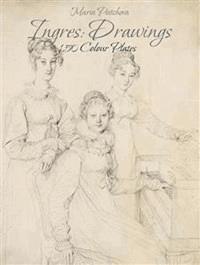
Ingres's style was formed early in life and changed comparatively little. His earliest drawings, such as the Portrait of a Man (1797) already show a suavity of outline and an extraordinary control of the parallel hatchings which model the forms. His portrait drawings, of which about 450 are extant, are today among his most admired works. While a disproportionate number of them date from his difficult early years in Italy, he continued to produce portrait drawings of his friends until the end of his life. Ingres drew his portrait drawings on wove paper, which provided a smooth surface very different from the ribbed surface of laid paper, which is, nevertheless, sometimes referred to today as "Ingres paper". Drawings made in preparation for paintings, are more varied in size and treatment than are the portrait drawings. He also drew a number of landscape views while in Rome but, with the exception of the small tondo Raphael's Casino, he painted no pure landscapes.
Das E-Book können Sie in Legimi-Apps oder einer beliebigen App lesen, die das folgende Format unterstützen:
Veröffentlichungsjahr: 2016
Ähnliche
Ingres: Drawings
150 Colour Plates
By Maria Peitcheva
First Edition
*****
Ingres: Drawings
150 Colour Plates
*****
Copyright © 2015 by Maria Peitcheva
Foreword
Ingres's style was formed early in life and changed comparatively little. His earliest drawings, such as the Portrait of a Man (1797) already show a suavity of outline and an extraordinary control of the parallel hatchings which model the forms. From the first, his paintings are characterized by a firmness of outline reflecting his often-quoted conviction that "drawing is the probity of art". He believed colour to be no more than an accessory to drawing, explaining: "Drawing is not just reproducing contours, it is not just the line; drawing is also the expression, the inner form, the composition, the modelling. See what is left after that. Drawing is seven eighths of what makes up painting."He abhorred the visible brushstroke and made no recourse to the shifting effects of colour and light on which the Romantic school depended; he preferred local colours only faintly modelled in light by half tones. "Whatever you know, you must know it with sword in hand."
His portrait drawings, of which about 450 are extant, are today among his most admired works. While a disproportionate number of them date from his difficult early years in Italy, he continued to produce portrait drawings of his friends until the end of his life. Agnes Mongan has written of the portrait drawings:
"Before his departure in the fall of 1806 from Paris for Rome, the familiar characteristics of his drawing style were well established, the delicate yet firm contour, the definite yet discreet distortions of form, the almost uncanny capacity to seize a likeness in the precise yet lively delineation of features.The preferred materials were also already established: the sharply pointed graphite pencil on a smooth white paper. So familiar to us are both the materials and the manner that we forget how extraordinary they must have seemed at the time ... Ingres' manner of drawing was as new as the century. It was immediately recognized as expert and admirable. If his paintings were sternly criticized as "Gothic," no comparable criticism was leveled at his drawings."
His student Robert Balze described Ingres's working routine in executing his portrait drawings, each of which required four hours, as "an hour and a half in the morning, then two-and-a-half hours in the afternoon, he very rarely retouched it the next day. He often told me that he got the essence of the portrait while lunching with the model who, off guard, became more natural."
Ingres drew his portrait drawings on wove paper, which provided a smooth surface very different from the ribbed surface of laid paper, which is, nevertheless, sometimes referred to today as "Ingres paper".
Drawings made in preparation for paintings, such as the many nude studies for The Martyrdom of St. Symphorien and The Golden Age, are more varied in size and treatment than are the portrait drawings. He also drew a number of landscape views while in Rome but, with the exception of the small tondo Raphael's Casino, he painted no pure landscapes.
Lesen Sie weiter in der vollständigen Ausgabe!




