


Erhalten Sie Zugang zu diesem und mehr als 300000 Büchern ab EUR 5,99 monatlich.
- Herausgeber: Paraclete Press
- Kategorie: Sachliteratur, Reportagen, Biografien
- Sprache: Englisch
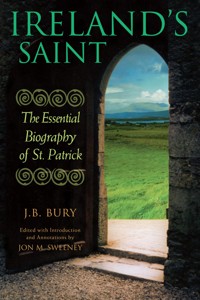
Explore Patrick's place in history, the spread of Christianity beyond the Roman Empire, how Patrick first came to Ireland, the influence of the earlier Palladius on Patrick's work, political and social conditions at that time, and the spiritual battles with the Druids. This 21st century edition includes notes from other notable biographers, mystics, historians, and storytellers of Ireland and is an ideal place to begin any exploration of this much loved but little-known saint. [This book was previously published in hardcover and trade paperback and is now available in this smaller format, with a new cover design, for the first time.]
Sie lesen das E-Book in den Legimi-Apps auf:
Seitenzahl: 280
Veröffentlichungsjahr: 2013
Das E-Book (TTS) können Sie hören im Abo „Legimi Premium” in Legimi-Apps auf:
Ähnliche


Praise for Ireland’s Saint
“Bury proves to be more than a mere dry historian; he turns out to be a fine storyteller as well, and his accounts of Patrick’s spiritual duels with Druid priests for the heart and mind of the Irish king are quite gripping.”
—History Book Club
“Editor-writer Sweeney gives Bury’s 1905 biography of the legendary St. Patrick a greater contemporary context in this meticulously researched and presented work… . Bury wrote what Sweeney calls the ‘ideal modern biography’ of Patrick… . Sweeney assembles and rearranges material from Bury’s original work and incorporates more of Patrick’s own words, from his Confession and Letter against Coroticus. Sweeney’s light edits to Bury’s text clarify exactly what Patrick did in Ireland, noting that although he did convert some pagan kingdoms, he also was responsible for organizing Christians who were already there and connecting the island with the church of the Roman Empire.”
—Publishers Weekly
Jon M. Sweeney is an editor and writer best known for his editing of Paul Sabatier’s classic biography The Road to Assisi: The Essential Biography of St. Francis, which has sold more than 40,000 copies, and was a featured selection of The History Book Club and Book-of-the-Month Club. The third volume in this series—The Road to Siena: The Essential Biography of St. Catherine, is also now available. He lives in Vermont.
J. B. Bury (1861–1927) was an Irish historian and an expert on the Greek and Roman Empires. He grew up in County Monaghan the son of an Anglican rector and was made a fellow of Trinity College in Dublin at the young age of 24. In 1902, Bury was appointed the prestigious Regius Professor of Modern History at Cambridge University, a position he held until his death. He wrote many scholarly works, including History of the Later Roman Empire, Invasion of Europe by the Barbarians, and this biography of St. Patrick of Ireland.
Mosaic of St. Patrick, Westminster Cathedral, London
Ireland’s Saint: The Essential Biography of St. Patrick
2010 First Paperback Printing2008 First Hardcover Printing
Copyright © 2008 by Jon M. Sweeney
ISBN: 978-1-55725-682-9
The Library of Congress has catalogued the hardcover edition as follows:Bury, J. B. (John Bagnell), 1861–1927. Ireland’s saint : the essential biography of St. Patrick / J.B. Bury; introduction and annotations by Jon M. Sweeney.—[New ed.]. p. cm. Rev. ed.: The life of St. Patrick and his place in history, 1905. Includes index. ISBN-13: 978-1-55725-557-0 1. Patrick, Saint, 373?–463? 2. Christian saints—Ireland—Biography. 3. Ireland—Church history—To 1172. I. Bury, J. B. (John Bagnell), 1861–1927. Life of St. Patrick and his place in history. II. Title. BX4700.P3B8 2008 270.2092—dc22 2008017071
10 9 8 7 6 5 4 3 2 1
All rights reserved. No part of this book may be reproduced, stored in an electronic retrieval system, or transmitted in any form or by any means—electronic, mechanical, photocopy, recording, or any other—except for brief quotations in printed reviews, without the prior permission of the publisher.
Published by Paraclete PressBrewster, Massachusettswww.paracletepress.comPrinted in the United States of America
FORSarah-Maria and Joseph,who remind me of Patrick’s words in the Confession,“I ought to give thanks to God without ceasing.”—J.M.S.
CONTENTS
Introduction
1 Patrick’s Place in History
2 The Spread of Christianity beyond the Roman Empire
3 How Patrick Came to Ireland
4 Captivity and Escape
5 Sojourn in Gaul and Back to Britain
6 Palladius and Patrick
7 Political and Social Conditions at That Time
8 The First Mission
9 Legends of Patrick and the Druids
10 Early Conversions and Communities
11 Preaching and Legends in Connaught
12 Visit to Rome
13 The Preeminence of Armagh
14 Cloisters and Chieftains
15 His Denunciation of Coroticus, and the Confession
16 The Real and the Mythic Patrick
17 Death and Burial
APPENDIX: The Seventh-Century Biography by Muirchu
SOURCES
ACKNOWLEDGMENTS
INDEX
INTRODUCTION
First published in 1905, John Bagnell Bury’s (1861–1927) biography of St. Patrick of Ireland was the most influential study of the saint ever written up until that point. Bury’s scholarship and conclusions directed the understanding of Patrick for at least a half century. Almost immediately, for instance, he overturned long-standing tradition that held that Patrick’s mission lasted sixty years and the saint died in 493. Bury said Patrick’s mission was only thirty years, the additional thirty were added by early hagiographers, and Patrick passed away in 461.
The original title of Bury’s book was The Life of St. Patrick and His Place in History. Bury was an Irish historian, and an expert on the Greek and Roman Empires. He was also a Protestant, which might be unnecessary to mention under other circumstances; however, in the case of Irish history, it is unavoidable. He grew up in County Monaghan, the son of an Anglican rector. He was made a fellow of Trinity College in Dublin at the young age of twenty-four, and became recognized as expert in ancient, medieval, and modern history over the course of the next decades. In 1902, Bury was appointed the prestigious Regius Professor of Modern History at Cambridge University, a position he held until his death. Modern, in this instance, refers to all but ancient. Subsequent holders of the title have included George Macaulay Trevelyan, Herbert Butterfield, and William Owen Chadwick. A senior professorship by the same name exists at Oxford.
As he mentions in the first sentence of his original preface, Bury was attracted to the subject of St. Patrick “not as an important crisis in the history of Ireland, but, in the first place, as an appendix to the history of the Roman Empire, illustrating the emanations of its influence beyond its own frontiers.” Bury’s earlier writings spanned the ancient Greeks and Romans, throughout the Middle Ages, and into Victorian history. But he was considered expert, most of all, on the later Roman Empire. Some of his many writings on the subject include History of the Later Roman Empire (still in print in 2 volumes), Invasion of Europe by the Barbarians (recently reissued), and History of the Eastern Roman Empire. One of the primary emphases of his biography of Patrick is to place the Ireland of Patrick’s day in the proper historical context, as influenced by the Germanic and Scandinavian invasions of the third to ninth centuries, but also, in many ways, to portray it as stubbornly apart from the empire. His biography of Patrick has been accurately described as “a postscript to the author’s history of the later Roman Empire, dealing with the final episode in the spread of Roman civilization (which by this time happened to include Christianity also) among the barbarian peoples” (Binchy, 10).
Many scholars today argue with Bury’s conclusions, saying that we cannot know as much as he claims to have discovered in the sources. “[The] Patrick of current mythology has been put together … mainly from an oblique inheritance from a long series of Lives,” writes one of these (Thomas, 309). In other words, Bury may have brought Patrick scholarship into the modern era, but he still contributes to the perpetuation of stories we cannot fully substantiate. According to this line of thinking, only the writings of Patrick—the Confession, written when Patrick was an old man responding to charges made against him by British priests, and the Letter Against Coroticus, written somewhat earlier—are reliable witnesses to the facts of Patrick’s life and work. This is all that such scholars say that we can know for certain about Patrick’s life:
He was an old man when he wrote his Confession, and his Latin was unskilled.
Patrick’s father was named Calpurnius. He was a deacon.
Patrick’s grandfather was named Potitus, and a presbyter in his village in Britain.
At 16, Patrick was kidnapped by pirates and taken to Ireland.
His faith was kindled while in captivity in Ireland.
He worked as a shepherd while in captivity, and he heard the “voice” of God speak to him.
After six years, he fled Ireland stowed away on a ship. The ship traveled for three days until reaching land.
After a harsh time with no food, Patrick and his companions found a herd of pigs and also ate honey from discovered hives.
Patrick visited his parents in Britain a few years after he escaped from Ireland.
He claimed to have baptized thousands of people while in Ireland.
Bury would agree with all of these items, but he also fills in additional details and challenges many others from legend and tradition and other medieval texts, creating a portrait that tells us far more than these simple “facts,” and yet, stops far short of hagiography. His is the ideal modern biography.
Bury was one of the leaders among historians at the turn of the twentieth century who desired to transform scholarship and modern understanding of the past using critical tools of analysis. In this way, he was in solidarity with two generations of contemporaries, such as the great Ernest Renan (d. 1892), author of Life of Jesus, and Paul Sabatier (d. 1928), author of the influential biography of Francis of Assisi recently republished as The Road to Assisi. In one of Bury’s most influential works, A History of Freedom of Thought (1913), he articulates how superstition, custom, and intellectual laziness have always hindered the progress of knowledge:
If the social structure, including the whole body of customs and opinions, is associated intimately with religious belief and is supposed to be under divine patronage, criticism of the social order savors of impiety, while criticism of the religious belief is a direct challenge to the wrath of supernatural powers.
The psychological motives which produce a conservative spirit hostile to new ideas are reinforced by the active opposition of certain powerful sections of the community, such as a class, a caste, or a priesthood, whose interests are bound up with the maintenance of the established order and the ideas on which it rests.
Let us suppose, for instance, that people believe solar eclipses are signs employed by their Deity for the special purpose of communicating useful information to them, and that a clever man discovers the true cause of eclipses. His compatriots in the first place dislike his discovery because they find it very difficult to reconcile with their other ideas; in the second place, it disturbs them, because it upsets an arrangement which they consider highly advantageous to their community; finally, it frightens them, as an offense to their Divinity. The priests, one of whose functions is to interpret the divine signs, are alarmed and enraged at a doctrine which menaces their power.
In prehistoric days, these motives, operating strongly, must have made change slow in communities which progressed, and hindered some communities from progressing at all. But they have continued to operate more or less throughout history, obstructing knowledge and progress. (Bury, 9–11)
Bury is a clear and precise writer. But he is also one for metaphor and the delicate turn of phrase. At times, such as this one from chapter 3, he sounds almost like a poet: “But as Patrick grew up, the waves were already gathering, to close slowly over the island, and to sweep the whole of western Europe.” We see in the same chapter a good example of Bury’s ability to tell a story; he chronicles the invasions of the Picts, Scots, and Saxons upon the British isle in the fourth century, foreshadowing what must have been felt by Patrick’s father, Calpurnius, when he “shared in the agonies that Britain felt in those two terrible years when she was attacked on all sides by Pict, by Scot, and by Saxon, when Theodosius, the great Emperor’s father, had to come in haste and use all his strength to deliver the province from the barbarians. In the valley of the Severn the foes whom the Britons dreaded were Irish freebooters, and surely in those years their pirate crafts sailed up the river and brought death and ruin to many.”
Still, as one Irish historian has put it, “this sturdy Rationalist [meaning, Bury] shows a curious tenderness towards the legendary material as a whole” (Binchy, 10). In other words, this biography is critical, but also sympathetic to the tradition and legends surrounding the saint.
A more recent biographer of Patrick has written, “Bury was possibly the most learned historian produced by the British Isles in the twentieth century. He knew all the European languages except three; and his familiarity with the scholarly literature of Europe was unmatched… . The result was such a work of scholarship as seemed to be the last word on Patrick” (Thompson, 176). But, of course, it wasn’t, and subsequent researchers have found much to add and amend in Bury’s famous account.
Additions and Changes to This Edition
Most contested among Bury’s assumptions is the idea that the seventh-century biography of Patrick written by Muirchu is to be trusted. As mentioned above, recent historians often argue that the only truly reliable sources for knowing Patrick’s life and beliefs come from the saint’s own writings. For this reason, the present edition of Bury’s important book includes many sidebar notes that add the thoughts (and occasional corrections) of more recent historians on various issues. Also, in the spirit of Bury’s account, several sidebars provide portions of Patrick’s own writings that have a bearing on the points being made. I have also plumbed the wealth of novels, poems, legends, art, theology, and other writings that serve to fill in the picture of Patrick drawn in Bury’s account.
Other changes have been made to the original edition in creating the present one. For example, I have taken what was originally Bury’s excellent summary chapter, “Patrick’s Place in History,” and made it his first. The style of biographical writing a century ago was different than it is today. It used to be that the biographer would tell his tale from beginning to end, only to unleash his most detailed opinions in a concluding chapter, followed by a voluminous amount of additional material, including refutations of other scholars, discursive analyses of key points, and so on, in various appendices. I have tried to cull the best of this latter material from the original edition and disperse it throughout where it properly belongs today, speaking straightforwardly to the reader. Many sentences and paragraphs that originally appeared in the notes and appendices sections of Bury’s biography have been incorporated into the main body of the biography.
I have updated the language of Bury’s prose, altering the style and sentence structure only when necessary to suit a more contemporary reader. Bury’s ubiquitous double negatives have been altered whenever it seemed reasonable to do so. In some cases, I have used more recent, agreed-upon spellings, such as Pechenegs instead of Patzinaks for the nomadic people of the Asian steppes once converted by St. Bruno of Querfurt. Throughout the work, I have added dates after the names of important figures and made other invisible additions aimed at an appreciation of the biography for today. I have tried to provide the source of quotations made by Bury without attribution because he was writing for an audience that had a much larger religious literacy than we do today; a few of these are quotations from the Bible, and in these cases, I have changed the renderings to the New Revised Standard Version translation. I have also quietly changed a very few mistakes that Bury made, in the judgment of later scholars. For instance, in the chapter on Patrick’s sojourn in Gaul after his escape from slavery in Ireland, Bury tells of his staying at the monastery of Lerinus. The Lerins islands, off the coast of France at Cannes, were made famous in the fourth century by St. Eucherius of Lyon, who was married before he became a hermit on the neighboring island of Lero. Bury mentions Eucherius’s wife, Galla, but probably makes the mistake of assigning her to living together with her husband in hermit life. Later scholars seem to universally agree that it was only after his wife’s death that Eucherius became a hermit.
I also have no doubt that today’s reader wants to read more of Patrick’s two writings—the Confession and the Letter Against Coroticus—in his own words. I have incorporated some of these into the book; they are taken from the translation given in the classic work published in New York in 1880, The Most Ancient Lives of Saint Patrick; Including the Life by Jocelin, Hitherto Unpublished in America, and His Extant Writings, by Rev. James O’Leary, D.D., fifth edition, modified only slightly. I have also included a prose translation of the bulk of the “Hymn of St. Seachnaill,” in chapter 10.
Bury’s Balanced Perspective
In his original preface, Bury wrote, “When I came to Patrick, I found it impossible to gain any clear conception of the man and his work. The subject was wrapped in obscurity, and this obscurity was encircled by an atmosphere of controversy and conjecture. Doubt of the very existence of St. Patrick had been entertained… . It was at once evident that the material had never been critically sifted, and that it would be necessary to begin at the beginning, almost as if nothing had been done, in a field where much had been written.”
He went on to explain that the present biography was necessary because of the way the author methodically examined the original sources—perhaps for the first time by a modern scholar. Bury described his attempt to be impartial by referring to himself as “one whose interest in the subject is purely intellectual.” Such a comment says more about his era than about the man. It is impossible to read this biography without feeling the passionate interest that the author had for his subject. And the fact that the author was a Protestant is perhaps what led him to also write in his original preface, “I will not anticipate my conclusions here, but I may say that they tend to show that the Roman Catholic conception of St. Patrick’s work is, generally, nearer to historical fact than the views of some anti-Catholic clergy.” All in all, this is a portrait for the ages.
As a modern historian writing at the beginning of modern religious history writing, Bury makes very few comments about Patrick’s direct influence on the spiritual life of the Irish, or anyone else. Bury was quite modern in this respect, trying to keep fact apart from feeling, and the spiritual away from the ecclesiastical, in his accounts. My concerns are somewhat different, and I have added some sidebars with reflections on the spiritual import of Patrick throughout the work.
“Patrick’s mission to the Irish had only been a limited success when he died, and since his greatness was not appreciated by the generation or two which followed–they did not even remember where his body was buried–it is not surprising that there are no early representations of him.” (Thompson, 160)
Why does the study of St. Patrick matter today? If you have come to this book with questions and curiosity of your own, I hope you will find much to engage you here. One of the best summaries of Patrick’s spirituality that I have encountered is this: “One of our most ancient manuscripts, the Book of Armagh, tells us that Patrick wished the Irish to have two phrases ever on their lips, Kyrie Eleison and Deo Gratias; Lord have mercy, and Thanks be to God. It was between these two prayers that Patrick lived out his own full and saintly life. It is where we, too, will find the fullness of life—trusting in the forgiveness of the One who loves us, and eternally grateful for everything” (O Riordain, 20).
CHAPTER ONEPatrick’s Place in History
There are two extreme and opposite views about the scope and dimensions of St. Patrick’s work in Ireland. The older view is that he introduced the Christian religion and converted the whole island. The more recent view holds that the sphere of his activity was restricted to the one, small province of Leinster on the eastern seaboard. This second opinion is refuted by a critical examination of the sources and by its own incapacity to explain the facts. The first view, meanwhile, cannot be sustained either because clear evidence exists that there were Christian communities in Ireland before Patrick arrived.
More about Leinster
Leinster has probably always been the most populated of the four provinces of Ireland (Connaught, Leinster, Munster, Ulster). It is the closest in proximity—just across the Irish Sea—from England. Dublin, the capital of the Republic of Ireland, is located in Leinster, as is Maynooth, the location of the national seminary. Leinster House is the seat of the National Parliament of Ireland. St. Brigid of Ireland was also from Leinster. Her mother was a Pictish slave who was baptized by St. Patrick, and her father was at one time the pagan Scottish king of the province.
Foundations had been laid for the faith sporadically here and there before Patrick ever arrived. This does not, however, deprive him of his eminent significance. Patrick did three things. He organized the Christianity which already existed. He converted kingdoms which were still pagan, especially in the west. And he brought Ireland into connection with the church of the empire, making Ireland formally part of universal Christendom.
Pytheas—the First Explorer of the Isle of Ireland
Pytheas was the first explorer from the continent of Europe to see Ireland. Sometime between 330 and 300 BC, the merchant-explorer left his home city of Marseilles, made his way around Spain, and set out westward. In those ancient days, the lands of Britain, Ireland, and Scotland were the undiscovered north and west. Pytheas circumnavigated the entire island of Britain. “This enabled him to report, correctly enough, that the island was shaped like a triangle… . He established the location of Britain (‘it extends obliquely along Europe’) and probably of Ireland, and made several visits into the interior of the former to observe the inhabitants” (Casson, 138).
These three aspects of his work will be illustrated in the following pages. Patrick’s achievements as organizer of a church and as propagator of his faith made Christianity a living force in Ireland never to be extinguished. Before him, it might have been in danger of extinction through predominant paganism. After him, it became the religion of Ireland, though paganism did not completely disappear. He did not introduce Christianity so much as he secured its permanence, shaped its course, and made it a power in the land.
No less significant, though more easily overlooked, Patrick played a role in bringing Ireland into a new connection with Rome and the empire. Ordinary communication, as we will see, had been maintained for ages with Britain, Gaul, and Spain; but now the island was brought into a more direct and intimate association with western Europe by becoming an organized part of the Christian world. There had been constant contact before, but this was the first link.
Birth and Death in the Ancient World
Why do we often know the death dates (the specific month and day) for ancient and medieval figures with certainty, but often seem to estimate their birth years? In earlier centuries, the birth of a child was not the celebration and occasion that it is today. Many children were born to a family, and many also died in childbirth. Those people that went on to do important and public things were honored in their lifetimes, and remembered in their deaths. Also, death often meant martyrdom for people such as missionaries, and martyrdom usually led to sainthood. Saints have always been remembered in Catholic and other churches on the exact day of their death, or new life.
The historical importance of this new bond, which marks an epoch in the history of Ireland as a European country, was somewhat obscured through circumstances after Patrick’s death. At that time, the Irish Church did not sever the link he had forged, and did not dream of repudiating its incorporation as a part of Christendom, but they did go ways of their own, developing along eccentric lines. Relations with the center were suspended, and this suspension seems to have been due to two causes.
An instinct of tribal independence, combined with the powerful attraction the Irish found in monasticism, promoted individualism and disorganization. Monastic institutions tended to override the Episcopal organization founded by Patrick, and the resulting disunity wasn’t favorable to maintaining a practical solidarity with the rest of Christendom. But it was not entirely due to the self-will and self-confidence of the Irish that they drifted from his moorings. Political changes on the continent must have also had their effect on the situation. If it were not for the decline of imperial power and the dismemberment of the empire in western Europe, the isolation and eccentricity of the Irish Church in the sixth century would not have been so remarkable. The bishops of Rome—from Leo I (440–461) to Gregory the Great (590–604)—were in no position to concern themselves with the drift of ecclesiastical affairs in the islands of the north. No sooner had Pope Gregory accomplished his great revival and augmentation of the authority of the Roman see in the west than the movement began which gradually brought Ireland back within the confederation. The renewal of the union with continental Christianity in the seventh century was simply a return by the church in Ireland to the system established by Patrick and his coadjutors. I wouldn’t be surprised if, during that period of revival, people looked back with a more intense interest to Patrick’s work and exalted his memory more than ever.
Tendencies that asserted themselves after Patrick’s death were part of a general relapse. People returned to some practices that had been adopted in the Christian communities that existed before his arrival on the scene. An old practice of dating the Easter celebration, which Patrick had attempted to replace, was, for instance, resumed. Perhaps too, the Druid tonsure from ear to ear, which had been used by earlier Irish Christians, prevailed after Patrick’s death.
Compared to Other Missionaries of His Time
Patrick’s work may be illustrated by comparing him with other bearers of the Christian message to the people of northern and central Europe. These are his contemporaries and near-contemporaries.
There were those who traveled among people that were entirely heathen, such as the Saxon St. Willibrord (ca. 658–739) to the Frisians in what is now The Netherlands; Adalbert of Prague (ca. 956–997) to the Hungarians and Prussians; or St. Bruno of Querfurt (ca. 970–1009) to the nomadic Pechenegs among the steppes of the Ural Mountains. Patrick’s mission also bears some resemblance to those of St. Columba (521–597) in Caledonia. Columba went to organize and maintain Christianity among the Irish Dalriadan settlers and to convert the neighboring Pictish heathen, just as Patrick went to organize as well as to prop-agate his faith. But while these conditions of their tasks were similar, their works were quite different. It was Patrick’s aim to draw Ireland into close intimacy with continental Christianity, while Columba represented in Ireland tendencies opposed to the Patrician tradition. Columba had no aims to intimacy with Rome, and he established in north Britain a church which offered a strenuous resistance to unity.
Dalriadans. One of the tribal clans that dominated northern Ireland in the ancient era, eventually expanding to include the islands of western Scotland.
Picts. Tribes of central and northern Scotland. Various tribes were ruled by separate kings who lived in various degrees of cooperation. The name “Pict” appears to derive from the Latin noun Picti meaning “tattooed” or “pictured” people. St. Patrick wrote of the “apostate Picts” who were in need of conversion from their various forms of heathenism and polytheism. Pictland is now known as the Isle of Iona.
St. Columba traveled to Scotland for the first time in 563, at least sixty-five years after the death of Patrick.
The closest likeness to Patrick is more likely St. Boniface (ca. 672–754), the Saxon. Like Patrick and Columba, Boniface set out to further the faith in regions where it was minimally known, and introduce it into regions where it had never penetrated. But, like Patrick and unlike Columba, he was in touch with the rest of western Christendom.
The political and geographical circumstances were different for Boniface. He was backed by the Frankish Empire; he was nearer Rome and in frequent communication with the popes, and the popes of that day had an authority far greater than the popes before Gregory the Great. If Patrick looked with reverence to Rome as the apostolic seat, Boniface looked to Rome far more intently. In Patrick’s day, the Roman Empire meant a great deal more than the Roman see; in the days of Boniface, the pope was still a subject of the emperor, but the emperor was far away in Constantinople; to a bishop in Gaul or Britain it was the bishop of Old Rome who, apart from the authority of his see, seemed to represent the traditions of Roman Christendom. But for both of them—Patrick and Boniface—their work was to draw new lands within the boundaries of Christian unity, which was closely identified at that time with the Roman name.
The Franks, Wulfilas, and Two Saints
The Frankish Empire was not so much an empire as it was a loose confederation of barbarian tribes living along the northern borders of the Rhine River, in what is today France, Belgium, and parts of The Netherlands. They were Germanic people. Toward the end of the fifth century, two centuries before Boniface, the Frankish king Clovis converted to Christianity, bringing the Franks ever closer to what was left of the Roman Empire at that time.
Wulfilas is credited, as Bury says, with originating Gothic literature by his translation of the Bible into Gothic. Sts. Cyril and Methodius were Greek brothers and mission-aries. Experts at Aramaic, Hebrew, and other languages, they are also credited with originating an alphabet—the Glagolitic—used in Slavonic manuscripts before the creation of Cyrillic.
St. Patrick did not do for the Scots what Wulfilas (ca. 311–ca. 381) did for the Goths, or Cyril and Methodius (ninth century) did for the Slavs. He did not translate the sacred books of his religion into Irish or found a national religious literature. The fame of Wulfilas and Cyril rests entirely upon their literary achievements, not on their success at converting barbarians. The Gothic Bible of Wulfilas was available for the Vandals and other Germans whose speech was close to Gothic. The importance of the Slavonic apostles, Cyril and his brother Methodius, is due to the fact that the literature they initiated was available for Bulgarians and Russians.
What Patrick did was diffuse a knowledge of Latin in Ireland. We know that this is what he did, rather than create a national ecclesiastical language, because of the rise of the schools of learning which distinguished Ireland in the sixth and seventh centuries. From a national point of view the policy may be criticized; but from a theological perspective the advantage was clear: these Latin schools opened the native clergy to the whole body of patristic literature and saved the Irish the trouble of translation and the chances of error that may creep in.
This represents a sizeable difference between eastern and western Christianity in Patrick’s era. During the reign of the Eastern Emperor Theodosius II (408–450) there was a Syrian as well as a Greek ecclesiastical literature. In Armenia there was an Armenian; in Egypt there was Coptic. But in the realm of Theodosius II’s cousin and colleague, Valentinian III (423–455), there was only one ecclesiastical language, the speech of Rome itself. The reason was that Latin had become the universal language in the western provinces, which conditioned the whole growth of western Christendom. In the east, where this unity of tongue did not exist, no policy was adopted for imposing Greek on any new people that might be brought into connection with the church of Constantinople. In the west, the community formed by the Latin tongue powerfully conduced to the realization of the unitas ecclesiae. The case of Ireland shows how potent this influence was.
Christianity in the Outer Empire
“By the end of Constantine’s reign, in 337, Christianity was well on its way to becoming the dominant religion in the eastern part of the Roman world. But in the less populous and more agrarian West, evangelism proceeded much more slowly.” (Freeman, 57)
If Patrick had called a sacred literature into being for the Scots, such as Cyril initiated for the Slavs, we may be sure that the independ-ent tendencies in the Irish faithful, which were already strongly marked in the sixth century, would have been more permanent in promoting isolation and aloofness. The successful movement of the following century that drew Ireland back into outward harmony and more active communion with the Western Church would have been more difficult and may possibly have failed. If Gaelic had been established by Patrick as the ecclesiastical tongue of Ireland, the reformers who in the seventh century sought to abolish idiosyncrasies and restore uniformity might have caused a rupture in the Irish Church which would have needed many years to heal. The Latin language was one of the arcane imperii, or “state secrets,” of the Catholic Church.




