


4,99 €
Mehr erfahren.
- Herausgeber: Cheapest Books
- Kategorie: Abenteuer, Thriller, Horror
- Sprache: Englisch
THE morning service was over, and the congrega-tion gone home. The preacher was to dine with Captain Maynard, but there was an hour and more to dinner-time, and she had begged permission to stroll about for half an hour, promising to find her way to the comfortable white cottage, perched on a point of rock over-looking the little bay. Now she was standing on the lower rocks, looking about her; a trim, quiet figure in a black gown, with a close straw bonnet set on her smooth brown hair. She "didn't handsome much," the people decided, but she had a taking way with her, and preached good, sound Advent doctrine. They were glad she had come, and would be sorry when the schooner should take her on her way the next day, to preach at other places along the coast. The young woman seemed to be looking for some one, for she shaded her eyes with her hand, and gazed earnestly up and down the line of rocks. So absorbed was she, that she almost stumbled over a figure sitting on the rocks, which now rose and confronted her.
Das E-Book können Sie in Legimi-Apps oder einer beliebigen App lesen, die das folgende Format unterstützen:
Seitenzahl: 123
Veröffentlichungsjahr: 2026
Ähnliche







Isla Heron
[Illustrated]
By
Laura E. Richards
Illustrator:
Frank T. Merrill
ILLUSTRATED &PUBLISHED
BY
CHEAPEST BOOKS
www.cheapestboooks.com
Copyright, 2026
Istanbul
ISBN: 978-625-387-558-9
All rights reserved. No part of this book shell be reproduced or transmitted in any form or by any means, electronic or mechanical, including photocopy, recording or by any information or retrieval system, without written permission form the publisher.
Laura E. Richards
Laura Elizabeth Howe Richards (1850 –1943) was an American writer. She born in Boston, Massachusetts, to a high-profile family. During her life, she wrote over 90 books, including children's, biographies,poetry, and others. A well-known children's poem for which she is noted is theliterary nonsense verse Eletelephony.
Her father was Dr. Samuel Gridley Howe, an abolitionist and the founder of thePerkins Institution and Massachusetts School for the Blind. Samuel Gridley Howe's famous pupil Laura Bridgman was Laura's namesake.
Julia Ward Howe, Laura's mother, was famous for writing the words to The Battle Hymn of the Republic.
In 1871 Laura married Henry Richards. He would accept a management position in 1876 at his family's paper mill at Gardiner, Maine, where the couple moved with their three children.
In 1917 Laura won a Pulitzer Prize for Julia Ward Howe, 1819-1910, abiography, which she co-authored with her sister, Maud Howe Elliott. Her children's book Tirra Lirra won the Lewis Carroll Shelf Award in 1959.
A pre-kindergarten to second grade Elementary School in Gardiner, Mainehonors her name.
Works:
· St. Nicholas Magazine (contributed poetry)
· Baby's Rhyme Book (1878)
· Babyhood: Rhymes and Stories, Pictures and Silhouettes for Our Little Ones (1878)
· Baby's Story Book (1878)
· Five Mice in a Mouse Trap (1880)
· The Little Tyrant (1880)
· Our Baby's Favorite (1881)
· Sketches and Scraps (1881)
· Baby Ways (1881)
· The Joyous Story of Toto (1885)
· Beauty and the Beast (retelling, 1886)
· Four Feet, Two Feet, and No Feet (1886)
· Hop o' My Thumb (retelling, 1886)
· Kaspar Kroak's Kaleidoscope (1886)
· L.E.R. (privately printed, 1886)
· Tell-Tale from Hill and Dale (1886)
· Toto's Merry Winter (1887)
· Julia Ward Howe Birthday-Book (1889)
· In My Nursery (1890)
· Captain January (later made into a movie with Shirley Temple, 1891)
· Star Bright (Captain January sequel, 1927)
· The Hildegarde Series
· Queen Hildegarde (1889)
· Hildegarde's Holiday (1891)
· Hildegarde's Home (1892)
· Hildegarde's Neighbors (1895)
· Hildegarde's Harvest (1897)
· The Melody Series
· Melody (1893)
· Marie (1894)
· Bethsada Pool (1895)
· Rosin the Beau (1898)
· The Margaret Series
· Three Margarets (1897)
· Margaret Montfort (1898)
· Peggy (1899)
· Rita (1900)
· Fernley House (1901)
· The Merryweathers (1904)
· Glimpses of the French Court (1893)
· When I Was Your Age (1893)
· Narcissa, or the Road to Rome (1894)
· Five Minute Stories (1895)
· Jim of Hellas, or In Durance Vile (1895)
· Nautilus (1895)
· Isla Heron (1896)
· "Some Say" and Neighbors in Cyrus (1896)
· The Social Possibilities of a Country Town (1897)
· Love and Rocks (1898)
· Chop-Chin and the Golden Dragon (1899)
· Quicksilver Sue (1899)
· The Golden-Breasted Kootoo (1899)
· Sundown Songs (1899)
· For Tommy and Other Stories (1900)
· Snow-White, or The House in the Wood (1900)
· Geoffrey Strong (1901)
· Mrs. Tree (1902)
· The Hurdy-Gurdy (1902)
· More Five Minute Stories (1903)
· The Green Satin Gown (1903)
· The Tree in the City (1903)
· Mrs. Tree's Will (1905)
· The Armstrongs (1905)
· The Piccolo (1906)
· The Silver Crown, Another Book of Fables (1906)
· At Gregory's House (1907)
· Grandmother, the Story of a Life that Never was Lived (1907)
· Ten Ghost Stories (1907)
· The Pig Brother, and Other Fables and Stories (1908)
· The Wooing of Calvin Parks (1908)
· A Happy Little Time (1910)
· Up to Calvin's (1910)
· On Board the Mary Sands (1911)
· Jolly Jingles (1912)
· Miss Jimmy (1913)
· The Little Master (1913)
· Three Minute Stories (1914)
· The Pig Brother Play-Book (1915)
· Fairy Operettas (1916)
· Pippin, a Wandering Flame (1917)
· A Daughter of Jehu (1918)
· To Arms! Songs of the Great War (1918)
· Honor Bright: A Story for Girls (1920)
· In Blessed Cyrus (1921)
· The Squire (1923)
· Acting Charades (1924)
· Seven Oriental Operettas (1924)
· Honor Bright's New Adventure (1925)
· Biographies
· Letter and Journals of Samuel Gridley Howe (Vol. I: 1906, Vol. II: 1909)
· Florence Nightingale: Angel of the Crimea (1909)
· Two Noble Lives: Samuel Gridley Howe and Julia Ward Howe (1911)
· Julia Ward Howe, 1819-1910 (1915)
· Elizabeth Fry, the Angel of the Prisons (1916)
· Abigail Adams and Her Times (1917)
· Joan of Arc (1919)
· Laura Bridgman: The Story of an Opened Door (1928)
· Stepping Westward (1931)
· Tirra Lirra: Rhymes Old and New (1932)
· Merry-Go-Round: New Rhymes and Old (1935)
· E. A. R. (1936)
· Please! Rhymes of Protest (1936)
· Harry in England (1937)
· I Have a Song to Sing You (1938)
· The Hottentot and Other Ditties (1939)
· What Shall the Children Read (1939)
· Laura E. Richards and Gardiner (a compilation of poems and articles, 1939)
ISLA HERON
BY
LAURA E. RICHARDS
Author of “Captain January,” “Melody,” “Marie,” “Nautilus,”
“Queen Hildegarde,” Etc.IllustratedBYFRANK T. MERRILLFifth ThousandBOSTON
Copyright, 1896,All rights reserved
TO MY HUSBANDAFTER TWENTY-FIVE HAPPY YEARS1871-1896
CHAPTER I.THE PREACHER.
THE morning service was over, and the congregation gone home. The preacher was to dine with Captain Maynard, but there was an hour and more to dinner-time, and she had begged permission to stroll about for half an hour, promising to find her way to the comfortable white cottage, perched on a point of rock overlooking the little bay.
Now she was standing on the lower rocks, looking about her; a trim, quiet figure in a black gown, with a close straw bonnet set on her smooth brown hair. She “didn’t handsome much,” the people decided, but she had a taking way with her, and preached good, sound Advent doctrine. They were glad she had come, and would be sorry when the schooner should take her on her way the next day, to preach at other places along the coast.
The young woman seemed to be looking for some one, for she shaded her eyes with her hand, and gazed earnestly up and down the line of rocks. So absorbed was she, that she almost stumbled over a figure sitting on the rocks, which now rose and confronted her. A strange figure enough; so rough and gray and battered that it was hardly to be wondered at that she had not distinguished it from the rock itself. The face it turned upon her was red and brown in patches, as if the skin were moth-eaten; the mouth was huge and misshapen; only the blue eyes, bright and kindly, redeemed, in some degree, the hideousness of the other features.
“Mornin’, preacher!” said this strange being. “You preached good this mornin’. Joe heard you; you might not have seen him, for he stood in the doorway, but Joe heard you, and it done him good.”
“I am glad to hear that!” said the preacher, smiling. “No, I did not see you. What is your other name, beside Joe? I could hardly call you by that, could I?”
“Brazybone; Joe Brazybone. Sculpin Joe, the boys call me. They don’t think Joe’s handsome, round here; but he’s got an uglier one to home, he tells ’em. Ma’am Brazybone, she beats Joe, preacher, I tell you.”
“Your—your wife?” asked the preacher, hardly knowing what to say.
“Brother’s wife,” said Joe. “Widder, I should say. Brother died ten year ago, effects of lookin’ at her too much. He was tender, Joe’s tough. I hope to wear her out fust, lookin’ at me, but ther’s no sayin’. There she is now, out searchin’ for me. Don’t you say a word, preacher, don’t you say a word! She can’t see none too well, and I ain’t goin’ in yet for a spell.”
He crouched down against the rock, and again seemed almost a part of it. The preacher, half amused, half embarrassed, stood still, as a woman came out of a tiny hut near by, and peered about her with angry, short-sighted eyes. Mrs. Brazybone was a vast woman, with a face like a comic nightmare, and a set of misfit features that might have been picked up at a rag and bottle shop. Her hair was untidy, her dress awry, and her little eyes gleamed with ill-humour. “Decidedly,” thought the preacher, “Joe is right, and she is the worse of the two.”
“Joe Brazybone!” called the sister-in-law. “Joseph! you comin’ in to dinner?”
There was no answer.
“Joe Brazybone, will you speak to me? I know you are there somewheres, if I can’t see you. Now you come in, or you won’t get no dinner this day. Skulkin’ round those rocks, as if you was a seal! I wish ’t you was!”
She went into the house and shut the door with a bang.
“Is this wise?” asked the preacher, looking down at Joe, who was shaking with silent laughter. “Why do you want to make her angry, Joseph? and you will be hungry presently, if you are not now.”
“Joe cooks his own dinner, whenever he gets a chance, preacher. He’s a good cook, Joe is, and Mother Brazybone ain’t, you see. She’ll go off a-visitin’ pretty soon, and then Joe’ll get him some dinner. What was you lookin’ for, preacher, when you come out here on my rocks? You was lookin’ for some one, and it wasn’t Joe.”
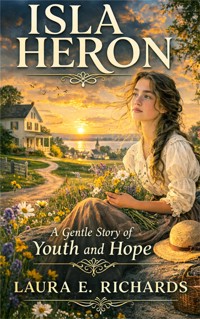
“You are right,” said the preacher, “I saw a young girl in the hall,—or rather, she stood outside, leaning in at the window,—whose face interested me greatly. She disappeared before the service was over, and I wondered if I might see her somewhere. I—I hardly know why I came down here to look for her. She was a beautiful girl, about fourteen, I should think, with long hair of a strange colour, and very brilliant eyes.”
She paused, for Joe Brazybone was nodding and blinking with every appearance of delight.
“You saw her, did you?” he said. “Yes! yes! anybody would notice Isly. She’d be queen of this hull island, if folks had their rights, and if other folks knowed a queen when they saw her. Not governor, I don’t mean, nor yet anything of that sort, but a real queen, with a crown on her head, and all the folks down on their marrer-bones every time she set her foot out-o’-doors.”
“I don’t understand you,” said the preacher. “Do you mean that the island belongs by right to that young girl?”
Joe nodded like a mandarin.
“It does, by the rights of it. Every step and foot of land belongs to the Herons, and she’s the only Heron left alive, save and except the boy, as he don’t count, bein’ deef-dummy. But Isly Heron she’s the born queen, and you may believe what Joseph says about that, preacher. I knowed Herons all my life. Herons was master folks over on the main, before ever they come here. When they come over, they brought Brazybones with ’em, to clean their fish and wash out their boats. Long ago thet was, way back among the gret-grets, and ’t hes been so ever since, till it come down to Giles and Joe. Joe done it, too, as long as Giles would let him. Old Joe would ha’ done it to the last, but Giles sent him away. He was sick and sufferin’, Giles was, and he didn’t want old Joe to know it, but Joe did know. Joe would have died when Giles did, preacher, if it hadn’t ha’ been for Isly and the boy.”
The strange creature was brushing his ragged gray sleeve across his eyes, and his voice quavered curiously.
“You never saw Giles?” he said, looking up presently.
“Giles was Isly’s father, but he’s dead now. You might never have seen him formerly, when he was over on the main some time?”
The preacher shook her head.
“He was another!” Joe went on, half to himself. “Like a king, Giles was, for all his smilin’, pleasant ways. Most folks didn’t know it, but Joe knowed it. Many’s the time I’ve hid down against the rock, after Giles wouldn’t see me no more, and waited so I could touch him when he went by. It done me good to touch his coat; I felt good come out to me, every time I done it.”




