


9,99 €
Mehr erfahren.
- Herausgeber: Pepper Press
- Sprache: Englisch
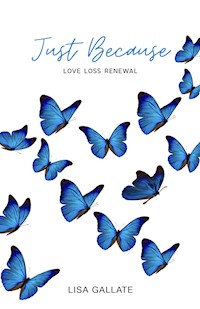
The life changing moment when Lisa’s 21-year-old sister Zoie, and Zoie’s 26-year-old partner James, died in a shocking car accident, is now memorialised by a beautiful oak tree. But Lisa then lost her 31-year-old husband Andrew to suicide, and her 32-year-old younger brother Justin to brain cancer. Faced with compounded grief from the untimely death of loved ones as well as a myriad of other losses, Lisa embarked on a journey of self-healing and renewal.
Just Because acts as a measure of wisdom about the often unspoken but universal topics of loss and grief, depression, suicide, miscarriage, Alzheimer’s Disease and the loss of a loved one to COVID-19. These candid pages offer comfort, warmth, honesty, hope and humour, as well as strategies for healing in the belief that loss and grief change your life, but they do not define you.
Just Because is a self-help memoir infused with unwavering accounts of how all sense of meaning in life may be lost, but we can manage our loss and grief to reshape and renew our own lives.
Sie lesen das E-Book in den Legimi-Apps auf:
Seitenzahl: 351
Veröffentlichungsjahr: 2023
Ähnliche






Just Because
LOVE LOSS RENEWAL
Just Because
LOVE LOSS RENEWAL
First published in 2023 by Pepper Press, an imprint of Fair Play Publishing
PO Box 4101, Balgowlah Heights, NSW 2093, Australia
www.pepperpress.com.au
ISBN: 978-1-925914-47-4
ISBN: 978-1-925914-48-1 (ePub)
© Lisa Gallate 2023
The moral rights of the author have been asserted.
All rights reserved. Except as permitted under the Australian Copyright Act 1968 (for example, a fair dealing for the purposes of study, research, criticism or review), no part of this book may be reproduced, stored in a retrieval system, communicated or transmitted in any form or by any means without prior written permission from the Publisher.
This is a memoir. The names of some individuals, or identifying characteristics of individuals, may have been changed to respect their privacy.
An early version of this book was self-published by the author in 2018 under the title Hitting My Reset.
Edited by Christine LePorte
Cover design by Lisa Rafferty
Typsetting by Ana Secivanović
Printed by SOS Media, Sydney
All inquiries should be made to the Publisher via sales@fairplaypublishing.com.au
A catalogue record of this book is available from the National Library of Australia.
“Just Because hits you like a tonne of bricks! This is a brave, brave book by Lisa Gallate and one that will live long in the memory. Lisa has courageously charted her experience through love, loss and grief and not only in a vulnerable way, but in a manner that gives back generously to the community. I highly recommend this book to everyone, especially if you have lost a loved one and are in need of honest, beautiful encouragement.”
Geoff Olds, Executive Counsellor and author of Death of an Entrepreneur and Break Up, Break Down, Break Through
“Just Because is an incredible story of the author’s journey through life changing losses, grief and renewal that is raw, real and topical with a backdrop of the global impact from the Covid pandemic. It is a riveting and inspiring chronicle of resilience through life’s toughest challenges filled with equal measures of humour, joy, love and of course sadness. Lisa Gallate writes without any pretension but with the precise intent to share stories of resilience and hope and inspire others to think beyond limits. It is an uplifting book that calls to the strength of the human spirit in all of us to be the best versions of ourselves and to live our best lives.”
Sam Buckingham, TV Presenter, Voice Coach and Yogi
“Just Because is a poignant, yet insightful read about the messy, inexplicable and often misunderstood journey called grief. Lisa exposes her deepest vulnerability as she thoughtfully explores the complexities and heart wrenching depths of death and loss, yet also the ironic beauty and joy of living. At times I felt I was sitting right next to Lisa in her mourning; inviting me to reflect on my own personal experiences of death and deep loss. Her touching words and sense of humour not only made me cry but also laugh out aloud. From a psychological perspective, Just Because provides pragmatic and evidence-based strategies to cope with the many stages of grief, cutting out unnecessary psychobabble - a welcomed relief for anyone in a time of mourning.”
Georgia Ray, Registered Psychologist
ABOUT THIS BOOK
Having been asked many times about my own coping skills and strategies, I decided to put pen to paper as a means of finding the real answers that might help me and others who are interested in those answers.
Part One (Love) of the book gives a brief account of my early childhood with my parents and siblings. Part Two (Loss) concerns the loss of those closest to me in life. Part Three (Renewal) examines strategies for healing and renewal.
My hopes are that this book:
shares enough of my experiences to provide you with comfort in relation to your own loss and grief;invites you to openly share your loss and grief with others; andprovides some key themes and strategies that may resonate with you in the context of your own journey.CONTENTS
COPYRIGHT
INTRODUCTION
PART ONE: LOVE
1. The Early Years
PART TWO: LOSS
2. Young Love Never Dies
3. On The Edge of Time
4. Lean on Me
5. Love, Loss and New Life
6. At Death’s Door
7. The Long Goodbye
PART THREE: RENEWAL
8. My Strategies for Healing
9. Understanding Grief
10. Immediate Aftermath
11. Build Your Resilience
12. Extend Yourself and Expand Your Horizons
EPILOGUE
ENDNOTES AND REFERENCES
ACKNOWLEDGEMENTS
ABOUT THE AUTHOR
INTRODUCTION
We all know something about love. We feel it for others and ourselves, and we are willing and happy to speak of our experiences of love, joy, happiness and peace.
But what of our losses and grief? In our modern society, why are loss and grief still considered taboo words? Why do we not speak of them and about them? Because they are complex, difficult and painful? Instead, we seem to demand of ourselves and each other that our losses and grief be avoided or managed or endured, and sometimes suffered, in silence.
It is an extraordinary feature of human behaviour that transcends cultures and continents, and must surely now demand our attention, given the COVID-19 pandemic, in which over 6.4 million confirmed deaths1 have been directly attributed to the pandemic globally, many thousands of jobs, businesses, industries and livelihoods have been lost or destroyed, and millions of people have been separated and isolated from their loved ones for extended periods.
We can readily say that almost all of us will come to know the pain of loss and the burden of grief, and this has been exacerbated by the COVID-19 pandemic. If we can teach ourselves and our young that our emotional wellbeing is something to be actively protected and nurtured, we can begin the conversations with ourselves and each other that create the opportunity for shared experiences and emotions in healthy, loving ways. In this shared human experience of loss and grief, we might just better understand, heal and rebuild ourselves on our own grief journeys. This will allow us to create new relationships and experiences that acknowledge our losses, honour our loved ones, and continue to provide our lives with meaning, joy and purpose.
But if we don’t do that, and instead seek to avoid or inhibit our grief, then we may find ourselves experiencing ‘incomplete grief’2 or ‘complex grief’ in which we experience prolonged preoccupation with our loss and painful emotions in ways that are debilitating to the bereaved. Our grief may then manifest itself in some physical way, such as in sleep disorders (I have had mine!), sickness, fatigue, headaches (I have had my share!), obesity or loss of appetite (ditto!), anxiety and depression. It can also cause us to become isolated from family and friends, colleagues and others, from the very people who might be available to provide us with care, kindness, support and a listening ear.
Whilst we might find it hard to vocalise our thoughts, feelings and emotions, we can gradually develop our confidence to share them in safe and loving ways. In doing so, and by practice, we will teach our brains to find the words that give voice to our difficult and complex feelings and emotions. You may just find that by sharing your grief, you will learn of the grief experiences of others, taking on board their insights and reflections, and know that in the realms of loss and grief, you are not alone.
From my own experiences, I have come to appreciate that one of the hardest losses in life to endure is the death of a loved one. I had never been truly aware of my own mortality until my sister, Zoie, and her partner, James, died. They were only young adults, with their whole lives ahead of them, and it made me realise how brutally short life could be. In my anger, fear, sadness, grief and loneliness, I questioned why I was still alive when they were not. Why had they died? Just because? Did it mean something? And yet, how could there be any meaning to such a tragedy?
The loss of loved ones adds layers to ‘living a full life’
In his insightful book When Bad Things Happen to Good People,3 Harold Kushner explains that whilst we can’t explain the loss of a loved one, we must live in the knowledge that just as we inherit their prized possessions, we also inherit their unlived years, and must live them along with our own. However, this is much easier said than done.
In my own life, I have tried to find some meaning to explain and help me accept the tragic death of loved ones. I have wanted to tempt fate in as many ways as I could, but I have also tried to live as full a life as possible, in the knowledge that those closest to me cannot. It is the loss of loved ones that for me has added another layer of meaning to ‘living a full life’, a layer in which you also try to live your life for them.
And so, I have lived my life for myself as much as for others. At Whakapapa, on Mt Ruapehu in the North Island of New Zealand, I skied with no regard for my own safety, hurtling down the slopes, totally out of control. My sister had always been a fast skier. After she died, whenever I was on the snow, I always felt her just ahead of me, and I seemingly chased after the image of her. On one occasion, I fell badly and split my ski suit right up the middle. It was very embarrassing. On another, I cracked my shin bone and had to be taken off the mountain by the medical team. The joys of skiing.
Bungy jumping was made famous by AJ Hackett and Henry van Asch at Kawarau Bridge in Queenstown, New Zealand. As a day trip, my brother Justin and I, with one of my girlfriends, drove out from Christchurch to Hanmer Springs. On impulse, my girlfriend and I decided to double bungy jump off the Waiau River Bridge at Thrillseekers Canyon. Our feet were tied together by the bungy, and we had to dive off the bridge together. We didn’t give any thought to the possibility that either of us might ‘flunk’ or fail to jump at the last second. Instead, we half jumped, half fell off the bridge. Our screams echoed through the canyon. The first few seconds were terrifying and then it was exhilarating. Afterwards, we felt like warriors—nothing could defeat us. We wined and dined on our bravery that day, and for many lunches afterwards.
Have you ever driven at reckless speeds on country roads or on beaches? I have watched the speedometer dial climb and felt like I was indestructible. It has only been for brief moments, and then my fear and my conscience take over, and I slow down. After my sister died, I made a solemn promise to my mum that I would be careful when driving, and I have tried hard to keep my promise (most of the time).
And what about paragliding? This is not for the fainthearted, the squeamish or those afraid of heights—and I was all three. On a beautiful day in the stunning city of Queenstown, an instructor pilot known to one of my friends, called Mike, took me paragliding from the skyline gondola above Queenstown. The vantage point was amazing as it meant we would fly over Queenstown and Lake Wakatipu.
I took the gondola up the hill, enjoying the scenery but quietly wondering what on earth I was doing. Mike met me at the top. After some preliminary platitudes, he said:
“Are you ready for the best time of your life?”
How do you answer that?
“Yes, I think so.” So lame.
“Okay, then, that’s GREAT! Let’s go over to our take-off point and I will give you a briefing.”
“Sure.” My throat constricted around this solitary word; I was so nervous. I wandered along behind Mike, agonising about what I had agreed to do.
We walked for about ten minutes to our take-off point. Mike strapped me into my harness and safety equipment. So far, so good. He then gave me a briefing on what to expect and what I had to do. In an instant, Mike was running behind me, pushing me along. I had to run as well, or I would fall over. We ran fast down a grassy bank to the edge and then simply ran off what I saw as a very safe, very stable cliff. The wind grabbed us and lifted us up, and we climbed through the air until we levelled out. I was breathless and speechless. Immediately struck by how quiet it was, we glided along like birds. After making sure—with some prodding—that I was okay, Mike found his camera to take photos of me, strapped in, looking terrified!
After about ten minutes flying over Queenstown, with views out to Lake Wakatipu and the Remarkables, we came in for our landing. We descended at a regular speed for some time, and then, without warning, Mike tilted the paraglider towards the Earth, and we descended rapidly, the Earth rushing up to meet us as we landed in a field. We landed on our feet and then I lost my balance and we both fell over, rolling through the grass.
“Well done, you did it!” Mike shouted.
“Thanks, I think!” Another lame response. It felt like my whole being had just been pushed up into my mouth as we landed.
“So, how do you feel?”
“Well, that was incredible. It was petrifying and amazing, at the same time. Thanks a lot for the experience, Mike, but I don’t think I will do it again.”
“Haha, no worries,” said Mike, no doubt having heard that a hundred times before.
My whole paragliding experience had been so fast and frantic that I was immensely glad that I had the photos to prove it.
The irony of something so certain as death being so unknown
Since those adventure-seeking experiences, I have lost many more loved ones. From both my adventures and grief experiences, I have realised that although we might think we are each responsible for, and in control of, our own destiny, we in fact have very little control over how, or when, we will die. Although each of our own deaths will always be certain—it cannot be avoided—what death will look like to each of us remains the great unknown. It is ironic that something so certain in our lives can be so ill-defined and so out of our control.
The loss of my loved ones has affected me greatly, and I have found it very hard to understand why death can be so cruel, so unforgiving and so relentless. When I lost my sister and her partner, I was a young woman studying at university, and I had never lost a member of my family. I had never known how mean death could be, snatching my sister from us in an instant.
After Zoie and James’ funerals, I searched for books that might help me with my grief, to explain why this tragedy had happened, and give comfort to deal with the pain and anguish I felt. But at that time, I only found academic literature about death and grief. From my searches, there seemed to be very few books written by authors about their own grief experiences. I desperately wanted to read and understand the grief experiences of others, so that I could better understand my own, and know that in what I was feeling, I was not alone.
Mitch Albom’s book Tuesdays with Morrie4 is a wonderful chronicle of the time that Mitch spent with his professor Morrie Schwartz, who was dying from amyotrophic lateral sclerosis. It was a very sad and yet uplifting book. However, reading it didn’t provide me with any comfort as Professor Schwartz had been reaching the end of seventy-eight years of a wonderful life, and my sister’s adult life had only just started.
Death and loss change your landscape
The pain of the death of loved ones in my life has, at times, been excruciating. I have felt incredible loneliness and wondered, why am I still here, living my life without them? I have had so many people through the years ask: How do you cope? How do you manage? What have you done to make it through so well? How are you able to keep going? Where do you find your strength from? How can you be so brave?
I have worked hard to understand and manage my own grief, and to find my own way through it, so that I can continue to appreciate and live my life with meaning and purpose, and so that I might live those ‘unlived years’ of my loved ones. I continued my studies after Zoie and James died, completing my Bachelor of Law and Commerce degrees, and a Master of Laws from one of the world’s most respected universities. I have lived overseas in the UK and Australia, and I have now made Sydney my home. As a lawyer, I have been involved in acting for external administrators of some of the largest corporate collapses in Australia. I have run half marathons and marathons. I have competed in ocean swim races. But most importantly, I am a mother to three beautiful young children, a wife, a daughter, a sister and sister-in-law, a niece, a cousin and a friend. I would like to think that I have lived my life in a landscape that has been irrevocably changed by death, loss and grief with humility and grace.
Grief grabs us in moments unaware
Even now, my grief seems to sit on my shoulder and goes where I do. At any time of the day or night, my grief can make itself known to me. It is easily triggered—by something someone says, by a song on the radio, by a change in my environment, or perhaps by the signs of a change in season. At times, it is simply a poignant moment that I can acknowledge and even appreciate, but at other times, I feel the urge to burst into tears, or I feel knotted and sick in my stomach.
Now, I have learned to manage that moment, to block everything else out and to focus on passing through it, breathing deeply and pausing long enough to let it pass. I can choose not to listen to my own thoughts, and I can choose not to act on them. I am in control of me, my thoughts, my emotions, my body, my actions and my words.
I also believe that I am in control of how I live my life, even though my grief and my healing will always be part of that journey.
PART ONE: LOVE
CHAPTER ONE: THE EARLY YEARS
“Look, no hands!” shouted Mark as he waved his long, spindly jazz hands in the air, the steering wheel held between his legs. The car screeched and swerved along the Wellington motorway to Miramar, as four little heads bobbed in the back seat, letting out a mix of screams and giggles and a few “whoas” and “go faster, Mark, go faster”. Mark delighted in waving with both hands to oncoming traffic, as the passing drivers looked at us with horrified faces.
We were out for a drive, a chance to get out of the house and go for an ‘outing’. A little light relief for our babysitter Mark, who was looking after me and my three siblings, all of us aged under ten years old, whilst Mum and Dad were away on holiday.
We turned into a parking bay off the motorway so we could watch the planes come into land at Wellington International Airport. The airport has a short runway bordered by the sea at each end, the Wellington Harbour at one end and Cook Strait at the other. The sea borders create gusty wind pockets, causing turbulent, choppy landings and the occasional swerving plane on the runway, much like Mark’s driving! For us kids, it was great entertainment. After watching a few landings and take-offs, we left the parking bay and drove past the airport. A plane took off and soared right above our heads. It seemed so close to the car’s roof that we all ducked in the back seat. The noise of the jet engines was deafening. Mark chuckled at our silliness.
“Can we stop for an ice cream, Mark?” screamed my sister, Zoie, from the back seat, followed by a chorus of “Pleeeease, pleeeease, can we?”
“Okay, but single scoops only. Let’s stop at the next dairy” (Kiwi slang for corner store).
Zoie and I knew this dairy well. We often stopped here on our afternoon walks from school to our dance academy. Not only did it stock the best flavours of Tip Top ice cream, but the old man behind the counter was always very generous with his serves. A single scoop here was a double scoop anywhere else.
Of course, it’s hard to choose when you’re limited to one flavour. My all-time favourite was hokey pokey, followed closely by boysenberry, which was Zoie’s favourite. My sister and I often shared licks of our ice creams, especially when the coins in our pockets didn’t extend to double scoops.
We entered the shop with Mark, falling over each other with excitement to get to the ice cream cabinet, contemplate our choices and place our orders.
“Me first!” said Zoie.
“No, I’m the oldest, it’s me first,” said George.
The bickering had started.
“Okay, okay, you can all look at the same time and decide what you want,” sighed Mark.
Since the store had run out of hokey pokey, it was an easy choice for Zoie and me, but my brothers dithered, peering into the ice cream cabinet, calling out one flavour and then changing it to another, a deliciously hard decision to make.
My mum, Iris, was born in Castlefin, Donegal, Eire. She was one of thirteen children and had a difficult childhood living on a farm with her parents and many siblings in rural Ireland. Determined to seek a better life for herself, she trained as a registered nurse at Leeds Infirmary and as a maternity nurse in Portsmouth. As a young Irish woman, she made the courageous decision to immigrate to Wellington, New Zealand, in a scheme sponsored by the New Zealand Government to recruit trained nurses to the far away land of Aotearoa, the ‘Land of the Long White Cloud’. It meant a free passage by ship, a secure job and a new life in a new country. After she arrived, Mum worked at Wellington Public Hospital as a staff nurse in the fracture clinic and on the orthopaedic ward.
Not long after she arrived in Wellington, Iris was invited by her Irish nursing friend Norah to a Saturday night dance at a dance hall in Wellington City. Unbeknownst to my mum, Norah and her partner, George, had set Iris up on a blind date.
During the dance, George tapped Iris on the shoulder, and over the music of the band, George leaned into her shoulder and half whispered to her, “Iris, please meet my cousin Nick.”
Iris spun around, her beautiful green silk cocktail dress floating around her long legs, and her big brown eyes framed with golden hair. She looked stunning.
“Good evening, I’m Nicholas, but you can call me Nick.”
“Hello, I am Iris,” said Mum in her lilting Irish accent.
“Very nice to meet you, Iris. Would you like a cigarette?”
“Yes, thanks.”
Dad only had one cigarette left, but he gave it to Iris, and lit it for her.
They spent the evening dancing and from that night on they were inseparable, attending many dances with friends at the various dance halls in the city, or dinner parties at the homes of friends and colleagues. They married twelve months later.
My father was a solicitor and barrister, a sole practitioner who worked from an office in Lambton Quay, what is now an illustrious shopping district in Wellington City, adjacent to New Zealand’s Beehive Parliament.
Dad was also an immigrant, having travelled as a young child with his parents and his young brother, Stathi, from Ithaca, Greece, to live in Wellington. They moved to Napier in Hawke’s Bay, a rural horticultural area which takes its name from Hawke’s Bay, the harbour ‘bite’ on the east coast of the North Island. Dad would return to Wellington as a young adult to study law at Victoria University and his brother, Stathi, trained as a doctor at Otago University in the South Island (affectionately known as ‘the Mainland’ to many Southern Kiwis). Stathi then worked at Wellington Public Hospital, where he was a respected, gifted and quick-witted junior doctor who was kind and friendly to both patient and colleague alike.
Mum and Dad settled in Wellington and started their own family. The firstborn was George, followed by Zoie, then me, and finally the baby in our family, Justin. When Justie arrived, Mum and Dad had four kids under five years of age.
Our lives as young children were typical of other families in Wellington. Most months of the year were spent battling the bitter winds of ‘Windy Wellington’, traipsing to school in our gumboots and raincoats on wet weather days, playing sports and dancing at the weekends. My brothers played rugby union, while my sister and I played netball and went to dance academy. I was a better ballerina than my sister, but Zoie was a talented jazz and contemporary dancer.
Mum was determined that we learn to swim, so her Friday night routine involved taking us to swimming lessons at the Freyberg Pool in Oriental Bay. I am sure she would have preferred relaxing at home in front of the fire, watching the TV. Mum sat at the top of the stadium in a large, draughty indoor pool complex, diligently scanning the pool for her children. Being of different ages and swimming abilities, we were in different classes, but it didn’t stop us chatting to each other across the lane ropes, or trying to dunk each other when we could, away from the prying eyes of our teacher.
After each lesson, Mum helped us have ‘rinse-off’ showers and get dressed. Mum then elaborately wrapped up Zoie’s and my hair in our towels, creating exotic turbans. We left the pool complex through the front glass doors, braving the wind and rain, with shouts of “run for your lives” as we raced to the carpark. We would stop for four orders at our local fish ’n’ chip shop, each wrapped as individual parcels in butcher’s paper. In the back seat of Mum’s car, we tore the top off our parcels and carefully pulled out and nibbled on our hot chips in the dark. At home, Mum sat us in front of the fire and towel dried and then brushed our hair, as we ate dinner from our parcels.
We lived in a four-bedroom but modest home in the hilly suburb of Hataitai. Zoie and I shared a bedroom. Mum decorated our room in yellow and brown hues, complete with matching duvets that she had made on her Singer sewing machine, and bright yellow round bedside cabinets.
Zoie was a terrific storyteller, relating tranquil, captivating stories of princesses and ballerinas, magicians and mystical figures in faraway lands of paradise.
“Tonight, I’m going to tell you the story of the great Empress of Zion.”
I was cuddled up in my bed, lying on my side in the dark, but able to make out the shape of Zoie in her bed beside me. I listened to her magical words as they sent me drifting off to sleep each night.
Zoie also loved to tell scary stories about the council rubbish collectors who used to climb our driveway to collect our rubbish from our outside bin before heading up the hill to the next house. I was scared of them in the daylight, and terrified of them when they appeared in my dreams at night.
Our Saturdays were invariably spent being driven around Wellington to attend sports and dance classes. For years, my sister and I attended the same dance academy. We spent hours there, either studying for dance exams or learning new dances that we performed at various fairs and fetes and nursing homes in the community. When we weren’t in a class, we would hang out at the dance academy, stretching, reading, nibbling on snack foods Mum had packed for our lunch, chatting to our dance pals, feeling bored waiting for our next class.
Zoie was my best friend and I loved every moment with her. I secretly wanted to be just like her.
Zoie was two years older, two years wiser, and she had a whole lot of sass. She had rich brown hair, with blonde streaks like sun kisses, that stretched down her back and ended with a blunt cut. Her fringe framed her oval face, her dark brown eyes peered through the fringe whispers, and her apple cheeks were matched by a wide smile with straight white teeth. She was gorgeous. When we were young girls, she was taller than me, and looked so much more grown-up in her leotards and tutus. I loved dancing with her, and I also loved to watch her dance. Zoie had great rhythm for a young dancer and moved so easily and fluently through her pique and chaine turns as she flew across the dance floor. Her battement kicks seemed to reach the ceiling, and she loved to pirouette. I felt that I was a more robotic, technical dancer without much ‘spunk’.
When I was ten years old, I found out that Zoie was changing dance schools; I was devastated. I took it personally and thought that I had done something wrong. But Zoie was just growing up and wanted to focus on her jazz and contemporary dancing at a specialist dance academy. It was the first time I realised that although we were sisters, we were not always going to be a team.
It was a great loss, as my sister started immersing herself in her own interests without me. I found it hard to keep going to dance classes by myself and I missed her terribly. I no longer had my buddy with me to help me get ready or to sit around with, killing time until our next class. I missed seeing her dance and missed being able to practise our dance moves together at home. Over time, I lost interest and gave up on my dance classes. My passion for dance had been inextricably tied to the time spent with my big sister.
I don’t know if Mum ever really understood how I felt as I struggled to understand my own feelings, and I didn’t know how to vocalise them. I didn’t want to take anything away from Zoie starting at a new dance academy, but I also didn’t want her to go. Zoie was steadily developing her dancing talent and, luckily for her, was enjoying every minute.
Mum and Dad seemingly managed to be in many places at once every Saturday. Having four young children to take to sports and dance classes must have been a logistical nightmare. By Saturday afternoon, they were exhausted. But somehow, they would find the energy to either have a family over for dinner, or they would take us to dinner at another family’s house.
Sometimes, our babysitter Mark would be asked to spend the evening with us when my parents went out to dinner parties. He was a wonderful man with a terrific sense of humour, and we relished his company. Mum and Dad also hosted dinner parties for their friends, and we were relegated to my older brother’s room to watch an old TV. Instead, we often sat at the top of the stairs, eavesdropping on the adult laughter and conversation that travelled up the stairwell. We knew the dinner party was ending when Dad brought out his collection of liqueurs, a kaleidoscope of colours in fancy bottles that were stored in a secret cupboard. As Dad placed them on the table, asking his guests which exotic potion they would like as a nightcap, we rushed to our beds.
On Sunday mornings, we would often lie in our beds, with the wind howling outside and rain pelting against the windows, listening to the children’s stories told on Wellington’s weekend radio programs. The characters of those stories came alive with the wonderful rich voices of the actors who played them. Sometimes Zoie and I would bake muffins in the morning for a late lunch. We rather fancied ourselves as mini Betty Crockers, even though the flour and sugar would be strewn from one end of the kitchen to the other (and the sieve may have been used to spray each other with flour!). Whilst Mum took the mounds of flour and sugar and splats of butter in her stride, she would still make us clean up the kitchen while the muffins were cooking.
“A good cook is a clean cook, so you should always clean up as you go, or when the food is cooking in the oven. Here, let me give you a hand.”
Mum washed the baking dishes so Zoie and I would race each other to see who could get the wiping down done before our muffins were cooked.
“Wow, come see, I think they are ready.”
“Watch out, Lise, let me get them out, I ammmm the oldest, you know.”
“What’s age got to do with getting muffins out of the oven?”
“Well, for starters, my hands are bigger for the oven mitts, and I can tell if they are cooked or not just by looking at them!”
“Really?! Well, I don’t need to look at them. They smell cooked to me!”
We would pull our hot muffins from their trays onto Mum’s cooling racks and set them by the kitchen windows. Both Zoie and I were desperate to eat them hot, cut in half with some blobs of creamy New Zealand butter spread on them, so the butter would melt along the top and drip down the sides. There was nothing quite like it.
But instead of devouring our hot home baking, we were rushed to get dressed for church. My mum was an Irish Protestant but never really spoke to us about her faith. Instead, she attended a Sunday service at the local Presbyterian Church and made us attend Sunday school next door. Our religious immersion was a smorgasbord. We had been baptised in the Greek Orthodox Church, attended a Presbyterian Sunday school, and were educated at Catholic schools. From my early experiences, I came to appreciate, as an adult, the many different approaches to Christianity.
After church, our big treat on the way home was to stop at the local bakery for some fresh crusty bread. Mum would cut it into thick slices and lather them with butter and cheddar cheese, which we would delve into, followed by a generous serve of muffins and a glass of milk. We were typical young Kiwis, fuelled on a diet of dairy, red meat, a mix of muffins, scones and pikelets, and green veggies grown in our back garden.
Mum was very loving, but like any parent, could also lose her cool. One day, I almost destroyed our back lawn, a long, narrow strip of grass that ran the length of the house. At the far end, away from the house, sat a large, round tin container which my parents used to incinerate garden waste. It was a cloudy but very windy day and Mum was busy feeding the fire in the incinerator. I was charged with watering the garden with the hose as she worked.
“Quick, Lisa, give me the hose, I think it’s getting too high.”
My back was turned away from Mum as I pottered in the garden, spraying the bushes, plants and weeds with the hose. Big puddles were forming in the garden beds as I overwatered anything in reach. I watched as the puddles turned into creeks that ran through the garden bed and pushed the soil around with my feet to create little dams.
As I spun around to calls of “Lisa, Lisa, quick, the hose,” I saw the huge flames dancing out of the top of the incinerator. Mum’s fire was out of control. It was being fanned by the wind and looked like it was about to jump onto the surrounding bushes and lawn.
As I turned, I paid no attention to the direction of the hose. I totally soaked Mum, head to toe. The water was running down her hair and face and dripping off her nose. Her T-shirt was stuck hard to her body, and her mouth was open in horror. It would have been quite funny had I not been devastated that I had upset my mum.
Mum started shouting at me in Gaelic. I couldn’t understand a word, but very quickly had the sense of what she was saying.
“Oh, Mum, Mum, I’m so sorry.”
I ran to her as she grabbed the hose and fully wet down the incinerator, extinguishing the fire. Mum was wet through, but as she let out a big sigh, I could see her relief that the fire hadn’t got out of control. Both we and her lawn were safe and sound, but it was a while before I was allowed to be on water duties again.
When we weren’t playing in the garden or making a racket in the house, and perhaps to save my parents’ hearing, we would often go for a Sunday afternoon drive. These were unplanned, chaotic and risky trips in Dad’s prized possession, an old mustard-coloured Daimler with leather seats and double exhausts—not really the ideal family car—which he would spend most weekends cleaning and polishing, and which he drove at speed.
“Nick, slow down.”
“Nick, slow doooown.”
“Nick, slow down or you can pull over and we will get out of the car and then you can drive as fast as you like.”
These were common catchcries as Mum held the armrest on the passenger door for dear life, her body twisted with anxiety and fear. She would continue shouting at Dad, pleading for him to slow down.
“But I’m not speeding.”
“Of course you are. You’re driving far too fast, and our children are in the car. Nick, pleeeease. Slow down or stop the car NOW.”
Reluctantly, Dad would slow the car, but it wouldn’t be long before his lead foot started pumping the accelerator pedal again, the speed dial started to climb and Mum resumed her pleading.
One Sunday, I decided Mum needed reinforcements in getting her point across to Dad. I layered myself with my roller-skating knee pads, my elbow pads and my helmet, just as we were being called to come to the car. I went downstairs, walked past the bemused faces of my siblings and headed outside.
“Lisa, what on earth are you wearing?” It was Dad.
“Just some extra gear for our Sunday drive.” My siblings had followed me outside and were cackling with laughter. Even Mum was giggling.
“But why?”
“Just so I can protect myself in case you have an accident.”
“We won’t have an accident. Now take that gear off and get in the car,” Dad scolded, with a smirk on his face.
My point was made, and it served to slow our speedster for a while, but not for long.
Dad’s driving style also included tailgating other cars, moving out erratically to check for oncoming traffic so he could overtake on the other side of the road, speeding short distances between cars “so we can get there faster” and providing a running commentary on just about everything outside the car. Or he would stretch his left arm across Mum’s body to point at some random object at the side of the road, or in the distance on the horizon. It might be one of the millions of sheep that inhabit New Zealand, or a cow, bull, horse, goat, deer, chicken shed, disused bridge, farmhouse or shed—the list of random objects that attracted Dad’s attention was endless.
Dad liked to drive towards a destination with no concept of directions and we would often spend our Sunday drives lost, doing U-turns, listening to Mum and Dad argue about where they were going, how we were going to get there and where we were. Dad was always adamant that he knew where he was going, and didn’t need a map. Long before Google maps, Dad’s road maps were gigantic paper maps that folded into A5 squares but were totally impractical to read from in a car that was screaming down the road with the driver looking in every direction for the next road sign, and five passengers sitting terrified in their seats.
“Will you stop at the next town and ask for some directions?”
“No, we don’t need to, I know where we are going.”
“You might know where we want to go, but you have no idea how to get there.”
“I do.”
“No, you don’t. I feel like we have been driving around in circles for hours.”
“We haven’t.”
“Yes, we have.”
“Okay, okay, let’s just wait and see what the next road sign says. If the next town has a service station, I will stop there.”
Despite the debates, many Sunday afternoon drives were fun. A favourite destination was north of Wellington to find ‘pick your own’ (PYO or u-pick) corn farms and fruit orchards. My siblings and I loved being outside running through the corn fields, the sun on our backs, the smell of soil beneath our feet.
We often played hide and seek or tag, running and chasing each other down the aisles between the corn bushes. Because we were young kids, the height of the corn bushes made for great camouflage from our brothers and sister. Mum and Dad were pleased to see us distracted, running and playing through the fields, and busied themselves picking cobs of corn and stacking them in buckets for weighing and payment at the exit.




