


Erhalten Sie Zugang zu diesem und mehr als 300000 Büchern ab EUR 5,99 monatlich.
- Herausgeber: epubli
- Kategorie: Gesellschafts- und Liebesromane
- Sprache: Englisch
Parables of the Kingdom and of Wisdom presents a collection of short stories that use metaphors, symbols, and archetypal characters to convey profound lessons about life, character, and spirituality. Each parable explores universal human conflicts — pride, humility, friendship, work, choices, temptation, ignorance, and the search for meaning — always accompanied by interpretations that deepen the reader's understanding. Throughout the chapters, figures such as knights, commoners, shepherds, merchants, children, animals, and even beings from other worlds appear as mirrors of human virtues and weaknesses. The narratives explore themes such as: the difference between wisdom and foolishness the value of true friendship the struggle between humility and pride the impact of choices on destiny the relationship between humanity and the divine the pursuit of true inner victory the contrast between material wealth and spiritual richness
Sie lesen das E-Book in den Legimi-Apps auf:
Seitenzahl: 78
Veröffentlichungsjahr: 2026
Das E-Book (TTS) können Sie hören im Abo „Legimi Premium” in Legimi-Apps auf:
Ähnliche















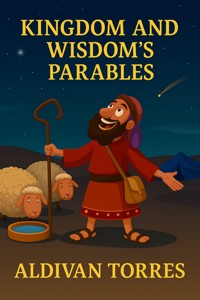
“Kingdom and Wisdom’s Parables”
Aldivan Torres
Kingdom and Wisdom’s Parables
____________________
Author: Aldivan Torres
©2018-Aldivan Torres
All the rights reserved
____________________________________________
This book, including all its parts, is protected by copyright and can’t to be reproduced without author’s permission, resold, or transferred.
______________________________________________
Short Biography: Aldivan Torres, The Seer, develops the series of novels “the seer”, poetry, books of the genre self-help, religious, the field of wisdom, among others. To date, it has published titles in Portuguese, Spanish, English, French, and Italian. From an early age, he has always been a lover of the art of writing and has consolidated a professional career since the second semester of 2013. He hopes to contribute to the Pernambuco and Brazilian culture, arousing the pleasure of reading in those who do not have the habit. Your mission is to win the heart of each of your readers. Besides literature, his main tastes are music, travel, friends, family, and the very pleasure of living. “For literature, equality, fraternity, justice, dignity, and honor of the human being always” is his motto.
Introduction
The Kingdom and Wisdom’s parables are a collection of parables that have as purpose the instruction for diverse situations that occur in our life. Let us look for in these parables the thread that unrolls during our problems, and we will live better.
I hope that they contribute in some way to the life of the readers and if at least one person is satisfied with this book, I will give a good use of the time used in their making. A hug.
The author
Kingdom and Wisdom’s Parables
Introduction
The firstborn and the bastard
The Black Knight
The Black Knight: Meaning
The true friend
The true friend (meaning)
The two employees
The two employees (meaning)
The great apple trees
The great apple tree (meaning)
The humble and the proud
The parable of the foolish man
The plantation
The Barn and The Cobra
The two commoners
Parable of Creation
The kingdom
The true victory
The merchant and the consumer
The two shepherds
The rich boy and the poor boy
The Alien and the Earth man
The Labyrinth
The Game of Life
The Fish and the Star
The Invisible Companion
The Drunk And the conscious
The antiquarian
The Librarian
Forewarned and reckless
The key
The frog and the butterfly
An Important Lesson
Parable of life
The firstborn and the bastard
Joshua was a prosperous merchant in Recife. He was married and had two children named Abelardo and Roger. Abelard was his son with his legitimate wife, and Roger was the fruit of an extramarital relationship. The two were raised together and treated equally by their parents. When they grew up, they learned the truth that they were half-brothers. Initially, this did not affect the relationship of the two. However, over time, the firstborn (Abelard) began to implicate his half-brother; therefore, he always wanted more attention from parents than did not happen.
With the opening of two more stores, Joshua decided to call a family meeting to declare his decision. The children attended, and their father began the dialogue.
“My children, we are gathered here to deliberate on an important question: The administration of the new stores that I have just inaugurated. I'm already very busy with the ones I have, and so I'm going to pass them on to my two children. Each of you will have a store. I am not discriminating against anyone because they both have the same sales capacity. What do they tell me? Accepted?
The eldest son rose angrily and protested:
“Is not fair. I have the right to stay with the two stores because I am your true son, the fruit of true love. While there, it's just an error.
The father, disgusted, broke out on top of him and slapped him.
“You are the one who has no right to humiliate you.” He is my son as much as you are. What is mine, do what I want. By this attitude, I will take away the administration from the store and deliver this to my other son because he did not even open his mouth to complain about my decision. Whoever deserves it will be given even more.
The Black Knight
There was, in a distant kingdom, an excellent and powerful king. He was served by numerous faithful servants who loved him. Each day, he chose some more to grow his wheat field because he was huge. Among the workers, there was one named Angel, who was one of the most important servants. He had six talents of significant importance. However, he did not know how to handle these tools and did not want to hurt others. The king, all powerful, knew of his acts because of the damage he was causing. At every turn of his, the king paid a gigantic sum in compensation to his creditors. The time passed and Angel unknowingly continued sowing tares instead of wheat. The king loved him. Among the servants, there was no one above him. However, the king realized that if he did not take an energetic attitude, he would ruin the plantation and with that, he would be sentenced to prison no matter how much it hurt him. Then the king decided to send the black knight.
The black knight, also called the devastating plague, was the first evil known in his field. He is the father of lies and malice. He approached Angel and began to cry:
“The weeds that you have unwittingly sowed I will gather you now. On the way back, I come to pick you up, too.
In this, a white knight appeared and complemented:
“This is just a warning. If you continue to carry out your crimes, you will also be condemned. The king sent me here to alert you. He knows you sowed tares thinking it was wheat. That is why he spared him this plague. Now, continue your work and be careful not to sow more tares.
At this moment, Angel had proof of the true love God had for him. From that day on, he would mend and cultivate the harvest more quickly.
The Black Knight: Meaning
The king represents the creator. The subjects represent their creatures. Wheat is the world. Tools are the talents that God gives us when we are born. An angel is a higher spirit sent by God to enlighten the world. Because of his gift, he sometimes harmed his fellow men. The king treats him as a son and therefore forgives his slips. The energetic attitude represents the celestial force that clarifies the true path of good. The black knight is the forces of evil that try in every possible way to harm the servants of the highest. The white knight represents the heavenly guardians who protect the spirits of light. Moral of the parable: God is always willing to give a second chance to those who recognize their mistakes.
The true friend
Gilson, Humberto, and Ronald were inseparable friends. The three of them had known each other since they had studied elementary education. He spent his childhood, came to youth, and remained friends. They got married and although the weather got shorter, they continued to be seen on weekends. Occasionally, the three of them would go out alone when the program they were going to enjoy was only suitable for men: games, fishing, adventure tours. One weekend, they combined a boat trip in the surroundings of the beautiful Angra dos Reis. They prepared everything: They prepared a nice barbecue, took some caipirinhas and a lot of soda. In addition, they brought with them a powerful sound system to perform some samba classics. The party was hectic and the party too. In this shuttle, Gilson approached the end of the boat without realizing it because the weather was cloudy and the fog began to thicken, making it impossible for him to see clearly where they were. The party's pace slowed, and they decided to rest a little. There was a noise of something falling into the water and the shrill scream of someone caught the attention of everyone. It was Gilson: A slipping unbalanced him and his body was thrown under the waters. I cannot swim! he screamed.
Humberto pondered and said, “I do not know how to swim, either.” I'm not going to risk it because I have children to raise.
Ronald felt himself shudder inside and was moved by his colleague's situation. He said, “I do not know how to swim, either. However, he is my friend, and I will not leave him alone in this difficult situation.
Another noise: Ronaldo threw himself into the stormy waters to help him. Wrapped in haze, he shouted his name to locate him. Something cleared his way and found Gilson almost exhausted and unable to swim. When Gilson saw him, he exclaimed, “You should not have come.” I know you do not swim either. We're going to succumb together!
Ronald replied, “I do not care. Do you remember how you helped me in that desperate financial crisis? We're grateful for what you did for our family. Because of this and the person you are, I do not mind losing you if you must.




