


6,99 €
Mehr erfahren.
- Herausgeber: No Exit Press
- Kategorie: Abenteuer, Thriller, Horror
- Sprache: Englisch
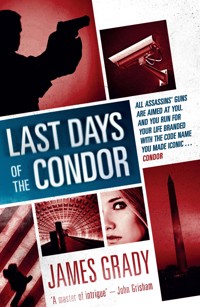
Look in the mirror. You're nobody. You know pursuing the truth will get you killed. But you refuse to just fade away. You've been designated an enemy of the largest secret national security apparatus in America's history. All assassins' guns are aimed at you. And you run for your life, branded with the code name you made iconic: Condor. Last Days of the Condor is a breakneck, ticking-clock saga of America on the edge of a startling spy world revolution. Set in the savage streets and Kafkaesque corridors of Washington DC, Last Days of the Condor is shot through with sex and suspense, secret agent tradecraft and full-speed action.
Das E-Book können Sie in Legimi-Apps oder einer beliebigen App lesen, die das folgende Format unterstützen:
Veröffentlichungsjahr: 2015
Ähnliche















Look in the mirror. You’re nobody. You know pursuing the truth will get you killed. But you refuse to just fade away.
You’ve been designated an enemy of the largest secret national security apparatus in America’s history. All assassins’ guns are aimed at you. And you run for your life, branded with the code name you made iconic: Condor.
Last Days of the Condor is a breakneck, ticking-clock saga of America on the edge of a startling spy world revolution. Set in the savage streets and Kafkaesque corridors of Washington DC, Last Days of the Condor is shot through with sex and suspense, secret agent tradecraft and full-speed action.
CRITICAL ACCLAIM FOR LAST DAYS OF THE CONDOR
‘wonderful... supremely entertaining and a sad, important look at America today’ - Washington Post
CRITICAL ACCLAIM FOR JAMES GRADY
‘Grady is a master of intrigue’ - John Grisham
‘(Grady is) a master of blending real life and fiction’ - John Marks, co-author of ‘The CIA and the Cult of Intelligence
‘James Grady is a master of Washington intrigue’ - Seymour Hersh, Pulitzer Prize winning journalist
James Grady is the New York Times bestselling author of Six Days of the Condor, Shadow of the Condor and Mad Dogs. He has worked as a screen-writer for CBS, FX, HBO and major studios. Grady’s been both A US Senate aide and a national investigative reporter. Grady’s writing honors include France’s Grand Prix du Roman Noir (2001) and Italy’s Raymond Chandler Medal (2003). Six Days of the Condor was made into a classic Robert Redford movie (Three Days of the Condor). He has two children, lives with his wife inside Washington, D.C.’s beltway.
LAST DAYS OF THE CONDOR
ALSO BY JAMES GRADY FROM NO EXIT PRESS
Six Days of the Condor
Mad Dogs
LAST DAYS OF THE CONDOR
JAMES GRADY
for
Desmond Jack Grady . . .
. . . running toward tomorrow
RAVE ON
Wonderful artists & colleagues & inspirations, plus loyal fans & friends & trusting sources helped Condor fly. THANKS to all of you, especially:
Jack Anderson, Rick Applegate, James Bamford, Richard Bechtel, David Black, Hind Boutaljante, Jackson Browne, Buffalo Springfield, L.C., Michael Carlisle, Tracy Chapman, Tina Chen, Stephen Coonts, Citizen Cope, Dino De Laurentiis, Nelson DeMille, Sally Denton, Sally Dillow, Tom Doherty, The Doors, Faye Dunaway, Bob Dylan, Jean Esch, Bob Gleason, Bonnie Goldstein, H.G., Nathan Grady, Rachel Grady, John Grisham, Francois Guerif, Julien Guerif, Jeanne Guyon, Jeff Herrod, Seymour Hersh, John Lee Hooker, Richard Hugo, Stephen Hunter, The Kingston Trio, Starling Lawrence, LM, Ron Mardigian, Mark Mazzetti, Maile Meloy, Lee Metcalf, The New York Times, Roy Orbison, Jp, George Pelecanos, Otto Penzler, Seba Pezzani, Walter Pincus, Sydney Pollack, Kelly Quinn, David Rayfiel, Robert Redford, Rivages Noir, Cliff Robertson, S J Rozan, Derya Samadi, Roberto Santachiara, Lorenzo Semple, Jr., Yvonne Seng, David Hale Smith, Bruce Springsteen, Steely Dan, Jeff Stein, Buffy Ford Stewart, John Stewart, Roger Strull, Max von Sydow, Simon Tassano, Richard Thompson, Shirley Twillman, Paul Vineyard, BW, Jess Walter, The Washington Post, Tim Weiner, Les Whitten, David Wood, Bill Wood, The Yardbirds, Jesse Colin Young, Warren Zevon, and Anlan Zhang.
Contents
1 Something’s Happening here
2 The Ones we don’t know we don’t know
3 Runaway American Dream
4 Zombie Jamboree
5 A Candy-colored Clown they Call the Sandman
6 We Deal in Lead
7 Sure it is
8 The Slow Parade of Fears
9 What Rough Beast
10 Gonna Fall
11 Secret Heart of Lonely (What Condor always Wrongly Thought The Song Says)
12 Trouble-lost Dog
13 Dragons Fight in the Meadow
14 Gonna Shoot you Right Down
15 The Way I always do
16 Survival is a Discipline
17 Be My Pillow
18 Say Your Life Broke Down
19 The Time to Hesitate
20 Maybe Together we can get Somewhere
21 If I Could Hide, ’Neath the Wings
22 Stuff Happens
23 Too Much Cunning Strategy . . . And Strange Things Start to Happen
24 Wheels Turnin’ Round and Round
25 Put Yourself
26 The Essence of Love is Betrayal
27 Better Roads
28 No More Forever
29 A Walk in the Park
30 Everybody Needs a way to die
31 Gonna take Someone Apart
32 Into the Vacuum of his Eyes
1
SOMETHING’S HAPPENING HERE
- Buffalo Springfield, ‘For What It’s Worth’
A cover team locked on him that rainy Washington, D.C., Monday evening as he left his surface job, flipped up his hood and stepped outside the brass back door for the Library of Congress’s John Adams Building.
A white car.
Indicator One on the white car as a cover team: Tinted windows and windshield.
Indicator Two: A car engine suddenly purred to life as raindrops tapped the blue mountaineering coat’s hood over his silver-haired skull. He spotted the white car parked illegally at the Third Street corner of A Street, SE, a town house–lined road that ran from Congress’s turf through Capitol Hill’s residential neighborhood.
Indicator Three: The chill in the rain let him see wisps of gray exhaust from behind the purring white car. As it didn’t pull out into traffic. As it sat there, wipers off, heaven’s tears dotting the tinted-glass windshield.
Indicator Four: No one hurried to the white car from a nearby home. No commuter leaving work splashed through the rain toward it to be greeted with a spouse’s kiss.
Indicator Five: He felt the cover team. Chinese martial artists talk about the weight of a stalker’s eyes, feeling the pressure of an enemy’s chi. Kevin Powell - who got his throat cut in an Amsterdam brothel the year the CIA-backed Shah fell in Iran and the Soviet Union invaded Afghanistan - Kevin insisted you must pay attention to your guts, your feelings. Or you’ll get butchered on some midnight street. Or wake up screaming in a windowless steel room. That Monday D.C. evening, the silver-haired man standing on hard cement in the chilly spring rain knew what his tingles meant.
One, two, three, four, five. Like fingers of a hand, a hand that meant cover team.
He looked to his left along the sidewalk running past the Adams Building with its six stories of white stone plus basements of knowledge and secrets. The brass door behind him could withstand a car ramming into it or a giant gorilla banging on its locked metal.
Walking down Third Street as if to pass the Adams Building came a man: Caucasian, dark hair, late thirties, white-collar-warrior suit and tie under a tan coat, brown shoes not built for running, holding a black umbrella in one brown-gloved hand, the other holding a cell phone pressed to his face as he said: ‘Where are you located?’
Could have been a cover team communications ploy.
Feed data via a phony phone conversation.
But the silver-haired man didn’t think so: Too unnecessary.
Suit & Tie Cell Phone Umbrella Man walked closer, now nearly perpendicular to him, brown shoe step by brown shoe step rippling puddles on the dark, wet sidewalk.
A stream of strangers joined Mister Cell Phoning Suit & Tie, all looking like innocent Americans headed somewhere after work on a Monday evening.
If your cover team is there for wet work, sometimes a better option than running from them is to imbue your assassination with Elevated Exposure Costs.
The silver-haired man in the blue hooded coat put his hands in its storm pockets as he stepped away from the Adams Building. Run, he did not run. He joined that stream of eight pedestrians, five of whom walked under umbrellas. Like a blue penguin, he wove a crooked course to the center of the umbrella group - innocent bystander casualties being a classic EEC.
The smart move.
Unless the cluster of strangers he’d slid into belonged to the cover team.
The Israelis used a twenty-nine-member cover team for the Dubai hotel room assassination of one Hamas executive back in 2010.
Of course, a cover team didn’t necessarily mean a hit or mere surveillance: these strangers walking with him under their umbrellas on a Washington, D.C., Capitol Hill sidewalk could be a snatch crew which he’d now let surround him.
But none of his fellow pedestrians vibed hunter as they marched toward the restaurant row on Pennsylvania Avenue just up from the House of Representatives’ three castle-like office buildings. He flashed on sixth grade, walking to school with other kids. He remembered the smell of bicycles.
We’re all kids on bicycles, he thought. A flock of birds.
Wondered if whoosh his flock of umbrella strangers would sense a shift in the universe and bank another direction and no, he hadn’t run to join them, though he remembered the joys of long-distance jogging before his knees, back, and the bullet remnants in his left shoulder all conspired against him.
Back then, he’d been passing through Washington as the powers that governed this hydrogen bomb–blessed country argued about blow jobs in the White House. When he jogged during that work trip, his aches & pains decoded as no more running for fun & fitness. He accepted that evolution.
But like he remembered blow jobs, he remembered how if you run fast and there’s a littler kid near you, you’ve got a better chance because Beirut snipers prioritize wounding the littlest kids to tempt rescuers. Run, you can make it to that doorway if only that doorway were there instead of the intersection of Third Street, SE, and Independence Avenue where it’s tonight, you don’t have a bicycle, and there is no sheltering doorway or black-smoke stench of burning rubber tires at street barricades.
Focus: This is here. This is now. Washington, D.C. A chilly rainy evening.
Hold on to that.
You can hold on to that.
Sure.
There’s a cover team on you.
If nothing else, have some pride. Make them work for it.
Whatever it is.
Third Street, SE, is a one-way route from busy Pennsylvania Avenue, passes Independence Avenue that heads out of D.C. like an illusion of escape. Third Street means rows of parked cars on both its Adams side and across the road in front of town houses often harboring political action committees for Congressmen whose public offices are two blocks away, only a four-minute walk from their official duties to private property where they can make legal phone calls whoring money for elections. Any car -
Say a cover team’s white car.
- any car parked facing the Adams Building on A Street, a block up from Independence Avenue, was stuck with a right-hand turn: the only legal choice. Parking where they had meant they couldn’t pull out of their surveillance spot, turn, and drive down Third Street the wrong way against traffic, the route he always walked home, so -
So the cover team knew his predictable route. So they were that kind of they: informed, briefed. Knew he wouldn’t - couldn’t - walk past them, put his shoes on the sidewalk of A Street, SE, that close to where. Once they knew he was out & on the move, on foot, going toward Independence Avenue, the white car would turn right with the one-way traffic flow as if they weren’t covering him.
Then circle the block. Given rush-hour traffic, rainy weather, odds are they’d be at the intersection of Pennsylvania Avenue and Third Street, SE, in time to spot whether he diverted down to Pennsylvania’s main street of bars & restaurants or continued on his normal route up Independence. Odds are, he’d be walking with the outbound traffic, so the white car could slowly drive behind him, leapfrog parking to keep him ahead of their windshield. Eyes on him the whole way home.
Just in case they’d put shoes on him too, he didn’t look back.
Instead, he scanned the bright lights of the restaurants and chain-store coffee shops and bars that served both Congressional staffers on beer-bottle budgets and lobbyists who made champagne flow. He cranked his head as far as he could toward the giant yellow-bulbed traffic sign that had been set up after 9/11, with its insistent arrow ordering all trucks to turn off Pennsylvania Avenue’s route between the House of Representatives’ office buildings and the Congress’s iconic Capitol building.
He saw the Congressional cop standing in the rain beside a cruiser parked next to the flashing detour sign. Wouldn’t matter if the truck that disobeyed the detour warnings was a cargo of dead tree products driven by a lost fool or a suicide bomber’s rental truck packed with fertilizer in a concoction powerful enough to devastate two city blocks, the cop knew he’d need to risk holding position in the kill zone and try to shoot out the truck’s tires before it blasted America’s core of government.
The silver-haired man peered past the cop outside his cruiser and the yellow detour arrow. Told himself that through the bare trees and over two blocks away, he could see the edge of the Capitol building; visualize its dome, white and slick in the rain.
Before and for a while after Watergate, the FBI maintained a covert station on Pennsylvania Avenue in the first block of private commercial buildings he saw as he turned back from staring at Congress’s domain. That former FBI lair had been a flat-faced concrete building with an underground garage, always shut. He’d learned about the building back when this life began. That the three-story gray building belonged to the FBI was gossiped about by all sorts of people who worked on Capitol Hill, including many of Congress’s members and staffs. If any of them had the guts and power to ask the Bureau about the building at the corner of Congress & the world, the official FBI response labeled the substation ‘a translation center.’
Sure, he thought: And how does that translate?
He stood on the corner of the block where he now worked, obeying the traffic light, faced down Independence Avenue with his head turned in its blue hood just enough so his peripheral vision might pick up the appearance in traffic of, say, a white car.
The DON’T WALK traffic signal he faced glowed orange with a line slashed across the orange stick figure image of a walker and counting-down flashes:
. . . 30 . . . 29 . . . 28 . . .
On the way to his rampage in 1998, a lone gunman from Montana who killed two Congressional cops while trying to shoot his way into the U.S. Capitol visited the for-decades town house headquarters of a fringe political group across the street from where the silver-haired man now stood. What the diagnosed paranoid schizophrenic gunman wanted from that political group is unknown, but he was drawn to them. The since-moved political group’s revered but deceased founder kept a life-sized black metal statue of Adolf Hitler at the foot of his bed and the group openly but illegally sold the same phony cancer-curing drug that failed to save movie star Steve McQueen.
. . . 3 . . . 2 . . . 1 . . . WALK flashed in traffic-light white and freed a white stick figure.
Hope you get where you’re going, telepathed the silver-haired man to the white stick figure in the signal light as he himself crossed the road for his eight-block journey with the traffic flowing along Independence Avenue.
He didn’t flinch when his peripheral glimpse of the intersection showed the rain-slick black street reflecting a red light and an idling white car.
At the next corner, Fourth Street, he let the green light send him to the right, across the road. Didn’t look behind him up that street to where it happened back then. Didn’t look sideways to see the white car he hoped was blocked a few vehicles back, not at this crosswalk revving its engine to roar off the slick street, smash into his blue-hooded figure, hurtle him to his death or under crushing wheels.
Rundowns are tricky.
What’s the Mission Risk Allotment for the cover team in the white car?
He made it to the curb. Didn’t look back as he turned left, his usual route.
Don’t let them know the weight of your eyes.
The rain stopped two blocks later as he slogged past the long low barn of Eastern Market where J. Edgar Hoover had worked as a grocery delivery boy before his left-wing subversive hunting days during the last century’s Palmer Raids.
Cars whooshed by his lone man walking. Homeward-bound citizens.
Four blocks later, as he neared his corner of Eleventh Street, he spotted the white hat and dark blue sweater of a Navy officer leaving the neighborhood dry cleaner’s that often served personnel stationed at the nearby Commandant of the Marine Corps. Flashed to cradling a Marine corporal shot in Afghanistan as that man, that boy, who’d saved his life flopped, gurgled, and died without ever knowing the truth about his fellow American or having it told to his family back in Oklahoma.
The Navy officer at the dry cleaner’s that evening drove away in a minivan outfitted with an empty child’s car seat.
The silver-haired man noted the red neon sign in the dry cleaner’s barred window:
ALTERATIONS
If only.
He focused on an address just past the corner: 309, a two-story blue-brick town house, four black metal steps up to its turquoise door, walked one step after another until finally, as he slid his key into the lock, he looked behind him, checked his four to eight.
The white car cruised past him, made a languid U-turn into one of the parking spots across the street, tinted windshield facing where he stood on his front stoop.
The white car’s engine turned off.
No one got out of the white car. Those tinted windows stayed closed.
He slid his key into the turquoise door, unlocked it, turned the doorknob. His eyes caught a downward flutter by his thigh, as low as he could reach without showing what he was doing every day when he put a stolen leaf in the crack of that door he pulled closed. Last summer, he’d worried his neighbors might notice their bushes being nibbled in this neighborhood that had yet to be invaded by the deer who bred madly in D.C.’s Rock Creek Park.
But no one mentioned that to him. Not even the wild-haired witch next door who often stood inside the low black iron fence around her front yard with her yippy filthy white dog to scream: ‘This place ain’t near nothing like North Carolina!’ She was wrong, but like everyone else, he never risked correcting her.
Today’s torn leaf fluttered from the doorjamb.
But it could have been replaced.
Someone could still have opened that door. Be inside.
Fuck ’em.
Then he was in the house, his back pressed against the door he slammed shut. Sundown pinked his landlord’s lair, the furniture she’d left when she had to rush move to her new GS insurance & pension federal job in Boston on seventeen days’ notice in order to hold her place for computation in the next budget. The flat-screen TV his Settlement Specialist insisted on delivering to him hung over the fireplace in which he burned papers along with pine wood bought from pickups from West Virginia that cruised the city during the cold months. The green sofa belonged to the landlord, as did the brass bed upstairs in the front bedroom where he slept. The rest of the household contents - a couple chairs, a little of this and less of that, what was on the walls, a satellite radio with speakers, those things belonged to him.
No one attacked him in pink light streaming through the house’s barred windows.
Yet.
This row house with common walls was six paces wide and twenty-one paces deep. That journey from the front door back to the kitchen took a jag around the bathroom under the stairs leading up to where he showered and slept. He walked toward the kitchen, glanced at the brown wooden stair eye level to him, and saw that the clear dental floss strand strung there had not been blown or pushed away by a passing shoe.
Or the strand had been replaced.
If they were that good, that compulsive, waiting upstairs in his bedroom or in the junk-filled back room, hiding in a closet, then fuck it: call him already deleted.
He checked the downstairs half bath: toilet seat up. Only his reflection haunted the mirror above the sink. He pushed the blue hood off his silvered head.
No one waited in the kitchen, the inside back door still shut and the outer iron-bars door locked in place. Beyond those black iron bars waited a wooden slab deck in a tiny fenced backyard with nothing but a waist-high Japanese maple tree rising from an engineered square opening in the deck. The hook & eye latch on the weathered gray back gate looked in place, but anyone who walked past that wooden fence in the alley knew such security was a joke.
They let him have knives.
For cooking.
The Settlement Specialist casually mentioned that need as she filled his shopping cart on their Household Establishment visit to the Fort Meade PX between D.C. and Baltimore where the National Security Agency keeps its official headquarters. He had a set of steak knives, plus a kitchen counter wooden slotted ‘display holder’ with a knife sharpener, a rapier-strong filleting blade, a serrated-edge bread knife, a monstrous isosceles triangle–bladed très Français carver, and a butcher blade that reminded him of Jim Bowie and the Alamo.
He refused to clutch one of those knives, sit waiting like a doomed fool on the living room couch.
His blue shell mountaineering coat was soaked. He shivered with that chill. Took the coat off, started back toward the living room -
Stopped in the bathroom to urinate. Told himself that wasn’t nerves.
Heard the flush shut off as he hung his wet coat up on the living room coat rack.
They were out there. Of course they were out there!
But they might not come tonight.
Or ever.
The cover team might be taggers on a Sit & See, or -
The turquoise front door boomed with a knock.
2
THE ONES WE DON’T KNOW WE DON’T KNOW
- U.S. Secretary of Defense Donald Rumsfeld
Faye Dozier eased the front passenger door shut on the car they parked on Washington, D.C.’s Eleventh Street, SE, unbuttoned her mid-thigh black coat and kept her eyes on the blue brick town house with the turquoise door. She flexed her empty bare hands. That comfortable metal weight rode on her right hip.
Her partner, Peter, slammed his driver’s door shut, didn’t give a damn who heard it or looked through the evening light to see her walk around the car to him. He wore a tan raincoat with something bigger than a book bulging its inside pocket and carried a silver briefcase.
‘Remember,’ he told Faye. ‘You’re lead on this one.’
‘Why him?’ she said as she stared at the house, calculated approach angles.
‘Why now? He’s not on today’s action list.’
‘After that thing we just did over across the D.C. line in P.G. County, the Taliban guy who was fucking worried about his son getting into college, this guy is between there and base, due to hit our screen, so . . .
‘We got a shot,’ said Peter. ‘Might as well take it now.’
Like two hawks dropping off the same tree branch, this man and woman stepped together across the street toward the blue brick house.
‘Not like you’ve got anything better to do with your night, right?’ he said.
Then laughed.
Like he knew, thought Faye, knowing he didn’t, no one did, no one could.
Peter said: ‘Heads up on this one, rookie.’
‘When did I become a rookie?’
‘Out here, with me, rookie is who you are. You’re lead on this one because I say so. Because it’s time for you to pop your cherry.’
‘You’re such a charmer.’
‘So people keep saying.’
They reached the side of the street of the blue brick house with the turquoise door.
‘Listen,’ he said to this Okay, so she wasn’t a rookie partner he’d never asked for, never wanted. ‘Take your time. Do it smart, do it thorough, do it right.
‘And then,’ he added as they reached the four black iron steps leading up to that narrow row house on the edge of Capitol Hill, ‘do the same for the report.’
‘Wait: What are you going to be doing while I’m doing that?’
‘My report, my identifier, your work, my seniority time off-line, because, like you said, you got nothing better to do with the rest of your night.’ He smiled.
‘I didn’t say.’ She held the palm of her left hand low where anyone but another professional like him might have missed the hang back signal.
Peter retreated from the black iron steps. Stood where optics let him catch movement in the windows on both floors of the blue brick town house, where his sight line included her on the black iron stoop:
As she knocked on the turquoise door.
3
RUNAWAY AMERICAN DREAM
- Bruce Springsteen, ‘Born to Run’
This is how you live or die.
Answer the knock on your front door.
That turquoise slab swung open to the rush of the world and they filled his vision.
Woman standing on front stoop.
Man posting on the miniscule front yard made of dirt and stone inside the black metal fence.
She’s the shooter if this is a Buzz & Bang.
But she just stands there on the front porch, green eyes reflecting him.
Call her thirty, maybe older. Black coat unbuttoned. Pretty, but you might not spot her in a crowd. Brown hair long enough for styled, not so long it’s an easy grab. An oval face from the stirred ethnicity of modern America. A nose that looked like it had been reset above unpainted lips. She carried her shoulders like a soldier. Her hands hung open by her side, her right strobed gun hand. No rings. Dark slacks. Sensible black shoes for running or a snap kick.
She waited in this sundown that smelled like rain on city streets.
The hardest thing.
Waiting.
For the right moment. The right move. For the target to appear.
Her backup man cleared his throat. Familiar, he seems . . . Older than her, say fifty, a bald white guy. Muscle in the mass under his tan raincoat. Silver metal briefcase in his left hand, right hand open by his side. He posted backup, a line of sight past her to whoever opened the turquoise door or moved in the front windows, yet the way he cleared his throat marked him as a boss, or maybe -
Standing on the black iron front stoop, she said: ‘How are you?’
Tell her the truth: ‘I don’t know.’
‘Can we come in?’
Her backup man added: ‘You can’t say no.’
‘I could, but what good would that do?’ Walk backwards into the living room.
They follow. The man in the tan coat shut the door to the rest of the world.
Her smile lied: ‘Damn, I hope we got the right guy! Your name is . . . ?’
‘I always hated my born-with-it name: Ronald. For a while, I think I was Joe. Sometimes I think I’m other names like Raul, Nick, Jacques, and oddly, Xin Shou.’
The bald man said: ‘Call him - ’
Peter! The bald backup man’s name is Peter!
‘ - Condor.’
There it is.
The silver-haired man said: ‘That’s a fluke.’
‘Why?’ she asked.
‘Because the Agency rotates code names. An earlier Condor was Frank Sturgis, a Watergate burglar. Then me. With a code name back then, I felt like two people. One was regular me, one was like the movie version of your life where you’re better-looking and smarter and get the right girl. While I was locked up, the code name rotated. Something happened to that guy, they won’t tell me what. But they redesignated me Condor.’
‘Right here, right now,’ she asked: ‘What’s your work name?’
‘Vin.’
‘Why Vin?’
‘The Magnificent Seven. Steve McQueen played him. As long as I’m a lie, I might as well be a cool one.’
‘My name is Faye Dozier. What do you want me to call you? Condor or Vin?’
‘Your choice.’
Bald Peter set his silver briefcase on the floor, pulled an iPad out of his tan raincoat. ‘Remember the drill?’
‘You made the first home evaluation visit after my Reintroduction Settlement.’
Faye said: ‘Was he a charmer back then, too?’
‘He had more hair.’
‘I was as bald then as - never mind.’
Faye caught the flicker of Condor/Vin’s gotcha smile.
Peter told the silver-haired man: ‘Kick off your shoes, go stand with your heels and head pressed against that bit of bare wall next to your fancy radio.’
Your black stocking feet press the wooden floor. Don’t get caught flexing your knees or bending your hips to sink your weight but make yourself smaller, the option no shoes gave you. The wall of bricks grinds against your skull.
Bald Peter raised the iPad to scan the man with his back against the wall.
‘Hold it,’ said Peter. ‘Calculations for metrics and . . .’
The iPad snapped that picture with a FLASH!
‘Turn to your right,’ said Peter. ‘Face your radio setup.’
Faye asked: ‘So you like radio? NPR, the news networks?’
FLASH!
‘I’m lucky. I can afford a radio that pulls in more than that from satellites.’
‘Tell her about clongs.’ Disdain filled the voice of the bald man with the iPad. ‘Messages from outer space. And turn with your other shoulder to the wall.’
‘She knows.’
‘No I don’t.’
‘Sure you do. You’re somewhere doing something or thinking something. Maybe driving in a car. A song comes on and it’s dead on target for whatever’s happening, for who you are right then. The universe dialing in the exactly right soundtrack as everything epiphanies the message and feels perfect, feels . . . yes!’
FLASH!
‘That’s a clong. I don’t like news on the radio. That’s the invisibles telling me what is. No clongs. Songs coming out of the cosmos show me something, lining up what could be, something about me, us. Like poetry. A movie or a novel.’
‘But one kind of radio broadcast is about your real life,’ she argued.
‘Yeah.’
Peter muttered: ‘Instead of voices in his head, he gets clongs.’
Condor said: ‘What helps you make sense of it all?’
‘Me?’ Peter held up his iPad. ‘I follow the program.’
She asked Vin: ‘Any problems at work?’
‘I show up. Do what’s there. Come home.’
‘Just so you know,’ she told him, ‘there’s no record of complaints.’
‘And yet, here you are.’ He smiled: ‘How do you like your job?’
‘Better than some.’
‘Better than some people like their jobs, or better than some jobs you’ve had?’
‘Yeah.’ She strolled toward the kitchen.
Bald Peter stared at the wall covered by taped-up newspaper articles and photographs, torn-out color bursts of magazine art, poems and paragraphs ripped from books destined for the furnace, scissored chunks of phonograph album covers and insert sleeves of lyrics from that all-but-dead medium. He raised the iPad.
FLASH! Working his way along the wall. FLASH!
Okay! It’s okay, routine, just routine. The crazy’s collage wall. Random weirdness. Textbook predictable. Nothing to see. Nothing to analyze.
Get your shoes on, go after her!
Faye stared into the kitchen’s refrigerator.
‘Milk, hope it’s fresh. OJ, that’s good. Styrofoam boxes of leftovers, butter. Vanilla yogurt: for the granola on the frig? Blueberries. Your bread looks dead. Mind if I throw out those single-serving boxes of white rice? You must eat a lot of Chinese.’
‘We all do.’
She stared through the bars over the back door to the wooden deck.
Said: ‘You look like you’re in good shape.’
See the tile floor come rushing toward your face then you bounce up away from it again. Your arms burn. Set after set after set of pushups on prison time.
Then in the Dayroom where the murder has yet to happen, Victor comes over, says: ‘It’s about your root, not your muscle. Your center, not your fist.’
Faye, if that’s not just her work name, Faye angled her head toward the fenced-in back deck beyond the bars, and with genuine curiosity said: ‘Is that where you do t’ai chi?’
‘That’s where I practice the form. I “do” t’ai chi all I can.’
‘Like now?’
Give her the void of no answer.
She said: ‘Show me upstairs - no: after you.’
They passed Peter on his way into the kitchen to make another FLASH!
‘Do you always make your bed?’ she asked after she’d glanced into his upstairs clutter room, moved to the room with the brass bed where dreams made him fly.
‘Who would do it for me?’ He shrugged. ‘It’s a rule of lockup. A symptom.’
She looked at his clothes hanging in the closet. Peter will photograph them, too.
Then she led him into the bathroom. Blue towel over the shower rod. The toilet seat up. She opened the mirrored door for the medicine cabinet above his sink.
‘Holy shit.’
On two shelves of the medicine cabinet stood lines of prescription pill bottles like squads of brave soldiers. Pill bottles labeled with words ending in ‘-zines’ and ‘-mine.’ Drugs whose names contain an abundance of “x”s.’ The pills famous for clearing cholesterol-clogged arteries. Blue pills. White pills. Football-shaped pills. Gel tabs. Hard yellow circle pills. Green spheres.
She pointed to one prescription bottle: ‘The TV commercial shows that drug is for a man and a woman sitting naked in side-by-side bathtubs as the sun sets.’
‘The daily dose is also used for us guys with certain . . . gotta go issues.’
‘Really?’ She pushed him with her stare. ‘What’s her name?’
‘There is no her.’
‘Or he, I don’t - ’
‘Romance is not as easy as just popping a pill.’
‘Tell me about it.’ She softened her eyes. ‘If there’s nobody now, who was your last somebody?’
Ruby lips pucker: ‘Shhh.’
‘I’m not sure.’
Faye said: ‘There are other medications for guys who need to go to the bathroom all the time. Maybe your doctors want the best you can be for you.’
‘Sure, that must be it.’
She looked at him. Looked back at the army of pills. Her eyes scanned the chart taped to the inside of the medicine cabinet door. ‘Thirteen pills a day.’
‘Everybody must get stoned.’ Looking at her, even as young as she was, she recognized that Bob Dylan quote.
‘Is there anything they’re not treating you for?’
‘Cancer or similar assassins.’
‘You think a lot about assassins?’
‘Really? That question? From you?’
Peter’s heavy footsteps clumped up the stairs outside his bathroom.
She asked: ‘What’s your diagnosis?’
‘Post-Traumatic Stress Disorder. Paranoid Psychosis. Delusional. Alienation. Anxiety. Depression. Recurrent Temporal Disfunctionality. Identity Integration Flux.’
‘That means . . . ?’
‘Sometimes it’s like I’m in a movie. I get lost in time. Can’t handle remembering. The pills, the program, you: all to help me keep forgetting and move on.’
‘How’s that working?’
‘I get flashes. Dreams. Ghosts. But I’m functional. Mainstreamable.’
They heard Peter enter the cluttered back room to upload its data with flashes.
‘Names drift,’ Condor told her, Vin told her. ‘Like Kevin Powell. I can tell you how he died but who he was . . . Beats me. I remember Victor and four other friends locked up with me in the CIA’s secret insane asylum but not my first boss in the Agency. I remember reading books for something called Section 9, Department 17, where something happened I can’t think about it don’t make me think about it don’t . . .
‘The big blur ends when I got out last year. What came before that . . . I remember the first woman who showed me herself naked, but not who I killed. Sometimes when I think about killing, I smell a men’s room. I remember alleys in Beirut. Bars in Amsterdam. Airports in jungles. A Brooklyn diner. L.A. freeways. Getting shot. Shooting back. How to snap your neck. The Dewey Decimal System. The triggering event that made Dashiell Hammett a political lefty. Lying and laughing and creepy-crawlies on the back of my neck as I’m walking down some city street I can’t remember the name of and that a 1911 Colt .45 automatic is my weapon of choice.’
‘Any changes lately?’
Lie. ‘All the time is all the same. Okay, as long as I keep taking the drugs.’
‘Medicines,’ she corrected.
‘Aren’t medicines supposed to make you better?’
She shrugged. But his question made her join him in a smile.
He said: ‘The diagnosis says what’s best for me is not knowing what I don’t know I don’t know.’
‘But you know what real is.’
‘If you say so. I know I’m really here, or really at work. But sometimes . . .
‘Sometimes I’m sitting on a park bench. Blue sky, trees. No sounds - or maybe whooshing. Smells like human sweat. I’m holding an iPad in my lap. In the tablet, I watch what a drone is seeing. Broadcasting. Wispy clouds. Clear air. My view drops from the sky. Buildings get distinct, bigger, then rushing closer in the center of the screen comes a park and benches and I know that if I can just keep sitting where I am, what I’ll see any second now in the iPad screen is the drone’s view of me.’
She’s staring at you, jaw dropped.
Bald Peter clunked his aluminum briefcase down outside the bathroom. Said: ‘Could you step out so I can get my data snaps?’
In the hall, Faye pointed to the bedroom, then to the junk room. ‘I didn’t spot any computer. Do you have one? A laptop? A tablet? A diary or dream journal or - ’
‘No, I comply with the conditions. And you know my cell phone is barely smart enough to call the Agent In Trouble line, plus you’ve got all its records.’
From inside the bathroom came FLASH!
‘Hey, Condor!’ yelled Peter. ‘You know what’s going to come out in the pee test, so tell us: you still buying pot from that anthropologist at the Smithsonian?’
FLASH!
‘Jah provides.’
The grin Peter carried out of the bathroom held no sympathy: ‘You get busted, you’re busted and gone.’
‘Guess we all better be careful then.’
Faye said: ‘What does the pot do for you?’
‘I get stoned. On my own terms. Well, at least on the terms of my own drugs. I also drink a couple glasses of red wine now and then, but that’s almost on doctor’s orders. Clean out my All-American arteries and veins.’
‘Whatever,’ said Peter as he clicked open the silver briefcase on the floor. ‘Drop your pants so I can be sure your business is your business, fill this plastic cup for me.’
Peter’s black marker pen wrote CONDOR on a specimen cup’s white label.
‘Sorry. I went right before I answered your knock on the door.’
‘Motherfucker!’ said Peter.




