


0,49 €
Niedrigster Preis in 30 Tagen: 1,99 €
Niedrigster Preis in 30 Tagen: 1,99 €
Mehr erfahren.
- Herausgeber: DigiCat
- Kategorie: Lebensstil
- Sprache: Englisch
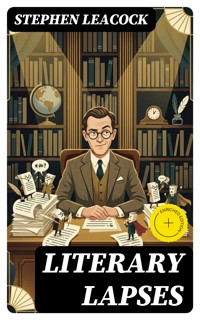
In "Literary Lapses," Stephen Leacock deftly employs his hallmark wit and humor to deconstruct the conventions of literature and the world at large. With a blend of satire, parody, and whimsical observation, Leacock scrutinizes various literary forms and tropes, creating a tapestry of comedic essays that challenge artistic pretensions while providing keen insights into human nature. Written in a style reminiscent of the early 20th-century literary landscape, Leacock's sharp prose illustrates the ridiculousness of societal norms and literary follies, making it a delightful exemplar of light-hearted yet poignant commentary. Stephen Leacock, a Canadian educator and humorist, rose to prominence in the early 1900s as one of North America's leading humorists. His diverse experiences—from studying in England to teaching at McGill University—shaped his perceptive critique of cultural and literary narratives. Influenced by contemporaries such as Mark Twain, Leacock's work often reflects a profound understanding of the absurdities of life, which is notably embodied in "Literary Lapses." This book is a must-read for those who appreciate literary humor and satirical commentary. It will appeal not only to fans of classic literature but also to readers seeking to explore the intersections of comedy and critique. Leacock's ability to make readers laugh while prompting introspection ensures that "Literary Lapses" remains a timeless and invaluable contribution to the world of literature. In this enriched edition, we have carefully created added value for your reading experience: - A comprehensive Introduction outlines these selected works' unifying features, themes, or stylistic evolutions. - A Historical Context section situates the works in their broader era—social currents, cultural trends, and key events that underpin their creation. - A concise Synopsis (Selection) offers an accessible overview of the included texts, helping readers navigate plotlines and main ideas without revealing critical twists. - A unified Analysis examines recurring motifs and stylistic hallmarks across the collection, tying the stories together while spotlighting the different work's strengths. - Reflection questions inspire deeper contemplation of the author's overarching message, inviting readers to draw connections among different texts and relate them to modern contexts. - Lastly, our hand‐picked Memorable Quotes distill pivotal lines and turning points, serving as touchstones for the collection's central themes.
Das E-Book können Sie in Legimi-Apps oder einer beliebigen App lesen, die das folgende Format unterstützen:
Veröffentlichungsjahr: 2022
Ähnliche




Literary Lapses
Table of Contents
Introduction
This volume presents Stephen Leacock’s Literary Lapses, his first book-length gathering of humorous prose, initially published in 1910. It brings together the complete sequence of sketches, essays, parodies, dialogues, and comic fragments that Leacock arranged under that title, offering them as a unified portrait of his early style. The pieces are short, self-contained, and designed for swift reading, but they interlock through recurring concerns and methods. Readers will find both topical trifles and more enduring satires, assembled here without abridgment. The aim is not to supply a novelistic arc, but to showcase the range and precision of Leacock’s comic intelligence.
Within these pages the modes vary widely. There are brief stories such as My Financial Career and The Awful Fate of Melpomenus Jones; burlesque instruction pieces like How to Make a Million Dollars, How to Live to be 200, and How to Avoid Getting Married; epistolary spoofs including Dear sir and A Christmas Letter; dialogues and monologues, as in A Model Dialogue and The Conjurer’s Revenge; and mock treatises, from Boarding-House Geometry to A Manual of Education. Social sketches, travel guidance, society columns, and statistical or scientific lampoons complete the miscellany, revealing a writer equally at home in narrative, parody, and essay.
Despite the variety, the collection is unified by a wry scrutiny of institutions and habits that pass for common sense. Banks, insurance offices, police procedures, boarding houses, and fashionable drawing rooms become laboratories of embarrassment, pomposity, and misplaced certainty. My Financial Career distills the anxieties of a timid entrant to the rituals of finance; Insurance up to Date toys with commercial promises; An Experiment with Policeman Hogan tests official logic; and A Study in Still Life—The Country Hotel observes provincial hospitality. Whether tallying absurd numbers in The Force of Statistics or surveying Society Chat-Chat, Leacock exposes the comic gap between intention and performance.
Leacock’s signatures are deadpan diction, controlled escalation, and impeccable mimicry of learned forms. He often frames nonsense in the solemn apparatus of reason, as when Boarding-House Geometry, Definitions and Axioms, and Postulates and Propositions imitate the structure of a Euclidean text, or when the four Remains essays parody the tone of an antiquarian handbook. The Human Element in Mathematics and The Force of Statistics send up quantitative certainty without abandoning precision of phrasing. His narrators keep straight faces, permitting readers to supply the laughter, and his paragraphs advance with lawyerly logic toward conclusions that reveal the fragility of tidy systems.
In several sections Leacock turns directly to literature and criticism, producing affectionate yet incisive pastiche. Half-hours with the Poets reimagines canonical figures such as Wordsworth, Tennyson, and Longfellow; A Study in Shakespearean Criticism lampoons the jargon and certitude of pedantry; The Poet Answered and The Passing of the Poet ponder authorship and reception. A Lesson in Fiction tests the clockwork of plot. Elsewhere he impersonates journalists and social chroniclers in pieces such as As It Should Be Written, Society Chat-Chat, and the contrasting dinner reports, and he spoofs guidebook authority in Hints to Travellers. Each variation broadens the range of his comedic register.
Other pieces anatomize minor ordeals and the theater of manners. Men Who have Shaved Me and Borrowing a Match recount ordinary encounters that expand into crises of tact; Getting the Thread of It and Telling His Faults examine conversational snares; Number Fifty-Six, Back to the Bush, Winter Pastimes, and Reflections on Riding sketch physical predicaments. On Collecting Things and Self-made Men take stock of social enthusiasms. Letters and open addresses, including Dear Mr. Leacock and related exchanges, sketch the pressures of public correspondence and literary celebrity, while items on benevolence and public appeals test the boundary between earnestness and performance.
Stephen Leacock, a Canadian humorist and political economist who taught for many years at McGill University, wrote Literary Lapses before the international success of Sunshine Sketches of a Little Town. First published in 1910, it established the method he would refine thereafter: civilized comedy built from precision, economy, and the confident parody of forms. The pieces here bear the print of their moment yet continue to illuminate human foibles that recur in new guises. Approached individually or read in sequence, they exhibit craft as much as whimsy. This edition presents the collection complete, inviting fresh readers to encounter Leacock’s enduring comic poise.
Historical Context
Literary Lapses first appeared in 1910, at the end of the Edwardian era and during Wilfrid Laurier’s boom years in Canada. Its author, Stephen Leacock (1869–1944), an English-born Canadian economist teaching at McGill University in Montreal, had earned a PhD at the University of Chicago in 1903. He wrote humorous sketches for a lively transatlantic magazine market that linked Toronto, Montreal, New York, and London. The book collects pieces shaped by this cosmopolitan circulation, yet rooted in Canadian urban experience. Leacock’s academic training and public lecturing sharpened his satire of modern institutions, while the prevailing taste for light essays and parodies smoothed the path to a receptive readership.
Several sketches draw on the expansion of finance and quantitative reason in the early 1900s. Montreal and Toronto banks multiplied branches as salaried clerks, deposit slips, and passbooks regulated middle-class money. The 1907 panic in the United States, and debates over central banking and regulation, colored North American attitudes toward risk. Actuarial science and the life-insurance business flourished, while national censuses in 1901 and 1911 promoted statistical confidence. Pieces like My Financial Career, Insurance up to Date, and The Force of Statistics turn this culture of numbers into comedy, revealing Leacock’s economist’s eye for how anxiety, deference, and error persist beneath formal systems.
Urban modernity supplied the collection’s stage. Between 1896 and 1914, Canadian cities swelled with immigrants and rural migrants, creating a service economy of boarding houses, barber chairs, clerks’ desks, and police beats. Telephone lines, typewriters, and standardized forms organized everyday transactions, while municipal police forces—often Irish in composition—embodied new regimes of order. Sketches such as Men Who have Shaved Me, Boarding-House Geometry, and An Experiment with Policeman Hogan mine this milieu, contrasting official procedure with human foibles. Leacock’s Montreal vantage offered firsthand acquaintance with the petty rituals of city life, from line-ups and tips to timid encounters at counters and windows.
Leacock’s jests about doctors, diets, and miracle cures reflect a period when laboratory medicine coexisted with exuberant quackery. Germ theory had remade practice by 1900, yet patent medicines and health fads thrived in newspapers and lecture halls. The United States’ Pure Food and Drug Act (1906) and Canada’s Proprietary or Patent Medicine Act (1909) signaled mounting scrutiny. Figures like John Harvey Kellogg popularized regimens of cereal, fasting, and hydrotherapy. In The New Food, A New Pathology, and How to be a Doctor, Leacock lampoons the performance of expertise, exposing how jargon, commercial zeal, and patient credulity persisted despite reform and regulation.
The collection’s burlesques of schooling and criticism emerged amid expansion of public education and the consolidation of a British literary canon in Dominion classrooms. Standardized examinations, teachers’ colleges, and mass-produced textbooks promoted rote learning and moral uplift through Shakespeare, Wordsworth, Tennyson, and Longfellow. As a professor of political economy at McGill, Leacock witnessed professionalization first-hand, and turned its solemnities into play in A Manual of Education, A Study in Shakespearean Criticism, and Half-hours with the Poets. He gently mocked the cult of “elevated” taste and the pretension of jargon-laden pedagogy, while affirming the shared texts that bound Canadian, British, and American readers.
Travel and spectacle also infuse the sketches. By 1910, transcontinental railways and grand hotels had knit Canada into imperial and tourist circuits, while steamship lines connected Montreal and New York to Liverpool and London. Middle-class households cultivated etiquette, French phrases, and conspicuous consumption, encouraged by department stores and society columns. Parlor magic and music-hall acts—soon to be joined by cinema—were popular fare; touring performers such as Harry Houdini exemplified the craze. In Hints to Travellers, Society Chat-Chat, and The Conjurer’s Revenge, Leacock teases pretension and gullibility, tracing how aspiration to cosmopolitan polish so often collided with the awkward facts of provincial life.
Philanthropy and seasonal sentiment form another through-line. Anglo-American newspapers had publicized Armenian suffering during the Hamidian massacres (1894–1897) and the Adana violence of 1909, spurring committees, collections, and missionary appeals across Canada and Britain. In Helping the Armenians, Leacock satirizes the performance of benevolence amid fashionable charity drives. Hoodoo McFiggin’s Christmas and the holiday letters riff on Victorian and Edwardian gift-giving revived by Dickens, now turbocharged by mail-order catalogues, cheap postage, and department-store advertising. These pieces register the contradictions of mass sympathy—genuine feeling paired with vanity, waste, and status anxiety—within a culture of organized giving and commercial festivity.
Literary Lapses was Leacock’s breakthrough. First appearing in 1910, it circulated quickly beyond Canada, aided by magazine reprints and the period’s appetite for comic lectures. Reviewers placed him in a lineage with Mark Twain, Jerome K. Jerome, and W. S. Gilbert, praising a genial satire that spared individuals while puncturing institutions. The book’s success prepared the way for Sunshine Sketches of a Little Town (1912) and Arcadian Adventures with the Idle Rich (1914). Rooted in Montreal and informed by Chicago-trained economics, the collection captured a prewar moment when confidence in expertise and progress met the enduring absurdities of everyday life.
Synopsis (Selection)
LITERARY LAPSES
A mosaic of comic sketches, parodies, and mock treatises, the collection uses deadpan logic and precise diction to turn ordinary institutions and fashions absurd.
Recurring motifs include flustered respectability, pedantic voices misapplied to trivial life, and the gap between social performance and common sense, with pieces ranging from micro-anecdotes to extended literary and academic send-ups.
Financial Foibles (My Financial Career; Insurance up to Date; Self-made Men)
Spanning My Financial Career, Insurance up to Date, and Self-made Men, these pieces lampoon money culture by letting routine transactions and success myths mushroom into politely panicked farce.
Leacock’s anxious, literal-minded narrators reveal commerce as social theater, where jargon and procedure mask insecurity and bluff.
Mock-Advice and How-To Satires (How to Make a Million Dollars; How to Live to be 200; How to Avoid Getting Married; How to be a Doctor; Hints to Travellers; Back to the Bush)
In how-to sketches like How to Make a Million Dollars, How to Live to be 200, How to Avoid Getting Married, How to be a Doctor, Hints to Travellers, and Back to the Bush, the confident manual voice promises impossible efficiencies and painless reinvention.
The humor comes from enumerated tips, cheerful contradictions, and faux expertise that turn self-improvement fads into elaborate self-deceptions.
Scientific and Medical Fads (The New Food; A New Pathology)
The New Food and A New Pathology dress quack nostrums and diagnostic fashion in clinical language to celebrate and undercut the era’s faith in quick cures.
Sober explanations collide with appetite and discomfort, exposing how scientific tone can dignify wishful thinking.
Mathematics and Statistics Satire (Boarding-House Geometry; DEFINITIONS AND AXIOMS; POSTULATES AND PROPOSITIONS; The Force of Statistics; THE HUMAN ELEMENT IN MATHEMATICS; A, B, and C)
Boarding-House Geometry (with its DEFINITIONS AND AXIOMS and POSTULATES AND PROPOSITIONS), The Force of Statistics, THE HUMAN ELEMENT IN MATHEMATICS, and A, B, and C apply proofs and figures to everyday muddle as if life were a neat diagram.
By parodying axiomatic certainty and numerical authority, Leacock shows how measurement and logic can rationalize nonsense when people are involved.
Education and Scholarly Send-ups (A Manual of Education; I.—REMAINS OF ASTRONOMY; II.—REMAINS OF HISTORY; III.—REMAINS OF BOTANY.; IV.—REMAINS OF NATURAL SCIENCE.)
A Manual of Education and its Remains of Astronomy, History, Botany, and Natural Science present textbook wisdom as a rummage of half-remembered facts delivered with serene authority.
The pieces poke at institutional learning and the ritual of the classroom, where tone outruns knowledge and structure collapses into comic non sequitur.
Literary Parodies and Criticism (A STUDY IN SHAKESPEAREAN CRITICISM; The Poet Answered; The Passing of the Poet; A Lesson in Fiction; AS IT SHOULD BE WRITTEN; A Model Dialogue)
These sketches mimic solemn criticism, editorial decorum, and creative-writing rules to reveal how earnest analysis drifts into bathos and self-importance.
Mock-scholarly tics—overreading, footnote-like asides, and theatrical diction—deflate literary authority while keeping the playfulness front and center.
Half-hours with the Poets (Half-hours with the Poets; I.—MR. WORDSWORTH AND THE LITTLE COTTAGE GIRL.; II:—HOW TENNYSON KILLED THE MAY QUEEN—PART I; PART II; Six months had passed.; PART III; Time moved on and spring came.; III.—OLD MR. LONGFELLOW ON BOARD THE HESPERUS.)
This mini-sequence revisits Wordsworth, serializes Tennyson’s May Queen across mock installments, and boards Longfellow’s Hesperus with affectionate irreverence.
By stretching simple pathos and magnifying trivial cues, it turns canon worship into playful farce without losing the music of the originals.
Epistolary Satires and Social Correspondence (A Christmas Letter; Dear sir; DEAR MR. LEACOCK; MY DEAR, DEAR BOY; STEPHEN LEACOCK; Helping the Armenians; Acknowledgments; END)
Framed as letters and appeals—A Christmas Letter, Dear sir, the exchange beginning DEAR MR. LEACOCK, followed by MY DEAR, DEAR BOY and STEPHEN LEACOCK, plus Helping the Armenians—these pieces expose the etiquette, vanity, and soft coercion of polite prose.
Meta-closers like Acknowledgments and END break the frame with wry self-reference, highlighting performance and self-advertisement in public address.
Society Vignettes and Domestic Scenes (DEJEUNER DE LUXE AT THE DE SMYTHE RESIDENCE; DINER DE FAMEEL AT THE BOARDING-HOUSE DE MCFIGGIN; DELIGHTFUL EVENING AT THE RESIDENCE OF MR. ALONZO ROBINSON; Society Chat-Chat; A Study in Still Life.—The Country Hotel; On Collecting Things; Winter Pastimes; Reflections on Riding)
Set-piece meals and visits—posh DEJEUNER DE LUXE, boarding-house DINER DE FAMEEL, and a DELIGHTFUL EVENING—catalogue menus, manners, and small humiliations to chart class display.
Companions on hotels, collecting, winter leisure, and riding use meticulous observation and piling detail to show how ordinary pastimes become social theater.
Comic Misadventures and Character Sketches (Lord Oxhead's Secret; The Awful Fate of Melpomenus Jones; Borrowing a Match; The Conjurer's Revenge; Men Who have Shaved Me; Getting the Thread of It; Telling His Faults; Number Fifty-Six; Aristocratic Education; An Experiment With Policeman Hogan; The Life of John Smith; Saloonio; A ROMANCE IN ONE CHAPTER)
These short narratives follow hapless figures—over-polite guests, conjurors and hecklers, barbers and their clients, officious policemen, ambitious social climbers, and one-chapter lovers—whose small choices escalate into mortifying tangles.
Blending precise timing with logical traps, the pieces present etiquette and identity as games no one quite knows how to play.
Holiday Tales (Hoodoo McFiggin's Christmas)
Hoodoo McFiggin’s Christmas offers a darkly comic portrait of gift-giving and expectation that punctures seasonal sentiment.
The tale balances sympathy with pointed satire about commercial pressure, showing how the economics of celebration can curdle goodwill.




