


18,49 €
Mehr erfahren.
- Herausgeber: The Crowood Press
- Kategorie: Lebensstil
- Sprache: Englisch
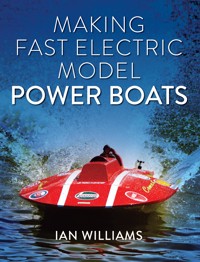
Fast electric model power boats have long outclassed other boat types in terms of speed, and racing them is becoming an ever-more popular pastime. Success in this exciting hobby relies not just on the skill of the boat's handler, but on the design and build of the boat as well. Illustrated with numerous photographs and diagrams showing technical details, this book looks at all aspects of building a model electric power boat, including How to choose a model and spot design flaws, especially in moulded hulls, and how to repair many of those faults, Brushed and brushless motors, and their speed controllers, drive systems and propellers, Guidance on rechargeable cells and the correct chargers, and safety tips for lithium polymer cells, Tips on construction and how to set up a boat for racing, Detailed instructions for building a wooden three-point outrigger hydroplane and Radio systems, wiring and connectors. While the emphasis of this book is on performance for competition use, beginners and recreational boaters are well catered for as many of the chapters start from first principles, rather than assuming a high level of initial competence. It covers all aspects of fast electric boating, from hull design right through to racing at world championships and setting speed records. Therefore, whether you are looking to compete or operate fast electric power boats as a hobby, it is a must-have addition to your library.
Das E-Book können Sie in Legimi-Apps oder einer beliebigen App lesen, die das folgende Format unterstützen:
Seitenzahl: 277
Veröffentlichungsjahr: 2023
Ähnliche



















First published in 2023 by
The Crowood Press Ltd
Ramsbury, Marlborough
Wiltshire SN8 2HR
www.crowood.com
This e-book first published in 2023
© Ian Williams 2023
All rights reserved. This e-book is copyright material and must not be copied, reproduced, transferred, distributed, leased, licensed or publicly performed or used in any way except as specifically permitted in writing by the publishers, as allowed under the terms and conditions under which it was purchased or as strictly permitted by applicable copyright law. Any unauthorised distribution or use of this text may be a direct infringement of the author’s and publisher’s rights, and those responsible may be liable in law accordingly.
British Library Cataloguing-in-Publication Data
A catalogue record for this book is available from the British Library.
ISBN 978 0 7198 4260 3
Acknowledgements
First and foremost, I must thank my wife Norma for putting up with me during the writing of this book. It couldn’t have been easy.
I would also like to thank all the members of the Northern Amp Draggers, the MPBA Fast Electric Section and the guys at Bridlington MBS for their help and friendship. Special thanks go to Martin Marriott, Peter Barrow and Ian Phillips, as well as to Tony Ellis, of Model Marine Supplies. Last, but certainly not least, I would like to thank Walter Geens, the President of NAVIGA, for his help over the years.
Picture credits
Walter Geens, pages 19 (top), 25 (top right), 26 (top) and 108 (bottom left); Walter Geens and NAVIGA page 125 (top left); D Harvey, pages 8 (bottom), 9, 10 and 12 (bottom); Arne Hold page 130 (bottom); Rich Marsh, pages 133 (right top, middle and bottom) and p.135 (all); Bill Oxidean, page 97 (bottom right); James Smithson, page 17 (bottom); Wikimedia Commons page 6.
Cover design by Bluegecko
Contents
Acknowledgements
1 In the Beginning
2 Hull Types and Design Considerations
3 Hull Defects and Handling Problems
4 Drive Systems
5 Brushed Motors and Electronic Speed Controllers
6 Brushless Motors and Their Controllers
7 Propellers
8 Rechargeable Cells
9 Battery Chargers and Energy Limiters
10 Radio Control
11 Construction, Setting Up and More
12 H1 Outrigger Hydro Build
13 Racing and Straight-Line Speed Records (SAWS)
14 FE Power in Scale Boats
Glossary
Suppliers
Index
Chapter One
In the Beginning
Radio control (RC) was first demonstrated to the public in 1898 at the Madison Square Garden arena in New York City, by none other than the legendary inventor and engineer Nikola Tesla. The vehicle that Tesla had built for the demonstration – described as a ‘teleautomaton’ – was a model boat and, yes, it was electric! Tesla also referred to it as his ‘Devil Automata’, as he recognised early on its potential for use in remotely controlled weaponry.
The very first RC model: Nikola Tesla’s ‘Devil Automata’ boat.
As far as RC models are concerned, Tesla’s ideas moved on and into World War I. Germany made use of radio control to send small, fast, explosive-filled boats to attack British warships. These were not very successful, however, and the same was more or less true of similar devices tried in World War II. In the years after the end of the war, a huge number of electronic components that had not been used by the Armed Forces became available very cheaply on the open market. Items such as relays, small motors, resistors and especially valves were put to good use by individuals with the necessary knowledge of radio, who began to experiment and make their own radio control equipment.
By the 1950s, a few commercially made systems began to be made available. In the USA, internal combustion (IC) models were beginning to appear, based on the full-sized hydroplanes that were being used for racing. The full-sized boats used ex-military Allison engines based on the Rolls Royce Merlin from the Mustang fighter planes and ran anti-clockwise around an oval course. There was a simple reason for this: as full-sized boats ran their props clockwise, when viewed from the stern, factors such as prop torque, and so on, meant that it was easier for the boats to turn left. Model motors (including electric motors), on the other hand, generally rotate anti-clockwise when viewed from the shaft end of the motor. This means that models perform better when turning to the right. After a short while, it was decided to change the oval course for model racing to a clockwise one. Later, speed record events were expanded to include a one-third mile oval and also a one-eighth mile (two times one-sixteenth) straightaway (SAWS).
Internal diagram of Tesla’s boat with all its various bits and bobs.
An early RC transmitter, probably dating from the mid- to late 1950s. Note the steering wheel.
Another 1950s transmitter, in a different, ship’s-wheel style but still with the huge switches.
In the mid- to late 1950s, radio equipment was improving and becoming more readily available commercially. Hull developments led to interesting increases in speeds, with the result that more people were drawn to the hobby. It was around this time that two young men who were to have a profound effect on RC boat racing appeared on the scene: Tom Perzentka and Ed Hughey. Tom founded Octura Models in 1954 and a little later Ed started Hughey Boats Inc. Octura became famous mainly for its props, but also produced hardware and boats, while Ed had his own line of hardware and boat designs. Both men did much to further the hobby. A little later Ed developed an interest in electric power, using some of the motors from the recently developing RC car scene. He designed and manufactured gearboxes for the new powerful brushed motors and electric boat speed started to increase significantly. In the 1990s I was the importer of Hughey Boats products into the UK and part of Europe, and during that time Ed Hughey taught me almost everything I know about fast electric (FE) boats.
The development of FE boats in the UK and Europe was different from that in the USA. Although the development of RC proceeded pretty much in the same way as it had in the USA, using ex-military discards, in the UK the focus in FE tended to be on submerged-drive boats. The Model Power Boat Association (MPBA) was formed in 1924 and events were soon being organised, mainly for IC boats. As in the USA, the progress in the design and function in both RC and hull design increased boat speeds. In the late 1950s, people were starting to use electric powered boats, but these were mainly of the MTB (motor torpedo boat) and fast launch types. The boats were often to scale and used for steering type speed competitions. With the formation of NAVIGA in 1958, the world-wide organisation concerned with model ship building and model ship sport, originally with only three countries (not including the UK), the situation began to get really interesting. Although there had been significant developments in the USA in the period between the late 1940s and the late 1950s and early 1960s, as far as FE boats are concerned, it was in the 1960s when activity really started to pick up. Competitions began to have formalised classes and RC became more sophisticated, allowing several boats to be run at the same time in ‘multi-racing’ events.
The underside of the 1960s F1 boat showing the wire drive and small rudder. Note also the hull shape and how thin the moulding is.
F1E boat from the 1960s, with silver zinc cells. At the rear of the boat are the steering servo and above that a servo fitted with two micro-switches for series/parallel battery switching.
A homemade charger for silver zinc cells. The charging current was only in milliamps.
A Ripmax Orbit motor that was used in the 100-watt class.
The UK later became a member of NAVIGA probably around 1965. The organisation’s events were run on three courses, two of which were used for FE racing as well as IC: F1E speed, F2 (a scale boat steering course) and F3E steering. In F1E, boats undertook a time run of the three 30-metre sides of a triangle once in each direction, with a 180-degree turn mid-way along the base of the triangle. The boat with the quickest time was the winner of the competition. A great test of skill, F3E involved steering around and through pairs of buoys set out in a triangle shape, with the fastest clear round winning. (SeeChapter 13 for more on these courses.)
Some brushed competition motors from the 1960s: (left to right) three of Dereck Holder’s homemade motors. The first was one of his original 1kg motors; the second is the final version with the 1mm prop shaft grub screwed directly into the motor shaft to save weight; the third is of the final +1kg motor again with a 2mm shaft grub screwed directly into the motor shaft, the fourth is a Keller motor made in Germany. All these motors ran on 42 volts.
F1E was split into 30-watt, 100-watt and 500-watt classes. The boats were not fast by today’s standards. Marksman was a 100-watt boat probably designed by Philip Connolly back in the 1960s, using silver zinc cells. It may not have been an out- and-out competition boat, but its speeds were quoted as 10 to 12mph. The rather odd-looking Moccasin was on a par in terms of performance.
Although F3E and F1E are still on the NAVIGA competition list, they are not run in the UK today, as interest in these particular classes seems to have died out.
Much development has been undertaken between then and now. It would really need a whole book on its own to trace every single increase in design and performance, but there are four major developments that have led to the latest very fast models. Apart from advances in hull design, which are still ongoing, cell technology and improvements in motors have been the main factors. The first significant boost to performance was the arrival of the NiCad cell, followed by the NimH cell. Second was the development of high-power modified brushed motors. The last two huge improvements were the introduction of the brushless motor and LiPo cells. This rather simplistic explanation brings the technology up to where it is today. It is also worth recognising that the development of electric flight and RC cars has also been a great provider of technology for the FE boating world.
A series/parallel switcher with silver contacts, mounted on a servo.
Fellow competitors in the Northern Amp Draggers club and at national level have been generous with descriptions and photos from the early years of the sport. One of these is David Harvey, who as a young man in the 1960s raced at international level. When David and his brother Martin first went into fast electrics in the 1960s the classes were 30-watt, 100-watt and 500-watt. The cell for the 30-watt was a small square flat unit, but silver zinc cells were used for the bigger classes. In the 30-watt class the Russians used salt cells. However, it was discovered that the first attempt served to warm the cells up, while on the second attempt they had more than 30 watts, so the cells were eventually banned. In those days competitors had five minutes to get two attempts at the course, but if they missed a buoy at the first attempt, they were not allowed to try for a second go. The current rules allow five minutes to get in as many attempts as possible.
Internal view of an early 1960s 100-watt boat, Marksman, designed by Phillip Connolly. Although it was not known as an out-and-out competition boat, it was reputed to do around 12mph.
Another view of Marksman.
Marksman at speed. It appears as this was probably around its maximum speed of 10–12mph.
Moccasin, an unusual design from the early 1960s. It seems to have two lead acid batteries fitted, probably 6-volt motorcycle types.
In the 1960s the boats varied in size from one not much bigger than a large hand to big versions that had to be lifted into the water by two people. In the 1970s, the classes changed to 1kg and +1kg, but now the classes have changed again to just one class – F1E – because it was found that competitors were adding just a little extra weight in a 1kg boat and then running it in the +1kg class.
A group of competitors in the +1kg class at the European Championships at Kiev (Kyiv) in the 1960s: (left to right) Dereck Holder 1st place, David Harvey 2nd, and ‘Zander’ 3rd. In front is the junior champion, Dereck’s son Daniel.
Chapter Two
Hull Types and Design Considerations
The hull is one of the most important elements to consider when constructing a model boat. No matter how good and expensive the equipment in a boat, if the hull is not up to scratch, it will probably all be a waste of time and money. A little knowledge of what it all means and what to look out for is a good idea.
THE BASICS
There are really only two basic hull types for boats: displacement and planing. Although in the modern full-sized world the two types can interact and overlap, in the world of fast electric-powered RC boats, the planing type is more relevant. There are many variations of the basic planing hull type, both full size and model size, and it is wise to avoid becoming bogged down in theory and details of design. However, it is useful to have an understanding of the basics of both full-size and model hulls and of the most important variations, and to be aware of the difference each can make. Those who wish to immerse themselves in theory will find many photographs and diagrams online, along with massive amounts of information, especially from builders of full-size boats.
(Note: some of the photographs in this chapter are used to illustrate a particular point, but may incorporate other features that are not discussed here. In that case, they will be covered later, in the relevant chapter.)
HULL DESIGN
A brief explanation of how a displacement hull pushes through the water can help in understanding how a planing hull works. The classic image of a full-size ship at sea shows a typical wave formation. As the hull is powered through the water, it will push the water ahead of it, causing a bow wave to form. At the same time, it pushes water sideways and down. This downward movement will cause a wave formation known as a stern wave. A displacement hull will ride between the bow wave and the stern wave. As the speed increases, the hull will try to get over the ‘hump’ of the bow wave, which is not a good effect with this type of hull. The water will not be able to react quickly enough and the stern wave will fall astern of the hull. With diminishing support at the stern, the bow will lift, the bow wave will get bigger, and the hull will tend to ride on the down slope of the rear side of the bow wave. This could be a dangerous position as the hull will more than likely become unstable.
A displacement hull at normal operating speed.
Despite the disadvantages of the displacement hull, it is possible for this type of structure to be really fast. One prime example is the World War II German Schnellboot (or E-Boat), which could do around 50mph, but this was a very specific hull design and had a lot of power!
An overpowered displacement hull. The hull is trying to push over the bow wave and the stern is not being supported, resulting in a dangerous situation.
This basic explanation of displacement hulls should help with an understanding of the concept of the planing hull. The planing hull is designed to make use of the hydrodynamic lift caused by the forward motion, allowing the hull to lift itself over the bow wave and rise up in the water, thus reducing drag. This also reduces wave making and tends to stabilise the hull. To expand on this explanation, a fast boat achieves high speeds by dragging itself out of the water and skimming or planing over the surface, using hydrodynamic lift (the pressure of water on the bottom of the boat) to support its weight. Only by coming out of the water and drastically reducing wetted area can high speeds be attained without the need for huge amounts of power.
It is said that a flat plate is the most efficient planing form. This model seems to prove it, but turning may be less straightforward.
In theory, the best planing surface is a flat plate, but in practice this would be totally unusable. There would be no space for accommodation, motors and so on, and the boat would be unable to turn without major stability problems. If, however, a flat plate is bent down its centre line at an angle of 20 degrees or so, the basic V-shaped hull bottom starts to become apparent. Add a bow shape for non-planing operation, some sides to give the hull volume, a deck and a transom, and the basic V hull appears. Obviously, it is not as simple as that in real life. Such things as structural integrity, machinery space, accommodation and so on, are all factors, not to mention that the hull has to be as smoothriding as possible for the sake of the humans inside it. Of course, with a fast model boat, there is no need to worry about crew comfort or injury caused by a rough ride, as long as there is room in the hull for motor, batteries and RC gear. Model boats are relatively much stronger than full-sized ones and are less likely to be damaged by stresses to the hull.
In the main, the design of model boats has developed from that of the full-size versions (and sometimes the other way round), but there is one major factor that has caused model boat design to diverge from full-size practice, especially with out-and-out racing boats. That is the fact that it is not possible to scale water! While a small ripple of the surface might be nothing to a full-size boat, it could be the equivalent of a 2-foot wave to a model. In addition, there is no guarantee that even an exact scale replica of a very efficient and fast full-size boat will work in model form. In fact, the probability is that there would be various problems getting the hull working well at all, and it would be necessary to introduce modifications to make it perform even reasonably well. (Note that this refers to models of competition boats, not models of cabin cruisers, or other types.)
A basic planing hull shown at the transom, demonstrating the basic terms of reference.
Planing hull showing the effect that chine rails and spray rails have on the lift component.
In the world of full-size powerboats there are constant design changes and tweaks to the basic planing hull structure, sometimes in pursuit of better performance, sometimes purely for the comfort of passengers. Of course, the same progress in design also applies to model boats, and the information given here can only be very basic. There are so many different ways of achieving the same effect with small design changes that a detailed description would take up most of this book, even if it were possible to track them all down. The information that follows will cover the types and classes of boat that are most common, any major differences from full-size hull design, and some features that would definitely not appear on a full-size boat.
TERMINOLOGY: STRUCTURE
Various terms may need explaining at this point. For example, many people will know what a ‘hard chine’ hull looks like, but what does the term actually mean? Looking at the basic V hull, the angle of the hull bottom from the horizontal is known as the ‘deadrise’ angle and can determine how the hull behaves in rough water. With the addition of hull sides, the sharp change of angle at the junction between hull bottom and hull side is known as the ‘chine line’. In boat building parlance, any sharp change of angle is termed ‘hard’, so we have the term ‘hard chine’.
The distance between the waterline and the deck edge is called the ‘freeboard’. Some full-size boats, which may have to cope with rough water at times but still require a high-speed performance, have a modified so-called ‘soft chine’ hull where the chine line has been curved slightly. This type of hull may also be found on some small sailing dinghies. Having a hard chine allowed water to be pushed side-ways instead of just running backwards along the hull, giving the hull lift and reducing wetted area. Flat-bottomed and shallow V hulls tend to bounce and slam in the rough, whereas a deep-V hull with a deadrise angle of 20 degrees or more will carve its way through waves and will handle rough water much better.
The early deep-V hulls had a deadrise that ran for the entire length of the boat. Often called a ‘monohedron’ hull, this was found to work quite well in rough conditions but could lack stability. Designers trying to improve the all-weather capabilities came up with a ‘modified-V’ hull. This compromise gave the front of the hull a wedge shape to slice through the water but altered the wedge to a flatter angle as it moved towards the stern of the boat. This is often called a ‘warped-bottom’ hull.
As it became clear that some water would not be deflected by the chine and could run up the side of the hull, causing drag, further design developments introduced ‘chine rails’. These are add-ons to the hull, where the bottom of the boat meets the sides. They serve to deflect spray, improve lift and turning response and offer greater stability.
As more experience was gained with small planing hulls, it was found necessary to fit external longitudinal strengthening strips to the bottom of the hull. The hull would actually ride on the area between pairs of these strips and be lifted more, often producing more speed. Consequently, the strips were developed to become an integral part of the design of the hull. Almost all fast boats today will feature one or more pairs of these ‘spray rails’ (sometimes referred to as ‘lifting strakes’), which have been developed to deflect water downwards and away from the hull, both to generate lift and to minimise wetted area.
FACTORS AFFECTING PERFORMANCE
Note: the information here refers almost exclusively to competition-type hulls. For more on scale-type hulls, seeChapter 14.
The first thing people (usually, but not always, young boys) ask at the lakeside is ‘How fast is it?’ If you know the answer, fine. If not, you can always explain the following and see if they are interested. The speed of a boat is directly governed by the following factors:
• the hull type;
• the power available from the motor;
• the weight of the boat;
• the efficiency of the drive system and propeller in converting the power of the motor into forward motion; and
• the amount of contact the hull has with the water.
As a boat that is designed to plane moves forward over or through the water, the effect of water flowing over the hull surface produces drag, due to viscosity and friction. Hydrodynamic drag is one of the major factors that affect performance, and the amount of drag a boat is subject to is directly proportional to its wetted area. Fortunately, within certain parameters (the law of diminishing returns applies), the faster a boat goes the greater the hydrodynamic lift. This means that the planing area required to support the boat’s weight will decrease. The heavier a boat is, the more planing area it will need to support its weight, and the more drag it will be subject to.
Heavy boats have more inertia (resistance to acceleration) and will not accelerate as well from a standing start. Also, they may not handle or change direction as well as a light boat. A light boat will therefore almost always be faster than a heavier boat. It will also be more agile and easier to drive, except in rough water conditions where a heavier boat will have the advantage. Of course, model boat enthusiasts will invariably encounter ‘disturbed’ water, so they have a decision to make! This is all relative, of course. With the power that modern brushless motors provide, a few grams here or there will not make very much difference to performance. If a boat is overweight by 100 grams or so, however, that will be a different story!
MODERN HULL TYPES: SPORTS (FUN) AND COMPETITION
Monohulls
There are two subtypes of monohull: those that have the props and rudders in the water under the hull (submerged drive) and those that have the prop and rudder behind the transom (back) of the boat with a surface-piercing prop being used (surface drive).
A rudder can significantly affect the handling of a heeled-over monohull in a turn.
Monohulls have a single hull and a single large planing area. Some designs incorporate one or more ‘steps’ in the hull bottom, although the norm appears to be a single step. In the UK and Europe, virtually all surface-drive racing monos are stepped, whilst submerged-drive boats are not. In the USA, generally, with one or two exceptions, stepped hulls are banned from competition and straight keels are the norm, even with surface-drive boats.
A very different-looking Eco Expert boat from MHZ. It is unusual to see these boats with decals like this.
Submerged Drive
Most submerged-drive monos are intended for so-called ‘multi’ racing and are a mixture of semi-flat-bottomed and shallow-V, usually with the V becoming much sharper towards the bow. Some have a shallow rounded hull with pronounced chine rails and quite often the hull will have no freeboard at all. In this case, the deck is angled down to the hull and in effect becomes the chine rail.
A Mini Eco class model: a modern submerged-drive race boat that runs anti-clockwise around a triangle course. This Type 2007 is a very competitive European boat.
The underside of the Mini Eco boat, showing a narrow raised centre section, which is the boat’s running surface.
One of my early submerged-drive boats, with homemade wire drive and a curved hull bottom.
The hull on the submerged-drive boat has no deadrise, and the deck slopes down and overlaps the edge of the hull to form the chines.
The multi classes require boats with instant acceleration from rest and out of corners, and precise handling, with minimum speed loss during turning. Most multi boats are functional in appearance, bearing very little similarity to full-size craft. In Europe there are several submerged-drive classes, while in the UK there are only two classes on the books for national competition. These are Eco Expert and Mini Eco Expert. (For more on all the classes, seeChapter 13.)
Surface Drive
Surface-drive monohulls tend to have a semi-scale resemblance (although only a passing one) to full-size craft. While they can be much faster in a straight line, especially if the hull is stepped, the handling characteristics of a surface-drive mono fall short of a submerged-drive multi boat. In common with their full-size counterparts, model deep Vs do not like to turn very tightly at full speed. A stepped hull tends to run flatter in a turn with much less heel and can be made to turn quite effectively when correctly set up for oval racing.
An Eco Expert hull flat out in choppy water. Note the wire drive line and the fact that it has a parallel thrust line.
A modified-V or warped-bottom hull – note how the V reduces in angle towards the stern.
The ‘footprints’ of monohulls: a standard V hull on the left and a stepped hull to the right.
Unstepped V hulls with surface drive have one drawback in comparison with other types of boat, and this is that they bank over when turning. This presents the rudder to the water at an angle, allowing it to generate lift when turning. This can cause the boat to wobble and hop around, and may result in it spinning. This can also happen with stepped hulls, although to a lesser degree.
Catamarans and Tunnel Hulls
Catamarans (usually referred to as cats) and tunnels are actually a development of the monohull and have two narrow hulls joined by a bridging section. Offshore cats invariably have surface drives and tunnels usually have outboard motors. They are generally more laterally stable and have less wetted area than a monohull. They also have the benefit of riding on the cushion of air trapped between the sponsons to partially support the weight of the boat and further reduce wetted area and drag.
The on-the-water footprints for a stepped and non-stepped cat hull.
There are a number of differences between a cat hull and a tunnel hull. Model tunnel hulls are usually semi-scale replicas of the full-size F1 racing boats and fitted with outboard motors. There are commercial kits available, but there are no official racing classes for them in the UK and Europe, unlike in the USA.
Catamarans are usually fairly faithful renditions of full-size offshore super cats. There are no official cat racing classes in Europe, but in the UK there is a cat class for the national championships. In the USA, cats are becoming very popular in straight-line speed records. Both cats and tunnels can be made to go very fast indeed in the right water conditions, and do not bank in a turn so do not suffer too much from the same rudder-induced handling problems as monos. The wide track and sharp edges on the sponson running surfaces mean that this type of boat can be very tight-turning – much tighter than a non-stepped deep V, for example.
The deadrise angle on the sponsons of a tunnel or cat can vary, from none at all up to 17–20 degrees if not using steps. In general, the more deadrise angle there is, the better the boat will be in rough water. However, the fastest cats usually have at least two steps per sponson and flat running surfaces with an outer anti trip.
Hydroplanes
A hydroplane takes the principle of reducing wetted area to its extreme by riding on three or four very small planing areas. Hydroplanes can be grouped into scale ‘unlimited’ and functional outrigger hull types (often known as just ‘riggers), and then further divided into those that fully propride and those that do not.
The footprint of an outrigger hydroplane is certainly minimal. Note the rear sponsons. Normally, the rear suspension point is the prop.
Prop-riding hydroplanes use a propeller that is designed so that it generates an amount of vertical lift to support the transom clear of the water when planing. What this means is that the propeller acts as the rearmost suspension point, providing thrust and supporting part of the boat’s weight and therefore reducing wetted area to an absolute minimum. Also found on some outrigger hydros are devices intended to be the rearmost suspension points, thus leaving the prop to provide thrust. For more on these, seeChapter 4, on drive systems.
Another type of hydroplane, not seen very often these days, is the ‘canard’ configuration, which rides on two widely spaced sponsons at the rear and one single ride area at the front. In effect they are three-point hydroplanes built back to front! Canards are not all that popular because, if they are not properly set up, they can exhibit peculiar handling characteristics. In addition, they generally seem to run slightly ‘wetter’ than a conventional ‘rigger, so are not quite as quick.
The underside of a stepped Mono 1 hull. Forward of the step the spray rails are fairly normal, but behind the step the rails are inverted.
Underside of a semi-scale non-stepped hull, showing standard spray rail configuration.
A back to front hydro, the canard hydro hull in GRP, for the Mini Hydro class. The narrow hull has a single running surface at the front.
Most scale hydro designs use more conventional props, which provide little or no lift and therefore ride permanently or intermittently on the rear of the hull. Scale boats are often slower and handle less well than outriggers due to their narrower track. However, they are considerably more pleasing to look at. Scale boats, in common with the full-size American ‘unlimited’ circuit racing hydroplanes, trap air between their sponsons to generate aerodynamic lift. The sponsons on most scale designs have moderate deadrise angles, up to a maximum of about 5 degrees, but typically an outrigger has no deadrise angle at all on its sponsons. However, it may well have an anti-trip angle. This allows the outside sponson to slide slightly in a turn and helps to prevent the sponson chine digging in and possibly flipping the boat.
The same canard hull from the rear, showing the small sponson at the back.
The Firefox canard from Hydro & Marine in Germany.
The hydroplane may be the fastest of the three hull types, but it is also the least manoeuvrable and needs a bit of room to turn at full speed. Hydroplanes really are ‘all or nothing’ boats, and only work properly at full speed. Below a certain speed, a hydro will drop completely off the plane, becoming a hugely inefficient displacement hull.
AERODYNAMIC EFFECTS




