


4,49 €
4,49 €
oder
-100%
Sammeln Sie Punkte in unserem Gutscheinprogramm und kaufen Sie E-Books und Hörbücher mit bis zu 100% Rabatt.
Mehr erfahren.
Mehr erfahren.
- Herausgeber: Kim Paradowski
- Kategorie: Gesellschafts- und Liebesromane
- Sprache: Englisch
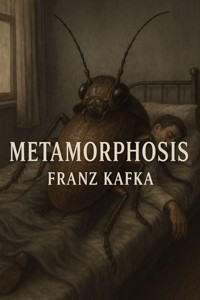
- This is an illustrated edition featuring striking illustrations, a detailed summary, an author biography, and a complete list of characters.
This illustrated edition vividly captures the unsettling beauty and psychological depth of Kafka’s masterpiece. With expressive artwork accompanying the text, readers can experience the surreal world of Gregor Samsa like never before. In addition, this edition includes:
A comprehensive summary to deepen understanding of the novel’s themes and symbolism
A biography of Franz Kafka, offering insight into the author’s life and literary vision
A character list to guide readers through the story’s complex relationships
Both timeless and thought-provoking, Metamorphosis remains a cornerstone of modern literature — a tale that continues to challenge and captivate readers around the world.
Das E-Book können Sie in Legimi-Apps oder einer beliebigen App lesen, die das folgende Format unterstützen:
Veröffentlichungsjahr: 2025
0,0
Bewertungen werden von Nutzern von Legimi sowie anderen Partner-Webseiten vergeben.
Legimi prüft nicht, ob Rezensionen von Nutzern stammen, die den betreffenden Titel tatsächlich gekauft oder gelesen/gehört haben. Wir entfernen aber gefälschte Rezensionen.




















Metamorphosis
By
Franz Kafka
ABOUT KAFLA
Franz Kafka was born on July 3, 1883, in Prague, which was then part of the Austro-Hungarian Empire. He came from a middle-class Jewish family and was the eldest of six children. Kafka’s father, Hermann Kafka, was a strict and domineering man, while his mother, Julie, was kind but often occupied with the family business. The difficult relationship with his father had a deep impact on Kafka’s personality and later influenced much of his writing.
Kafka was an excellent student who studied law at the German University of Prague. After completing his degree, he worked for an insurance company, a job that provided financial stability but little personal satisfaction. He often found himself torn between his demanding work and his passion for writing. During his spare time, he wrote stories and novels that explored themes of isolation, guilt, and the struggle of the individual against powerful, often incomprehensible systems.
His most famous work, The Metamorphosis, was published in 1915. The story tells of Gregor Samsa, a man who wakes up one morning to find himself transformed into a giant insect. The novella reflects Kafka’s feelings of alienation, anxiety, and helplessness in a world that seemed hostile and uncaring. The surreal and symbolic nature of his writing made The Metamorphosis a landmark of modernist literature.
Despite his talent, Kafka was deeply self-critical and published very little during his lifetime. He suffered from poor health and was diagnosed with tuberculosis in 1917. His illness and fragile mental state often prevented him from finishing his works. Before his death, Kafka instructed his friend Max Brod to destroy all his unpublished writings, but Brod ignored this request and published them after Kafka’s passing.
SUMMARY
The Metamorphosis tells the story of Gregor Samsa, a traveling salesman who wakes up one morning to find that he has turned into a giant insect. Shocked and confused, Gregor tries to get out of bed and go to work, but his new body makes it impossible. His strange transformation changes not only his own life but also the lives of his family members.At first, Gregor worries about losing his job because he is the main person who earns money for his family. When his boss comes to check on him, Gregor tries to explain, but no one can understand him. His parents and sister are terrified when they see his new insect form, and they lock him in his room. Gregor begins to feel lonely and unwanted.As time passes, Gregor’s family becomes used to his condition but grows more distant. His sister, Grete, brings him food and tries to care for him, but even she becomes less kind over time. The family struggles financially and takes on boarders to make money. Gregor listens from his room and realizes that he is now a burden to them.Gregor’s condition worsens as he becomes weaker and more hopeless. One night, he comes out of his room and frightens the boarders. His family feels ashamed and decides that they can no longer live with him. Grete insists that they must get rid of Gregor, saying that the creature is no longer her brother. Hearing this breaks Gregor’s heart.Soon after, Gregor quietly dies in his room. When the family discovers his death, they feel relieved instead of sad. They move to a new home and begin to plan a happier future. The story ends with the family finding hope again, while Gregor’s life and suffering are forgotten. Kafka uses this story to show themes of isolation, rejection, and the loss of humanity.
CHARACTERS LIST
Gregor Samsa – The protagonist, a traveling salesman who wakes up one morning transformed into a giant insect.
Grete Samsa – Gregor’s younger sister, who initially cares for him but eventually grows resentful.
Mr. Samsa (Gregor’s Father) – Gregor’s strict father who becomes hostile and violent after the transformation.
Mrs. Samsa (Gregor’s Mother) – Gregor’s anxious and caring mother, torn between love for her son and fear of his new form.
The Chief Clerk – Gregor’s overbearing boss who visits the Samsa home to check on Gregor’s absence from work.
The Charwoman (Cleaning Lady) – A blunt, fearless woman hired later in the story who takes care of cleaning and mocks Gregor.
The Three Lodgers – Boarders who move into the Samsa apartment, symbolizing economic pressure and the family’s moral decay.
The Manager – Gregor’s superior who represents corporate authority and control (often conflated with the Chief Clerk in adaptations).
The Doctor – A minor character mentioned as someone Mrs. Samsa wishes to consult about Gregor’s condition.
The Maid (Anna) – The original housemaid who quits her job after seeing Gregor’s transformed state.
One morning, when Gregor Samsa woke from troubled dreams, he found himself transformed in his bed into a horrible vermin.
He lay on his armour-like back, and if he lifted his head a little he could see his brown belly, slightly domed and divided by arches into stiff sections. The bedding was hardly able to cover it and seemed ready to slide off any moment. His many legs, pitifully thin compared with the size of the rest of him, waved about helplessly as he looked.
“What’s happened to me?” he thought. It wasn’t a dream.
His room, a proper human room although a little too small, lay peacefully between its four familiar walls. A collection of textile samples lay spread out on the table -
Samsa was a travelling salesman - and above it there hung a picture that he had recently cut out of an illustrated magazine and housed in a nice, gilded frame. It showed a lady fitted out with a fur hat and fur boa who sat upright, raising a heavy fur muff that covered the whole of her lower arm towards the viewer.
Gregor then turned to look out the window at the dull weather. Drops of rain could be heard hitting the pane, which made him feel quite sad. “How about if I sleep a little bit longer and forget all this nonsense”, he thought, but that was something he was unable to do because he was used to sleeping on his right, and in his present state couldn’t get into that position. However hard he threw himself onto his right, he always rolled back to where he was. He must have tried it a hundred times, shut his eyes so that he wouldn’t have to look at the floundering legs, and only stopped when he began to feel a mild, dull pain there that he had never felt before.
“Oh, God”, he thought, “what a strenuous career it is that I’ve chosen! Travelling day in and day out. Doing business like this takes much more effort than doing your own business at home, and on top of that there’s the curse of travelling, worries about making train connections, bad and irregular food, contact with different people all the time so that you can never get to know anyone or become friendly with them. It can all go to Hell!” He felt a slight itch up on his belly; pushed himself slowly up on his back towards the headboard so that he could lift his head better; found where the itch was, and saw that it was covered with lots of little white spots which he didn’t know what to make of; and when he tried to feel the place with one of his legs he drew it quickly back because as soon as he touched it he was overcome by a cold shudder.
He slid back into his former position. “Getting up early all the time”, he thought, “it makes you stupid. You’ve got to get enough sleep. Other travelling salesmen live a life of luxury. For instance, whenever I go back to the guest house during the morning to copy out the contract, these gentlemen are always still sitting there eating their breakfasts. I ought to just try that with my boss; I’d get kicked out on the spot. But who knows, maybe that would be the best thing for me. If I didn’t have my parents to think about I’d have given in my notice a long time ago, I’d have gone up to the boss and told him just what I think, tell him everything I would, let him know just what I feel. He’d fall right off his desk! And it’s a funny sort of business to be sitting up there at your desk, talking down at your subordinates from up there, especially when you have to go right up close because the boss is hard of hearing. Well, there’s still some hope; once I’ve got the money together to pay off my parents’ debt to him - another five or six years I suppose - that’s definitely what I’ll do. That’s when I’ll make the big change. First of all though, I’ve got to get up, my train leaves at five.”
And he looked over at the alarm clock, ticking on the chest of drawers. “God in Heaven!” he thought. It was half past six and the hands were quietly moving forwards, it was even later than half past, more like quarter to seven. Had the alarm clock not rung? He could see from the bed that it had been set for four o’clock as it should have been; it certainly must have rung. Yes, but was it possible to quietly sleep through that furniture-rattling noise? True, he had not slept peacefully, but probably all the more deeply because of that. What should he do now? The next train went at seven; if he were to catch that he would have to rush like mad and the collection of samples was still not packed, and he did not at all feel particularly fresh and lively. And even if he did catch the train he would not avoid his boss’s anger as the office assistant would have been there to see the five o’clock train go, he would have put in his report about Gregor’s not being there a long time ago. The office assistant was the boss’s man, spineless, and with no understanding. What about if he reported sick?
But that would be extremely strained and suspicious as in fifteen years of service Gregor had never once yet been ill.
His boss would certainly come round with the doctor from the medical insurance company, accuse his parents of having a lazy son, and accept the doctor’s recommendation not to make any claim as the doctor believed that no-one was ever ill but that many were workshy. And what’s more, would he have been entirely wrong in this case? Gregor did in fact, apart from excessive sleepiness after sleeping for so long, feel completely well and even felt much hungrier than usual.




