


Erhalten Sie Zugang zu diesem und mehr als 300000 Büchern ab EUR 5,99 monatlich.
- Herausgeber: Nordic e-publisher
- Kategorie: Abenteuer, Thriller, Horror
- Sprache: Englisch
I got the idea of writing this book when I first visited Israel in 1990. I was pregnant with my eldest daughter. We had travelled for days from Nubia through all of Egypt, crossing the Sinai desert, by trucks, trains, boats, buses and on camels and donkeys to arrive at Jerusalem. We thought of taking it easy, relaxing in Jerusalem with the blessings of one God, who had many names. It was late afternoon, not a single soul was on the road; we thought this was due to the Sabbath. People in rushing cars stared at us with curiosity, some even tried to signal us; at first we thought that the condition of our Vagabond made us look like drifters. We had no idea that a few hundred metres from us, there had been two simultaneous bomb attacks. A Jewish couple stopped their car, and said we could stay with them until we found a safe place. We were very young, naive but curious, every word said, heard, things seen, experienced, and impulses felt began to reverberate and be transformed into words. I was no longer a tourist in Jerusalem but an undercover self-made detective. I left my blond Swedish husband in the hotel to sunbathe, and scooted off wearing Palestinian traditional female attire to experience how it was to live in Jerusalem as a Palestinian pregnant woman. I was stopped several times while taking taxis, since as a Palestinian you were not allowed to take taxis; I was kept for hours in queues. Finally, I declared my Sri Lankan Swedish identity and showed my documents; Israel soldiers laughed and joked and welcomed me to Israel. They even explained their own dilemmas and miseries; they were young, my age, we could joke, and they were curious about what's happening in Scandinavia, and were curious for what was happening in Sri Lanka, my birth land, once under brutal warfare. While waiting in line I chatted with Palestinians who gave detailed accounts about their daily plights.
Sie lesen das E-Book in den Legimi-Apps auf:
Seitenzahl: 279
Veröffentlichungsjahr: 2013
Das E-Book (TTS) können Sie hören im Abo „Legimi Premium” in Legimi-Apps auf:
Ähnliche



















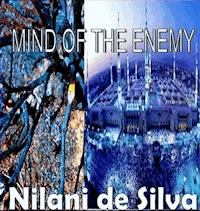
Mind of the Enemy
By
Nilani L. de Silva
Copyright© Nilani L. De Silva
The rights of Nilani Ljunggren De Silva to be identified as author of this work have been asserted by the author in accordance with the Copyright law in Sweden and the USA.
Cover designed by Nilani Ljunggren De Silva
All rights reserved.
For further information and full list of publication of this author please contact [email protected]
and www.devexpgroup.com
e-book information please contact the above.
Dedication
This book is dedicated toWorldTradeCentre victimsand others who were killed by act of terrorism.
The writing here is, indeed, factual and fiction; it is for the reader to identify the thin line between the two.
Preface
I got the idea of writing this book when I first visited Israel in 1990. I was pregnant with my eldest daughter, Natalie. We had travelled for days from Nubia through all of Egypt, crossing the Sinai desert, by trucks, trains, boats, buses and on donkeys to arrive at Jerusalem. We thought of taking it easy, relaxingin Jerusalemwith the blessings of one God, who had many names. It was late afternoon, not a single soul was on the road; we thought this was due to the Sabbath. People in rushing cars stared at us with curiosity, some even tried to signal us; at first we thought that the condition of our Vagabond made us look like drifters. We had no idea that a few hundred metres from us, there had been two simultaneous bomb attacks. A Jewish couple stopped their car, and said we could stay with them until we found a safe place to live.
We were very young, naive but curious, every word said, heard, things seen, experienced, and impulses felt began to reverberate and be transformed into words. I was no longer a tourist in Jerusalem but an undercover detective. I left my blond Swedish husband in the hotel to sunbathe, and scooted off wearing Palestinian traditional female attire to experience how it was to live in Jerusalem as a Palestinian pregnant woman. I was stopped several times while taking taxis, since as a Palestinian you were not allowed to take taxis; I was kept for hours in queues. Finally, I declared my Sri Lankan Swedish identity and showed my documents; Israel soldiers laughed and joked and welcomed me to Israel. They even explained their own dilemmas and miseries; they were young, my age, we could joke, and they were curious about what’s happening in Scandinavia, and werecuriousfor what was happening in Sri Lanka, my birth land, once under brutal warfare.While waiting in line I chatted with Palestinians who gave detailed accounts about their daily plights.
I visited both countries years later and did the same detective work, this time as a more mature person—an academic, already having three children, finished with my doctoral study, and tired of writingtediousacademic papers. I realised that the situation had worsened. The rebel in me slowly started to transform me into writing this book. It is actually fiction but fiction can easily turn out to be real, if we do not act now. Some episodes and places and facts are authentic, but the story itself is fiction. It is up to you, the reader, to figure out what is fiction and what is not.
Many,who read myrawmanuscript,warned me.Where I come from, freedom of expression is a virtue, so I have no fear.Manysaid I will bebanfrom travelling to the USA or to Israel in future,or black listed.Theyalsosaid I sympathised Muslims too much.But the truth of the matter is radicals, terroristsandfanaticswill disappear from this world by finding root causes to problems. Thesolutions liein the cause, not in thesymptoms.Ihavenot triedto provide a panorama of hostility towards the west—where I belong.All I want to do is to orchestration of consciousness which will permit to render the multi-dimensionality of events, I argue, that should be the idea of each literature.
Finally, in writing this book I want to express my gratitude to my friends, family and colleagues. Theirsupport and good will kept me going through the writing of this edition. I must particularly thank my family,Micael, Natalie, Jonathan and Mark,without whose love and enduring patience I could not have finished this book. During the slow and often interrupted evolution of this book I have accumulated many debts, only a portion of which I have space to acknowledge here.
No book will ever do justice to the courage and kindness of those who have opened their hearts to share their ideas, in Palestine, Israel, Jordan, Syria, Egypt, Turkey,Tunisia, Pakistan, Malaysia, the USAand Sri Lanka. Interactions with people from all walks of life—young Israeli soldiers, resistance organisations, family members of martyrs and suicide bombers, families of victims at the World Trade Center in New York, people like you and me eating an ice cream on a hot summer daywith your kids, all want one thing—peace, security and stability. Who is failing us?
Nilani Ljunggren De Silva
January, 2011
Stockholm
The Angry Mother Nature
The sky had taken on an orange hue as sandstorms swept through the small village. The Hisma—the sandy desert of Wadi Rum in Arabia—was under a severe attack. The increasingly thick air blocked the sun andviolent wind formed the sandstorm blocking the vicinity.The howling storm was destroying everything around. Through patches ofbrown mist one could see most of the cattle, goats and herds of sheep already suffocated and lying dead. Everything in the environs was trying hard to resist the tempered sand, to no avail. The sand had been attacking the rock surfaces, eroding softer parts and resulting in the shape of a mushroom or various other strange shapes.One could faintly see the sand grains being moved along by a wind that was waiting to carry any object with it.People had never seen such an aggressive sandstorm before and werein a state of shock. They were digging caves inside their houses to find shelter from the angry Mother Nature.
It was a steaming hot February day. The exact year was 1969. Thethree weeks ofshattering storm had taken its worst toll outside. It was an unusual natural catastrophe. Nobody knew the fatalities, but the ancient Nabatean city of Petra, in the southern part of Jordan (275 kilometres from Amman), was in a state of fury.Prince Bin Abdil Muhammad, the clan leader of the village,looked through the window from his mansion,which was well hidden by craggy rocks. Hecould not see the village,anyroads, oases or wells.
Abdil offered a prayer to have mercy on them.The thobe, a long, hooded robe that encased him, looked like a firm outer skin and was unusually dirty and dusty. His reddish tired eyes looked annoyed. His large restrained face had the authority of a commanding nose and strong cheeks, and his muscular hazel eyes, deep under thick black brows, lookedworried butself-controlled.
Although hisfirm natural posture told a tale of authority, the look of him ever since the storm and his wife’s labour, two at the same time, had been transformed to one of a susceptible person. Walking in circles in the dark spacious room, hehelplesslylooked at his ancestors' photos that were hanging on the wall. They, once desert dwellers,had been living in thishistorical citadel of Petra, carved in the blossom of a sandstone rock, for centuries, but it was now facing its worst catastrophe.
Frustration evaporated as he contemplated the survival stories of his own father’s caravan in the midst of the Sohail desert.My forefathersjourneyed by camel from oasis to oasis,how did they survive this kind of catastrophes? His ancestorsfrom theNabatean tribe from northern Arabia, and had settled in the area around 800 BC,laying the foundations in Petra of a commercial dominion that extended to the Far East. Camels supplied much of the food and other needs to survive in the brooding solitude of thedesert. Theymaintained a pastoral culture with exceptional grace, honour and beauty, living in harmony with their environment.Theyhad actively joined Prophet Muhammad to fight the battles in the holy city of Mecca.
The city of Petra, Prince Abdil´s birthplace, was once a kingdom of his ancestors; though now fragmented and in ruins, it was yet breathtaking, and less known to the world outside. Although the place was occasionally visited by more adventurous travellers, it definitely did not rank second place to the arrogant sphinx of the Pharaohs in north Egypt. The blood-shedding Jerusalem to the east, bloody and bruised Iraq to the northwest, staggering Syria to the east, and confusing Israeli tanks aiming everywhere and nowhere in between, made Petra a restless place.
The village Abdil live with his large familywas shut in by mountain cliffs and could be approached only by a narrowravine;the towering hills of rust-coloured sandstone gave a feeling of some kind of natural protection to the villagers, protection from the world outside and even from the worst desert sandstorms.
“I am going to survive, just like my ancestors,” he whispered.
His feelings were succeeded by a more sincere pleasure, a feeling of anticipation. He gave a swift downwards glance at his watch, hesitated,and wasexasperated, with a shadow of concern crossing his face. He knew there was no way he could reach the doctor in case of a complication. He looked at the women walking hurriedly past him; he fretted at their heavy steps.Aglimpse of hope as well as apprehension ravaged within; he was not sure what the news was going to be at the end of the ordeal.
Time was passing at a snail's pace. He disliked himself in this mood, and instead tried to restore calm by sipping the fresh orange juice served by one of his daughters. Weights of tiredness settled on him.The accelerating moans escaping from his wife’s room brought him to a state of pandemonium.
He had waited years in limbo, waiting for a son to continue the family’s legacy. He sipped the last bit of orange juice to soothe the dryness in his throat. Suddenly, a loud moan from the room almost made him bite his tongue. His older sister appeared in front of him with a beaming smile, showing her large teeth. She was speaking with grateful enthusiasm.
Ayesha was recovering from a tedious delivery; it was a full-size baby, who had struggled violently to leave the womb, to be born.
There was a pause. Abdil stood listening to the silence as if there were something more, some other words that needed to be said.
Allah has bestowed upon you a son.
Prince Bin Abdil Muhammad tried to compose himself; he transformed himself into a statue-like posture, faced Mecca, offered a prayer, kissed the floor ravaged with sand and thanked the almighty for bestowing upon them a son—the precious gift from God. He vowed to God that he would bring his son up to serve him.
The next moment he removed his sandy clothes and washed his body, eagerly waiting to visit his wife’s chamber. Finally, when he was able to hold his son, a small boy opened his sleepy blue eyes and yawned at his father. Abdil did not want to wink, so his son did.Handsome he was, but more—every feature, every curve, had an impressive finality, an absolute rightness, as if the atoms which composed him had never had a moment’s hesitation in falling where they did. He whispered to Ayeshalovingly, “I want to name himAl Akbar.” Ayesha feebly mumbled her approval. She was glad she had finally fulfilled her husband's wish by giving birth to a beautiful healthy son after eight daughters.
A New Prince Is Born
The sandstorm subsided.After gauging their heavy losses, the people of Petra got on with the daily chaos. The sandstorms were part of their lives, but the strong bonds people shared helped them to rebuild their lives with the least expectation from the world outside. Theinhabitants soon started to enjoy the sanctuary of the well-hidden oasis beneath the hillocks of the sand, in the valleys, in the Sahara sand dunes, when they heard the good news. A new prince had been born.
Abdil was in good humour as the entire village gathered to greet the new prince. Ayesha used the special occasion to treat the people to a grand feast lasting several days. Abdil addressed his people with a sense of authority and concern and hope.
He reminded the youth about their ancestors. “Our ancestors lived in this harsh environment for many centuries, stubbornly clinging to our traditions and way of life. They survived the Romans. You young ones must not forget that this is our birthplace.Petra wasonce a renowned caravan city, a resting place to traders travelling from Europe to Asia along the Silk Road. This place that we live, like all great civilisations, once existed in the world was destroyed undercolonial invasions. Starting in the late 19thcentury most of our clan members came under British rule and began the transition to a semi-nomadic lifestyle. We are now losing our younger generation. Although we do not have the symmetry that we once had from Saudi Arabia through to the Sahara, we must not forget how our ancestors fought with our enemies.
Al Akbar is your new prince, and you must hail he who is going to protect your sons and daughters from all possible intrusions and invasions.”
“You mustnot fear the Zionists. For them, national borders mean everything, not only their own but also the land they have stolen from neighbours. Now, struggle, war, blood, and a matter of life and death have become part and partial of our lives. Remember, we are Bedouins; national borders never meant anything to us until the Zionists came into being. Oil in the Persian Gulf, as well as interference from Israel and America,ischanging the architecture of our Bedouin lifestyle.”
“The faith in Islam and its traditions we must cherish, and in spite of the bloodshed going on in neighbouring countries we are going to prevail. Wemust not forget the traditions that gave rise to a network of kin relations among us; God has bestowed upon us a new leader for a new era. We are a group of related families claiming descent from the same ancestors. I will say again as your natural leader, my son will do everything toprotectyou;I will educate him to indulge his benevolent affection for you as long as you need us. This is a promise.”
Abdil spent a large part of his waking time watching his only son grow to become a bubbling child. He taught Al everything that his father had taught him. Bedouin lifewas the star that guided them together. The little boy grewupabsorbing every word that escaped from his father’s mouth.Last Supper in theWadeRum
It was a special day, and friends, relatives and the family were gathered in a large tent to share a special meal. After concluding the prayer, everyonesat around to join the ‘Grand Thala.
The vast landscape of ancient riverbeds and pastel-coloured stretches of sandy desert was unusually quiet, just like the guests.The colours, the shapes of the evening sky, pulsated like whipped cream in orange coffee.
Al looked at the horizon full of curly clouds.The light from the rising full moon shined in his face.Cookedlamb with goat yoghurt, fried rice with pine nuts, pistachio and parsley, and the golden sauce did not seem to tempt the appetite of many, especially Abdil´s daughters and his wife.
Abdil looked at his large family with concern, and silently served thema portion of rice from the middle of the plate, as it had been done always, a symbolic way to open the Thala. The absolute silence annoyed him, but he tried to control his feelings. He watched others forcing food down their throats. Abdil was glad they left no grain of rice behind, which was a bad omen.
He addressed his family with a calm note as if Al was not present among them.
“Al is my only son and your only brother, and your future protector. He does not belong to us. His future is constrained if we keep him here. He must learn about the world beyond these sandstone rocks, beyond the citadel of Petra, and beyond Jordan, so he can come back and lead your children for a better tomorrow, he needs to experience the world out there.”
His sharp words echoed in the cold desert, and nobody bothered to add more logs to the cold fire. The desert wind made creepy noises. With tearful eyes Al looked at his mother and sisters for rescue. He knew how much they loved him, as iftheir happiness depended on him. He did not want to leave them. He felt the burning gas in his stomach pushing his lungs and choking him. He tried to gasp for air.
When the crowd ceased, Abdil´s older daughter resisted showing her tears. She did not want to part from her brother.
“Papa, he is only seven, too young to live alone in a boarding school, can you let him stay for awhile with us?”
Others cleared the plates, not humming a word to disappear into the dark. The idea of losing their brother suddenly made a huge hole in their hearts.
Later that day when the children were out, Ayesha tried to persuade her husband, thinking that he would at least reconsider and keep him at home until his tenth birthday.
“He is our only son, and we simply cannot send him into a world we hardly know!” she moaned.
Sheknew that the little boy was hardly ready for the world outside.Ayesha also knew the promise that her husband had made to God when Al was born, and that this was the beginning of fulfilling that promise.
“I will not let my son idle, there are no proper schools around here, he is special and meant for the big world, woman. You must not try to prevent what’s good for him. The earlier he starts the better it is for him, and he will be able to take our clan to a better era. It is my duty to prepare my son.”
“Unfortunately, our leaders are getting more and more influenced by the West. They are replacing our lamb with cheaply imported meat from New Zealand. My people have to travel with herbs to the Saudi Arabian border to sell products. We need strong blood to fight all these upheavals. We like the life in bedrock. Intruders need to be kept at bay; he needs to learn know-how, skills. I am sure he will come back and these sandstone rocks will be waiting for him.”
Al´s father gave a determined look at his wife. He adjusted the cufflinks of the chalk white thobe. Ayesha realised the futility of furthering the conversation and instead continued to look at him as she usually did when he dressed; she simply did not want to upset him.
“He will be going to a very good boarding school in Alexandria,” he said irreproachably.
She tried to conceal her tears as she handed over the red shemagh, a headdress. He adjusted the shemagh on his head and tightened it to fit around his forehead with an igal. She looked at him admiringly and thought how handsome the man standing in front of her was; he looked rough and dignified on the outside, mellow and soft inside, like a cactus in the desert.
Studying his wife’s eyes Abdil knew how difficult it was for her to let go of her only son. But he was determined not to let emotions take a toll on his only son’s future. Instead, he attempted to console her. In return, Ameena controlled her tears in front of him, to cry later when she was alone.
“You must be optimistic; he is a gift from Allah. We are doing this for his good; after all, he is not going too far away from us.”
Beginning of Destruction of a Young Life
At the age of seven, the little boy started a long journey away from home. He tearfully bid farewell to the family that was his lifeline, oxygen, and left Petra. His father hugged his son hard; teardrops spattered out.
“I will come to see you every month and you can come home every holiday, time will fly son, be strong and remember the courage of your ancestors.”
The renowned boarding school in the heart of the Mediterranean citadel of Alexandria, the second largest metropolis in Egypt, was heaven for elite children, but it did not appeal to Al. In fact, it took longer for him to get adjusted to the new life in Egypt. He felt abandoned, angry and deprived. On cold nights, when the Kalahari wind thrust upon them, he trembled in the cold and solitude. The graceful uniforms, ardent discipline, stylistic English language and coolness of performance could not conceal the damage to his soul. Everything that took place was a false pretence in the midst of a destroyed mind.
For Al, the rest of the world appeared less alluring, a pale surface to be attached to. He could not make sense of where he was heading; it was like the embarkation to a brand new world with many dark hollows. At times he resisted, to no avail.
“I am a Petra boy; my ancestors were from one of the oldest Arabian tribes living in the beautiful city of Petra. Petra is one of the silent world miracles, like your pyramids in Egypt,” he challenged classmates, as none of them knew anything of his significant Petra.
Almissed Petra, especially the Bedouin life that he cherished, living in close contact with an abundance of friends, cousins, animals and the utter beauty that the desert offered. He longed for the affectionate touch, songs and cuddles from his mother and sisters. He suppressed the natural love and compassion within him; hate and anger replaced dark hollows. He lost the ability to enjoy the sun from both sides—to love and be loved.
During his free time Al walked on the field adjoining the school, mostly in a blurry state, a lost boy with no sense of direction. He started to build his own life in a place he hardly felt he belonged.A familiar sound of the desert, a smell of camels, wasreplaced by the sound of tooting vehicles and exhaust fumes. Al grew taller and taller. The taller he grew, the more determined he became to find his freedom, and he kept on searching.
As a youth, growing up in isolation, the dichotomy between thinking and feeling had merged into an intellect with passion. Time healed his aggression; bitterness turned him into a strong young man and brilliant student, different from his fellow mates in many ways. He learned about Greek mythology, Roman history, and European colonisation and neocolonisation, the rise of nationalism, power of Bretton Woods institutions and theirridiculousinterventions, civil wars, and the birth of terrorism with the creation of Israel, the gigantic American state that had emerged in a fully institutionalised form, Islam phobia and a new kind of western domination.
He memorised the Quran by heart, learned jurisprudence, Hadith, rhetoric, philosophy and poetry. He reached a certain proficiency in an area widely misunderstood by the world at large and by his own Muslims, in particular.
He openly resisted the Eurocentric teaching that boasted of western heroisms.
“The authors we were asked to read are almost entirely from the West, these histories masquerade as world history! Our great Muslim ancestors conquered territories and established new territories; they were hardy and frugal, incorrupt in morals, freedom loving and self-reliant, and so made excellent fighters.” He attracted a crowd.
With the acquired knowledge, he challenged teachers who knew only half of the real history, the history that had been rewritten to subordinate one human race by another. He argued about and questioned the omitted histories of the Ottoman Empire, Arab, Asian and African civilisations, and teachings from the great history his father had taught him. He questioned the wars in Granada when thousands of Muslims were killed, literature burned, and mosques destroyed.
“What happened to the 700 years of history during the time that Islam brought enlightenment to Europe? Why doesn’t anybody teach us about the renowned Alhambra Palace in Spain; it is one of the wonders of the world; and about Petra, the city where I was born? We live in this great cityof Alexandria, in this comfortable classroom, learning only about the amazing civilisation of the West.”
“I am an Arabic lad, so why do we have to spend hours learning of the Columbus expeditions? Why did he have an army of people with weapons when he travelled? What did he bring back? Why do you try to teach us that he was a hero, and that if not for his voyages we would have never discovered the world? Who is discovering whom for which purpose? Why cannot we learn the truth?” He questioned the gaps and was a menace to his teachers.
He bellowed with anger and slowly turned to his fellow classmates to share his newfound knowledge.
“We are people rooted in ancient cultures that we still keep intact. I would say that one of the most remarkable things is that just like many nations, Islamic nations convulse themselves and the only way to stop that is by revolution. But I do not know how.”
His questions were brushed under the carpet, as was his voice, by the adults around him. Students who listened to him never dared to challenge Al´s undeniable intellectual vigour. The thirst to search for the history of Islam continued to inhabit him. He started visiting half-ruined mosque libraries and museums in the city looking for clues. He never stopped his utterances; he knew they could bring some kind of revolution.
As he became more deeply engrossed in the search for knowledge through Islamic historical doctrines, thousands of questions reverberated. He found Oriental history from the time of the Amarna letters, inscribed on clay tablets that were found in 1897 in the ruins of Akhetaten, the capital city of Pharaoh, at a site near El-Amarna. The letters were international correspondence, mostly sent by Pharaoh and rulers of other great powers in the Middle East and Asia.
That era had given birth to the modern understanding of international relations and diplomacy, and as Al absorbed new knowledge he became more sceptical about the knowledge poured on them at school.
“The international diplomacy the West has been grappling with had always been there in the Orient. The West dictates all international diplomacy as if they had invented it; those who dictate terms for diplomacy are manipulating leaders in less powerful countries. Our leaders hardly understand the game.”
“How come the West has never learned to communicate, but only to dictate, how come Christians never communicate to Muslims in the way our great leaders did, sending friendly delegations with gifts, that is what I call high diplomacy.”
He tightened his jaw muscles with anger when he spoke to his growing audience.
Reading ofmen,who fought to protect Islam, and their military strategies, excited Al the most. But he could not find a finger to point at anybody in particular in retaliation, and he felt that the fingers on his hands were not enough to point at emerging enemies.
Leaving Gaza
Leila was crossing a deep stream without a plank to hold onto; on the other hand, she did not want to hold onto a rail that was deceiving her, as providing a railing might make her dependent on it. The prospects of living in solitude appealed to her.
Her only consolation was the ability to hold on to fragmented elements of the shattered past, the life spent as a refugee in the historic town of Jerash, which was situated just an hour drive from Amman, Jordan. The small alleys, storefronts, empty faces and all the refugees like herself were an important part of Leila’s life.
“We all had a few things in common; we had left our homeland, Palestine, lived in temporary homes as permanent refugees” Every family had members who had sacrificed their lives as martyrs, while many lived permanently in Israeli prisons.
“We were a bunch of people whom any army general could easily hire to train to kill. People were oozing with anger, hatred like boiling lava, and ready to offer their lives.”
Leila’s parents had been forced to settle down in Jerash when their house in Gaza was demolished to ground zero. She tried to soften her resentment, fondly thinking of the days that she sat on her grandmother’s lap listening to her past, growing up in Palestine, stories that sounded like fairy tales.
The turning point in their lives was when a rubber-coated bullet killed her eldest brother. He was a student, only ten years old. Although it was the beginning of their nightmare, similar stories had been mingled with the daily life of many who lived in Jerash.
The pouring of tears had become an habitual occurrence. She often thought how unfairly the joys of life were sometimes distributed in this world.
Her father held on to the dead body and cried loudly, and his voice echoed permanently in her. ¨I never hated occupants and brought up my sons not to hate them. All I wanted was for him to become a doctor like me, how can anybody who was given the power to hold a gun shoot an innocent schoolboy carrying a school bag full of books? How long must we go on saying that Allah takes care of everything, while burying one by one our children?”
Hamas, vowing to take revenge, carried Leila’s brother, who was the youngest martyr, to the nearby cemetery. The world watched the episode on BBC; the next day business went on as usual, the world moved on, Palestinians moved on, Israel moved on, but not the ones who buried their loved ones.
For her father, the gap between Hamas Palestinian militants and Israeli militants was a thin one, they were both vicious lots. He was so angry when Hamas printed her dead brother’s poster to rejoice his martyrdom. She remembered young bearded men visiting after the death.
She could remember hearing one say, "Those who die forGoddo not consider them dead. They are alive.” She did not know what to believe.
Her brother’s death attracted resistance groups who were active politically and militarily, and her father, being a medical doctor, had no choice but to take care of wounded rebels who came to their home day and night.
When the situation worsened they opted to flee.
One day, when the night was quiet and chilly, and people were fast sleep, Leila’s family got into an old van and fled occupied Gaza. On the Syrian border they moved into a vehicle full of fruits and vegetables and drove for another few hours. They rested in a small hotel in Damascus before they crossed the Jordanian border, and ended up in Jerash refugee camp. They were happy to have left the crumbled-down concrete poles, bullet-marked house facades, dust, military tanks,and allthe misery in Gaza. The orderly traffic, big mansions, clean buildings and even trees on the road, all appealed to them in Jerash.




