


0,49 €
Niedrigster Preis in 30 Tagen: 2,49 €
Niedrigster Preis in 30 Tagen: 2,49 €
Mehr erfahren.
- Herausgeber: Booksell-Verlag
- Kategorie: Ratgeber
- Sprache: Englisch
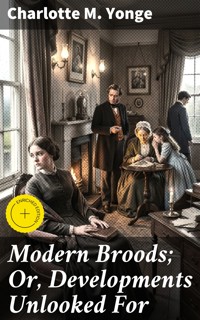
In "Modern Broods; Or, Developments Unlooked For," Charlotte M. Yonge explores the intricate dynamics of family life and social expectations in Victorian England. The novel, characterized by Yonge's elegant prose and keen psychological insights, navigates the complexities of familial relationships, personal aspirations, and moral dilemmas. Set against a backdrop of contemporary societal norms, Yonge weaves a compelling narrative that reflects both the trials and triumphs of her characters, resonating with readers through its deft portrayal of emotional conflict and ethical imperatives. Charlotte M. Yonge was a prominent Victorian author known for her extensive body of work encompassing novels, essays, and children's literature. Growing up in a devout Anglican family, she was deeply influenced by the religious and moral philosophies of her time, which inform her writings. Yonge's experiences as a caregiver and her observations of societal roles undoubtedly shaped the themes of duty, sacrifice, and growth found throughout this novel. Her dedication to portraying the lives of women, often marginalized in literature, adds a unique perspective to her narratives. "Modern Broods" is a must-read for those intrigued by Victorian literature and personal development. Yonge's masterful storytelling invites readers to reflect on their own societal roles and the struggle for self-identity amidst familial obligations. This novel not only entertains but also provokes thought, making it a valuable addition to the library of any literature enthusiast. In this enriched edition, we have carefully created added value for your reading experience: - A succinct Introduction situates the work's timeless appeal and themes. - The Synopsis outlines the central plot, highlighting key developments without spoiling critical twists. - A detailed Historical Context immerses you in the era's events and influences that shaped the writing. - A thorough Analysis dissects symbols, motifs, and character arcs to unearth underlying meanings. - Reflection questions prompt you to engage personally with the work's messages, connecting them to modern life. - Hand‐picked Memorable Quotes shine a spotlight on moments of literary brilliance. - Interactive footnotes clarify unusual references, historical allusions, and archaic phrases for an effortless, more informed read.
Das E-Book können Sie in Legimi-Apps oder einer beliebigen App lesen, die das folgende Format unterstützen:
Veröffentlichungsjahr: 2019
Ähnliche



Modern Broods; Or, Developments Unlooked For
Table of Contents
Introduction
When inherited duties collide with unforeseen turns of character and circumstance, even the most carefully ordered family life can become a proving ground.
Modern Broods; Or, Developments Unlooked For is a novel by Charlotte M. Yonge, a prolific English Victorian writer best known for domestic and moral fiction. Read in that context, the book belongs to the broad nineteenth-century tradition of family-centered realist storytelling, where everyday decisions carry ethical weight and private rooms become arenas for public values. Yonge’s approach characteristically treats home, parish, and neighborhood as intimately connected, presenting social change not as spectacle but as pressure felt in ordinary relationships.
The story opens by placing readers in close proximity to a household whose expectations about conduct, affection, and responsibility will be tested by events that do not conform to the family’s assumptions. Without relying on sensational twists, the narrative builds from interpersonal frictions, obligations, and the slow revelation of temperaments that do not fit the roles assigned to them. The premise is less a single mystery to be solved than an unfolding pattern of consequences, in which small choices accumulate and “unlooked for” developments reshape what seemed settled.
Yonge’s reading experience is marked by a steady, observant voice that values nuance over speed and moral attention over melodrama. The prose tends toward careful description of motives and manners, inviting the reader to weigh competing claims rather than simply applaud or condemn. The tone is earnest and often sympathetic, even when it is critical of folly, because it is invested in the idea that people are formed by training, example, and the difficult work of self-knowledge. The effect is immersive and reflective, designed to be considered as much as consumed.
Family, in this novel, is not merely background but the instrument through which ideals are taught, resisted, and revised. The book examines how authority is exercised, how affection can both steady and mislead, and how the language of duty may conceal fear or pride. It is also attentive to the ways reputations are made inside a community, how misunderstanding spreads, and how moral certainty can be complicated by partial information. Across these concerns runs an interest in growth: not the triumph of a single hero, but the ongoing formation of character under pressure.
The title’s emphasis on developments suggests a preoccupation with surprise and with the limits of foresight, especially for those who think they can plan outcomes through good intentions alone. Yonge probes the distance between principles and practice, asking what it means to act responsibly when circumstances shift and when the needs of others prove harder to interpret than expected. The novel’s domestic scale becomes a lens for larger questions about change, generational tension, and the negotiation between individual inclination and communal expectation, all handled through close social observation.
Modern Broods still matters because it treats the family as a moral ecosystem, tracing how private decisions ripple outward and how judgments, once spoken, are difficult to retract. Contemporary readers may recognize the pressures of caregiving, the burden of being “the reliable one,” and the ways social narratives form around people before they can speak for themselves. The book’s patience with complexity offers an alternative to quicker, more polarized storytelling, inviting a slower kind of attention to motive and consequence. In its quiet insistence that character is shaped over time, it remains a searching study of responsibility in everyday life.
Synopsis
I don’t have enough reliable, verifiable information about the plot and structure of Charlotte M. Yonge’s Modern Broods; Or, Developments Unlooked For to write an accurate seven-paragraph synopsis that follows the narrative flow without inventing details. Producing a “neutral summary” under your constraints requires specific knowledge of the book’s characters, setting, major situations, and sequence of developments, which I cannot confirm from my current materials.
If you can provide the text (or substantial excerpts), I can create the compact synopsis you want while keeping spoilers light. Supplying a table of contents, chapter-by-chapter outline, or even a brief description of the main characters and central conflict would also be sufficient for me to write a faithful, spoiler-safe synopsis that tracks the work’s progression.
If you share the source in any of these forms, I will write exactly seven paragraphs of about 90–110 words each, maintaining a formal continuous tone, highlighting pivotal developments without revealing major twists or the ending, and closing with the book’s broader significance. I will avoid direct quotations and will not add any speculative or uncertain claims.
You can paste the opening pages and then continue in batches, or you can upload images/PDF pages. If the book is long, a chapter-by-chapter list of key events (two to five sentences per chapter) will let me compress it into the requested synopsis length while preserving the work’s actual narrative order.
Once I have the material, I will identify the work’s central ideas and conflicts as they appear—such as the pressures shaping family life, social expectations, moral choices, or generational change—only insofar as the text supports them. I will also track how the “developments unlooked for” function structurally, without revealing any decisive late-book reversals or final resolutions.
If you prefer not to paste the full text, tell me where you are reading it (edition and chapter list) and provide a short summary of each major section. With that, I can still produce a precise, compact synopsis that stays within your spoiler boundaries and does not introduce any unverified names, places, or events.
Send whatever portion you can, and I will convert it into the seven-paragraph JSON output you requested, ensuring each paragraph stays within the target word range and that the final paragraph gestures to the work’s enduring resonance and thematic stakes while remaining spoiler-safe.
Historical Context
Charlotte M. Yonge published Modern Broods; Or, Developments Unlooked For in the late Victorian period, when Britain’s social order was being reshaped by industrialization, expanded literacy, and urban growth. The novel’s world is rooted in England’s established institutions—family, parish life, schools, and respectable middle-class domesticity—whose influence remained strong even as economic and cultural change accelerated. Victorian fiction commonly treated moral formation as a public matter, linking private conduct to national strength. Yonge wrote as a prominent novelist for family audiences, and her work reflects a culture that expected novels to instruct as well as entertain.
Yonge’s outlook was closely associated with the Church of England and the Anglo-Catholic revival that followed the Oxford Movement (1833–1845). That movement emphasized sacramental worship, pastoral discipline, and renewed devotion within Anglicanism, provoking controversy over ritual, authority, and identity. In the decades after 1850, debates over church practice and the role of clergy in daily life remained intense, and parish-based philanthropy expanded. Such ecclesiastical currents inform Yonge’s depiction of conscience, duty, and guidance by religious mentors. Her fiction often assumes the parish as a key social unit, mediating between personal character and communal responsibility.
Education reforms provide important context for a novel concerned with upbringing and “development.” The Elementary Education Act of 1870 established school boards and widened access to primary schooling in England and Wales, while later measures strengthened attendance and standards. Secondary and higher education also changed, including growing attention to girls’ schooling and training for paid work. These shifts intensified public discussion about what children should learn and who should shape them—parents, clergy, teachers, or the state. Yonge wrote during this transition from primarily home- and church-centered instruction toward more formalized, regulated education, a change that affected expectations of youth and family authority.
Victorian family life was further shaped by shifting legal and economic realities. Industrial and professional employment increasingly drew men—and, in some sectors, women—into structured careers, while middle-class domestic ideology idealized the home as a moral refuge. At the same time, legislation altered women’s legal position, including the Married Women’s Property Acts of 1870 and 1882, which expanded married women’s rights to control earnings and property. Public debates over marriage, inheritance, and domestic power accompanied these reforms. Such developments provide a backdrop for fiction attentive to household management, moral accountability, and the pressures placed on parents and guardians.
The period also saw major public-health and welfare initiatives that changed everyday expectations of responsibility toward the vulnerable. Reforms to sanitation and disease prevention followed recurring cholera outbreaks earlier in the century, and the Public Health Acts of 1872 and 1875 improved local authority oversight. The Poor Law system, established in 1834, continued to influence perceptions of poverty and charity, while voluntary philanthropy remained influential among Anglican and middle-class networks. These realities underlie the era’s careful moral distinctions between improvidence and misfortune. Yonge’s social settings typically treat practical care—health, housing, and relief—as inseparable from ethical and religious obligations.
Imperial and national politics formed the wider horizon of late Victorian life even in domestic novels. Britain’s empire expanded and consolidated during the century, and newspapers brought imperial conflicts and political debates into ordinary homes. At home, parliamentary reform broadened the electorate through the Reform Acts of 1867 and 1884, encouraging greater public engagement and anxiety about social cohesion. Such changes heightened concern about the formation of “good citizens” and responsible households. Yonge’s fiction tends to locate national strength in local virtue, presenting domestic discipline and community service as the foundation for stable public life.
Literary culture of the time favored realistic social observation combined with moral seriousness. The dominance of the three-volume novel in circulating libraries shaped what could be published and what topics were considered suitable for family readership. Critics and readers often expected fiction to address conduct, religious belief, and class relations without explicit sensationalism. Yonge, who also edited and wrote for Anglican periodicals, participated in a network where fiction, devotional writing, and social commentary overlapped. Her narratives typically use everyday incidents—schooling, friendships, household decisions—to explore moral causality, reflecting a Victorian belief in character as something formed through habits and guidance.
Against this historical background, Modern Broods can be read as engaging with contemporary questions about childrearing, authority, and the moral consequences of modern change. The novel’s interest in “developments unlooked for” resonates with a society experiencing rapid educational reform, legal redefinition of family roles, and persistent religious debate within Anglicanism. Yonge’s treatment of domestic and parish life reflects the era’s confidence that personal virtue could be cultivated, while also acknowledging the disruptions that new social conditions could bring to households and communities. In doing so, the work mirrors and critiques late Victorian assumptions about progress, duty, and the sources of moral stability.




