


Erhalten Sie Zugang zu diesem und mehr als 300000 Büchern ab EUR 5,99 monatlich.
- Herausgeber: Allison & Busby
- Kategorie: Krimi
- Serie: Museum Mysteries
- Sprache: Englisch
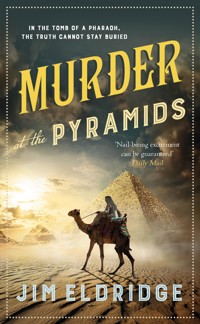
'The plotting is excellent, with admirable narrative drive . an engaging and entertaining read' Historical Novels Review January 1901. Abigail and Daniel Wilson, often lauded as 'The Museum Detectives', are on their way to the Great Pyramid of Khufu at Giza. Their explorations of the pyramid, including the Robbers' Tunnel, take a very sinister turn when they come upon the dead body of a man who has been brutally garrotted. Investigations by the local police reveal him to be Simeon McGruder, a wealthy American who is financing an excavation of the pyramids. When Daniel and Abigail return to Cairo they are asked by the American Embassy if they can take on the case, but they have a difficult path to tread as they try to keep different factions onside: the British and American authorities, the puppet Egyptian Government and officials, while at the same time facing lies and deviousness from McGruder's associates and friends.
Sie lesen das E-Book in den Legimi-Apps auf:
Seitenzahl: 362
Veröffentlichungsjahr: 2026
Das E-Book (TTS) können Sie hören im Abo „Legimi Premium” in Legimi-Apps auf:
Ähnliche

1
MURDER AT THE PYRAMIDS
JIM ELDRIDGE2
3
For Lynne, without whom there is nothing
4
Contents
CHAPTER ONE
Giza, Egypt, Monday 28th January 1901
Forty-year-old Charles Wicksteed, recently released from a cell in Giza police station, walked towards the Great Pyramid and was relieved to find his tent still in place. He had erected it half a mile from the pyramid when he first arrived two weeks earlier. As so often happened to him, he had been severely short of funds and had decided it was inadvisable to try and rent a room, because lately he’d discovered potential landlords seemed to insist on payment in advance. The Mena House Hotel had looked attractive, but it would view with caution a prospective visitor arriving without any expensive-looking luggage, just a rather shabby and much-used tent. But the tent had been good to him so far, and he’d erected it near to the Great Pyramid to act as his headquarters while he drummed up sufficient guide work to permit him to find somewhere more comfortable. He’d chosen Giza because there was an abundance of English-speaking tourists and he offered them the chance to have a guide who not only spoke their own language, but was unmistakably ‘one of them’. That was one thing for which he’d been grateful to the minor 8public school he’d attended in England – the upper-class accent. Everything else about the place had been hideous, but the accent opened doors that would be shut to many others. Unfortunately, it hadn’t been enough to open the door of the cell in the Giza police station; damn those suspicious Arab coppers.
He’d developed another talent at St Hilda’s Educational Establishment for the Sons of Gentlefolk – not that his parents had been Gentle in any sense of the word – the ability to pick pockets. Watches, wallets, loose change, all were as one to the nimble fingers of Charles Wicksteed. It was unfortunate that the couple who’d hired him as their guide to the pyramids had been so observant. Her, particularly. Mrs Muriel Hepworth, blast her eyes. Charles had done a brilliant job of diverting Henry Hepworth’s attention to the Sphinx, describing its intricate construction, while he extracted Henry’s wallet from his pocket and transferred it to his own. But then had come that fateful shriek from the harridan Muriel Hepworth. ‘He’s pinched your wallet!’ In vain he’d protested his innocence, his appeals falling on deaf ears when Mrs Hepworth had had the audacity to reach into his pocket and take out what looked suspiciously like her husband’s wallet.
‘How did that get there?’ demanded Charles, putting on his best look of shock.
It had all been to no avail. The local constabulary in their ominous black uniforms had been summoned and he’d been hauled off to the police station, where they’d thrown him into a cell while they took statements from the Hepworths. Language and communication problems meant the procedure took some time, and in the end the constabulary decided to 9return the wallet to Mr Hepworth while they deliberated on what to do about the miscreant, Charles Wicksteed.
As day and night turned into another long day behind bars, Charles had resigned himself to the idea of appearing in a court in Cairo and being incarcerated in the city’s prison. It would not be the first time he’d spend time behind bars: he’d experienced that in England, and Scotland, and also in France, but he anticipated the Cairo prison would have lower standards of accommodation. He hoped with his smattering of Arabic he might be able to talk his way out of this difficult situation, but it soon became obvious that the local police had no respect or time for him. He was just resigning himself to his fate when – miracle of miracles! – Henry Hepworth had turned up and announced that he didn’t want to press charges. Charles noted that Hepworth had arrived at the jail unaccompanied by his wife, for which he gave thanks. He was fairly sure if Muriel had been with Henry, she would have demanded that Charles be hanged, drawn and quartered.
And so Charles had been released.
As he sat himself down beside his faithful old tent, he reflected that it had been a good outcome. He was due some change in his fortunes. So far his time in Giza had been a bust. First there had been that Englishman he’d managed to dip who’d almost immediately realised that his wallet had gone. As Charles was the only other person in the immediate vicinity, suspicion had moved across the visage of the man. Acting swiftly, before the Englishman could summon the local gendarmerie, Charles managed to ‘spot’ the missing wallet where it had ‘obviously fallen’. The Englishman took it back but Charles noticed the man still kept a look of suspicion in 10his eyes, and also made no attempt to offer him a generous tip for having found his wallet. No matter – the main thing was, Charles retained his freedom.
Then there had been that American, Simeon McGruder, who’d hired Charles to be his guide to the Sphinx. That had been for two days, and at least Charles had earned some money. Even if the cost had been having to listen to the man’s bitching and complaints about how he’d been persecuted by some mysterious forces. But there had been something about the man. He had the smell of money about him. It was a smell with which Charles Wicksteed was very familiar.
Thirty-three-year-old Ursula Kenton and her thirty-year-old brother, Benjy, watched the tall man standing outside his tent, checking it, before he sat down on a wooden crate.
‘Funny place to pitch a tent,’ said Benjy.
‘Each to their own,’ said Ursula philosophically.
They stood, taking in the three huge pyramids.
‘You sure this is where McGruder is?’ asked Benjy.
‘This is where the magazine he works for said he was making for. Giza, the site of the Great Pyramid and the Sphinx.’
For Ursula and Benjy, Simeon McGruder was their mark. Their rook. Their pigeon. They’d worked on him back home in Boston, leading him by the nose, as all good grifters did, and it had paid off. Well, almost paid off. They’d got a reasonable amount of cash from him, with the promise of more. But when they’d turned up to collect the rest of the money, McGruder had gone.
‘He’s in Egypt,’ they were told at the office of Weird Days, the magazine for which McGruder wrote articles. ‘He’s doing 11a piece on the Sphinx. He’ll be there for a while.’
‘The cheating bastard,’ Ursula had scowled as they left the offices of the magazine.
‘We got some cash off him,’ Benjy pointed out.
‘Yes, but not nearly as much as we should have,’ said Ursula. ‘That was just a down payment.’
‘What are we going to do?’ asked Benjy. ‘Wait till he comes back?’
‘We don’t know when that will be,’ said Ursula. ‘For all we know, he’s gone for good. And with our money.’ She thought it over, then announced, ‘We’re going to Egypt.’
‘It’s a long way,’ said Benjy, whose only previous experience of leaving the United States had been brief trips to Canada and Mexico, to avoid the American police who had been on their tail.
‘It may be, but it’ll be worth it. And it’ll be educational. They say that everyone should see the pyramids before they die.’
‘Who says?’
‘People. Knowledgeable people. And there’ll be other Americans out there as well as McGruder. Europeans, too. People we can fleece. Pigeons just waiting to be plucked.’
The people at the magazine had given them the name of the place McGruder was staying while in Egypt, the Royal Court Hotel in Cairo. When they arrived after their long sea voyage, and asked for him at the hotel, they were advised that Mr McGruder had gone for the day.
‘Where to?’ asked Ursula. ‘You see, we’re old friends of his and we promised to call on him as soon as we got to Cairo.’
‘I believe he’s gone to Giza,’ the receptionist told her. ‘It’s the site of the Great Pyramid.’12
‘How far is Giza?’
‘Not far, about five miles from Cairo. You can get there by carriage. There are always plenty available. Or you can hire a couple of camels. That’s very popular with visitors.’
They followed the receptionist’s directions to the large market square, which was a heaving mass of people, most of them in long, flowing, loose robes. Camels were everywhere, sitting on the ground waiting for customers, their Bedouin owners sitting beside them. Benjy and Ursula watched as a woman in Western clothes climbed onto one of the sitting camels, helped by the creature’s owner. The woman’s husband watched, too, exhorting her to hold tight to the handle of the saddle. When she seemed to be settled in place, the camel owner prodded the animal into action and the huge creature rose, back legs first. This meant that the woman was jerked forwards, and the look of startled panic on her face showed that she was about to slide precariously down the camel’s neck and fall off over its head.
The owner shouted a warning, the woman’s husband yelled, ‘Hold tight, for God’s sake!’, and then the camel rose abruptly on its front legs, and the woman jerked backwards so violently that it looked like she was going to tumble and slide down the camel’s hump and come to grief in the other direction.
The Bedouin steadied the camel, keeping a firm grip on the rope around its neck and uttering soothing words to the animal. Finally, the camel was upright and the woman settled into the saddle between the humps.
The Bedouin looked questioningly at the woman and indicated another camel, seated on the ground, which a 13young boy was tending to. The woman’s husband shook his head.
‘I’ll give it a miss,’ he told his wife. ‘Next time will be fine, but for now I’ll walk alongside you.’
‘Forget the camels,’ muttered Benjy.
Instead, they opted for one of the carriages pulled by a donkey. Even that was a bone-shaking experience as it rattled over the rough terrain, but finally they reached Giza, the fabled site of the giant pyramids. Hundreds of tourists were there already, all taking in the sight, along with crowds of Arabs acting as guides.
‘McGruder’s not going to be easy to find,’ said Benjy.
‘For the money we’ll be making from him, it’s worth the effort,’ said Ursula.
Of the two of them, Ursula was the driving force, Benjy swept along in her wake. Their mother had died when Ursula had been six and Benjy three, leaving them to be brought up by their father, Erasmus. He was a grifter and had been for most of his adult life. Not a very successful one, alas. The children’s formative years had been spent in dingy boarding houses and moving from place to place whenever things got too hot for Erasmus, when unhappy people came looking for him. The big lesson Ursula had learnt from life with their father was to choose their marks carefully. Avoid people who had a tendency to violence. She’d learnt that the hard way after too often seeing her father lying in the street, having been badly beaten by an irate victim and in urgent need of medical care, which they couldn’t afford. In the end, when the children were in their mid-teens, it had been one beating too many that had put paid to Erasmus. Unable to pay for 14a funeral, Ursula had taken the decision to leave his body in the park where he’d met his end and let the local authorities bury him in a pauper’s grave, while she took Benjy off to a new city in a new state. Their status as orphans gave them a certain amount of sympathy, especially from some married men who offered to take care of them – or, rather, take care of Ursula, while grudgingly accepting that her younger brother would have to tag along.
Having spent her life watching her father manipulating people, Ursula knew which buttons to push.
CHAPTER TWO
Giza, Egypt, Tuesday 29th January
‘Queen Victoria’s dead,’ said Daniel Wilson.
He and his wife, Abigail, were in a small carriage being driven along the elevated road across the desert from the Mena House Hotel at Giza, the short distance to the Great Pyramid of Khufu. Daniel had picked up an English-language newspaper at the hotel, but he had put it in his pocket, unlooked at until now.
‘When did she die?’ asked Abigail.
It was not just a question asked from curiosity. She and Daniel had been commissioned by the late Queen to investigate a murder at the new Victoria and Albert Museum in London, and they had both been impressed by Her Majesty on the occasions they’d met her to discuss the case.
‘22nd January,’ said Daniel. ‘At Osborne House on the Isle of Wight. She was eighty-one.’
So, Victoria had died a week before. It was only because a firm of printers in Cairo were reproducing English-, French- and German-language editions of some newspapers that the news had reached them as soon as it had. Prior to that it had 16depended on newspapers being despatched from Britain, via trains and boats, which often took many weeks.
‘What did she die of?’ asked Abigail.
‘They don’t say, just “after a short illness”.’
‘So, we have a new King.’
‘Edward VII. Formerly the Prince of Wales.’
They’d also been commissioned by the former Prince of Wales, now Edward VII, to investigate a murder at the Tower of London; although their relationship with His new Majesty had been rather more fractious due to Daniel having considered the King’s late son, Albert Victor, as a possible suspect when he and Inspector Abberline were investigating the Jack the Ripper murders in London in the 1880s. At that time Daniel had been part of Scotland Yard’s detective squad, but for the last nine years he had worked as a private detective, alongside his wife, the famous archaeologist, formerly Abigail Fenton, now Abigail Wilson. Together they were known in the British press as the Museum Detectives, as most of their cases seemed to involve famous museums. Their most recent cases had been at the Louvre, in Paris, and the Colosseum in Rome. They were in Egypt because Daniel wanted to see where Abigail had made her archaeological reputation, at the Pyramids of Giza.
As their carriage neared the three giant pyramids, Daniel observed, ‘What I can’t get over is our hotel right next to the pyramids, so modern, so luxurious. It’s even got a swimming pool, for heaven’s sake. I always pictured you archaeologists out here in the desert in tents and caves.’
‘That’s how it used to be. Still is for many,’ said Abigail. ‘The Mena House Hotel opened fifteen years ago, in 1886. 17I’m sure it came about because there were so many Westerners who were interested in coming to the pyramids, many of them archaeologists, but even more who come as tourists. Arthur Conan Doyle stayed there with his wife in 1894. I believe that visit gave him the idea for his expedition to the pyramids, which he funded.’
‘And which you led,’ said Daniel.
‘Yes. Although I’m still not sure he got the results he wanted from it.’
‘The healing power of the pyramid?’ asked Daniel.
Abigail nodded. Louisa Conan Doyle suffered from tuberculosis, and Abigail had become convinced from her conversations with the author that Doyle believed the pyramids had healing powers that could help his wife’s recovery. In the end, Doyle settled for building a house in Hindhead in Surrey, after being told by a friend of his that the soil and air in the area had cured him of consumption. Doyle and Louisa also vacationed in the clean air of the mountains of Switzerland.
‘Of course, Flinders Petrie would have nothing to do with anything as grand as the Mena House Hotel,’ smiled Abigail. William Matthew Flinders Petrie was possibly the most famous English archaeologist and expert on the pyramids of the time, a large unkempt bear of a man whom Abigail had worked with on some of his famous digs in Egypt. ‘I remember at Hawara, while I stayed in a tent with others, he chose to live in a cave he’d made from three rock tombs knocked together. The place was infested with rats, but he insisted the local dogs kept them under control.’
Daniel, looking out of the carriage window, observed, ‘You 18talked about three pyramids being here at Giza.’
‘Khufu, Khafre and Menkaure,’ said Abigail. ‘And there they are.’
‘But now we’re getting closer to them, you can see there are three smaller pyramids as well. We couldn’t see them from the hotel because the big pyramid was in the way.’
‘Those were for Khufu’s queens.’
‘Tell me again when they ruled?’
‘All three were Fourth Dynasty in the Old Kingdom. Khufu was in power from 2551 until 2528BC. Then his son, Djedefre, from 2528 to 2520. Djedefre’s pyramid is at Abu Roash, about five miles to the west. After him, another of Khufu’s sons, Khafre, came to power in 2520 to 2490, followed by another son, Menkaure, from 2490 to 2472.’
The carriage stopped and Daniel and Abigail dismounted. Abigail told the driver he could leave them and return in four hours.
‘Four hours?’ queried Daniel.
‘Believe me, that will barely give us time to start exploring – if we want to go inside the pyramid, which I assume you do.’
‘I do,’ said Daniel.
The driver left, presumably to return to the Mena House Hotel to pick up more visitors.
Daniel looked at the three pyramids, awed.
‘I’ve seen your photographs of them, obviously, but nothing really gives an idea of how vast they are,’ he said. ‘Especially the biggest one.’
‘Khufu’s,’ said Abigail. ‘That’s why it’s known as the Great Pyramid.’
They’d set out from their hotel shortly after sunrise to get 19ahead of the rush of tourists, but as they neared the pyramids they saw the camels sitting sprawling on the sand with their owners, and men and boys in Arab dress waiting with wooden boxes beside them. Daniel looked enquiringly at Abigail.
‘They’re guides,’ explained Abigail. ‘Not that we’ll need one, I’ve been inside the pyramid before. But we will need torches, which are in the boxes. The only light inside the pyramid is from air vents, of which there aren’t many, and the opening.’
Abigail pointed to what looked like a narrow gap in the stonework about twenty feet up the face of the pyramid.
‘That’s the entrance,’ she said. ‘It’s a climb, but I’ve done it before so I’m sure you can manage. The good thing is we’re here early, before the crowds arrive.’
‘Does it get busy?’
She nodded. ‘In the past few years, the tourist industry has boomed. Fortunately, most of them discover their footwear is completely wrong for climbing up and they get fed up part-way and go back to just looking at it.’
Daniel smiled and flexed his feet in the pair of stout leather boots that Abigail had insisted on both of them wearing.
‘Hence these,’ he said. He looked at the camels and asked, ‘How difficult is it to ride one of those?’
‘Not difficult at all once you get used to it,’ said Abigail. ‘You’ll have to try one. It’s an interesting experience. They call them the ships of the desert, because they can travel across vast expanses. But the action when you’re on one is not dissimilar to being on a ship. They rock from side to side and backwards and forwards as they move. It’s very different from riding a horse.’
‘I’ve never ridden a horse,’ said Daniel.20
‘Never?’ said Abigail, surprised.
‘Growing up in Camden Town there were plenty of horses, but mostly they were those big shaggy ones pulling dray carts, brewery wagons, coal wagons and the like.’
As they neared the Great Pyramid there was a rush of boys and men towards them, offering their service. In Arabic, Abigail politely told them they did not need a guide as she had been to the pyramids many times before. Suddenly Abigail stopped talking and pointed to an elderly man, who had not joined in the initial rush but remained sitting on the ground.
‘Good heavens!’ she exclaimed. ‘That’s Abu!’
‘Abu?’ asked Daniel.
‘He was here when I was at Giza before. He was much younger, then, of course.’ She gave a rueful smile as she added, ‘But then, so was I.’ She waved at the man and called out ‘Abu!’, followed by something short in Arabic.
The man got to his feet and hurried towards them, a smile on his face at being recognised. He arrived and made the traditional salaam, which Abigail returned, and then the pair began a conversation in Arabic which caused the other guides to look at them in surprise, and with enhanced respect for Abu. Abigail and Abu chuckled and reminisced, then Abigail introduced Daniel to him. Daniel shook Abu’s hand and apologised in English for not speaking Arabic. The conversation ended with Abigail buying four of the wooden torches from Abu and giving them to Daniel to hold.
‘Four?’ asked Daniel, looking at the torches, which were made from wood and rushes tied together, as they left Abu and the other guides and made their way towards the Great Pyramid. ‘How long will we be in there?’21
‘We’ll be coming back again,’ said Abigail. ‘And I’d rather our money went to Abu. He was a wonderful worker when I was here before. Invaluable.’
The nearer they got to the pyramid, the better they were able to make out the details of its construction.
‘The stone blocks it’s made of are enormous,’ said Daniel. ‘Each one must weigh tons.’
‘Two and a half tons each, on average,’ said Abigail. ‘And they were moved on wooden sledges. It was the only way to move them across sand.’
‘And you said the pyramids weren’t built by slaves, which is what I’d always been told, but by free men.’
‘Mostly farmers,’ said Abigail. ‘When the River Nile floods in the wet season the farmlands are under water, so the farmers and most of their workers went to work as labourers on the pyramids until the floods subsided, which took about three months. After that, the farmers returned to their fields, which could be worked again. The soil was wet enough for the seeds to be sown. The farmers walked their fields, casting the seed on the wet ground. The waters of the Nile also brought good things to the soil, which helped the seeds grow. Then, the following year, after the harvest, the Nile began to flood, and the whole cycle started again.’
‘And they were paid?’ pressed Daniel.
‘Well paid,’ said Abigail. ‘And well looked-after. They had somewhere to live, and good meals. Fresh bread every day. It was a hard life, the work was tough, but the workers were well provided for.’
‘How many men were working here at any one time?’
‘Here at the Great Pyramid there were about five thousand 22working, cutting the quarried stone into blocks of the right size, others hauling them on sledges up ramps. There’d also be about a thousand women. Someone had to prepare all those meals.’
‘How did they go about organising the workforce?’
‘It was split into work gangs of about a thousand men in each. That gang was divided into five groups of two hundred. Those groups were split into ten smaller gangs of twenty men in each. Twenty men together could pull a wooden sledge with a large stone block on it from the quarry and up the ramps. If it was a smaller stone block, ten men could pull it.’
‘Fascinating,’ said Daniel.
They walked past the three pyramids of the queens, and as they reached the wall that ran along the base of the Great Pyramid’s face, they began their climb up the rugged structure. They reached the entrance, which – up close – was wider and taller than it appeared from ground level. Once they were inside, they lit one of the torches.
‘We’ll go down towards the subterranean chamber,’ said Abigail, pointing down the steep slope of the narrow interior passage. ‘It’s been years since I’ve been here, but I don’t imagine it’s changed much.’
‘What’s in the subterranean chamber?’ asked Daniel.
‘When I was last here, nothing except a large empty space. It’s said that it was supposed to be the original burial chamber for Khufu, but he changed his mind before it was finished because he wanted it to be higher up in the pyramid. I’ll show you that later. The subterranean chamber was carved out of bedrock, so it’s deep underneath the pyramid. Just like this passage.’23
Daniel looked at the rock sides and ceiling of the passage.
‘Is this safe?’ he asked.
‘It’s stood for five thousand years without collapsing – but there’s always a danger in these pyramids, when you consider that above us the blocks of stone weigh in at some six and a half million tons.’
‘And yet it never stopped you coming into these places?’
‘You do your best to check things, but if there is a collapse, there’s not a lot you can do about it.’ Suddenly she stopped. ‘What’s that ahead?’
Something was lying in the passage ahead of them. They approached it slowly, and as they neared they realised it was a man, lying on his back. Abigail held the torch aloft while Daniel knelt by the man, checking him.
‘He’s dead,’ he announced.
The man was dressed in Western clothes, a dark suit along with a white shirt and tie. He looked to be in his thirties.
Daniel checked the man over, looking for signs of injury.
‘He’s been shot in the stomach,’ he said. ‘And at close range. There are powder burns on his shirt.’
‘We need to inform the police,’ said Abigail. She gestured back up the slope. ‘Let’s get back to the entrance. I suggest you stay there to keep people away if anyone comes in, while I go and get the police. I speak Arabic, so I can get the men we saw to help.’ She looked at the dead man as Daniel got to his feet. ‘Why is it wherever we go, we seem to find dead bodies?’ she asked plaintively.
CHAPTER THREE
There was a police station not far from the pyramid site, so a squad arrived fairly quickly.
‘They’re part of the Ministry of Tourism,’ Abigail explained to Daniel as the officers entered the pyramid and began to walk down the sloping passage to where the dead man lay. ‘Their job is to protect these precious monuments.’
When they reached the dead man, Abigail and Daniel stood back to let the police carry out their examination of the body and a search of the surroundings. Once the officer in charge, Lieutenant Ibrahim, realised that Abigail spoke Arabic, he began to ply her with questions. She told the lieutenant that the dead man was completely unknown to them, they’d never seen him before. They were just visitors to the Great Pyramid, although she added that she was an archaeologist who knew the pyramids at Giza well. They had been inside the pyramid because she had carried out explorations inside it some years before as part of a major archaeological expedition, and she wanted to show the interior to her husband.
‘I am sorry to ask you this,’ said the lieutenant apologetically, ‘but I need to search your belongings. This man has been shot, 25and the rules require me to ensure that you do not have any weapons with you.’
‘We do not have any weapons with us,’ Abigail assured him, ‘but you are welcome to search our bags.’
She handed over her bag in which she carried a bottle of water, then told Daniel to do the same. ‘It’s just procedure,’ she told him.
‘Don’t worry. As a former Scotland Yard detective, I would have done the same,’ said Daniel.
He handed over his own bag for the lieutenant to search, and then also handed over his coat so they could go through the pockets. Abigail did likewise. When the lieutenant was satisfied there were no weapons, they were given their belongings back.
A few more questions followed from Lieutenant Ibrahim. Abigail’s answers seemed to satisfy the lieutenant, and he gave instructions for the men with him to carry the body up the passageway to the entrance. Once there, it was carried to a waiting carriage. Abigail gave the lieutenant details for her and Daniel, and their temporary address at the Mena House Hotel, and asked what would be happening now. He told her the body would be taken to a hospital in Cairo where they had the necessary equipment to carry out an autopsy, although he agreed that the obvious cause of death was a gunshot wound. He thanked them for their help, and said he would be in touch with them if the police needed any further information.
As Daniel and Abigail watched the police carriage depart, they saw their own carriage arriving. It pulled up and their driver got down.26
‘Well, that was four hours spent in an unexpected way,’ said Daniel, as they made for the carriage. ‘What do you reckon? Shall we send him away again?’
Abigail shook her head. ‘No, we’ll take the opportunity to go back to the hotel to get some lunch. Then, I suggest, we come back here and try again. Only this time we’ll go up the passageway, towards Khufu’s burial chamber.’
‘Yes,’ said Daniel. ‘And let’s hope we don’t find any more dead bodies in that direction.’
When they got back to the hotel they found a shortish man in a smart dark blue police uniform, decorated with plenty of gold braid, in the reception area. With him was a uniformed constable.
‘Mr and Mrs Wilson,’ he said. ‘I am Captain Salah. I understand from my lieutenant, Ibrahim, that you were the ones who found the body of the dead man inside the Great Pyramid.’
‘That is correct,’ said Abigail.
Captain Salah looked around the lounge at the other guests, who were watching him, Daniel and Abigail with undisguised interest.
‘I think our conversation should be in private,’ said Salah. ‘We can go to the local police station, or, if you prefer, to your room here at the hotel.’
Abigail and Daniel exchanged looks.
‘Our room here would be our preferred choice,’ said Abigail.
‘Thank you,’ said the captain.
He and the constable followed the couple up the stairs to 27the first floor and their room. Abigail gestured for the officers to sit. There were three chairs in the room. Salah took one of them, Abigail and Daniel the others, while the constable remained standing. Captain Salah was clean-shaven, but sported a luxurious dark moustache that had been oiled so that its ends poked upwards like the horns of a bull. He had obviously used the same oil on his hair because it shone and gave off a strong smell of perfume.
The captain looked at Daniel and said, ‘I understand you were a police officer at Scotland Yard in London for many years, Mr Wilson. I know you have both already spoken to my lieutenant, but I’m sure you realise, as a former detective, that sometimes a senior officer needs to ask further questions.’
‘Of course,’ said Daniel.
From his pocket Salah took a sheet of paper on which Lieutenant Ibrahim had jotted down their answers to his questions at the pyramid, and went through them again. Why had they been inside the pyramid? Why were they without one of the local guides?
‘I am an archaeologist who has spent a lot of time excavating and studying the pyramids in Egypt, including those here at Giza,’ said Abigail. ‘I was involved in excavations inside the Great Pyramid of Khufu some years ago and so am familiar with its interior. This is my husband’s first visit to Egypt, and I wanted to show him the pyramids and tell him about my experiences in excavating and studying them.’
The captain nodded and made a note, then asked, ‘What was your reaction on discovering the dead man? Did you try to revive him?’
This time it was Daniel who answered. ‘No. We realised 28he was dead, and had been for some time. Some hours. The body was very cold. I imagine he’d been there overnight.’
‘We decided to leave him in situ and let the police examine the scene undisturbed,’ added Abigail. ‘We didn’t want to disturb any evidence.’
‘Did you recognise him?’
Both Daniel and Abigail shook their heads. ‘No. We’d never seen him before.’
‘From his features and his clothes, we believe he is a Westerner. Many Westerners who come to Giza stay here at the Mena House Hotel. Have you seen him here at this hotel?’
‘No,’ said Daniel.
‘This is a luxury hotel,’ said Abigail. ‘Not all Western visitors can afford it. Giza is only five miles from Cairo. Many Westerners prefer to stay in Cairo and take a carriage to the pyramids.’
‘Did you see a gun of any sort near the body?’ asked the captain.
‘No,’ said Daniel and Abigail together.
The questions continued, most of them the same questions the lieutenant had asked them earlier. After about half an hour, Captain Salah put his notebook and pen away and rose to his feet.
‘Thank you,’ he said. ‘If we have further questions, we know where to find you. Are you planning to leave the area shortly?’
‘No,’ said Abigail. ‘We’ve only just arrived in Giza. We shall be staying here for a week at least.’
Daniel showed the two police officers out, and when he’d shut the door on them commented, ‘That was déjà vu. Did 29you notice any questions from the captain that the lieutenant hadn’t already asked us?’
‘No,’ said Abigail. ‘I assume it’s now the way things are done here since the British took over. Everything done in triplicate.’
‘I thought the French were in charge in Egypt?’
‘They used to be,’ said Abigail. She looked at her watch. ‘Now we’ve dealt with the captain, let’s go down for lunch and I’ll fill you in on the recent history of this fascinating country.’
At the local Giza police station, Captain Salah summoned Lieutenant Ibrahim to the office. He gestured the lieutenant to sit, then picked up the notes Ibrahim had made on his meeting with Daniel and Abigail.
‘I see you searched the belongings of the two Westerners, this Mr and Mrs Wilson,’ he said.
‘I did,’ confirmed Ibrahim. ‘In the case of a murder it is a requirement.’
‘But these are important Westerners,’ said Salah. ‘The man is a former detective at Scotland Yard in England. The woman is a very well-known archaeologist with an international reputation.’
‘It is still a requirement in a murder case,’ said Ibrahim.
‘They could have been offended,’ persisted Salah. ‘We cannot risk upsetting Westerners. They are our main source of income, and as a country we are governed by the British.’
‘They did not appear offended,’ said Ibrahim. ‘In fact, the opposite. They were both very co-operative. And my attitude towards them was polite. I apologised for the fact I had to search their belongings.’30
Salah looked at his lieutenant, doubt still obvious on his features, then he nodded. ‘Good,’ he said. ‘Fortunately I also interviewed the couple myself, and I agree they seemed to be very co-operative. Co-operation with our Western visitors is very important, Lieutenant. Please bear that in mind at all times.’
‘Yes, sir,’ said Ibrahim.
Captain Salah rose from his chair behind the desk. ‘I shall now return to headquarters in the city,’ he announced. ‘If there are any developments, I expect to be notified at once.’
‘Of course, sir,’ said Ibrahim, rising to his feet.
He saluted the captain, who returned the salute, then picked up his briefcase and left the office.
Idiot, thought Ibrahim angrily as he watched the captain leave. He is not worthy of the role of Captain of Police – he is only interested in appeasing the Westerners, and especially the British Consul-General, the bigoted Sir Evelyn Baring.
Not for the first time, he reminded himself he had to be careful and keep such opinions to himself. If the captain had any awareness of how deeply Ibrahim resented the way the British Consul-General treated the local police force – indeed, the way he treated most ordinary Egyptians as peasants beneath his contempt – his rank in the police force would be at risk. Possibly even his job would be at risk.
Lieutenant Ibrahim was proud of his rank in the police force, and aspired to rise higher. To be promoted to captain was his next target, but at the moment that way was blocked by Salah. He had to be on his guard and avoid giving voice to the rebellious attitudes that he knew some of his men harboured. Corporal Fathi, for example. A good officer, but Captain 31Salah had overheard him making derogatory comments about some Westerners, saying to a colleague that they were nothing more than parasites, sucking the money and the lifeblood from Egypt. Captain Salah had taken Lieutenant Ibrahim to one side and warned him about Corporal Fathi, telling Ibrahim that he didn’t think the corporal was the kind of person they wanted in the police force.
‘But he is a good officer,’ Ibrahim had responded. ‘He is honest and reliable.’
‘That may be, but he has a negative attitude towards Westerners. I have heard him say things about them.’
‘I am sure it was just a momentary thing,’ said Ibrahim. He did not want to lose an exemplary officer like Omar Fathi. ‘But I shall keep an eye on him.’
Captain Salah nodded, then said, ‘See that you do. We cannot have that attitude in this police force.’
I’d rather have one officer as good as Corporal Fathi than ten of you, Ibrahim had thought vengefully after that conversation. But he’d had a cautionary word with Corporal Fathi, advising him to watch what he said when Captain Salah was around. ‘The captain has his own views about Westerners. It’s not worth getting on the wrong side of him,’ he’d told Fathi. ‘You are an excellent officer, one I would hate to lose.’
He hadn’t expanded on this; he hoped that Fathi would get the message without it being spelt out.
In the hotel restaurant, Daniel studied the two menus. Both were in English, but while one listed familiar Western dishes, the other bore the names of Egyptian specialities.
‘I suggest we select from the local dishes,’ said Abigail. 32‘When one’s in a foreign land, it’s the best way to get the feeling of that country.’
‘Sounds good to me,’ said Daniel. He put the Western menu aside and concentrated on the list of Egyptian dishes. ‘I’m going to need some help with you letting me know what they are. What’s ful medames, for example?’
‘It’s a very old traditional dish. Fava beans cooked with olive oil, parsley and cumin, flavoured with lemon juice.’
‘And kushari?’
‘It’s a stew of rice, lentils and chickpeas. Very tasty.’
‘No meat?’ enquired Daniel.
‘You can have it with meat. Not all the dishes are vegetarian. Kofta, for example, is meat rolled into a long parcel and grilled. Then there’s hamam mahshi, which is pigeon stuffed with various spices.’
‘Pigeon?’
‘There are a lot of pigeons in Egypt,’ pointed out Abigail. ‘A free source of food.’
‘What’s shawarma?’ asked Daniel.
‘Layers of lamb, chicken or beef, cooked in a flat bread roll.’
‘Like a sandwich?’
‘In a way.’
‘I think I’ll go for that,’ said Daniel.
‘I’ll go for the kushari,’ said Abigail. ‘And you can have a taste if mine if you let me have a bite of your shawarma.’
Over their lunch Daniel and Abigail discussed the dead man.
‘As I told the captain, he was really cold,’ said Daniel. ‘Which suggests he’d been dead for some time.’
‘During the night?’ said Abigail.33
‘In that case, what was he doing in the pyramid during the night? Hardly looting, there was nothing valuable inside to take.’
‘But someone shot him, at point-blank range,’ said Abigail.
They lapsed into a thoughtful silence as they ate, then Daniel reminded her, ‘You were going to fill me in on how Egypt came under British rule.’
Abigail nodded. ‘It all comes back to England and France being at war for centuries. When Napoleon took over in France his main desire was to kick the British out of Egypt, which was ruled by a khedive, an Ottoman king. Still is, officially, albeit backed up by the British. The British took charge of the country.’
‘What happened to the French? Why didn’t they take control?’
‘They had a lot to deal with back home in France and elsewhere. Revolutions and such. That’s the short version. The longer version is more complicated.’
‘In that case, I’m happy with the short version,’ said Daniel. ‘So, Egypt is part of the British Empire?’
‘No,’ said Abigail. ‘It’s a British protectorate. Yes, the British run the government, but it’s still an independent sovereign nation ruled by the Khedivate.’
Daniel shook his head. ‘I don’t know how you keep all this in your head,’ he said. ‘When we were in France you were able to fill me in on French history since the year dot, then the same with Italian history when we were in Rome, despite it all being so complicated.’
‘I’m interested,’ said Abigail. ‘I like to find out about people and places. That’s why I went to university. History 34fascinates me. Not just ancient history, but recent history. It’s like you and crime. You’re fascinated by really old criminal cases as well as newer ones.’
After lunch, they returned to the Great Pyramid, but found the police were there examining the interior, so visitors were prevented from entering.
‘We’ll have to settle for exploring Khafre’s pyramid, unless the police have also stopped people going into that,’ suggested Abigail.
However, as they neared Khafre’s pyramid, they realised that too was off-limits to visitors. A cordon of police officers was lined up in front of the base to stop anyone from climbing or entering the pyramid.
‘Disappointing,’ said Abigail.
‘There’s another option,’ said Daniel. ‘That huge statue we passed. It looks like it’s got the body of a lion but the head of a person.’




