


2,99 €
Mehr erfahren.
- Herausgeber: Maria Peitcheva
- Kategorie: Geisteswissenschaft
- Sprache: Englisch
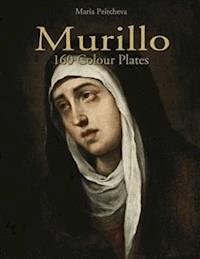
Bartolomé Esteban Murillo (1617 – 1682) was a Spanish Baroque painter. Although he is best known for his religious works, Murillo also produced a considerable number of paintings of contemporary women and children. These lively, realist portraits of flower girls, street urchins, and beggars constitute an extensive and appealing record of the everyday life of his times.
Das E-Book können Sie in Legimi-Apps oder einer beliebigen App lesen, die das folgende Format unterstützen:
Veröffentlichungsjahr: 2016
Ähnliche
Murillo
160 Colour Plates
––––––––
By Maria Peitcheva
––––––––
First Edition
*****
Murillo: 160 Colour Plates
*****
Copyright © 2016 Maria Peitcheva
Table of Contents
Title Page
Copyright Page
Foreword
Paintings
Foreword
Bartolomé Esteban Murillo (1617 – 1682) was a Spanish Baroque painter. Although he is best known for his religious works, Murillo also produced a considerable number of paintings of contemporary women and children. These lively, realist portraits of flower girls, street urchins, and beggars constitute an extensive and appealing record of the everyday life of his times.
Murillo was born to Gaspar Esteban and María Pérez Murillo. He may have been born in Seville or in Pilas, a smaller Andalusian town. It is clear that he was baptized in Seville in 1618, the youngest son in a family of fourteen. His father was a barber and surgeon. His parents died when Murillo was still very young, and the artist was largely brought up by his aunt and uncle.
Murillo began his art studies under Juan del Castillo in Seville. There he became familiar with Flemish painting and the "Treatise on Sacred Images" of Molanus (Ian van der Meulen or Molano). The great commercial importance of Seville at the time ensured that he was subject to influences from other regions. His first works were influenced by Zurbarán, Jusepe de Ribera and Alonzo Cano, and he shared their strongly realist approach. As his painting developed, his more important works evolved towards the polished style that suited the bourgeois and aristocratic tastes of the time, demonstrated especially in his Roman Catholic religious works.
In 1642, at the age of 26, he moved to Madrid, where he most likely became familiar with the work of Velázquez, and would have seen the work of Venetian and Flemish masters in the royal collections; the rich colors and softly modeled forms of his subsequent work suggest these influences. In 1645 he returned to Seville and married Beatriz Cabrera y Villalobos, with whom he eventually had eleven children.
In that year, he painted eleven canvases for the convent of St. Francisco el Grande in Seville. These works depicting the miracles of Franciscan saints vary between the Zurbaránesque tenebrism of the Ecstasy of St Francis and a softly luminous style that became typical of Murillo's mature work.
Also completed c. 1645 was the first of Murillo's many paintings of children, The Young Beggar, in which the influence of Velázquez is apparent. Following the completion of a pair of pictures for the Seville Cathedral, he began to specialize in the themes that brought him his greatest successes: the Virgin and Child and the Immaculate Conception.
After another period in Madrid, from 1658 to 1660, he returned to Seville. Here he was one of the founders of the Academia de Bellas Artes, sharing its direction, in 1660, with the architect Francisco Herrera the Younger. This was his period of greatest activity, and he received numerous important commissions, among them the altarpieces for the Augustinian monastery, the paintings for Santa María la Blanca (1665), and others. He died in Seville in 1682 at the age of 64.
Lesen Sie weiter in der vollständigen Ausgabe!




