


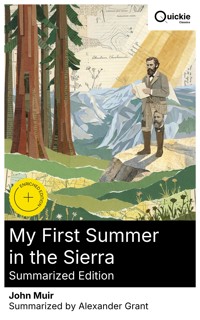
1,99 €
Mehr erfahren.
- Herausgeber: Quickie Classics
- Kategorie: Lebensstil
- Sprache: Englisch
Drawn from Muir's 1869 Sierra Nevada journal, My First Summer in the Sierra recounts a season of shepherding transformed into field science. In compressed daily entries, lyrical yet exact, he maps meadows, sequoias, granite domes, and the glacial architecture of Yosemite and the high country. Emersonian cadences meet taxonomic precision, placing the book within late‑nineteenth‑century American nature writing and early ecological thought. Original drawings and period photographs intensify the immediacy, echoing the textures the prose anatomizes. Scottish-born in 1838 and raised on a Wisconsin farm, Muir trained as an inventor until a blinding 1867 injury redirected him to long foot travels and natural study. Self-taught yet rigorous, he advanced Sierra glacial theory, co-founded the Sierra Club in 1892, and shaped park policy. A Calvinist upbringing gives the journal a sacramental register that fuses observation with praise. Readers of Thoreau and environmental history alike will find here both a primer in mountain ecology and a landmark of American prose. For hikers, teachers, and conservationists, the text and images model attentive seeing and the roots of preservationist ethics. Read slowly; let Muir instruct your gaze. Quickie Classics summarizes timeless works with precision, preserving the author's voice and keeping the prose clear, fast, and readable—distilled, never diluted. Enriched Edition extras: Introduction · Synopsis · Historical Context · Author Biography · Brief Analysis · 4 Reflection Q&As · Editorial Footnotes.
Das E-Book können Sie in Legimi-Apps oder einer beliebigen App lesen, die das folgende Format unterstützen:
Veröffentlichungsjahr: 2026
Ähnliche









My First Summer in the Sierra (Summarized Edition)
Table of Contents
Introduction
At the meeting point of toil and transcendence, this book traces how careful attention to the living world can turn necessity into reverence. My First Summer in the Sierra, by John Muir, is a classic of American nature writing drawn from his 1869 season among the high meadows of California’s Sierra Nevada and first published in 1911. Set primarily in the Yosemite region, it records a months-long ascent with a sheep camp into the subalpine and alpine zones. Part journal, part field notebook, and part spiritual meditation, the work balances observation with rapture while situating natural history within the rhythms of daily labor.
Composed as day-by-day entries, the narrative follows Muir’s duties as a hired hand accompanying a flock, while he uses every interval to study streams, trees, flowers, rocks, weather, and animals. The result is a kinetic diary of trail life that feels immediate and unhurried at once. His voice moves between precise, almost scientific description and an ecstatic register that seeks to honor what science cannot fully hold. The tone is exuberant yet patient, attentive to small changes in light and water. Readers encounter a mind testing instruments and naming species while also practicing a generous, wondering solitude.
Among the book’s central themes are the discipline of attention, the interdependence of living systems, and the capacity of language to shape perception. Muir continually fuses analytic observation with an ethics of care, suggesting that to know a place is to accept obligations toward it. He treats mountains as dynamic processes rather than static scenery, measuring time in tree rings, glacial polish, and the seasonal pulse of snowmelt. The journal also meditates on naming, classification, and the humility of partial knowledge, inviting readers to hold curiosity and restraint together as they approach wild landscapes and their human stories.
Because the entries arise from daily circuits through meadows, ridgelines, and moraines, the setting is experienced through motion, weather, and work. Scenes of cooking, camp chores, and watchkeeping sit beside close readings of bark, granite, pollen, and bird flight, creating a layered portrait of the Sierra Nevada as both home and teacher. Geologic forces and botanical intricacy are rendered with equal care, and the sense of time stretches from afternoon thunderheads to the reach of ice ages. The experience is immersive yet grounded, a companionship with place that rewards readers who listen for pattern within apparent simplicity.
Threaded throughout is an ethical tension between the pastoral labor that brings Muir into the high country and the evident strain livestock places on fragile meadows and watersheds. Without reducing people or animals to symbols, he registers damage alongside delight, forming a seedbed for later arguments about stewardship and public lands. The book emerges from a period when the American West was rapidly transforming, and Muir would become a leading conservation voice and a founder of the Sierra Club. Reading this journal alongside that history clarifies how attentive description can mature into civic responsibility and durable environmental imagination.
For contemporary readers navigating climate disruption, biodiversity loss, and competing claims on land, the book models a way of seeing that joins inquiry with care. Its slow, cumulative method suggests practical habits: keep notes, learn names, watch the weather, return to the same place and notice what changes. Scientists may value its early field sensibility and careful phenomenology; artists and general readers may find the language enlarges wonder without abandoning clarity. The work’s lasting significance lies in its insistence that affection grows from knowledge, and that such affection can guide decisions far beyond a single summer.
This edition presents original drawings and photographs alongside the text, giving tactile context to places, species, and forms that the journal evokes. The images do not explain the prose so much as deepen it, encouraging readers to compare the exactness of visual detail with the cadence of Muir’s sentences and the cadence of the trail itself. Together, words and images illuminate a formative encounter between a working naturalist and a monumental landscape. Approach it as a companionable walk: attentive, unhurried, mindful of limits. What unfolds is a record of seeing that continues to shape how we inhabit shared ground.
Synopsis
John Muir’s My First Summer in the Sierra, drawn from his 1869 field journals and first published in 1911, recounts his initial season exploring the Sierra Nevada while tending a flock of sheep. The narrative follows his movement from California’s Central Valley into the granitic high country around Yosemite, tracking day-by-day observations of terrain, plants, animals, and weather. Working as a shepherd gave him unusual freedom to wander from camp and record what he saw. The edition with original drawings and photographs complements the text’s observational focus, underscoring Muir’s aim to document a living landscape with both descriptive precision and quiet wonder.
In early June, Muir ascends from the foothills into rising belts of oak, pine, and fir, noting how elevation alters temperature, light, and plant communities. He sketches meadow structure, stream behavior, and soil moisture, setting baseline conditions for the season. The practical demands of herding shape each day, yet he turns routine tasks into study, collecting specimens, recording plant forms, and tracing watercourses from spring to cascade. The journal’s cadence emerges: a blending of natural history, travel log, and reflective practice. He emphasizes close attention, pairing precise naming when possible with careful description of patterns, growth, and habitat.
As the party approaches the Yosemite region, granite domes, polished pavements, and clear streams dominate his entries. Camps shift among forested benches and flowered meadows, with Muir using early and late hours to roam while the flock rests. He studies bark patterns, cone forms, and the architecture of pines and firs, relating tree stature to slope, snow, and wind. Waterfalls and cascades become laboratories for observing spray, erosion, and mosses. The rock’s smooth contours prompt comparative notes on ice action, and he begins to assemble evidence that past glaciers, rather than catastrophic floods alone, carved much of the landscape.
Building on these hints, Muir methodically records glacial polish, striations, perched boulders, and moraines, arranging them into a coherent account of valley formation. He contrasts river-cut canyons with the broad profiles he sees in cirques and high basins, proposing sequences of advance, stasis, and melt. The journal balances hypothesis with observation, returning repeatedly to particular slabs, ridges, and tarns to test ideas against the ground. This emphasis on process reshapes his understanding of Yosemite’s walls and meadows, anchoring a key strand of the book: that careful fieldwork can illuminate large geological stories without recourse to grand speculation.
By mid-summer the drive reaches higher elevations, where thin soils, stunted trees, and broad meadows mark the subalpine zone. Days lengthen into long rambles over open granite, with sudden thunderstorms clearing the air and renewing streams. He remarks on seasonal succession—early snowmelt flowers giving way to later blooms—and follows insect traffic between clustered blossoms. Camp life remains spare: simple meals and the practical routines of guarding and moving the flock. The relative isolation affords stretches of solitary study, and he refines a practice of sketching outlines first, then adding botanical and geological detail as time and light permit.
Whenever work allows, Muir makes solitary scrambles to nearby summits and domes, using elevation to read the country’s structure. From these vantage points he traces watersheds, aligns distant peaks, and notes how meadows occupy glacial basins linked by stair-stepped streams. He compares forest belts across aspects, observing how exposure and snow depth influence species and form. The climbs are practical as well as reflective, granting him bearings for future excursions and a broader canvas for his notes. These chapters emphasize orientation—how knowledge accumulates when short forays interlock, each view sharpening the pattern of rock, water, soil, and life.
Close observation of animals fills many entries: birds weaving through streamsides, small mammals claiming logs and talus, and insects marking the hours of heat and shadow. Muir often follows tracks and feeding signs to reconstruct habits. He also measures the impact of grazing, comparing trampled ground and cropped shoots with nearby undisturbed patches. The contrast troubles him, and he returns to it throughout the season, weighing pastoral use against the resilience of meadows and forests. This ecological attention extends to fire and weather as well, as he notes how disturbance can both damage and renew, depending on timing, intensity, and scale.
As summer wanes, frost silvering the grasses signals a turning point. Streams shrink to threads and the highest flowers set seed, while birds shift their ranges and quiet the mornings. The party angles downslope toward lower camps, retracing parts of the route and revisiting favored outcrops and pools. Muir takes stock of the season’s notes, drawings, and measurements, shaping them into more connected reflections on form and change. In editions that pair the text with drawings and photographs, these images echo the journal’s method, inviting readers to see the relationships among rock, water, plant, and light that organize his account.




