


1,99 €
Mehr erfahren.
- Herausgeber: Quickie Classics
- Kategorie: Sachliteratur, Reportagen, Biografien
- Sprache: Englisch
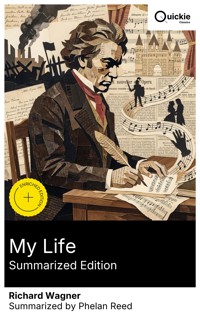
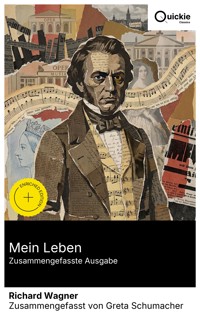
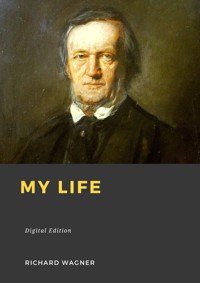
My Life is Wagner's expansive autobiography, tracing precarious youth, Parisian failures, the 1849 upheaval and exile, and the genesis of Rienzi, Tannhäuser, Lohengrin, Tristan und Isolde, and the Ring. Dictated in a theatrical cadence, it blends confession and apologia with deliberate myth‑making: debts, flights, and sudden patronage are staged like scenes. He notes working methods, leitmotivic experiments, and the ideal of the Gesamtkunstwerk, alongside gossip and grievance. In the era's culture of artistic self‑fashioning, it doubles as politics of memory, including troubling polemics and self‑exonerations. Composer, conductor, and polemicist (1813–1883), Wagner wrote amidst upheaval: the Dresden uprising sent him to Zurich, where he forged theories and composed much of the Ring. Dependent on patrons—most fatefully King Ludwig II—and on Cosima's collaboration, he turned to autobiography in the mid‑1860s to consolidate reputation, instruct adherents, and answer detractors. Dictated to Cosima and privately printed in limited copies before wider release, it mirrors Bayreuth's vow to bind art, life, and legacy. Read critically yet generously, My Life yields unmatched access to a working imagination: workshop detail for opera lovers, context for historians, and a case study in artistic self-fashioning. Essential for musicologists, performers, and readers of nineteenth‑century culture. Quickie Classics summarizes timeless works with precision, preserving the author's voice and keeping the prose clear, fast, and readable—distilled, never diluted. Enriched Edition extras: Introduction · Synopsis · Historical Context · Author Biography · Brief Analysis · 4 Reflection Q&As · Editorial Footnotes.
Das E-Book können Sie in Legimi-Apps oder einer beliebigen App lesen, die das folgende Format unterstützen:
Veröffentlichungsjahr: 2026
Ähnliche


My Life (Summarized Edition)
Table of Contents
Introduction
My Life turns a composer’s pursuit of artistic unity into a chronicle of self-making amid a volatile nineteenth-century Europe. Richard Wagner’s autobiography, known in German as Mein Leben, stands within the broad tradition of life-writing that merges personal history with artistic reflection. Dictated across years in the later nineteenth century, it first circulated privately before wider publication. Its settings span the cultural centers of Central Europe, where opera houses, salons, and political currents intersect. The book presents not only the trajectory of a celebrated composer but also the forging of an artistic identity shaped by travel, collaboration, conflict, and aspiration in an era of intense cultural change.
The premise is straightforward yet capacious: Wagner narrates his origins, apprenticeships, struggles for recognition, and evolving artistic convictions, presenting his life as the matrix from which his works arise. The voice is expansive and rhetorical, alternating between intimate confession and public manifesto. Readers encounter digressions on theater practice, musicianship, and the pressures of patronage, alongside scenes of rehearsal rooms and city streets. The style rewards patient attention, moving from anecdote to argument with operatic flair. Without relying on technical jargon, the tone assumes a musically literate audience, inviting them into a self-portrait that doubles as a workshop of ideas.
Key themes emerge early and persist: the tension between artistic independence and institutional power; the hazards and uses of exile; the allure and risk of patronage; and the composer’s proprietorship over his own legend. My Life continually asks who gets to narrate an artist’s life—the subject, the public, or posterity—and how that authority is won. Wagner highlights the practical demands of mounting large-scale works while framing those labors within a vision of art as a transformative social force. The result is a sustained meditation on ambition, loyalty, reputation, and the price of turning one’s life into an aesthetic project.
The book’s geographic and social map amplifies those concerns. From German stages to cosmopolitan circles abroad, Wagner portrays a Europe of border-crossing musicians, impresarios, and critics whose fortunes rise and fall with political tides. Cities function as characters: places of opportunity, rivalry, and reinvention. Operatic institutions emerge as ecosystems where conductors, singers, craftsmen, and patrons negotiate tastes and resources. Without dwelling on private scandal, the narrative suggests how artistic networks form and fracture, and how travel—forced or chosen—reshapes a creative voice. Through this panorama, readers see how a composer navigates both marketplace and court, both rehearsal hall and public square.
As autobiography, My Life also behaves like an aesthetic treatise. Wagner explains the labor of composition in concrete terms—rehearsals, orchestral color, stage mechanics—while connecting those details to a larger ideal of unified drama, poetry, and music. He describes craft not as a private mystery but as a public responsibility: a promise to audiences and collaborators that artistic form can reflect human experience at scale. The prose is often argumentative, but its insistence is part of the performance, making the book an artifact of nineteenth-century artistic debate as much as a record of one career’s twists and turns.
For contemporary readers, the work remains resonant because it dramatizes questions that still animate cultural life: how artists fashion public identities, how they rationalize choices under pressure, and how institutions shape what gets heard. It foregrounds the ethics of influence and the economics of creation, illuminating the bargains that sustain ambitious art. The narrative’s self-awareness—its acknowledgment of narrative control and selective emphasis—invites a critical reading without requiring prior specialized knowledge. In an age of memoir, brand-building, and cultural contention, Wagner’s account offers a case study in the uses and limits of artistic self-explanation.
Approached as both story and argument, My Life provides an immersive, spoiler-safe entry into the world that produced some of the nineteenth century’s most debated works. It rewards readers interested in biography, music history, and the sociology of the arts, while remaining accessible as a study of ambition under constraint. The book matters now because it demonstrates how personal narrative can shape reception long after a premiere, and because it models a fierce—sometimes uncomfortable—honesty about artistic aims. To read it is to witness the making of a persona and to consider how such making continues to influence cultural conversations today.
Synopsis
My Life is Richard Wagner’s autobiographical account, dictated in the later decades of the nineteenth century and initially intended for private circulation. It opens with his childhood in Leipzig and Dresden, describing a household steeped in theater through his stepfather’s profession and the cultural life of the time. Wagner recalls early schooling, voracious reading, and first encounters with music that prompted an ambition to write for the stage. The narrative frames these formative years as a steady shift from literary aspirations to composition, culminating in the awakening force of orchestral sound and the conviction that drama and music should be fused in a single, living art.
The memoir moves into Wagner’s youth as a budding composer, recounting student days in Leipzig and the gradual acquisition of technique through study and disciplined practice. He sketches his earliest attempts at opera, the lessons gleaned from choral and theatrical work, and the excitement of hearing major repertoire performed. Small professional posts lead him to practical stagecraft and the realities of rehearsal rooms. Wagner emphasizes how these experiences shaped his sense of pacing, declamation, and musical rhetoric, while also hinting at the ambitions that quickly exceeded the limited means and routine expectations of provincial theater life.
Wagner then describes his entry into the jobbing world of German opera houses, the challenges of unreliable companies, and his marriage to the actress Minna Planer. Moves to different cities bring unstable contracts and debts, culminating in an escape from creditors and a storm-tossed voyage that deposits him in Paris. There he tries to gain a foothold amid the prestigious institutions of French grand opera. He recalls meetings with well-known musicians, strenuous arranging and copying work, and the conception of large-scale projects, all against a backdrop of poverty, delayed hopes, and a growing impatience with prevailing operatic fashions.
A breakthrough arrives when a major opera of his is accepted for production in Dresden, opening the door to a court conducting appointment. Wagner narrates the rehearsals and premiere preparations in granular detail, portraying the balance between administrative obligation and artistic drive. Subsequent works follow, each grappling with mythic subjects and the demands of a newly assertive orchestral language. He records the pressures of public taste, the volatile climate of criticism, and his evolving conviction that music must grow organically from the drama rather than adorn it, laying the groundwork for a developing theory of music drama.
Political upheaval interrupts this ascent. Wagner recounts his involvement with revolutionary circles, the failure of the uprising, and his flight into exile. Switzerland becomes the anchor for a new phase of reflection and creation. He writes programmatic essays that argue for the unity of the arts and the regeneration of theater, and he begins conceiving a far-reaching mythological cycle. The memoir details friendships, patronage, and the labor of drafting poems and scores, while acknowledging strains in his domestic life. Throughout, he links creative progress to a broader cultural critique that seeks renewal beyond the opera customs he has come to reject.
Philosophical discovery shapes the next stage, as Wagner encounters ideas that deepen his thinking about desire, renunciation, and musical expression. He charts the genesis of a tragic love drama that demands unprecedented vocal and orchestral intensity, alongside continued work on segments of the mythic cycle. Travels to various cities bring attempts to secure performances, including a contested Paris staging that crystallizes his mistrust of certain operatic institutions. The memoir weighs failure and resolve in equal measure, presenting setbacks not as detours but as clarifying tests of artistic purpose and practical strategy.
Amnestied from political penalties, Wagner resumes contact with German theaters and musical allies. The narrative highlights the support of eminent performers and conductors, new friendships, and a deepening relationship that will figure prominently in his personal life. He traces the conception of a comic yet serious masterwork rooted in guild traditions and communal artistry, while continuing long-range plans for his cycle. Administrative burdens, controversies over rehearsal methods, and money troubles persist. Yet he insists on the need for dedicated conditions—capable ensembles, coherent staging, and thoughtful criticism—to bring his envisioned synthesis of music and drama to life.
A decisive change arrives when royal patronage extends an invitation and financial relief, allowing Wagner to relocate and work under protection. He describes courtly expectations, local politics, and the renewed possibility of realizing large projects, including the recent love tragedy and the comedy of masters. This influx of support brings its own frictions with the press and the public, and the memoir recounts quarrels, withdrawals, and returns with a plainness that is both defensive and revealing. The tone oscillates between gratitude and impatience as he argues for institutions willing to risk discomfort for artistic integrity.
The book closes near this turning point, with Wagner poised between vindication and unfinished ambitions. He looks toward completing an expansive cycle and imagines a properly equipped venue to present it as a communal experience rather than mere entertainment. My Life thus fuses itinerary, workshop notebook, and polemic: a chronicle of theaters entered and left, allies gained and lost, and ideas tested against circumstance. Its broader significance lies in the firsthand portrait of a nineteenth-century composer redefining opera’s aims, while reminding readers that the narrative—rich in insight and bias alike—remains a self-fashioned lens on a transformative career.
Historical Context
In 1813, amid the Napoleonic upheavals and the reorganization of Central Europe, Richard Wagner was born in Leipzig, a trade and university city within the post‑1815 German Confederation. The city’s musical institutions, notably the Thomaskirche and the Gewandhaus, embodied a canon-centered tradition shaped by Sebastian Bach’s legacy and the concert culture of the early nineteenth century. Romanticism’s expansion, the rise of German literary nationalism, and the network of court theaters provided the environment in which Wagner was educated and first worked. This setting grounded his lifelong engagement with institutional music-making while sharpening his ambition to reform opera as a culturally unifying art.
Early professional life unfolded across precarious provincial stages that typified German theatrical production before unification. Wagner held posts or engagements in Würzburg, Magdeburg, Königsberg, and Riga during the 1830s, learning repertory under tight budgets and unstable management. Debt and professional frustration drove him to Paris in 1839, then Europe’s operatic capital dominated by grand opéra and the Paris Opéra’s patronage system. Encounters with Giacomo Meyerbeer’s influence and the machinery of French spectacle clarified Wagner’s opposition to prevailing taste. The perilous sea voyage to London en route to Paris, often cited by Wagner, later fed his maritime imagination and artistic myth-making.
After Paris disappointments, Wagner reoriented his career in Dresden, capital of the Kingdom of Saxony. Rienzi premiered there in 1842, opening doors to his appointment as one of the Royal Saxon Court Theatre’s Kapellmeisters in 1843. The Flying Dutchman followed in 1843, and Tannhäuser in 1845, as Wagner advanced ideas about continuous musical drama against established operatic numbers. Dresden’s court opera offered resources, a disciplined orchestra, and ceremonial responsibilities, but also critics and bureaucratic constraints. These years consolidated his reputation and intensified his critique of operatic convention, positioning him within a broader German debate about tradition, innovation, and national culture.
The European revolutions of 1848–1849 overturned many German states’ routines and reshaped Dresden’s politics. Wagner moved within radical democratic circles and participated in the 1849 uprising that briefly seized parts of the city. When Saxon and Prussian forces suppressed the revolt, a warrant forced his flight into exile, aided by friends including Franz Liszt. The repression that followed silenced many theatres, tightened surveillance, and scattered artists across borders. This crisis reframed Wagner’s thinking about art’s social mission, linking aesthetic reform to political transformation. My Life recounts these events to explain his break with court service and the ensuing years abroad.
Exile in Zurich, then a refuge for political émigrés, became Wagner’s laboratory for theory and long-form projects. There he published Art and Revolution and The Artwork of the Future, arguing for a communal, integrative theatre. Opera and Drama (1851) laid out dramaturgical principles behind the Ring des Nibelungen, whose poetic texts he drafted in the early 1850s. From 1854 he engaged deeply with Arthur Schopenhauer’s philosophy, bearing on Tristan und Isolde’s conception. Supported by Zurich’s bourgeois patrons, notably the Wesendoncks, he composed while lacking a permanent institutional stage. These conditions fostered independence from court theatres and sharpened his polemical voice.
Wider German musical networks sustained Wagner’s visibility during exile. In Weimar, under the court’s patronage and Franz Liszt’s advocacy, Lohengrin premiered in 1850, keeping Wagner in the public ear despite his absence. The 1850s witnessed polemics between the so‑called New German School, associated with Liszt and Wagner, and more conservative currents championed elsewhere. Critics debated program music, symphonic innovation, and the future of opera in journals like the Neue Zeitschrift für Musik. Wagner’s own controversies, including the pseudonymous 1850 essay Jewishness in Music and its expanded 1869 version, reveal the era’s fractious discourse and his combative self-justification.
Amnestied by Saxony in 1862, Wagner returned to the German states amid accelerating national consolidation and expanding railway-linked cultural markets. He struggled with debts and sought institutional backing to realize his evolving music dramas. A decisive turn came in 1864 when the young King Ludwig II of Bavaria summoned him to Munich, paid pressing liabilities, and offered court protection. Ludwig’s patronage enabled performances with first‑rate forces and new rehearsal standards, while provoking public controversy and ministerial resistance. This royal sponsorship frames the point at which My Life’s narrative closes, situating Wagner between embattled innovator and officially sanctioned reformer within a modernizing monarchy.
Wagner began dictating My Life in 1865, soon after Ludwig’s intervention, and continued through 1880 with Cosima Wagner recording and editing. Intended for private circulation, the autobiography was printed in a very limited edition at royal expense and remained largely inaccessible until a public edition appeared in 1911. The work blends detailed recollection with advocacy for his artistic program, portraying institutions—Paris Opéra, German court theatres, the press—as forces to overcome or convert. It registers the shocks of 1848, the exile networks, and shifting patronage from courts to bourgeois audiences. In doing so, it both mirrors and critiques nineteenth‑century Europe’s cultural transformations.
Author Biography
Richard Wagner (1813–1883) was a German composer, dramatist, conductor, and theorist whose operatic innovations reshaped European music and theater in the nineteenth century. Active across the tumultuous decades surrounding the 1848 revolutions and the rise of German nationalism, he pursued a reform of opera into what he called music drama, integrating poetry, staging, and orchestral design. His works—spanning early Romantic grand gestures to harmonically adventurous later scores—prompted fervent devotion and intense controversy. Wagner also built an institutional framework for his art in the Bayreuth Festival, ensuring controlled performance conditions. His writings and music left a long, complicated legacy that still provokes engagement.
Raised in Leipzig, Wagner attended local schools and briefly enrolled at the University of Leipzig, focusing increasingly on music and theater. He studied composition with the Thomasschule cantor Christian Theodor Weinlig, whose tutelage grounded him in counterpoint and large-form writing. Early inspirations included Beethoven’s symphonic example and the German Romantic operas of Carl Maria von Weber, as well as the spectacle of French grand opera associated with Giacomo Meyerbeer. Wagner absorbed literary influences from classical tragedy and German medieval sources, which later fed his librettos. In the 1850s he read Arthur Schopenhauer, whose philosophy decisively shaped his mature aesthetics and musical rhetoric.
Before achieving wider prominence, Wagner held conducting and theatrical posts in several German and Baltic cities, gaining practical experience with singers, orchestra, and stagecraft. He composed the grand opera Rienzi, premiered in Dresden in 1842, which brought him attention. The Flying Dutchman followed, drawing on nautical legends, and then Tannhäuser, both premiered in Dresden during the 1840s. Lohengrin, completed before his exile, received its first performance in Weimar in 1850 under the advocacy of Franz Liszt, while Wagner was unable to attend. These works established a strengthening orchestral role and recurring motives, even as critical responses ranged from ardent support to strenuous objection.
Appointed Royal Saxon Court Conductor in Dresden in the 1840s, Wagner rose to a prominent institutional role. His political engagement during the 1849 uprising in Dresden forced him into exile, and he settled for years in Switzerland. There he wrote major theoretical essays—including Art and Revolution, The Artwork of the Future, and Opera and Drama—articulating the ideal of the Gesamtkunstwerk, or total work of art. He drafted the librettos for the tetralogy Der Ring des Nibelungen and began composition. During this period he also published the polemical Judaism in Music, an anti-Semitic text that remains a central and troubling aspect of his legacy.
Wagner’s fortunes changed when King Ludwig II of Bavaria became his patron in the 1860s, enabling debts to be addressed and ambitious projects revived. This support facilitated the Munich premieres of two landmark works: Tristan und Isolde in 1865 and Die Meistersinger von Nürnberg in 1868. Tristan’s chromatic language challenged prevailing tonal norms and influenced subsequent composers, while Meistersinger offered a contrasting vision anchored in German civic and musical tradition. These scores also refined his leitmotif technique and an ‘endless melody’ approach to vocal writing. Public and critical responses remained polarized, amid debates about aesthetics, performance logistics, and finances.
Determined to create a venue tailored to his ideals, Wagner oversaw construction of the Festspielhaus in Bayreuth, a theater with a recessed orchestra pit and acoustics designed for his scores. In 1876 the first Bayreuth Festival presented the complete Ring cycle: Das Rheingold, Die Walküre, Siegfried, and Götterdämmerung. The event drew international attention and set a precedent for festival-based repertory performance. Bayreuth also fostered disciplined staging and orchestral standards under Wagner’s supervision. Cosima Wagner played an increasing organizational role, helping to institutionalize the festival’s practices and interpretive traditions that would shape the reception of his works long after the composer’s death.
Wagner’s final years centered on Bayreuth and the completion of Parsifal, a work with a sacred subject that premiered at the festival in 1882. He died the following year in Venice and was buried in Bayreuth, which remained the focal point for performances of his operas. His influence radiated across music, theater, and film, from the harmonic expansions taken up by Bruckner, Mahler, and Richard Strauss to leitmotivic techniques in modern scoring. At the same time, his writings and their later political appropriations have prompted persistent ethical scrutiny. The Bayreuth Festival continues, reflecting both the artistic achievements and the complexities of his legacy.
My Life (Summarized Edition)
PART I 1813-1842
I was born in Leipzig on 22 May 1813 in the ‘Red and White Lion[1]’, baptized two days later at St. Thomas’s[2] as Wilhelm Richard. My father, police clerk Friedrich Wagner, aimed at the chief constableship, yet the Battle of Leipzig[3]’s turmoil and a raging fever killed him that October. His friend, actor-painter Ludwig Geyer[4], married my widowed mother within a year, moved us to Dresden, and became head of our brood of seven. Court portrait commissions and a steady engagement at the new Court Theatre improved his fortunes; he placed me in school under his own surname, so until fourteen I answered to Richard Geyer.
Living with Geyer I dabbled in paints, copying King Frederick Augustus, but a pedantic cousin soon killed my zeal. After a wasting illness that nearly ended me, Geyer’s steady hope brought me back to vigor. The stage amazed me: from a magic box I watched him stalk as villains in Die Waise und der Mörder[5] and Die beiden Galeerensklaven, then I joined the play. Winged and tight-clad I posed as an angel in Der Weinberg an der Elbe, devoured a huge iced cake "sent by the King," and later spoke lines in Kotzebue’s Menschenhass und Reue[6], boasting at school of glorious rehearsals.
At six I boarded with Pastor Wetzel in Possendorf; evenings brought Robinson Crusoe, Mozart’s life, and bulletins from the Greek revolt that fired my love for Hellas. A year later a messenger reported Geyer dying. Wetzel walked me hours to Dresden; doctors battled hydrothorax[7] while I played "Üb’ immer Treu und Redlichkeit" next door. He whispered, "Is it possible he has musical talent?" and died before dawn. Mother sobbed, "He hoped to make something of you." Back in Possendorf I was recalled for the funeral; Geyer’s brother promised schooling and carried me to Eisleben. Years later Wetzel’s grave and a parsonage rebuild ended my returns.
My step-father’s younger brother, a goldsmith in Eisleben, took me in; Julius was already apprenticed to him, and our frail grandmother shared the dark back room that overlooked a narrow court. The servant snipped the mourning crape from my coat, whispering she would restore it when the old woman died. I entertained Grandmother with tales and brought new robins after the cat’s raids, and she kept me neat until her expected death, when the crape returned and I moved downstairs to the soap-boiler’s household, charming them with stories. I attended Herr Weiss’s school and later thrilled to read of his presence at a Tannhäuser concert.
Memories of the old market echoed vividly: Luther’s relics, acrobats strung a rope from tower to tower, and their daring made me practise on a cord I twisted across our yard until I could cross it with a pole. I adored the Hussar band blaring the fresh “Huntsmen’s Chorus” and debated its composer Weber with my uncle and brother; neighbours sang the Jungfernkranz, and those tunes displaced my beloved “Ypsilanti” Waltz. Scuffles over my square cap and expeditions along the Unstrut spiced the days. After my uncle married, he carried me to Leipzig, lodging me in rococo rooms whose powdered-lady portraits robbed me of sleep.
Plump Jeannette, my angular aunt, and Uncle Adolph shared the floor. He sat in a dark den, pointed felt cap amid books. Forsaking the Church, he earned a living from pen, charmed with his tenor, visited Schiller about Wallenstein and blushed at praise for juvenile poems, then issued Parnasso Italiano, for which Goethe sent a silver cup. To me, eight, he was a riddle. Soon he took me back to Dresden: Albert joined the Breslau opera, Louisa and Clara trained for the stage, Rosalie sustained Mother, even letting rooms to guests like Spohr, and I entered Kreuz School[9] at the lowest class.
My mother watched every hint of talent I showed. She came from Weissenfels, called herself “Perthes” though the name was Bertz, had baker parents, and owed her Leipzig boarding-school to “her father’s influential friend,” a Weimar prince who died suddenly. She married my father, later gaining the regard of Ludwig Geyer, who painted her. Humorous and devout, she preached and warned, “I’ll curse you if you touch the stage!” Each dawn after Geyer died she had us read a hymn before coffee; when Clara chose “Prayer to be said in time of War,” Mother cried, “Oh, stop! Gracious me! There’s no war on at present
Though funds were scarce, our house stayed lively. Friends from my stepfather’s prosperous painting days—Court-Theatre actors among them—filled our evening gatherings, and we picnicked at Loschwitz where Carl Maria von Weber cheerfully cooked at a gypsy campfire. At home Rosalie played piano while Clara tried her voice. Hoping to astonish everyone, I unearthed Geyer’s toy theatre, painted new scenery, clumsily carved puppets, and wrote a chivalric drama. My sisters discovered the script, roared with laughter, and for weeks teased me by repeating the heroine’s line, “Ich hore schon den Ritter trapsen,” until I abandoned the project.
Den Freischütz[8], with its spectres, stirred my imagination. I shivered at furniture that seemed alive, woke nightly from ghostly dreams shrieking for help, and was banished to a distant bed so others could sleep. Yet the fear drew me to backstage shadows: a painted bush, a mask, even my sisters’ silks felt like portals to another realm, my pulse racing at their touch. Growing among women sharpened that longing, but school provided steadier ground. I devoured eerie tales, ignored arithmetic, tolerated Latin, and clung to Greek, yearning to hear its heroes speak, even while grammar stood in the way.
My patchy language study soon dulled; only Grimm’s newer philology later rekindled interest, yet too late. Still, school translations and poems won Master Sillig’s favour. He had twelve-year-old me recite “Hector’s Farewell” and Hamlet’s soliloquy, and when classmate Starke dropped dead the headmaster demanded a memorial poem. Mine, dashed off, was rejected with the rest; distressed, I ran to Sillig. Together we trimmed bombast, laughing when he found my borrowed line, “The stars shall fade away, the sun himself grow dim with age, and nature sink in years.” Revised, the verses pleased the headmaster, were printed, and circulated.
Success convinced my family and me that poetry was my fate; Mother folded her hands in thanks while Sillig urged a grand epic on the Muses’ rescue of Delphi. I began the hexameters yet never finished the first canto, just as a tragedy on Ulysses’ death soon stalled. Greek myths, history, and dreams of theatre consumed me; I forged intense school friendships for verse, pranks, or wanderings. In 1820 Rosalie’s Prague engagement uprooted the household; I stayed in Dresden, lodging with the rough Bohmes. Study waned amid horseplay, quarrels, and the thrilling nearness of their grown daughters, whose arms carried a feigned-sleeping boy to bed.
Mother fetched me through blinding winter; three bone-numbing days in a hackney carriage over Bohemian mountains ended in glorious Prague. Foreign speech, peaked bonnets, roadside shrines, native wine, and the city’s antique splendor thrilled my theatrical soul. Ottilie shone within the aristocratic Pachta circle, while elegant Marsano and other wits debated Hoffmann’s eerie stories at our rooms, planting lifelong fascination. Next spring Rudolf Bohme and I marched there on foot: blisters near Teplitz, a wagon ride to Lowositz, empty purses, scorching bypaths. At dusk I begged alms from a passing coach, bought supper not a bed, and shared the inn with a harpist homeward bound.
My spirits soared beside a jovial harpist shouting "non plus ultra." He lent me two twenty-kreutzers; we emptied Czernosek wine while he thrashed his harp and repeated the motto until collapsing on straw. Dawn couldn’t rouse him, so my companion and I trudged on, sure he’d catch up; weeks later he visited my mother seeking news, not repayment. The march was hard, yet the hilltop sight of Prague felt like ecstasy. Near the suburb a carriage stopped; Ottilie’s friends knew me despite my burnt face, blue blouse, red cap. Ashamed, I hid two days under parsley, then left Prague weeping and reached Dresden unremarkably.




