



0,49 €
Mehr erfahren.
- Herausgeber: Booksell-Verlag
- Kategorie: Krimi
- Sprache: Englisch
The "MYSTERY CLASSICS Boxed Set - Earl Derr Biggers Edition (Illustrated)" presents a captivating collection of Biggers' seminal works, encapsulating the hallmark blend of intrigue, wit, and charm that characterizes his writing. Esteemed for his pioneering role in the detective fiction genre, Biggers created memorable characters, notably the beloved detective Charlie Chan, whose investigations delve into the complexities of human nature amidst rich cultural tapestries. The illustrated edition enhances the reader's experience, intertwining visual art with the gripping narratives, thus elevating the literary context of early 20th-century mystery stories that often reflected societal norms and cultural dynamics of the time. Earl Derr Biggers (1884-1933) emerged as a significant figure in American literature during a period ripe with interest in both crime narratives and Asian-themed stories. His travels, exposure to diverse cultures, and personal experiences during a transformative era effectively informed his storytelling. Biggers' creation of Charlie Chan, an astute Chinese-American detective, not only provided a counterpoint to the typical Western heroes of his day but also explored themes of racial identity and stereotypes, showcasing his nuanced understanding of cultural representation. Readers seeking immersive, intellectual, and entertaining tales will find the "MYSTERY CLASSICS Boxed Set" an invaluable addition to their literary library. This collection not only embodies the essence of classic mystery fiction but also invites reflection on cultural dialogues that persist today. Ideal for both new enthusiasts and seasoned fans of the genre, Biggers' works resonate with timeless appeal and deserved recognition. In this enriched edition, we have carefully created added value for your reading experience: - A comprehensive Introduction outlines these selected works' unifying features, themes, or stylistic evolutions. - A Historical Context section situates the works in their broader era—social currents, cultural trends, and key events that underpin their creation. - A concise Synopsis (Selection) offers an accessible overview of the included texts, helping readers navigate plotlines and main ideas without revealing critical twists. - A unified Analysis examines recurring motifs and stylistic hallmarks across the collection, tying the stories together while spotlighting the different work's strengths. - Reflection questions inspire deeper contemplation of the author's overarching message, inviting readers to draw connections among different texts and relate them to modern contexts. - Lastly, our hand‐picked Memorable Quotes distill pivotal lines and turning points, serving as touchstones for the collection's central themes.
Das E-Book können Sie in Legimi-Apps oder einer beliebigen App lesen, die das folgende Format unterstützen:
Veröffentlichungsjahr: 2024
Ähnliche


















MYSTERY CLASSICS Boxed Set - Earl Derr Biggers Edition (Illustrated)
Table of Contents
Introduction
This boxed set assembles a comprehensive survey of Earl Derr Biggers’s signature mystery writing, bringing together his celebrated early standalones alongside the complete cycle of Charlie Chan novels. Rather than attempting a total “collected works,” the volume concentrates on the books that established his reputation for ingenious puzzles, humane humor, and cosmopolitan settings. Readers can follow his development from playful, high-concept premises to the mature craftsmanship of the Chan series. Presented as an illustrated edition, the collection offers a unified reading experience intended both for newcomers seeking a definitive gateway and for longtime admirers revisiting Biggers’s most enduring achievements.
The contents are novels, and the range of modes within that single form is notable. Seven Keys to Baldpate showcases a locked-doors-and-double-crosses premise with comedic overtones. Love Insurance blends romantic comedy with caper mechanics. Inside the Lines turns on espionage-inflected suspense. The Agony Column (Second-Floor Mystery) experiments with epistolary devices and misdirection. Fifty Candles is a crime-and-puzzle narrative shaped by questions of identity and motive. The House Without a Key and its five successors introduce a sustained detective series, with each novel delivering a distinct investigation. Collectively, these books demonstrate how Biggers stretched mystery fiction to accommodate wit, romance, and adventure.
The early standalones reveal Biggers testing forms and tones with striking assurance. He delights in theatrical setups that invite multiple interpretations, then patiently clarifies them through plausible human behavior rather than mere contrivance. A hotel, an office, a city street, a mail column—everyday spaces and media become stages for surprise. The comic charm of Love Insurance and the letter-driven intrigue of The Agony Column demonstrate his confidence with dialogue and structure, while Seven Keys to Baldpate and Fifty Candles refine his sense of pacing and clue placement. These experiments supply the toolkit he would later apply with exceptional control in series form.
The six Charlie Chan novels—The House Without a Key, The Chinese Parrot, Behind That Curtain, The Black Camel, Charlie Chan Carries On, and Keeper of the Keys—anchor the collection with a sustained portrait of a detective whose method blends patient observation with quiet rigor. Based in Honolulu and sometimes traveling farther afield, Chan engages mysteries that pivot on character, opportunity, and concealed histories. Biggers’s approach favors legible motives, credible alibis, and tidily orchestrated revelations. The series balances urbane humor with fair-minded detection, inviting readers to puzzle alongside the sleuth while enjoying richly evoked milieus that change from book to book.
Across these novels, unifying themes emerge. Identity—assumed, concealed, or misunderstood—propels investigations, as do the everyday instruments of communication that shape perception: letters, newspapers, rumors, and witness talk. Obsession and chance intersect with design; coincidence tempts, but causality ultimately rules. Hospitality spaces—inns, houses, ships, theaters—recur as social microcosms where strangers reveal themselves under pressure. Moral legibility matters: crimes are not merely puzzles to be solved but catalysts for clarifying loyalties, ambitions, and regrets. Biggers sustains a tone of civility even in danger, allowing surprise to flourish without sacrificing plausibility or the essential dignity of his characters.
Stylistically, Biggers combines crisp pacing with lucid, conversational prose. He favors cleanly planted clues, lightly worn erudition, and dialogue that advances both character and plot. Humor works in service of mystery rather than at its expense, and romance appears as grace note rather than detour. Several works reflect the period in which they were written, including attitudes and portrayals characteristic of early twentieth-century popular fiction. Readers may encounter language or assumptions of their time; approaching them critically allows appreciation of Biggers’s craft while acknowledging historical context. The result is fiction that is accessible, brisk, and carefully engineered to reward attention.
Taken together, these novels show why Biggers remains a vital figure in classic mystery. The standalones provide a laboratory of narrative ingenuity; the Charlie Chan cycle refines that ingenuity into a coherent method that shaped popular expectations for fair-play detection. The collection offers multiple pathways: read chronologically to trace craft, thematically to compare variations on deception and identity, or sequentially through the Chan novels for cumulative resonance. Whether for sustained study or leisurely enjoyment, this edition presents a durable body of work that entertains first and continues to yield insights about character, culture, and the elegant mechanics of storytelling.
Historical Context
Earl Derr Biggers (1884–1933), born in Warren, Ohio, and educated at Harvard (A.B., 1907), began as a drama critic for the Boston Traveler before turning to fiction. From Seven Keys to Baldpate (1913) through Keeper of the Keys (1932), his career traced the United States’ passage from Progressive Era optimism through the First World War and into the early Great Depression. He wrote for mass-circulation magazines, notably The Saturday Evening Post, whose serializations brought his mysteries to a national middle-class audience. Biggers’ novels quickly entered a transmedia circuit: stage adaptations flourished on Broadway and on tour, and during the 1920s–early 1930s Hollywood studios converted his plots into widely seen films, amplifying their cultural footprint.
In the prewar years shaping his earliest mysteries, Progressive Era faith in efficiency and leisure converged in resorts, grand hotels, and rail-linked mountain retreats that served as social laboratories for American manners. Theatricality saturated popular storytelling: Biggers’ quick dialogue and ensemble timing reflect a critic’s ear trained on Boston and New York stages, while George M. Cohan’s 1913 hit dramatization of Seven Keys to Baldpate affirmed the era’s page-to-stage reciprocity. Simultaneously, an Atlantic world of finance and travel—symbolized by steamship lines and Lloyd’s of London—fed plots about contracts, wagers, and identities in motion, themes that course from Love Insurance (1914) into later tales where mobility and mistaken appearances propel suspense.
World War I (1914–1918) reshaped public sensibilities about secrecy, surveillance, and allegiance, and Biggers’ middle-period fiction reflects that climate. Britain’s Defense of the Realm Act (1914) and the United States’ Espionage Act (1917) tightened information flows, even as newspapers remained ubiquitous intermediaries. London’s Times “agony columns”—cryptic personal advertisements—offered both romantic intrigue and clandestine signaling, a device that fascinated transatlantic readers. New passport regimes, cable censorship, and wartime port security made borders legible in narrative terms, turning hotels, docks, and waiting rooms into liminal stages for spycraft and courtship alike. These pressures infuse works from Inside the Lines to The Agony Column with an atmosphere of vigilance, uncertainty, and gallows wit.
After a 1919 visit to the Territory of Hawaii, Biggers found in Honolulu a cosmopolitan setting shaped by annexation (1898) and the Organic Act (1900). Sugar plantations, interisland steamers, and the Matson Navigation Company’s transpacific routes linked the islands to San Francisco and Los Angeles, enabling tales in which tourists, merchants, and film people mingled with local communities. The real Honolulu detective Chang Apana (born 1871), famed for his bullwhip and multilingual street savvy, modeled professional competence that informed Biggers’ creation of a humane, meticulous Chinese American policeman. Territorial courts, municipal policing, and Chinatown’s dense social networks provided authentic texture and ethical complexity for several interwar mysteries set between Waikiki and the waterfront.
Biggers wrote amid fierce debates over immigration and race in the United States. The Chinese Exclusion Act (1882, extended in 1892 and 1902) and the Immigration Act of 1924 framed Asian communities as perpetual outsiders, while popular fiction trafficked in “Yellow Peril” villains such as Sax Rohmer’s Dr. Fu Manchu (from 1913). Against this backdrop, Biggers fashioned a courteous, family-centered Chinese American detective from Hawaii who solved crimes through patience and moral clarity, complicating prevailing stereotypes. Yet adaptation practices revealed contradictions: Fox Film’s 1930s cycle cast Swedish-born Warner Oland in yellowface, and studio publicity alternately exoticized and domesticated the character; The Black Camel (1931), filmed on Oahu, epitomized this ambivalent visibility.
The interwar “Golden Age” of detective fiction established expectations that Biggers both shared and softened. Agatha Christie’s The Mysterious Affair at Styles (1920), Dorothy L. Sayers’ debut (1923), and S. S. Van Dine’s Philo Vance novels (from 1926) emphasized logical deduction and a fair-play distribution of clues. Biggers’ serializations in The Saturday Evening Post invited the same participatory reading while preserving comedy, romance, and travel as integral pleasures. Advances in forensic practice—expanding fingerprint bureaus after 1900 and the FBI’s Identification Division (1924)—lent procedural texture, even as Biggers privileged observation, courtesy, and conversation. International itineraries, from Pacific sailings to round-the-world cruises, mirrored a booming global tourist economy that made cosmopolitan puzzles feel timely.
Prohibition (1920–1933) and the Jazz Age reconfigured American nightlife, policing, and celebrity. Speakeasies, bootlegging routes, and the glamour of coastal hotels furnished plausible backgrounds for crimes of opportunity and desire. Radio networks (NBC 1926; CBS 1927) and aviation feats such as Charles Lindbergh’s 1927 Atlantic crossing accelerated the tempo of news and travel, letting plots leap between San Francisco, New York, and Honolulu. Hollywood’s transition from silent pictures to sound after The Jazz Singer (1927) enlarged the culture of stardom that Biggers braided into several stories, while Fox Film turned his Honolulu-based sleuth into an international screen franchise, underscoring the porous boundary between printed mystery and cinematic spectacle.
The stock market crash of 1929 and the onset of the Great Depression darkened the horizon of Biggers’ final books, published between 1929 and 1932. Yet their tone remained humane and cosmopolitan, honoring interwar yearnings for order amid instability. Charlie Chan Carries On (1930) and Keeper of the Keys (1932) appeared as isolationist sentiment and internationalist travel coexisted uneasily in American life. Biggers died in Pasadena, California, on April 5, 1933, just before the end of Prohibition, while his Honolulu detective persisted in print and on screen. His oeuvre links Progressive-era playfulness to Golden Age craft, situating mysteries within a web of journalism, theater, tourism, and the expanding machinery of global media.
Synopsis (Selection)
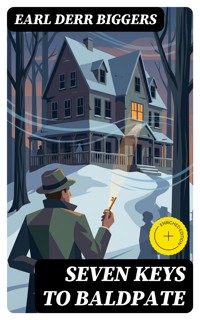
Seven Keys to Baldpate
A novelist seeking solitude at a snowbound mountain inn finds a parade of unexpected visitors—each with a key—and is drawn into a tangle of stolen cash, political intrigue, and masquerade. A playful blend of mystery and farce that blurs the line between reality and stagecraft.
Love Insurance
To guarantee a society wedding, an insurance company posts an agent to prevent anything that might derail the groom’s nuptials. The assignment leads to comic complications, romantic entanglements, and a brush with crime at a seaside resort.
Inside the Lines
Set in Malta during World War I, an American woman and a British officer stumble into a German spy plot aimed at crippling the Royal Navy. Suspicion, double agents, and wartime secrecy drive a taut espionage thriller.
The Agony Column (Second-Floor Mystery)
In London on the eve of war, a young American woos a woman through cryptic personal ads in the newspaper’s Agony Column—until a murder turns their game deadly. Clues embedded in letters and classifieds propel a swift romantic mystery.
Fifty Candles
A long-gestating revenge mystery linking America and the Far East culminates in a birthday-night killing and an elaborate alibi scheme. The investigation turns on secret pasts, assumed identities, and the meaning of 'fifty candles.'
The House Without a Key
After a Boston scion is murdered in Honolulu, visiting relative John Quincy Winterslip is drawn into the case alongside Inspector Charlie Chan. Island society, family secrets, and mainland prejudices collide in Chan’s first appearance.
The Chinese Parrot
Assigned to safeguard a priceless necklace in California, Charlie Chan goes undercover far from Honolulu and encounters a desert ranch, a cryptic 'Chinese parrot,' and a web of imposture. A jewel-heist mystery with Western-noir overtones.
Behind That Curtain
In San Francisco, an old disappearance shadows a judge’s farewell banquet that ends in sudden death. Charlie Chan unravels connections stretching across years and continents to expose a methodical killer.
The Black Camel
A Hollywood star filming in Hawaii is found murdered, and Charlie Chan must link the crime to an unsolved case from the mainland. Prophecies, studio intrigue, and island glamour frame a sober meditation on fate and fame.
Charlie Chan Carries On
After a murder on a round-the-world tour, Scotland Yard’s pursuit falters and Charlie Chan takes up the chase. Following the suspects across ports and continents, he pieces together a traveling killer’s pattern.
Keeper of the Keys
At a secluded Tahoe estate, a tense house party erupts into murder, trapping guests and servants under suspicion. In his final case, Charlie Chan conducts a classic closed-circle investigation amid old loyalties and jealousies.
MYSTERY CLASSICS Boxed Set - Earl Derr Biggers Edition (Illustrated)
Seven Keys to Baldpate
Chapter I. "Weep No More, My Lady"
A young woman was crying bitterly in the waiting-room of the railway station at Upper Asquewan Falls, New York.
A beautiful young woman? That is exactly what Billy Magee wanted to know as, closing the waiting-room door behind him, he stood staring just inside. Were the features against which that frail bit of cambric was agonizingly pressed of a pleasing contour? The girl's neatly tailored corduroy suit and her flippant but charming millinery augured well. Should he step gallantly forward and inquire in sympathetic tones as to the cause of her woe? Should he carry chivalry even to the lengths of Upper Asquewan Falls?
No, Mr. Magee decided he would not. The train that had just roared away into the dusk had not brought him from the region of skyscrapers and derby hats for deeds of knight errantry up state. Anyhow, the girl's tears were none of his business. A railway station was a natural place for grief—a field of many partings, upon whose floor fell often in torrents the tears of those left behind. A friend, mayhap a lover, had been whisked off into the night by the relentless five thirty-four local. Why not a lover? Surely about such a dainty trim figure as this courtiers hovered as moths about a flame. Upon a tender intimate sorrow it was not the place of an unknown Magee to intrude. He put his hand gently upon the latch of the door.
And yet—dim and heartless and cold was the interior of that waiting-room. No place, surely, for a gentleman to leave a lady sorrowful, particularly when the lady was so alluring. Oh, beyond question, she was most alluring. Mr. Magee stepped softly to the ticket window and made low-voiced inquiry of the man inside.
"What's she crying about?" he asked.
A thin sallow face, on the forehead of which a mop of ginger-colored hair lay listlessly, was pressed against the bars.
"Thanks," said the ticket agent. "I get asked the same old questions so often, one like yours sort of breaks the monotony. Sorry I can't help you. She's a woman, and the Lord only knows why women cry. And sometimes I reckon even He must be a little puzzled. Now, my wife—"
"I think I'll ask her," confided Mr. Magee in a hoarse whisper.
"Oh, I wouldn't," advised the man behind the bars. "It's best to let 'em alone. They stop quicker if they ain't noticed."
"But she's in trouble," argued Billy Magee.
"And so'll you be, most likely," responded the cynic, "if you interfere. No, siree! Take my advice. Shoot old Asquewan's rapids in a barrel if you want to, but keep away from crying women."
The heedless Billy Magee, however, was already moving across the unscrubbed floor with chivalrous intention.
The girl's trim shoulders no longer heaved so unhappily. Mr. Magee, approaching, thought himself again in the college yard at dusk, with the great elms sighing overhead, and the fresh young voices of the glee club ringing out from the steps of a century-old building. What were the words they sang so many times?
He regretted that he could not make use of them. They had always seemed to him so sad and beautiful. But troubadours, he knew, went out of fashion long before railway stations came in. So his remark to the young woman was not at all melodious:
"Can I do anything?"
A portion of the handkerchief was removed, and an eye which, Mr. Magee noted, was of an admirable blue, peeped out at him. To the gaze of even a solitary eye, Mr. Magee's aspect was decidedly pleasing. Young Williams, who posed at the club as a wit, had once said that Billy Magee came as near to being a magazine artist's idea of the proper hero of a story as any man could, and at the same time retain the respect and affection of his fellows. Mr. Magee thought he read approval in the lone eye of blue. When the lady spoke, however, he hastily revised his opinion.
"Yes," she said, "you can do something. You can go away—far, far away."
Mr. Magee stiffened. Thus chivalry fared in Upper Asquewan Falls in the year 1911.
"I beg your pardon," he remarked. "You seemed to be in trouble, and I thought I might possibly be of some assistance."
The girl removed the entire handkerchief. The other eye proved to be the same admirable blue—a blue half-way between the shade of her corduroy suit and that of the jacky's costume in the "See the World—Join the Navy" poster that served as background to her woe.
"I don't mean to be rude," she explained more gently, "but—I'm crying, you see, and a girl simply can't look attractive when she cries."
"If I had only been regularly introduced to you, and all that," responded Mr. Magee, "I could make a very flattering reply." And a true one, he added to himself. For even in the faint flickering light of the station he found ample reason for rejoicing that the bit of cambric was no longer agonizingly pressed. As yet he had scarcely looked away from her eyes, but he was dimly aware that up above wisps of golden hair peeped impudently from beneath a saucy black hat. He would look at those wisps shortly, he told himself. As soon as he could look away from the eyes—which was not just yet.
"My grief," said the girl, "is utterly silly and—womanish. I think it would be best to leave me alone with it. Thank you for your interest. And—would you mind asking the gentleman who is pressing his face so feverishly against the bars to kindly close his window?"
"Certainly," replied Mr. Magee. He turned away. As he did so he collided with a rather excessive lady. She gave the impression of solidity and bulk; her mouth was hard and knowing. Mr. Magee felt that she wanted to vote, and that she would say as much from time to time. The lady had a glittering eye; she put it to its time-honored use and fixed Mr. Magee with it.
"I was crying, mamma," the girl explained, "and this gentleman inquired if he could be of any service."
Mamma! Mr. Magee wanted to add his tears to those of the girl. This frail and lovely damsel in distress owning as her maternal parent a heavy unnecessary—person! The older woman also had yellow hair, but it was the sort that suggests the white enamel pallor of a drug store, with the soda-fountain fizzing and the bottles of perfume ranged in an odorous row. Mamma! Thus rolled the world along.
"Well, they ain't no use gettin' all worked up for nothing," advised the unpleasant parent. Mr. Magee was surprised that in her tone there was no hostility to him—thus belying her looks. "Mebbe the gentleman can direct us to a good hotel," she added, with a rather stagy smile.
"I'm a stranger here, too," Mr. Magee replied. "I'll interview the man over there in the cage."
The gentleman referred to was not cheerful in his replies. There was, he said, Baldpate Inn.
"Oh, yes, Baldpate Inn," repeated Billy Magee with interest.
"Yes, that's a pretty swell place," said the ticket agent. "But it ain't open now. It's a summer resort. There ain't no place open now but the Commercial House. And I wouldn't recommend no human being there—especially no lady who was sad before she ever saw it."
Mr. Magee explained to the incongruous family pair waiting on the bench.
"There's only one hotel," he said, "and I'm told it's not exactly the place for any one whose outlook on life is not rosy at the moment. I'm sorry."
"It will do very well," answered the girl, "whatever it is." She smiled at Billy Magee. "My outlook on life in Upper Asquewan Falls," she said, "grows rosier every minute. We must find a cab."
She began to gather up her traveling-bags, and Mr. Magee hastened to assist. The three went out on the station platform, upon which lay a thin carpet of snowflakes. There the older woman, in a harsh rasping voice, found fault with Upper Asquewan Falls,—its geography, its public spirit, its brand of weather. A dejected cab at the end of the platform stood mourning its lonely lot. In it Mr. Magee placed the large lady and the bags. Then, while the driver climbed to his seat, he spoke into the invisible ear of the girl.
"You haven't told me why you cried," he reminded her.
She waved her hand toward the wayside village, the lamps of which shone sorrowfully through the snow.
"Upper Asquewan Falls," she said, "isn't it reason enough?"
Billy Magee looked; saw a row of gloomy buildings that seemed to list as the wind blew, a blurred sign "Liquors and Cigars," a street that staggered away into the dark like a man who had lingered too long at the emporium back of the sign.
"Are you doomed to stay here long?" he asked.
"Come on, Mary," cried a deep voice from the cab. "Get in and shut the door. I'm freezing."
"It all depends," said the girl. "Thank you for being so kind and—good night."
The door closed with a muffled bang, the cab creaked wearily away, and Mr. Magee turned back to the dim waiting-room.
"Well, what was she crying for?" inquired the ticket agent, when Mr. Magee stood again at his cell window.
"She didn't think much of your town," responded Magee; "she intimated that it made her heavy of heart."
"H'm—it ain't much of a place," admitted the man, "though it ain't the general rule with visitors to burst into tears at sight of it. Yes, Upper Asquewan is slow, and no mistake. It gets on my nerves sometimes. Nothing to do but work, work, work, and then lay down and wait for to-morrow. I used to think maybe some day they'd transfer me down to Hooperstown—there's moving pictures and such goings-on down there. But the railroad never notices you—unless you go wrong. Yes, sir, sometimes I want to clear out of this town myself."
"A natural wanderlust," sympathized Mr. Magee. "You said something just now about Baldpate Inn—"
"Yes, it's a little more lively in summer, when that's open," answered the agent; "we get a lot of complaints about trunks not coming, from pretty swell people, too. It sort of cheers things." His eye roamed with interest over Mr. Magee's New York attire. "But Baldpate Inn is shut up tight now. This is nothing but an annex to a graveyard in winter. You wasn't thinking of stopping off here, was you?"
"Well—I want to see a man named Elijah Quimby," Mr. Magee replied. "Do you know him?"
"Of course," said the yearner for pastures new, "he's caretaker of the inn. His house is about a mile out, on the old Miller Road that leads up Baldpate. Come outside and I'll tell you how to get there."
The two men went out into the whirling snow, and the agent waved a hand indefinitely up at the night.
"If it was clear," he said, "you could see Baldpate Mountain, over yonder, looking down on the Falls, sort of keeping an eye on us to make sure we don't get reckless. And half-way up you'd see Baldpate Inn, black and peaceful and winter-y. Just follow this street to the third corner, and turn to your left. Elijah lives in a little house back among the trees a mile out—there's a gate you'll sure hear creaking on a night like this."
Billy Magee thanked him, and gathering up his two bags, walked up "Main Street." A dreary forbidding building at the first corner bore the sign "Commercial House". Under the white gaslight in the office window three born pessimists slouched low in hotel chairs, gazing sourly out at the storm.
hummed Mr. Magee cynically under his breath, and glanced up at the solitary up-stairs window that gleamed yellow in the night.
At a corner on which stood a little shop that advertised "Groceries and Provisions" he paused.
"Let me see," he pondered. "The lights will be turned off, of course. Candles. And a little something for the inner man, in case it's the closed season for cooks."
He went inside, where a weary old woman served him.
"What sort of candles?" she inquired, with the air of one who had an infinite variety in stock. Mr. Magee remembered that Christmas was near.
"For a Christmas tree," he explained. He asked for two hundred.
"I've only got forty," the woman said. "What's this tree for—the Orphans' Home?"
With the added burden of a package containing his purchases in the tiny store, Mr. Magee emerged and continued his journey through the stinging snow. Upper Asquewan Falls on its way home for supper flitted past him in the silvery darkness. He saw in the lighted windows of many of the houses the green wreath of Christmas cheer. Finally the houses became infrequent, and he struck out on an uneven road that wound upward. Once he heard a dog's faint bark. Then a carriage lurched by him, and a strong voice cursed the roughness of the road. Mr. Magee half smiled to himself as he strode on.
"Don Quixote, my boy," he muttered, "I know how you felt when you moved on the windmills."
It was not the whir of windmills but the creak of a gate in the storm that brought Mr. Magee at last to a stop. He walked gladly up the path to Elijah Quimby's door.
In answer to Billy Magee's gay knock, a man of about sixty years appeared. Evidently he had just finished supper; at the moment he was engaged in lighting his pipe. He admitted Mr. Magee into the intimacy of the kitchen, and took a number of calm judicious puffs on the pipe before speaking to his visitor. In that interval the visitor cheerily seized his hand, oblivious of the warm burnt match that was in it. The match fell to the floor, whereupon the older man cast an anxious glance at a gray-haired woman who stood beside the kitchen stove.
"My name's Magee," blithely explained that gentleman, dragging in his bags. "And you're Elijah Quimby, of course. How are you? Glad to see you." His air was that of one who had known this Quimby intimately, in many odd corners of the world.
The older man did not reply, but regarded Mr. Magee wonderingly through white puffs of smoke. His face was kindly, gentle, ineffectual; he seemed to lack the final "punch" that send men over the line to success; this was evident in the way his necktie hung, the way his thin hands fluttered.
"Yes," he admitted at last. "Yes, I'm Quimby."
Mr. Magee threw back his coat, and sprayed with snow Mrs. Quimby's immaculate floor.
"I'm Magee," he elucidated again, "William Hallowell Magee, the man Hal Bentley wrote to you about. You got his letter, didn't you?"
Mr. Quimby removed his pipe and forgot to close the aperture as he stared in amazement.
"Good lord!" he cried, "you don't mean—you've really come."
"What better proof could you ask," said Mr. Magee flippantly, "than my presence here?"
"Why," stammered Mr. Quimby, "we—we thought it was all a joke."
"Hal Bentley has his humorous moments," agreed Mr. Magee, "but it isn't his habit to fling his jests into Upper Asquewan Falls."
"And—and you're really going to—" Mr. Quimby could get no further.
"Yes," said Mr. Magee brightly, slipping into a rocking-chair. "Yes, I'm going to spend the next few months at Baldpate Inn."
Mrs. Quimby, who seemed to have settled into a stout little mound of a woman through standing too long in the warm presence of her stove, came forward and inspected Mr. Magee.
"Of all things," she murmured.
"It's closed," expostulated Mr. Quimby; "the inn is closed, young fellow."
"I know it's closed," smiled Magee. "That's the very reason I'm going to honor it with my presence. I'm sorry to take you out on a night like this, but I'll have to ask you to lead me up to Baldpate. I believe those were Hal Bentley's instructions—in the letter."
Mr. Quimby towered above Mr. Magee, a shirt-sleeved statue of honest American manhood. He scowled.
"Excuse a plain question, young man," he said, "but what are you hiding from?"
Mrs. Quimby, in the neighborhood of the stove, paused to hear the reply. Billy Magee laughed.
"I'm not hiding," he said. "Didn't Bentley explain? Well, I'll try to, though I'm not sure you'll understand. Sit down, Mr. Quimby. You are not, I take it, the sort of man to follow closely the light and frivolous literature of the day."
"What's that?" inquired Mr. Quimby.
"You don't read," continued Mr. Magee, "the sort of novels that are sold by the pound in the department stores. Now, if you had a daughter—a fluffy daughter inseparable from a hammock in the summer—she could help me explain. You see—I write those novels. Wild thrilling tales for the tired business man's tired wife—shots in the night, chases after fortunes, Cupid busy with his arrows all over the place! It's good fun, and I like to do it. There's money in it."
"Is there?" asked Mr. Quimby with a show of interest.
"Considerable," replied Mr. Magee. "But now and then I get a longing to do something that will make the critics sit up—the real thing, you know. The other day I picked up a newspaper and found my latest brain-child advertised as 'the best fall novel Magee ever wrote'. It got on my nerves—I felt like a literary dressmaker, and I could see my public laying down my fall novel and sighing for my early spring styles in fiction. I remembered that once upon a time a critic advised me to go away for ten years to some quiet spot, and think. I decided to do it. Baldpate Inn is the quiet spot."
"You don't mean," gasped Mr. Quimby, "that you're going to stay there ten years?"
"Bless you, no," said Mr. Magee. "Critics exaggerate. Two months will do. They say I am a cheap melodramatic ranter. They say I don't go deep. They say my thinking process is a scream. I'm afraid they're right. Now, I'm going to go up to Baldpate Inn, and think. I'm going to get away from melodrama. I'm going to do a novel so fine and literary that Henry Cabot Lodge will come to me with tears in his eyes and ask me to join his bunch of self-made Immortals. I'm going to do all this up there at the inn—sitting on the mountain and looking down on this little old world as Jove looked down from Olympus."
"I don't know who you mean," objected Mr. Quimby.
"He was a god—the god of the fruit-stand men," explained Magee. "Picture me, if you can, depressed by the overwhelming success of my latest brain-child. Picture me meeting Hal Bentley in a Forty-fourth Street club and asking him for the location of the lonesomest spot on earth. Hal thought a minute. 'I've got it', he said, 'the lonesomest spot that's happened to date is a summer resort in mid-winter. It makes Crusoe's island look like Coney on a warm Sunday afternoon in comparison.' The talk flowed on, along with other things. Hal told me his father owned Baldpate Inn, and that you were an old friend of his who would be happy for the entire winter over the chance to serve him. He happened to have a key to the place—the key to the big front door, I guess, from the weight of it—and he gave it to me. He also wrote you to look after me. So here I am."
Mr. Quimby ran his fingers through his white hair.
"Here I am," repeated Billy Magee, "fleeing from the great glitter known as Broadway to do a little rational thinking in the solitudes. It's getting late, and I suggest that we start for Baldpate Inn at once."
"This ain't exactly—regular," Mr. Quimby protested. "No, it ain't what you might call a frequent occurrence. I'm glad to do anything I can for young Mr. Bentley, but I can't help wondering what his father will say. And there's a lot of things you haven't took into consideration."
"There certainly is, young man," remarked Mrs. Quimby, bustling forward. "How are you going to keep warm in that big barn of a place?"
"The suites on the second floor," said Mr. Magee, "are, I hear, equipped with fireplaces. Mr. Quimby will keep me supplied with fuel from the forest primeval, for which service he will receive twenty dollars a week."
"And light?" asked Mrs. Quimby.
"For the present, candles. I have forty in that package. Later, perhaps you can find me an oil lamp. Oh, everything will be provided for."
"Well," remarked Mr. Quimby, looking in a dazed fashion at his wife, "I reckon I'll have to talk it over with ma."
The two retired to the next room, and Mr. Magee fixed his eyes on a "God Bless Our Home" motto while he awaited their return. Presently they reappeared.
"Was you thinking of eating?" inquired Mrs. Quimby sarcastically, "while you stayed up there?"
"I certainly was," smiled Mr. Magee. "For the most part I will prepare my own meals from cans and—er—jars—and such pagan sources. But now and then you, Mrs. Quimby, are going to send me something cooked as no other woman in the county can cook it. I can see it in your eyes. In my poor way I shall try to repay you."
He continued to smile into Mrs. Quimby's broad cheerful face. Mr. Magee had the type of smile that moves men to part with ten until Saturday, and women to close their eyes and dream of Sir Launcelot. Mrs. Quimby could not long resist. She smiled back. Whereupon Billy Magee sprang to his feet.
"It's all fixed," he cried. "We'll get on splendidly. And now—for Baldpate Inn."
"Not just yet," said Mrs. Quimby. "I ain't one to let anybody go up to Baldpate Inn unfed. I 'spose we're sort o' responsible for you, while you're up here. You just set right down and I'll have your supper hot and smoking on the table in no time."
Mr. Magee entered into no dispute on this point, and for half an hour he was the pleased recipient of advice, philosophy, and food. When he had assured Mrs. Quimby that he had eaten enough to last him the entire two months he intended spending at the inn, Mr. Quimby came in, attired in a huge "before the war" ulster, and carrying a lighted lantern.
"So you're going to sit up there and write things," he commented. "Well, I reckon you'll be left to yourself, all right."
"I hope so," responded Mr. Magee. "I want to be so lonesome I'll sob myself to sleep every night. It's the only road to immortality. Good-by, Mrs. Quimby. In my fortress on the mountain I shall expect an occasional culinary message from you." He took her plump hand; this motherly little woman seemed the last link binding him to the world of reality.
"Good-by," smiled Mrs. Quimby. "Be careful of matches."
Mr. Quimby led the way with the lantern, and presently they stepped out upon the road. The storm had ceased, but it was still very dark. Far below, in the valley, twinkled the lights of Upper Asquewan Falls.
"By the way, Quimby," remarked Mr. Magee, "is there a girl in your town who has blue eyes, light hair, and the general air of a queen out shopping?"
"Light hair," repeated Quimby. "There's Sally Perry. She teaches in the Methodist Sunday-school."
"No," said Mr. Magee. "My description was poor, I'm afraid. This one I refer to, when she weeps, gives the general effect of mist on the sea at dawn. The Methodists do not monopolize her."
"I read books, and I read newspapers," said Mr. Quimby, "but a lot of your talk I don't understand."
"The critics," replied Billy Magee, "could explain. My stuff is only for low-brows. Lead on, Mr. Quimby."
Mr. Quimby stood for a moment in dazed silence. Then he turned, and the yellow of his lantern fell on the dazzling snow ahead. Together the two climbed Baldpate Mountain.
Chapter II. Enter a Lovelorn Haberdasher
Baldpate Inn did not stand tiptoe on the misty mountain-top. Instead it clung with grim determination to the side of Baldpate, about half-way up, much as a city man clings to the running board of an open street-car. This was the comparison Mr. Magee made, and even as he made it he knew that atmospheric conditions rendered it questionable. For an open street-car suggests summer and the ball park; Baldpate Inn, as it shouldered darkly into Mr. Magee's ken, suggested winter at its most wintry.
About the great black shape that was the inn, like arms, stretched broad verandas. Mr. Magee remarked upon them to his companion.
"Those porches and balconies and things," he said, "will come in handy in cooling the fevered brow of genius."
"There ain't much fever in this locality," the practical Quimby assured him, "especially not in winter."
Silenced, Mr. Magee followed the lantern of Quimby over the snow to the broad steps, and up to the great front door. There Magee produced from beneath his coat an impressive key. Mr. Quimby made as though to assist, but was waved aside.
"This is a ceremony," Mr. Magee told him, "some day Sunday newspaper stories will be written about it. Baldpate Inn opening its doors to the great American novel!"
He placed the key in the lock, turned it, and the door swung open. The coldest blast of air Mr. Magee had even encountered swept out from the dark interior. He shuddered, and wrapped his coat closer. He seemed to see the white trail from Dawson City, the sled dogs straggling on with the dwindling provisions, the fat Eskimo guide begging for gum-drops by his side.
"Whew," he cried, "we've discovered another Pole!"
"It's stale air," remarked Quimby.
"You mean the Polar atmosphere," replied Magee. "Yes, it is pretty stale. Jack London and Doctor Cook have worked it to death."
"I mean," said Quimby, "this air has been in here alone too long. It's as stale as last week's newspaper. We couldn't heat it with a million fires. We'll have to let in some warm air from outside first."
"Warm air—humph," remarked Mr. Magee. "Well, live and learn."
The two stood together in a great bare room. The rugs had been removed, and such furniture as remained had huddled together, as if for warmth, in the center of the floor. When they stepped forward, the sound of their shoes on the hard wood seemed the boom that should wake the dead.
"This is the hotel office," explained Mr. Quimby.
At the left of the door was the clerk's desk; behind it loomed a great safe, and a series of pigeon-holes for the mail of the guests. Opposite the front door, a wide stairway led to a landing half-way up, where the stairs were divorced and went to the right and left in search of the floor above. Mr. Magee surveyed the stairway critically.
"A great place," he remarked, "to show off the talents of your dressmaker, eh, Quimby? Can't you just see the stunning gowns coming down that stair in state, and the young men below here agitated in their bosoms?"
"No, I can't," said Mr. Quimby frankly.
"I can't either, to tell the truth," laughed Billy Magee. He turned up his collar. "It's like picturing a summer girl sitting on an iceberg and swinging her open-work hosiery over the edge. I don't suppose it's necessary to register. I'll go right up and select my apartments."
It was upon a suite of rooms that bore the number seven on their door that Mr. Magee's choice fell. A large parlor with a fireplace that a few blazing logs would cheer, a bedroom whose bed was destitute of all save mattress and springs, and a bathroom, comprised his kingdom. Here, too, all the furniture was piled in the center of the rooms. After Quimby had opened the windows, he began straightening the furniture about.
Mr. Magee inspected his apartment. The windows were all of the low French variety, and opened out upon a broad snow-covered balcony which was in reality the roof of the first floor veranda. On this balcony Magee stood a moment, watching the trees on Baldpate wave their black arms in the wind, and the lights of Upper Asquewan Falls wink knowingly up at him. Then he came inside, and his investigations brought him, presently to the tub in the bathroom.
"Fine," he cried, "a cold plunge in the morning before the daily struggle for immortality begins."
He turned the spigot. Nothing happened.
"I reckon," drawled Mr. Quimby from the bedroom, "you'll carry your cold plunge up from the well back of the inn before you plunge into it. The water's turned off. We can't take chances with busted pipes."
"Of course," replied Magee less blithely. His ardor was somewhat dampened—a paradox—by the failure of the spigot to gush forth a response. "There's nothing I'd enjoy more than carrying eight pails of water up-stairs every morning to get up an appetite for—what? Oh, well, the Lord will provide. If we propose to heat up the great American outdoors, Quimby, I think it's time we had a fire."
Mr. Quimby went out without comment, and left Magee to light his first candle in the dark. For a time he occupied himself with lighting a few of the forty, and distributing them about the room. Soon Quimby came back with kindling and logs, and subsequently a noisy fire roared in the grate. Again Quimby retired, and returned with a generous armful of bedding, which he threw upon the brass bed in the inner room. Then he slowly closed and locked the windows, after which he came and looked down with good-natured contempt at Mr. Magee, who sat in a chair before the fire.
"I wouldn't wander round none," he advised. "You might fall down something—or something. I been living in these parts, off and on, for sixty years and more, and nothing like this ever came under my observation before. Howsomever, I guess it's all right if Mr. Bentley says so. I'll come up in the morning and see you down to the train."
"What train?" inquired Mr. Magee.
"Your train back to New York City," replied Mr. Quimby. "Don't try to start back in the night. There ain't no train till morning."
"Ah, Quimby," laughed Mr. Magee, "you taunt me. You think I won't stick it out. But I'll show you. I tell you, I'm hungry for solitude[1q]."
"That's all right," Mr. Quimby responded, "you can't make three square meals a day off solitude."
"I'm desperate," said Magee. "Henry Cabot Lodge must come to me, I say, with tears in his eyes. Ever see the senator that way? No? It isn't going to be an easy job. I must put it over. I must go deep into the hearts of men, up here, and write what I find. No more shots in the night. Just the adventure of soul and soul. Do you see? By the way, here's twenty dollars, your first week's pay as caretaker of a New York Quixote."
"What's that?" asked Quimby.
"Quixote," explained Mr. Magee, "was a Spanish lad who was a little confused in his mind, and went about the country putting up at summer resorts in mid-winter."
"I'd expect it of a Spaniard," Quimby said. "Be careful of that fire. I'll be up in the morning." He stowed away the bill Mr. Magee had given him. "I guess nothing will interfere with your lonesomeness. Leastways, I hope it won't. Good night."
Mr. Magee bade the man good night, and listened to the thump of his boots, and the closing of the great front door. From his windows he watched the caretaker move down the road without looking back, to disappear at last in the white night.
Throwing off his great coat, Mr. Magee noisily attacked the fire. The blaze flared red on his strong humorous mouth, in his smiling eyes. Next, in the flickering half-light of suite seven, he distributed the contents of his traveling-bags about. On the table he placed a number of new magazines and a few books.
Then Mr. Magee sat down in the big leather chair before the fire, and caught his breath. Here he was at last. The wild plan he and Hal Bentley had cooked up in that Forty-fourth Street club had actually come to be. "Seclusion," Magee had cried. "Bermuda," Bentley had suggested. "A mixture of sea, hotel clerks, and honeymooners!" the seeker for solitude had sneered. "Some winter place down South,"—from Bentley. "And a flirtation lurking in every corner!"—from Magee. "A country town where you don't know any one." "The easiest place in the world to get acquainted. I must be alone, man! Alone!" "Baldpate Inn," Bentley had cried in his idiom. "Why, Billy—Baldpate Inn at Christmas—it must be old John H. Seclusion himself."
Yes, here he was. And here was the solitude he had come to find. Mr. Magee looked nervously about, and the smile died out of his gray eyes. For the first time misgivings smote him. Might one not have too much of a good thing? A silence like that of the tomb had descended. He recalled stories of men who went mad from loneliness. What place lonelier than this? The wind howled along the balcony. It rattled the windows. Outside his door lay a great black cave—in summer gay with men and maids—now like Crusoe's island before the old man landed.
"Alone, alone, all, all alone," quoted Mr. Magee. "If I can't think here it will be because I'm not equipped with the apparatus. I will. I'll show the gloomy old critics! I wonder what's doing in New York?"
New York! Mr. Magee looked at his watch. Eight o'clock. The great street was ablaze. The crowds were parading from the restaurants to the theaters. The electric signs were pasting lurid legends on a long suffering sky; the taxis were spraying throats with gasoline; the traffic cop at Broadway and Forty-second Street was madly earning his pay. Mr. Magee got up and walked the floor. New York!
Probably the telephone in his rooms was jangling, vainly calling forth to sport with Amaryllis in the shade of the rubber trees Billy Magee—Billy Magee who sat alone in the silence on Baldpate Mountain. Few knew of his departure. This was the night of that stupid attempt at theatricals at the Plaza; stupid in itself but gay, almost giddy, since Helen Faulkner was to be there. This was the night of the dinner to Carey at the club. This was the night—of many diverting things.
Mr. Magee picked up a magazine. He wondered how they read, in the old days, by candlelight. He wondered if they would have found his own stories worth the strain on the eyes. And he also wondered if absolute solitude was quite the thing necessary to the composition of the novel that should forever silence those who sneered at his ability.
Absolute solitude! Only the crackle of the fire, the roar of the wind, and the ticking of his watch bore him company. He strode to the window and looked down at the few dim lights that proclaimed the existence of Upper Asquewan Falls. Somewhere, down there, was the Commercial House. Somewhere the girl who had wept so bitterly in that gloomy little waiting-room. She was only three miles away, and the thought cheered Mr. Magee. After all, he was not on a desert island.
And yet—he was alone, intensely, almost painfully, alone. Alone in a vast moaning house that must be his only home until he could go back to the gay city with his masterpiece. What a masterpiece! As though with a surgeon's knife it would lay bare the hearts of men. No tricks of plot, no—
Mr. Magee paused. For sharply in the silence the bell of his room telephone rang out.
He stood for a moment gazing in wonder, his heart beating swiftly, his eyes upon the instrument on the wall. It was a house phone; he knew that it could only be rung from the switchboard in the hall below. "I'm going mad already," he remarked, and took down the receiver.
A blur of talk, an electric muttering, a click, and all was still.
Mr. Magee opened the door and stepped out into the shadows. He heard a voice below. Noiselessly he crept to the landing, and gazed down into the office. A young man sat at the telephone switchboard; Mr. Magee could see in the dim light of a solitary candle that he was a person of rather hilarious raiment. The candle stood on the top of the safe, and the door of the latter swung open. Sinking down on the steps in the dark, Mr. Magee waited.
"Hello," the young man was saying, "how do you work this thing, anyhow? I've tried every peg but the right one. Hello—hello! I want long distance—Reuton. 2876 West—Mr. Andy Rutter. Will you get him for me, sister?"
Another wait—a long one—ensued. The candle sputtered. The young man fidgeted in his chair. At last he spoke again:
"Hello! Andy? Is that you, Andy? What's the good word? As quiet as the tomb of Napoleon. Shall I close up shop? Sure. What next? Oh, see here, Andy, I'd die up here. Did you ever hit a place like this in winter? I can't—I—oh, well, if he says so. Yes. I could do that. But no longer. I couldn't stand it long. Tell him that. Tell him everything's O. K. Yes. All right. Well, good night, Andy."
He turned away from the switchboard, and as he did so Mr. Magee walked calmly down the stairs toward him. With a cry the young man ran to the safe, threw a package inside, and swung shut the door. He turned the knob of the safe several times; then he faced Mr. Magee. The latter saw something glitter in his hand.
"Good evening," remarked Mr. Magee pleasantly.
"What are you doing here?" cried the youth wildly.
"I live here," Mr. Magee assured him. "Won't you come up to my room—it's right at the head of the stairs. I have a fire, you know."
Back into the young man's lean hawk-like face crept the assurance that belonged with the gay attire he wore. He dropped the revolver into his pocket, and smiled a sneering smile.
"You gave me a turn," he said. "Of course you live here. Are any of the other guests about? And who won the tennis match to-day?"
"You are facetious." Mr. Magee smiled too. "So much the better. A lively companion is the very sort I should have ordered to-night. Come up-stairs."
The young man looked suspiciously about, his thin nose seemingly scenting plots. He nodded, and picked up the candle. "All right," he said. "But I'll have to ask you to go first. You know the way." His right hand sought the pocket into which the revolver had fallen.
"You honor my poor and drafty house," said Mr. Magee. "This way."
He mounted the stairs. After him followed the youth of flashy habiliments, looking fearfully about him as he went. He seemed surprised that they came to Magee's room without incident. Inside, Mr. Magee drew up an easy chair before the fire, and offered his guest a cigar.
"You must be cold," he said. "Sit here. 'A bad night, stranger' as they remark in stories."
"You've said it," replied the young man, accepting the cigar. "Thanks." He walked to the door leading into the hall and opened it about a foot. "I'm afraid," he explained jocosely, "we'll get to talking, and miss the breakfast bell." He dropped into the chair, and lighted his cigar at a candle end. "Say, you never can tell, can you? Climbing up old Baldpate I thought to myself, that hotel certainly makes the Sahara Desert look like a cozy corner. And here you are, as snug and comfortable and at home as if you were in a Harlem flat. You never can tell. And what now? The story of my life?"
"You might relate," Mr. Magee told him, "that portion of it that has led you trespassing on a gentleman seeking seclusion at Baldpate Inn."
The stranger looked at Mr. Magee. He had an eye that not only looked, but weighed, estimated, and classified. Mr. Magee met it smilingly.
"Trespassing, eh?" said the young man. "Far be it from me to quarrel with a man who smokes as good cigars as you do—but there's something I haven't quite doped out. That is—who's trespassing, me or you?"
"My right here," said Mr. Magee, "is indisputable."
"It's a big word," replied the other, "but you can tack it to my right here, and tell no lie. We can't dispute, so let's drop the matter. With that settled, I'm encouraged to pour out the story of why you see me here to-night, far from the madding crowd. Have you a stray tear? You'll need it. It's a sad touching story, concerned with haberdashery and a trusting heart, and a fair woman—fair, but, oh, how false!"
"Proceed," laughed Mr. Magee. "I'm an admirer of the vivid imagination. Don't curb yours, I beg of you."
"It's all straight," said the other in a hurt tone. "Every word true. My name is Joseph Bland. My profession, until love entered my life, was that of haberdasher and outfitter. In the city of Reuton, fifty miles from here, I taught the Beau Brummels of the thoroughfares what was doing in London in the necktie line. I sold them coats with padded shoulders, and collars high and awe inspiring. I was happy, twisting a piece of silk over my hand to show them how it would look on their heaving bosoms. And then—she came."
Mr. Bland puffed on his cigar.
"Yes," he said, "Arabella sparkled on the horizon of my life. When I have been here in the quiet for about two centuries, maybe I can do justice to her beauty. I won't attempt to describe her now. I loved her—madly. She said I made a hit with her. I spent on her the profits of my haberdashery. I whispered—marriage. She didn't scream. I had my wedding necktie picked out from the samples of a drummer from Troy." He paused and looked at Mr. Magee. "Have you ever stood, poised, on that brink?" he asked.
"Never," replied Magee. "But go on. Your story attracts me, strangely."
"From here on—the tear I spoke of, please. There flashed on the scene a man she had known and loved in Jersey City. I said flashed. He did—just that. A swell dresser—say, he had John Drew beat by two mauve neckties and a purple frock coat. I had a haberdashery back of me. No use. He out-dressed me. I saw that Arabella's love for me was waning. With his chamois-gloved hands that new guy fanned the ancient flame."
He paused. Emotion—or the smoke of the cigar—choked him.
"Let's make the short story shorter," he said. "She threw me down. In my haberdashery I thought it over. I was blue, bitter. I resolved on a dreadful step. In the night I wrote her a letter, and carried it down to the box and posted it. Life without Arabella, said the letter, was Shakespeare with Hamlet left out. It hinted at the river, carbolic acid, revolvers. Yes, I posted it. And then—"
"And then," urged Mr. Magee.
Mr. Bland felt tenderly of the horseshoe pin in his purple tie.
"This is just between us," he said. "At that point the trouble began. It came from my being naturally a very brave man. I could have died—easy. The brave thing was to live. To go on, day after day, devoid of Arabella—say, that took courage. I wanted to try it. I'm a courageous man, as I say."
"You seem so," Mr. Magee agreed.
"Lion-hearted," assented Mr. Bland. "I determined to show my nerve, and live. But there was my letter to Arabella. I feared she wouldn't appreciate my bravery—women are dull sometimes. It came to me maybe she would be hurt if I didn't keep my word, and die. So I had to—disappear. I had a friend mixed up in affairs at Baldpate. No, I can't give his name. I told him my story. He was impressed by my spirit, as you have been. He gave me a key he had—the key of the door opening from the east veranda into the dining-room. So I came up here. I came here to be alone, to forgive and forget, to be forgot. And maybe to plan a new haberdashery in distant parts."
"Was it your wedding necktie," asked Mr. Magee, "that you threw into the safe when you saw me coming?"
"No," replied Mr. Bland, sighing deeply. "A package of letters, written to me by Arabella at various times. I want to forget 'em. If I kept them on hand, I might look at them from time to time. My great courage might give way—you might find my body on the stairs. That's why I hid them."
Mr. Magee laughed, and stretched forth his hand.
"Believe me," he said, "your touching confidence in me will not be betrayed. I congratulate you on your narrative power. You want my story. Why am I here? I am not sure that it is worthy to follow yours. But it has its good points—as I have thought it out."
He went over to the table, and picked up a popular novel upon which his gaze had rested while the haberdasher spun his fabric of love and gloom. On the cover was a picture of a very dashing maiden.




