


1,99 €
Mehr erfahren.
- Herausgeber: Quickie Classics
- Kategorie: Religion und Spiritualität
- Sprache: Englisch
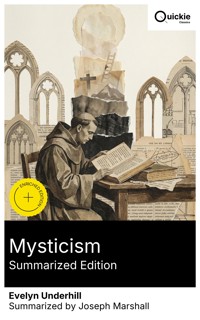
Mysticism: A Study in the Nature and Development of Spiritual Consciousness (1911) is Evelyn Underhill's classic synthesis of the history, psychology, and theology of the mystical life. Moving from Plotinus and Dionysius to Eckhart, Ruysbroeck, Teresa, and John of the Cross, she frames the "mystic way" in five phases—Awakening, Purgation, Illumination, the Dark Night, and Union. Her lucid prose joins generous quotation to careful taxonomy, and distinguishes magic (will to power) from mysticism (surrender to Reality). Composed amid Edwardian interest in comparative religion and the new psychology, it converses with William James while remaining anchored in Christian practice. An English lay theologian and retreat leader, Underhill united literary training with pastoral instinct. Mentored by Baron Friedrich von Hügel and steeped in continental scholarship, she countered occult enthusiasms by presenting mysticism as disciplined and ecclesial. Later works—on Ruysbroeck and in Practical Mysticism—confirm her move toward mature Anglican devotion. This classic rewards scholars and seekers alike: historians will value its sources, theologians its union of doctrine and experience, psychologists its phenomenology, practitioners its sane counsel. If you would grasp how religious consciousness grows, suffers, and is transformed, Underhill is an indispensable guide. Quickie Classics summarizes timeless works with precision, preserving the author's voice and keeping the prose clear, fast, and readable—distilled, never diluted. Enriched Edition extras: Introduction · Synopsis · Historical Context · Brief Analysis · 4 Reflection Q&As · Editorial Footnotes.
Das E-Book können Sie in Legimi-Apps oder einer beliebigen App lesen, die das folgende Format unterstützen:
Veröffentlichungsjahr: 2026
Ähnliche







Mysticism (Summarized Edition)
Table of Contents
Introduction
At the heart of Evelyn Underhill’s Mysticism lies a vivid tension between an experience said to surpass language and the determined effort to render that experience intelligible without reducing its mystery, a tension she approaches with the patient discipline of a scholar, the sympathetic imagination of a spiritual director, and the conviction that rigorous thinking and reverent attention can carry readers to the threshold of what cannot be captured, not to conquer it with definitions, but to prepare mind and heart to recognize, test, and honor the signs of a life oriented toward the Real with more than mere curiosity.
Mysticism is a work of non-fiction religious and philosophical study, first published in 1911, written by a British lay thinker whose influence has endured in both academic and devotional circles. Composed in the early twentieth century, it reflects an era when psychology, historical theology, and literary criticism were being brought into fruitful conversation. Underhill places herself within that conversation yet writes for general readers as well as specialists, drawing mainly on Western sources while attending to patterns that appear across human experience. The book belongs to the tradition of comprehensive syntheses, offering a careful map rather than a sectarian manifesto.
The book’s premise is straightforward yet ambitious: to ask what mysticism is, how it has been lived, and how its claims can be understood without distortion. Underhill distinguishes it from adjacent practices and theories, tests its boundaries, and examines its marks through biography, analysis, and reflection. Her voice is lucid, measured, and hospitable, inviting readers into a sustained inquiry rather than a polemic. The style combines close reading of classic texts with an accessible prose that favors image and analogy when concepts alone grow brittle. The tone is rigorous but never dry, and sympathetic without surrendering critical standards.
Central themes emerge with clarity: the primacy of lived transformation over abstract speculation, the interplay of knowledge and love in approaching the divine, and the disciplined reshaping of desire that gives mysticism its ethical edge. Underhill traces a dynamic pattern commonly reported by practitioners, moving from initial awakening through purification and illumination, often tempered by trial, toward a mature unitive orientation. She attends to the role of symbolism and imagination, not as ornament but as a necessary bridge between experience and expression. She probes the limits of language while insisting that careful language can safeguard truth from sentimentality and confusion.
For contemporary readers, the book matters because it treats spiritual experience with both seriousness and restraint at a time when quick answers and vague uplift abound. Underhill models how to honor testimony without credulity and to test claims without cynicism, offering a grammar for speaking about the interior life that remains intelligible across disciplines. Her synthesis engages psychology, history, and philosophy in ways that anticipate ongoing conversations about consciousness, meaning, and character. In a culture marked by distraction and fragmentation, the emphasis on attention, practice, and ethical consequence provides a counterweight, suggesting that depth is not an escape but a reorientation.
As a reading experience, Mysticism unfolds deliberately, moving from orientation and definition to a developmental account that keeps returning to concrete lives and texts. Underhill writes with an eye for distillation, but she also allows complexity to stand where it is warranted, trusting readers to linger. The prose is elegant, metaphor-rich, and transparent in method, drawing evidence from classic treatises and firsthand reports while weighing counterarguments. The result is neither a manual nor a creed, but a generous guidebook that rewards slow reading. Beginners gain a framework; seasoned readers meet a disciplined synthesis that still leaves room for wonder.
Approached with historical awareness, the book’s early twentieth-century vantage yields both limitations and gifts: some categories reflect its moment, yet its patient method and humane curiosity travel remarkably well. What Underhill offers is not a shortcut but a tested pathway for thinking about experiences that resist simplification, an invitation to attend, to discern, and to be changed. Read now, Mysticism serves as a companion for those who suspect that the most important realities cannot be coerced into formulas, yet can be responsibly explored. It opens a conversation that continues, equipping readers to meet mystery with steadiness, intelligence, and reverence.
Synopsis
First published in 1911, Evelyn Underhill’s Mysticism: A Study in the Nature and Development of Man’s Spiritual Consciousness presents an ambitious, systematic account of mystical experience. Combining historical survey, psychological reflection, and close reading of classic texts, Underhill seeks to describe what mystics claim, how they arrive there, and why such claims have persisted. She writes as a sympathetic yet critical interpreter, organizing a wide field into a coherent map rather than arguing for a sectarian doctrine. The book proceeds from defining the phenomenon and setting boundaries, through analysis of its dynamics and expressions, toward a detailed account of the mystic path’s progressive stages.
Underhill begins by clarifying what mysticism is and is not. For her subjects, it denotes direct, transformative consciousness of an ultimate Reality, treated as more real than sense-data or abstract ideas. She distinguishes this from magic, spiritualism, or mere metaphysical speculation, arguing that authentic mysticism is practical, morally urgent, and tested in life. The mystic’s aim is not power or curiosity but an ever-deepening union that reorients conduct and perception. She examines the “mystic type,” assessing temperaments, capacities, and limits, while insisting that the phenomenon cannot be reduced to temperament alone. The inquiry proceeds by correlating claims with disciplined methods and observable fruits.
Turning to psychology, Underhill reviews conversions, raptures, and altered states, engaging scientific literature of her time while disputing pathologizing accounts. She treats these episodes as secondary signs of a deeper reorientation, not ends in themselves. Because ultimate experience eludes literal description, she analyzes the symbolic language mystics adopt—light, darkness, fire, marriage, journey—and the complementary roles of affirmative and negative approaches to the divine. She explores how ritual, poetry, and art can mediate or express longing without exhausting its object. Throughout, she stresses the interplay of intellect, will, and love, and the discipline required to integrate heightened states.
The heart of the book outlines the mystic way as a developmental sequence. Underhill describes an awakening in which reality is intuited more vividly, followed by purification, where desires and habits are reordered through ascetic effort and ethical rigor. Illumination brings a sense of presence, meaning, and interconnection that reshapes perception and creativity. Yet the path deepens through surrender beyond felt consolations, a period of aridity and conflict that tests motives and attachments. Finally she treats consummating union, not as absorption that cancels personality, but as stabilized conformity of life and love with the ultimate, issuing in renewed action.
To substantiate this pattern, Underhill surveys a wide range of witnesses, drawing primarily from Christian sources while engaging Neoplatonic, Islamic, and Asian materials. Plotinus, Dionysius the Areopagite, Meister Eckhart, Ruysbroeck, Julian of Norwich, Teresa of Ávila, and John of the Cross illustrate diverse temperaments and vocabularies oriented to a common goal. She notes convergences with Sufi and Vedantic writers, yet keeps differences of doctrine and practice in view. Rather than homogenizing traditions, she uses them comparatively to test generalizations, highlighting how context shapes imagery and counsel while a family resemblance persists in method, transformation, and ethical fruits.
Practical sections examine prayer, contemplation, self-denial, and service as the ordinary means by which the way is pursued. Underhill is careful to separate genuine progress from unusual sensations, warning that visions, voices, and psychic gifts can distract from the central task of surrender and charity. She also treats the social and artistic outflow of union, arguing that true realization expands capacity for work, compassion, and creativity rather than withdrawing from the world. The unitive life thus appears as active and steady, marked by balance of action and contemplation, humility in judgment, and patience under obscurity or acclaim.
Throughout, Underhill balances sympathetic exposition with critical sifting, assembling a typology that has influenced later scholarship on religion and spirituality. Without collapsing differences, she contends that mysticism offers a disciplined route to deeper integration and perception of value, accessible in varying degrees across cultures and eras. The book’s lasting interest lies in its careful synthesis of sources, clarity about method, and insistence that heightened experience be assessed by transformed life. As a result, Mysticism remains a touchstone for readers seeking a reliable, historically grounded map of spiritual development while leaving room for ongoing questions and fresh inquiry.
Historical Context
Evelyn Underhill’s Mysticism: A Study in the Nature and Development of Spiritual Consciousness appeared in London in 1911 through Methuen & Co., at the close of Britain’s Edwardian period. Underhill, a widely read lay Anglican educated at King’s College for Women, wrote within metropolitan networks centered on London, Oxford, and Cambridge, where historical theology and comparative religion flourished. Her study ranges from Plotinus and Dionysius the Areopagite to medieval and early modern writers, while addressing contemporary debates. Its confident, synthetic survey mirrors a moment when English readers sought authoritative yet accessible accounts of religion that could unify scholarship and devotion amid rapid scientific, social, and ecclesiastical change.
Late nineteenth- and early twentieth-century religious thought in Britain grappled with Darwinian science, German biblical criticism, and disputes over authority within churches. Anglican debates about ritualism and doctrine intersected with the Roman Catholic Modernist crisis, condemned by Pius X in Pascendi Dominici Gregis (1907) and the anti-modernist oath (1910). In university settings, historical method and philology reshaped theology. Underhill positions mysticism as a disciplined, historically grounded strand of religious life, not a rival to doctrine but a vital experiential core. Her emphasis on traditioned experience, tested by history and practice, responds to an era anxious about reconciling faith with critical scholarship.
New scholarly fields also reframed experience. The psychology of religion, shaped by Edwin D. Starbuck’s The Psychology of Religion (1899) and William James’s The Varieties of Religious Experience (1902), analyzed conversion, prayer, and mystical states. The Society for Psychical Research (founded in London in 1882) and F. W. H. Myers’s Human Personality (1903) investigated extraordinary experiences with quasi-scientific tools. Medical models sometimes treated ecstasy as pathology. Underhill acknowledges such literature yet argues that genuine mysticism is orderly, ethical, and transformative, distinguishable from aberration by its fruits. Her measured engagement reflects an Edwardian confidence that disciplined description and comparison could clarify, rather than dismiss, spirituality.
Underhill’s sources were newly accessible thanks to nineteenth-century editorial enterprises. The Early English Text Society (founded 1864) issued medieval devotional works, while scholars produced critical editions of continental mystics. Franz Pfeiffer’s editions of Meister Eckhart and other fourteenth-century writers (begun 1857) spurred renewed study. English readers encountered Teresa of Ávila and John of the Cross in reliable translations, and Grace Warrack’s 1901 edition of Julian of Norwich broadened interest in English vernacular mysticism. Mysticism draws heavily on this philological recovery, presenting medieval voices in conversation with one another. The book embodies a period convinced that careful historical editing could renew contemporary spiritual understanding.
Comparative religion expanded dramatically through translations and orientalist scholarship. Max Müller’s Sacred Books of the East (1879–1910) made Hindu, Buddhist, and Islamic texts widely available in English. R. A. Nicholson’s Studies in Islamic Mysticism (1906) introduced Sufi poets and doctrines to Anglophone readers. At the same time, the Theosophical Society (founded 1875) and fin-de-siècle occult revivals popularized esoteric ideas outside universities. Underhill cites non-Christian traditions with respect yet keeps her criteria historical and ethical, distancing disciplined mysticism from occultism and mere curiosity. Her cross-cultural comparisons reflect pre-war intellectual cosmopolitanism while insisting on method: mystical claims must be weighed by tradition, practice, and moral transformation.
Philosophy and theology supplied further frameworks. British Idealism (for example, F. H. Bradley) and neo-Platonic revivals encouraged interest in absolute experience, while Henri Bergson’s Creative Evolution (1907) valorized intuition against reductionism. Anglican scholar William Ralph Inge’s Christian Mysticism (Bampton Lectures, 1899) had already mapped a patristic-to-medieval tradition. Baron Friedrich von Hügel’s The Mystical Element of Religion (1908), grounded in historical criticism, examined sanctity via St. Catherine of Genoa. Underhill synthesizes these strands into a developmental account of spiritual consciousness attentive to history, psychology, and philosophy. Her project exemplifies an era confident in systematic synthesis yet wary of metaphysics detached from lived practice.
Within English church life, the nineteenth-century revival of religious orders and parochial missions fostered renewed interest in prayer and spiritual direction. Communities such as the Society of St John the Evangelist (founded 1866) and the Community of the Resurrection (1892) promoted retreats and contemplative practice within Anglicanism. Meanwhile, women’s higher education expanded through institutions like Girton College (1869) and Somerville College (1879), widening participation in theological discourse. Underhill, a laywoman author, addressed clergy and laity alike in an erudite yet nontechnical voice. Her accessible synthesis matched a public appetite for practical, historically informed spirituality that could be pursued outside monastic settings and clerical structures.
Composed on the eve of the First World War, Mysticism organizes cross-cultural testimony into a staged account of spiritual maturation, arguing that authentic contemplation issues in charity and action. The book’s historical method, psychological vocabulary, and ecumenical range mirror pre-war Britain’s confidence in synthesis across disciplines. At the same time, it criticizes both reductive materialism and rigid confessionalism by insisting that lived transformation validates doctrine. Its wide reading across Christian and non-Christian sources models engagement without relativism. In that balance of scholarship and devotion, the work both reflects its moment’s ambitions and offers a considered corrective to its intellectual polarizations.
Mysticism (Summarized Edition)
Preface
Two interlocking parts compose this work: a brief opening guide and a fuller psychological inquiry. The initial portion surveys metaphysics, psychology, and symbolism, gathering scattered knowledge into one place so beginners can confront mystical masterpieces without stumbling. Its first seven sections smooth the way, showing how mysticism fits other kinds of life. Though each temperament may deem some pages redundant—scientists spurning symbols, artists scorning pathology—no facet can be ignored if the subject is to be met whole. A short note on familiar symbols is supplied, and the gulf dividing genuine mysticism from every form of magic is firmly marked.
Pure chronology receives scant attention, for the contemplatives speak a timeless language; yet an appendix sketches their order in time and place to spare newcomers the awkwardness of nameless faces. The longer, second portion is frankly psychological, proposing a definite theory of mystical consciousness: successive organic stages, the equilibrium it seeks, and the baffling experiences of visions, voices, contemplation, and ecstasy. Each phase is lit by examples drawn from the mystics themselves. Delacroix’s acute studies have guided the scheme, though his conclusions are declined, while Baron von Hügel’s monumental research has offered constant stimulus and encouragement throughout its preparation.
The word ‘mysticism’, misused alike by sentimentality, occultism, and hostile criticism, is here reclaimed for the science of the spiritual life. It denotes the soul’s native urge for perfect harmony with a transcendental order—named God, World-Soul, or Absolute—an impulse that can seize the whole consciousness and achieve union. This movement, not mere speculation, is held to represent the highest human development. Warm gratitude is given to W. Scott Palmer, Margaret Robinson, Dr. Inge, May Sinclair, Eleanor Gregory, Arthur Symons, Constance Jones, Ethel Barker, J. A. Herbert, Dr. Nairn, A. E. Waite, and H. Stuart Moore; portions first appeared in The Quest and The Fortnightly Review; completed on the Feast of St. John of the Cross, 1910.




