


1,99 €
Mehr erfahren.
- Herausgeber: Quickie Classics
- Kategorie: Religion und Spiritualität
- Sprache: Englisch
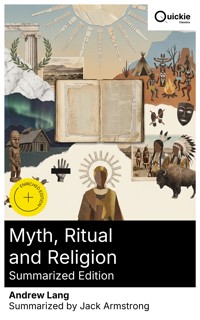
Myth, Ritual and Religion (Vols. I & II) is Andrew Lang's far‑ranging inquiry into the origins and transformations of sacred narrative. Marrying classical learning to the new comparative anthropology, he tests the "solar myth" and evolutionary schools against folktale corpora, travelers' reports, and ritual practice from Australia and the Americas to Greece and Scandinavia. Urbane, precise, and wry, his style combines scrupulous citation with close motif analysis and attention to totemism, taboo, and early "high gods." A Scottish classicist, folklorist, and journalist, Lang studied at St Andrews and Oxford and popularized ballads and fairy tales while engaging London learned societies. His distaste for armchair philology and his respect for ethnographic evidence inform his revisions: that moralized supreme beings may precede priesthoods and that myth resists reduction to a single physical allegory. Scholars and students of religion, folklore, and classical reception will find these volumes indispensable: a methodological primer and an encyclopedic archive in one. Read it to see Victorian debate at its sharpest, to sharpen your own comparative practice, and to encounter sacred stories with humane skepticism and durable curiosity. Quickie Classics summarizes timeless works with precision, preserving the author's voice and keeping the prose clear, fast, and readable—distilled, never diluted. Enriched Edition extras: Introduction · Synopsis · Historical Context · Brief Analysis · 4 Reflection Q&As · Editorial Footnotes.
Das E-Book können Sie in Legimi-Apps oder einer beliebigen App lesen, die das folgende Format unterstützen:
Veröffentlichungsjahr: 2026
Ähnliche









Myth, Ritual and Religion (Summarized Edition)
Table of Contents
Introduction
Between the human need to explain the unknown and the impulse to consecrate it, Andrew Lang traces how stories and ceremonies shape each other. Myth, Ritual and Religion (Vol. 1 & 2) is a two‑volume comparative inquiry by a Scottish scholar writing in the late nineteenth century, poised between folklore, classical studies, and early anthropology. Lang surveys narratives and practices from many parts of the world to ask how belief begins, changes, and endures. He writes with historical awareness and a critic’s eye, testing prevailing explanations against varied evidence. The result is a work seeking pattern without flattening variety, inviting curiosity about the bonds linking myth, ritual, and culture.
Composed during an era when European scholarship debated the origins of religion and the functions of myth, the book belongs to the tradition of comparative study rather than fiction or travel writing. Its pages range through classical texts, vernacular lore, and reports from explorers and missionaries, considering how ceremonies, taboos, and sacred narratives intersect. Lang positions his investigation among competing nineteenth‑century theories without merely repeating them, pressing each claim against a breadth of examples. He is mindful of chronology and diffusion yet resists narrow determinism. Readers encounter a survey that is scholarly in purpose and panoramic in scope, anchored in documented materials.
Reading Lang is to experience an urbane, occasionally combative voice that balances synthesis with close attention to particulars. His prose reflects the cadences of Victorian scholarship—measured, allusive, and dense with reference—yet it remains animated by curiosity and moments of dry wit. Argument alternates with catalogues of instances, so that patterns are never asserted without illustration. The tone is formal but not forbidding, suited to a work that aims to test explanations as much as to collect data. While the canvas is vast, the chapters are organized to guide non‑specialists as well as researchers through recurring questions about mythic form and ritual action.
The inquiry proceeds by comparing how communities narrate beginnings, name powers, mark transitions, and enforce prohibitions, and how such acts of telling and doing illuminate each other. Without relying on any single master key, Lang examines convergences and anomalies, watching where stories accrete around rites and where practices endure without explanatory tales. He considers persistence and change, continuity and rupture, mindful that sacred forms adapt even as they claim immemorial origins. The reading experience is exploratory rather than conclusive: arguments are advanced, tested, and sometimes left open, allowing readers to measure competing hypotheses alongside a wealth of carefully collated examples.
Several themes recur with force: the entanglement of ritual obligation with narrative imagination; the emergence of deities, spirits, and ancestors within systems of taboo; the relation of magic and worship; and the survival of archaic patterns in later literature and custom. Lang attends to classification while warning against reducing cultures to fixed stages, emphasizing both resemblance and irreducible difference. He treats myth as a living practice as much as a story, showing how communal acts of sacrifice, initiation, or seasonal celebration give shape to belief. Throughout, the study tracks how authority is claimed, challenged, and maintained within sacred frameworks.
For contemporary readers, the two volumes matter as foundational documents in the history of folklore and religious studies and as prompts for critical reflection on method. They show how comparative work can illuminate shared human problems while also revealing the limits and biases of its era, including terminology and perspectives that today require careful contextualization. Engaging the book thus becomes a double exercise: learning from its reach and rigor while interrogating its assumptions. It models interdisciplinarity—moving among philology, ethnography, and literary analysis—and it invites present‑day scholars to rethink how evidence is gathered, framed, and ethically interpreted.
Approached with both sympathy and scrutiny, Myth, Ritual and Religion rewards readers who seek an expansive map of human meaning‑making. It offers a durable framework for asking how beliefs travel, why they cohere in ritual, and what they reveal about memory, imagination, and social order. The work’s long view helps situate contemporary debates about identity, tradition, and cultural exchange within older conversations. As a study from the late nineteenth century, it is also a document to read against the grain, sharpening awareness of scholarly responsibility. Above all, it keeps alive a disciplined wonder at how humanity narrates the sacred.
Synopsis
Myth, Ritual and Religion (Vol. 1 & 2), first published in 1887, is Andrew Lang’s wide-ranging inquiry into how stories of gods, spirits, and sacred practices arise and persist. Writing against the dominance of purely philological explanations, Lang integrates folklore, ethnography, and classical learning to reconsider myths that seem irrational beside more ethical strands of religion. He frames a central question: how can cultures hold lofty conceptions of the divine while preserving tales of capricious or crude behavior among the gods? Across two volumes, he assembles comparative evidence to test theories of origin, transmission, and reinterpretation in both small-scale and literate traditions.
Lang opens by defining a comparative method grounded in folklore and the study of “survivals,” customs and ideas that outlast the contexts that produced them. He challenges systems that derive myths primarily from ancient wordplay or assume a single key, such as solar symbolism, to decode them. Instead, he proposes cross-checking linguistic interpretations with ritual practice, social institutions, and narratives from diverse peoples. The goal is not to prove uniformity but to assess recurring patterns and local variations. By treating myth as part of a wider cultural complex, he seeks a more disciplined account of how myths begin, change, and endure.
From this platform, Lang surveys early forms of thought—animistic beliefs, magical reasoning, taboos, and totemic affiliations—and the social rules attached to them. He examines how clans linked to particular animals or plants regulate marriage, inheritance, and ritual obligations, and how such arrangements generate explanatory stories. Myths do not merely ornament belief; they authorize conduct, sanction boundaries, and rationalize prohibitions. Lang also notes how evolving institutions can retain archaic features, producing tensions between inherited narratives and newer ethical ideals. These tensions, he argues, help explain why later religions preserve mythic episodes that appear inconsistent with their official doctrines.
The relation between practice and tale is central to Lang’s analysis. He contends that ritual may precede and shape narrative, with stories arising to explain or dignify ceremonies whose original motives have faded. Seasonal observances, initiation ordeals, and sacrificial or purificatory rites are treated as engines of myth-making as much as expressions of belief. He traces how actions once deemed necessary for communal welfare can be reinterpreted aesthetically, morally, or theologically in new settings. The endurance of rites within highly developed religions, he suggests, often reflects this process of reinterpretation rather than simple continuity of meaning.
Lang then turns to recurrent mythic types: accounts of world origins, explanations for death and disaster, the theft or bestowal of fire, and widespread cycles of the trickster and the culture hero. He compares versions from classical antiquity with those preserved in oral traditions across several continents, highlighting both shared structures and local coloration. Hero tales and stories of founders reveal how communities invest authority in exemplary figures, sometimes rationalizing gods as ancient leaders or sanctifying rulers through legend. Throughout, Lang emphasizes the friction between flamboyant or transgressive episodes in myth and the later theological systems that seek to discipline them.
A major through line is Lang’s survey of belief in a supreme being or creator among many non-literate peoples. He compiles reports of remote sky-fathers or high gods credited with moral oversight and cosmic authorship, whose worship may be intermittent yet conceptually elevated. These cases, he argues, complicate linear schemes that would place monotheistic ideas at the end of a fixed evolutionary ladder. At the same time, he weighs issues of evidence, including possible missionary influence and the limits of travel narratives, and stresses the coexistence of refined beliefs with stories that degrade or humanize the divine.
By the close, Lang presents a rebalanced study of myth that refuses single-cause explanations and insists on testing linguistic hypotheses against social custom and ritual form. The two volumes mark an early synthesis in comparative religion and folklore, modeling a method attentive to data, distribution, and transformation. While some terminology and assumptions reflect their time, the work’s central questions—about origins, the interplay of practice and story, and the uneven pace of cultural change—remain influential. Myth, Ritual and Religion endures less for definitive answers than for its disciplined curiosity, which continues to prompt critical reappraisal of how human communities imagine and remember the sacred.
Historical Context
Published in 1887 in two volumes, Andrew Lang’s Myth, Ritual and Religion emerged from late-Victorian Britain’s universities, learned societies, and imperial networks. Lang, a Scottish classicist and man of letters educated at St Andrews and Balliol College, Oxford, moved easily between classical studies, folklore, and emerging anthropology. London-based institutions such as the Royal Anthropological Institute (founded 1871) and the Folklore Society (founded 1878) fostered comparative collecting of traditions. Britain’s global empire supplied reports from missionaries, administrators, and travelers. Within this setting, Lang set out to examine myths and rites comparatively, testing scholarly theories against a broad, multilingual archive.
The book took shape amid nineteenth-century debates about human origins, culture, and belief. Charles Darwin’s works (1859, 1871) encouraged evolutionary explanations of social institutions. E. B. Tylor’s Primitive Culture (1871) proposed animism and “survivals” as keys to religion and folklore. By contrast, Friedrich Max Müller’s comparative philology had explained myths largely as poetic misunderstandings of language, especially solar imagery. Lang evaluated these competing models, adopting anthropological comparison and psychological uniformity while challenging narrow philological allegory. He also engaged ideas circulating through Auguste Comte’s and Herbert Spencer’s evolutionist sociology, asking how mental habits, narrative forms, and ritual practices might develop across societies.
Victorian anthropology relied heavily on secondhand ethnography, and Lang’s sources reflect that “armchair” method. Reports in the Journal of the Anthropological Institute (begun 1872), missionary periodicals, travel narratives, and colonial blue books furnished descriptions of ceremonies, taboos, and oral traditions from Africa, Oceania, the Americas, and Asia. Such accounts were uneven in quality and shaped by imperial perspectives, yet they provided the comparative inventory scholars sought. Lang sifted this material alongside classical texts and medieval chronicles, treating non-European testimony as evidence for recurrent patterns. His use of dispersed, published reports typified the data practices of British scholarship in the 1880s.
Religious scholarship in Britain was simultaneously historicizing scripture and broadening comparison. German-influenced “Higher Criticism” examined the Bible as a historical document. In anthropology, J. F. McLennan’s writings on totemism and exogamy (1869) and W. Robertson Smith’s studies of Semitic kinship (1885) advanced social explanations for ritual and sacrifice. James G. Frazer’s The Golden Bough would appear in 1890, but its concerns were already active in debate. Lang positioned his work within this ferment, exploring taboo, sacrifice, and sacred narratives without privileging any one tradition. He weighed whether social institutions, not linguistic accidents, better accounted for recurring mythic forms.
Contemporary psychology offered further tools. Following Tylor’s emphasis on animism and dreams, scholars explored how perceptions of spirits might arise from dreaming, trance, and misinterpreted natural phenomena. The period also saw organized inquiry into extraordinary experiences through the Society for Psychical Research (founded London, 1882), with which Lang later engaged. Without abandoning critical standards, he drew on available psychological theories of association and on Adolf Bastian’s notion of a “psychic unity” underlying human cultures. This framework encouraged Lang to seek shared mental processes behind diverse myths while analyzing how local environments, customs, and authority shaped ritual enactments.
Classical studies in Britain still centered on philology, with Greek and Latin authors scrutinized for linguistic origins and allegorical meaning. Lang, trained within that tradition, redirected attention from etymology to custom, rite, and story-pattern, comparing Greek myth with ethnographic parallels. He disputed Max Müller’s “disease of language” hypothesis, arguing that divine caprice, metamorphosis, and scandal in classical myths made better sense when read against totemism, taboo, and animistic logic. Although the later Cambridge ritualists would press ritual primacy more explicitly, Lang already treated rites and myths as historically intertwined, using ancient literature as one case within a wider anthropological field.
The publishing milieu of the 1880s favored ambitious syntheses aimed at educated general readers. Two-volume monographs, disciplinary journals, and review periodicals created channels for debate across classics, anthropology, and theology. Lang, an active journalist, translator, and essayist, wrote accessibly while marshaling scholarly citations. His study thus operated at the boundary of academic and popular discourse, testing expert theories against widely circulated travelogues and missionary compendia. The work’s comparative sweep and clear prose fitted the Victorian appetite for grand explanatory schemes, yet its detailed footnotes and engagement with society papers signaled a commitment to the evidentiary norms of learned institutions.
Myth, Ritual and Religion exemplifies late-Victorian comparative method while criticizing the era’s overconfident philological allegories. It reflects imperial information networks, evolutionist models, and the search for universal psychological mechanisms, even as it questions easy hierarchies between “primitive” and “civilized” thought. Lang’s synthesis, grounded in print evidence rather than fieldwork, helped redirect classical mythology toward social practice and belief, anticipating aspects of twentieth-century anthropology and the study of religion. Its arguments expose the assumptions and possibilities of 1880s scholarship: an insistence on cross-cultural pattern, a reliance on textual compilations, and a readiness to test theories against a broad, contested archive.
Myth, Ritual and Religion (Summarized Edition)
Volume 1
The book opens with a contents list—two introductions followed by eleven sections on mythic systems, savage thought, nature stories, cosmogonies, and divine legends. First issued in 1886, it attacked the prevailing philological school; “Amurath to Amurath succeeds,” and anthropologists soon took the throne. Spencer’s “ghost theory[1]” and Tylor’s Animism[2] traced gods to ancestral spirits, yet the work proclaimed a “relatively supreme being,” anthropomorphic, as ancient as, perhaps older than, spirit worship, a claim later expanded in Making of Religion. By 1901 the case stood stronger, and fresh editions prepared the ground for the mounting evidence.
Since 1901 abundant testimony has arrived. African papers in the Journal of the Anthropological Institute recount Oleron, maker and father of men, and Oro, lord of the bull-roarer[3]. From Australia come Howitt on south-east tribes, Spencer and Gillen on Arunta[4] and Kaitish, and Parker on Euahlayi: each portrays an “All Father,” while Arunta narratives, rich in animism yet lacking the sky-god, unveil totem groups chosen, not inherited, and free of marriage rules. Spencer hails this as the oldest pattern, Frazer derives it from spirits, and The Secret of the Totem rebuts them, pointing to further research and a new Golden Bough.
The 1887 issue having vanished from shops, the text is revised: inconsistent passages trimmed, two sections on the lowest peoples rewritten, yet its core remains—amid endless wild tales even savages hold “a maker of everything,” living above, watching deeds, punishing law-breakers and sometimes rewarding the good hereafter. Animism no longer seems all-sufficient; origins stay hidden, degeneration from pure faith to legend is traced, and Zeus supplies the model. Darwin is quoted: high faculties foster devotion and, while reason is weak, strange customs. Later civilisations, not Andaman or Australian hunters, forged ordeals and human sacrifice. Debate with Hartland over Daramulun[5]’s “lame” creator closes the defence.




