


Erhalten Sie Zugang zu diesem und mehr als 300000 Büchern ab EUR 5,99 monatlich.
- Herausgeber: Huia Publishers
- Kategorie: Bildung
- Sprache: Englisch
Niho Taniwha equips educators with culturally responsive practices to better serve and empower Māori students and their whānau. The book is centred around the Niho Taniwha model in which both the learner and the teacher move through three phases in the teaching and learning process: Whai, Ako and Mau. Educational success for Māori students is about more than academic achievement – it includes all aspects of hauora (health and wellbeing). This book demonstrates how to create learning environments that encompass self-esteem, happiness and engagement in Māori language, identity and culture. While Niho Taniwha presents challenging topics, the book has a practical focus that supports teachers in how to implement the model. Niho Taniwha will challenge and motivate the reader to improve their learning and teaching environment.
Sie lesen das E-Book in den Legimi-Apps auf:
Seitenzahl: 332
Veröffentlichungsjahr: 2022
Das E-Book (TTS) können Sie hören im Abo „Legimi Premium” in Legimi-Apps auf:
Ähnliche






First published in 2021 by Huia Publishers
39 Pipitea Street, PO Box 12280
Wellington, Aotearoa New Zealand
www.huia.co.nz
ISBN 978-1-77550-668-3 (print)
ISBN 978-1-77550-675-1 (ebook)
Copyright © Melanie Riwai-Couch 2021
“Tongiaki of Tonga” image, p. 236–7 © Herbert K. Kane, LLC
Cover image: Niho Taniwha by Maia Gibbs 2021
Back cover image of Dr Melanie Riwai-Couch by Tina Tuipulotu
Images on p. 234–5 from the Tapasā publication © Crown copyright 2018
Photographic images of the Riwai-Couch whānau from
Whai Rawa © Te Rūnanga o Ngāi Tahu 2021
Photographer: Natalie Morgan Photography
This book is copyright. Apart from fair dealing for the purpose of private study, research, criticism or review, as permitted under the Copyright Act, no part may be reproduced by any process without the prior permission of the publisher.
A catalogue record for this book is available from the National Library of New Zealand.
Published with the assistance of Te Pūtahitanga o Te Waipounamu
Ebook conversion 2022 by meBooks
CONTENTS
HE MIHI
ABOUT THE COVER ART – ‘NIHO TANIWHA’
How this book is organised
Your feedback is welcome
KUPU WHAKAMIHI | ACKNOWLEDGEMENTS
KŌRERO WHAKAMUA | FOREWORD
Professor Angus Hikairo Macfarlane
Michael Absolum and Mary Chamberlain
Preface
WHAI
CHAPTER ONE
Improving teaching and learning for ākonga Māori
CHAPTER TWO
Māori living and learning
CHAPTER THREE
Honouring Te Tiriti o Waitangi
CHAPTER FOUR
Whanaungatanga and whānau–school partnerships
CHAPTER FIVE
Te reo me ōna tikanga Māori
CHAPTER SIX
Cultural competence
AKO
CHAPTER SEVEN
Improving teaching and learning for ākonga Māori who are neurodiverse
CHAPTER EIGHT
Puna kōrero: Whānau voices
CHAPTER NINE
Iwi as guardians of education
CHAPTER TEN
Addressing racism in school settings
MAU
CHAPTER ELEVEN
Dealing with school concerns
CHAPTER TWELVE
Looking after kaiako Māori
CHAPTER THIRTEEN
Insights into improving teaching andlearning for Pacific learners
TIPU
CHAPTER FOURTEEN
Lift where you stand
NGĀ TOHUTORO
HE KUPUTOHU
FIGURES
1:The Niho Taniwha model is presented visually as three outer triangles and one inner inverted triangle
2:Infographic 1 provided by Janelle Riki-Waaka and CORE Education, all rights reserved
3:Infographic 2 provided by Janelle Riki-Waaka and CORE Education, all rights reserved
4:Infographic 3 provided by Janelle Riki-Waaka and CORE Education, all rights reserved
5:Continuum for cross-cultural communication (based on Bennett, 1993)98
6:Themes emerging from Māori whānau responses about their hopes and dreams for tamariki at school
7:Themes emerging from Māori whānau responses about their worries and concerns for tamariki at school
8:Themes emerging from Māori whānau responses about what they want their tamariki to learn about, or do more of, at school
9:Themes emerging from Māori whānau responses about what teachers can do differently
10:Themes emerging from Māori whānau about connecting with parents159
11:Key features of effective iwi–school communities of practice (Riwai-Couch, 2015)
12:Tapasā: Cultural competencies framework for teachers of Pacific learners (Teaching Council of Aotearoa New Zealand, 2017)
13:Tapasā compass of Pasifika learners, parents, families and communities (Teaching Council of Aotearoa New Zealand, 2017)
14:Si’ilata, R. (2014). Va’a Teel: Pasifika learners riding the success wave on linguistically and culturally responsive pedagogies. University of Auckland: Unpublished thesis: http://hdl.handle.net/2292/23402 (Painting by Herb Kawainui Kane, used with permission)
15:Teacher, Katherine Ferguson (left), and ākonga Māori, Xanthe Banks (right) © Melissa Banks
W H A K A T A U Ā K Ī
Ka hihiri ahau, ka WHAII perk up and CLOSE INKa wānanga ahau, ka AKOI deliberate and LEARNKa haratau ahau, ka MAUI refine and GRASPKa huritao ahau, ka TIPUI reflect and GROWKa hihiri ahau, ka WHAI. Ka wānanga ahau, ka AKO. Ka haratau ahau, ka MAU. Ka huritao ahau, ka TIPU. Ko ngā tapa o te niho taniwha, ko ngā tapa o taku whare mātauranga.When I perk up, I CLOSE IN. When I deliberate, I LEARN. When I refine, I GRASP. When I reflect, I GROW. The edges of the niho taniwha shape my education.He Mihi
Nau mai rā ki tēnei wāhi ako; nei mātou me ā mātou mihi matakuikui ki a koe i tēnei haerenga ōu. Ka rerekē te āhuatanga o te haerenga o tēnā, o tēnā, engari kia mōhio mai koe he haerenga takitini tēnei.
He nui ngā whāinga o tēnei tuhinga, ā, ko te whāinga matua kia whakawhānui ake i ngā mōhiotanga ki ngā tāngata, ki ngā hononga ki te Tiriti o Waitangi, ki ngā kōrero o mua, me ngā pānga ki ā tātou mahi, ā mohoa nei. Ko te wawata ia, kia whakapakari i ngā kaiwhakaako kia pai ake ai ā rātou mahi ki te taha o Ngāi Māori hei painga mō ngā ākonga Māori i roto i ngā wāhi ako katoa.
Ko tā tātou i konei, ko te whai i ngā taumata o ‘whakaaro’, o ‘whai’, o ‘ako’, o ‘mau’, tae noa ki ‘tipu’. Mā konā tātou e eke ai ki taumata kē atu, waihoki, ehara i te mea he ngāwari noa iho tērā ekenga. Nā reira kia kaha, kia māia.
Nei te tono kia ngākau māhaki, kia whakaiti hoki te tangata i a ia anō hei whakawhānui ake i tōna tirohanga ki tāna e ako ai. Nā reira he mea akiaki tēnei ki te hunga e hiahia ana kia kapo atu i ngā mātauranga hou mō te whakapiki ake, mō te whakapai ake, mō te whakahou ake i ngā āhuatanga o whakaako i ngā ākonga Māori, kia eke puhitaioreore ai rātou ki te taumata i wawatatia ai e ō rātou tūpuna.
I welcome you and commend you for being on this journey. The experience that follows will look different for each of us, but we are all in this together.
This publication has the overarching goals of widening and deepening our understanding of people, of Treaty relationships, of history and impacts. Mostly, the intention is to enable educators to be better, more effective practitioners who can stand with Māori to enable Māori education success for ākonga Māori in all settings.
In this learning journey, we will cycle through stages of whai, ako, mau and tipu. These revolutions will help us to move to a better place, and that movement will be challenging for some. Kia kaha, kia māia.
I encourage those of you who want to embark on a journey of new learning, who want to improve, rebuild and reframe the ways ākonga Māori are taught, so they can reach the heights of educational success hoped for by their ancestors.
Dr Melanie Riwai-Couch
About the cover art
– ‘NIHO TANIWHA’
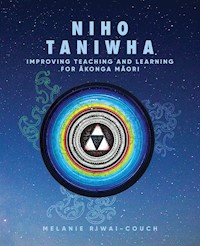
This artwork on the cover of Niho Taniwha is by Māia Gibbs. The centre represents the pattern of Niho Taniwha. Each section of the pattern holds its own mana and collectively creates its own life force: Whai, Ako, Mau and Tipu.
As the pattern grows out, we move through the different stages of consciousness: the white being ‘Te Kore’; the black being ‘Te Pō’; and the red moving outward into blue is ‘Te Ao’.
These stages are representative of the learning process, moving from a place of emptiness and also limitless potential into the reality of the world we know. Each element of the niho has its own journey that moves through whai, ako, mau and tipu, then out into the universe.
HOW THIS BOOK IS ORGANISED
This book is organised according to the Niho Taniwha model. The most coherent learning pathway will be achieved by working through the complete Niho Taniwha cycle. This will also allow for the different learning experiences to be connected more completely to each other. Like a tukutuku panel, when the designs are connected, you will see the larger picture forming and the logic of the patterns. In thirteen chapters, it will take you through the phases of whai, ako and mau, with the intent of achieving tipu.
You will be asked questions before each section to consider how you might have responded or reacted to the opportunities and challenges. You are encouraged to think deeply about how you might use the new knowledge gained in each chapter.
YOUR FEEDBACK IS WELCOME
I am interested in your feedback about this book, its content and any experiences you have improving teaching and learning for ākonga Māori. Please use this QR code or email [email protected] to send me a message.
Ngā mihi, Melanie
Kupu whakamihi
ACKNOWLEDGEMENTS
This book percolated for a very long time before I applied to Te Pūtahitanga o Te Waipounamu for funding that enabled me to work on it full-time for several months. Te Pūtahitanga represents the iwi of Te Waipounamu, enabling whānau transformation, and for this I am extremely grateful.
Many people helped me to shape the final content of this book. Kate Dreaver worked on the original draft with me and ensured coherence and connection between chapters and with other literature. She carried on this journey until the end, for which I am grateful. Jane Nicholls was likewise a cool, intelligent head who critiqued and encouraged throughout, and lent a hand with review and editing as needed. Both Kate and Jane went above and beyond what I could have hoped for as support people, editors and reviewers.
The talented artist Māia Gibbs created the cover artwork titled ‘Niho Taniwha’. Its visual representation provides another layer of depth to the Niho Taniwha methodology and approach that is both promoted and modelled in this book. Henare Te Aika-Puanaki crafted the thought-provoking whakatauākī for each section of Niho Taniwha – Whai, Ako, Mau and Tipu. Thank you, Henare, especially during such a tender time with the passing of your lovely pāpā. The translations for these whakatauākī were provided by Matt Fraser, a good friend and exceptional school leader, who has always been a generous soul willing to share his talents with me and others.
Angus Hikairo Macfarlane, Michael Absolum and Mary Chamberlain wrote the forewords for Niho Taniwha: Improving Teaching and Learning for Ākonga Māori – thank you for lending your voices and wisdom. The co-contributors to various chapters were Puti Gardiner, Sue Ngārimu, Joseph Houghton and Janelle Riki-Waaka. Their words add significant insights and experience that will be of great benefit to you as you learn from them. Numerous whānau members and parents have shared experiences and contributed to Chapter Eight: Puna Kōrero. I am grateful for your voices – you and your tamariki deserve the very best.
The Ministry of Education generously allowed me to include content from a recent literature review I conducted for them: Poipoia Ngā Ākonga Kanorau ā-Roro (2021). It forms the basis of Chapter Seven, which will help you improve teaching and learning for Māori students who are neurodiverse.
The Banks whānau from Nelson generously gifted the story of Xanthe included in the final chapter. I am grateful to Xanthe and her dad Jeremy for being willing to share this beautiful, positive experience. Xanthe’s teacher Katherine Ferguson also contributed to this chapter; her approach to teaching in this case study is a superior example of culturally competent teaching.
Dotted throughout this book are stories, anecdotes and quotes by whānau members and ākonga Māori; to you I am grateful for the gift of your voices that add to the richness of each chapter. My children Brigham and Mei have both shared experiences included in different chapters.
Special thanks Natalie Morgan Photography and Whai Rawa (Te Rūnanga o Ngāi Tahu) for the beautiful photographs included in this book.
Lastly, thank you to my family. My husband Jared has the patience of a saint, and he has needed it while I worked on this book. To my tamariki Brigham, Mei, Eden, Mānuera and Makere – you are exceptional. I am very blessed. Thank you for letting me draw from your experiences of schooling and my experiences as a māmā so that together we can help to improve teaching and learning for others.
Kōrero whakamua
FOREWORD
PRESENTED BY PROFESSOR ANGUS HIKAIRO MACFARLANE, PROFESSOR OF MĀORI RESEARCH, UNIVERSITY OF CANTERBURY
E ngā nui o te whakaaroE ngā pou o te akoE ngā kaitiaki o te kete mātaurangaNei te mihi ki a koutou
It is always good to be welcomed on a journey, in this case a learning journey that will encourage us to move to a better place – one that is intended to improve, rebuild and reframe the way ākonga are taught so they can reach the heights of educational success. The profound statement on page 7 resonates by stating that if this book does its job well then the reader moves between different states of feeling connected, challenged and empowered.
This book reiterates that places of learning are not isolated institutions. Rather, they both reflect and respond to the society of which they are a part. What does a centre or a school look like? For whom do they cater and for how long? What aspirations and goals are in place for the ākonga? What strategies are adopted by teachers to reach these goals? What are the indicators – the measures of success? These questions are bigger than they seem – educators, strategists and governments have been grappling with these for many decades. In more recent years, these questions have been compounded with requirements and expectations specific to culturally responsive pedagogies coming to the fore and with it the salient reality of an ever-changing and diverse global demographic. More questions are now being raised across the education sector and, naturally, more answers are being sought.
Responding to this clarion call, this book provides information, opinions and strategies upon which teachers can begin to build meanings and understandings of these complex realities. Generously and cleverly, Melanie Riwai-Couch articulates – among other things – an understanding of the learner in their respective sociocultural environment, the environment’s aims, structures and functions, and the relationship between each of these coexisting dynamics. Each of the fourteen chapters brings together a selection of these interconnected relationships. The chapters are based on theory that is richly culturally imbued and based on a growing body of practice-based evidence that indicates that a school/centre/classroom culture is significantly enhanced by the development of kaiako cultural competency, strength-based approaches and a curriculum that is contextualised, has relevance and is designed to provide scaffolding for the learner, the teacher and the wider community.
The book is organised according to the Niho Taniwha model and the beautiful accompanying whakatauākī. The tapestry of content comprises a cohesive narrative that takes the reader through the phases of whai, ako and mau, with the intent of achieving tipu. Four co-contributors to various chapters have added significant insights, adding potency to the axiom that there is indeed diversity within diversity. As cultural and linguistic diversity expands in Aotearoa New Zealand, so does the demand for all individuals working in the field of education to be prepared and better equipped to work alongside diverse learners. In Niho Taniwha: Improving Learning and Teaching for Ākonga Māori, the author has assembled a volume that serves as an invaluable resource to inform teachers, researchers and tertiary education institutions in the pursuit of amplifying professionals’ capacity to better serve and empower ākonga and their whānau.
Niho Taniwha provides insightful prospects for scholars and teacher practitioners to explore and climb the steps needed to foster and promote cultural proficiency. Melanie offers well-defined contentions on how to enact transformative practices that directly impact and improve culturally and linguistically diverse learners’ experiences. In addition, she attempts to address various issues relating not only to the work that educators are urged to undertake, but also to the roles the educational institutions are required to consider in order to create inclusive and inviting environments for all learners. This book is a conduit for successfully moving the reader, scholars and teachers between various states of thinking, of feeling connected, of feeling challenged and of feeling empowered. It has, therefore, done its job well.
When words are written with assertion and warmth, as they are by Melanie in Niho Taniwha, it is an authoritative step forward on the journey to citizenship, as Māori.
E taku ākonga o mua o Te Whare Wānanga o Waitaha, e poho kererū ana au i a koe.
(I offer this foreword with immense pride of a humble and talented former doctoral scholar.)
Angus Hikairo Macfarlane, CNZM
Professor of Māori Research, University of Canterbury
Kōrero whakamua
FOREWORD
PRESENTED BY MICHAEL ABSOLUM AND MARY CHAMBERLAIN,DIRECTORS, EVALUATION ASSOCIATES LTD
Nei rā te owha atu ki a koutou i runga i ngā āhuatanga o te wā.
There is one thing certain about schooling – all of our young people are required to engage in it and some of the young people who engage in it are not well served. The winds of educational and political change and debate have raged across Aotearoa for more than eighty years, while all the time too many of our precious ākonga have experienced compulsory schooling as a time when they learn that they are not learners, that they don’t belong, that the rhetoric about an inclusive, bicultural Te Tiriti o Waitangi-honouring society is just that – rhetoric. Melanie Riwai-Couch has written a book that says that it is possible to offer our ākonga something different, something positive for their future, that there is a way and that there are many examples where it does happen.
Melanie is a straight talker. She asks us to seek knowledge about doing better and she provides us with the ideas and practical advice we need to do so.
Melanie’s book challenges us to think about teaching ākonga Māori in new ways – to ‘know better and to do better’ – ‘to stand close together’ and to ‘lift where we stand.’ Melanie provides insights into how to avoid tokenism, busts myths about what culturally responsive practice means and poses thought-provoking questions. The Niho Taniwha model sets out a learning pathway through a comprehensive, yet accessible, framework that helps us fully engage our current understandings, so that we can learn and design personal paths to do better.
The book is full of engaging stories underpinned by research and examples that get to the heart of what is needed to teach ākonga Māori successfully. We found the story of Xanthe and Katherine, her English teacher, particularly poignant and powerful. It gives those of us with backgrounds like Katherine, the certainty that where there is a will to make a positive difference for ākonga Māori, there is a way.
The book is not an easy ‘how to’ manual. Its value lies in the thinking that it evokes, that may then lead to action. The provocative questions are designed to take us into ourselves, our schools, our communities and our contexts, to examine the gap between what really is and the potential of what it might become. We see Melanie’s book as a taonga for school leaders, teachers, professional development facilitators and policy makers who want to make a bigger difference for ākonga Māori.
Ngā mihi nui,
Michael AbsolumMary Chamberlain
Directors
Evaluation Associates Ltd
New Zealand
Matakōrero
PREFACE
My upbringing provided a lens through which to view my own educational practice, and a desire to improve education outcomes for Māori students. I am the youngest of four daughters and was raised from the age of five by my father (who is Māori) in the 1980s, in urban Christchurch. We were largely dependent on state welfare.
My father and I lived opposite the Caledonian Hotel and bottle store. This address provided interesting situations to observe, such as people fighting or falling asleep propped up against fences, or in the gutter. The local gang headquarters was situated behind our house.
My father was the pōtiki (or last-born child) of his family, the sixteenth child of George and Kate MacDonald from Wairau Pā in Blenheim. As a child, I was privileged to gain knowledge through travelling with my father. We would drive to and from Blenheim, usually for the tangi (funeral and grieving process) of his brothers and sisters. I never realised how fortunate I was to be the one who followed Dad everywhere, simply because I was the youngest and only child living with him. I got to listen to family stories (and legends), learn the lay of the land and know what belonged to whom.
I was streamed into the lowest band class when I started intermediate. I spent that year teaching a boy in my class how to read, and not much else. The following year when I arrived at the start of the year I was told to go to the top streamed class. It was very confusing. Again, at high school, I was put into the top stream class, but there was just me and one other Māori student. I was made to study Latin and French because those were the subjects the top streamed classes did.
In Fifth Form (equivalent to today’s Year 11), I was given an English assignment that involved interviewing a grandparent. My dad took me to sit with my Aunty Dolly1 in her little house at Spring Creek, where she told me about how she had taken care of my father while she worked at a bakery, him sitting under the table until his sister had finished her ten-hour shift. She told me about the family homestead, learning to weave, my grandparents – who died when my father was a child – and her ability to see visions.
That same year, my school principal in Christchurch was Marian Hobbs. She wrote ‘tino pai’ on my school report – a commonly used affirmation meaning ‘very good’. This was the first time I recall a school leader using the Māori language with me. It was significant, as it indicated that she identified me as Māori, and that made me wonder how I identified myself.
At age fifteen, I went to a boarding school in Hamilton, the Church College of New Zealand (CCNZ), operated by The Church of Jesus Christ of Latter-day Saints. The school introduced me to a very different life from what I had been accustomed to in Christchurch. Living in a dorm, our daily routine was tightly timetabled. There was a distinct hierarchy dependent on year levels, and high expectations with set consequences. Dorm parents tracked my participation and progress; dorm prefects tried to keep me in line. At a church school there was the added bonus of church leaders taking an active interest in my welfare.
During this time at CCNZ, extended whānau contributed to my education and upbringing. Some weekends I would stay with my cousins, the Reihanas, in Hamilton. Cousin Waimarie told me the first time I visited that I should always remember to take my shoes off if I wanted to be accepted in a Māori home. I learnt from Uncle Chris that white sauce (cream) could be eaten with anything, and that my Aunty Piki, Waimarie’s mother, was actually my first cousin.
In contrast to my earlier schooling, at CCNZ there was a strong cultural and values-based purpose for everything. There were teachers who were Māori. The teachers encouraged participation in cultural activities, which were exciting and had mana (prestige). I felt that the teachers didn’t just want me to achieve; they expected me to. This new sort of positive pressure was one I embraced, and so I achieved; I discovered I was good at learning.
Brother Lloyd Keung and Brother Ngātai Smith were two of the teachers I admired. They presented information in ways I understood and they communicated in ways that made me want to do well. Brother Keung would open his chemistry lab in the evenings so we could sit and do homework with him there to supervise. Thanks to the dedication of these teachers and the desire I had to do well for them, I sat and passed six academic subjects that year for Sixth Form Certificate.2 I received good grades, which allowed me provisional university entrance. To me, this is a direct example of student achievement being positively impacted because of the relationship with, and positive influence of, teachers and the school setting.
Alan Scott and Ian Culpan were to become my mentors at teachers’ college – politically correct in the most incorrect ways, incredibly intelligent and extremely caring. They became my new guides and, as non-Māori advocates, they helped me to surface and shape my own philosophy of education. Soon after I graduated I returned to the teachers’ college as a lecturer aged twenty-one. I taught alongside Alan and Ian and was grateful to learn from them almost every day.
Now, more than twenty-five years later I still remember the people who were there at critical times and helped me to stay in the education system as I studied to become a teacher, when it would have been so easy to fall away. There were key people who helped me to learn how to write an essay and the protocols of tertiary institutions (Alan Scott); to think my way out of trouble and into opportunity (Ian Culpan); how to access financial aid when my father’s benefit was cut (Jenny Hamlin); and to believe in myself that I could do great things despite my age or what hadn’t been achieved before (Ross Tasker).
My education has continued throughout my career and I am still learning. What I have written in this book is a collection of those career learnings, sorted into an order that I believe will be most useful for teachers wanting to improve teaching and learning for ākonga Māori. While I use many of my own stories, the importance of the content is not about me. It is about the difference that one teacher can make, for one ākonga, in one moment – and how we can make Māori education success the norm rather than the exception.
We can and will improve the system into one that does work for ākonga Māori; how we do that is the focus of this book.
1Aunty Dolly’s legal name was Anituhia Neame (née MacDonald).
2Equivalent to today’s NCEA Level 2, usually completed in Year 12.
WHAI
Ko te kimiTo searchKo te aruTo followKo te toroTo reach outKo te WHAIIs to CLOSE INKo te WHAI ko te ratanga o te ākonga ki te kārewa o te wai. He whāwhā, he tiehu, he ao te mahi.WHAI is about the enjoyment that comes with the exploration of new learning and the many aspects that enhance the way we experience this.CHAPTER ONE
IMPROVING TEACHING AND LEARNING FOR ĀKONGA MĀORI
This chapter explains why this book is necessary, what is happening for many ākonga Māori and their whānau in schools, and how teachers can take steps to create more inclusive, culturally responsive environments for ākonga Māori. Niho Taniwha is presented as both the methodology used to organise the content of this book and the process that can be followed to improve teaching and learning.
Whakaaro tuatahi
Kōrero
Why we need to do better for ākonga Māori
How we can improve
Niho Taniwha model for teaching and learning
Whakatauākī
What the chapters are about
How the chapters are structured
Using a kaupapa Māori model
Whakaaroaro
Whakaaro tuatahi
QUESTIONS TO HELP SURFACE EXISTING BELIEFS AND IDEAS
1.What do you expect to read about in this chapter?
2.Do you think there is room for improvement in how you teach ākonga Māori?
3.What does your achievement data tell you about how well your ākonga Māori are performing at your school?
4.How do you think ākonga Māori and whānau feel about how well they are included in school? Do they all feel the same way? Which of them might feel differently, and why?
Kōrero
NARRATIVE
From the author
It is Tuesday lunchtime at kura (school) and I am working on my research, drawing up my methodology on the classroom whiteboard. A thirteen-year-old student named Tamahou walks in and reads aloud one of the questions on the board, “What is the quality of education for Māori in New Zealand?”
He turns to me and says, “It’s not very good, aye? There’s a better chance of one of the boys in my class getting arrested than going to university.”
I spend the next half hour listening as Tamahou teaches me about Māori ideology and education in New Zealand.
Journal entry, 20 October 2011
Why we need to do better for ākonga Māori
Tamahou was a curious student with a ready smile. He was always willing to share his thoughts and opinions through speech and performance. Fortunately, Tamahou made his way through the school system and has now completed a double degree at the University of Canterbury. Unfortunately, many young Māori men and women don’t make it through the education system in the same successful way as Tamahou.
The majority of ākonga Māori in Aotearoa New Zealand attend English-medium schools, where English language is the language of instruction. A small percentage attend Māori-medium schools where te reo Māori is the priority language of instruction. There is ongoing concern in the education sector that ākonga Māori are not achieving as well in literacy and numeracy as other groups of students.
In 2019, only 82.1 percent of Māori school leavers had achieved NCEA Level 1 literacy and numeracy requirements, compared to 87.5 percent of Pacific school leavers and 92.5 percent of Pākehā school leavers. There have been improvements. For example, from 2009 to 2019 there was an impressive 19 percent increase in the number of Māori school leavers achieving Level 2 NCEA or its equivalent. But the achievement gaps remain firmly intact, with 64.7 percent of Māori school leavers achieving that goal in 2019, compared to 73.7 percent of Pacific and 82.0 percent of Pākehā.3
How we can improve
To improve academic outcomes for Indigenous students, culturally responsive pedagogical approaches need to be effective and authentic, and involve culturally informed teachers and educational leaders. Alternative paradigms about how to more effectively teach ākonga Māori are being explored, in the hope that these will support improved achievement outcomes (Berryman, Lawrence, & Lamont, 2018; Macfarlane, Macfarlane, Teirney, Kuntz, Rarere-Briggs, Currie, & Macfarlane, 2019; Ministry of Education, 2019; Ratima, Smith, Macfarlane & Macfarlane, 2020; Si‘ilata, 2014). One proposed way to increase the cultural responsiveness of schools is for them to work with whānau (parents and families) and iwi (Māori tribal authorities) to influence, inform and implement teaching and learning programmes. This was the topic I explored in my doctoral thesis (Riwai-Couch, 2014), and it continues to be close to my heart.
The purpose of this book is to increase understanding about how teachers can provide better teaching and learning experiences for ākonga Māori, that they enjoy and that provide access to the qualifications necessary for quality of life after school. Niho Taniwha is also for school leaders who create the environment within which teachers work. If this book does its job well, then you will move between different states of feeling connected, challenged and – increasingly – empowered.
If this book does its job well, then you will move between different states of feeling connected, challenged and – increasingly – empowered.
Educational success for ākonga Māori is about more than academic achievement. It includes all aspects of hauora. It encompasses self-esteem, happiness and awareness of language, identity and culture, and it encompasses the quality of personal relationships, and having respect and regard for others.
I’ve selected content for this book based on my knowledge of what helps to make the greatest improvements to the overall quality of the education experience for ākonga Māori in the least time. I have also considered the esteemed work of Viviane Robinson (2018) about improvement. I’ve heard her messages about the need to identify what is holding undesirable practices in place; the importance of reaching for shared understandings about critical issues and potential improvements; and the benefits of a collaborative approach to informing how they are addressed.
The book is organised in line with the Niho Taniwha model for teaching and learning, which is explained below.
Niho Taniwha model for teaching and learning
Kaiako Peter Moeau introduced the Niho Taniwha model to me in the early 1990s. In the years since, I have further developed my own understanding of what the Niho Taniwha model could look like and how it could be applied. I’ve used it to shape a variety of programmes and presentations for both Māori and non-Māori, often with teacher audiences. My personal experience over many years suggests that it provides a sound process for planning teaching and learning episodes that are underpinned by Māori values and understandings about how we learn.
In brief, Niho Taniwha is made up of two words with the following meanings:
•Niho: (noun) tooth, tusk, point, triangle.
•Taniwha: (noun) water spirit, monster, dangerous water creature, powerful creature, chief, powerful leader, something or someone awesome.
Triangles are often used in Māori design. Niho Taniwha is a triangular motif associated with Te Arawa and Waikato iwi. Niho Taniwha are usually arranged in rows, columns or groups, and look like the teeth of a taniwha. Traditionally, Niho Taniwha were seen on the hem of cloaks, but they are now used widely by Māori artists in many different mahi toi (Māori art works). These include tukutuku, tāniko (finger-weaving), tā moko (tattoo) and whakairo (carving).
Tā moko artist Derek Lardelli once told me that the niho shape is associated with education and educational achievements. The triangular shape is also replicated in haka movements (when men place their hands on their hips), representing strength and power. For these reasons, the triangular shape of the Niho Taniwha model for teaching and learning comes from the word ‘niho’.
In the Niho Taniwha model for teaching and learning, both the learner and teacher move through three phases. The first is Whai, when the partners in learning encounter the subject matter and commit to engaging with it; the second is Ako, when they engage with the subject matter; and the third is Mau, when the teaching and learning has been completed and they are able to review the impact of the experience and identify any further teaching and/or learning needs.
The following definitions for whai, ako, mau and tipu are from the Māori Dictionary (www.maoridictionary.co.nz):
Figure 1: The Niho Taniwha model is presented visually as three outer triangles and one inner inverted triangle
Whai (verb) to follow, chase, pursue, look for, search for, court, woo, aim at
Ako (verb) to learn, study, instruct, teach, advise
Mau (verb) to lay hold of, grasp, wield (as in mau rākau)
Tipu (verb) to grow, increase, spring, issue, begin, develop, sprout, prosper, originate – eastern dialect variation of tupu.
The first three phases rest in their own niho and, when the cycle is complete, TIPU occurs. Tipu is presented as the outcome in the central inverted triangle. It can only be achieved when the three phases of Whai, Ako and Mau have been completed.
Whakatauākī
Many people are familiar with whakataukī, proverbial sayings of unknown authorship that express wisdom from a Māori world view. Whakatauākī (note the ā) are slightly different in that the author is known.
The whakatauākī in this book were created by Henare Te Aika-Puanaki and translated by Matt Fraser. Henare was one of my kaiako when I was a tumuaki and I was constantly amazed at his tender use of reo Māori and ability to shape words and language in beautiful configurations. I believe he has achieved this again in the writing of the whakatauākī that represent Niho Taniwha: Whai, Ako, Mau and Tipu in this book, and that appear at the start of those sections. The translations for each whakatauākī were provided by Matt Fraser who was my Tumuaki Tuarua (Deputy Principal) and who is an exceptional advocate for te reo Māori.
What the chapters are about
Chapters One to Five are grouped together under WHAI – they provide you with the opportunity to consider teaching and learning from the perspective of ākonga Māori and a Māori world view. Their content is intended to help you to understand ākonga Māori better, exploring some of their experiences as learners and what makes them unique from other learners who you may teach.
Chapter One focuses on the opportunity we have to improve teaching and learning for ākonga Māori and how we can make it happen. It explains why this book is necessary, what is happening for many ākonga Māori and their whānau in schools, and how teachers can take steps to create more inclusive, culturally responsive environments for ākonga Māori. Niho Taniwha is presented as the methodology used to organise the content of this book and the process that can be followed to improve teaching and learning.
Chapter Two is called ‘Māori living and learning’. It provides an overview of Māori education and society. Its purpose is to help you understand how Māori individuals and families identify and connect with each other as whānau, hapū and iwi, and how Māori values and beliefs influence the teaching and learning experience.
Chapter Three examines why and how Te Tiriti o Waitangi is essential to creating equitable classrooms. It considers each of the articles of Te Tiriti and unpacks how they might apply in modern classrooms; how the Treaty articles and principles can provide a useful framework for successful classrooms; and how teachers can develop Treaty-centric practices. It unpacks some key concepts to build your understanding so you can apply them to your practice.
Chapter Four explores whanaungatanga (relationships) and whānau (family)–school partnerships. It is an expansion of the home–school partnership concept that includes the notion that not all family members may be resident in a student’s home, and ‘home’ can mean a variety of things. It gives consideration to what positive partnerships look like, how they can be strengthened and how you can use the strength of whakawhanaungatanga and home–school partnerships to support good decision-making and curriculum design.
Chapter Five focuses on te reo me ōna tikanga Māori (the Māori language and its practices). It will help teachers answer questions like, “Why is it important to have correct pronunciation?” and “What is the impact on Māori students when te reo me ōna tikanga Māori are not visible, valued and used correctly in school settings?” An assessment tool for teachers is also presented to help identify strengths and areas for improvement with your own language capability and knowledge of tikanga Māori.
Chapter Six invites you to construct an accurate working definition of what cultural competence is and what it can look like in Aotearoa New Zealand. Examples from a variety of teachers and school settings help illustrate the different ways cultural competence can be evidenced.
The second group of chapters in this book move you through an experience of AKO. They focus on how you can improve both what and how you teach in order to better serve ākonga Māori.
Chapter Seven is about kanorautanga, also known as neurodiversity. In that chapter, you will learn about the special learning needs of ākonga Māori and how they can be catered for in culturally responsive ways. You will have the opportunity to consider how these might be incorporated into your own practice and what benefits you and your ākonga might expect if you do.
Chapter Eight is called ‘Puna Kōrero: Parent voices’. Following disruptions to schooling in Aotearoa New Zealand caused by COVID-19 in 2020, Puna Kōrero was a methodology I developed for use in multiple settings to gather the voices of parents of Māori and Pacific learners. Listening to and honouring these voices helped schools and kāhui ako4 review their practices and find out how they could better design learning for Māori and Pacific learners.
Chapter Nine




