


9,99 €
Mehr erfahren.
- Herausgeber: Saage Media GmbH
- Kategorie: Geisteswissenschaft
- Serie: Anxiety
- Sprache: Englisch
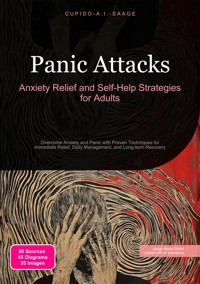
Are you tired of anxiety panicking about panic controlling your life? 'Panic Attacks: Anxiety Relief and Self-Help Strategies for Adults' offers a comprehensive approach to understanding and overcoming anxiety and panic attacks through practical, evidence-based techniques.
This guide walks you through the fundamental differences between everyday anxiety and debilitating panic, explaining the physiological reactions and psychological components that create these overwhelming experiences. You'll learn to identify various forms of anxiety—from generalized anxiety affecting your daily life to social anxiety impacting your relationships and performance anxiety in professional settings.
The book provides immediate solutions for when panic strikes, including effective breathing techniques, thought-stopping methods, and grounding exercises that engage your senses to bring you back to the present moment. For daily management, you'll discover valuable anxiety relief practices such as relaxation methods, journaling to identify triggers, and positive self-talk strategies that gradually reduce anxiety levels.
Beyond self-help for anxiety, this resource explores professional treatment options including cognitive behavioral therapy approaches that restructure negative thought patterns, medication considerations, and alternative therapies that complement traditional treatments.
The lifestyle section addresses how nutrition, physical activity, and sleep quality directly impact anxiety levels, with specific recommendations for anxiety relief for adults through dietary choices and exercise routines that naturally reduce stress hormones.
Perhaps most importantly, the book provides long-term strategies for recovery, teaching you to recognize early warning signs, develop personalized emergency plans, and build resilience through self-acceptance and personal growth.
Whether you're experiencing your first panic attack or have struggled with anxiety for years, this practical guide offers the tools and knowledge to move from merely surviving to thriving. Take the first step toward reclaiming your life from anxiety and panic today.
For this book, we relied on innovative technologies, including Artificial Intelligence and tailor-made software solutions. These supported us in numerous process steps: brainstorming and research, writing and editing, quality assurance, as well as the creation of decorative illustrations.
We aim to provide you with a reading experience that is particularly harmonious and contemporary.
Das E-Book können Sie in Legimi-Apps oder einer beliebigen App lesen, die das folgende Format unterstützen:
Seitenzahl: 175
Veröffentlichungsjahr: 2025
Ähnliche








Imprint
Saage Media GmbH c/o SpinLab – The HHL Accelerator Spinnereistraße 7 04179 Leipzig, Germany E-Mail: [email protected] Commercial Register: Local Court Leipzig, HRB 42755 (Handelsregister: Amtsgericht Leipzig, HRB 42755) Managing Director: Rico Saage (Geschäftsführer) VAT ID Number: DE369527893 (USt-IdNr.)SaageBooks.com//imprint
Publisher: Saage Media GmbH
Publication: 06.2025
Cover Design: Saage Media GmbH
ISBN Softcover (en): 978-3-69141-277-2
ISBN Ebook (en): 978-3-69141-276-5
Legal / Notices
All rights reserved. No part of this book may be reproduced, stored, or transmitted without written permission from the publisher. The external links and source references listed in this book were checked at the time of publication. The author has no influence on the current and future designs and contents of the linked pages. The provider of the linked website alone is liable for illegal, incorrect or incomplete contents as well as for damages arising from the use or non-use of the information, not the person who refers to the respective publication via links. All external sources used are listed in the bibliography. Despite careful content control, we assume no liability for the contents of external sources. The operators of the quoted sources are solely responsible for their content. Images and sources from third parties are marked as such. The reproduction, processing, distribution and any kind of exploitation outside the limits of copyright require the written consent of the respective author or creator. This book has been translated from German. Deviations from the original or translation errors cannot be completely ruled out. All sources linked in the book are available in English. We assume no liability for any content inaccuracies or misunderstandings that may have arisen through translation. The data in the diagrams that are not explicitly marked with a source are not based on studies but are non-binding assumptions for better visualization. This book was created using Artificial Intelligence (AI) and other tools. Among other things, tools were used for research, writing/editing, and generating decorative illustrations. Despite careful checking, errors cannot be completely ruled out. We would like to emphasize that the use of AI serves as a supporting tool to provide our readers with a high-quality and inspiring reading experience. The references contained in this book refer to online sources that have been carefully researched. The information is always reproduced analogously (paraphrasing); literal quotations are avoided. The interpretation and presentation of the reproduced content reflects the opinion of the author and does not necessarily correspond to the intention or opinion of the original authors. When reproducing the meaning, the core statements of the original sources are embedded in the context of this work to the best of our knowledge and belief. Two approaches are used here: Reproduction of meaning: Core statements are paraphrased directly and placed in the thematic context of the book. Transfer and application: Findings from a source that originally came from a different subject area or context are transferred and applied to the specific topic of this book. In both cases, the original formulations and nuances of meaning may differ from the original sources as a result of the transfer, simplification and contextual embedding. The responsibility for the interpretation and the specific application in the context of this book lies with the author. All online sources used are listed in the list of sources at the end of the book. It is recommended to consult the original sources for detailed information, although the permanent availability of online content cannot be guaranteed. The author has endeavoured to present complex issues in a generally understandable way. Simplifications and generalisations cannot be ruled out. No guarantee can be given for the technical accuracy and completeness of the simplified descriptions. The analogous reproduction of findings is carried out conscientiously in compliance with the applicable copyright regulations. When simplifying, transferring and, if necessary, translating content into generally understandable language, nuances of meaning and technical details may be lost. The author makes no claim to the rights of the cited works and respects all copyrights of the original authors. Should any unauthorised use be detected, the author asks to be informed so that appropriate measures can be taken. For academic purposes and when used as a scientific reference, it is expressly recommended to refer to the original sources. The simplified presentation is for popular scientific information only. Translated with DeepL.com (free version) The information contained in this book regarding panic attacks, anxiety disorders, and coping strategies has been carefully researched; however, it cannot claim completeness or freedom from errors. The self-help techniques and strategies presented for overcoming anxiety and panic do not replace professional medical, psychiatric, or psychotherapeutic treatment. In cases of acute or severe anxiety symptoms, panic attacks, or other psychological complaints, it is strongly recommended to seek medical or psychotherapeutic assistance. The application of the methods described in this book is at one's own risk. No liability can be accepted for any negative consequences or lack of success in applying the techniques presented. Medical and psychological knowledge in the field of anxiety disorders is continuously evolving. Therefore, new research findings or treatment approaches may have emerged since the publication of this book that could not be taken into account here. All content in this book, including the described exercises, case studies, and explanatory models, is protected by copyright. Any reproduction, translation, microfilming, as well as storage and processing in electronic systems without the publisher's permission is prohibited. Brand and product names mentioned in this book may be trademarks or registered trademarks of their respective owners and are hereby acknowledged. The use of such names is solely for identification and explanation purposes and does not imply any connection to the trademark holders. The sources and further literature references listed in the appendix serve to provide a scientific foundation and offer interested readers the opportunity for deeper exploration. No responsibility is accepted for the content of external sources.Table of Contents
introductionCupido A.I. Saage
50 Sources 45 Diagrams 35 Images
© 2025 Saage Media GmbH
All rights reserved
We sincerely thank you for choosing this book. With your choice, you have not only given us your trust but also a part of your valuable time. We truly appreciate that.
Panic attacks and anxiety disorders affect millions of people and can make everyday life a torment. However, they no longer have to dictate your life. This specialized book offers a comprehensive insight into the mechanisms of anxiety and panic, illustrating how these states arise, intensify, and—most importantly—how they can be overcome. From immediate coping strategies to long-term changes. Readers benefit from evidence-based methods of cognitive behavioral therapy, practical breathing techniques, and everyday exercises that have been shown to reduce anxiety and prevent panic attacks. The book combines scientific findings with concrete action guidelines and provides a structured path out of the cycle of fear. Those suffering from panic attacks or anxiety disorders will find a reliable companion on the journey to greater calmness and quality of life. Start today to understand and manage your fears.
This guide provides you with easy-to-understand and practical information on a complex topic. Thanks to self-developed digital tools that also use neural networks, we were able to conduct extensive research. The content has been optimally structured and developed up to the final version to provide you with a well-founded and easily accessible overview. The result: You get a comprehensive insight and benefit from clear explanations and illustrative examples. The visual design has also been optimized through this advanced method so that you can quickly grasp and use the information.
We strive for the highest accuracy but are grateful for any indication of possible errors. Visit our website to find the latest corrections and additions to this book. These will also be incorporated in future editions.
We hope you enjoy reading and discover new things! If you have any suggestions, criticism or questions, we look forward to your feedback. Only through active exchange with you, the readers, can future editions and works become even better. Stay curious!
Cupido A.I. Saage Saage Media GmbH - Team www.SaageBooks.com//contact/[email protected]ße 7 - c/o SpinLab – The HHL Accelerator, 04179 Leipzig, GermanyQuick access to knowledge
To ensure an optimal reading experience, we would like to familiarize you with the key features of this book:Modular Structure: Each chapter is self-contained and can be read independently of the others.Thorough Research: All chapters are based on thorough research and are supported by scientific references. The data shown in the diagrams serves for better visualization and is based on assumptions, not on the data provided in the sources. A comprehensive list of sources and image credits can be found in the appendix.Clear Terminology: Underlined technical terms are explained in the glossary.Chapter Summaries: At the end of each chapter, you'll find concise summaries that give you an overview of the key points.Concrete Recommendations: Each subchapter concludes with a list of specific advice to help you put what you've learned into practice.We plan to provide the following exclusive materials on our website:
Bonus content and additional chaptersA compact overall summaryAn audio drama version. (In planning)The website is currently under construction.
1. Fundamentals of Panic Attacks and Anxiety Disorders
Have you ever wondered why your heart suddenly races and you feel like you can't breathe, even though there is no objective danger? The mechanisms behind such intense bodily reactions follow specific patterns that are well-researched scientifically and can manifest in various forms. Both biological factors and life experiences, as well as thought habits, play a crucial role in the emergence and maintenance of these distressing states. Certain situations or thoughts can act as triggers, while other factors contribute to the intensification or chronicity of the symptoms. In this chapter, we decode the hidden logic of these seemingly uncontrollable reactions, thereby laying the groundwork for effective coping strategies.
1. 1 Differences between Anxiety and Panic
Anxiety and panic – both evoke strong emotions and physical reactions, yet they fundamentally differ. This understanding is crucial for managing panic attacks and anxiety disorders. Misinterpretations of symptoms can exacerbate the vicious cycle of fear and avoidance behavior, significantly impairing quality of life. This chapter provides you with the necessary knowledge to differentiate between anxiety and panic and take the first step towards coping. Read on to gain clarity about your individual challenges.
Anxiety focuses on future, uncertain threats, while panic concentrates on the catastrophic interpretation of present bodily sensations.
Physiological Reactions in Anxiety Attacks
Anxiety attacks are accompanied by a range of intense physical reactions caused by the activation of the sympathetic nervous system. This system is part of the autonomic nervous system and controls the body's "fight-or-flight" response. [s1] Typical physiological symptoms include, among others, palpitations or a rapid pulse, sweating, trembling or shivering, breathing difficulties such as shortness of breath or a feeling of choking, and dizziness or lightheadedness. [s1] Nausea, abdominal pain, hot flashes or chills, numbness or tingling sensations, and chest pain may also occur. These physical symptoms arise because the body reacts to a perceived threat, even though no actual danger exists. [s1] The intense perception of these bodily changes can further amplify anxiety and lead to a vicious cycle. For example, palpitations and shortness of breath may be misinterpreted as signs of a heart attack, which further heightens anxiety and intensifies the physical symptoms. Studies show that individuals with a history of panic attacks and heightened anxiety sensitivity react particularly strongly to physical changes, even when these are induced by false feedback. [s2] They report increased panic-specific symptoms in such situations and exhibit stronger physiological reactions such as a rapid pulse or increased sweating. [s2] This heightened sensitivity to bodily sensations plays a crucial role in the development and maintenance of panic disorders. [s3] Individuals with panic disorders exhibit a higher resting heart rate compared to those with generalized anxiety disorder or healthy controls, indicating a generally increased tension. [s3] To break this vicious cycle, it can be helpful to consciously perceive and label the physiological reactions during an anxiety attack. Instead of interpreting the symptoms as threatening, one can view them as a natural response of the body to stress and recognize that they are temporary and pose no danger. Regular cardiovascular training can improve overall stress resistance and positively influence the perception of physical symptoms.An anxiety disorder characterized by excessive and persistent worries about various everyday matters. Unlike panic disorder, the anxiety is not tied to specific situations or objects.
Sympathetic Nervous SystemThe part of the nervous system that prepares the body for stressful situations ('fight or flight'). It is activated during a panic attack and leads to physical reactions such as palpitations and sweating.
This chart highlights the significant differences in the intensity of physiological responses between general anxiety and panic attacks. While both share similar symptoms, panic attacks are characterized by a much more dramatic surge in intensity across nearly all physiological indicators. This visualization emphasizes the overwhelming nature of panic attacks compared to general anxiety, which, though uncomfortable, presents less extreme physiological responses.
Psychological Components of Distress
Thoughts and feelings during a distress attack significantly influence the course and intensity. Anxiety is often associated with worries about future events and uncertain, often distant threats. This future-oriented concern can manifest in rumination loops characterized by "what if" scenarios, thereby intensifying the distress. In contrast, panic attacks focus on immediate, present threats. The perception of symptoms—e.g., rapid heartbeat—is catastrophically interpreted, such as an imminent heart attack or loss of control. These misinterpretations amplify panic and can lead to avoidance behavior, such as avoiding certain places or situations. For instance, someone may begin to avoid supermarkets altogether after experiencing a panic attack in one, fearing that the attack might recur. A crucial aspect of coping with distress is thus learning to realistically assess the perceived threat and one's bodily sensations. This means observing thoughts and feelings during an attack without judging them or becoming overwhelmed. Mindfulness exercises can help redirect attention to the present moment, interrupting rumination loops and catastrophic thoughts. By consciously acknowledging one's thoughts and feelings—without judgment—one learns to distinguish between thoughts, feelings, and actual reality. This distinction is the first step in breaking the cycle of anxiety and panic.Avoidance behavior refers to the conscious or unconscious avoidance of situations, places, or objects that trigger fear or panic. While it may reduce anxiety in the short term, it can maintain or even exacerbate anxiety in the long term.
Distress AttackA distress attack describes the sudden onset of intense fear or panic, accompanied by physical symptoms such as rapid heartbeat, shortness of breath, or dizziness. It can occur in both anxiety and panic, with different triggers and interpretations of symptoms.
Mindfulness ExercisesMindfulness exercises are techniques aimed at directing attention to the present moment without judgment. They can help interrupt rumination loops, improve the perception of bodily sensations, and promote emotional regulation.
This chart highlights the differing contributions of psychological factors to general distress, differentiating between anxiety and panic. The largest segment represents 'Physical Symptoms,' emphasizing the significant role of bodily sensations in the experience of distress. 'Negative Thoughts' contribute substantially, indicating the impact of cognitive processes. While 'Emotional Reactivity' plays a notable role, its smaller proportion suggests that automatic emotional responses may be less central than physical sensations and thoughts in overall distress. The relatively small 'Avoidance Behaviors' segment suggests that while avoidance can be a factor, it represents a smaller portion of the overall distress experience compared to other components. This understanding helps to prioritize interventions targeting physical sensations, negative thoughts, and emotional regulation in managing distress and overcoming panic attacks.
Connection between Restlessness and Panic Attacks
Restlessness and panic attacks are closely related, with restlessness often serving as a precursor or accompanying symptom of a panic attack. Restlessness describes a state of diffuse, uncomfortable tension and worry, frequently accompanied by physical symptoms such as inner agitation, muscle tension, or difficulties concentrating. These symptoms can gradually intensify and culminate in a panic attack, characterized by sudden, intense fear and a variety of distressing physical sensations. The heart races, breathing becomes difficult, and dizziness and nausea may occur. Affected individuals often experience a sense of derealization or depersonalization, accompanied by the fear of losing control or dying. A cycle emerges in which physical symptoms exacerbate anxiety and vice versa. For instance, one may notice a slight heart flutter, triggering worries about a potential heart attack. These worries increase anxiety, which in turn intensifies the heart flutter. To break this cycle, it is helpful to understand the connection between restlessness and panic attacks. By learning to recognize the early signs of restlessness—such as fidgeting, constant throat clearing, or a queasy feeling in the stomach—one can intervene early. Relaxation techniques such as progressive muscle relaxation or breathing exercises can help reduce physical tension and alleviate restlessness before it escalates into a panic attack. Additionally, consciously addressing triggering thoughts and worries can aid in managing anxiety and preventing panic attacks. Keeping a journal to record thoughts and feelings can help identify patterns and better understand the causes of restlessness. By combining relaxation techniques and cognitive strategies, the spiral of restlessness and panic attacks can be effectively disrupted. It is important to seek professional help if restlessness and panic attacks significantly impair daily life. A therapist can develop individualized strategies for coping with anxiety and, if necessary, initiate a medication treatment.Depersonalization refers to the feeling of being detached from oneself, as if observing oneself from the outside. This feeling of alienation from one's own person can occur during a panic attack and can be additionally frightening.
Derealization




