


1,99 €
Mehr erfahren.
- Herausgeber: DigiCat
- Kategorie: Geisteswissenschaft
- Sprache: Englisch
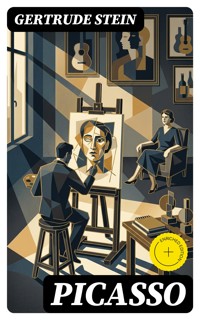
In her insightful exploration, "Picasso," Gertrude Stein delves into the life and artistry of the pioneering modernist painter, Pablo Picasso. Written in Stein's distinctively experimental style, the book transcends traditional biographical narratives, employing innovative syntax and a fragmented structure that mirrors the cubist form itself. This work not only offers an intimate glimpse into Picasso's creative process but also positions his art within the broader avant-garde movements of the early 20th century, reflecting the shifting paradigms of perception and representation that shaped the artistic landscape of the time. Gertrude Stein, an emblematic figure of the modernist literary movement, immersed herself in the vibrant circles of early 20th-century Paris, where she mingled with luminaries of art and literature. Her friendships with influential artists, including Picasso, informed her understanding of modernity and abstraction. Stein's avant-garde methods, shaped by her interactions with these intellectuals, inform the narrative style of "Picasso," repurposing her literary techniques to illuminate the painter's revolutionary oeuvre. This book is essential reading for anyone looking to understand not only Picasso's artistic evolution but also Stein's unique contribution to modernist literature. Its daring approach invites readers to reconsider the intersections of art and language, making it a profound addition to the library of any connoisseur of modernist thought. In this enriched edition, we have carefully created added value for your reading experience: - A comprehensive Introduction outlines these selected works' unifying features, themes, or stylistic evolutions. - The Author Biography highlights personal milestones and literary influences that shape the entire body of writing. - A Historical Context section situates the works in their broader era—social currents, cultural trends, and key events that underpin their creation. - A concise Synopsis (Selection) offers an accessible overview of the included texts, helping readers navigate plotlines and main ideas without revealing critical twists. - A unified Analysis examines recurring motifs and stylistic hallmarks across the collection, tying the stories together while spotlighting the different work's strengths. - Reflection questions inspire deeper contemplation of the author's overarching message, inviting readers to draw connections among different texts and relate them to modern contexts. - Lastly, our hand‐picked Memorable Quotes distill pivotal lines and turning points, serving as touchstones for the collection's central themes.
Das E-Book können Sie in Legimi-Apps oder einer beliebigen App lesen, die das folgende Format unterstützen:
Veröffentlichungsjahr: 2022
Ähnliche

Picasso
Table of Contents
Introduction
This volume gathers Gertrude Stein’s two most sustained engagements with the figure and idea of Pablo Picasso: the poem If I Told Him: A Completed Portrait of Picasso and the prose study Picasso. Read together, they reveal a writer who treated portraiture not as description but as composition, and who found in Picasso a subject equal to her experiments in language. The collection’s purpose is not to assemble a complete edition of Stein’s writings on art, but to focus the dialogue she sustained across genres—moving from concentrated poetic performance to extended critical reflection—around a single modern artist whose work helped shape her understanding of how art makes meaning.
The scope here is selective and intentional. It brings together a poem and a book-length essay, each a distinct text type with different pressures and freedoms. If I Told Him belongs to Stein’s series of verbal “portraits,” in which she remakes the conventions of likeness through rhythm and syntax. Picasso is a prose study that considers his work, method, and historical position from Stein’s vantage. No letters, diaries, or fiction are included, and the collection does not aim at completeness. Instead, it presents two complementary forms—poem and essay—that show how Stein used genre to test and re-state her idea of portraiture.
If I Told Him: A Completed Portrait of Picasso, composed in 1923, is a poem that fashions likeness without resorting to description or anecdote. It proceeds through patterned repetition, incremental variation, and a calibrated disruption of expectation, building identity as a sequence of verbal events rather than as a catalog of traits. The title’s promise of completion is itself a challenge, as the poem proposes that completion arises in the act of composition. In this work, Stein transforms portraiture into a temporal experience, asking readers to register motion, emphasis, and return within language as the means by which a person may be rendered.
Picasso, Stein’s essay published in 1938, approaches its subject in sustained prose. It places Picasso’s art within a modern context while emphasizing the processes by which his work alters seeing and knowing. The essay is not a conventional biography and does not seek to narrate a life in full. It is a critical portrait concerned with how his art organizes form and time, and with how changes in method produce changes in meaning. Stein’s prose moves with deliberate recurrence and definition, using her own stylistic instrumentation to discuss an oeuvre that itself reimagined the relations among objects, space, and perception.
Across these works, portraiture becomes an inquiry into what it means to know a person through the making of form. Stein explores identity not as an essence to be unveiled but as a pattern of relations that language can enact. Time is crucial: the portrait is made in the present and remade as the reader moves through the text. These writings also meditate on collaboration across the arts, proposing that painting and writing can meet in methods—fragment, emphasis, simultaneity—even when they differ in medium. The works unite around the problem of how art can represent motion, change, and attention without resorting to narrative explanation.
Stylistically, Stein’s hallmarks are unmistakable: repetition that intensifies rather than redundantly restates, variation that tests the limits of a phrase, and syntax that brings foregrounded attention to the smallest units of language. She often called this orientation the continuous present, a practice evident in both texts. Nouns and verbs acquire palpable weight through recurrence; shifts in order or stress suggest new alignments. In effect, she composes with linguistic facets, turning them this way and that, so that likeness emerges from cumulative resonance. The result is a poetics of perception, wherein language does not describe the subject but structures the conditions under which the subject can appear.
These writings also mark a significant dialogue between literary modernism and the visual innovations associated with Picasso. Without translating painting into words, Stein shows how a writer might engage analogous procedures: breaking habitual perspective, distributing attention across a field, and insisting on composition as an active encounter. The poem’s pulse and the essay’s considered cadences answer the pressure of an art that reconfigured form. Rather than borrowing imagery, Stein borrows problems—how to present simultaneity, how to keep seeing alert—and proposes verbal solutions that remain literary while recognizing the shared ambitions of modern arts.
The genres represented here invite different reading postures. The poem rewards aloudness, pacing, and return; meaning accumulates in the ear and in the sequence of recognitions generated by recurrence. The essay asks for sustained attention to Stein’s terms and to the clarity that emerges from her measured reiteration. Neither text depends on prior knowledge of Picasso’s works to be apprehended, though such knowledge can enrich the encounter. Together they demonstrate how genre shapes access: condensed intensity in the poem, extended articulation in the prose. Read consecutively, each illuminates the other’s strategies and aims.
The temporal spread of the pieces underscores a development in Stein’s engagement. If I Told Him, from 1923, belongs to an early period of portrait-experiments that redefined likeness through language. Picasso, published in 1938, adopts a broader, retrospective vantage, considering an artist whose work had by then transformed contemporary art. Taken together, they register Stein’s persistence in approaching the same figure through different methods at different moments: first as a concentrated, present-tense verbal event, later as a critical synthesis. The juxtaposition allows readers to see continuity of method alongside adjustment of scale and scope.
As documents of modernism, these works possess lasting significance. They show a writer fashioning criticism and portraiture in a style adequate to new artistic realities. Stein resists the impulse to translate visual art into plot or moral lesson; instead, she articulates principles of construction and attention. The poem has influenced approaches to performance, sound, and conceptual writing, while the essay continues to be read for its account of method and its example of criticism conducted in a singular prose. Their endurance rests on how they make process visible and audible, turning reading itself into an aesthetic act.
This collection also raises enduring questions about representation: What does it mean to write a person rather than describe one? How does a portrait account for change? Stein’s answer is to let composition carry the ethical and aesthetic weight. The portrait is faithful not by mirroring a face but by sustaining the pressures that make a subject recognizable across variations. The essay extends this argument to the public realm of artistic reception, considering how an oeuvre teaches its spectators how to see. Both works insist that understanding arises from attention to form, sequence, and the conditions of making.
By gathering these two texts, the present volume offers a concentrated view of Stein at work alongside one of the central figures of her milieu. It is an invitation to experience how a poem and an essay can converge on the same subject while disclosing different facets of it, and to recognize how Stein’s commitments—to the continuous present, to repetition as discovery, to composition as thought—hold across forms. The result is neither a biography nor a catalogue, but a portrait in two modes, demonstrating how language, carefully arranged, can reframe what we think it means to see.




