


14,99 €
Mehr erfahren.
- Herausgeber: John Wiley & Sons
- Kategorie: Fachliteratur
- Sprache: Englisch
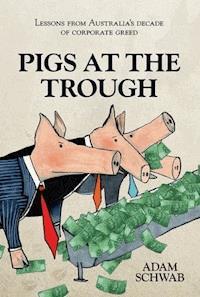
The past decade has seen a period of unparalleled growth in executive remuneration. But while CEO pay exploded, shareholders looked on helplessly as some of Australia's best-known companies self-destructed. When the fall eventually came, executives were well protected. Shareholders and creditors were not so lucky. From Telstra's enriching of Sol Trujillo to the toppling of Eddy Groves's ABC Learning Centres and the untold accounts of the billions lost by the collapsed Babcock & Brown, Allco Finance Group and MFS, Pigs at the Trough tells the story of how a generation of executives, under the supervision of well-known and respected non-executive directors, pushed all the boundaries and sometimes sailed right over them ... and got away with it. A pacey, irreverent read but with a devastatingly serious message, Pigs at the Trough gives investors invaluable insights into how to spot the telltale signs of impending corporate collapse, and how to avoid being another victim.
Sie lesen das E-Book in den Legimi-Apps auf:
Seitenzahl: 437
Veröffentlichungsjahr: 2010
Ähnliche



















Pigs at the trough: lessons from Australia’s decade of corporate greed®
Table of Contents
About the author
Acknowledgements
Preface
CHAPTER 1: Telstra
BS: before Sol (1992–2005)
You gotta have Sol
Jobs for the amigos (2005)
Sol cashes in (2006)
Talking down his book
The Telstra shareholders are revolting (2006–07)
The lucre continues to flow (2007)
Who dares Winns
The NBN: Sol meets his Waterloo (2008–09)
Sol departs (2009)
CHAPTER 2: ABC Learning Centres
The early days
Going public (1997)
The biggest little company in the world (2003)
Losing friends
The big little Australian: ABC takes over its biggest rivals (2004)
Going for broke (2005)
A debt-fuelled honeymoon (2007)
Catastrophe (2008)
Skirting the margins
Eddy’s last roll of the dice
The sword falls
Related-party transactions
Selling stock (2006–07)
What went wrong?
CHAPTER 3: MFS
Never trust a lawyer (late 1990s–2002)
The early days (2002–04)
Rapid growth (2005–06)
A tourism giant (2006–07)
The dark clouds gather
The phone call from hell (January 2008)
Sharing the pain: the MFS satellites collapse
The fallout (February 2008–09)
The pain spreads
Who was watching the watchers?
To the losers go the spoils
CHAPTER 4: Village Roadshow
Roc’s legacy (1954–1988)
Heading abroad (1998–2002)
A preference for trouble (2003)
The Germans are coming
Some of my best friends are Jews
The Kirbys keep on cashing in (2004–08)
An unhappy ending (2007–09)
CHAPTER 5: Toll and Asciano
The buyout (1986)
The takeover of the decade (2005–06)
Breaking up is hard to do (2006–07)
Asciano goes for broke (2007–08)
Paying for underperformance: Rowsthorn cleans up (November 2008)
Little’s big windfall (revealed: November 2008)
Please sir, may i have some more? (Asciano, 2009)
Shareholders pay the toll
CHAPTER 6: Allco
The rise of the financial engineers (1979–2001)
Going public (2001–04)
Taking control (2005)
HITs and misses (2004–05)
Allco takes record (2005–06)
Flying the friendly skies — allco moves on Qantas (December 2006)
Ramming it home (August 2007)
Crossing the rubicon (December 2007)
The death spiral (January 2008)
Oh what a tangled web we weave …
After the fall (2008–09)
CHAPTER 7: Babcock & Brown
The student becomes the master (1977–2000)
The brothers green: death and envy
Babcock gets listed (2004)
Boom (2005)
Spinning off: Babcock adopts the Macquarie model
Joint venturing out (2005)
Babcock bosses’ big bonus bonanza (2005–06)
Going gangbusters — and going bust (2007–08)
Babcock starts to wobble
Babcock crumbles
Babcock noteholders get shafted (2009)
The survivor: Phil Green lives on
CHAPTER 8: Timbercorp and Great Southern Plantations
Early stumbles (2000–02)
Sales, share price and related-party deal explosion (2003–05)
A Ponzi scheme exposed? (2005)
Ignoring the obvious: the good times continue to roll (2006–07)
The taxman cometh (2007–08)
Collapse (2009)
Owner-growers get shafted
The villains
NOTES
First published 2010 by John Wiley & Sons Australia, Ltd 42 McDougall Street, Milton Qld 4064
Office also in Melbourne
Typeset in 11.3/13.8 pt Caslon
© Adam Schwab 2010
The moral rights of the author have been asserted
National Library of Australia Cataloguing-in-Publication data:
Author: Schwab, Adam.
Title: Pigs at the trough: lessons from Australia’s decade of corporate greed / Adam Schwab.
ISBN: 9781742169903 (pbk.)
Notes: Includes index.
Subjects: Financial crises – Australia.
Global Financial Crisis, 2008–2009.
Executives – Conduct of life.
Fraud.
Dewey number: 338.5420994
All rights reserved. Except as permitted under the Australian Copyright Act 1968 (for example, a fair dealing for the purposes of study, research, criticism or review), no part of this book may be reproduced, stored in a retrieval system, communicated or transmitted in any form or by any means without prior written permission. All inquiries should be made to the publisher at the address above.
Cover design by Xou Creative
Printed in China by Printplus Limited
10 9 8 7 6 5 4 3 2 1
Disclaimer
The material in this publication is of the nature of general comment only, and does not represent professional advice. It is not intended to provide specific guidance for particular circumstances and it should not be relied on as the basis for any decision to take action or not take action on any matter which it covers. Readers should obtain professional advice where appropriate, before making any such decision. To the maximum extent permitted by law, the author and publisher disclaim all responsibility and liability to any person, arising directly or indirectly from any person taking or not taking action based upon the information in this publication.
About the author
Adam Schwab was a corporate lawyer at one of Australia’s largest firms before becoming a founding director of the privately owned diversified accommodation and services group AJ Capital. Since 2004, Adam has also been a financial journalist and business commentator for Australia’s largest and most influential online publication Crikey,and a business contributor to Fairfax publications, including TheSydney Morning Herald and The Age. Schwab has also acted as a corporate governance adviser to Australia’s largest institutions and fund managers.
Acknowledgements
A few people deserve my heartfelt thanks for their generous time and assistance. I am deeply grateful for the assistance of Jeremy, Lesley-Anne and Rosie, my outstanding proofreaders; and to Campbell for his wise guidance. I am also eternally thankful to Dean and Martin for imparting a mere fraction of their wisdom and knowledge to me, which hopefully was able to find its way into this book in some way.
To Mary, Brooke, Hannah and everyone at Wiley, my editor Michael and legal adviser Richard, your diligence, expertise and enthusiasm for the project throughout has been invaluable.
I am in the debt of the team at Crikey: Andrew, Thomas, Sophie, Jane, Leigh and Jonathan; and especially to Stephen for literally trailblazing the journalistic pursuit of corporate governance. Misha, my first editor, your faith in me and generosity have not been forgotten.
Finally, a special thank you to my family and close friends for their constant faith and support over the years; and to those executives whose greed and foolishness made this book possible.
Preface
The world is now caught in the worst economic crisis since the Great Depression. This crisis has been created by an ideology of unrestrained greed … turbocharged by unregulated financial markets, by obscene remuneration packages that maximised risk with no regard whatsoever to the impact of their behaviour on ordinary investors … this has been extreme capitalism writ large.
Prime Minister Kevin Rudd, 2008
From the recession of the early 1990s until the global financial crisis of 2008, shareholders experienced almost two decades of unrestrained joy, punctuated only briefly by an Asian hiccup and burst dotcom bubble. Insatiable share price and earnings growth, coupled with billions of dollars of superannuation money, saw the Australian stock market explode.
But as good as the good times seemed, the boom was built on very shaky foundations. Generous use of debt created many paper fortunes. However, it is often said, the greater the bubble, the greater the deception — and there is little doubt that many of the fast-growing businesses were running on bluff and bluster, rather than sustainable and honest business models.
Throughout this period of excess there were several constants: the ever-increasing trajectory of executive remuneration, coupled with a new-found love of debt and widespread use of financial engineering. While real wages for ordinary workers barely kept up with inflation, executives received lucrative share options, performance rights and short-term cash bonus payments that contained very little alignment with long-term wealth creation (except for their own).
As executive remuneration skyrocketed, Australia also witnessed insatiable growth in companies that made very little of anything of value, but instead engaged in pursuits called ‘asset origination’ or ‘asset recycling’. These companies (typically called ‘financial engineers’) would hide the nature of their businesses among an ever-growing cloak of complexity. Their Byzantine structures and opaque financial reports allowed executives such as David Coe and Phil Green to accumulate multi-million-dollar nest eggs. When the fall eventually came, these so-called masters of the universe would be well protected. Shareholders and creditors would not be so lucky.
The financial engineers, usually operating in the once staid, government-owned infrastructure sector, used layers of leverage and billions of dollars of shareholder capital to acquire assets and later pay income from that very capital and borrowings. The engineers — led by Babcock & Brown, Allco and MFS — would become the custodians of Australia’s most important infrastructure and tourism assets. Their inevitable death, under the weight of burgeoning debt, would bear an eerie resemblance to the endeavours of the entrepreneurs of yesteryear — household names such as Bond, Skase and Spalvins would be replaced in 2008 by a new set of faces, with names such as Coe, Groves and Green.
The ease with which founders and executives enriched themselves at shareholders’ expense will long remain a case study for the importance of corporate governance.
Eddy Groves, the man who ran what was once the world’s largest childcare company, paid his brother-in-law millions of dollars in untendered maintenance works, while Allco directors David Coe and Gordon Fell collected tens of millions of dollars after they sold their Rubicon property business to Allco — after the sub-prime crisis had taken hold. Only days after the sale, Gordon Fell’s wife spent $27 million purchasing one of Australia’s finest homes on Sydney harbour, the asset remaining safely out of reach of Fell’s creditors and Allco’s beleaguered shareholders.
Babcock & Brown’s Phil Green and MFS’s Michael King stood by while the empires they created crumbled. Both appear to have retained extensive private financial interests, often purchased with monies extracted from their companies during the glory years.
But it wasn’t only the engineers who brought pain to shareholders.
The Village Roadshow troika of Robert and John Kirby and ‘surrogate brother’ Graham Burke would turn the notion of ‘alignment’ into a furphy. The Village executives received tens of millions of dollars over a decade while their bumbling management of Australia’s largest cinema and production concern cost shareholders millions.
Telstra, once a staid, government-owned utility, would turn to a big-talking American to improve its fortunes. It took four years and many billions of dollars in lost market value for the Telstra board to realise the error of their ways.
Toll Holdings, one of Australia’s most successful companies, became a pariah, paying its already wealthy executives millions for worthless options, right under the noses of shareholders.
Even two agribusiness companies, which sold woodchips to the Japanese, ended up being Australia’s largest (alleged) Ponzi schemes, all the while costing taxpayers billions of dollars as Collins and Pitt street farmers collected tax deductions for upfront losses on revenue that would never materialise.
This is the story of how a generation of executives, under the apparent supervision of respected non-executive directors, duped millions of Australian investors, analysts and commentators.
From the carnage comes some valuable lessons. While the likes of Allco and MFS were complex, arcane entities, their financial statements gave warnings to investors to stay well away. But they were signals that were missed or ignored by almost all investors and analysts. At the same time, the business elite, the men and women who occupy the blue-chip boardrooms of corporate Australia, did little or nothing to rein in executives. On many occasions, non-executive directors were unwilling or unable to stand up to executives who enriched themselves while their companies burned.
This book is not merely a tale of greed, but of the clues that can be gleaned — important evidence that all investors who manage their own wealth should always be on the lookout for before trusting their retirement savings to the care of highly paid executives and boards of directors.
Pigs at the Trough will show you how to spot the next corporate car crash — and hopefully how to avoid becoming the next casualty. Santayana once noted that those who forget history are doomed to repeat it. Unfortunately for many investors, history is too often forgotten as soon as the next bubble appears.
CHAPTER 1: Telstra
Dialling up a loser
Once I’ve developed a strategy, I want everyone to fall behind it — you either catch the vision or catch the bus.
Sol Trujillo, prior to his appointment as CEO of Telstra in 20051
There have been few more polarising figures in Australian corporate history than former Telstra chief executive Solomon Trujillo. He brought an American style of leadership to what was once Australia’s largest company. Despite being paid like a king, Trujillo is widely believed to have left Telstra in a far worse state than when he arrived four years earlier.
For critics of Telstra, the Trujillo experiment represented an extreme case of a board of directors, appointed by shareholders to represent their interests and reduce agency costs, utterly failing. As business commentator Ian Verrender observed, ‘between them, Trujillo and [Donald] McGauchie in the past five years have infuriated and alienated almost everyone who has come into contact with them; federal politicians on both sides of the house, regulators, customers, even their own shareholders’.2
BS: before Sol (1992–2005)
Telstra under Trujillo was a long way from the government-owned monopoly that had been in existence for the best part of a century. Australia’s pre-eminent telecommunications company grew out of the ashes of Telecom, the formerly government-owned phone carrier that was established in 1901 when the Postmaster-General’s Department was created to run domestic telephone, telegraph and postal services. In 1992, Telecom merged with the government-owned Overseas Telecommunications Corporation, and the following year the company was renamed Telstra.3
Telstra was partially privatised in 1997 when the Howard government sold off one-third of the company as part of the global shift towards private ownership of assets.[1] At the same time as Telstra was being sold, the federal government opened the Australian telecommunications sector to full competition. (Telstra’s full monopoly over telecommunications was gradually eroded from 1991 when competition began in the long-distance and international markets.)
From 1992, Telstra was led by American former AT&T executive Frank Blount. In 1996, shortly before Telstra was partially privatised, it earned $3.2billion in profits and paid its American CEO $1.2million in salary and bonuses. A decade later, Telstra managed to improve earnings by 59percent (to $5.1billion) but saw executive remuneration skyrocket. In fact, over that time Telstra increased the amount it paid its senior management by more than 1000 per cent. (The Telstra directors did not fare too poorly either in the financial stakes. While former Telstra chairman David Hoare was paid $124
Lesen Sie weiter in der vollständigen Ausgabe!
Lesen Sie weiter in der vollständigen Ausgabe!
Lesen Sie weiter in der vollständigen Ausgabe!
Lesen Sie weiter in der vollständigen Ausgabe!
Lesen Sie weiter in der vollständigen Ausgabe!
Lesen Sie weiter in der vollständigen Ausgabe!
Lesen Sie weiter in der vollständigen Ausgabe!
Lesen Sie weiter in der vollständigen Ausgabe!




