


6,99 €
Mehr erfahren.
- Herausgeber: Open Book Publishers
- Sprache: Englisch
During the international coronavirus lockdowns of 2020–2021, millions of children, youth, and adults found their usual play areas out of bounds and their friends out of reach. How did the pandemic restrict everyday play and how did the pandemic offer new spaces and new content? This unique collection of essays documents the ways in which communities around the world harnessed play within the limiting frame of Covid-19.
Folklorists Anna Beresin and Julia Bishop adopt a multidisciplinary approach to this phenomenon, bringing together the insights of a geographically and demographically diverse range of scholars, practitioners, and community activists. The book begins with a focus on social and physical landscapes before moving onto more intimate portraits of play among the old and young, including coronavirus-themed games and novel toy inventions. Finally, the co-authors explore the creative shifts observed in frames of play, ranging from Zoom screens to street walls.
This singular chronicle of coronavirus play will be of interest to researchers and students of developmental psychology, childhood studies, education, playwork, sociology, anthropology and folklore, as well as to toy, museum, and landscape designers. This book will also be of help to parents, professional organizations, educators, and urban planners, with a postscript of concrete suggestions advocating for the essential role of play in a post-pandemic world.
Das E-Book können Sie in Legimi-Apps oder einer beliebigen App lesen, die das folgende Format unterstützen:
Veröffentlichungsjahr: 2023
Ähnliche

















PLAY IN A COVID FRAME
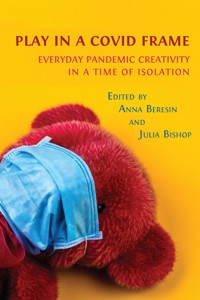
Play in a Covid Frame
Everyday Pandemic Creativity in a Time of Isolation
Edited by Anna Beresin and Julia Bishop
https://www.openbookpublishers.com
© 2023 Anna Beresin and Julia Bishop (eds). Copyright of individual chapters is maintained by the chapter’s authors
This work is licensed under an Attribution-NonCommercial 4.0 International (CC BY-NC 4.0). This license allows you to share, copy, distribute and transmit the text; to adapt the text for non-commercial purposes of the text providing attribution is made to the authors (but not in any way that suggests that they endorse you or your use of the work). Attribution should include the following information:
Anna Beresin and Julia Bishop (eds), Play in a Covid Frame: Everyday Pandemic Creativity in a Time of Isolation. Cambridge, UK: Open Book Publishers, 2023, https://doi.org/10.11647/OBP.0326
Copyright and permissions for the reuse of many of the images included in this publication differ from the above. This information is provided in the captions and in the list of illustrations. Every effort has been made to identify and contact copyright holders and any omission or error will be corrected if notification is made to the publisher.
Further details about CC BY-NC licenses are available at http://creativecommons.org/licenses/by-nc/4.0/
All external links were active at the time of publication unless otherwise stated and have been archived via the Internet Archive Wayback Machine at https://archive.org/web
Digital material and resources associated with this volume are available athttps://doi.org/10.11647/OBP.0326#resources
ISBN Paperback: 978-1-80064-891-3
ISBN Hardback: 978-1-80064-892-0
ISBN Digital (PDF): 978-1-80064-893-7
ISBN Digital ebook (EPUB): 978-1-80064-894-4
ISBN XML: 978-1-80064-896-8
ISBN HTML: 978-1-80064-897-5
DOI: 10.11647/OBP.0326
Cover photo by Volodymyr Hryshchenko on Unsplash, https://unsplash.com/photos/7JAyy7jLTAk.
Cover design by Jeevanjot Kaur Nagpal
The game would commence by him batting a sensory ball that loosely resembles the virus pictures we see everywhere onto the trampoline [. . .]. If the ball hit them once, they would ‘self-isolate’ at the edge of the trampoline, counting to 10. This could happen 3 times, but once the ball hit you a fourth time, dramatic coughing would begin, then they would fall over and ‘die’.
Rebecca Oberg (quoted in Beresin 2020)
Contents
List of Illustrations and Recordings xi
Introduction
Anna Beresin and Julia Bishop
Section 1: Landscapes 1
1. ‘Tag, You’ve Got Coronavirus!’ Chase Games in a Covid Frame 3
Julia Bishop
2. Gathered in Play: Play as the Common Space during the Covid-19 Lockdown in Serbia 33
Živka Krnjaja and Nevena Mitranić
3. Up, Down, Stop, Go, and Everything In Between: Promoting a Resident-Driven Play-based Agenda during a Global Pandemic in Rochester, New York 55
Holly Sienkiewicz, Jenn Beideman, Beatriz LeBron, Shanielia Lewis, Emma Morrison, Lydia Rivera, and Dina Faticone
4. ‘Let Them Play’: Exploring Class, the Play Divide and the Impact of Covid-19 in the Republic of Ireland 77
Maria O’Dwyer, Carmel Hannan, and Patricia Neville
5. How Playwork in the United Kingdom Coped with Covid-19 and the 23 March Lockdown97
Pete King
6. Playworkers’ Experiences, Children’s Rights and Covid-19: A Case Study of Kodomo Yume Park, Japan 119
Mitsunari Terada, Mariia Ermilova, and Hitoshi Shimamura
Section 2: Portraits 141
7. Objects of Resilience: Plush Perspectives on Pandemic Toy Play in Finland 143
Katriina Heljakka
8. ‘This Is the Ambulance, This Truck’: Covid as Frame, Theme and Provocation in Philadelphia, USA 167
Anna Beresin
9. Parents’ Perspectives on Their Children’s Play and Friendships during the Covid-19 Pandemic in England 191
Caron Carter
10. Digital Heroes of the Imagination: An Exploration of Disabled-Led Play in England during the Covid-19 Pandemic 215
William Renel and Jessica Thom
11. Play and Vulnerability in Scotland during the Covid-19 Pandemic 239
Nicolas Le Bigre
12. How Young Children Played during the Covid-19 Lockdown in 2020 in Ireland: Findings from the Play and Learning in the Early Years (PLEY) Covid-19 Study 265
Suzanne M. Egan, Jennifer Pope, Chloé Beatty, and Clara Hoyne
13. Children’s Emerging Play and Experience in the Covid-19 Era: Educational Endeavours and Changes in South Korea 285
Pool Ip Dong
14. The Observatory of Children’s Play Experiences during Covid-19: A Photo Essay 299
John Potter and Michelle Cannon
Section 3: Shifting Frames
15. Happy Yardi Gras! Playing with Carnival in New Orleans during the Covid-19 Pandemic
Martha Radice
16. ‘We Stayed Home and Found New Ways to Play’: A Study of Playfulness, Creativity and Resilience in Australian Children during the Covid-19 Pandemic
Judy McKinty, Ruth Hazleton, and Danni von der Borch
17. Techno-Mischief: Negotiating Exaggeration Online in Quarantine
Anna Beresin
18. What’s behind the Mask? Family, Fandoms and Playful Caring around Children’s Masks during the Covid-19 Pandemic
Yinka Olusoga and Catherine Bannister
19. Art in the Streets: Playful Politics in the Work of The Velvet Bandit and SudaLove
Heather Shirey
Conclusion: Covid in a Play Frame
Anna Beresin and Julia Bishop
Author Biographies
Postscript: Suggestions for Those Who Work and Play with Children, Youth and Adults
Anna Beresin, Julia Bishop, with Chloé Beatty, Caron Carter, Suzanne Egan, Beatriz LeBron, Ruth Hazleton, Katriina Heljakka, Nicolas Le Bigre, Shanielia Lewis, Judy McKinty, Nevena Mitranić, Emma Morrison, Patricia Neville, John Potter, Martha Radice, Holly Sienkiewicz, and Danni von der Borch
Acknowledgements
Index
List of Figures and Recordings
LANDSCAPES: ‘April 1, 2021’, created by Vanessa Dinh, Graphic Design Major, University of the Arts, Philadelphia, USA, CC BY 4.0
1
Fig. 1.1
Instances of coronavirus tag games per country (Feb. 2020–Apr. 2022). Created by Julia Bishop, CC BY-NC 4.0
9
Fig. 1.2
Instances of coronavirus tag games by date played. Created by Julia Bishop, CC BY-NC 4.0
10
Rec. 1.3
Corona Tip and Corona Bullrush, Griffin, aged nine, Australia, 18 June 2020. Recorded by Mithra Cox, 2020, CC BY-NC-ND 4.0
12
Fig. 2.1
The Treasury for Common Play between Children and Adults (main page), April 2020. Available on the MOESTD website https://mpn.gov.rs/vesti/riznica-igara-za-decu-i-odrasle/. Created by 4th-year students and teachers in the Department of Preschool Pedagogy, University of Belgrade, CC BY-NC 4.0
39
Fig. 2.2
The Treasury for Common Play between Children and Adults (introduction), April 2020. Available on the MOESTD website https://mpn.gov.rs/vesti/riznica-igara-za-decu-i-odrasle/. Created by 4th-year students and teachers in the Department of Preschool Pedagogy, University of Belgrade, CC BY-NC 4.0
39
Fig. 2.3
Screenshot of The Treasury for Common Play between Children and Adults on the MOESTD website https://mpn.gov.rs/vesti/riznica-igara-za-decu-i-odrasle/. Image by the authors, CC BY-NC 4.0
40
Fig. 2.4
Family photograph of father and child playing Spider Web, May 2020. Reproduced with permission of the family, 2023, all rights reserved
44
Fig. 2.5
Family photograph of father and child playing Game of Shadows, April 2020. Reproduced with permission of the family, 2023, all rights reserved
45
Fig. 2.6
Photographs of the whole family engaged in storytelling, May 2020. Reproduced with permission of the family, 2023, all rights reserved
47
Fig. 4.1
Child reports on differences in time spent on classes of activities in December 2020 compared with March 2020, before the pandemic (data source: Infant ’08 Cohort, wave 5 and Covid survey, Growing Up in Ireland study), CC BY-NC 4.0
87
Fig. 4.2
Children’s comparison of time spent outdoors by region in December 2020 compared with March 2020, before the pandemic (data source: Infant ’08 Cohort, wave 5 and Covid survey, Growing Up in Ireland study), CC BY-NC 4.0
89
Fig. 5.1
A ‘typical’ adventure playground, pre-March 2020 lockdown (data from King 2021a), CC BY-NC 4.0
108
Fig. 5.2
A ‘typical’ adventure playground, July 2020 (data from King 2021a), CC BY-NC 4.0
108
Fig. 5.3
A ‘typical’ after-school club pre-March 2020 lockdown (data from King 2021b), CC BY-NC 4.0
110
Fig. 5.4
A ‘typical’ after-school club, July 2020 (data from King 2021b), CC BY-NC 4.0
110
Fig. 6.1
Timeline of Covid-19 in Japan, 2020 (based on data from Ministry of Health, Labour and Welfare, Japan). Created by Mitsunari Terada, CC BY-NC-ND 4.0
120
Fig. 6.2
Main facilities of Yume Park mentioned in this chapter. Created by Mitsunari Terada, CC BY-NC-ND 4.0
125
Fig. 6.3
Scenery of adventure playground in Yume Park before Covid-19. Photo by Hitoshi Shimamura, CC BY-NC-ND 4.0
126
Fig. 6.4
Daily reflections of playworkers outside; children join naturally. Photo courtesy of Kawasaki Kodomo Yume Park, CC BY-NC-ND 4.0
128
Fig. 6.5
Timeline of Yume Park, 2020 (based on data from Kawasaki City). Created by Mitsunari Terada, CC BY-NC-ND 4.0
130
Fig. 6.6
Children play on water slide in 2016 and in 2020 with social distancing. Photo courtesy of Kawasaki Kodomo Yume Park, CC BY-NC-ND 4.0
135
Fig. 6.7
Children and playworkers reformulating the rules together in the adventure playground. Photo courtesy of Kawasaki Kodomo Yume Park, CC BY-NC-ND 4.0
137
PORTRAITS: ‘Cough’, drawing on schoolyard fence, Philadelphia, 1 July 2021. Photo by Anna Beresin, CC BY-NC 4.0
141
Fig. 7.1
Data collection and analysis: Methods used for the three-part study, CC BY-NC 4.0
151
Fig. 7.2
Photo-played display of three plush toys taking part in the #teddychallenge, 2020. Photo by Katriina Heljakka, CC BY-NC 4.0
153
Fig. 7.3
Development of plush characters into ‘objects of resilience’—an evolutionary concept. Created by Katriina Heljakka, CC BY-NC 4.0
157
Fig. 8.1
‘Playroom’ (22 February 2021), Elliott, aged five. Screenshot © Anna Beresin, 2023, and used with permission, all rights reserved
184
Fig. 8.2
‘Monument Valley, an Ustwo Puzzle Game’ (23 February 2021), played by Mona, aged nine. Photo © Mona’s parent, 2023, all rights reserved
185
Fig. 8.3
‘House with Satellite Dish’ (28 April 2021), chalked by a child on the schoolyard with no playground. Photo by Anna Beresin, CC BY-NC 4.0
185
Fig. 8.4
‘Some Air’, Conor (9 April 2021), aged seven. Photo © Conor’s parent, 2023, all rights reserved
186
Fig. 10.1
Touretteshero Delivering ‘Top Secret’ Superhero Kits in South London during the Covid-19 Pandemic, July 2020. Photo © Touretteshero CIC, 2023, all rights reserved
220
Fig. 10.2
Cereal boxes showing the distinction between ‘impairment’ and ‘disability’ (2020). Image © Jessica Thom, 2023, all rights reserved
222
Fig. 10.3
Top Secret Accessible Superhero Kit (2020). Image © Touretteshero CIC, 2023, all rights reserved
225
Fig. 11.1
‘Colourful Sign on Water of Leith Path, Edinburgh’, 4 April 2020. Photo © Nicolas Le Bigre, 2023, all rights reserved
246
Fig. 11.2
‘Humorous Beware of Dog Sign, Leith, Edinburgh’, 25 March 2020. Photo © Nicolas Le Bigre, 2023, all rights reserved
247
Fig. 11.3
‘Masked Scarecrow, Leith, Edinburgh’, 5 April 2020. Photo © Nicolas Le Bigre, 2023, all rights reserved
248
Fig. 11.4
‘Botanical Chalking, Granton, Edinburgh’, 13 April 2020. Photo © Nicolas Le Bigre, 2023, all rights reserved
253
Fig. 11.5
‘Sardonic Eyechart, Leith, Edinburgh’, 10 June 2020. Photo © Nicolas Le Bigre, 2023, all rights reserved
258
Fig. 11.6
‘Ironic Sticker Request, Aberdeen’, 26 March 2021. Photo © Nicolas Le Bigre, 2023, all rights reserved
261
Fig. 12.1
Percentage of children in each time category for each activity on a typical weekday and weekend day. Created by Egan et al. 2022, CC BY-NC 4.0
270
Fig. 12.2
Percentage of children engaged in various play activities during the first two months of lockdown in 2020 in Ireland. Created by Egan et al. 2022, CC BY-NC 4.0
271
Fig. 12.3
Percentage of children engaged in various activities ‘every day’ by age group. Created by Egan et al. 2022, CC BY-NC 4.0
272
Fig. 12.4
Percentage of parents who engaged with their child in various play activities during the first two months of lockdown in 2020 in Ireland. Created by Egan et al. 2022, CC BY-NC 4.0
273
Fig. 13.1
‘A Package for Play’ (including face masks, coloured paper, Play-Doh, balloons, wooden puzzles, paper puzzles, and some snacks), 23 October 2020, https://www.kjilbo.co.kr/news/articleView.html?idxno=91070. Photo © Jae-chun Chung, 2023, all rights reserved
287
Fig. 13.2
A screen capture from the i-Nuri portal (http://i-nuri.go.kr), 2022. Image © Korea Institute of Child Care and Education, 2023, all rights reserved
289
Fig. 13.3
Photos on a class website showing children’s play with paper cups at home, 12 November 2020. Photo © Pan-kyu Kim, 2023, all rights reserved
291
Fig. 14.1
‘Child and chalked rainbow’, Sheffield, UK, 2020-21, Play Observatory PL38A1/S001/p1, https://doi.org/10.15131/shef.data.21198142. CC BY-NC-ND 4.0
303
Fig. 14.2
‘Child doing Cosmic Yoga’, Kusterdingen, Germany, 2020, Play Observatory PL65A1/S007/p1, https://doi.org/10.15131/shef.data.21198142. CC BY-NC-ND 4.0
304
Fig. 14.3
‘Masked and socially distanced small toys’, Singapore, 2020-21, Play Observatory PL175A1/S001/p2, https://doi.org/10.15131/shef.data.21198142. CC BY-NC-ND 4.0
305
Fig. 14.4
‘Joint birthday party in Minecraft’, Sheffield, UK, May 2021, Play Observatory PL170A1/S007/p2, https://doi.org/10.15131/shef.data.21198142. CC BY-NC-ND 4.0
306
Fig. 14.5
‘Homemade den showing exterior and interior with child’, Nicosia, Cyprus, April 2020, Play Observatory PL72A1/S003/p1, https://doi.org/10.15131/shef.data.21198142. CC BY-NC-ND 4.0
307
Fig. 14.6
‘Child drawing with chalk outside the house’, Leeds, UK, April 2020, Play Observatory PL34C1/S001/p1, https://doi.org/10.15131/shef.data.21198142. CC BY-NC-ND 4.0
308
Fig. 14.7
‘Children watching cardboard cinema screen outside’, Sheffield, UK, March 2021, Play Observatory PL79A1/S001/p1, https://doi.org/10.15131/shef.data.21198142. CC BY-NC-ND 4.0
309
Fig. 14.8
‘HomeCool Kids magazine cover’ Birmingham, UK, May 2020, Play Observatory PL158A1/S001/p8. Image © HomeCool Kids, 2023, all rights reserved
310
Fig. 14.9
‘Intergenerational LEGO play and sorting’, Nottingham, UK, 2020-21, Play Observatory PL78C1/S005/p2, https://doi.org/10.15131/shef.data.21198142. CC BY-NC-ND 4.0
311
Fig. 14.10
‘Children playing in a stream with their dog’, North Anston, UK, March-June 2020, Play Observatory PL80A1/S002/p1, https://doi.org/10.15131/shef.data.21198142. CC BY-NC-ND 4.0
312
Fig. 14.11
‘Child pointing at spider in a plastic tank’, Sheffield, UK, 2020-21, Play Observatory PL172C1/S001/p2, https://doi.org/10.15131/shef.data.21198142. CC BY-NC-ND 4.0
313
Fig. 14.12
‘Children in a tyre’, Ipswich, UK, June 2020, Play Observatory PL48A1/S009/p1, https://doi.org/10.15131/shef.data.21198142. CC BY-NC-ND 4.0
314
SHIFTING FRAMES: ‘Pandemic walk peephole’. Photo by iStock.com/Tatyana Tomsickova
317
Fig. 15.1
The first house float by the Hire a Mardi Gras Artist initiative, ‘The Night Tripper’, a tribute to the late New Orleans musician Dr John, is installed on Toledano Street, New Orleans, December 2020 (centre, with right arm outstretched, is Caroline Thomas, cofounder of HAMGA). Photo by Ryan Hodgson-Rigsbee, CC BY-NC-ND 4.0
329
Fig. 15.2
‘Snacking in Place’, Fern Street, New Orleans, February 2021. Photo by Ryan Hodgson-Rigsbee, CC BY-NC-ND 4.0
331
Fig. 15.3
‘Forever Festin’’, Fortin Street, New Orleans, February 2021. Photo by Ryan Hodgson-Rigsbee, CC BY-NC-ND 4.0
332
Fig. 15.4
Thom Karamus in front of his house float, Dryades Street, New Orleans, February 2021. Photo by Ryan Hodgson-Rigsbee, CC BY-NC-ND 4.0
336
Fig. 16.1
‘Mud on our Face’, Children playing ‘together apart’ during The Venny’s ‘Mud on our Face’ online play session over Zoom, 2020. Screen image by Danni von der Borch, courtesy of The Venny Inc., CC BY-NC-ND 4.0
355
Fig. 16.2
‘Spoonville, Glen Iris (2020)’, one of the many ‘Spoonvilles’ created by children in local parks and neighbourhoods during lockdown. Photo by Judy McKinty, CC BY-NC-ND 4.0
360
Fig. 16.3
’Pin the Mask on the Virus game (2021)’, a Covid-19 adaptation of the traditional blindfold game Pin the Tail on the Donkey, created by two children, aged eleven and nine, for a birthday party. Photo by Kate Fagan, CC BY-NC-ND 4.0
362
Fig. 17.1
‘Online Play Session’, 2 March 2021. Screenshot by Anna Beresin from parent video, used with permission, 2023, all rights reserved
389
Fig. 18.1
Child trying on a home-made fabric face covering, gifted in one of the party bags visible (2020). Photo © Catherine Bannister, 2023, all rights reserved
410
Fig. 18.2
Ash’s Facebook post offering to make bespoke face masks in exchange for donations to a charity, 2020. Screenshot © Yinka Olusoga and used with permission of OP Words and Pictures, 2023, all rights reserved
412
Fig. 18.3
Hand-sewn and hand-felted parent and child Mini Mes made by Jakob and Ash, 2020. Photo © OP Words and Pictures, 2023, all rights reserved
415
Fig. 19.1
The Velvet Bandit, ‘Take Me To Your Leader’, photographed 6 April 2020. Photo © The Velvet Bandit, 2023, all rights reserved
429
Fig. 19.2
The Velvet Bandit, ‘Bring Back Ebola’, photographed 11 May 2020. Photo © The Velvet Bandit, 2023, all rights reserved
430
Fig. 19.3
The Velvet Bandit, ‘Smile More’, photographed 10 May 2020. Photo © The Velvet Bandit, 2023, all rights reserved
432
Fig. 19.4
The Velvet Bandit, ‘Wake Me Up When It’s Over’, photographed 17 December 2020. Photo © The Velvet Bandit, 2023, all rights reserved
433
Fig. 19.5
The Velvet Bandit, ‘Orange Ya Glad I’m Not Covid 19’, photographed 4 March 2021. Photo © The Velvet Bandit, 2023, all rights reserved
434
Fig. 19.6
SudaLove with Khalid al Baih, ‘Covid Explosion’, photographed March 2020. Photo © Assil Diab/SudaLove, 2023, all rights reserved
435
Fig. 19.7
SudaLove, ‘Stay At Home’, photographed March 2020. Photo © Assil Diab/SudaLove, 2023, all rights reserved
436
Fig. 19.8
SudaLove, ‘Face Masks’, photographed March 2020. Photo © Assil Diab/SudaLove, 2023, all rights reserved
437
Fig. 19.9
SudaLove, ‘Face Masks/Stay At Home’, photographed March 2020. Photo © Assil Diab/SudaLove, 2023, all rights reserved
437
Fig. 19.10
SudaLove, ‘Omar al-Bashir Virus’, photographed March 2020. Photo © Assil Diab/SudaLove, 2023, all rights reserved
438
Introduction
Anna Beresin and Julia Bishop
© 2023, Anna Beresin and Julia Bishop, CC BY-NC 4.0 https://doi.org/10.11647/OBP.0326.22
Teddy bears in windows.
LEGO ventilators.
Corona Tag. . .
Play in a Covid Frame documents everyday pandemic creativity, a record of how children, youth, adults and communities improvised expressively in different places around the world. What emerges is an exploration of the complicated bio-social cultural process of play as framed by the novel coronavirus SARS-CoV-2 and its phases of lockdown and quarantine from 2020–2022. Our book mainly emphasizes the play of children during this time, although we recognize that play remains important for health throughout the lifespan. For many during the pandemic, access to play became both a public health and an educational crisis associated with extreme isolation. For some, the pandemic offered new opportunities for play.
There are books explaining Covid-19 to young children and books explaining the basic idea that play is important for those who care for children in general. There are studies of how Covid has affected children in health care settings and schools, and how children have been affected behaviourally by loss or by lockdown (Kara and Koo 2021; Alabdulkarim et al. 2021; Sama et al. 2020). There are graphic novels and poetry collections about Covid and picture books with titles like Momma Can I Sleep with You Tonight? Helping Children Cope with the Impact of COVID-19. Everyone on this planet of nearly eight billion people has been affected by the loss of face-to-face social time, the removal of public encounters, the increase in uncertainty and the strangeness of the unknown trajectory of the virus. For some, it has been particularly devastating, with multiple losses of life, income and housing. According to the World Health Organization, a study published in The Lancet estimated 1.5 million children have lost a parent, custodial grandparent or other caregiver because of Covid between March 2020 and April 2021 (Hillis et al. 2021). Many traditional avenues of mourning or comforting the ill face-to-face had become impossible. Mental health referrals for children in the editors’ home countries of the US and UK have sky-rocketed (Abramson 2022; Weedy 2021). What we have very little knowledge about is how children, youth, families and communities have coped creatively and how Covid has appeared in children’s play cultures. What happens improvisationally when people are cut off from their normal social networks and the spaces they typically inhabit? How have we used the riskiness of play to help deal with the pandemic’s unknowns?
The title Play in a Covid Frame references the notion that play is always rooted in some sort of frame. In fact, all knowledge is framed by specific moments in time and geography and is seen through particular lenses. In the following chapters, we find that play in its complexity has been illuminated by Covid, and that children and families have adapted in both traditional and innovative ways. For some in crisis, play may disappear entirely, but for many, play has been a key to emotional and social survival. The sociologist Erving Goffman saw all of social life as reflecting a kind of frame inviting frame analysis and, in a sense, this book is a series of snapshots of social life as marked by the pandemic frame (Goffman 1974).
The chapters that follow range from micro-studies of solo toy-hospital play and Zoom playdates of techno-mischief during quarantine to large-scale studies of families in their communities. The authors are researchers and practitioners in Australia, Canada, England, Finland, Ireland, Japan, Scotland, Serbia, Sudan, South Korea, the United States and Wales. Cultures studied include families from different social classes and different speech communities. The editors sent out invitations to major international organizations involved in play research and advocacy: the International Play Association, the Association for the Study of Play, and journals including the International Journal of Play, along with scholarly organizations in psychology, folklore and anthropology. We thank the International Journal of Play for allowing permission to include versions of chapters here from their double special issue on ‘Play: Resilience and Vulnerability in Difficult Circumstances’ (2021-22), the Royal Anthropological Institute and Folklore Society in the United Kingdom for encouraging our editors’ participation in its conference ‘Creativity during COVID Lockdown: Life and Renewal During the Pandemic’ (2021), and the Play Observatory team for its symposium ‘Pandemic Play Experiences: Practices Activities/Objects/Texts’ (2022). These conferences served as a scholarly introduction to several of the authors in this book.
We recognize that many parts of the world are struggling with basics and the pandemic continues as new variants of the virus emerge. Initially intending to collect a more global portrait of pandemic play, we are therefore still honored to be including the work of so many colleagues from so many different countries. At the same time, we acknowledge that there are many other play stories to be told from around the world and from under-represented peoples, and we hope that they will emerge in due course. That the primary contributions here come from English-speaking countries says more about the networking of scholarship than the true availability of research in the countries that we are missing. Meanwhile, for those seeking more global information about the anthropology of play, we recommend Helen Schwartzman’s Transformations: The Anthropology of Play (1978), Melvin Konner’s The Evolution of Childhood (2010), and David Lancy’s The Anthropology of Childhood: Cherubs, Chattel, Changelings (2022). Schwartzman speaks of western biases in the description of normative play and Konner reminds us that, for many cultures, ‘teaching, observational learning, and play are combined, and in effect, become one process’ (2010: 517). Konner suggests that studies of play must be situated in larger studies of cultural practice, as we have attempted to do in this volume. Lancy’s book includes a society index from Angola to Yacqui and notes that in communities where food sourcing is the primary activity and labor-demanding, play decreases. We do know that play, like sleep, can disappear in moments of high stress. We hope that this book sparks further study across the globe, documenting diverse pandemic frame cycles.
Play in a Covid Frame is one of the first books to focus exclusively on play during the pandemic. This will likely not be the only pandemic in our lifetime, however, and the questions it raises are relevant beyond the specifics of Covid-19. How can play help us stay vibrant? How can play help us adapt to new challenges? What distinctive cultural variations have emerged in this time and what creative activities do many groups have in common? How are young people, adults, and communities utilizing objects like toys, along with public, private and online spaces, as tools to deal with the isolation of this moment? When we treat children and young people as creative agents who are able to talk to us theatrically through the things they make and the ways they move, there is much to learn about them individually and collectively. We cannot assume that we know what they are experiencing, or what they need, until we observe them in careful detail like folklorists and ethnographers do.
What Is a Folkloristic Approach to Pandemic Play?
Folklorists study artistic communication—the genres of games, toys, songs, tales, jokes, material culture, festivals and other forms of performance. Folklorists value the oral in times dominated by print and its authority, along with informal means of learning and realization. Folkloristic approaches have been comparative, diachronic and synchronic. They may espouse an ethnographic approach but have an awareness of analogues and connections in space and time. Folklore studies may then take an historical approach, looking at threads of continuity and change, and focusing on ‘re-creation’, the crafting of meaning in this process. They may also take a geographical approach, examining the flow and distribution of specific creative forms and genres, and they may take a cross-cultural or comparative approach. Often, folklorists study pieces of culture that are overlooked, art outside the museum, music outside the concert hall. Steve Zeitlin, author of The Poetry of Everyday Life, writes, ‘Folklorists work to document, interpret, present, and advocate for forms of cultural expression that society may view as marginalized or insignificant, but which are often at the core of a community’s identity and culture’ (2021:19). If the folklorists of childhood and of play across the life course offer any wisdom, it is in the genres of play, games, humour, and toys that the strangeness of the adult world emerges.
In the 1950s, for example, Iona and Peter Opie documented children in Wolstanton, England, playing a tag game called Germ, one in Cranford called Fever, and in Wales they played the Plague (1969: 119). In 1968, Jeanne Pitre Soileau recorded this one in New Orleans, USA, also recorded similarly by the Opies in the United Kingdom:
Call the doctor quick, quick, quick.
Doctor, Doctor, will I die?
Close your eyes and count to five,
1-2-3-4-5.
(Soileau 2016: 58; cf. Opie and Opie 1959: 34)
In the 1980s, Vivian Gussin Paley famously audio-taped the play in her Chicago preschool; a four-year-old told another that the bad guys they were fighting were ‘wet to death’. His friend countered, ‘But if I touch anyone they could come back to life’. ‘Back to life, wet to death, back to life!’ (Paley 1988: 118). For Paley, children would play with death as a normal existential crisis often related to familial dramas surrounding the birth of a new sibling or power dynamics within social groups. In this book, we offer the paradox of this most unusual time—that we have witnessed the extraordinariness of Covid play as both theme and frame, and recognize that play forms have always reflected existential crises.
In the early 1990s, Beresin recorded children creating a spontaneous news programme on a playground in Philadelphia where children warned each other not to go to California ‘or you’ll get shot’. It was just weeks after the violence emerged in South Central Los Angeles after the brutal beating of Rodney King. The playground was filled with narratives of violence, warnings about travel to other cities and warnings about violence on the boulevard, spurred on by the presence of the author’s video camera, an impromptu report of the ‘newses’ of the day (Beresin 2010). After September 11, 2001, in another Philadelphia playground, one nine-year-old sang to her softly:
World Trade Center is falling down, falling down, falling down,
World Trade Center is falling down, Oh-on top of us.
(Beresin 2002)
Play allows children to repeat things they have seen and heard, retell it and remould it until it makes some kind of sense as a coping mechanism. And yet some things we encounter make no sense at all, and sometimes it is not the job of play to try and make sense. In order to tackle such a large field, this volume includes perspectives from a range of disciplines beyond folklore and anthropology: psychology, sociology, art history, education, communication, cultural studies, early childhood studies, as well as the perspectives of health advocates, project managers, educators, playworkers, artists, and park, game and toy designers.
Individual children or families are not the unit of study here; it is the play of human beings caught up in the pandemic and affected by its associated regimes, restrictions and consequences. Drawing from folklore, the activity and the talk around the activity is the focus, deeply rooted in its various settings or contexts, whether it be the home, the schoolyard, the street or the park. Unlike anthropology, the place itself is not the primary frame but the cultural context is considered essential as a window into understanding. The activities belong to a place and time, and also reflect our global collective struggle. What folklorists do is to document, preserve and study these play genres as a reflection of the past and the present. Some connect it to archival material, some to oral history and some compare the material cross culturally. This volume does some of all the above within the larger window of child and family study. After such a time of anxiety and fear, of disruption to our normal social networks, of no sleep, of constant reminders about risk, death and loss, play, and the documentation of it in this volume, offers a set of counter-narratives: that we have been cut off and frightened and yet we are very much alive and connected. So, we play chase. And we compose satires. And we run from safety to danger to safety again. We play in forts and under tables. We make things and destroy them. We label things and relabel them, and label them again.
Psychologist and folklorist Brian Sutton-Smith spoke of the ‘triviality barrier of play’, that somehow the deep and poetic process of human playful expression has to fight for its legitimacy alongside other more respected containers of paradox like art or religion (1997). It is a well-accepted cliché that play is ‘fun’ and yet play may sometimes evoke surrealism and sad emotions (Axline 1947; Erikson 1975; Freud 1995 [1907];Klein 1932). Games are as much about failure as they are about success, as meditation can be said to be a form of controlled suffering. Both are a type of practice for the unknown and both can make room for complex feelings (Juul 2013; Beck 2021). In the complexity of emotions at play, we make emotional space for experimentation, adjustment, renewal and healing. It is hoped that this work demonstrates that in the lightness of play lies a corresponding space for heaviness, and that schools and child care programmes, if they are serious about helping students readjust post-pandemic, will all safeguard time for play and recess.
Children fearful or not sleeping well?
Make time for play
.
Children overwhelmed by academic catch up
? Make time for play
.
Children antisocial?
Make time for play
.
Need a way to address social-emotional learning on a regular basis?
Make time for play
.
One hundred years of developmental psychology from such divergent authors as Sigmund Freud, Jean Piaget and Lev Vygotsky point to the absolute necessity of play for children and of the creative forces connected to play itself (Freud 1995 [1907]; Elkind 2008; Piaget 1962; Vygotsky 1978).
We still do not know what play is exactly, but we know that when it is missing it is a sign of ill health. Brian Sutton-Smith’s aphorism ‘the opposite of play is not work—it’s depression’ applies to toddlers and high schoolers, to college students and senior citizens. As D. W. Winnicott wrote, play has much to do with reality, offering a transition from our attachments to our interdependence. Toys and games serve to challenge our thinking, to allow us to puzzle and sort through the illogic of the present. Freud’s student Erik Erikson would nod and say that after play we are refreshed as if after a good night’s sleep (Erikson 1950; Winnicott 1971). This is true, even in a time of tremendous insomnia.
Covid has been an extremely limiting constraint for some, limiting social time, touch, sound, movement and the visual communication of the human face (Steiner and Veel 2021). Games themselves are artificial constraints and so potentially prepare us for such moments of serious constraint. In games, we limit running around to certain patterns or we use fewer words, like the mini crossword puzzle. Play scholar Johann Huizinga wrote that play is itself associated with its own magic circle, its own artificial limits and boundaries (1938). Katie Salen and Eric Zimmerman called play ‘free movement in a more rigid structure’ (2004; 304). Games and play can be then considered as the ultimate preparation for challenging times and this is true for humans as well as for animals (Fagen 1981; Burghardt 2005). It is also true that for some, the pandemic gave them more time but less geographical freedom, leading to more family time and less peer time, or more time with siblings and less with friends. It is clear that no one scholarly discipline holds all the tools for understanding the complexity of play and the complexity of this time frame. So, this book will turn and turn again to the lenses of sociology, anthropology, folklore, history and psychology as we attempt to shed light on pandemic play.
Adults play; often it appears through the arts and through crafts. We have seen bakeries serve coronavirus-shaped breads, round balls with the characteristic protruding sticks on all sides, like the icon of the virus (Kirshenblatt-Gimblett 2021). Some have turned to creative ways of decorating and personalizing masks, for example, in some cases donating hand-sewn masks to hospitals and schools. Some museums have hosted art made during Covid, notably New York’s Arts Westchester’s exhibit, ‘Together ApART: Reflections during Covid’, featuring diverse art forms. Highlights included Jennifer Larrabee’s quilt made from remnants left over from mask making and Rebecca Thomas’ inventive flamenco dance recorded at home with a mustachioed broom and bucket faux partner. Thomas danced and played with the motif of cleaning and scrubbing to keep her family safe. These play forms exaggerate the basics—what it means to eat, to cover ourselves, to wash, to move during the pandemic.
Play is the seed of all creativity. The Irish poet and theologian Pádraig Ó Tuama writes:
The creative is not just a decoration. It’s not a luxury. The creative is an element. And ‘the creative’ doesn’t have to mean I’m going to go and write an orchestral suite. It might be I’m going to make a scarf with my terrible knitting, for instance, or a pie, or write a letter. It isn’t something to turn to when you’ve time. It’s something that makes time and something that, in a time of constraint, actually allows time to expand. (Ó Tuama, 2022)
Sometimes play creates and sometimes it destroys, making room for new ideas and new creations.
The goals of Play in a Covid Frame are threefold: to witness what anthropologist Victor Turner called ‘the human seriousness of play’, to document a diversity of human inventiveness during the novel coronavirus and to attempt to crystalize a useful definition of play itself through descriptive portraiture (Turner 1982). If we note what play is and does informally, it may help families, schools and other programmes that work with children safeguard time for play in the future and not confuse it with other similar-looking activities, like organized adult-led recess, art class or gym. Even in solitary play there are cultural frames and the hidden rhetoric of toy or game designers. We cannot help but play in community even when we are by ourselves. As videogame scholar Chris Bateman writes, ‘No one plays alone’ (2017). Like art, play is fundamentally a form of dialogue (Bakhtin 1981; Bateson 1972), so studying social play in a time of fluctuation in isolation can prove particularly useful as we search for strategies to live together on this planet.
Following the metaphor of the frame, the book is divided into three sections: landscapes, portraits and shifting frames. Landscape chapters focus on larger projects, with a particular emphasis on the built environment or playground. Portraits contain smaller-scale case studies, sometimes as small as a single toy or as large as play in a specific town. The third section raises new questions by studying hybrid play in different forms. Specifically, our landscape section begins with Julia Bishop’s examination of Covid-themed chase games as they emerged in the pandemic, largely as evidenced through the eyes of adults on Twitter. Živka Krnjaja and Nevena Mitranić look at ‘play as the common space’ in the Serbian lockdown. Holly Sienkiewicz, JennBeideman, Beatriz LeBron, Shanielia Lewis, Emma Morrison, Lydia Rivera and Dina Faticone describe a ‘resident-driven play-based agenda’ in Rochester, New York, addressing Covid interventions there. Maria O’Dwyer, Carmel Hannan, and Patricia Neville focus on social class and play access during Covid in the Republic of Ireland. Pete King points to how adventure playgrounds in the United Kingdom responded to both Covid and the first lockdown there, while Mitsunari Terada, Mariia Ermilova and Hitoshi Shimamura document facility management of Covid restrictions in a youth centre complex in Japan. This section contains wider lenses.
The portrait section includes Katriina Heljakka’s study of plush toys as ‘objects of resilience’ during Covid in Finland through the intergenerational display of teddy bears. Anna Beresin chronicles the pandemic as frame, theme and provocation as families searched for communal play spaces in three different communities in the US city of Philadelphia, Pennsylvania. There is a sense of ambiguity here, as many families denied the appearance of the virus in their children’s play but acknowledged that their children were constantly playing ‘going to the doctor’. Caron Carter offers parents’ perspectives on their children’s friendships during the pandemic in England, highlighting a sense of loss and their renewed understanding of children’s social worlds. William Renel and Jessica Thom recount ‘disabled-led play’ and advocacy during Covid in England with their programme Touretteshero. . Suzanne M. Egan, Jennifer Pope, Chloé Beatty and Clara Hoyne Like these authors, Pool Ip Dong . Many of the portraits focus on toys and crafts during Covid, balancing both the specificities and the universals of pandemic play. The section finishes with John Potter and Michelle Cannon’s .
The shifting frames section opens with Martha Radice’s study of ‘Yardi-Gras’ in New Orleans. (No, Yardi-Gras is not a typo.) Judy McKinty, Ruth Hazleton and Danni von der Borch describe children finding ‘new ways to play’ during the pandemic in Australia. Beresin returns with a microanalysis of techno-mischief during a Zoom playdate. Yinka Olusoga and Catherine Bannister problematize the complexity of children’s masking during the pandemic, sharing personal accounts of mask decoration and identity play. We finish with Heather Shirey’s ‘Art in the Streets: Playful Politics in the Work of the Velvet Bandit and SudaLove’, representing Covid-related graffiti art in the work of two artists, one from the San Francisco Bay area in the USA and one from Sudan.
Young people’s art appears in specific chapters but also forms a montage at the end of the portraits and shifting frames sections, highlighting young people’s direct participation in curating their own documentation. Following the model of Robert Coles’ works Children of Crisis (1967), The Moral Life of Children (1986a), The Political Life of Children (1986b) and The Spiritual Life of Children (1986c), Play in a Covid Frame honours not just the words of children, youth, adults and communities but their designs, their bodily intelligence. In conclusion, Beresin and Bishop flip the title and examine ‘Covid in a Play Frame’, making connections between play theory, folklore and public health, as we examine the pandemic not just as one episode but as an ongoing global challenge. Concrete suggestions for those who work and play directly with children, youth and adults are offered as a postscript, created collectively on Zoom with the contributing authors, a virtual conference designed to meet new challenges and meet each other.
It is hoped that this book will demonstrate youthful sophistication at play along with familial innovation during the pandemic, and remind us to safeguard time and public space for exaggerated playful activity and art. We who write, study or work in play, or who aim to keep our lives playful, must shift our understanding of play’s importance in community life, as play remains a most trivialized topic of study in all fields and a most sidelined activity in most countries’ public schooling. Play moves into open spaces, coming out of restricted ones. In this spirit, Play in a Covid Frame has been made open access by design, as free as possible.
Works Cited
Abramson, Ashley. 2022. ‘Children’s Mental Health Is in Crisis’, Monitor on Psychology Trends Report, 53: 69, https://www.apa.org/monitor/2022/01/special-childrens-mental-health
Alabdulkarim, Sarah Omar, et al. 2022. ‘Preschool Children’s Drawings: A Reflection on Children’s Needs within the Learning Environment Post COVID-19 Pandemic School Closure’, Journal of Research in Childhood Education, 36: 203-18, https://doi.org/10.1080/02568543.2021.1921887
Axline, Virginia. 1947. Play Therapy: The Inner Dynamics of Childhood (Boston: Houghton Mifflin)
Bakhtin, Mikhail. 1981. The Dialogic Imagination (Austin: Texas University Press)
Bateman, Chris. 2017. ‘No-one Plays Alone’, DiGRA: Transactions of the Digital Games Research Association, 3.2: 5-36, https://doi.org/10.26503/todigra.v3i2.67
Bateson, Gregory. 1972. Steps to an Ecology of Mind (New York: Ballentine)
Beresin, Anna. 2002. ‘Children’s Expressive Culture in Light of September 11, 2001’, Anthropology and Education Quarterly, 33: 331-37
——. 2011. Recess Battles: Playing, Fighting, and Storytelling (Jackson, MS: University of Mississippi Press)
——. 2020. Playful Introduction, International Journal of Play, 9: 275-76, https://doi.org/10.1080/21594937.2020.1805967
Burghardt, Gordon. 2005. The Genesis of Animal Play: Testing the Limits (Cambridge, MA: MIT Press)
Beck, Charlotte Joko. 2021. Ordinary Wonder: Zen Life and Practice (Boulder, CO: Shambhala Press)
Coles, Robert. 1967. Children of Crisis (New York: Little, Brown & Co.)
——. 1986a. The Moral Life of Children (Boston: Atlantic Monthly Press)
——. 1986b. The Spiritual Life of Children (Boston: Atlantic Monthly Press)
——. 1986c. The Political Life of Children (Boston: Atlantic Monthly Press)
Delacruz, Jenny. 2020. Momma, Can I Sleep With You Tonight? Helping Children Cope with the Impact of Covid-19 (Philadelphia, PA: Cobbs Creek)
Elkind, David. 2008. ‘The Power of Play: Learning What Comes Naturally’, American Journal of Play, 1: 1-6
Erikson, Erik. 1950. Childhood and Society (New York: Norton)
——. 1975. Studies of Play (New York: Arno)
Fagen, Robert. 1981. Animal Play Behavior (New York: Oxford University Press)
Freud, Sigmund. 1995 [1907]. ‘Creative Writers and Day-Dreaming,’ in On Freud’s ‘Creative Writers and Day-dreaming’, ed. by Ethel Spector Person, Peter Fonagy and Sérvulo Augusto Figueira (New Haven: Yale University Press), pp. 143-49
Goffman, Erving. 1974. Frame Analysis (Cambridge, MA: Harvard University Press)
Hillis, Susan D., et al. 2021. ‘Global Minimum Estimates of Children Affected by Covid-19-Associated Orphanhood and Deaths of Caregivers: A Modeling Study’, The Lancet, 398: 391–402, https://doi.org/10.1016/S0140-6736(21)01253-8
Huizinga, Johan. 1938. Homo Ludens: A Study of the Play-Element in Culture (New York: Random House)
Juul, Jesper. 2013. The Art of Failure: An Essay on the Pain of Playing Video Games. (Cambridge, MA: MIT Press)
Kara, Helen, and Su-Ming Khoo (eds). 2020. Researching in the Age of Covid-19, Volume 2: Care and Resilience (Bristol: Bristol University Press), https://doi.org/10.46692/9781447360414
Kidman, Rachel, and others. 2021. ‘Estimates and Projections of Covid-19 and Parental Death in the US’, JAMA Pediatrics, 175: 745-56, https://doi.org/10.1001/jamapediatrics.2021.0161
Kirshenblatt-Gimblett, Barbara. 2021. ‘Anticipatory Heritage’, Heritage, Folklore, and the Public Sphere, American Folklore Society Folklore Talks, https://youtu.be/_paUiQ4lmOc
Klein, Melanie. 1932/1975 The Psycho-analysis of Children, trans. by A. Strachey (London: Hogarth)
Konner, Melvin. 2010. The Evolution of Childhood: Relationships, Emotions, Mind. (Cambridge, MA: Belknap Press of Harvard University)
Lancy, David. 2022. The Anthropology of Childhood: Cherubs, Chattel, Changelings, 3rd edn (Cambridge: Cambridge University Press)
Ó Tuama, Pádraig. 2022. Poetry Unbound, Bonus: An Invitation from Pádraig and Krista. On Being with Krista Tippett, 28 March, https://onbeing.org/programs/bonus-an-invitation-from-padraig-and-krista/
Opie, Iona, and Peter Opie. 1959. The Lore and Language of Schoolchildren (Oxford: Clarendon Press)
——. 1969. Children’s Games in Street and Playground (Oxford: Oxford University Press)
Paley, Vivian Gussen. 1988. Bad Guys Don’t Have Birthdays: Fantasy Play at Four (Chicago: University of Chicago Press)
Salen, Katie and Eric Zimmerman. 2004. Rules of Play: Game Design Fundamentals (Cambridge, MA: MIT Press)
Sama, Bhupinder Kaur, et al. 2021. ‘Implications of Covid-19 Induced Nationwide Lockdown on Children’s Behaviour in Punjab, India’, Child Care Health Development, 47: 128-35, https://doi.org/10.1111/cch.12816
Schwartzman, Helen. 1978. Transformations: The Anthropology of Children’s Play (New York: Plenum)
Soileau, Jeanne Pitre. 2016. Yo’ Mama, Mary Mack, and Boudreaux and Thibodeaux: Louisiana Children’s Folklore and Play (Jackson, MS: University of Mississippi Press)
Steiner, Henriette and Kristin Veel. 2021. Touch in the Time of Corona: Reflections on Love, Care, and Vulnerability in the Pandemic (Berlin: De Gruyter)
Sutton-Smith, Brian. 1997. The Ambiguity of Play (Cambridge, MA: Harvard University Press)
Turner, Victor. 1982. From Ritual to Theatre: The Human Seriousness of Play (New York: Performing Arts Journal Press)
Vygotsky, Lev. 1978. Mind in Society: The Development of Higher Psychological Processes, ed. by M. Cole (Cambridge, MA: Harvard University Press)
Weedy, Simon. 2020. ‘Concern Over the Record Number of Child Mental Health Referrals in England and Wales’, Child in the CityOnline Newsletter, 9, https://www.childinthecity.org/2021/09/30/concern-over-record-number-of-child-mental-health-referrals-in-england-and-wales/
Winnicott, D. W. 1971. Playing and Reality (London: Tavistock)
Zeitlin, Steve. 2016. The Poetry of Everyday Life: Storytelling and the Art of Awareness (Ithaca, NY: Cornell University Press)
——. 2021. ‘Folklore’s Four Sisters: Scholarship, Fieldwork, Activism, and Artistry’. Voices: Journal of New York Folklore, 47: 19-21, https://citylore.org/folklores-four-sisters/
Landscapes
‘April 1, 2021’
Created by Vanessa Dinh, Graphic Design Major, University of the Arts, Philadelphia, USA, CC BY 4.0
1. ‘Tag, You’ve Got Coronavirus!’ Chase Games in a Covid Frame
Julia Bishop
© 2023, Julia Bishop, CC BY-NC 4.0 https://doi.org/10.11647/OBP.0326.01
Touch chase is one of the oldest and most widespread forms of play in the childhood repertoire. It is elegantly simple in conception—the chaser role changes from one player to another when the latter is caught—yet amenable to adaptation in a myriad of ways. Its requirements are likewise simple—a defined space to move around in and more than one player, plus an agreement to chase or be chased according to rules agreed by the players to govern a particular game. These affordances have led to huge variety as well as the remarkable recurrence of certain forms and elements.1
Touch chase is often high on the list in surveys of games popular among children in the school playground during breaktimes (e.g. Blatchford, Creeser and Mooney 1990). Yet, there is generally little detail as to which children it is popular with and how frequently, in what forms and for what reasons chasing is played. Likewise, for such a universal kind of play, there are few in-depth or international studies. Part of many children’s everyday experience in middle childhood (around six to twelve years), touch chase often goes unnoticed by adults, although they might recognize having played it themselves as children, and may intervene if it leads to injury, conflict or aggression (Blatchford 1994).
At the time of the global spread of the novel coronavirus SARS-CoV-2 in early 2020, however, adults quickly became aware that children were incorporating elements into their play that related to what was happening in the wider world. Among the reports that started to crop up, especially on social media, were some which spoke of chase games with names like Coronavirus Tag, Corona Tip, Infection and Covid Tiggy. In these, the chaser was typically cast as the coronavirus, or as having Covid-19, and they had to chase the others and transmit it to them:
‘You got the Covid’ (Place unknown, 20 March 2021, Twitter)
‘CORONA CORONA!’ (Place unknown, 22 September 2021, Twitter)
‘Run he’s infected!’ (Place unknown, 5 November 2020, Twitter)
‘Tag you’ve got coronavirus!’ (Canada, 23 March 2020, Twitter)
Children were also adapting their chase games to circumvent or accommodate social distancing measures:
The students aren’t allowed to touch hands, so they’ve invented ‘corona rules’ for all their normal games. We’re about to play ‘corona rules mushroom tag’ and it involves a lot of elbows. (Australia, 19 March 2020, Twitter).
Adult responses varied. Some expressed sadness and pessimism at the emergence of coronavirus chasing games, some reacted with amusement, and others saw them as potentially dangerous, victimizing or inappropriate, on the one hand, or educational, therapeutic or creative on the other. Incongruity and bemusement were common. ‘Just heard that the kids at the local primary school were playing “Coronavirus Tag” this morning before bell. Not sure whether to laugh or cry’, tweeted a parent in the UK in March 2020. ‘It’s bizarre hearing 8 year olds asking their friends if they can play Corona’, posted a member of staff at a Swedish school nine months later.
This chapter examines accounts of coronavirus-related chase games gathered from scholarly research, news reports and social media posts for insights into how the games were played, by whom and in what countries and settings, how they came about and why, and how they relate to earlier chasing games. The focus is on any touch chase games which have been inflected by the Covid-19 pandemic in the way they were played, be this in terms of rules, roles, language and terminology, embodied practices, imagined scenarios, use of space and/or proxemics. Beneath the similar-sounding names are varied and dynamic games. As I have described elsewhere, there is thus not one coronavirus tag game but many (Bishop 2023). They emerged rapidly and in many places at once, continued to be reported for at least two years (although with dwindling frequency), and generally seem to have been the result of children’s own initiatives. Touch chase games relating to current affairs are not a new phenomenon (Eberle 2016), and neither are those relating to illness and affliction (e.g. Opie and Opie 1969: 75–78), but in the case of Covid-19, they are probably the most widely spread and extensively reported instances. They have the potential to shed light on children’s practices and experiences of chasing play, and highlight the importance of taking it seriously and considering its nuances.
Tracing Chasing in a Pandemic: Social Research and Social Media as Sources
Due to the conditions of the pandemic and the widespread and rapid emergence of the games, I have had to rely on others’ accounts, predominantly those of other adults, rather than direct observation of and research with children themselves. These comprise i) research projects documenting aspects of everyday life during the pandemic using online surveys and video call interviews, ii) journalists’ reports and iii) individuals’ posts on social media. Projects focusing specifically on children’s lives and play experiences include the ‘Play and Learning in the Early Years (PLEY) Covid-19 Survey in Ireland’ (discussed by Egan and others in Chapter 12), the ‘Pandemic Play Project in Australia’ (see McKinty and Hazleton 2022, and also Chapter 16 in the present volume) and the ‘Play Observatory’ in the UK (Cowan et al. 2021, and Potter and Cannon in Chapter 14).2 The news reports derive from the UK, Denmark and the USA (BBC 2020, Christian 2020, Smith 2020, Cray 2020, Hunter and Jaber 2020, Griffiths 2020). One drew on accounts garnered through an appeal made via the news outlet’s Facebook page for parents (Bologna 2020a, 2020b).
By far the most numerous reports of Coronavirus Tag appeared on Twitter, however. With over two million daily active users worldwide (Dean 2022), the platform is increasingly being used as a source of data in scholarly research (Ahmed 2021). In particular, it can provide real-time and ‘naturally occurring’ information on attitudes, responses and networks (Sloan and Quan-Haase 2017). Social media, including Twitter, were of particular importance during the pandemic as a source of information and means of conversation, especially during periods of social distancing and lockdown (Chen et al. 2020). It is not surprising that it has proved an important source for this study. Previously folklorists have focused on folklore as transmitted and created on social media and in digital communication (Blank 2012, De Seta 2020, Peck and Blank 2020). In this case, social media, and specifically Twitter, has been drawn on as a major source of information about children’s folklore taking place in face-to-face settings.
To locate ‘tweets’ (messages of up to 280 characters posted on Twitter) relating to Coronavirus Tag, I used the platform’s own advanced search function, employing such terms as ‘coronavirus’, ‘covid’, ‘corona’, ‘pandemic’, and ‘infection’ in various combinations with ‘tig’, ‘tiggy’, ‘tag’, ‘chase’, ‘playground’ and ‘game’. Twitter users can connect their content and make it more findable by tagging a keyword or topic with a hashtag (#) to link it to other tweets incorporating the same hashtag. I therefore searched on #coronavirustag, #coronatag, #covidtag, #covidgames, #pandemicplay and #pandemictag. A wide range of terms and some educated guesswork was required since the name of the game, and the way it is described and hashtagged, is variable. Further searches became necessary as new names and possible hashtags (such as #kidsarefunny corona) were discovered. Searches containing the term ‘tag’ returned many irrelevant results given the use of this term in a different sense within the platform itself.
Only tweets stating that a person had directly observed play, or were reporting first-hand testimony about it, were used. This resulted in 247 examples. Tweets are thus the source of approximately 75% of the 331 examples of coronavirus tag games assembled in total for this research. There are undoubtedly more to be uncovered and it should be noted that the resulting data is currently confined to English-language examples only.
There is currently considerable debate concerning the ethics of using Twitter data in academic research (Ahmed, Bath and Demartini 2017, Ahmed 2021). It is important to note that Twitter’s terms of service and privacy policy clearly state that tweets are in the public domain and users are able to restrict who has access to them if they wish. Users can also opt to be known by a pseudonym rather than their real name when they tweet. There are still ethical issues to consider, however, such as the lack of informed consent from users and the possibility that they could be identified (insofar as they have made themselves identifiable on the platform) from the words of their tweet, and whether this would cause them harm or put them at risk. There is also the difficulty of being able to sufficiently contextualize Twitter content and to obtain demographic profiles of those providing it (e.g. Fiesler and Proferes 2018; Sloan 2017). While it is theoretically possible to contact individuals via the platform to gain consent, this has proved difficult in practice. Not all have enabled direct messaging and, as described in a British Educational Research Association case study (Pennacchia 2019), the process proved complex and time-consuming, and had a patchy response.
The following approach to the use of Twitter data in this study has received ethical approval from the University of Sheffield, UK. Tweets have been harvested to provide details of children’s touch chase play in its many manifestations. The central focus is on the attributes of the game and those playing it (their age and gender), and when (date and time of day) and where (geographical location and specific setting) this was happening. The identity of the person tweeting is only of interest inasmuch as it sheds light on the context in which they have observed or heard about the game—as a teacher or parent, for example—and the context in which they may pass comment on it.
The tweets themselves are not consistent in mentioning the date and place of the game they describe so the date it was tweeted and the geographical location of the person tweeting have been taken as the next best clues. The date of the tweet is always clear but establishing a person’s location has generally meant consulting their personal profile to see whether they have included their location. For Twitter users to do so is optional, however, so it has not been possible to establish the location of the game in all cases. It is also possible that the location of the person tweeting is not the same as that where the game was being played.
Due to my focus on tweets as a source of information about children’s games rather than the person posting, and the minimal use of personal data, the risk of harm to those tweeting is judged to be low. I have therefore not attempted to seek consent from the individuals whose tweets I draw on. Instead, all tweets reproduced here are presented anonymously excluding the author’s Twitter handle and the tweet url. Geographical location, also potentially identifying, has been limited to country. Any tweets that reveal personal information about the children playing the game, such as their names, have been redacted, and any photographs and films of children included have not been used.
Nevertheless, quotations from tweets appearing below are mostly presented verbatim and as such could be traced on Twitter. Verbatim quotations are at the heart of much qualitative research, however, and in this case they contain details that would be difficult to paraphrase and it is important not to distort. The quoted examples have been selected with care and the status of all the tweets used in the study as in-the-moment conversational reports is fully acknowledged.
Data Overview
To date the number of examples of coronavirus tag games gathered from all sources combined is 331. The vast majority (roughly 97%) of these examples comprise adult observations of children and adult-reported children’s testimony.3 Many are necessarily brief and inevitably partial, omitting details that might seem mundane to an adult and instead tending to focus on the more striking aspects of the play. As a result, the accounts are uneven and there is no easy way to check the reliability of the information they contain. There is also minimal or no contextualization in terms of the players’ identities and the norms of play in that particular setting nor in wider socio-cultural terms. Even so, they are of significant value when taken together as an indicator of children’s experiences and provide unique insights into aspects of their everyday lives that would otherwise have gone undocumented. The corpus does contain a small amount of testimony gathered directly from children who have played coronavirus chase games, including first-hand audio-recorded accounts gathered as part of the Pandemic Play and the Play Observatory projects, and a number of these are drawn on below.
The overall corpus covers the period February 2020 to April 2022. The examples emanate from at least eighteen different countries, as far as it has been possible to ascertain their geographical provenance in the case of the Twitter data, as discussed above. Their geographical distribution is shown in (Figure 1.1).
Figure 1.1 Instances of coronavirus tag games per country (Feb. 2020–Apr. 2022)
Created by Julia Bishop, CC BY-NC 4.0
Approximately 39% of the reports mention the age of the children involved and this ranges from three to eighteen years, sometimes as part of mixed-age groups, such as older and younger siblings, and sometimes including parents. The majority of ages mentioned (120 out of 149 instances) are in the range six to eleven years. There is likewise reference to gender in some of the accounts but this is generally in terms of the child from whom the information comes rather than an indicator of the composition of the group who were playing the game.
In terms of chronology the earliest reference to Coronavirus Tag so far discovered was reported in a tweet from Australia (4 February 2020):
Dropped the son at school. Boys playing tag. One yells: I’M CORONA VIRUS AND I’LL CATCH Y’ALL! Sad times.
Further reports quickly followed on social media. Taken together with later accounts that date the playing of the game to this period, they evidence a huge surge in observations of coronavirus tag games in March 2020, comprising 131 instances or 39% of the total number of examples found over the 27-month period (Figure 1.2).
Figure 1.2 Instances of coronavirus tag




