


42,99 €
Mehr erfahren.
- Herausgeber: John Wiley & Sons
- Kategorie: Fachliteratur
- Sprache: Englisch
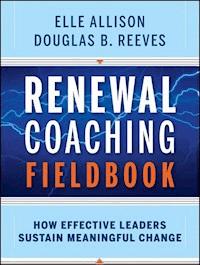
The Renewal Coaching Fieldbook outlines the seven practicesthat leaders can learn and develop in order to sustain their energyto do meaningful work. These practices enable leaders to bounceforward in the face of loss, create networks of support, make wiseand timely decisions, and engage in personal renewal daily.Throughout are compelling stories of leaders who have overcome thechallenges that seek to diminish and overwhelm them, and succeededin doing meaningful work for a greater good. Praise for Renewal Coaching Fieldbook "Elle and Douglas have written an important book that couldchange the way business is done by changing the lives of peopledoing it. In our fantastically connected planet, worldwide commerceimpacts all of us immediately, making almost nothing more importantfor our long term success than committing to meaningful work livesaimed at the 'greater good.' As Elle and Douglas suggest,individual happiness and global happiness will be the outcomes. Ifthis is what you want in your own life--and I hope youdo--read this book!"--Rick Foster, co-author, How WeChoose to Be Happy and Happiness & Health;publisher, SustainableHappinessCourse.com "The questions in this book will help you generate new ideas andways of thinking about your predicaments. They will provide youwith the way forward to hope, excitement, and satisfaction inservice of a greater good."--Daniel J. Pesut, PhD, RN,professor of nursing, Certified Hudson Institute Coach, IndianaUniversity, Indianapolis "This is not a fairytale approach to leadership where all isgood and everyone is happy. It is a skillfully written manual thataddresses the challenges and hard times leaders experience andmakes resiliency visible and sustained happinessattainable."--Dr. Kristine Servais, former principal andprofessor of leadership, North Central College, Naperville,Illinois
Sie lesen das E-Book in den Legimi-Apps auf:
Seitenzahl: 302
Veröffentlichungsjahr: 2011
Ähnliche



















Table of Contents
Title Page
Copyright
Dedication
Acknowledgments
About the Authors
List of Tables, Figures, and Exhibits
Preface
Chapter 1: The Heart of Leadership for Sustainable Change: Meaningful Work to Serve a Greater Good
Wisdom and the Pursuit of the Greater Good
The Greater Good in Action
Passion and Purpose Meet Opportunity
Chapter 2: The Renewal Coaching Leadership Framework: Seven Choices of Leaders of Sustainable Change
Sustainable Change
The Seven Choices of Renewal
Chapter 3: Renewal: Choose to Take Care of Yourself
Renewal: Creating and Sustaining Energy to Do Meaningful Work
How Leaders of Sustainable Change Choose Renewal
Daily Renewal
Renewal to Build the Future
From Renewed Leaders to Renewed Organizations
Chapter 4: Resilience: Choose to Bounce Forward from Challenges and Loss
Happy Leaders Doing Meaningful Work
How Leaders of Sustainable Change Choose Resilience
Resilience Risk Survey
Toward Resilience
Powerful Thought Leadership Questions to Activate Resilience
Chapter 5: Resonance: Choose to Create Force Fields of Positive Energy
Resonance Is a Force Field of Positive Energy
Happy Leaders Doing Meaningful Work
How Leaders of Sustainable Change Use Resonance
Powerful Thought Leadership Questions to Activate Resonance
Chapter 6: Relationship: Choose to Create and Sustain Networks of People
Relationship: Leading with a Little Help from Your Friends
Essential Networks for Meaningful Work
Happy Leaders Doing Meaningful Work
Networks of Relationships
How Leaders of Sustainable Change Build Networks of Relationships
What's So Big About the First Hundred Days?
Harsh Realities and Clear Visions
Powerful Thought Leadership Questions to Activate Relationship
Chapter 7: Reciprocity: Choose to Initiate Learning and Give More Than You Take
Reciprocity Is a Mutually Beneficial Exchange of Energy
Happy Leaders Doing Meaningful Work
How Leaders of Sustainable Change Use Reciprocity
Powerful Thought Leadership Questions to Activate Reciprocity
Chapter 8: Reality: Choose to Be Optimistic and a Little Naive in the Face of Harsh Realities
Reality Is Facing Harsh Realities with Optimism
Happy Leaders Doing Meaningful Work
How Leaders of Sustainable Change Use Reality
Powerful Thought Leadership Questions to Activate Reality
Chapter 9: Recognition: Choose to Use Patterns to Make Wise and Timely Decisions
Recognition Is Using Patterns to Make Wise and Timely Decisions
Happy Leaders Doing Meaningful Work
Patterns Leading to Wise and Timely Decisions
A Checklist for Making Wise Decisions
Powerful Renewal Thought Leadership Questions to Activate Recognition
Chapter 10: Greater Good from the Next Generation
From Students at Roosevelt Middle School in Tijeras, New Mexico
References
Index
Copyright © 2012 by Elle Allison and Douglas B. Reeves. All rights reserved.
Published by Jossey-Bass
A Wiley Imprint
One Montgomery Street, Suite 1200, San Francisco, CA 94104-4594—www.josseybass.com
No part of this publication may be reproduced, stored in a retrieval system, or transmitted in any form or by any means, electronic, mechanical, photocopying, recording, scanning, or otherwise, except as permitted under Section 107 or 108 of the 1976 United States Copyright Act, without either the prior written permission of the publisher, or authorization through payment of the appropriate per-copy fee to the Copyright Clearance Center, Inc., 222 Rosewood Drive, Danvers, MA 01923, 978-750-8400, fax 978-646-8600, or on the Web at www.copyright.com. Requests to the publisher for permission should be addressed to the Permissions Department, John Wiley & Sons, Inc., 111 River Street, Hoboken, NJ 07030, 201-748-6011, fax 201-748-6008, or online at www.wiley.com/go/permissions.
Limit of Liability/Disclaimer of Warranty: While the publisher and author have used their best efforts in preparing this book, they make no representations or warranties with respect to the accuracy or completeness of the contents of this book and specifically disclaim any implied warranties of merchantability or fitness for a particular purpose. No warranty may be created or extended by sales representatives or written sales materials. The advice and strategies contained herein may not be suitable for your situation. You should consult with a professional where appropriate. Neither the publisher nor author shall be liable for any loss of profit or any other commercial damages, including but not limited to special, incidental, consequential, or other damages. Readers should be aware that Internet Web sites offered as citations and/or sources for further information may have changed or disappeared between the time this was written and when it is read.
Jossey-Bass books and products are available through most bookstores. To contact Jossey-Bass directly call our Customer Care Department within the U.S. at 800-956-7739, outside the U.S. at 317-572-3986, or fax 317-572-4002.
Wiley publishes in a variety of print and electronic formats and by print-on-demand. Some material included with standard print versions of this book may not be included in e-books or in print-on-demand. If this book refers to media such as a CD or DVD that is not included in the version you purchased, you may download this material at http://booksupport.wiley.com. For more information about Wiley products, visit www.wiley.com.
Library of Congress Cataloging-in-Publication Data
Allison, Elle, 1960-
Renewal coaching fieldbook : how effective leaders sustain meaningful change / Elle Allison, Douglas B. Reeves.—1st ed.
p. cm.
Includes bibliographical references and index.
ISBN 978-0-470-41498-9 (pbk.)
1.Leadership. 2.Organizational change. 3.Employees—Coaching of. 4.Personal coaching. 5.Change (Psychology) I. Reeves, Douglas B., 1953- II. Title.
HD57.7.A427 2011
658.3′124—dc23
2011039776
From Elle:
For Len and Ole', who make me happy
In memory of Trudi Spierling
Acknowledgments
This book would have been impossible without the generosity of many people who gave us their skills, support, resources, time, and energy. First, we thank literary agent Esmond Harmsworth for encouraging us to put forth these ideas. In addition, many individuals from Jossey-Bass shepherded this book from concept to publication, including Lesley Iura, editorial director; Marjorie McAneny, senior editor; Tracy Gallagher, senior editorial assistant; Pamela Berkman, production editor; and Alice Rowan, copyeditor.
In addition, Elle thanks Carolyn Napolitano, independent editor and writing fellow at Brown University, who served as the first editor of the book. Her keen eye and love of putting sentences together like “beads on a necklace” have made each chapter more delightful to read.
Elle also thanks Becky Wagley, graphic artist extraordinaire, who captured the essence of each of the seven Renewal Coaching choices in conceptual images that create powerful memories for the leaders who attend my workshops; Margaret Rode, our Web site specialist, who does more than people would suspect to deliver service to the Renewal Coaching community; and Helen Ludvigson, operations manager, who has expertly taken on important work in the Renewal Coaching office, which allows Elle to spend more time writing and working with leaders.
None of the stories in this book would be possible without the gracious agreement of the many leaders who told them to Elle. First, back in 2010, she was fortunate enough to have the opportunity to interview Trudi Spierling, in whose memory this book is written, before she lost her battle with cancer. Elle feels extraordinarily blessed to have had the opportunity to learn from her. Elle also thanks Ann McCollum, Carroll Garland, Tara McAuliffe, Karen Friedman, Jesse Torres, Kim Klein, Margaret Rode, Kyle Zimmerman, Mark Cerney, Jonathan Sperling, John Simpkins, Keith Beck, Catherine Munson, Jock Brandis, Mark Cerney, Caren Miranda, Chief Dan Turner, Tracee Grigsby, Janine Hoke, Maria Venegas, Officer Greg Coleman, Officer Karen Coleman, Sharon Rohrbach, Catalino Tapia, Debbie Lee, Wallace Howard, Marty Gothberg, Bruce Klafter, Eva Wong, Catherine Scott, Lisa Foley, Cathy Lassiter, Amber Young, and Mary Anne Bronson.
Last but certainly not least, my gratitude goes to Len, to whom (along with my dog Ole') this book is dedicated. Both Len and Ole' listen tirelessly to my stories from the field—but only Len is allowed into nice restaurants in San Francisco where we sit for hours drinking wine and diagramming ideas about leadership and renewal on tablecloths.
About the Authors
Elle Allison is cofounder and president of Renewal Coaching. She is coauthor with Douglas Reeves of the three-book series on Renewal Coaching: Renewal Coaching: Sustainable Change for Individuals and Organizations (2009); the Renewal Coaching Workbook (2010); and now the Renewal Coaching Fieldbook (2012). She is also founder of Wisdom Out, a hub of research on and ideas about contemporary wisdom in individuals and couples. She has worked with clients in health care, business, education, nonprofit organizations, and government agencies, and has been a school principal and school district assistant superintendent. Elle is a member of the National Speakers Association and a graduate of the National Staff Development Academy. She reaches a diverse audience by delivering engaging and informative keynote addresses and seminars on Renewal Coaching, wisdom, and leadership. She earned her doctorate in organizational learning at the University of New Mexico, her master's degree at Northeastern Illinois University, and her bachelor's degree at Illinois State University. She is available for keynotes and workshops on leadership, renewal, wisdom, and coaching. She can be reached at [email protected].
Douglas B. Reeves is coauthor of more than twenty books, including, with Elle Allison, the three-book series on Renewal Coaching: Renewal Coaching: Sustainable Change for Individuals and Organizations (2009); the Renewal Coaching Workbook (2010); and now the Renewal Coaching Fieldbook (2012). An internationally recognized expert on educational leadership, he was twice named to the Harvard Distinguished Authors Series and was recently named Brock International Laureate for his pioneering research. His work appears in national journals, magazines, and newspapers and has been translated into six languages. He can be reached at [email protected].
List of Tables, Figures, and Exhibits
Table6.1What Leaders of New Initiatives Can Request from Their NetworksFigures2.1The Renewal Coaching Leadership Model2.2Renewal as the Antidote to Decline8.1The Ladder of InferenceExhibits3.1The Renewal Coaching Renewal Scale4.1The Renewal Coaching Resilience Scale5.1The Renewal Coaching Resonance Scale5.2Resonance Journal6.1The Renewal Coaching Relationship Scale7.1The Renewal Coaching Reciprocity Scale8.1The Renewal Coaching Reality Scale8.2Definitions of Change Killers: Snakes, Wasps, and Mosquitoes9.1The Renewal Coaching Recognition Scale9.2Wise and Timely Decision-Making ChecklistPreface
As the world economy endures the throes of an era characterized by quick and unsustainable gains for the few and the privileged, the purpose of this book may seem fanciful: to create a movement, a groundswell of individuals who accept nothing less of themselves than engagement in meaningful work—not only to earn a good living, but also to experience happiness—and use the resulting energy to manifest and sustain a greater good.
We began the research for this book in 2009 with this assumption: a sense of overall happiness combined with the pursuit of meaningful work fuels leaders who use the subsequent energy to achieve results efficiently. Most people understand why we include meaningful work in the sustainable change equation—but why happiness? Could not unhappy leaders engage in meaningful work? Our answers to these questions come from years of working as consultants on and facilitators of leadership development and organizational change. Over the years, we've observed that some leaders thrive and express joy as they go about their work, whereas others display frustration and boredom. The most discouraged leaders are so burned out that despair, the extreme opposite of happiness, envelops them in a dense fog.
Curiosity about the difference between these two types of leaders led us to discover that the happy leaders make personal choices that produce energy for their work and lives. They have ample energy and passion to take on innovative projects that sustain the best work in their organizations. Unhappy leaders, on the other hand, may start meaningful work but they run out of steam before they can make a real difference. Moreover, to the extent that leaders are either happy or unhappy, so goes the overall happiness of the organization. As Tara McAuliffe, a school principal in Rhode Island, put it, “Happiness is an infectious choice that leaders can make. If you are a happy person, you take small setbacks and obstacles in stride—and that carries over to others. Unfortunately, unhappiness is infectious too.” For effective leaders, happiness is directly connected to the energy they have to give to meaningful work. Jesse Torres, president of the Pan American Bank located in East Los Angeles, explains it this way: “When you are happy, it is easier to get a job done.” And Carroll Garland, an instructional coach in Rhode Island, says, “When you are unhappy, you are preoccupied with your own issues and you cannot focus on the important work in front of you.” In the long run, meaningful work without personal happiness is unsustainable.
To our minds, the combination of happiness and meaningful work is essential to sustainable change. But perhaps the simplest yet most significant discovery we've made in our research and fieldwork is that meaningful work is the greatest source of energy for happy and effective leaders. At times, conversation on this topic sounds like a chicken and egg puzzle: Which comes first? Is it that happy leaders naturally create meaningful work? Or is it that meaningful work produces happiness? Instead of seeking a definitive answer to this quandary, we choose to accept the complex synergy between these two concepts and instead focus on the choices that leaders can make each and every day to create and sustain energy for meaningful work that has an impact. The value of this approach is that human beings can learn to make better choices—including the choice to be happy (Foster and Hicks, 1999). And with a little support—like the support provided by a great leadership coach who also understands what it takes to make better choices—more leaders will be happy and engaged in meaningful work.
The seeds of this book were planted during a dinner conversation between us (Elle and Doug) in 2006. Elle was just completing her dissertation research on the nature of wisdom in nurses. At dinner she told Doug that the most significant finding so far was that the nurses in her study, who were nominated by their colleagues for being wise in their work, all spoke of transforming challenges and loss, in their work and in their personal life, into energy for work that creates what many of the study subjects called a “greater good.” Elle's initial interest in wisdom was sparked in 2000 when she read in a book, “Wisdom is the pinnacle of adult thought” (Merriam and Caffarella, 1999). As a student of organizational learning, she was intrigued. If it were true that wisdom is the pinnacle of adult thought, then wouldn't we want to understand how to encourage wisdom in leaders, who presumably would then create organizations where wisdom could flourish?
Further discussions led us to recognize that even wise leaders can't make a difference if they aren't engaged in meaningful work, or if they lack energy to follow through. Believing that every person (except perhaps the chronically narcissistic) possesses the capacity for wisdom, we decided to focus our research on the choices that effective leaders make that allow them to sustain their energy to do meaningful work.
We believe that happy leaders doing meaningful work will change the world. This book is full of stories—stories of real leaders from various fields and industries about what they do to renew their personal energy in order to spend it doing good work that makes a difference for others, and meets the goals of the organization. The stories in this book describe how focusing on the greater good fuels a deep and sustaining happiness that in turn defeats despair, boredom, and frustration.
Leaders are not necessarily born with the ability to engage in sustainable personal change or to inspire sustainable organizational change. In fact, much of what we know from the fields of neurology and psychology and from behavioral economists such as Dan Ariely (2010), who writes about the many ways our biases alter our perceptions, points to myriad human impulses that cause us to get in our own way. Thankfully, the seven choices in the Renewal Coaching model comprise practices that can be learned and developed. Best of all, these practices are highly coachable, which means that leaders can learn and use a coaching approach to support colleagues, team members, and the employees they supervise in their organization in choosing energy and happiness over frustration, boredom, and despair. Here are the seven choices in a nutshell:
1. Choose to engage in personal renewal, every day.
2. Choose to bounce forward in the face of loss.
3. Choose to resonate a positive force field of emotional energy.
4. Choose to create networks of support.
5. Choose to initiate cycles of learning—give more than you take.
6. Choose to face harsh realities with optimism and a “can do” attitude.
7. Choose to make wise and timely decisions.
Ongoing participation in leadership development is crucial for anyone who is in the position of influencing others. We therefore hope that the leaders you meet in the pages that follow will mentor you each time you read this book. The field stories woven throughout will immerse you in the seven choices of renewal and in the practices that leaders employ to activate those practices mindfully during the workday. Making the seven choices is not always easy, but as choices they all are possible. These are stories about leaders like you who have overcome the challenges that have sought to diminish and overwhelm them. In the end, this book provides personal leadership development in order to inspire you to do meaningful work for a greater good, to maintain your energy to create sustainable change, and to leave you with a heightened sense of compassion for others who wish to do the same.
Lesen Sie weiter in der vollständigen Ausgabe!
Lesen Sie weiter in der vollständigen Ausgabe!
Lesen Sie weiter in der vollständigen Ausgabe!
Lesen Sie weiter in der vollständigen Ausgabe!
Lesen Sie weiter in der vollständigen Ausgabe!
Lesen Sie weiter in der vollständigen Ausgabe!
Lesen Sie weiter in der vollständigen Ausgabe!
Lesen Sie weiter in der vollständigen Ausgabe!
Lesen Sie weiter in der vollständigen Ausgabe!
Lesen Sie weiter in der vollständigen Ausgabe!
Lesen Sie weiter in der vollständigen Ausgabe!




