


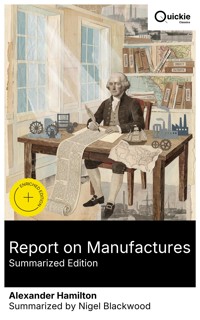
1,99 €
Mehr erfahren.
- Herausgeber: Quickie Classics
- Kategorie: Fachliteratur
- Sprache: Englisch
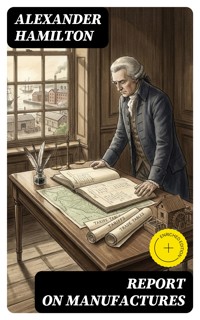
Report on Manufactures is a state paper that fuses economic reasoning with republican statecraft. Written in 1791, it lays out a comprehensive program to accelerate American industry: moderate protective tariffs, targeted bounties and premiums, encouragement of patents and skilled immigration, and federal support for internal improvements. Hamilton defends division of labor, mechanization, and diversification as sources of national wealth and resilience, explicitly countering agrarian exceptionalism. The prose is lawyerly and enumerative, marshalling comparative examples from Britain and continental Europe, and embedding policy within a wider Atlantic debate over commerce and national power. A West Indian immigrant, Revolutionary War aide to Washington, and the new republic's first Treasury Secretary, Hamilton had just established public credit and the national bank when Congress asked for this report. Wartime shortages, exposure to British mercantilism, and a realist concern for security convinced him that manufacturing capacity was essential to independence and prosperity. Readers interested in economic history, political theory, and policy design will find a foundational blueprint here. Whether one embraces or contests its activism, the Report remains indispensable for understanding American state formation, the infant-industry argument, and the origins of a national innovation system. Quickie Classics summarizes timeless works with precision, preserving the author's voice and keeping the prose clear, fast, and readable—distilled, never diluted. Enriched Edition extras: Introduction · Synopsis · Historical Context · Author Biography · Brief Analysis · 4 Reflection Q&As · Editorial Footnotes.
Das E-Book können Sie in Legimi-Apps oder einer beliebigen App lesen, die das folgende Format unterstützen:
Veröffentlichungsjahr: 2026
Ähnliche









Report on Manufactures (Summarized Edition)
Table of Contents
Introduction
At the heart of Alexander Hamilton’s Report on Manufactures lies a nation-building wager that the political independence of the United States will be secured not by abstaining from economic intervention but by deliberately organizing credit, tariffs, and public encouragement so that agriculture, commerce, and industry reinforce one another, converting a vulnerable importer into a diversified producer capable of weathering external shocks, cultivating innovation, and forging a common prosperity strong enough to sustain republican government through institutions that align private ambition with public purpose and spread opportunity across regions and skill levels.
Composed as an official Treasury report and delivered to the United States Congress in 1791, the Report on Manufactures belongs to the genre of state papers and economic policy treatises born in the crucible of the early American republic. Written while Hamilton served as the first Secretary of the Treasury, it addresses a nation still consolidating its finances, institutions, and commercial footing after the Revolution. Circulated in legislative chambers and in print, the document proposed a comprehensive approach to nurturing domestic industry within a federal constitutional framework, and it quickly became a touchstone in public debates over the proper scope of national economic policy.
Its premise is straightforward yet ambitious: demonstrate why encouraging domestic manufacturing can strengthen the republic, outline specific mechanisms for doing so, and anticipate objections from those who fear distortion or dependency. Hamilton’s voice is methodical and persuasive, moving from general principles to concrete applications with a lawyer’s structure and a financier’s attention to incentives and credit. The prose is formal, dense in places, and studiously reasoned, but it remains accessible through clear definitions and orderly exposition. Readers encounter a blend of analysis, historical observation, and pragmatic recommendations that invites deliberation rather than dogma, creating a reading experience that feels rigorous, civic-minded, and forward-looking.
Among its abiding themes is the proposition that economic diversity undergirds political stability, with manufacturing complementing rather than displacing agriculture and commerce. The report advances the idea that productivity gains arise from specialization, technology adoption, and the intelligent diffusion of skills, and that public policy can accelerate these processes without smothering private enterprise. It treats infrastructure, patents, immigration, and education as mutually reinforcing levers of national capacity. Threaded through is a security argument: a country less reliant on foreign supplies is better positioned to withstand economic pressure. Equally central is federalism’s challenge—how national tools can serve local prosperity without eroding republican accountability.
These arguments retain force for contemporary readers navigating debates over trade policy, industrial strategy, and technological leadership. The report models how to weigh the benefits of protective measures and public incentives against risks of inefficiency, favoritism, or international retaliation, emphasizing capacity-building over isolation. Its focus on supply resilience, workforce development, and the diffusion of innovation speaks to current concerns about strategic sectors and regional inequality. By insisting that economic policy is ultimately about national security and civic cohesion, the work invites a broader metric for success than short-term price movements, challenging readers to align private investment with durable, widely shared prosperity.
Approaching the text benefits from attention to its careful definitions and to the distinction it draws between revenue-raising tariffs and measures designed to foster domestic capability. Readers will notice how objections are presented in full before being answered, how empirical observations temper theory, and how recommendations are arranged to minimize disruption while maximizing learning and diffusion. The document’s structure rewards patient study: arguments build cumulatively, with institutional proposals framed as means rather than ends. Because it is a public paper, its rhetoric is civic and measured, inviting readers to test claims against evidence and constitutional purpose rather than partisanship.
Read today, the Report on Manufactures serves as a foundational map of American political economy and a durable primer on statecraft in markets. Its influence can be measured less by any single statute than by the enduring vocabulary it supplies—infant industries, public encouragement, national systems of improvement—and by the recurrent controversies it helps clarify. Whether one embraces or challenges its prescriptions, the report illuminates how policy, finance, technology, and civic aims can be integrated into a coherent national project. That is why it still matters: it equips readers to think systematically about prosperity, resilience, and liberty in a demanding, interconnected world.
Synopsis
Report on Manufactures, submitted by Alexander Hamilton to the U.S. House of Representatives in December 1791, addresses how the young nation might strengthen its economy through the encouragement of domestic industry. Writing as Secretary of the Treasury, Hamilton sets out to evaluate the viability of manufacturing in the United States and to recommend measures consistent with federal powers. The report blends economic reasoning with an appraisal of national resources and commercial conditions. Hamilton aims to demonstrate that a more diversified economy—one that includes robust manufacturing alongside agriculture—would advance prosperity, stability, and national independence, while remaining compatible with the constitutional framework and the government’s revenue needs.
Hamilton begins by outlining general advantages of manufactures. He emphasizes how division of labor increases productivity, how machinery magnifies human effort, and how factories can employ persons not fully occupied in agriculture, thereby expanding overall output. Domestic manufactures, he argues, create steady markets for farm produce and reduce reliance on distant, uncertain foreign demand. By situating manufacturing alongside commerce and agriculture, he portrays a mutually reinforcing economic system. The report stresses that these gains are not merely private but national, enhancing the capacity to mobilize resources, cultivate skills, and foster innovation that can spill over into other sectors of the economy.
A central theme is national self-sufficiency. Hamilton contends that relying too heavily on foreign manufactures leaves the country vulnerable to external shocks, trade interruptions, and political leverage from more industrialized nations. He points to strategic goods, including those relevant to defense, as areas where domestic capacity is particularly important. The report argues that internal industry can stabilize prices and supply, reduce the outflow of specie, and strengthen the balance of trade. In framing manufacturing as a component of national security and economic resilience, Hamilton links industrial development to the broader project of consolidating the nation’s independence after the Revolution.
The report addresses prevalent objections, especially those that elevate agriculture as the sole foundation of republican virtue and prosperity. Critics feared that manufacturing would degrade morals, create unhealthy urban concentrations, or diminish the independence of rural producers. Hamilton counters that manufacturing need not impair agriculture; instead, it can stimulate demand for farm goods, provide alternative employment in off-seasons, and help stabilize rural incomes. He further argues that a diversified economy offers wider outlets for talent and enterprise. The report treats social concerns soberly, contending that proper policy design can mitigate risks while preserving liberty, public order, and economic opportunity.
Turning to America’s endowments, Hamilton catalogs practical strengths and weaknesses. He notes abundant raw materials and power sources, a growing population, and entrepreneurial energy as advantages. Yet he also acknowledges scarcities that hinder rapid industrial growth: limited capital, a short supply of skilled artisans, and established foreign competition. To close these gaps, he highlights the role of financial institutions and public credit in mobilizing savings, and he encourages the lawful immigration of skilled workers. He also links steady commercial policy and secure property rights to the predictability investors and manufacturers require to undertake long-term, capital-intensive ventures.
Hamilton then delineates policy instruments he considers appropriate for encouraging manufactures. These include moderate protective duties, selective prohibitions on competing imports, bounties or premiums to offset start-up disadvantages, and drawbacks to facilitate re-export trade. He supports exempting essential raw materials from duties to lower production costs, strengthening patent protections to reward invention, and ensuring quality through inspection regimes. The report also underscores the importance of improving internal transportation to reduce costs and integrate regional markets. Hamilton presents these tools not as ends in themselves but as means to nurture promising industries until they can sustain competition.
On tariffs and related measures, Hamilton favors a discriminating approach calibrated to national circumstances. Duties should secure revenue while affording reasonable encouragement to targeted manufactures, avoiding rates so extreme that they invite evasion or unduly burden consumers. He treats protective measures as temporary aids to nascent industries rather than permanent barriers, allowing domestic producers time to reach efficient scale. The report also weighs potential international repercussions, acknowledging that commercial relations must be managed prudently. Overall, Hamilton casts a national tariff policy as part of a coherent framework, coordinated with subsidies, exemptions, and support for technological progress.
The report surveys sectors where the United States has either natural advantages or promising prospects. Hamilton points to industries such as iron and related metals, textiles, glass, paper, shipbuilding, and various household and mechanical goods. He links sectoral potential to access to inputs, energy, and existing skill bases, and he attaches importance to goods with clear strategic or commercial value. Without relying solely on prohibitions, he proposes combinations of bounties, duty exemptions for inputs, and measured import duties to help these sectors take root. This catalog reflects his broader method: align national resources and policy tools to advance practical, attainable industrial growth.
Hamilton closes by reiterating that manufacturing complements, rather than displaces, agriculture and commerce, and that the federal government has constitutional authority to promote the general welfare through such measures. The report’s enduring significance lies in its systematic case for an American developmental policy—one that harnesses finance, trade regulation, and innovation to build national capacity. It frames enduring questions about the balance between markets and public action, short-term costs and long-term strength, domestic needs and global competition. As a founding analysis of industrial policy, it set terms of debate that have continued to shape U.S. economic discourse.




