


0,49 €
Mehr erfahren.
- Herausgeber: Quickie Classics
- Kategorie: Sachliteratur, Reportagen, Biografien
- Sprache: Englisch
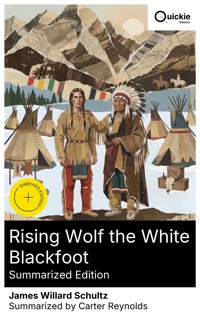
Rising Wolf the White Blackfoot recounts the early life of Hugh Monroe—a Hudson's Bay apprentice who became 'Rising Wolf' among the Pikuni—during the turbulent fur-trade era of the northern Plains. In a supple, as-told-to narrative that blends ethnographic observation with frontier adventure, Schultz follows Monroe through buffalo hunts, winter camps, intertribal diplomacy, and spiritual obligations. The prose is brisk yet attentive to ceremonial detail and kinship etiquette, situating Monroe's crossings of language and allegiance within the larger contest of empires and nations along the Rocky Mountain front. James Willard Schultz, adopted by the Blackfeet and known as Apikuni, lived for decades among them, married into the tribe, and later guided in the high country that became Glacier National Park. Drawing on long residence, fluency, and elders' testimony—along with Monroe's own recollections preserved in camp talk—Schultz renders a life history that is both personal memorial and cultural document. Scholars of Indigenous North America, the fur trade, and environmental history will value its granular portrait of Pikuni lifeways; general readers will relish its clear-eyed drama. Read this work for a nuanced bridge between oral tradition and written history, and for an intimate perspective rarely granted in frontier literature. Quickie Classics summarizes timeless works with precision, preserving the author's voice and keeping the prose clear, fast, and readable—distilled, never diluted. Enriched Edition extras: Introduction · Synopsis · Historical Context · Brief Analysis · 4 Reflection Q&As · Editorial Footnotes.
Das E-Book können Sie in Legimi-Apps oder einer beliebigen App lesen, die das folgende Format unterstützen:
Veröffentlichungsjahr: 2026
Ähnliche



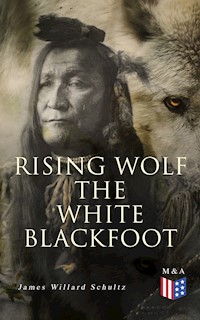









Rising Wolf the White Blackfoot (Summarized Edition)
Table of Contents
Introduction
In Rising Wolf the White Blackfoot, the magnetic pull of a new home meets the stubborn gravity of origins as a young outsider is welcomed into Blackfeet life and must reimagine loyalty, courage, and kinship amid the hazards and beauties of the northern Plains, confronting the uncertainty of seasonal hunts, the discipline of camp and trail, the thrill of first honors, and the abiding question of where a person belongs when two cultures, two languages, and two codes of worth press upon the same heart and ask not for a choice of sides, but for a way to live fully in both.
James Willard Schultz’s book is a work of frontier historical fiction rooted in the northern Great Plains, centering the Blackfeet people and the landscapes they inhabited during the nineteenth century. Written in the early twentieth century, it belongs to a moment when American readers were eager for narratives about the Plains and their Indigenous nations, and Schultz was among the authors who shaped that popular imagination. The novel blends adventure with ethnographic attentiveness, describing hunts, travel, camp routine, and communal obligations with an eye for practical detail and the rhythms of a society calibrated to the seasons, horses, and kin ties.
At its outset, the novel follows a white youth who journeys into Blackfeet territory and, through a combination of circumstance, mentorship, and earned trust, becomes a member of the community and receives the name that titles the book. The narrative moves episodically through trials that test skill and character without relying on melodrama. Schultz’s prose is clear and grounded in physical detail—weather, animals, tools, and trails—while the tone remains intimate and attentive to domestic as well as martial scenes. The reading experience balances kinetic set pieces with moments of quiet instruction, allowing the protagonist’s education to unfold at a humane pace.
Identity and belonging drive the story, but they are never treated abstractly; they emerge from specific practices, obligations, and relationships. As Rising Wolf learns to ride, hunt buffalo, and move with seasonal camps, the book traces how competence becomes a language of respect and how kin terms structure a moral world. Courage is defined as much by self-restraint and reliability as by daring. The novel emphasizes reciprocity with animals and land, stewardship of communal resources, and mentorship between generations, setting its hero’s maturation against a collective horizon. That attention to daily labor gives weight to larger questions about loyalty and home.
Schultz’s storytelling also provides a textured view of nineteenth-century Plains life, from trade relations and intertribal diplomacy to the material culture of clothing, shelter, and horse gear. While the novel aims to honor Blackfeet experience, it is also a product of its early twentieth-century moment, and contemporary readers will notice period language and framing choices shaped by the publishing norms of that time. Reading it now invites both appreciation and critique: appreciation for the care given to daily realities and social ties, and critique that asks who speaks, how authority is established, and where silence or romanticization may enter the record.
For today’s readers, the book’s most enduring value lies in how it treats belonging as a learned practice and community as an ethical discipline. At a time when conversations about migration, identity, and cultural exchange are urgent, the novel offers a story in which respect is acquired not through claims but through service, language, and care. Its attention to the ecological matrix of buffalo, river, weather, and horse speaks to contemporary concerns about stewardship and interdependence. The narrative’s insistence that courage includes patience and fidelity challenges sensationalized violence, modeling a slower, steadier heroism that resonates beyond the particularities of place and era.
As an introduction to Schultz’s larger body of Plains narratives, Rising Wolf the White Blackfoot stands out for its patient, immersive attention to the making of a life between cultures. It offers the satisfactions of an adventure novel while foregrounding relationships, obligations, and the work of learning, inviting readers to enter a world on its own terms. Approached with curiosity and critical awareness, it becomes both a story of personal transformation and a prompt to consider how stories shape memory. That dual appeal—vivid scene and reflective undercurrent—helps explain the book’s continued presence and the conversations it still opens for new audiences.
Synopsis
Rising Wolf the White Blackfoot, by James Willard Schultz, recounts the life of Hugh Monroe, a Euro-American who entered the northern Plains fur trade and came to live among the Blackfeet. Written in the early twentieth century from oral histories and frontier reminiscence, the book blends biography, adventure narrative, and cultural observation. Schultz frames Monroe’s youth and first journeys west as a gateway into a society that would shape his identity. The narrative follows an episodic arc, using Monroe’s experiences to introduce Blackfeet geography, customs, and values while tracing the tensions produced by trade, migration, and shifting power along the Rocky Mountain front.
As the story begins, Monroe departs the world of company posts and guides to travel with Blackfeet bands across open country. He learns the language, adapts to camp protocols, and proves himself in demanding tasks that test endurance and judgment. Through steady conduct, he earns trust and a place within households that feed and teach him. The Blackfeet bestow the name Rising Wolf, signaling both acceptance and expectation. Schultz uses these formative scenes to show how status is conferred by deeds, how obligations are shared across kin networks, and how skills such as tracking, horse-handling, and reading weather determine safety and success.
Much of the narrative’s texture arises from seasonal movements and work. Monroe joins large hunts, tends horses, guards camps, and participates in the labor that makes mobility possible. The book details the making of clothing and gear, the organization of travel and encampment, and the subtle rules governing hospitality and leadership. Schultz underscores the moral education embedded in daily practice: elders explain why generosity seals alliances, why restraint prevents feud, and why courage is measured by prudence as much as daring. The rhythms of camp life foreground communal resilience while situating Monroe as a learner who observes, imitates, and gradually contributes.
Encounters with traders and neighboring peoples push Monroe into roles that require mediation. As an interpreter, he helps translate intentions that do not easily align, confronting misunderstandings about property, honor, and recompense. The narrative presents war parties, tense parley, and cautious barter as recurring tests of judgment. Danger appears in ambushes, sudden storms, and the missteps of inexperienced travelers, yet survival is just as often secured by tact as by force. Schultz emphasizes how the fur trade’s shifting alliances, rivalries, and supply routes shape decisions in camp, positioning Monroe at the crossroads of economic change and the defense of homeland use.




