


6,00 €
Mehr erfahren.
- Herausgeber: Daniel B. Smith
- Kategorie: Lebensstil
- Sprache: Englisch
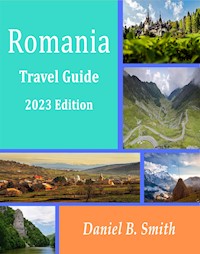
This book addresses tourists and people who want to know more information about Romania.
The guide is organized into 41 main chapters, each presenting corresponding county and some ”need to know” advice.
This book teaches you general knowledge about traveling and will also get you familiar with Romanian cuisine.
Please keep in mind that there are many to be discovered by yourself.
You will find basic information about the main tourist attractions, pictures of them and accommodation for each county.
Have a great holiday!
Das E-Book können Sie in Legimi-Apps oder einer beliebigen App lesen, die das folgende Format unterstützen:
Veröffentlichungsjahr: 2022
Ähnliche











Romania Basic Travel Guide:
2023 Edition
Daniel B. Smith
Daniel B. Smith Copyright © 2022
All rights reserved. No part of this publication may be reproduced, distributed or transmitted in any form or by any means, including photocopying, recording, or other electronic or mechanical methods, without the prior written permission of the author, excepting the case of brief quotations embodied in critical reviews and certain other noncommercial uses permitted by copyright law.
Table of contents
Introduction
Things you need to know before traveling to Romania/Europe
General pieces of advice about travelling
Romania: Things you need to know about this country
Romanian cuisine
List of dishes:
Wines:
Alba County
Tourist sights:
Accommodations:
Arad County
Tourist sights:
Accommodations:
Argeș County
Tourist sights:
Accommodations:
Bacău County
Tourist sights:
Accommodations:
Bihor County
Tourist sights:
Accommodations:
Bistrița-Năsăud County
Tourist sights:
Accommodations:
Botoșani County
Tourist sights:
Accommodations:
Brăila County
Tourist sights:
Accommodations:
Brașov County
Tourist sights:
Accommodations:
București
Tourist sights:
Accommodations:
Buzău County
Tourist sights:
Accommodations:
Călărași County
Tourist sights:
Accommodations:
Caraș-Severin County
Tourist sights:
Accommodations:
Cluj County
Tourist sights:
Accommodations:
Constanța County
Tourist sights:
Accommodations:
Covasna County
Tourist sights:
Accommodations:
Dâmbovița County
Tourist sights:
Accommodations:
Dolj County
Tourist sights:
Accommodations:
Galați County
Tourist sights:
Accommodations:
Giurgiu County
Tourist sights:
Accommodations:
Gorj County
Tourist sights:
Accommodations:
Harghita County
Tourist sights:
Accommodations:
Hunedoara County
Tourist sights:
Accommodations:
Ialomița County
Tourist sights:
Accommodations:
Iași County
Tourist sights:
Accommodations:
Ilfov County
Tourist sights:
Accommodations:
Maramureș County
Tourist sights:
Accommodations:
Mehedinți County
Tourist sights:
Accommodations:
Mureș County
Tourist sights:
Accommodations:
Neamț County
Tourist sights:
Accommodations:
Olt County
Tourist sights:
Accommodations:
Prahova County
Tourist sights:
Accommodations:
Sălaj County
Tourist sights:
Accommodations:
Satu Mare County
Tourist sights:
Accommodations:
Sibiu County
Tourist sights:
Accommodations:
Suceava County
Tourist sights:
Accommodations:
Teleorman County
Tourist sights:
Accommodations:
Timiș County
Tourist sights:
Accommodations:
Tulcea County
Tourist sights:
Accommodations:
Vâlcea County
Tourist sights:
Accommodations:
Vaslui County
Tourist sights:
Accommodations:
Vrancea County
Tourist sights:
Accommodations:
To be continued
Introduction
This book addresses tourists and people who want to know more information about Romania. The guide is organized into 46 main chapters, each presenting corresponding county and some ”need to know” advices. This book teaches you general knowledge about traveling and will get you familiar with Romanian cuisine. Inside every chapter, you will find the main tourist sights but there are many to be discovered by yourself.
You will find information about the main tourist attractions, pictures, accommodations, routes and plenty of useful tips in your journey.
Please pay attention: All the names and / or titles written between inverted commas are in Romanian language because I think this way it will be easily for you to obtain information in your journey to Romania.
I hope you will have a successful holiday!
Things you need to know before traveling to Romania/Europe
1. Check the weather:
The weather is the single factor most likely to affect your trip positively or negatively, and one of the things many people most take for granted. Of course it is going to be warm in Spain during the spring for example - but there are always exceptions prevailing weather patterns, especially during transitional seasons. A weather forecast can guide your packing strategy, and failure to check the weather can result in unprepared, unhappy and very soggy travelers.
2. Make sure you have a valid passport:
If you’re planning to travel out of the country this summer, now is the time to find your passport and make sure it’s valid. Remember that many countries require that your passport be valid for at least six months (some just three months) after your arrival date before they’ll grant entry to their country. It doesn’t matter if you’re only going for a day; if you don’t have at least six months validity, you could, and probably will, be denied entry.
3. Pack light:
One of my top three travel tips is to pack light. Trust me: It will make your travel experience so much easier. When my girlfriend, showed up for our first trip together, which was just a weekend trip, she looked like a 1920s transatlantic passenger with the size of her trunk! I had to put on the brakes and show her the light.
I used to pack the same way but I learned the benefits of traveling light, like not having to pay for checked luggage, not having to show up early to the airport, not having to stand in long lines to check your bag or stand around for what seems like an eternity for your bags to come out at baggage claim (if they ever do). You also don’t have to worry about the airline losing your bag, and you’ll be able to switch to an earlier or non-delayed flight more easily and you can take public transportation to get around, which is usually faster and cheaper – especially in Europe
4. Call your credit/debit card company:
Tell your bank before you leave on your trip that you are going out of the country. Let them know the places you are going and the dates you’ll be away because after all of the credit card hacking, they will put a block on your card(s) immediately and this can put a real damper on your trip. So make a quick call in advance to avoid this hassle.
Note: Using the company’s website doesn’t always work; my girlfriend set a travel notification online with her CIBC account (a Canadian bank) and they still blocked her card. When she called the representative, she was told it’s much better to call than to register online.
5. Always pay in local currency:
One of the biggest scams I find major stores committing overseas is after they swipe my credit card and it registers as U.S., they try and make it sound like they are helping me save money when they say, “Oh, would you like to pay in U.S. dollars or euros/pounds (or whatever their local currency is). Paying in U.S. dollars would seem to be the more convenient option, but in reality, it’s not. In fact, it’s a total rip-off, since the stores that do this charge a higher exchange fee than your bank back home does. So, remember to always pay in the local currency of the country you’re in!
6. Avoid ATM fees:
Before leaving the country, it’s always smart to check with your bank to see what ATM fees to expect. “When you use a foreign ATM, you could be charged a variety of fees, including non-bank ATM usage fees, ATM operator access fees, and international transaction fees for conversion to U.S. dollars.” That quote is directly from Bank of America, which goes on to tell its customers, “one way to limit such fees is to use your Bank of America ATM or debit card at one of our international partner ATMs. This enables you to avoid the Non-Bank of America ATM $5 usage fee for each withdrawal, transfer or balance, as well as the ATM operator access fee.” To find your bank, just search their name and international ATM partners.
7. Download Apps like Google Maps & Google Translate:
These days, you rarely have to worry about not being able to communicate overseas. People always think I speak multiple languages because I travel so often and don’t have a difficult time doing it. Sadly, I only speak English and I’m not even very good at that. However, I’ve noticed that more and more people are speaking English in the past 10 years (especially the younger generation). During all my travels, I only once ran into a problem not speaking the local language and that was in China. But since then, there’s been a whole slew of technological innovation, including the Google Translate app. It’s free to download and can translate over 90 languages, from Afrikaans to Zulu. The app has an integrated the Word Lens app so travelers can translate any text including street signs and menus just by holding up their camera: English to-and-from seven languages: French, German, Italian, Portuguese, Russian, and Spanish. Google is working to add more … all without an internet connection. The translation is suddenly overlaid on the phone screen, just like that.
8. Check your phone plan:
Before you start using all of your apps, make sure your cell provider won’t bankrupt you. Before leaving on your trip, call your provider and ask them if you are covered for the countries you are traveling to. If not, either turn your phone off or put it in airplane mode and just use Wi-Fi.
General pieces of advice about travelling
1. Most of the world's people are friendly and decent:
Some stereotypes really hold up, but on average, most of the people around the world are extremely polite, friendly and helpful. "They are generally interested in why I chose to visit their home" says a friend of mine. They are eager to assist if it's obvious I'm lost or in trouble. They'll go out of their way to try to make sure I have a good stay in their country.
Don't be convinced before leaving that "everyone there is _______". Show a modicum of respect to people and their culture and you'll be blown away by what you get back. Try picking up a little of the local language. Just learning how to say "thank you" can make a huge impact.
2. Most places are as safe (or safer) than your home
In over 365 days on the road, staying mostly in dormitory-style hostels and traveling through several countries considered 'high-risk,' the only incident I had was an iPhone stolen out of my pocket on the metro in Medellin, Colombia. I didn't even notice and deserved it for waiving the damn thing around in the wrong part of town. Most people think that in a place like Colombia you'll still get kidnapped or knocked off by a motorcycle assassin, but that's not true. According to the locals I talked to (who grew up there), things have been safer there for at least 10 years.
This doesn't give you a license to be stupid, and some places really warrant respect. Guatemala and Honduras, where there are major drug wars going on (and the Peace Corps recently pulled all of their volunteers), or Quito, Ecuador, where everyone I talked to had been robbed, are reasonably dangerous (I had no trouble in any of them).
3. In most places, moving around is incredibly easy
Unlike the independent car culture of the U.S., people all over the world rely on some kind of bus service to get around.
In most places you can get from anywhere to just about anywhere else, and most of the time it doesn't take more than a few minutes to figure out. Generally (outside the middle of peak tourist season in popular places) I haven't bothered with reservations or pre-planning transportation routes. I just show up at the bus or train station and go.
I've ridden buses for hours into the middle of the Costa Rican jungle as well as through BFE in the Northern Chilean Andes. There's almost always a group of locals who needs to get to where you're going too. And if there's no bus you can always hitchhike (this only happened once or twice on my entire trip).
It's an eye-opener to see how some of the poorest countries on earth can still provide better public transportation than San Francisco.
In places like Europe and South East Asia you also have the opportunity to take advantage of discount airlines like RyanAir and EasyJet. I flew across Europe seven times in two months for less than $120 that way.
4. Every pound over 20 makes life worse
There is virtually no reason to carry more than 20lbs (~9kg) of gear unless you're going on a major trek or you have some serious sporting event in mind (like multi-day backpacking or cold weather sports). If you're traveling in the summer you can get by on even less.
Here's the first key: Try only to do one thing on your trip. If you are hiking, just hike. If you are surfing, just surf. If you're party backpacking and staying in hostels, just do that. Packing for every possibility is suicidal. You just can't carry street clothes and backpacking gear in the same pack and expect to not have a million tons of crap.
When most people pack for a trip, they make a list of things to pack and then try to figure out how to fit it all in. But the best way to choose a backpack is to find the bag you want to carry and then see what you can fit inside. Make sure the pack doesn't weigh more than 3lbs by itself. Trust me, the longer you travel the less you want to carry.
5. "Travelers" and "Tourists" are different
You know what I mean. Tourists exchange money for pre-packaged experiences. They consume experiences and move on without engaging with the local culture. Travelers are there to see things, not buy them. Travelers tend to be more involved. They may stay with locals, hang out with locals, try to learn local language or just plain move slowly enough to really live and be where they are. Sometimes I play "tourist" but that doesn't mean I see myself as one.
6. Don't worry about traveling alone (it may be better)
Although I'm a solo traveler I haven't spent much more than a handful of days on the road alone. That's because you meet people everywhere: in hostels, on buses, trains, planes, restaurants, trail-heads, monuments, etc. If you're doing a standard travel circuit you'll see the same people over and over again (most people don't leave the Lonely Planet itinerary), and it isn't uncommon to fall in with a large group of people who are all going the same way.
It's so easy to meet people that I'm often stuck with the opposite problem: trying to get away from everyone. While I love all my new friends I need some downtime every so often. Most travelers are uncommonly interested in meeting new people. That's one of the big reasons they're on the road. A simple "where are you headed" has often turned into a new travel partner for weeks. And when it stops working you simply set off on your own again.
Are you afraid to go it alone? Don't be. Go to the first big city in your destination country and hang out in the hostel lobby for a few days. I promise you'll make new friends. This is why you should also stay in hostels. Don't be afraid of sharing a room. It's a small trade-off for the amazing people you'll meet.
7. Movement can be addictive
The "traveler's rush" that hits you upon arrival to a new place is like a drug. And like a drug, the more you expose yourself to it the more you want.
This can mean moving too fast or skipping out on places just to experience the ecstasy of arrival again. The results are obvious: less time in places you thought you wanted to see and ultimately, burnout. The tendency to try to cram more places into an over-packed schedule is often hard to control.
One trick I've found to deal with this is to have a minimum stay: Three nights in every destination. This is enough time to see the place, relax, and get sorted before the next stop. It also means you'll have to cut out some places if you're tight on time. Of course, some places aren't what you expected either. If that's the case, get the hell out of there and spend more time in a place you want to be.
8. Don't bank on paradise
Keep your expectations in check. This isn't easy, since you really want that place you've been dreaming about to be paradise. But like anything else, high expectations are a recipe for disappointment. Expectations can also make or break a place. Most of the places I knew nothing about before arriving blew my mind. Most of the places I had high expectations failed to impress me. The other thing is that as you go through life the rules are always changing. Take recommendations with a grain of salt. Another person's paradise might be your personal hell, and vice-versa. A close friend of mine thinks tropical beaches are the reason for existence. Well, unless there is wind or waves on them I'll crack up after three days. Getting stuck on a deserted tropical island is my definition of hell-on-earth.
9. You can't work and travel at the same time
For the remote-work inclined... Ok, yousort of can, but you just won't ever get nearly as much done as you want to.
Let me clarify this for the uninitiated: obviously, you can work in the places you travel to, e.g. working as a SCUBA Divemaster or a Kiteboarding instructor, but my focus here is on location-independent internet work. At this point I've worked all over the world on my laptop, and in order to get shit done I have to hunker down in one spot for at least a week. Try building/fixing things/growing an online business on the road and you're going to just get irritated when you can't finish anything in the two to four hour block you've set aside.
If you're going to travel, then just travel. There are sights to see, spontaneous adventures to be a part of, and all kinds of unexpected things that happen. Aren't you traveling to take advantage of those?
But when you're going to work, just work. Work for one to three months and then take a mini-retirement for one to three months.
10. When everything gets irritating, may it's time to head home
I've had this experience more than once: a nice local is trying to help me but can't understand what I'm asking for. I can feel my impatience rise and I notice my voice gets that "what the fuck is wrong with you" tone. Then I remember: this isn't home. People don't speak English. Don't expect anything to operate on your schedule. This is usually the first sign of burnout, and usually means it's time to find a cheap place to relax or time to book a flight home. If you start really missing hot showers, strong coffee, Mexican food, or climate control, it might just be time, but...
Romania: Things you need to know about this country
This is the position of Romania in Europe.
Capital: Bucharest
Official languages: Romanian
Ethnic groups: 89% Romanians, 6.5% Hungarians, 3.3% Rroma, 0.3% Ukrainians, 0.2% Germans, 0.6% other minorities
Government: Semi-presidential republic
Romania is member of European Union since 1 January 2007 and member of North-Atlantic Treaty Organization since 1 January 2004.
Area: 238.391 square kilometers
Population: 19.942.642 (estimated value)
GDP(PPP) Per capita: 20.355
Gini: 34
Currency: Romanian leu(RON)
Drives on the: right
Calling code: +40
For more information, please click HERE.
This picture shows the main eight development regions of Romania. Please google it if you would like to find out more about it with regard to development regions.
Romania is often dismissed as simply a mysterious place where fairy-tales are upheld as truths and the mountains are inhabited by vampires and wolves. However, the country has achieved and given the world much more than you think. Here are some facts about Romania that might just surprise you:
Despite many people still thinking Russian is spoken in Romania, the
Romanian language
is in fact one of the five major romance languages, along with French, Spanish, Portuguese and Italian. Furthermore it 1,700 years old.
They have a
black magic tax
. That’s right, Romania is a country so superstitious that the government decided they would cash in on it. The country’s numerous witches and fortune tellers are recognised as legitimate business people and therefore subject to taxes. False predictions by fortune tellers can result in fines and witches must carry a permit with them at all times.
The country gave the world
Nadia Comăneci
. The first Olympic gymnast ever to achieve a perfect score. In 1976, the 14 year old Romanian made history at the Montreal games by scoring a maximum of 10 on the uneven bars. This had previously been thought impossible, so much so that the score board could not show the actual score.
In 1856, Bucharest became the first city in the world to be illuminated by
oil lamps
. In 1889, Timişoara then became the first city in Europe to be lit by
electric streetlamps
.
Romania has the largest
gold
reserves in all of Europe. The country is also home to Europe’s only museum dedicated to gold.
The first
fountain pen
was invented by a Romanian. Whilst studying in Paris, Petrache Poenaru realized that a pen which would last indefinitely and refill itself with ink would save a considerable amount of time and would not interrupt his work. He received a patent from the Manufacture Department of the French Ministry of the Interior in 1827.
Bucharest is home to the
world’s largest administrative building
. The Palace of Parliament in the Romanian capital was completed in 1997 at a cost equivalent to €3 billion. It is recognized by the World Record Academy as the largest civilian building with an administrative function as well as being the most expensive and the heaviest. It is the second largest building in the world after the Pentagon in the United States.
Romanian physiologist Nicolae Paulescu is remembered for his work in the discovery of
insulin
. Born in Bucharest he trained as a doctor in Paris. In 1916, he successfully developed an aqueous pancreatic extract, which, when injected into a diabetic dog, normalized its blood sugar levels. In 1922, he patented his method of producing pancreatin, which would later be called insulin, with the Romanian Ministry of Industry and Trade.
The forests in Romania are the last place in Europe that the
brown bear
can be found. There are approximately 6,000 bears living in the country’s Carpathian region.
The most famous novels, inspired by Romania are "The castle in the Carpathians" by Jules Verne and "Dracula" by Bram Stoker.
Romania is the ninth largest wine producer in the world.
The modern jet engine was invented by the Bucharest-born inventor "Henri Coandă" in 1910.
"Peleș" Castle was the first European castle entirely lit by electrical current. The electricity was produced by the castle's own plant. The castle's central heating system, built in 1888, is still functional and in use today.
Europe's second largest underground glacier, the "Scărișoara" glacier, is found underneath the Bihor Mountains in Romania.
The archetypal vampire Count Dracula, created by Bram Stoker, was inspired by the Romanian prince "Vlad
Țepeș", also known as Vlad the Impaler.
The earliest homo sapiens fossils, up to now, were discovered in 2002 in southwestern Romania, in the Cave of Bones. The fossil's age is estimated at 37.800 to 42.000 years old.
The Carpathian Mountains are home to one of the largest virgin forests in Europe. 400 unique species of mammals, including the Carpathian chamois, call the Carpathian Mountains home.
The Danube River flows 1.788 miles from its springs in Germany's Black Forest to the Black Sea. Just before reaching the sea it forms the second largest and best preserved of Europe's deltas: 2.200 square miles of rivers, canals, marshes, tree-fringed lakes and reed islands.
The statue of Dacian king Decebal, carved in the rocky bank of the Danube River, is the tallest rock sculpture in Europe.
The Romania language is a romance language with ties to Latin as this region was part of the ancient Roman Empire. "Salut" means Hello, "Pardon" means Excuse me and "La revedere" means Goodbye.
Social Conventions: Handshaking is the most common form of greeting, but Romanian men may kiss a woman’s hand when being introduced. Mr or Mrs should be used when greeting someone for the first time. Visitors should follow normal European courtesies on social occasions. Dress tends to be rather conservative but casual wear is suitable. Beachwear should not be worn away from the beach or poolside. If visiting a home, a small wrapped gift should be given to the host, such as flowers or chocolates (to women only), wine or liquor. Flowers should be given as a gift in odd numbers only. Many Romanians are smokers and gifts of Western cigarettes are greatly appreciated.
Number of Highway Kilometers: 695,4 and Number of Railroad Kilometers: 11385
The medium net salary in Romania is about 450 Euro/month.
Classification of hotels/pensions in Romania:
2 Stars hotels/pensions (Standard): In such hotels and pensions you should at least find towels, soap and toilet paper. The comfort level varies greatly from one case to another, especially from one country to another. Remember however that sheets will be changed every 4 days and towels every 3 days!
3 Stars hotels/pensions (Comfort): Double rooms must have at least 15 m² (without bathroom) and air conditioning (only on the coast side), wireless internet, telephone, mini-bar, television and bedspread. Sheets are changed every 3 days and towels every two days. In the bathroom you should find three towels for every person, shampoo, shower gel and bathing cap, emergency call system in the reception and skid mat. The reception must have a luggage storage room and a space for storing sports equipment.
4 Stars hotels/pensions (First class): If you accommodate in a double room in a 4 * hotel, it should have a minimum of 18 m² and remember that hotel employees must bring bedding and fresh towels (obligatory white) every two days and clean gowns every 3 days. The rooms are equipped with safe deposit box, wireless internet, telephone, mini-bar, television and in the bathroom should be (in addition to the 3 *) a hairdryer, a bathrobe and disposable slippers. The hotel must have a restaurant and shall provide at least 15 additional services (included in the accommodation's price or charged separately): for example playroom for children, a hydro-massage bathtub or hairdresser.
5 Stars hotels/pensions (Deluxe): The minimum size of a double room is 20 m² and as well as 4 *, linen and towels are changed every two days and gowns every 3 days. In the bathroom you must find a set of hygiene products and cosmetics (minimum 5 products-instead of shampoo, shower gel and bathing cap). Five stars hotels have secure parking and make available at least 3 leisure/recreation services (for example: swimming pool, tennis court, gym etc) and like 4 * hotels, at least 15 additional services (included in the accommodation's price or charged separately).
Unfortunately, there is no international classification of hotels generally valid, thus a 3 stars hotel in Romania is unlike a 3 starts hotel in Turkey, Argentina or India. Moreover, it is well known that in countries such as Turkey, Morocco, Egypt or Tunisia, if you choose hotels that have less than 4 stars, it might not be very good.
Romanian cuisine
Romanian cuisine is a diverse blend of different dishes from several traditions with which it has come into contact, but it also maintains its own character. It has been greatly influenced by Ottoman cuisine, while it also includes influences from the cuisines of other neighbors, such as Germans, Serbs, Bulgarians and also Hungarians.
List of dishes:
Soups:
"
Borş" is fermented wheat
-
bran, a souring agent for "ciorbă". "Borș" is also used today as a synonym for "ciorbă", but in the past a distinction was made between "borș" and "ciorbă (acritură)", the souring agent for the latter being the juice of unripe fruits, such as grapes or wood sorrel leaves.
"Borş de urechiuşe"= wild mushroom sour soup
"Ciorbă" is the traditional Romanian sour soup
"Ciorbă de burtă"= tripe soup, soured with sour cream
"Ciorbă de perişoare"= meatball soup
"Ciorbă de fasole cu afumătură”= beans and smoked pork meat soup
"Ciorbă de legume"=vegetable soup
"Ciorbă de peşte ca-n Deltă"= fish soup prepared in the style of the Danube Delta
"Ciorbă de praz"= leek soup
"Ciorbă de pui"= chicken soup
"Ciorbă de salată cu afumătură"= green salad and smoked meat soup
"Ciorbă ţărănească"= peasant soup, made with a variety of vegetables and from any kind of meat (beef, pork, mutton, fish).
"Supă" is the generic name for sweet (usually clear) soups, made out of vegetables alone or combined with poultry and beef). The difference between "Supă" and "Ciorbă" is that the meat and most of the vegetables are removed, the resulted liquid being served with dumplings or noodles. There are also a number of sour soups, which use lemon juice as a souring agent, called "Supe a la grec"(Greek soups).
Meat:
"Caltaboş/chişcǎ"= a cooked sausage made of minced pork organs and rice, stuffed in a pig's casing.
"Cârnaţi"= a garlicky sausage.
"Chiftele"= a type of large meatball covered with breadcrumbs or a flour crust.
"Drob de miel"= a lamb haggis made from minced organs, wrapped in a crust and roasted like a meatloaf; a traditional Easter dish.
"Frigărui"= Romanian-style kebabs.
"Varză călită"= steamed cabbage with pork ribs, duck, or sausages.
"Sarmale"= minced meat with rice, wrapped in either pickled cabbage leaves or vine leaves.
Fish:
"Salată de icre"= roe salad, traditionally made from carp, pike, or various marine/river fish species, with onion.
"Plachie din peşte"= ragout of river fish with vegetables.
"Saramură de crap"= carp in brine
"Pană de somn"= catfish in brine with garlic
"
Crap pane
"= breaded carp fillet
Vegetables:
"
Ardei umpluți
"= stuffed bell peppers
"Dovlecei umpluți"= stuffed zucchini
"Vinete umplute"= stuffed eggplant
"Ghiveci călugăresc"= vegetable stew prepared by the nuns in the monasteries
"Fasole bătută"= boiled beans that are mashed up, spiced with salt, black pepper and a bit of garlic. It is served with diced and fried onions and tomato paste or sauce.
Salads:
"
Ardei copți
"= roasted pepper salad, with vinegar and sunflower or olive oil.
"Murături asortate"= pickled mixed vegetables.
"Mujdei"= crushed garlic sauce
"Salată de boeuf"= minced meat with boiled vegetables, mayonnaise and a dash of mustard.
"Salată orientală"= potato salad with eggs, onions and olives.
Cheese:
The generic name for cheese in Romania is "brânză" and it is considered to be of Dacianorigin. Most of the cheeses are made from cow's or sheep's milk. Goat's milk is rarely used. Sheep cheese is considered "the real cheese", although in modern times, some people refrain from consuming it due to its higher fat content and specific smell.
"B
rânză de burduf
"= is a kneaded cheese prepared from sheep's milk and traditionally stuffed into a sheep's stomach; it has a strong taste and semi-soft texture.
"Brânză topită"= is a melted cheese/processed cheese; industrial product
"Caș"= is a semi-soft fresh white cheese, unsalted or lightly salted, stored in brine, which is eaten fresh (cannot be preserved); traditional; seasonal product.
"Cașcaval"= is a semi-hard cheese made from sheep's or cow's milk; traditional product
"Telemea"= cow's or sheep's milk white cheese, vaguely similar to feta.
"Urdă"= made by boiling the whey drained from cow's or ewe's milk until the remaining proteins precipitate and can be collected; traditional product.
Dessert:
"Rahat"= Turkish delight
"Colivă"= boiled wheat, mixed with sugar and walnuts (often decorated with candy and icing sugar); is distributed at funerals and memorial ceremonies.
"Plăcintă"= pie
"Cozonac"= a kind of cake made from leavened dough, into which milk, eggs, sugar, butter and other ingredients are mixed together before baking.
"Cremă de zahăr ars"= Creme brulee
"Clătite"= pancakes
"Turtă dulce"= gingerbread
"Chec"= coffee cake
"Papanași"= a kind of doughnut made from a mixture of sweet cheese and eggs, boiled or fried and served with fruit syrup or jam and sour cream.
"Amandine"= chocolate sponge cake with almond and chocolate filling, glazed in chocolate.
"Mere coapte"= baked apples.
Drinks:
"Afinată"= blueberry liqueur
"Bere'= beer
"Cafea"= coffee
"Palincă"= is a strong, double-distilled plum brandy, produced in Transylvania.
"Rachiu"= is a fruit brandy.
"Socată"= is a non-alcoholic beverage made from fermented elderflower.
"Țuică"= is a plum brandy
"Vișinată"= is a sour cherry liqueur
"Vin"= Wine
"Vodcă"= Vodka
"Ceai"= tea
"Zmeurată"= is a raspberry liqueur
"Must"= is the grape juice in the fermentation process that hasn't become wine yet.
Wines:
Whether you travel in Romania along the coast of the Black Sea or in the Dobrogea Plateau near the Danube Delta region or in the Province of Moldova or along valley slopes of the scenic Carpathian Mountains or in Transylvania Province or in Wallachia or in nearly any agricultural area throughout Romania, you're in wine country. Romania is one of the world's top-ranking producers of numerous delicious wines, some of which never leave its borders.
Archeological evidence of country-wide wine production in Romania's grape-friendly soil and climate dates back to the classical Greek and Roman eras of settlement in Romania. Today, on a list of the world's "Top 12 Wine Producers", in which France ranks number one and Italy is listed as number two, Romania ranks tenth (10th) among the world's top wine producers by volume. Romania's climate and soil are hospitable to the production of many different types of wines, from dry, sparkling whites to rich, aromatic, purplish reds.
Popular domestic grape varieties used for wine production include: "Frâncuşă", "Fetească Albă", "Tămâioasă", "Fetească Neagră", "Băbească".
"Frâncuşă" – Is a very versatile soft, dry wine, crisp and lively, with just the slightest touch of sweetness.
"Fetească Albă" – Semi-dry white wine, well balanced, with a distinct aroma reminiscient of the first flowering of the vineyard.
"Tămâioasă Romanească" - A naturally sweet or semi-sweet white wine with subtle honey and basil aromas, an exquisite amber color and a persistent rich taste. Its sweet taste may also suggest a blend of rose petals and wild berries.
"Grasă de Cotnari" – A naturally sweet white wine with a delicate fragrance and a smooth interplay of fruitiness and acidity.
"Galbenă de Odobeşti" – A light white wine with a delicate bouquet that preserves the fragrance of the mellow grape.
"Fetească Neagră" – Semi-sweet, medium bodied, light red wine, with original aromas.
"Băbească Neagră" – Traditional full bodied red wine with a delicate bouquet and a slight taste of clove.
"Cadarca" - this red, native variety, displaying a ruby-red color with a stinging taste of fresh clove, was the wine of the imperial court of Vienna during the reign of Emperor Franz Josef, in the 18th century.
Romania also produces its share of worldwide vintages, including Riesling, Merlot, Sauvignon Blanc, Cabernet Sauvignon, Chardonnay and Muscat "Ottonel". For the traveler interested in adding viniculture to his or her cultural itinerary, a trip to Romania offers many opportunities to visit wine-producing regions and to discover and sample the many different wines of Romania, from little known local and regional wines to Romania's great wine labels, such as "Murfatlar", "Cotnari", "Jidvei", "Dealu Mare" and "Odobeşti".
Vineyards:
“Jidvei" Vinery:Located in the "Târnava" valley (Transylvania), is known for its superb dry white wines. Wine tasting is offered at the 16th century Bethlen Castle in "Cetatea de Baltă", located between "Târnăveni" and "Blaj".Website:http://www.jidvei.ro/en/
“Segarcea" - Crown's Estate(Royal Domain): Located 150 miles southwest of Bucharest, "Segarcea" winery is known for its quality Cabernet Sauvignon, Merlot, Sauvignon Blanc, "Fetească Albă" and Italian Riesling. The Crown's Estate may be the only vineyard in the world which produces the "Tămâioasă Roză" (Pink Tămâioasă) - a fine rosé wine with a delicate aroma of candied peels of orange and grapefruit. Other domestic grape varieties grown at "Segarcea" vineyards include: "Novac", "Negru de Drăgăşani", "Fetească Neagră", "Tămâioasă Albă Românească", "Fetească Albă", "Crâmpoşie".Website: http://www.domeniulcoroanei.com/
"Murfatlar" Vineyard: "Murfatlar", one of the most famous Romanian vineyards, is located just miles west from the Black Sea coast. Over 300 days of sunshine, along with cool breezes from the sea, make this area ideal for the production of sweet dessert wines, such as late harvest Chardonnay, Pinot Gris and Muscat "Ottonel". Soft, rich red wines are also produced here - Cabernet Sauvignon and Pinot Noir being the most popular.More information:http://www.murfatlar.com/
"Cotnari" Vineyard: "Cotnari" Vineyard is world famous for the delicious sweet white wines made of grapes rich in sugar and harvested in late autumn following the first frost, such as "Grasă de Cotnari", a noble aromatic wine with a nutlike savor. The quality of these wines relies on a combination of rich soil, the late harvest and the presence of a special mold (Botritis cinerea). The vineyards have a long history, spanning over seven centuries, dating from the time of Stephan the Great (1457 - 1504). The winery's most popular wines include "Frâncuşă" (dry), "Fetească Albă"(semi-sweet) - highly appreciated for preserving the flavor and freshness of the grape; and the sweet, golden "Grasă de Cotnari", a noble aromatic wine with a nutlike savor and "Tămâioasă". More information: http://www.cotnari.ro/
"Recaș" Vineyard: Nearby Timisoara lays the vineyard of "Recaş", with a history dating back to the 15th century. Some of the award-winning wines produced here include Italian Riesling, "Fetească Regală", Muscat "Ottonel", Sauvignon Blanc (white wines); Cabernet Sauvignon, Merlot, Pinot Noir/Merlot (red wines). More information:http://www.recaswine.ro/index.php?r=ie
Alba County
"Alba" County is located in the central western part of Romania, on the river called "Mures" and its tributaries; is limited by "Cluj" County to the north, "Bihor and Arad" to the north-west, "Valcea" County to the south, Sibiu County to the east and "Mures" County to the east and northeast. In these limits, "Alba" County's area of 6242 square kilometers is what represents approximately 2.6% of Romania.
Population:
Important places in the county are: Alba Iulia (county seat), "Abrud", "Aiud", "Blaj", "Campeni", "Cugir", "Ocna Mures", "Sebes", "Teiuş", "Zlatna". In these and in rural areas live in total about 382000 inhabitants.
Relief:
The relief includes three major units: the "Apuseni" Mountains ("Trascau", "Bihor"), the Meridional Carpathians represented by units of "Parang" Group ("Sureanu" and "Candrel") and Plateau "Tarnavelor".
Climate:
The climate is temperate continental, depending on the relief unit (mountain or plateau). The average annual temperature varies between 7-9 degrees Celsius with warm summers and cool winters, with winds blowing from west direction and sometimes "foehn" phenomena.
Hydrography:
The waters are tributaries to Mures basin. The rivers are: "Sebes", "Târnave", "Ampoi", "Aries", "Geoagiu", "Galda" and "Aiudu".
Tourism:
Alba County has a significant tourism potential, being with "Cluj" the heartland of "Moţilor's Country" with specific customs and traditions. Besides significant anthropogenic touristic sights (Citadel of Alba Iulia, "Aiud" fortress, medieval buildings in cities, Roman Galleries in "Rosia Montana") Alba stands out with valued natural objects: Cave "Scarisoara", Cave of "Huda's Papara" and Gorge of "Rametului".
Tourist sights:
Evangelical Church of "Sebeș":
Objective type: Church ; Location: "Sebes"
Evangelical Church of "Sebes" whose construction started before 1241 was completed in 1382 and is an interesting mix of Romanesque and Gothic style. His altar is decorated with paintings and sculptures in relief made in the period 1518-1528.
Orthodox Church in "Aiudul de Sus":
Objective type: Church ; Location: "Aiudul de Sus"
Bust of Dorin Pavel:
Objective type: Statue ; Location: "Sebes"
The bust of "Dorin Pavel" is located near Evangelical Church of "Sebes".
Waterfall "Vârciorog" :
Objective type: Waterfall ; Location: "Arieșeni"
Waterfall "Vârciorog" is situated in "Arieseni" locality at an altitude of 1090m. A 4 km forest road leads to the waterfall "Vârciorog" from the national road 75, where there is an indicator. All the way along "Vârciorog" valley, you will be accompanied by yellow marking that leads to the waterfall. The waterfall itself has a height of 15 meters and is of great beauty especially in high level of waters. Nearby there is an old abandoned mine shaft.
St. Michael Roman Catholic Cathedral-Alba Iulia:
Objective type: Cathedral ; Location: "Alba Iulia"
Built between 1246 and 1291 with additions and successive restoration (repairs: 1718-1739, 1907-1917, 1950-1953), is one of the most valuable monuments of medieval architecture in Transylvania; it is as old as Notre Dame in Paris having a late Romanesque style. In this cathedral you can find the tomb of "Iancu de Hunedoara".
"Alba Iulia" Fortress:
Objective type: Fortress ; Location: Alba Iulia
The first medieval fortress (IX-X century); it was built by Prince Gyula. Today fortress Alba Carolina is built on the site of the first fortress, in 1715-1733 by Giovanni Morando Visconti's plans - is the largest of its kind and the last fortress in Transylvania. It's built in Vauban style, like a heptagonal fort with seven bastions and particularly thick walls. It has several gates with reliefs made by Johann Konig representing figures and scenes from mythology.
"Câlnic" Fortress:




