


0,99 €
Niedrigster Preis in 30 Tagen: 0,99 €
Niedrigster Preis in 30 Tagen: 0,99 €
Mehr erfahren.
- Herausgeber: Musaicum Books
- Kategorie: Krimi
- Sprache: Englisch
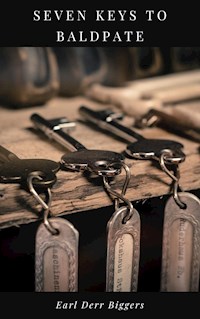
In 'Seven Keys to Baldpate', Earl Derr Biggers weaves a captivating mystery filled with complex characters, intricate plot twists, and clever dialogue. The novel, originally published in 1913, epitomizes the Golden Age of Detective Fiction with its cleverly constructed puzzles and unexpected revelations. Set in a secluded mountain resort, the story follows a novelist who is bet that he cannot write a complete book in 24 hours, leading to a thrilling tale of greed, deception, and hidden motives. Biggers' narrative style is both engaging and suspenseful, keeping readers on the edge of their seats until the final resolution. This book serves as a prime example of early 20th-century American mystery fiction, showcasing the author's talent for crafting intricate tales of intrigue. Earl Derr Biggers, known for creating the iconic detective Charlie Chan, drew inspiration for 'Seven Keys to Baldpate' from his own experiences in the remote settings of upstate New York. His insight into human nature and sharp wit shine through in the characters he brings to life within the pages of this novel. I recommend 'Seven Keys to Baldpate' to mystery lovers and fans of classic detective fiction looking for a compelling and well-crafted read that stands the test of time. In this enriched edition, we have carefully created added value for your reading experience: - A succinct Introduction situates the work's timeless appeal and themes. - The Synopsis outlines the central plot, highlighting key developments without spoiling critical twists. - A detailed Historical Context immerses you in the era's events and influences that shaped the writing. - A thorough Analysis dissects symbols, motifs, and character arcs to unearth underlying meanings. - Reflection questions prompt you to engage personally with the work's messages, connecting them to modern life. - Hand‐picked Memorable Quotes shine a spotlight on moments of literary brilliance. - Interactive footnotes clarify unusual references, historical allusions, and archaic phrases for an effortless, more informed read.
Das E-Book können Sie in Legimi-Apps oder einer beliebigen App lesen, die das folgende Format unterstützen:
Veröffentlichungsjahr: 2017
Ähnliche













Seven Keys to Baldpate
Published by
Books
Table of Contents
Introduction
A writer who goes in search of silence and control discovers that every locked door he opens multiplies the noise and uncertainty, turning a retreat into a stage where chance visitors, hidden motives, and the very tools of storytelling collide, so that keys meant to promise access become tokens of how little can be contained, and the calm needed to write becomes a test of whether imagination can keep pace with events, capturing the book’s irresistible tension between planned solitude and the unruly society that insists on entering, unasked, exactly when it is least welcome.
Seven Keys to Baldpate is a mystery-comedy novel set in a shuttered mountaintop resort hotel during the winter off-season, written by American author Earl Derr Biggers and published in the early 1910s. Before he became widely associated with the later Charlie Chan mysteries, Biggers crafted here a brisk entertainment that plays with conventions of suspense, romance, and farce. The isolated inn, emptied of summer guests and reduced to caretakers and echoes, provides the ideal stage for a closed-circle tangle of motives. The book emerges from a vibrant era of popular fiction in which clever plotting and swift dialogue were prized.
At the outset, a successful novelist seeks absolute quiet to prove a point about craft, entering the deserted Baldpate Inn under a simple arrangement that grants him a key and a promise of solitude. His plan is straightforward: withdraw from distractions long enough to produce a new story at speed. Almost immediately, the controlled experiment is interrupted by the arrival of unexpected visitors, each with their own key and urgency, until the inn that was to be empty hosts a procession of secrets. What begins as a private challenge broadens into a nocturnal puzzle whose pieces refuse to stay still.
Readers encounter a lively narrative voice that balances wry observation with genuine suspense, shifting between crisp description and rapid exchanges whose rhythm owes something to the era’s stage sensibilities. Biggers favors clean scenes, timely entrances, and setups that turn on misunderstandings without abandoning the gravity of danger. The tone moves from playful to tense and back again, treating menace and charm as complementary textures rather than opposites. The prose is direct, the chapters fleet, and the clues arranged so that surprise feels earned. The result is a page-turner that invites a smile even as the stakes tighten around the inn.
Central to the book is the friction between the desire for isolation and the inescapability of other people, a tension refracted through the figure of the writer who must wrestle with both inspiration and interruption. Keys, doors, and rooms operate as more than props; they become emblems of access, secrecy, and the fragile boundaries we trust to organize our lives. The story also toys with the blurred line between invention and actuality, asking what happens when narrative formulas seep into lived experience. Beneath the momentum lies a quietly satirical edge aimed at grandstanding, sensation, and the hunger to control outcomes.
For contemporary readers, Seven Keys to Baldpate remains striking for how shrewdly it anticipates later, self-aware mysteries that comment on their own mechanics while still delivering thrills. Its portrait of a publicity-driven culture, of rumors outrunning facts, and of individuals staging performances for advantage, travels well into the present. The book’s compact, winter-bound setting retains the appeal of modern closed-location thrillers, while its humane wit reminds us that laughter and anxiety often share a border. As a study of process, it also resonates with anyone who has tried to create amid interruption, turning creative struggle into narrative propulsion.
As an early showcase for Biggers’s knack for structure and tempo, the novel offers a satisfying blend of ingenuity and warmth without overburdening itself with gloom. It rewards readers who enjoy classic setups reimagined with speed and good humor, and it provides a vivid portrait of how a single night can bend around competing ambitions. Without leaning on nostalgia, the book demonstrates how a clever premise can sustain surprise while reflecting on the act of storytelling itself. That dual achievement—entertainment coupled with insight—explains why the doors of Baldpate continue to swing open for new visitors, key after tempting key.
Synopsis
Published in 1913, Earl Derr Biggers’s Seven Keys to Baldpate opens with the successful novelist William Magee seeking absolute quiet to begin a new book. In midwinter he journeys to Baldpate Inn, a popular mountain resort closed for the season, where he believes he has been granted exclusive access. Snow isolates the shuttered hotel, promising the solitude he craves and a practical test of his craft. The setting’s emptiness, echoing corridors, and locked rooms supply both creative inspiration and foreboding. Magee settles in to write, confident that silence and a single key will shield him from interruption and outside intrigue.
Solitude proves short-lived. As night falls, unexpected visitors arrive one by one, each producing a key that contradicts Magee’s supposed exclusivity. Their appearances transform the vacant inn into a stage of entrances and exits, with the number of keys hinting at overlapping secrets. The guests vary in manner and motive, signaling a collision of agendas that the inn’s caretaker arrangements cannot contain. What begins as a retreat morphs into a living melodrama, and the keys themselves become emblems of rival claims to access, privilege, and truth. Magee’s plan to observe from a distance falters as he is thrust into the action.
The heart of the mystery centers on a sum of money connected to local political maneuvering, rumored to be a bribe intended to sway civic decisions. The cash’s fate, and who controls it, drives the nocturnal traffic through the inn’s locked spaces, especially the safe that acts as a magnet for all involved. Figures with ties to politics, the press, and the criminal underworld circle one another with wary calculation. A young woman’s presence complicates loyalties and ethics, inviting Magee’s protective instincts. The novelist finds his analytical habits useful, yet his involvement brings moral choices that are not purely imaginative exercises.
As the night deepens, overlapping schemes multiply: secret appointments, disguised identities, and hurried exchanges play out along the inn’s corridors and shadowed rooms. Magee measures every development against his storyteller’s intuition, noting how the scene resembles serial fiction while resisting the passive role of observer. He tests tactics he might give a protagonist, challenging others with questions, traps, and appeals to conscience. Comedy flickers around the edges—misplaced bravado, flustered gatekeeping, and misunderstandings—yet the stakes remain serious. The once-simple promise of isolation becomes a maze of motives that pull Magee into the center of a contest over evidence and influence.
Snow and darkness tighten the enclosure, limiting escape and delaying official intervention. Messages are sent and intercepted, telephones become bargaining tools, and the inn’s doors—so easily unlocked by competing keys—turn into fault lines where alliances briefly hold, then crumble. The contested money shifts hands amid reversals, while reputation, office, and newspaper headlines loom as the true prizes behind the cash. Magee balances empathy and skepticism, wary of being outmaneuvered even as he offers help. He must decide how far to push, how publicly to act, and whether to trust a partner whose intentions might be nobler—or murkier—than they appear.
The tangle culminates in confrontations that draw all parties into the same rooms, demanding explanations and staking claims. Accounts of who brought what to Baldpate, and why, are tested against physical facts, alibis, and missing pages. Biggers orchestrates swift reversals while preserving a buoyant tone, allowing humor to deflate menace without dissolving it. The resulting disclosures clarify the relationship between the bribe, the keys, and the night’s choreography. A final turn reframes the entire affair, raising questions about performance, authenticity, and the porous boundary between artful contrivance and lived experience, while keeping the precise mechanism of that shift delicately veiled.
Seven Keys to Baldpate endures as a lively blend of mystery, satire, and meta-fiction, showcasing Biggers’s knack for quick pacing and playful structure. The novel skewers political corruption and sensationalism, even as it indulges the pleasures of locked rooms, disguises, and wily dialogue. Its premise anticipates later self-aware mysteries by making a novelist both witness and actor, and by treating the crime story as a lens for examining how narratives are made, sold, and believed. Widely adapted for stage and screen, the book’s resonance lies in its crisp entertainment and its sly meditation on who holds the keys to truth.
Historical Context
Earl Derr Biggers’s Seven Keys to Baldpate appeared in 1913, amid the U.S. Progressive Era’s faith in reform and expertise alongside anxiety about corruption. A Harvard‑educated journalist turned novelist, Biggers set his tale at an isolated, off‑season mountain resort hotel, letting the closed setting frame questions about access, secrecy, and authority. American readers in 1913 knew such resorts from railroad‑driven tourism and magazine features that romanticized rustic retreats. The book’s premise—a writer seeking solitude and finding a tangle of visitors with competing claims—draws on modern America’s congestion of voices. It stages a comic yet pointed encounter between individual intention and the era’s bustling institutions.
By the early twentieth century, grand wooden hotels dotted American mountain and lakes regions, their prosperity tied to rail timetables and summer seasons. In winter, proprietors commonly shuttered such properties, leaving caretakers to guard supplies and ledgers while storms and isolation made travel difficult. The locked, echoing hotel in Seven Keys to Baldpate evokes that culture: private property rendered empty yet vulnerable, a stage for intruders and contested rights of entry. The prominence of keys, doors, and check‑in registers reflects practical concerns of hospitality management circa 1900–1915, when electrification and telephones were spreading unevenly and the reliability of telegraph and trains shaped expectations of safety and news.
American politics in 1913 was marked by reform battles against entrenched city machines and corporate favoritism. The ratification of the Seventeenth Amendment that year, promising direct election of U.S. senators, symbolized an attack on back‑room deals. Muckraking journalists had recently exposed municipal graft, utility franchises won by bribery, and police collusion in vice districts. Seven Keys to Baldpate uses a remote location to compress these worries into a single night’s contest over access, money, and influence. Its plot elements resonate with headlines about payoffs and patronage without naming specific cities, translating Progressive critiques of secrecy and privilege into the mechanics of who holds a key and who controls a room.
The book also plays with the era’s booming news culture. Around 1910–1913, mass‑circulation newspapers and weeklies thrived on sensational scoops, stunts, and human‑interest angles, while reporters increasingly became recognizable public personalities. Biggers had worked as a journalist and drama critic before turning to fiction, and his familiarity with deadline pressure and theatrical publicity informs the narrative’s preoccupation with announcements, masquerades, and performance. Characters’ efforts to script events and manipulate appearances mirror contemporary practices of press agents and political operatives. The story thus situates a solitary writer within a media ecosystem that rewards speed and spectacle, questioning how truth can be staged, packaged, and sold to a restless public.
Before the codification of the Golden Age puzzle mystery in the 1920s, American readers already enjoyed detective tales by Anna Katharine Green and imported Sherlock Holmes adventures. Seven Keys to Baldpate contributes to this transitional moment by blending detection with farce, melodrama, and a self‑aware premise about writing a novel under pressure. Its locked‑premises device predates the post‑World War I vogue for country‑house mysteries, while its backstage tone reflects Broadway’s appetite for witty thrillers. The book’s alternation between menace and comedy aligns with popular entertainment that offered suspense without nihilism, promising resolution even as it catalogs the modern world’s proliferating alibis, disguises, and false leads.
The work leapt quickly to the stage when George M. Cohan adapted it in 1913, premiering on Broadway and touring widely. Cohan’s version emphasized brisk pacing and showmanship, confirming the story’s compatibility with contemporary theater’s mix of laughs and thrills. The property then inspired multiple film adaptations across changing technologies: silent versions (including 1917 and 1925), an early sound film in 1929, and later talkies in 1935 and 1947. Such persistence tracks the expansion of American mass entertainment from Broadway to Hollywood, while indicating how the tale’s central device—a contested, enclosed space policed by keys—translated readily into visual suspense and comic timing.
The novel’s machinery depends on contemporary technologies and authorities readers recognized: railroad schedules that make sudden arrivals plausible, telegraph or telephone messages that can be delayed or intercepted, and local sheriffs whose jurisdiction bumps against private security. Hotels kept cashboxes, safes, and registers that functioned as quasi‑official records of presence and intent. Seven Keys to Baldpate turns these ordinary infrastructures into plot engines, highlighting the ambiguities of ownership and access in a property‑driven society. The key—literal and metaphorical—signifies not only entry but sanction, raising questions about who grants permission in an America reorganizing power through corporate charters, municipal franchises, and reform statutes.
Taken together, these contexts show the book as a witty barometer of 1913 America: reformist in sentiment, skeptical of political insiders and publicity mills, yet confident that ingenuity can untangle confusion. Its rural‑urban interface—a metropolitan writer confronting small‑town politics at a secluded resort—mirrors the nation’s uneven modernization. By staging ethical disputes as a contest over locked rooms, Seven Keys to Baldpate dramatizes Progressive concerns about transparency and accountability without sermonizing. Its comic tone and self‑referential frame temper cynicism with theatrical pleasure, suggesting that narrative craft—like good governance—depends on balancing openness and control, public disclosure and the disciplined protection of private spaces.
Seven Keys to Baldpate
Chapter I. "Weep No More, My Lady"
A young woman was crying bitterly in the waiting-room of the railway station at Upper Asquewan Falls, New York[1q].
A beautiful young woman? That is exactly what Billy Magee wanted to know as, closing the waiting-room door behind him, he stood staring just inside. Were the features against which that frail bit of cambric was agonizingly pressed of a pleasing contour? The girl's neatly tailored corduroy suit and her flippant but charming millinery augured well. Should he step gallantly forward and inquire in sympathetic tones as to the cause of her woe? Should he carry chivalry even to the lengths of Upper Asquewan Falls?
No, Mr. Magee decided he would not. The train that had just roared away into the dusk had not brought him from the region of skyscrapers and derby hats[2] for deeds of knight errantry up state. Anyhow, the girl's tears were none of his business. A railway station was a natural place for grief—a field of many partings, upon whose floor fell often in torrents the tears of those left behind. A friend, mayhap a lover, had been whisked off into the night by the relentless five thirty-four local. Why not a lover? Surely about such a dainty trim figure as this courtiers hovered as moths about a flame. Upon a tender intimate sorrow it was not the place of an unknown Magee to intrude. He put his hand gently upon the latch of the door.
And yet—dim and heartless and cold was the interior of that waiting-room. No place, surely, for a gentleman to leave a lady sorrowful, particularly when the lady was so alluring. Oh, beyond question, she was most alluring. Mr. Magee stepped softly to the ticket window and made low-voiced inquiry of the man inside.
"What's she crying about?" he asked.
A thin sallow face, on the forehead of which a mop of ginger-colored hair lay listlessly, was pressed against the bars.
"Thanks," said the ticket agent. "I get asked the same old questions so often, one like yours sort of breaks the monotony. Sorry I can't help you. She's a woman, and the Lord only knows why women cry. And sometimes I reckon even He must be a little puzzled. Now, my wife—"
"I think I'll ask her," confided Mr. Magee in a hoarse whisper.
"Oh, I wouldn't," advised the man behind the bars. "It's best to let 'em alone. They stop quicker if they ain't noticed."
"But she's in trouble," argued Billy Magee.
"And so'll you be, most likely," responded the cynic, "if you interfere. No, siree! Take my advice. Shoot old Asquewan's rapids in a barrel if you want to, but keep away from crying women."
The heedless Billy Magee, however, was already moving across the unscrubbed floor with chivalrous intention.
The girl's trim shoulders no longer heaved so unhappily. Mr. Magee, approaching, thought himself again in the college yard at dusk, with the great elms sighing overhead, and the fresh young voices of the glee club ringing out from the steps of a century-old building. What were the words they sang so many times?
He regretted that he could not make use of them. They had always seemed to him so sad and beautiful. But troubadours, he knew, went out of fashion long before railway stations came in. So his remark to the young woman was not at all melodious:
"Can I do anything?"
A portion of the handkerchief was removed, and an eye which, Mr. Magee noted, was of an admirable blue, peeped out at him. To the gaze of even a solitary eye, Mr. Magee's aspect was decidedly pleasing. Young Williams, who posed at the club as a wit, had once said that Billy Magee came as near to being a magazine artist's idea of the proper hero of a story as any man could, and at the same time retain the respect and affection of his fellows. Mr. Magee thought he read approval in the lone eye of blue. When the lady spoke, however, he hastily revised his opinion.
"Yes," she said, "you can do something. You can go away—far, far away."
Mr. Magee stiffened. Thus chivalry fared in Upper Asquewan Falls in the year 1911.
"I beg your pardon," he remarked. "You seemed to be in trouble, and I thought I might possibly be of some assistance."
The girl removed the entire handkerchief. The other eye proved to be the same admirable blue—a blue half-way between the shade of her corduroy suit and that of the jacky's costume in the "See the World—Join the Navy[1]" poster that served as background to her woe.
"I don't mean to be rude," she explained more gently, "but—I'm crying, you see, and a girl simply can't look attractive when she cries."
"If I had only been regularly introduced to you, and all that," responded Mr. Magee, "I could make a very flattering reply." And a true one, he added to himself. For even in the faint flickering light of the station he found ample reason for rejoicing that the bit of cambric was no longer agonizingly pressed. As yet he had scarcely looked away from her eyes, but he was dimly aware that up above wisps of golden hair peeped impudently from beneath a saucy black hat. He would look at those wisps shortly, he told himself. As soon as he could look away from the eyes—which was not just yet.
"My grief," said the girl, "is utterly silly and—womanish. I think it would be best to leave me alone with it. Thank you for your interest. And—would you mind asking the gentleman who is pressing his face so feverishly against the bars to kindly close his window?"
"Certainly," replied Mr. Magee. He turned away. As he did so he collided with a rather excessive lady. She gave the impression of solidity and bulk; her mouth was hard and knowing. Mr. Magee felt that she wanted to vote, and that she would say as much from time to time. The lady had a glittering eye; she put it to its time-honored use and fixed Mr. Magee with it.
"I was crying, mamma," the girl explained, "and this gentleman inquired if he could be of any service."
Mamma! Mr. Magee wanted to add his tears to those of the girl. This frail and lovely damsel in distress owning as her maternal parent a heavy unnecessary—person! The older woman also had yellow hair, but it was the sort that suggests the white enamel pallor of a drug store, with the soda-fountain fizzing and the bottles of perfume ranged in an odorous row. Mamma! Thus rolled the world along.
"Well, they ain't no use gettin' all worked up for nothing," advised the unpleasant parent. Mr. Magee was surprised that in her tone there was no hostility to him—thus belying her looks. "Mebbe the gentleman can direct us to a good hotel," she added, with a rather stagy smile.
"I'm a stranger here, too," Mr. Magee replied. "I'll interview the man over there in the cage."
The gentleman referred to was not cheerful in his replies. There was, he said, Baldpate Inn.
"Oh, yes, Baldpate Inn," repeated Billy Magee with interest.
"Yes, that's a pretty swell place," said the ticket agent. "But it ain't open now. It's a summer resort. There ain't no place open now but the Commercial House. And I wouldn't recommend no human being there—especially no lady who was sad before she ever saw it."
Mr. Magee explained to the incongruous family pair waiting on the bench.
"There's only one hotel," he said, "and I'm told it's not exactly the place for any one whose outlook on life is not rosy at the moment. I'm sorry."
"It will do very well," answered the girl, "whatever it is." She smiled at Billy Magee. "My outlook on life in Upper Asquewan Falls," she said, "grows rosier every minute. We must find a cab."
She began to gather up her traveling-bags, and Mr. Magee hastened to assist. The three went out on the station platform, upon which lay a thin carpet of snowflakes. There the older woman, in a harsh rasping voice, found fault with Upper Asquewan Falls,—its geography, its public spirit, its brand of weather. A dejected cab at the end of the platform stood mourning its lonely lot. In it Mr. Magee placed the large lady and the bags. Then, while the driver climbed to his seat, he spoke into the invisible ear of the girl.
"You haven't told me why you cried," he reminded her.
She waved her hand toward the wayside village, the lamps of which shone sorrowfully through the snow.
"Upper Asquewan Falls," she said, "isn't it reason enough?"
Billy Magee looked; saw a row of gloomy buildings that seemed to list as the wind blew, a blurred sign "Liquors and Cigars," a street that staggered away into the dark like a man who had lingered too long at the emporium back of the sign.
"Are you doomed to stay here long?" he asked.
"Come on, Mary," cried a deep voice from the cab. "Get in and shut the door. I'm freezing."
"It all depends," said the girl. "Thank you for being so kind and—good night."
The door closed with a muffled bang, the cab creaked wearily away, and Mr. Magee turned back to the dim waiting-room.
"Well, what was she crying for?" inquired the ticket agent, when Mr. Magee stood again at his cell window.
"She didn't think much of your town," responded Magee; "she intimated that it made her heavy of heart."
"H'm—it ain't much of a place," admitted the man, "though it ain't the general rule with visitors to burst into tears at sight of it. Yes, Upper Asquewan is slow, and no mistake. It gets on my nerves sometimes. Nothing to do but work, work, work, and then lay down and wait for to-morrow. I used to think maybe some day they'd transfer me down to Hooperstown—there's moving pictures and such goings-on down there. But the railroad never notices you—unless you go wrong. Yes, sir, sometimes I want to clear out of this town myself."
"A natural wanderlust," sympathized Mr. Magee. "You said something just now about Baldpate Inn—"
"Yes, it's a little more lively in summer, when that's open," answered the agent; "we get a lot of complaints about trunks not coming, from pretty swell people, too. It sort of cheers things." His eye roamed with interest over Mr. Magee's New York attire. "But Baldpate Inn is shut up tight now. This is nothing but an annex to a graveyard in winter. You wasn't thinking of stopping off here, was you?"
"Well—I want to see a man named Elijah Quimby," Mr. Magee replied. "Do you know him?"
"Of course," said the yearner for pastures new, "he's caretaker of the inn. His house is about a mile out, on the old Miller Road that leads up Baldpate. Come outside and I'll tell you how to get there."
The two men went out into the whirling snow, and the agent waved a hand indefinitely up at the night.
"If it was clear," he said, "you could see Baldpate Mountain, over yonder, looking down on the Falls, sort of keeping an eye on us to make sure we don't get reckless. And half-way up you'd see Baldpate Inn, black and peaceful and winter-y. Just follow this street to the third corner, and turn to your left. Elijah lives in a little house back among the trees a mile out—there's a gate you'll sure hear creaking on a night like this."
Billy Magee thanked him, and gathering up his two bags, walked up "Main Street." A dreary forbidding building at the first corner bore the sign "Commercial House". Under the white gaslight in the office window three born pessimists slouched low in hotel chairs, gazing sourly out at the storm.
hummed Mr. Magee cynically under his breath, and glanced up at the solitary up-stairs window that gleamed yellow in the night.
At a corner on which stood a little shop that advertised "Groceries and Provisions" he paused.
"Let me see," he pondered. "The lights will be turned off, of course. Candles. And a little something for the inner man, in case it's the closed season for cooks."
He went inside, where a weary old woman served him.
"What sort of candles?" she inquired, with the air of one who had an infinite variety in stock. Mr. Magee remembered that Christmas was near.
"For a Christmas tree," he explained. He asked for two hundred.
"I've only got forty," the woman said. "What's this tree for—the Orphans' Home?"
With the added burden of a package containing his purchases in the tiny store, Mr. Magee emerged and continued his journey through the stinging snow. Upper Asquewan Falls on its way home for supper flitted past him in the silvery darkness. He saw in the lighted windows of many of the houses the green wreath of Christmas cheer. Finally the houses became infrequent, and he struck out on an uneven road that wound upward. Once he heard a dog's faint bark. Then a carriage lurched by him, and a strong voice cursed the roughness of the road. Mr. Magee half smiled to himself as he strode on.
"Don Quixote, my boy," he muttered, "I know how you felt when you moved on the windmills."
It was not the whir of windmills but the creak of a gate in the storm that brought Mr. Magee at last to a stop. He walked gladly up the path to Elijah Quimby's door.
In answer to Billy Magee's gay knock, a man of about sixty years appeared. Evidently he had just finished supper; at the moment he was engaged in lighting his pipe. He admitted Mr. Magee into the intimacy of the kitchen, and took a number of calm judicious puffs on the pipe before speaking to his visitor. In that interval the visitor cheerily seized his hand, oblivious of the warm burnt match that was in it. The match fell to the floor, whereupon the older man cast an anxious glance at a gray-haired woman who stood beside the kitchen stove.
"My name's Magee," blithely explained that gentleman, dragging in his bags. "And you're Elijah Quimby, of course. How are you? Glad to see you." His air was that of one who had known this Quimby intimately, in many odd corners of the world.
The older man did not reply, but regarded Mr. Magee wonderingly through white puffs of smoke. His face was kindly, gentle, ineffectual; he seemed to lack the final "punch" that send men over the line to success; this was evident in the way his necktie hung, the way his thin hands fluttered.
"Yes," he admitted at last. "Yes, I'm Quimby."
Mr. Magee threw back his coat, and sprayed with snow Mrs. Quimby's immaculate floor.
"I'm Magee," he elucidated again, "William Hallowell Magee, the man Hal Bentley wrote to you about. You got his letter, didn't you?"
Mr. Quimby removed his pipe and forgot to close the aperture as he stared in amazement.
"Good lord!" he cried, "you don't mean—you've really come."
"What better proof could you ask," said Mr. Magee flippantly, "than my presence here?"
"Why," stammered Mr. Quimby, "we—we thought it was all a joke."
"Hal Bentley has his humorous moments," agreed Mr. Magee, "but it isn't his habit to fling his jests into Upper Asquewan Falls."
"And—and you're really going to—" Mr. Quimby could get no further.
"Yes," said Mr. Magee brightly, slipping into a rocking-chair. "Yes, I'm going to spend the next few months at Baldpate Inn."
Mrs. Quimby, who seemed to have settled into a stout little mound of a woman through standing too long in the warm presence of her stove, came forward and inspected Mr. Magee.
"Of all things," she murmured.
"It's closed," expostulated Mr. Quimby; "the inn is closed, young fellow."
"I know it's closed," smiled Magee. "That's the very reason I'm going to honor it with my presence. I'm sorry to take you out on a night like this, but I'll have to ask you to lead me up to Baldpate. I believe those were Hal Bentley's instructions—in the letter."
Mr. Quimby towered above Mr. Magee, a shirt-sleeved statue of honest American manhood. He scowled.
"Excuse a plain question, young man," he said, "but what are you hiding from?"
Mrs. Quimby, in the neighborhood of the stove, paused to hear the reply. Billy Magee laughed.
"I'm not hiding," he said. "Didn't Bentley explain? Well, I'll try to, though I'm not sure you'll understand. Sit down, Mr. Quimby. You are not, I take it, the sort of man to follow closely the light and frivolous literature of the day."
"What's that?" inquired Mr. Quimby.
"You don't read," continued Mr. Magee, "the sort of novels that are sold by the pound in the department stores. Now, if you had a daughter—a fluffy daughter inseparable from a hammock in the summer—she could help me explain. You see—I write those novels. Wild thrilling tales for the tired business man's tired wife—shots in the night, chases after fortunes, Cupid busy with his arrows all over the place! It's good fun, and I like to do it. There's money in it."
"Is there?" asked Mr. Quimby with a show of interest.
"Considerable," replied Mr. Magee. "But now and then I get a longing to do something that will make the critics sit up—the real thing, you know. The other day I picked up a newspaper and found my latest brain-child advertised as 'the best fall novel Magee ever wrote'. It got on my nerves—I felt like a literary dressmaker, and I could see my public laying down my fall novel and sighing for my early spring styles in fiction. I remembered that once upon a time a critic advised me to go away for ten years to some quiet spot, and think. I decided to do it. Baldpate Inn is the quiet spot."
"You don't mean," gasped Mr. Quimby, "that you're going to stay there ten years?"
"Bless you, no," said Mr. Magee. "Critics exaggerate. Two months will do. They say I am a cheap melodramatic ranter. They say I don't go deep. They say my thinking process is a scream. I'm afraid they're right. Now, I'm going to go up to Baldpate Inn, and think. I'm going to get away from melodrama. I'm going to do a novel so fine and literary that Henry Cabot Lodge will come to me with tears in his eyes and ask me to join his bunch of self-made Immortals. I'm going to do all this up there at the inn—sitting on the mountain and looking down on this little old world as Jove looked down from Olympus."
"I don't know who you mean," objected Mr. Quimby.
"He was a god—the god of the fruit-stand men," explained Magee. "Picture me, if you can, depressed by the overwhelming success of my latest brain-child. Picture me meeting Hal Bentley in a Forty-fourth Street club and asking him for the location of the lonesomest spot on earth. Hal thought a minute. 'I've got it', he said, 'the lonesomest spot that's happened to date is a summer resort in mid-winter. It makes Crusoe's island look like Coney on a warm Sunday afternoon in comparison.' The talk flowed on, along with other things. Hal told me his father owned Baldpate Inn, and that you were an old friend of his who would be happy for the entire winter over the chance to serve him. He happened to have a key to the place—the key to the big front door, I guess, from the weight of it—and he gave it to me. He also wrote you to look after me. So here I am."
Mr. Quimby ran his fingers through his white hair.
"Here I am," repeated Billy Magee, "fleeing from the great glitter known as Broadway to do a little rational thinking in the solitudes. It's getting late, and I suggest that we start for Baldpate Inn at once."
"This ain't exactly—regular," Mr. Quimby protested. "No, it ain't what you might call a frequent occurrence. I'm glad to do anything I can for young Mr. Bentley, but I can't help wondering what his father will say. And there's a lot of things you haven't took into consideration."
"There certainly is, young man," remarked Mrs. Quimby, bustling forward. "How are you going to keep warm in that big barn of a place?"
"The suites on the second floor," said Mr. Magee, "are, I hear, equipped with fireplaces. Mr. Quimby will keep me supplied with fuel from the forest primeval, for which service he will receive twenty dollars a week."
"And light?" asked Mrs. Quimby.
"For the present, candles. I have forty in that package. Later, perhaps you can find me an oil lamp. Oh, everything will be provided for."
"Well," remarked Mr. Quimby, looking in a dazed fashion at his wife, "I reckon I'll have to talk it over with ma."
The two retired to the next room, and Mr. Magee fixed his eyes on a "God Bless Our Home" motto while he awaited their return. Presently they reappeared.
"Was you thinking of eating?" inquired Mrs. Quimby sarcastically, "while you stayed up there?"
"I certainly was," smiled Mr. Magee. "For the most part I will prepare my own meals from cans and—er—jars—and such pagan sources. But now and then you, Mrs. Quimby, are going to send me something cooked as no other woman in the county can cook it. I can see it in your eyes. In my poor way I shall try to repay you."
He continued to smile into Mrs. Quimby's broad cheerful face. Mr. Magee had the type of smile that moves men to part with ten until Saturday, and women to close their eyes and dream of Sir Launcelot. Mrs. Quimby could not long resist. She smiled back. Whereupon Billy Magee sprang to his feet.
"It's all fixed," he cried. "We'll get on splendidly. And now—for Baldpate Inn."
"Not just yet," said Mrs. Quimby. "I ain't one to let anybody go up to Baldpate Inn unfed. I 'spose we're sort o' responsible for you, while you're up here. You just set right down and I'll have your supper hot and smoking on the table in no time."




