


88,99 €
Mehr erfahren.
- Herausgeber: John Wiley & Sons
- Kategorie: Wissenschaft und neue Technologien
- Serie: Statistics in Practice
- Sprache: Englisch
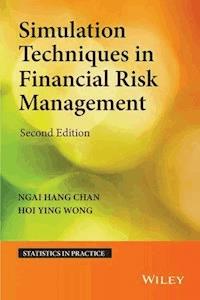
Praise for the First Edition "...a nice, self-contained introduction to simulation and computational techniques in finance..." - Mathematical Reviews Simulation Techniques in Financial Risk Management, Second Edition takes a unique approach to the field of simulations by focusing on techniques necessary in the fields of finance and risk management. Thoroughly updated, the new edition expands on several key topics in these areas and presents many of the recent innovations in simulations and risk management, such as advanced option pricing models beyond the Black-Scholes paradigm, interest rate models, MCMC methods including stochastic volatility models simulations, model assets and model-free properties, jump diffusion, and state space modeling. The Second Edition also features: * Updates to primary software used throughout the book, Microsoft Office Excel VBA * New topical coverage on multiple assets, model-free properties, and related models * More than 300 exercises at the end of each chapter, with select answers in the appendix, to help readers apply new concepts and test their understanding * Extensive use of examples to illustrate how to use simulation techniques in risk management * Practical case studies, such as the pricing of exotic options; simulations of Greeks in hedging; and the use of Bayesian ideas to assess the impact of jumps, so readers can reproduce the results of the studies * A related website with additional solutions to problems within the book as well as Excel VBA and S-Plus computer code for many of the examples within the book Simulation Techniques in Financial Risk Management, Second Edition is an invaluable resource for risk managers in the financial and actuarial industries as well as a useful reference for readers interested in learning how to better gauge risk and make more informed decisions. The book is also ideal for upper-undergraduate and graduate-level courses in simulation and risk management.
Sie lesen das E-Book in den Legimi-Apps auf:
Seitenzahl: 267
Veröffentlichungsjahr: 2015
Ähnliche


















Table of Contents
Cover
Wiley Series in Statistics in Practice
Title Page
Copyright
Dedication
List of Figures
List of Tables
Preface
Preface to the Second Edition
Preface to the First Edition
Chapter 1: Preliminaries of VBA
1.1 Introduction
1.2 Basis Excel VBA
1.3 VBA Programming Fundamentals
Chapter 2: Basic Properties of Futures and Options
2.1 Introduction
2.2 Options
2.3 Exercises
Chapter 3: Introduction to Simulation
3.1 Questions
3.2 Simulation
3.3 Examples
3.4 Stochastic Simulations
3.5 Exercises
Chapter 4: Brownian Motions and Itô's Rule
4.1 Introduction
4.2 Wiener and Itô's Processes
4.3 Stock Price
4.4 Itô's Formula
4.5 Exercises
Chapter 5: Black–Scholes Model and Option Pricing
5.1 Introduction
5.2 One Period Binomial Model
5.3 The Black–Scholes–Merton Equation
5.4 Black–Scholes Formula
5.5 Exercises
Chapter 6: Generating Random Variables
6.1 Introduction
6.2 Random Numbers
6.3 Discrete Random Variables
6.4 Acceptance-Rejection Method
6.5 Continuous Random Variables
6.6 Exercises
Chapter 7: Standard Simulations in Risk Management
7.1 Introduction
7.2 Scenario Analysis
7.3 Standard Monte Carlo
7.4 Exercises
7.5 Appendix
Chapter 8: Variance Reduction Techniques
8.1 Introduction
8.2 Antithetic Variables
8.3 Stratified Sampling
8.4 Control Variates
8.5 Importance Sampling
8.6 Exercises
Chapter 9: Path Dependent Options
9.1 Introduction
9.2 Barrier Option
9.3 Lookback Option
9.4 Asian Option
9.5 American Option
9.6 Greek Letters
9.7 Exercises
Chapter 10: Multiasset Options
10.1 Introduction
10.2 Simulating European Multiasset Options
10.3 Case Study: On Estimating Basket Options
10.4 Dimension Reduction
10.5 Exercises
Chapter 11: Interest Rate Models
11.1 Introduction
11.2 Discount Factor and Bond Prices
11.3 Stochastic Interest Rate Models and Their Simulations
11.4 Hull–White Model
11.5 Fixed Income Derivatives Pricing
11.6 Exercises
Chapter 12: Markov Chain Monte Carlo Methods
12.1 Introduction
12.2 Bayesian Inference
12.3 Simulating Posteriors
12.4 Markov Chain Monte Carlo
12.5 Metropolis–Hastings Algorithm
12.6 Exercises
References
Index
Wiley Series in Statistics in Practice
End User License Agreement
Pages
xi
xii
xiii
xiv
xv
xvi
xvii
xviii
1
2
3
4
5
6
7
8
9
10
11
12
13
14
15
16
17
18
19
20
21
22
23
24
25
26
27
28
29
30
31
32
33
35
36
37
38
39
40
41
42
43
44
45
46
47
48
49
50
51
52
53
54
55
56
57
58
59
60
61
62
63
64
65
66
67
68
69
70
71
72
73
74
75
76
77
78
79
80
81
82
83
84
85
86
87
88
89
90
91
92
93
94
95
96
97
98
99
100
101
102
103
104
105
106
107
108
109
110
111
112
113
114
115
116
117
118
119
120
121
122
123
124
125
126
127
128
129
130
131
132
133
134
135
136
137
138
139
140
141
142
143
144
145
146
147
148
149
151
152
153
154
155
156
157
158
159
160
161
162
163
164
165
166
167
168
169
170
171
172
173
174
175
176
177
178
179
180
181
182
183
184
185
186
187
188
189
190
191
192
193
194
195
196
197
199
200
201
202
206
207
203
204
205
Guide
Cover
Table of Contents
Preface
Begin Reading
List of Illustrations
Chapter 1: Preliminaries of VBA
Figure 1.1 Excel [Options].
Figure 1.2 Developer mode selection.
Figure 1.3 Excel in developer mode.
Figure 1.4 Macro security.
Figure 1.5 Visual basic editor.
Figure 1.6 The macro recorder.
Figure 1.7 The recorded codes.
Figure 1.8 Creating command button.
Figure 1.9 Assigning a macro to a command button.
Chapter 2: Basic Properties of Futures and Options
Figure 2.1 Payoffs of option positions.
Figure 2.2 The prices of Hang Seng Index options on September 12, 2014.
Chapter 3: Introduction to Simulation
Figure 3.1 Densities of a lognormal distribution with mean and variance , that is, and and a standard normal distribution.
Chapter 4: Brownian Motions and Itô's Rule
Figure 4.1 Sample paths of the process for different
n
and the same sequence of .
Figure 4.2 Sample paths of Brownian motions on [0,1].
Figure 4.3 Geometric Brownian motion.
Chapter 5: Black–Scholes Model and Option Pricing
Figure 5.1 One period binomial tree.
Chapter 6: Generating Random Variables
Figure 6.1 Sample paths of the portfolio.
Figure 6.2 Sample paths of the assets and the portfolio.
Chapter 7: Standard Simulations in Risk Management
Figure 7.1 The shape of GED density function.
Figure 7.2 Left tail of GED.
Figure 7.3 QQ plot of normal quantiles against daily Dow Jones returns.
Figure 7.4 Determine the maximum of graphically.
Figure 7.5 QQ plot GED(1.21) quantiles against Dow Jones return quantiles.
Figure 7.6 Simulations of the call price against the size.
Figure 7.7 The log likelihood against .
Chapter 8: Variance Reduction Techniques
Figure 8.1 Illustration of payoffs for antithetic comparisons.
Figure 8.2 Payoff on a straddle as a function of input normal
Z
based on the parameters , , , and .
Figure 8.3 Simulations of 500 standard normal random numbers by standard Monte Carlo.
Figure 8.4 Simulations of 500 standard normal random numbers by stratified sampling.
Chapter 9: Path Dependent Options
Figure 9.1 The exercising region of the American put option.
Figure 9.2 Exercise regions of the American style Asian option.
Figure 9.3 The strike against the delta of a down-and-out call option.
Chapter 10: Multiasset Options
Figure 10.1 The distribution of simulated price.
Figure 10.2 The historical price of shocks.
Figure 10.3 Simulating terminal asset prices.
Chapter 11: Interest Rate Models
Figure 11.1 Cash flow of a 3-year coupon bond.
Figure 11.2 Yield to maturity .
Figure 11.3 Discount curve .
Figure 11.4 Simulated sample path of .
Figure 11.5 .
Figure 11.6 .
Chapter 12: Markov Chain Monte Carlo Methods
Figure 12.1 A sample path of the jump-diffusion model.
List of Tables
Chapter 1: Preliminaries of VBA
Table 1.1 Numeric Data Type
Table 1.2 VBA Logical Operators
Table 1.3 Common Built-In Math Functions in VBA
Chapter 2: Basic Properties of Futures and Options
Table 2.1 Strategy A for Longing Futures Contracts
Table 2.2 Data on Stock and Futures Prices
Table 2.3 Payoffs of Different Options with Strike Price
K
Table 2.4 Payoffs of Portfolios A and B
Table 2.5 Payoffs of Portfolios C and D
Table 2.6 Payoffs of Portfolios E and F
Table 2.7 Properties of Stock Options
Chapter 7: Standard Simulations in Risk Management
Table 7.1 Sales Record
Table 7.2 Probability Mass Function
Table 7.3 Policy Simulation and Evaluation
Table 7.4 Simulated Prices of the First and the Last 10 Weeks
Table 7.5 The Discounted Call Prices for the First 20 Paths
Chapter 8: Variance Reduction Techniques
Table 8.1 Effects of Stratification for Simulated Option Prices with Different Bin Sizes
Table 8.2 Effects of Stratification for Simulated Option Prices with Restricted Normal
Chapter 9: Path Dependent Options
Table 9.1 Sample Paths
Table 9.2 Regression at
Table 9.3 Optimal Decision at
Table 9.4 Regression at
Table 9.5 Optimal Decision at
Chapter 12: Markov Chain Monte Carlo Methods
Table 12.1 Conjugate Priors
Table 12.2 Performance of the Gibbs Sampling
Table 12.3 Jump-Diffusion Estimation for Dow Jones
WILEY SERIES IN STATISTICS IN PRACTICE
Advisory Editor, MARIAN SCOTT, University of Glasgow, Scotland, UK
Founding Editor, VIC BARNETT, Nottingham Trent University, UK
Statistics in Practice is an important international series of texts which provide detailed coverage of statistical concepts, methods, and worked case studies in specific fields of investigation and study.
With sound motivation and many worked practical examples, the books show in down-to-earth terms how to select and use an appropriate range of statistical techniques in a particular practical field within each titl's special topic area.
The books provide statistical support for professionals and research workers across a range of employment fields and research environments. Subject areas covered include medicine and pharmaceutics; industry, finance, and commerce; public services; the earth and environmental sciences, and so on.
The books also provide support to students studying statistical courses applied to the above areas. The demand for graduates to be equipped for the work environment has led to such courses becoming increasingly prevalent at universities and colleges.
It is our aim to present judiciously chosen and well-written workbooks to meet everyday practical needs. Feedback of views from readers will be most valuable to monitor the success of this aim.
A complete list of titles in this series appears at the end of the volume.
SIMULATION TECHNIQUES IN FINANCIAL RISK MANAGEMENT
Second Edition
NGAI HANG CHAN AND HOI YING WONG
The Chinese University of Hong Kong
Copyright © 2015 by John Wiley & Sons, Inc. All rights reserved
Published by John Wiley & Sons, Inc., Hoboken, New Jersey
Published simultaneously in Canada
No part of this publication may be reproduced, stored in a retrieval system, or transmitted in any form or by any means, electronic, mechanical, photocopying, recording, scanning, or otherwise, except as permitted under Section 107 or 108 of the 1976 United States Copyright Act, without either the prior written permission of the Publisher, or authorization through payment of the appropriate per-copy fee to the Copyright Clearance Center, Inc., 222 Rosewood Drive, Danvers, MA 01923, (978) 750-8400, fax (978) 750-4470, or on the web at www.copyright.com. Requests to the Publisher for permission should be addressed to the Permissions Department, John Wiley & Sons, Inc., 111 River Street, Hoboken, NJ 07030, (201) 748-6011, fax (201) 748-6008, or online at http://www.wiley.com/go/permissions.
Limit of Liability/Disclaimer of Warranty: While the publisher and author have used their best efforts in preparing this book, they make no representations or warranties with respect to the accuracy or completeness of the contents of this book and specifically disclaim any implied warranties of merchantability or fitness for a particular purpose. No warranty may be created or extended by sales representatives or written sales materials. The advice and strategies contained herein may not be suitable for your situation. You should consult with a professional where appropriate. Neither the publisher nor author shall be liable for any loss of profit or any other commercial damages, including but not limited to special, incidental, consequential, or other damages.
For general information on our other products and services or for technical support, please contact our Customer Care Department within the United States at (800) 762-2974, outside the United States at (317) 572-3993 or fax (317) 572-4002.
Wiley also publishes its books in a variety of electronic formats. Some content that appears in print may not be available in electronic formats. For more information about Wiley products, visit our web site at www.wiley.com.
Library of Congress Cataloging-in-Publication Data:
Chan, Ngai Hang.
Simulation techniques in financial risk management / Ngai Hang Chan and Hoi Ying Wong. – Second edition.
pages cm. – (Statistics in practice)
Includes bibliographical references and index.
ISBN 978-1-118-73581-7 (hardback)
1. Finance–Simulation methods. 2. Risk management–Simulation methods. I. Wong, Hoi Ying, 1974- II. Title.
HG173.C47 2015
338.5–dc23
2015001921
Cover image courtesy of iStockphoto © pawel.gaul
To our families
N.H. Chan and H.Y. Wong
Preface
Preface to the Second Edition
This book has now been in print for almost 10 years and has seen several printings. During this period, the field of quantitative finance has experienced abrupt changes, some for better and some for worse. But it has been very gratifying to us to have heard from many readers that this book has been helpful to them in dealing with the ever-changing financial landscape. It appears that to some extent at least the original objectives set out in the first edition have been realized. This book can be used either as an introductory text to simulations at the senior undergraduate or as a Master's level course. It can also be used as a complimentary source to the more specialized treatise by Chan and Wong (2013) entitled Handbook of Financial Risk Management: Simulations and Case Studies.
This second edition has been thoroughly revised and enhanced. Many of these changes were results of teaching different courses in simulation for financial risk managers over the years. In addition to cleaning up as many errors and misprints as possible, the following specific changes have been incorporated in this revision.
Many readers suggested more exercises with worked solutions. As a result, we enlarge the problems and answers section in light of these requests.
Because the use of VBA in Excel has been common in the financial industry, the current edition incorporates this suggestion. We have now replaced all S-Plus codes with VBA codes.
Due to the advent in IT technology, a new website has been set up for readers to download the VBA computer codes.
http://www.sta.cuhk.edu.hk/Book/SRMS/
As long as the website is available, we no longer print computer codes, so that more space can be used for expanded topics.
Likewise, suggested solutions to exercises at the end of each chapter are now available via online supplementary materials.
To make the book self-contained, two new chapters,
Chapters 1
and
2
, have been added.
Chapter 1
introduces basic concepts of Excel VBA, and
Chapter 2
introduces basic concepts of derivatives.
Corresponding to
Chapter 9
in the first edition,
Chapter 11
of this edition is expanded to discuss in detail a one-factor interest rate model and the calibration to yield curves.
More examples have been added to illustrate the concept of MCMC, in particular the Metropolis–Hastings algorithm.
Finally, we would like to thank colleagues and students alike, who have been giving us suggestions and ideas throughout the years. In particular, we would like to thank the editorial assistance of Dr. Warwick Yuen and Mr. Tom Ng of CUHK and Ms. Sari Friedman and Mr. Jon Gurstelle of Wiley. We also want to express our gratitude to the Research Grants Council of HKSAR for support at various stages of our work on this revision.
Ngai Hang Chan and Hoi Ying WongShatin, Hong Kong
Preface to the First Edition
Risk management is an important subject in finance. Despite its popularity, risk management has a broad and diverse definition that varies from individual to individual. One fact remains, however. Every modern risk management method comprises a significant amount of computations. To assess the success of a risk management procedure, one has to rely heavily on simulation methods. A typical example is the pricing and hedging of exotic options in the derivative market. These over-the-counter options experience very thin trading volume, and yet their nonlinear features forbid the use of analytical techniques. As a result, one has to rely on simulations in order to examine their properties. It is therefore not surprising that simulation has become an indispensable tool in the financial and risk management industry today.
Although simulation as a subject has a long history by itself, the same cannot be said about risk management. To fully appreciate the power and usefulness of risk management, one has to acquire a considerable amount of background knowledge across several disciplines: finance, statistics, mathematics, and computer science. It is the synergy of various concepts across these different fields that marks the success of modern risk management. Although many excellent books have been written on the subject of simulation, none has been written from a risk management perspective. It is therefore timely and important to have a text that readily introduces the modern techniques of simulation and risk management to the financial world.
This text aims at introducing simulation techniques for practitioners in the financial and risk management industry at an intermediate level. The only prerequisite is a standard undergraduate course in probability at the level of Hogg and Tanis (2006), say, and some rudimentary exposure to finance. The present volume stems from a set of lecture notes used at the Chinese University of Hong Kong. It aims at striking a balance between theory and applications of risk management and simulations, particularly along the financial sector. The book comprises three parts.
Part one consists of the first three chapters. After introducing the motivations of simulation in
Chapter 1
, basic ideas of Wiener processes and Itô's calculus are introduced in
Chapters 2
and
3
. The reason for this inclusion is that many students have experienced difficulties in this area because they lack the understanding of the theoretical underpinnings of these topics. We try to introduce these topics at an operational level so that readers can immediately appreciate the complexity and importance of stochastic calculus and its relationship with simulations. This will pave the way for a smooth transition to option pricing and Greeks in later chapters. For readers familiar with these topics, this part can be used as a review.
Chapters 4
–
6
comprise the second part of the book. This part constitutes the main core of an introductory course in risk management. It covers standard topics in a traditional course in simulation, but at a much higher and succinct level. Technical details are left in the references, but important ideas are explained in a conceptual manner. Examples are also given throughout to illustrate the use of these techniques in risk management. By introducing simulations this way, both students with strong theoretical background and students with strong practical motivations get excited about the subject early on.
The remaining
Chapters 7
–
10
constitute part 3 of the book. In this part, more advanced and exotic topics of simulations in financial engineering and risk management are introduced. One distinctive feature in these chapters is the inclusion of case studies. Many of these cases have strong practical bearings such as pricing of exotic options, simulations of Greeks in hedging, and the use of Bayesian ideas to assess the impact of jumps. By means of these examples, it is hoped that readers can acquire a first-hand knowledge about the importance of simulations and apply them to their work.
Throughout the book, examples from finance and risk management have been incorporated as much as possible. This is done throughout the text, starting at the early chapter that discusses VaR of Dow to pricing of basket options in a multiasset setting. Almost all of the examples and cases are illustrated with Splus and some with Visual Basics. Readers would be able to reproduce the analysis and learn about either Splus or Visual Basics by replicating some of the empirical work.
Many recent developments in both simulations and risk management, such as Gibbs sampling, the use of heavy-tailed distributions in VaR calculation, and principal components in multiasset settings are discussed and illustrated in detail. Although many of these developments have found applications in the academic literature, they are less understood among practitioners. Inclusion of these topics narrows the gap between academic developments and practical applications.
In summary, this text fills a vacuum in the market of simulations and risk management. By giving both conceptual and practical illustrations, this text not only provides an efficient vehicle for practitioners to apply simulation techniques, but also demonstrates a synergy of these techniques. The examples and discussions in later chapters make recent developments in simulations and risk management more accessible to a larger audience.
Several versions of these lecture notes have been used in a simulation course given at the Chinese University of Hong Kong. We are grateful for many suggestions, comments, and questions from both students and colleagues. In particular, the first author is indebted to Professor John Lehoczky at Carnegie Mellon University, from whom he learned the essence of simulations in computational finance. Part 2 of this book reflects many of the ideas of John and is a reminiscence of his lecture notes at Carnegie Mellon. We would also like to thank Yu-Fung Lam and Ka-Yung Lau for their help in carrying out some of the computational tasks in the examples and for producing the figures in LaTeX, and to Mr. Steve Quigley and Ms. Susanne Steitz, both from Wiley, for their patience and professional assistance in guiding the preparation and production of this book. Financial support from the Research Grant Council of Hong Kong throughout this project is gratefully acknowledged. Last, but not least, we would like to thank our families for their understanding and encouragement in writing this book. Any remaining errors are, of course, our sole responsibility.
Ngai Hang Chan and Hoi Ying WongShatin, Hong Kong
1Preliminaries of VBA
1.1 Introduction
This chapter introduces the elementary programming skills in Visual Basic for Applications (VBA) that we use for numerical computation of the examples in the book. Experienced readers can read this chapter as a quick review.
1.2 Basis Excel VBA
Microsoft Excel is widely used in the financial industry for performing financial calculations. VBA is a common programming language linked to Excel and other Microsoft Office software that was developed to automatically control and perform repetitive actions. In this section, we guide readers on how to start a VBA in Microsoft Excel and give some popular algorithms for performing repetitions. In most cases, simple algorithms will be sufficient to perform the computations in the examples and exercises. We provide the illustrations in Excel 2010, although other versions can be set up in a similar way. For a comprehensive reference, readers are referred to other books.
1.2.1 Developer Mode and Security Level
For first-time users of VBA in Excel, it is more convenient to switch on the developer mode, where many of the VBA functions can be easily accessed. To open the developer mode, follow the following steps:
Click [File] → [Options] (
Fig. 1.1
) → [Customize Ribbon] (
Fig. 1.2
) → [Developer].
Figure 1.1 Excel [Options].
Figure 1.2 Developer mode selection.
Figure 1.3 shows the ribbons at the top of Excel after switching on the developer mode. Macros refer to the codes executed in the VBA language. To execute the macros promptly, users are recommended to turn down the security level as follows:
Click [Macro Security] (
Fig. 1.3
) → Macro Settings [Enable all macros] (
Fig. 1.4
).
Figure 1.3 Excel in developer mode.
Figure 1.4 Macro security.
1.2.2 Visual Basic Editor
To edit the VBA codes, Microsoft provides a Visual Basic editor (VBE) in Excel for editing the macros. Macros are created, edited, and debugged in the VBE before being executed. A macro is usually created as a Sub or Function procedure that can perform automatic tasks, while a module consists of one or more macros. Similarly, a project has one or more modules. and are reserved keywords in VBA. Users need to avoid using keywords when defining new variables. The codes in the VBE are saved together with the Excel worksheet. In Excel 2010, these worksheets can be saved as .xlsm as an Excel Macro-Enabled Workbook file. To open and edit macros in VBE, follow the following procedure:
Lesen Sie weiter in der vollständigen Ausgabe!
Lesen Sie weiter in der vollständigen Ausgabe!
Lesen Sie weiter in der vollständigen Ausgabe!
Lesen Sie weiter in der vollständigen Ausgabe!
Lesen Sie weiter in der vollständigen Ausgabe!
Lesen Sie weiter in der vollständigen Ausgabe!
Lesen Sie weiter in der vollständigen Ausgabe!
Lesen Sie weiter in der vollständigen Ausgabe!
Lesen Sie weiter in der vollständigen Ausgabe!
Lesen Sie weiter in der vollständigen Ausgabe!
Lesen Sie weiter in der vollständigen Ausgabe!
Lesen Sie weiter in der vollständigen Ausgabe!
Lesen Sie weiter in der vollständigen Ausgabe!
Lesen Sie weiter in der vollständigen Ausgabe!
Lesen Sie weiter in der vollständigen Ausgabe!




