


2,99 €
Mehr erfahren.
- Herausgeber: Interactive Media
- Kategorie: Krimi
- Sprache: Englisch
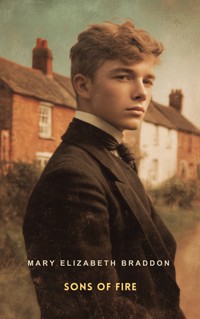
Sons of Fire is a Victorian novel of identity, inheritance, and hidden connection. Allan Carew inherits a country estate near Matcham and enters an unfamiliar social world, where he is repeatedly mistaken for Geoffrey Wornock, the local squire. Drawn into village life and intrigued by the enigmatic Mrs. Wornock, Allan uncovers unsettling resemblances and buried ties. Braddon builds suspense around family secrets, social position, and the dangerous pull of a past that refuses to remain hidden.
Das E-Book können Sie in Legimi-Apps oder einer beliebigen App lesen, die das folgende Format unterstützen:
Veröffentlichungsjahr: 2026
Ähnliche













Mary Elizabeth Braddon
Sons of Fire Volume 1
Published by Fractal Press
This edition first published in 2026
Copyright © 2026 Fractal Press
All Rights Reserved
ISBN: 9781836101673
Contents
CHAPTER 1.
CHAPTER 2.
CHAPTER 3.
CHAPTER 4.
CHAPTER 5.
CHAPTER 6.
CHAPTER 7.
CHAPTER 8.
CHAPTER 9.
CHAPTER 10.
CHAPTER 11.
CHAPTER 1.
A STRIKING LIKENESS.
The meet was at the Pig and Whistle, at Melbury, nine miles off. Rather a near meet—compared with the usual appointments of the South Sarum hounds—the ostler remarked, as Allan Carew mounted a hired hunter in the yard of the Duke’s Head, chief, and indeed only possible inn for a gentleman to put up at, in the little village of Matcham, a small but prosperous hamlet, lying in a hollow of the hills between Salisbury and Andover. He had only arrived on the previous afternoon, and he was sallying forth in the crisp March morning, on an unknown horse in an unfamiliar country, to hunt with a pack whose master’s name he had heard for the first time that day.
“Can he jump?” asked Allan, as he scrutinized the lean, upstanding bay; not a bad kind of horse by any means, but with that shabby, under-groomed and over-worked appearance common to hirelings.
“Can’t he, sir? There ain’t a better lepper in Wiltshire. And as clever as a cat! We had a lady staying here in the winter, Mrs. Colonel Parkyn, brought two ‘acks of her own, besides the colonel’s two ‘unters, and liked this here horse better than any of ‘em. She was right down mashed on him, as the young gents say.”
“I wonder she didn’t buy him,” said Allan.
“She couldn’t, sir. Money wouldn’t buy such a hunter as this off my master. He’s a fortune to us.”
“I hope I may be of Mrs. Parkyn’s opinion when I come home,” said Allan. “Now then, ostler, just tell me which way I am to ride to get to the Pig and Whistle by eleven o’clock.”
The ostler gave elaborate instructions. A public-house here, an accommodation lane there—a common to cross—a copse to skirt—three villages—one church—a post-office—and several cross-roads.
“You’re safe to fall in with company before you get there,” concluded the ostler, whisking a bit of straw out of the bay’s off hind hoof, and eyeing him critically, previous to departure.
“If I don’t, I doubt if I ever shall get there,” said Allan, as he rode out of the yard.
He was a stranger in Matcham, a “foreigner,” as the villagers called such alien visitors. He had never been in the village before, knew nothing of its inhabitants or its surroundings, its customs, ways, local prejudices, produce, trade, scandals, hates, loves, subserviencies, gods, or devils. And yet henceforward he was to be closely allied with Matcham, for a certain bachelor uncle had lately died and left him a small estate within a mile of the village—a relative with whom Allan Carew had held slightest commune, lunching or dining with him perhaps once in a summer, at an old family hotel in Albemarle Street, never honoured by so much as a hint at an invitation to his rural retreat, and not cherishing any expectation of a legacy, much less the bequest of all the gentleman’s worldly possessions, comprising a snug, well-built house, in pretty and spacious grounds, with good and ample stabling, and with farms and homesteads covering something like fifteen hundred acres, and producing an income of a little over two thousand a year.
It need hardly be stated that Allan Carew was not a poor man when this unexpected property fell into his lap.
The children of this world are rarely false to the gospel precept—to every one which hath shall be given. Allan’s father had changed his name, ten years before, from Beresford to Carew, upon his succession to a respectable estate in Suffolk, an inheritance from his maternal grandfather, old Squire Carew, of Fendyke Hall, Millfield.
Allan, an only son, was not by any means ill provided for when his maternal uncle, Admiral the Honourable Allan Darnleigh, took it into his head to leave him his Wiltshire property; but this bequest raised him at once to independence, and altogether dispensed with any further care about that gentleman-like profession, the Bar, which had so far repaid Mr. Carew’s collegiate studies, labours, outlays, and solicitude by fees amounting in all to seven pounds seven shillings, which sum represented the gross earnings of three years.
So, riding along the rustic high-road, in the clear morning air, under a sapphire sky, just gently flecked with fleecy cloudlets, Allan Carew told himself that it was a blessed escape to have done with chambers, and reading law, and waiting for briefs; and that it was a good thing to be a country gentleman; to have his own house and his own stable; not to be obliged to ride another man’s horses, even though that other man were his very father; not to be told after every stiffish day across country that he had done for the grey, or that the chestnut’s legs had filled as never horse’s legs filled before, nor to hear any other reproachful utterances of an old and privileged stud-groom, who knew the horses he rode were not his own property. Henceforth his stable would be his own kingdom, and he would reign there absolute and unquestioned. He could choose his own horses, and they should be good ones. He naturally shared the common creed of sons, and looked upon all animals of his father’s buying as “screws” and “duffers.” His own stables would be something altogether different from the drowsy old stables at home, where horses were kept and cherished because they were familiar friends, rather than with a view to locomotion. His stud and his stable should be as different as if horses and grooms had been bred upon another planet.
He loved field-sports. He felt that it was in him to make a model squire, albeit two thousand a year was not a large revenue in these days of elegant living and Continental holidays, and eclectic tastes. He felt that among his numerous nephews, old Admiral Darnleigh had made a wise selection in choosing his god-son, Allan Carew, to inherit his Wiltshire estate. He meant to be prudent and economical. He had spent the previous afternoon in a leisurely inspection of Beechhurst. He had gone over house and stables, and had found all things so well planned, and in such perfect order, that he was assailed by none of those temptations to pull down and to build, to alter and to improve, which often inaugurate ruin in the very dawn of possession. He thought he might build two or three loose boxes on one side of the spacious stable-yard. There were two packs within easy reach of Matcham, to say nothing of packs accessible by rail, and he would naturally want more hunters than had sufficed for the old sailor, who had jogged out on his clever cob two or three times a week, and had gone home early, after artful riding and waiting about the lanes, or to leeward of the great bare hills, and in snug corners, where a profound knowledge of the country enabled him to make sure of the hounds. Allan’s hunting-stable would be on a very different footing; and although Beechhurst provided ample accommodation for a stud of eight, Allan told himself that one of his first duties would be to build loose boxes.
“I shall often have to put up a couple of horses for a friend,” he thought.
The morning was lovely, more like April than March. The bay trotted along complacently, neither lazy nor feverishly active, but with an air of knowing what he had to do for his day’s wage, and meaning honestly to do it. Allan was glad that his road took him past Beechhurst. Possession had still all the charm of novelty. His heart thrilled with pride as he slackened his pace to gaze fondly at the pretty white house, low and long, with a verandah running all along the southern front, admirably placed upon a gentle elevation, against the swelling shoulder of a broad down, facing south-west, and looking over garden and shrubbery, and across a stretch of common, that lay between Beechhurst and the high-road, and gave a dignified aloofness to the situation; seclusion without dulness, a house and grounds remote, but not buried or hidden.
“Nothing manorial about it,” mused Allan; “but it certainly looks a gentleman’s place.”
He would naturally have preferred something less essentially modern. He would have liked Tudor chimneys, panelled walls, and a family ghost. He would have liked to know that his race had taken deep root in the soil, had been lords of the manor centuries and centuries ago, when Wamba was keeping pigs in the woods, and when the jester’s bells mixed with the merry music of hawk and hound. Admiral Darnleigh, so far as Wiltshire was concerned, had been a new man. He had made his money in China, speculating in tea-gardens, and other property, while pursuing his naval career with considerable distinction. He had retired from active service soon after the Chinese war, a C.B. and a rich man, had bought Beechhurst a bargain—during a period of depression—and had settled down in yonder pretty white house, with a small but admirable establishment, each member thereof a pearl of price among servants, and had there spent the tranquil even-tide of an honourable and consistently selfish life. He had never married. As a single man, he had always felt himself rich; as a married man he might often have felt himself poor. He had heard Allan at five and twenty declare that he had done with the romance of life, and that he, too, meant to be a bachelor; and it may be that this boyish assertion, carelessly made over a bottle of Lafitte, did in some measure influence the Admiral’s choice of an heir.
Allan’s father and mother were of a more liberal mind.
“You are in a better position than your father was at your age,” said Lady Emily Carew, on her son’s accession to fortune. “I hope you will marry well—and soon.”
There was no thought of woman’s love, or of married bliss, in Allan Carew’s mind, as he rode through the lanes and over a common, and across a broad stretch of open down to the Pig and Whistle. He was full, not of his inner self, but of the outer world around and about him, pleased with the pleasant country in which his lot was cast, wondering what his new neighbours were like, and how they would receive him.
“I wonder whether the South Sarum is a hospitable hunt, or whether the members are a surly lot, and look upon every stranger as a sponge and an interloper,” he mused.
He had ridden alone for about half the way, when a man in grey fustian and leather gaiters, who looked like a small tenant farmer, trotted past him, turned and stared at him with obvious astonishment, touched his hat and rode on, after a few words of greeting, which were lost in the clatter of hoofs.
He had ridden right so far by the aid of memory; he now followed the man in grey, and, taking care to keep this pioneer in view, duly arrived at a small rustic inn, standing upon high ground, and overlooking an undulating sweep of woodland and common, marsh and plain, one of those picturesque oases which diversify the breadth of wind-swept downs. The inn was an isolated building, the few labourers’ cottages within reach being hidden by a turn of the road.
Hounds and hunt-servants were clustered on a level green on the other side of the road, but there was no one else upon the ground.
Allan looked at his watch, and found that it was ten minutes to eleven.
The man in grey had dismounted from his serviceable cob, and was standing on the greensward, talking to the huntsman. Huntsman and whips had taken off their caps to Allan as he rode up, and it seemed to him that there was at once more respect and more friendliness in the salutation than a stranger usually receives—above all a stranger in heather cloth and butcher boots, and not in the orthodox pink and tops. The man in grey, and the hunt-servants, were evidently talking of him as he sat solitary in front of the inn. Their furtive glances in his direction fully indicated that he was the subject of their discourse.
“They take a curious interest in strangers in these parts,” thought Allan.
Two minutes afterwards, a stout man, with a weather-beaten red face showing above a weather-beaten red coat, rode up with two other men. Evidently the master and his satellites.
“Hulloa!” cried the jovial man, “what the deuce brings you back so much sooner than Mrs. Wornock expected you? She told me there was no chance of our seeing you for the next year. When did you arrive? I never heard a word about it.”
The master’s broad doeskin palm was extended to Allan in the most cordial way, and the master’s broad red face irradiated kindliest feelings.
“You are under a misapprehension, sir,” said Allan, smiling at the frank, friendly face, amused at the eager rapidity of speech which had made it impossible for him to interrupt the speaker. “I have never yet enjoyed the privilege of a day with the South Sarum, and this is my first appearance in your neighbourhood.”
“And you ain’t Geoffrey Wornock,” exclaimed the master, utterly discomfited.
“My name is Carew.”
“Ah, your voice is different. I should have known you were not Geoff if I had heard you speak. And now, of course, when one looks deliberately, there is a difference—a difference which would be more marked, I dare say, if Wornock were here. Are you a relation of Wornock’s?”
“I never heard the name of Wornock in my life until I heard it from you.”
“Well, I’m—dashed,” cried the master, suppressing a stronger word as premature so early in the day. “Did you see the likeness, Champion?” asked the master, appealing to one of his satellites.
“Of course I did,” replied Captain Champion. “I was just as much under a delusion as you were—and yet—Mr. Carew’s features are not the same as Wornock’s—and his eyes are a different colour. It’s the outlook, the expression, the character in the face that is so like our friend’s—and I think that kind of likeness impresses one more than mere form and outline.”
“Hang me if I know anything about it, except that I took one man for the other,” said the master, bluntly. “Well, Mr. Carew, I hope you will excuse my blunder, and that we may be able to show you some sport on your first day in our country. We’ll draw Wellout’s Wood, Hamper, and if we don’t find there we’ll go on to Holiday Hill.”
Hounds and servants went off merrily across the down, and dipped into a winding lane. A good many horsemen had ridden up by this time, with half a dozen ladies among them. Some skirmished across the fields, others crowded the lane, and in this latter contingent rode the master, with his hounds in front of him, and Carew at his side.
“Are you staying in the neighbourhood?” he asked; “or did you come by rail this morning? A long ride from Matcham Road station, if you did.”
“I am staying at the Duke’s Head, at Matcham; but I only arrived yesterday. I am going to settle in your neighbourhood.”
“Indeed! Have you bought a place?”
“No.”
“Ah, going to rent one. Wiser, perhaps, till you see how you like this part of the country.”
“I have had a place left me by my uncle, Admiral Darnleigh.”
“What! are you Darnleigh’s heir? Yes, by-the-by, I heard that Beechhurst was left to a Mr. Carew; but I’ve a bad memory for names. So you have got Beechhurst, have you? I congratulate you. A charming place, compact, snug, warm, and in perfect order. Stables a trifle small, perhaps, for a hunting man.”
“I am going to extend them,” said Allan, with suppressed pride.
“Then you are going to do the right thing, sir. The only part in which Beechhurst falls short of perfection is in the stables. Capital stables, as far as they go, but it isn’t far enough for a man who wants to hunt five days a week, and accommodate his hunting friends. Besides, the owner of Beechhurst ought to be in a position to take the hounds at a push.”
“I hope it may be long before that push comes,” said Allan.
“Ah, you’re very kind; but I’m not so young as I was once, nor so rich as I was once—and—the Preacher says there’s a time for all things. My time is very nearly past, and your time is coming, Mr. Carew. When do you establish yourself at Beechhurst?”
“I am going back to London to-morrow to settle a few matters, and perhaps have a look round at Tattersall’s, and I hope to be at Beechhurst in less than a fortnight.”
“I shall do myself the pleasure of calling upon you. Any wife?”
“I am still in the enviable position my uncle enjoyed till his death.”
“A bachelor? Ah! that won’t last long. It’s all very well for a sun-dried old sailor to keep the fair sex at arm’s length; but you won’t be able to do it, Mr. Carew. I give you till our next hunt-ball for a free man. You’ve no notion what complexions our Wiltshire women have—Devon can’t beat ‘em—or what a lot of pretty girls there are within a fifteen-mile drive of Matcham.”
“I look forward with a thrill of mingled rapture and apprehension to your next hunt-ball.”
“It’ll be here before you know where you are. We have postponed it till the first of May. We shall kill our May fox on the thirtieth of April, and dance on his grave on the first.”
“I shall be there, my lord,” said Allan, as Lord Hambury galloped off after his huntsman, who had just put the hounds into the covert.




