


3,99 €
Mehr erfahren.
- Herausgeber: BOYD MEDIA
- Kategorie: Religion und Spiritualität
- Sprache: Englisch
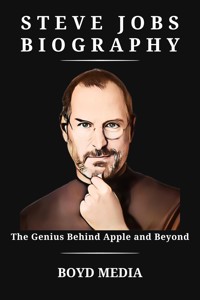
* Delve into the fascinating life of one of the most influential visionaries of our time.
* From his humble beginnings in a garage to revolutionizing multiple industries, Steve Jobs's story is a testament to perseverance, creativity, and relentless passion.
* Explore the behind-the-scenes moments that shaped Apple's iconic products and the culture of innovation that continues to inspire millions worldwide.
* Discover the trials and triumphs of a man who dared to think differently, challenging the status quo at every turn.
With exclusive insights and interviews, this biography offers a rare glimpse into the mind of a genius, exploring not only his professional achievements but also his personal struggles and profound impact on modern society.
Whether you're an Apple enthusiast, an aspiring entrepreneur, or simply curious about the man behind the iconic brand, "Steve Jobs Biography: The Genius Behind Apple and Beyond" is a must-read. Join us on this captivating journey of discovery and be inspired to unleash your own creativity and innovation.
Click the Buy Now Button and embark on an unforgettable exploration of genius and legacy.
Das E-Book können Sie in Legimi-Apps oder einer beliebigen App lesen, die das folgende Format unterstützen:
Veröffentlichungsjahr: 2024
Ähnliche
















STEVE JOBS BIOGRAPHY
-----------------
The Genius Behind Apple and Beyond
BOYD MEDIA
All rights reserved. No part of this book may be reproduced, stored in a retrieval system, or transmitted in any form or by any means—electronic, mechanical, photocopying, recording, or otherwise—without the prior written permission of Boyd Media, except for brief quotations in critical reviews and certain other noncommercial uses permitted by copyright law.
The information in this book is provided "as is" and without warranties of any kind, either express or implied. The author and publisher make no representations or warranties with respect to the accuracy or completeness of the contents of this book and specifically disclaim any implied warranties of merchantability or fitness for a particular purpose. The advice and strategies contained herein may not be suitable for your situation. You should consult with a professional where appropriate. The author and publisher shall not be liable for any loss of profit or any other commercial damages, including but not limited to special, incidental, consequential, or other damages.
Copyright © 2024 by Boyd Media. All rights reserved
Table of contents
Introduction
chapter 1: beginnings in silicon valley
chapter 2: childhood influences and early interests
chapter 3: the formation of apple inc.
chapter 4: the breakthrough: apple i and apple ii
chapter 5: turbulent times and departure from apple
chapter 6: founding next and the birth of pixar
chapter 7: the pixar-disney partnership and success
chapter 8: return to apple: the resurgence of the company
chapter 9: launching the imac and apple's design revolution
chapter 10: the ipod: redefining the music industry
chapter 11: the iphone: changing the face of communication
chapter 12: the ipad and the tablet revolution
chapter 13: a visionary's approach to product design
chapter 14: the reality distortion field and management style
chapter 15: personal and professional challenges
chapter 16: health struggles and legacy planning
chapter 17: philanthropy and impact beyond apple
chapter 18: the last days and steve jobs' legacy
chapter 19: the influence of steve jobs on modern technology
chapter 20: family, friends, and personal reflections
conclusion
Introduction
Jobs was adopted by Paul and Clara Jobs, a working-class couple living in Mountain View, California. He was a bright and curious child, and he developed an early interest in electronics and technology. At the age of 13, he built his first computer, a simple machine called the "Blue Box" that could mimic the tones of a telephone company switchboard, allowing users to make free calls.
After dropping out of Reed College after just one semester, Jobs took a job as a technician at Atari, a video game company. It was at Atari that he met Steve Wozniak, a brilliant engineer who shared his passion for technology. The two quickly became friends and collaborators.
In 1976, Jobs and Wozniak founded Apple Computer in Jobs's garage. Their first product was the Apple I, a personal computer that was sold to hobbyists and electronics enthusiasts. The Apple I was a success, but it was the Apple II, released in 1977, that made Apple a household name. The Apple II was one of the first mass-produced personal computers, and it revolutionized the way people worked and played.
Jobs was a visionary leader who had a clear vision for the future of technology. He believed that computers should be easy to use and accessible to everyone, not just tech experts. He also had a strong focus on product design and user experience. Under Jobs's leadership, Apple released a series of innovative products, including the Macintosh computer, the iPod, the iPhone, and the iPad.
Jobs was a perfectionist who demanded the best from his employees. He was also known for his temper and his ruthless business tactics. But despite his flaws, he was a charismatic and inspiring leader who motivated his team to achieve great things.
Steve Jobs died on October 5, 2011, at the age of 56, following a long battle with pancreatic cancer. He left behind a legacy as one of the most influential and innovative figures in the history of technology. His products have changed the way we live and work, and his vision for the future continues to inspire people around the world.
chapter 1: beginnings in silicon valley
Steve Jobs arrived in Silicon Valley in 1971, a young man with a passion for technology and a dream of changing the world. He had just graduated from high school and enrolled at Reed College in Portland, Oregon, but he quickly realized that the traditional college experience wasn't for him. After just one semester, Jobs dropped out and moved to California, where he hoped to find a job in the tech industry.
Jobs's early days in Silicon Valley were humble. He worked a series of odd jobs, including working at a video game company called Atari. It was at Atari that he met Steve Wozniak, a brilliant engineer who shared his passion for technology. The two quickly became friends and collaborators, and they began working on their own computer projects.
In 1976, Jobs and Wozniak founded Apple Computer in Jobs's garage. Their first product, the Apple I, was a bare-bones computer that was sold to hobbyists and electronics enthusiasts. The Apple I was a commercial success, but it was the Apple II, released in 1977, that really put Apple on the map.
The Apple II was one of the first mass-produced personal computers, and it revolutionized the way people worked and played. It was also one of the first personal computers to be widely used in schools, which helped to introduce a new generation to the power of computing.
Jobs's role in the early success of Apple was undeniable. He was the company's visionary leader and its chief marketing officer. He had a clear vision for the future of personal computing, and he was able to communicate that vision to the world in a way that was both inspiring and persuasive.
Jobs was also a demanding leader. He expected the best from his employees, and he was not afraid to push them to their limits. But he was also known for his loyalty and his generosity. He was always willing to help his employees succeed, and he was always willing to share the credit for Apple's success.
In the early days of Apple, Jobs and Wozniak were inseparable. They worked together on every product, and they were both deeply involved in the company's day-to-day operations. However, as Apple grew, it became increasingly difficult for Jobs and Wozniak to maintain their close working relationship.
Wozniak was a brilliant engineer, but he was not interested in the business side of technology. He preferred to stay in his lab and work on new products. Jobs, on the other hand, was a natural businessman. He had a keen understanding of the market, and he was always looking for new ways to grow Apple's business.
The differences between Jobs and Wozniak's management styles eventually led to a rift between the two friends. In 1985, Wozniak left Apple to pursue other interests. Jobs remained at Apple for several more years, but he was eventually fired by the company's board of directors in 1985.
Despite his setbacks, Jobs never gave up on his dream of changing the world through technology. In 1985, he founded NeXT Computer, a company that developed high-end workstations for the education and research markets. NeXT was not a commercial success, but it did produce some innovative technologies, such as the NeXTSTEP operating system.
In 1996, Jobs returned to Apple as CEO. He quickly set about turning the company around. He fired many of the old guard and brought in new talent. He also introduced a new line of products, including the iMac, the iPod, the iPhone, and the iPad.
Under Jobs's leadership, Apple became one of the most successful and innovative companies in the world. Its products have changed the way we live and work, and its brand has become synonymous with quality and innovation.
Steve Jobs died in 2011 at the age of 56, but his legacy lives on. He is remembered as one of the most visionary and influential figures in the history of technology. He was a man who changed the world, and his story is an inspiration to us all.




