


0,49 €
Mehr erfahren.
- Herausgeber: Booksell-Verlag
- Kategorie: Abenteuer, Thriller, Horror
- Sprache: Englisch
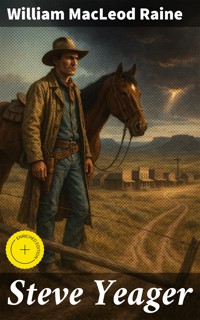
In "Steve Yeager," William MacLeod Raine presents a gripping tale set against the backdrop of the American West. Raine's narrative prowess reflects the conventions of early 20th-century Western literature, imbued with vivid descriptions and palpable tension. The story follows the escapades of the titular hero, Steve Yeager, a rugged individual navigating both personal conflicts and the broader societal challenges of his time. Raine's rich depictions of the landscape and dialect craft a vibrant world that resonates with themes of honor, survival, and the relentless quest for justice, exemplifying the era's fascination with the frontier ethos. William MacLeod Raine, a contemporary of Zane Grey and an influential voice in Western fiction, drew from his experiences as a young man in Wyoming, which profoundly influenced his storytelling. His intimate knowledge of the region and its culture informs the authenticity of his characters and settings, making "Steve Yeager" not just a narrative but an exploration of the rugged American spirit. Raine's ability to intertwine personal narratives with broader historical contexts reflects his commitment to capturing the essence of the American West. This novel is a must-read for enthusiasts of Western literature and anyone interested in the complexities of character and environment found within this genre. Raine's engaging prose and nuanced storytelling deliver a vivid adventure that captivates readers, inviting them to explore the moral dilemmas and triumphs of life on the frontier. In this enriched edition, we have carefully created added value for your reading experience: - A succinct Introduction situates the work's timeless appeal and themes. - The Synopsis outlines the central plot, highlighting key developments without spoiling critical twists. - A detailed Historical Context immerses you in the era's events and influences that shaped the writing. - A thorough Analysis dissects symbols, motifs, and character arcs to unearth underlying meanings. - Reflection questions prompt you to engage personally with the work's messages, connecting them to modern life. - Hand‐picked Memorable Quotes shine a spotlight on moments of literary brilliance. - Interactive footnotes clarify unusual references, historical allusions, and archaic phrases for an effortless, more informed read.
Das E-Book können Sie in Legimi-Apps oder einer beliebigen App lesen, die das folgende Format unterstützen:
Veröffentlichungsjahr: 2019
Ähnliche





Steve Yeager
Table of Contents
Introduction
At its heart, Steve Yeager is a study of how a determined individual tries to reconcile private conscience with public order, as a man learns that keeping faith - with himself, with companions, and with a hard, widening country - means negotiating shifting allegiances, blunt instruments of law and violence, and the quieter pressure of reputation, discovering along the way that courage in the open is only the beginning of a longer test that demands patience, restraint, and the will to claim a place in a community still deciding what justice, decency, and belonging should look like at the far edge of the West.
Written by William MacLeod Raine, a prolific author of Western fiction, Steve Yeager belongs to the popular tradition that mapped the American West through fast-moving narratives of peril, pursuit, and contested authority. Dating from the early twentieth century, the book situates its action on the frontier, where formal institutions lag behind immediate necessity and reputation travels quickly. Readers can place it among Raine's contributions to the genre, which helped codify familiar patterns of action, moral testing, and landscape-inflected atmosphere for a growing audience across the United States, reflecting the period's appetite for stories that dramatized settlement, risk, and rough-hewn community.
Without disclosing its turns, the premise is straightforward: Steve Yeager faces moments when delay is impossible, and the choices he makes ripple through friendships, rivalries, and fragile civic arrangements. The book offers the kind of experience associated with classic Western storytelling - clear stakes, outdoor movement, tense confrontations, and a steady escalation toward reckoning - while allowing room for interior pressure and the burden of responsibility. Its appeal lies less in an intricate puzzle than in the way a recognizable figure meets complications that feel both inevitable and self-made, carrying the reader through danger, reflection, and the gradual emergence of a workable course.
Raine's manner is accessible and direct, favoring uncluttered prose that moves efficiently from scene to scene and keeps the horizon in view. Description serves momentum rather than decorative display, yet the settings register as more than backdrop, giving the action texture and scale. Dialogue tends to be purposeful and plainspoken, underscoring the emphasis on conduct over ornament. The mood balances vigor with sobriety: there is dynamism in pursuits and confrontations, but also attention to the cost of those eruptions, so the book reads as both adventure and a measured consideration of what endurance, prudence, and earned trust demand of those who act.
Among the questions it raises are perennial Western concerns: What distinguishes justice from revenge when legal remedies are scarce and tempers close to hand? How far can a personal code carry someone before it must engage with communal obligations? What weight does a name or reputation carry in a place where rumor can outrun proof? The novel considers loyalty, courage, forgiveness, and restraint not as abstractions but as daily habits under pressure, exploring the overlap between private ethics and emerging institutions, and suggesting that character, however sturdy, must bend toward fairness if a rough settlement is to become livable.
Readers today may find its strongest interest in the light it throws on the Western as a cultural form and on the questions that continue to shadow debates about responsibility and force. Steve Yeager invites reflection on how stories of the frontier shape ideas of belonging, manhood, law, risk, and community, and how power is negotiated when resources are sparse and violence tempting. It also offers an opportunity to examine genre conventions - the lone actor, the moral crossroads, the testing landscape - with an eye to their appeal and their limits, keeping emphasis on accountability and empathy alongside decisive, outward-facing action.
For newcomers to Raine or admirers of early twentieth-century Westerns, this novel is an energetic entry point into a tradition that prizes decisiveness tempered by conscience. Expect a straight-ahead narrative that privileges cause and consequence over ornament, a protagonist whose grit is tested by the demands of community, and a setting that keeps choices stark. Students of American popular literature will also note how the book reflects its era's confidence and anxieties. Approached on its own terms, Steve Yeager rewards with movement, tension, and a measured moral gravity that continues to engage readers across different times and tastes.
Synopsis
Steve Yeager follows a capable cowhand whose steadiness and practical judgment place him at the center of a tense frontier community. The setting is the evolving cattle country of the American Southwest, where open range, new fences, and ambitious men overlap uneasily. As Steve hires on with a reputable outfit, he encounters a landscape already divided by simmering grievances—old ranch claims, disputed water rights, and the arrival of newcomers seeking opportunity. With a quiet manner and a habit of acting rather than boasting, he becomes a natural problem-solver, drawing notice from allies and opponents who sense his influence on the balance of power.
Trouble surfaces early when small provocations escalate into open quarrels on the range and in town. Rumors of stock theft and covert sabotage unsettle ranches, while hard men gather around strong personalities hoping to benefit from disorder. Steve’s first tests come as he tries to keep tempers from boiling over, shuttling between pastures, line camps, and a wary sheriff’s office. He meets a family whose ranch is a flashpoint, as well as a determined young woman closely tied to the dispute. These encounters introduce the personal stakes behind the larger conflict and hint at loyalties Steve will be expected to choose.
A public clash in the settlement serves as the spark for broader hostilities. What begins as a harsh exchange of words becomes a brief, chaotic burst of violence that leaves mistrust in its wake. Though Steve helps steady the situation, the incident cements divisions that had only been implied before. Cattle go missing in the days that follow, riders are shadowed on lonely trails, and fires threaten outbuildings under suspicious circumstances. The sheriff and his deputies struggle to assert authority, constrained by partial information and competing pressures. Steve’s role grows less about fence-mending and more about finding facts in a haze of accusation.
Circumstantial evidence soon casts suspicion on Steve himself. A brand discrepancy, a witness who claims too much, and a set of tracks that do not quite match plant him near wrongdoing he did not commit. Reluctant to inflame matters by resisting arrest yet unwilling to accept a tainted process, he withdraws from the immediate reach of his accusers. From the margins—safe houses, remote line shacks, and canyons he knows well—he works to learn who benefits from the conflict. His choice preserves room to act while respecting the community’s demand for order, even as whispers about his guilt circulate.
From this vantage, Steve pieces together a pattern beneath the skirmishes. He notices how incidents align with key resources—water access, rail shipping, and contested grazing—and how a few well-placed men profit from fear. Quiet interviews with hands on both sides yield fragments: altered tallies, unusual movements by hired riders, and coded messages passed in town. Meanwhile, his connection with the young woman strengthens around shared responsibilities to family and neighbors, though trust must be earned carefully. The midpoint turns on discovery rather than confrontation, as Steve learns the conflict is less about pride than about a concealed plan to control the range.
With this insight, pressure intensifies. Night rides grow more dangerous, and a poorly lit street nearly becomes a killing ground. Steve adopts a bolder strategy: slipping into hostile territory to map alliances and turning former rivals into sources by proving his fairness. He engages the law where possible, presenting what he can verify without exposing those who helped him. The antagonists, worried by his progress, set snares meant to break his credibility. Each feint sharpens the lines between opportunists and ordinary men pulled along by events, while Steve’s methodical approach keeps the focus on evidence instead of rumor.
A decisive crisis draws the factions into one place. A threatened property—and the people attached to it—forces urgent choices, bringing the quiet investigators and the loudest agitators into the same frame. Steve shapes a plan that relies on timing, witnesses, and the careful presentation of facts before tempers erupt. The tactic is not a challenge of bravado but a bid to align conscience with proof, so bystanders can see the joined threads at once. The sequence is tense, with movement across darkened corrals and a wary street, and it sets the stage for the dispute’s turning point without foreclosing what individuals will do.
In the climactic confrontation, the underlying scheme is made clear enough to be undeniable. Alignments shift as those who were uncertain recognize how violence has been used to mask profit. Steve’s name is disentangled from the crimes attached to it, not by declarations but by the unrolling of verifiable facts in front of affected parties. The sheriff reasserts authority with renewed legitimacy, and the immediate danger to the threatened family is addressed. While the settlement of all scores remains a matter for courts and community decisions, the central dispute loses the ambiguity that gave it force, opening a path back to ordinary life.
Afterward, the town and range begin the work of repair—recounting cattle, revisiting agreements, and reestablishing cooperation across suspicious lines. Steve weighs what comes next, mindful that calm is not permanence but a responsibility shared by all. His connection to the young woman, forged under strain, points toward steadier prospects, yet the story closes without overstating private outcomes. The book’s message underscores the value of patience, fairness, and the courage to stand in the middle rather than at the extremes. In a changing West, it suggests, justice depends as much on careful attention to facts as on boldness in the saddle.
Historical Context
Set in the American Southwest in the early twentieth century, Steve Yeager unfolds amid ranches, mining camps, and border towns strung across Arizona and New Mexico. The novel inhabits the hinge years when the open range was closing, territorial governance was yielding to statehood (1912), and the frontier economy was being reorganized by railroads, irrigation, and capital. Social life combined older codes of horsemanship and kinship with the quickening pace of modern technologies—telegraph, automobiles, and, crucially, motion-picture cameras arriving for location work. The arid landscape is not mere scenery: scarce water, long distances, and porous frontiers shape law enforcement, commerce, and everyday risk, giving the book its hard-edged realism.
The closing of the open range after the 1870s transformed cattle country. Joseph Glidden’s 1874 patent for barbed wire enabled mass fencing, triggering fence-cutting wars in Texas (mid‑1880s) and intensifying conflicts between large outfits and small homesteaders. Notorious clashes such as the Lincoln County War (New Mexico, 1878) and the Johnson County War (Wyoming, 1892) set patterns of hired guns, blacklists, and captured courts. By 1900–1910, branding laws, roundups, and railroad shipping had professionalized the industry, yet rustling and range feuds persisted. The novel’s ranch conflicts—over access to grass, the policing of brands, and the legitimacy of vigilante remedies—mirror this long arc, placing Steve Yeager between cattle-baron power and the claims of smaller settlers.
Territorial law-and-order in Arizona and New Mexico was thinly stretched, and specialized forces emerged to fill gaps. The Arizona Rangers (1901–1909) and the New Mexico Mounted Police (established 1905) pursued rustlers and gunmen across vast counties, while U.S. marshals and county sheriffs struggled with patronage and local oligarchies. Statehood arrived in 1912—New Mexico on January 6, Arizona on February 14—bringing reorganized courts, codified procedures, and new political offices. Raine stages dilemmas at the fault line between extralegal justice and due process: posse chases, courthouse showdowns, and the tension between a ranch “code” and statutory law. The book uses sheriffs, deputies, and reformed gunmen to dramatize the region’s institutional maturation and the costs of bypassing it.
The Mexican Revolution (1910–1920) reshaped the borderlands. After Francisco I. Madero toppled Porfirio Díaz (1911), struggles among Huerta, Carranza, Villa, and Zapata spilled toward the U.S. frontier. The 1914 U.S. occupation of Veracruz, Pancho Villa’s March 9, 1916 raid on Columbus, New Mexico, and General John J. Pershing’s Punitive Expedition (1916–1917) militarized towns like Douglas, Nogales, and El Paso. Smuggling of cattle and arms, refugee flows, and cross-border labor altered ranch economies. The book reflects these pressures in patrols, ambush risks, and strained commerce, showing how a ranch hand’s loyalties and routes could intersect with international politics. Its border scenes register both collaboration and suspicion among communities divided by a line but bound by markets and kin.
Irrigation and water law reengineered the desert. The Reclamation Act of 1902 financed federal projects such as Roosevelt Dam on the Salt River (1905–1911) and the Yuma Project on the Colorado (works ongoing by 1912), while Elephant Butte Dam (Rio Grande, completed 1916) transformed New Mexico’s valleys. Western doctrines of prior appropriation—first in time, first in right—empowered ditch companies and speculators, producing litigation and, at times, violence. Control of springs and stock tanks could make or break a ranch. Raine threads these realities into plot stakes: surveys, fraudulent claims, and attempts to monopolize waterholes drive confrontations as surely as six-guns do, underscoring how modernization amplified old conflicts over scarce resources.
Copper and hard‑rock mining booms drew capital and conflict. In Arizona, Phelps Dodge’s operations anchored company towns and railways like the El Paso and Southwestern. Labor strife flared: the Clifton‑Morenci strike (1903) in Graham County and, later, the Bisbee Deportation (July 12, 1917), when authorities and deputized posses rounded up and exiled over 1,000 strikers, exposed alliances between mine owners and law enforcement. Colorado’s Cripple Creek labor wars (1903–1904) offered a regional precedent for militarized industrial disputes. While Steve Yeager centers on ranch life, its counties are economically entangled with mining; courthouse politics, newspaper alignments, and hired guards echo the era’s corporate reach. The atmosphere of coercion and contested legitimacy informs the novel’s treatment of power and resistance.
The rise of American filmmaking directly shapes the novel. By 1908 the Motion Picture Patents Company squeezed independents, prompting a flight to California’s open skies and lax enforcement. Studios such as Triangle and Universal built facilities at Inceville (1912) and Universal City (1915) while dispatching units to Arizona and New Mexico for canyons, mesas, and reliable weather. Westerns, popular since The Great Train Robbery (1903), sought authentic riders; cowboys performed dangerous stunts amid rudimentary safety regimes and piecework pay. In Mutual Film Corp. v. Ohio (1915), the U.S. Supreme Court allowed state censorship, reflecting anxieties about screen violence. Steve Yeager inserts a working cowhand into this industry, contrasting genuine range skills with manufactured myths and revealing how logistics, money, and risk turn frontier experience into saleable spectacle.
As social and political critique, the book indicts vigilantism, oligarchic control of courts, and the privatization of public resources through barbed‑wire monopolies and dubious water claims. By situating ranchers and deputies alongside mining capital, speculators, and film impresarios, it reveals how power accrues in counties where law is still consolidating. Border distrust and nativist reflexes are exposed as shortsighted, undermining the commerce and cooperation on which communities depend. The narrative privileges due process over posse justice, questions reputational honor that excuses brutality, and demystifies the commodification of violence by the movie business. In doing so, it defends a civic order—jury rooms, surveyed deeds, accountable sheriffs—against both romantic outlawry and modern corporate coercion.




