


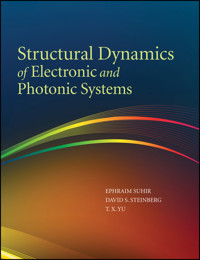
Structural Dynamics of Electronic and Photonic Systems E-Book
167,99 €
Mehr erfahren.
- Herausgeber: John Wiley & Sons
- Kategorie: Fachliteratur
- Sprache: Englisch
The proposed book will offer comprehensive and versatile methodologies and recommendations on how to determine dynamic characteristics of typical micro- and opto-electronic structural elements (printed circuit boards, solder joints, heavy devices, etc.) and how to design a viable and reliable structure that would be able to withstand high-level dynamic loading. Particular attention will be given to portable devices and systems designed for operation in harsh environments (such as automotive, aerospace, military, etc.) In-depth discussion from a mechanical engineer's viewpoint will be conducted to the key components' level as well as the whole device level. Both theoretical (analytical and computer-aided) and experimental methods of analysis will be addressed. The authors will identify how the failure control parameters (e.g. displacement, strain and stress) of the vulnerable components may be affected by the external vibration or shock loading, as well as by the internal parameters of the infrastructure of the device. Guidelines for material selection, effective protection and test methods will be developed for engineering practice.
Sie lesen das E-Book in den Legimi-Apps auf:
Seitenzahl: 1007
Veröffentlichungsjahr: 2011
Ähnliche




















Table of Contents
Title Page
Copyright
Preface
Contributors
Chapter 1: Some Major Structural Dynamics-Related Failure Modes and Mechanisms in Micro- and Opto-Electronic Systems and Dynamic Stability of These Systems
1 Physics of Electronic Failures in Vibration and Shock
2 Case History for Design, Analysis, and Testing of Electronic Chassis Required to Operate in Severe Sine Vibration Environment and Effects of Using Viscoelastic Damping Material on PCBs to Increase Fatigue Life
3 What Happens When 20 Plug-in PCBs Are Tied Together, Then Installed in a Chassis That Is Subjected to a 5G Peak Sine Vibration Input Level?
4 Consider Using Snubbers to Increase Fatigue Life of Electronic Systems Required to Operate in Severe Vibration and Shock Environments
5 Sample Problem: Calculating Forces, Stresses, and Fatigue Life of the End Aluminum Plates in Previous Housing Enclosure
6 How Displacements Are Related to Frequency and Acceleration
7 Sample Problem: Find Dynamic Displacement of PCB Exposed to Sine Vibration Using English Units and Metric Units
8 Octave Rule Can Avoid Vibration Failures due to Resonance Coupling of Outer Housing Enclosure with Internal PCBs
9 Another Application Where Snubbers Can Be Used To Improve Fatigue Life of PCBs in Severe Vibration and Shock Environments
10 Vibration Failures due to Connector Fretting Corrosion in Random Vibration
11 Why Some Failures May Be Difficult to Solve or May Never Be Solved
12 Companies with Financial Problems May Reduce Quality to Save Money
13 Why Some People Will Ship Electronic Equipment They Know Will Fail Just to Get Their Shipping Bonus
14 Can Vibration Alone Produce a V-Shaped Deep Hole in a 65-Pound Aluminum Casting 12 Inches in Diameter That Is 0.25 Inch Thick?
15 Failure Modes in Opto-Electronic Fiber-Optic Systems Related to Structural Dynamics
16 How Electronics Are Being Used to Control Structural Dynamics and Dynamic Stability of Systems for Improved Reliability and Safety
References
Chapter 2: Linear Response to Shocks and Vibrations
1 Single-Degree-of-Freedom (SDOF) System
2 SDOF System Subjected to Harmonic Excitation
3 Systems with Multiple Degrees of Freedom (MDOF)
4 Forced Vibrations of Elongated PCB due to Harmonic Oscillations of Its Support Contour
5 Forced Vibrations of a Heavy Electronic Component Subjected to Harmonic Excitation
A.1 Appendix: Natural Vibration Frequency of a Heavy Electronic Component
References
Chapter 3: Linear and Nonlinear Vibrations Caused by Periodic Impulses
1 Introduction
2 Review
3 Shock-Excited Vibrations
References
Chapter 4: Random Vibrations of Structural Elements in Electronic and Photonic Systems
1 Introduction
2 Elongated PCB Subjected to External Loading: Nonlinear Equations
3 Dynamic Response of Multi-Degree-of-Freedom Linear System to External Loading
4 Solution Using Duhamel Integral
5 Solution Using Fourier Integral
6 Complex-Frequency Characteristic as Spectrum of Impulse Response
7 Duration of a Process and Width of Its Spectrum
8 Correlation Theory and Spectral Theory of Random Processes
9 Spectral Theory of Transformation of Stationary Random Processes by Linear Dynamic Systems
10 White Noise
11 Bivariate Correlation Function and Bivariate Spectral Density in PCB Random Vibrations
12 Probability of Exceeding the Given Level
13 Role of Higher Modes (Harmonics)
14 Optimized Damping
References
Chapter 5: Natural Frequencies and Failure Mechanisms of Electronic and Photonic Structures Subjected to Sinusoidal or Random Vibrations
1 Introduction
2 Natural Frequencies for Beam Types of Structures
3 Sample Problem: Calculating the Natural Frequency of a Uniform Beam
4 Simple Method for Finding the Natural Frequency of Complex Structures
5 Sample Problem
6 Sample Problem
7 Effects of Sine Vibrations on Forces, Stresses, and Fatigue Life of Lead Wires and Solder Joints on Electronic Components Soldered to PCBs
8 Sample Problem
9 Sample Problem
10 Sample Problem
11 Octave Rule for Reducing Severe Sine Vibration Dynamic Coupling with a Chassis Housing and Reducing Failures in Internal PCBs
12 Sinusoidal Vibrations
13 Large Dynamic Displacements in PCBs
14 Sample Problem: Vibration Fatigue Life of Large Ball Grid Array
15 Using Sine Sweeps through a Resonance to Evaluate Electronic Equipment
16 Sample Problem: Fatigue Damage Accumulated by a Sine Sweep through the Half-Power Points
17 Properties of Various Types of Enclosures and PCBs
18 When Octave Rule Cannot Be Followed, Other Options Such as Snubbers or Ultrasmall Ping-Pong Balls or Isolation Systems Are Available
19 Isolation Systems for Improved Fatigue Life in Vibration and Shock
20 Determining Natural Frequencies of Uniform Flat Plates and PCBs
21 Sample Problem
22 Natural Frequency Equations
23 Effects of Loose Edge Guides on Plug-in Types of Rectangular Circuit Boards
24 Additional Details
25 Sample Problem: Finding Minimum Desired PCB Natural Frequency
26 How Bending Curvature of PCB Can Affect PCB Fatigue Life
27 Vibration Characteristics of Box Structures and Frame Structures
28 Sample Problem
29 Effects of Random Vibration on Various Types of Electronics and Their Structures
30 Differences between Random Vibration and Sinusoidal Vibration
31 Log–Log Input and Response Curves Used for Random Vibration
32 Sample Problem
33 Random Vibration PSD in Terms of Mean-Squared Acceleration Density
34 Simplified Method for Calculating Areas under Different-Shaped Random Vibration Input PSD Curves
35 Sample Problem
36 Locating Break Points on PSD Random Vibration Curve
37 Sample Problem
38 Gaussian and Rayleigh Probability Distribution Functions for Estimating Fatigue Life of Different Types of Electronic Equipment Exposed to Random Vibration
39 Characteristics of Single-Degree-of-Freedom System and Fatigue Life in Random Vibration
40 Sample Problem
41 Response of Cantilever Beam to Random Vibration
42 Miner's Cumulative Fatigue Damage Ratio Can Be Used to Estimate Fatigue Life
43 A Bit of History Regarding Random Vibration Methods of Analysis and Testing
44 Quick Method for Finding Approximate Fatigue Life for Structures Exposed to Random Vibration Using Three-Band Technique
45 Special Applications for Designing PCB to Operate in Random Vibration
46 Sample Problem
47 Effects of Shock on Various Types of Electronic Systems and Structures
References
Chapter 6: Drop/Impact of Typical Portable Electronic Devices: Experimentation and Modeling
1 Introduction
2 Experimental Set-Up
3 Repeatability of Impact Tests
4 Experimental Results and Discussion
5 Dynamic Model
6 Conclusions
References
Chapter 7: Shock Test Methods and Test Standards for Portable Electronic Devices
1 Introduction: Necessity of Drop/Impact Testing of Portable Electronic Products
2 Test Criteria and Specifications
3 Shock Test Machine
4 Comparison of Different Test Methods
5 Discussion
6 Conclusions
References
Chapter 8: Dynamic Response of Solder Joint Interconnections to Vibration and Shock
1 Solders Must Be Carefully Attached to Structural Members to Avoid Failures
2 Vibration Problems with Electronic Components Mounted on PCBs
3 Problems with Lead-Free Solders
4 Methods for Predicting Fatigue Life of Solder Joints
5 How Poor Manufacturing and Poor Assembly Methods Might Affect Reliability
6 Typical Tolerances in Electronic Components and Effects on Vibration and Thermal Cycling and Fatigue Life
7 Problems Associated with Thermal Cycling on Solder Joints and Lead Wires
8 Vibration and Thermal Cycling Environments on Lead Wires and Solder Joints
9 Comparing Reliability Perspective Mean Time between Failures (MTBF) with Failure-Free Operating Period (FFOP)
Chapter 9: Test Equipment, Test Methods, Test Fixtures, and Test Sensors for Evaluating Electronic Equipment
1 Component Failures Produced by Thermal Cycling and Vibration Cycling
2 How Manufacturing Methods and Material Properties Can Produce Failures in Electronic Equipment
3 Viscoelastic Damping Materials Cause Problems If They Are Not Used Carefully
4 Different Types of Test Equipment Are Often Required
5 Vibration Test Fixtures and Adapters
6 Basic Vibration Fixture Design Considerations
7 Oil Film Slider Table Vibration Fixtures
8 Vibration Fixture Counterweights
9 Summary for Good Vibration Fixture Design
10 Effects of Shock on Electronic Equipment
11 Specifying the Shock Motion and Environment
12 Pulse Shocks in Electronic Equipment
13 How PCBs Respond to Shock Pulses
14 Case Histories of Failures and Failure Analyses
15 Failures in Small Cantilever Shafts of Spinning Gyro
Chapter 10: Correlation between Package-Level High-Speed Solder Ball Shear/Pull and Board-Level Mechanical Drop Tests with Brittle Fracture Failure Mode, Strength, and Energy
1 Introduction
2 Experimental Investigation of High-Speed Ball Shear and Pull Tests
3 Effects of IMC Growth on High-Speed Ball Shear and Pull Tests after Thermal Aging
4 Correlation of High-Speed Ball Shear/Pull Tests and Board-Level Drop Test
5 Conclusions
References
Chapter 11: Dynamic Mechanical Properties and Microstructural Studies of Lead-Free Solders in Electronic Packaging
1 Introduction
2 Microstructure of Solder Joints
3 Specimen Preparation
4 Microstructure of Sn–37Pb Solder Ball Specimens
5 Microstructure of Sn–3.5Ag Solder Specimens
6 Microstructure of Sn–3.8Ag–0.7Cu Solder Specimens
7 Quasi-Static Material Properties of Solder Specimens
8 Quasi-Statically Compressed Solder Specimens
9 Young's Modulus of Solder Specimens
10 Yield of Solder Specimens
11 Tangential Modulus of Solder Specimens
12 Dynamic Material Properties of Solder Specimens
13 Mechanical Properties of Sn–37Pb, Sn–3.5Ag, and Sn–3.8Ag–0.7Cu Solder Balls
14 Conclusions
Acknowledgments
References
Chapter 12: Fatigue Damage Evaluation for Microelectronic Components Subjected to Vibration
1 Introduction
2 Test Vehicle Design
3 Experiment
4 Failure Analysis
5 Methodology Development for Determination of Vibration Fatigue Damage
6 Finite Element Analysis
7 Vibration Fatigue Damage Model Development and Validation
8 Conclusions
Bibliography
Chapter 13: Vibration Considerations for Sensitive Research and Production Facilities
1 Introduction
2 Planning and Design Guidance
3 Vibration Criteria
4 Design Considerations
5 Testing and Evaluation
Appendix: Vibration Isolation of Sensitive Equipment
Bibliography
Chapter 14: Applications of Finite Element Analysis: Attributes and Challenges
1 History of Finite Element Analysis
2 Linear and Nonlinear FEA Analyses
3 Commercial FEA Codes
4 Challenges in FEA Modeling and Simulation
5 Types of Simulation
6 Conclusions
Chapter 15: Shock Simulation of Drop Test of Hard Disk Drives
1 Introduction
2 Finite Element Modeling
3 Drop Test Simulation and a Pseudoresonance Phenomenon
4 Pulse Shape Effects and Power Spectrum Analysis
5 Conclusions
References
Chapter 16: Shock Protection of Portable Electronic Devices Using a “Cushion” of an Array of Wires (AOW)
1 Introduction
2 Analysis
3 Numerical Example
Appendix A: Compressed Cantilever Beam of Finite Length Lying on an Elastic Foundation
Appendix B: Unembedded Cantilever Wire (Beam) Subjected to Axial Compression
References
Chapter 17: Board-Level Reliability of Lead-Free Solder under Mechanical Shock and Vibration Loads
1 Introduction
2 Methods of Shock Impact Testing
3 Vibration Test as Method to Test to Replace Drop Test
4 Reliability under Combined Loading Conditions
5 Conclusions
Appendix
References
Chapter 18: Dynamic Response of PCB Structures to Shock Loading in Reliability Tests
1 Introduction
2 Measured Deformations and Predicted Failures in Assembly Subjected to Shock Loading
3 Board-Level Shock Tests
4 Theoretical Considerations
5 PCB Response in Shock Tests: Experimental Data
6 Modeling of PCB Shock
7 Conclusions
References
Chapter 19: Linear Response of Single-Degree-of-Freedom System to Impact Load: Could Shock Tests Adequately Mimic Drop Test Conditions?
1 Introduction
2 Analysis
3 Elongated Rectangular Plate Subjected to Instantaneous Impulse Applied to Its Support Contour
4 Error from Substituting an Impact Load with an Instantaneous Impulse
5 What If the Applied Acceleration Is not Short Enough?
6 Energy Approach
7 Probabilistic Approach
8 Conclusions
References
Chapter 20: Shock Isolation of Micromachined Device for High-g Applications
1 Introduction
2 Fundamentals of Mechanical Vibration System
3 Shock Isolation
4 Classification of Shock Isolator
5 Dynamic Response of Micromachined Device under Shock and Vibration
6 Woodpecker-Inspired Microparticle Shock Isolator
7 Conclusions
References
Chapter 21: Reliability Assessment of Microelectronics Packages Using Dynamic Testing Methods
1 Introduction
2 Isothermal Mechanical Twisting Testing Method
3 Four-Point Dynamic Bending (4PDB) Testing Method
4 High-Frequency Dynamic Vibration Testing Method
5 Conclusions
References
Chapter 22: Thermal Cycle and Vibration/Drop Reliability of Area Array Package Assemblies
1 Summary
2 Technology Trend for Area Array Packages
3 PBGA Thermal Cycle Solder Joint Reliability
4 Test Results for TC Reliability of High I/O PBGA Assemblies
5 Cycles-to-Failure of PBGA 676 I/Os
6 CSP-TC and Vibration Behavior (Sn37Pb)
7 BGA 225-I/O Vibration: Sn37Pb and SAC397
8 CBGA Assemblies: Vibration and Thermal Cycle Synergism
9 Drop Shock Behavior with/without Isothermal Aging of Sn37Pb and Lead-free BGA/CSPs
10 Drop Behavior with/without a Priori Thermal Cycle
11 Summary
Acknowledgments
Acronyms
References
Chapter 23: Could an Impact Load of Finite Duration Be Substituted with an Instantaneous Impulse?
1 Introduction
2 Analysis
3 Numerical Example
4 Conclusions
References
Index
Copyright
This book is printed on acid-free paper.
Copyright © 2011 by John Wiley & Sons, Inc. All rights reserved.
Published by John Wiley & Sons, Inc., Hoboken, New Jersey
Published simultaneously in Canada
No part of this publication may be reproduced, stored in a retrieval system, or transmitted in any form or by any means, electronic, mechanical, photocopying, recording, scanning, or otherwise, except as permitted under Section 107 or 108 of the 1976 United States Copyright Act, without either the prior written permission of the Publisher, or authorization through payment of the appropriate per-copy fee to the Copyright Clearance Center, 222 Rosewood Drive, Danvers, MA 01923, (978) 750-8400, fax (978) 646-8600, or on the web at www.copyright.com. Requests to the Publisher for permission should be addressed to the Permissions Department, John Wiley & Sons, Inc., 111 River Street, Hoboken, NJ 07030, (201) 748-6011, fax (201) 748-6008, or online at www.wiley.com/go/permissions.
Limit of Liability/Disclaimer of Warranty: While the publisher and the author have used their best efforts in preparing this book, they make no representations or warranties with respect to the accuracy or completeness of the contents of this book and specifically disclaim any implied warranties of merchantability or fitness for a particular purpose. No warranty may be created or extended by sales representatives or written sales materials. The advice and strategies contained herein may not be suitable for your situation. You should consult with a professional where appropriate. Neither the publisher nor the author shall be liable for any loss of profit or any other commercial damages, including but not limited to special, incidental, consequential, or other damages.
For general information about our other products and services, please contact our Customer Care Department within the United States at (800) 762-2974, outside the United States at (317) 572-3993 or fax (317) 572-4002.
Wiley also publishes its books in a variety of electronic formats. Some content that appears in print may not be available in electronic books. For more information about Wiley products, visit our web site at www.wiley.com.
Library of Congress Cataloging-in-Publication Data:
Structural dynamics of electronic and photonic systems / edited by Ephraim Suhir, David S. Steinberg, T. X. Yu
p. cm.
Includes index.
ISBN 978-0-470-25002-0 (hardback); ISBN 978-0-470-88665-6 (ebk); ISBN 978-0-470-88678-6 (ebk); ISBN 978-0-470-88679-3 (ebk); ISBN 978-0-470-95001-2 (ebk); ISBN 978-0-470-95162-0 (ebk); ISBN 978-0-470-95179-8 (ebk)
1. Electronic apparatus and appliances—Reliability. 2.
Optoelectronic devices—Reliability. 3. Fault tolerance (Engineering) 4.
Microstructure. 5. Structural dynamics. I. Suhir, Ephraim. II. Steinberg, David S. III. Yu, T. X. (Tongxi)
TK7870.23.S77 2010
621.382—dc22
2010031072
Preface
Electronic, optoelectronic, and photonic components and systems often experience dynamic loading. In commercial electronics, such loading can take place during handling or transportation of the equipment. In military, avionic, space, automotive, and marine electronics, dynamic loading, whether deterministic or random, is expected to occur even during normal operation of the system. On the other hand, random vibrations are sometimes applied (in addition to, or even instead of, thermal cycling or environmental testing) as an effective and fast means to detect and weed out infant mortalities. In addition, the necessity to protect portable electronics from shock loading (typically, because of an accidental drop) resulted in an elevated interest in the development of theoretical and experimental techniques for the prediction of the consequences of an accidental shock, as well as for an adequate shock protection of portable products. Development of new shock absorbing materials is regarded equally important. Finally, owing to numerous optoelectronic and photonic technologies emerged during the last decade or so, the ability to evaluate and possibly optimize the dynamic response of various photonic devices to shocks and vibrations is becoming increasingly important.
The following objectives are pursued in this book:
familiarize the readers with the major problems related to the dynamic behavior of electronic and photonic components, devices, and systems;examine typical failure modes and mechanisms in electronic and photonic structures experiencing dynamic loading;address the basic concepts and fundamentals of dynamics and vibration analysis, including analytical, computer-aided, and experimental methods, and demonstrate how these methods can be effectively used to adequately approach the above problems;discuss and solve particular problems of the dynamic response of electronic and photonic systems to shocks and vibrations, andsuggest how to choose the appropriate mechanical design and materials to create a viable and reliable product.The reader of the book will become familiar with the mechanical, materials, and reliability related problems encountered in systems experiencing shocks and/or vibrations and will learn about the theoretical and experimental methods, approaches, and techniques which are used to solve these problems. This will enable those in the field to enhance their knowledge and skills in their profession and will teach those not in the field yet how to apply their background in mechanics, materials, and structures to this exciting and rapidly developing area of “high-tech” engineering.
The book is unique: it is the first time that a book of such a broad scope is written. The content of the book covers some of the most important mechanical, materials, and reliability aspects of the dynamic response, stability, and optimal design of electronic and photonic components, devices, and structural elements experiencing dynamic loading. The book contains 23 chapters written by leading specialists in the field. After getting familiar with the book's chapters, readers will better understand the reliability problems in, and mechanical behavior of, typical microelectronic, optoelectronic, and photonic structures subjected to dynamic loading, as well as be able to select the most appropriate materials for, and geometries of, such structures. Some of the design decision could be made based on simple and easy-to-apply formulas which will be provided in the book. These formulas indicate the role of different materials and geometrical factors affecting the mechanical behavior and reliability of a structure and can be effectively used prior to, and quite often even instead of, computer-aided modeling or experimental analyses.
The technical emphasis of the book is on the application of the basic principles of the dynamic structural analysis to understand, analyze, and improve the dynamic behavior and reliability of microelectronic and photonic structures operating in dynamic environments. The book will enable a design and reliability engineer, who did not work before in the field of electronics and photonics, to apply his/her knowledge in dynamical analysis to this new and exciting field. At the same time, physicists, materials scientists, chemical or reliability engineers who deal with “high-technology” components and devices for many years will learn how methods and approaches of mechanical and structural engineering can be effectively used to design a viable and reliable product.
The book is written with the emphasis on the physics of the phenomena. No in-depth knowledge of the mechanical, materials, or structural engineering is required. The needed information is given in the book chapters, when appropriate. Nonetheless, some knowledge of the basic calculus, strength of materials, and theory of vibrations is desirable to better understand the contents of the book.
Contributors
Hal Amick
Colin Gordon & Associates
Brisbane, CA 94005
Luciano Arruda
Instituto Nokia de Technologia
Terra Nova
Manaus-AM, 69048-660, Brazil
Stephen Clark
Dage Precision Industries
Rabans Lane, Aylesbury
Bucks HP19 8RG United Kingdom
J. E. Field
University of Cambridge
Cambridge, CB30HE
United Kingdom
Reza Ghaffarian
Jet Propulsion Laboratory
California Institute of Technology
Pasadena, CA 91125
Ki-Lyug Kim
Agency for Defense Development
Yuseong, Daejeon 305-600
Republic of Korea
Jorma K. Kivilahti
Helsinki University of Technology
02015 TKK, Finland
S. W. Ricky Lee
Hong Kong University of Science and
Technology
Kowloon, Hong Kong
People's Republic of China
G. Y. Li
South China University of Technology
Guangzhou 516040
People's Republic of China
C. T. Lim
National University of Singapore
Singapore 117576
J. Luo
Nanyang Technological University
Singapore 639798
Pekka Marjamäki
Helsinki University of Technology
02015 TKK, Finland
Toni T. Mattila
Helsinki University of Technology
02015 TKK, Finland
Keith Newman
Oracle Corporation
Santa Clara, CA 95054
K. C. Ong
National University of Singapore
Singapore 117576
Metin Ozen
Ozen Engineering, Inc.
Sunnyvale, CA 94085
Jin-Eep Rho
Agency for Defense Development
Yuseong, Daejeon 305-600
Republic of Korea
B. J. Shi
Nanyang Technological University
Singapore 639798
Daniel X.Q. Shi
Applied Science & Technologies Research
Institute (ASTRI)
Shatin, Hong Kong
People's Republic of China
D. W. Shu
Nanyang Technological University
Singapore 637331
Fubin Sung
Hong Kong University of Science and
Technology
Kowloon, Hong Kong
People's Republic of China
Dave S. Steinberg (retired)
Steinbergelectronics, Inc.
Westlake Village, CA 91361
Ephraim Suhir
University of California
Santa Cruz, CA 95064
Bob Sykes
Dage Precision Industries
Rabans Lane, Aylesbury
Bucks HP19 8RG United Kingdom
V. B. C. Tan
National University of Singapore
Singapore 117576
Eric E. Ungar
Acentech, Incorporated
Cambridge, MA 02138-1118
Milena Vujosevic
Intel Corporation
Folsom, CA 95630
T. Eric Wong
Raytheon Company
El Segundo, CA 90245
Q. J. Yang
Bosch Chassis Systems Asia-Pacific Ltd.
East Bentleigh VIC 3165
Australia
Sang-Hee Yoon
University of California
Berkeley, CA 94720
T. X. Yu
Hong Kong University of Science and
Technology




