


14,39 €
Mehr erfahren.
- Herausgeber: Rudolf Steiner Press
- Kategorie: Religion und Spiritualität
- Sprache: Englisch
'When you perform a ritual, it is an appeal to the spiritual powers of the universe, an appeal to the powers that are meant to connect with the earth precisely through what people do…' – Rudolf SteinerWith rituals or cultic forms as his central motif, Rudolf Steiner refers extensively to Indian, Persian and in particular Egyptian initiation rites, and how these enabled people of antiquity to connect with specific spiritual beings. He explains the practical purpose of mummification for the religious life of ancient Egypt, and of the use of ritual in certain secret societies or brotherhoods today as, in turn, a mummification of Egyptian rites. But he also points to the future, describing how truly-formulated rituals have a positive effect on human development. Whilst inhalation exercises were relevant to cultures of the past, the principle of 'exhalation' is important for future evolution.On the one hand, these extraordinary lectures relate to Rudolf Steiner's ceremonial work in the Esoteric School of 1906-1914, but more significantly they were given in parallel to the founding of the Christian Community, for which Rudolf Steiner mediated its sacraments. Today, he states, Christ must be sought through a new access to the spiritual world, and any remaining traditional ritualistic forms should be permeated with the power of the Mystery of Golgotha. The lectures are accompanied with an introduction by Dale Brunsvold, editorial notes and an index. Eight lectures, Dornach, Sept.-Oct. 1922, GA 216
Das E-Book können Sie in Legimi-Apps oder einer beliebigen App lesen, die das folgende Format unterstützen:
Veröffentlichungsjahr: 2024
Ähnliche


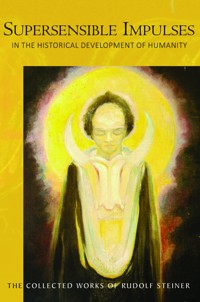
SUPERSENSIBLE IMPULSES
IN THE HISTORICAL DEVELOPMENT OF HUMANITY
Eight lectures held in Dornach from 16 September to 1 October 1922
TRANSLATED BY PAUL KING
INTRODUCTION BY DALE BRUNSVOLD
RUDOLF STEINER
Rudolf Steiner Press
Hillside House, The Square
Forest Row, RH18 5ES
www.rudolfsteinerpress.com
Published by Rudolf Steiner Press 2024
Originally published in German under the title Die Grundimpulse des weltgeschlichtlichen Werdens der Menschheit (volume 216 in the Rudolf Steiner Gesamtausgabe or Collected Works) by Rudolf Steiner Verlag, Dornach, based on shorthand notes that were not reviewed or revised by the speaker. This authorized translation is based on the third German edition (1988), edited by Ernst Weidmann
Published by permission of the Rudolf Steiner Nachlassverwaltung, Dornach
© Rudolf Steiner Nachlassverwaltung, Dornach, Rudolf Steiner Verlag 1988
This translation © Rudolf Steiner Press 2024
All rights reserved. No part of this publication may be reproduced, stored in a retrieval system, or transmitted, in any form or by any means, electronic, mechanical, photocopying or otherwise, without the prior permission of the publishers
A catalogue record for this book is available from the British Library
ISBN 978 1 85584 649 4
Cover by Morgan Creative
Typeset by Symbiosys Technologies, Visakhapatnam, India
Printed and bound by 4Edge Ltd., Essex
CONTENTS
Publisher’s Note
Introduction, by Dale Brunsvold
LECTURE 1
DORNACH, 16 SEPTEMBER 1922
Experiences between death and a new birth
After death the human being is led out into the planetary spheres by the supersensory aspect of the plant world, mineral world, particularly the metals. In the moon-sphere we meet an image of our moral-spiritual value and the group-souls of the animals. In the sphere of fixed stars we permeate ourselves with the forces of divine-spiritual beings, thus preparing the spirit-seed of our future physical body. By connecting with the Christ we can gain strength not to fall prey to the animal forces in the moon-sphere as we descend to a new incarnation.
LECTURE 2
DORNACH, 17 SEPTEMBER 1922
The connection of the human being with divine-spiritual beings
In our head-system there lives a reflection of our pre-birth experiences of the cosmos. Behind our sensory consciousness, the third hierarchy is at work in our head-system, untouched by the moral aberrations of earthly life. In our chest-system there is an interaction between cosmic and earthly aspects; the second hierarchy here receives a reflection of the human being’s moral-spiritual quality. In our metabolic-limb system the earthly aspect predominates over the cosmic; the first hierarchy works here carrying mastered forces of substance into the Jupiter-existence of the earth. After death they receive the image of the person’s moral-spiritual quality, and for a new birth the third hierarchy weaves this image into the head-system.
LECTURE 3
DORNACH, 22 SEPTEMBER 1922
The connection between historical life and the spiritual worlds I: primal ancient India to Greece
The primal ages of Indian and Persia: through inhalation, human beings are connected to spiritual moon-beings; these are used by initiates to guide humanity. The Egyptian-Chaldean age: this possibility is lost; the Egyptian initiates make the connection possible through mummification. Greco-Roman period: the Greeks connect themselves with spiritual air-beings in an equilibrium between inhalation and exhalation; this is the basis of the particular quality of Greek art and philosophy (Orphic wisdom, ‘lyre of Apollo’). Hexameter and the source of Homer’s poetry.
LECTURE 4
DORNACH, 23 SEPTEMBER 1922
The connection between historical life and the spiritual worlds II: what is needed for the present and the future
Individually grasped moral impulses as understood in The Philosophy of Freedom, which are imprinted into our exhalations, and their significance for the transition of the earth to its Jupiter-existence. From the fourth, fifth century AD onwards elemental beings have been waiting to unite as helpers with human beings; human beings will then be able to imprint the moral impulses they grasp inwardly in freedom into the configuration of their blood. This connection is resisted by the overestimation of heredity over individuality (Ibsen) and by modern machinery and intellectualism (Hershon and Ivanov). Alois Mager, critic of anthroposophy.
LECTURE 5
DORNACH, 24 SEPTEMBER 1922
The significance of mummification for the spiritual life of ancient Egypt and the significance in our time of traditional ancient ceremonies for the spiritual life of the present
Egyptian initiates could only attain information about the kingdoms of nature by means of the dead who were bound to their mummified body. The relationship of the Chaldeans and Hebrews to these practices, Moses. As a counter-image to mummified bodies, the occult Orders of the present have ancient ceremonial rituals passed down by tradition. Elemental earth-spirits and the unborn under the guidance of the angeloi are connected with these rituals. Individuals with a special disposition for such things can draw spiritual content from these rituals. Goethe in particular was able to do this (but also Wieland and Chancellor von Müller). The spiritual quality in the nature philosophy of Steffens, Troxler, and Schubert; the spiritual style in the history writings of Johannes von Müller in contrast to Ranke and Taine. Mauthner.
LECTURE 6
DORNACH, 29 SEPTEMBER 1922
The significance of ritual for the future of the earth
Correspondences between the centre of the earth and the planetary spheres, formation of the head through the working-together of earth and cosmos. The original Indian and Persian initiates studied the effects of head-forces in the rest of the organism by means of the breath-art of yoga; the Egyptian initiates studied it by means of the mummy. The tendency in respiration to form and dissolve an ‘etheric mummy’. Traditional ritual forms that have survived into our times must be permeated with the power of the Mystery of Golgotha. Unity of science and religion in Paracelsus. There is a spiritual element in rituals properly conducted that works over into the formation of the ‘Jupiter’ condition of the earth. The meaning of the words ‘Heaven and earth will pass away, but my words shall not pass away’. The significance of exhalation in preparing the future.
LECTURE 7
DORNACH, 30 SEPTEMBER 1922
The urgent need today to enliven dead thinking
Ordinary thinking of today is the corpse of living pre-birth thought-forces. Nietzsche’s view of the progression towards abstraction in the thinking of Greek philosophy (pre-Socratics, Parmenides, Heraclitus, Socrates, Aristotle; Vedanta philosophy, the Vedas). The Egyptian initiates no longer had the living thinking of the ancient Orientals, but did also not yet have the abstract thinking of a later age. They trained themselves towards dead abstract thinking by means of the mummified corpse. Today traditional forms of ritual are the corpse of something that was once living. Goethe was able to derive spiritual life from Masonic forms of ritual; a fruit of this is his theory of metamorphosis. Metamorphosis of plants and animals. The head as a metamorphosis of the rest of the body of our previous incarnation. The need for science to be permeated by religious feeling (the laboratory table as altar). Soul-forces today must be ‘un-mummified’. (Spengler).
LECTURE 8
DORNACH, 1 OCTOBER 1922
The need for a new openness towards the spiritual world
In the development of world history, hidden from external observation, comprehensive spiritual impulses are at work. The Crusades (Knights Templar, Knights of St John of Malta, Peter of Amiens, Godfrey von Bouillon, Bernard of Clairvaux). A crossroads of European development: the reign of Pope Nicholas I in the middle of the ninth century; Nicholas I’s confrontation with three spiritual streams: In Western Europe: starting from the Arab regions of Asia and reaching as far as Ireland, the esoteric conception of the Mystery of Golgotha (the three Magi or Kings), figuratively expressed in the story of the Holy Grail (Wolfram von Eschenbach’s Parzival). In Central Europe, starting from Rome, dogmatic forms and mere contents of faith (Boniface, Merovingians and Carolingians). The Western current should lead to the experience of the etheric cosmos, the Eastern to the experience of one’s own etheric body. To grasp the etheric cosmos, the strongest ideas are necessary, the meaning of the metamorphosis in Goethe and in spiritual science. The three streams later fall into materialism. The connection of these steams with the mood of the Crusades. The Rosicrucian mood: ‘He whom you seek is no longer here, seek him elsewhere.’ Today, the Christ must be sought through a new access to the spiritual world. Appeal to the members of the Anthroposophical Society.
Notes
Rudolf Steiner’s Collected Works
Significant Events in the Life of Rudolf Steiner
Index
PUBLISHER’S NOTE
THESE lectures, in which the essence of the cultic forms a central motif, receive their special significance on the one hand from the fact that they are to be seen in connection with the cultic activity which Rudolf Steiner himself carried out in the years 1906–1914 within the epistemological department of the Esoteric School (see Rudolf Steiner, Zur Geschichte und aus den Inhalten der erkenntniskultischen Abteilung der Esoterischen Schule 1904–1914. Briefe, Dokumente und Vorträge, GA Bibl. No. 265, Freemasonry and Ritual Work, SteinerBooks 2007), on the other hand by the fact that they were held in the same days in which The Christian Community was founded, for which Rudolf Steiner mediated the cultus.
INTRODUCTION
WHAT must it have been like as a neophyte in the ancient mysteries, to sit at the feet of the great hierophant and be instructed; to be given the preparation necessary to enter into the spiritual worlds protected, filled with the strength to receive and understand all that the spiritual world then reveals? How must it have been to be removed, for a time, from one’s day-to-day consciousness that is filled with the concepts awakened by the perceptions of the physical world, and be filled instead with concepts that have yet to experience their spiritually perceived counterpart in initiation?
In our time, we have the vast spiritual research of Rudolf Steiner – a research fit and appropriate for today – through which to begin our own preparation: either for the time after death or as the firm scaffolding through which to navigate our own spiritual development. In these eight lectures, begun on 16 September 1922 – the day of the inauguration of the soon-to-be worldwide organization known as The Christian Community, Movement for Religious Renewal – we experience the spiritual riches of a great hierophant of the modern age. Although not founded by Dr Steiner, The Christian Community, that he helped into being, became very dear to his heart. And, from the very start, the intensity of these lectures seems to suggest that that endearing sentiment might have been there from the very beginning, although these are not lectures about that Movement for Religious Renewal as such.
So, imagine the beginning of a worldwide movement – the hope, the excitement that would underlie it, in all who attended – and recall that Steiner always spoke to those present and not out of an abstract vacuum. Who was present mattered!
From the start, we are flung into the cosmic expanses of the spiritual worlds, carried up on the astral spirals rising out of the blossoms of the plant realm (yes, so it is said!). We are aided also by the ‘negative’ weight (that rises instead of falls) of the spiritual–ideal content of the mineral–metal world, directing us to various planets in the planetary spheres. We consider the constellations from the vantage point of the earth and the point-centredness of egohood, and then from the other side and the periphery nature of spirit consciousness. We encounter, upon reincarnation, the horizontal-like contentious passions of the group souls and are informed how important our relationship to Christ is in order to preserve one’s destiny, as laid out by the spiritual hierarchies in spirit spheres.
In 1917, Rudolf Steiner published Riddles of the Soul, which brought forth the fundamental anthroposophical idea of the threefold human being. In the second of his lectures here, we see Steiner expanding on our relation to the three hierarchies in respect to the ‘head system’, the ‘chest/rhythm system’ and the ‘limb/metabolic system’. The connections he establishes again point to the fruits of our lives lived, our busy time between death and a new birth, and the mutual relations of our moral fruits (good and bad) with our experiences of the spiritual hierarchies. Each part of us undergoes specific metamorphoses in the spiritual worlds. The head is a work of art, ‘an image of something universal that is contracted and filled out with material existence’ (p. 16).
One gets the impression here that Dr Steiner would like to bring to the celebrants of a new ritual an historical context, from out the spiritual world, as to what transpires spiritually in authentic celebration. What are the hidden aspects of most relevance, considering that Dr Steiner has such a vast panorama of spiritual facts that could be shared? There is the karmic reality of a life lived – and this a sacrament in every case – that raises up its fruits to the higher hierarchies via the head, chest and limb systems. Thus given over, they are worked upon and – in this work – the hierarchies evolve. In the transformation of a given life’s thoughts, feelings and deeds, a new spirit seed is returned to the earth to again reap what it shall sow in a new incarnation.
In Lecture 3, we are introduced to the evolution of consciousness in a different way. Here, the ideas of inhalation and exhalation frame our relationship to the spiritual world. Through a predominance of inhalation in the Indian and Persian epochs, and the porous nature of sleep and waking in that time, we were able to receive revelation from the moon beings, through which civilization was guided. As this quality of consciousness began to fade but inhalation still prevailed, the moon beings only became available through darker forces, and so were no longer accessible in a healthy way. In a sense, they could find no shelter here until, in the Egyptian epoch, mummification led to a renewed capacity for communication with the moon beings, who could ‘find shelter’ in these human forms. And once again, the wisdom from the moon beings via Egyptian initiates could guide civilization.
By the time of the Greek and Roman civilizations, inhalation and exhalation achieved a balance that brought about a relationship to elemental luciferic beings. They half flew, half swam in the air, and this dance affected the way that music and poetry developed at that time. So, in the fourth and fifth centuries after Christ, we have another set of elemental beings finding a relationship to our ever-evolving consciousness. Whereas the earlier relationships to the moon beings in Indian and Persian times and the air demons of Greek and Roman times looked to the past, now we have a period where exhalation predominates and this new set of elementals, called ‘earth being elementals’, have arrived on the scene. This means that, since the fifteenth century, those who experience a moral idea can ‘exhale’ it into external cosmic life. This is the beginning of the creation of a foundation for the future Jupiter existence! But a hindrance to this mutual endeavour is our dogmatic adherence to the idea of heredity. Also, when these elemental earth-beings come upon machines – which only reflect ideas and are devoid of spirit – they are particularly horrified.
In Lecture 5, Rudolf Steiner again takes us through the ways that people of different epochs approached the spiritual worlds for guidance; how, in the Indian and Persian epochs, the spiritual world was more directly experienced through inhalation. Through the beings of the moon, wisdom was imparted through which civilization was guided. By the time of the Egyptian epoch, this orientation towards inhalation had faded, and for a period there was no way to continue to communicate with the moon beings – until the time of mummification! Here, albeit in a now decadent form, human souls were for a time bound to their mummified remains and, through this orientation, the moon beings – who otherwise could not find ‘shelter’ here – were again able to communicate with the Egyptian initiates. The Egyptian initiates were able to discover knowledge of the human being directly, but they could only come to an understanding of nature – of the mineral, plant and animal kingdoms – through the indirect method with mummies.
The Egyptians were otherwise unable to form concepts of nature, as we can now do after the Mystery of Golgotha. After Christ, our whole inward organization was changed and, when looking upon the world without revelations from the spirit, we ourselves began to take hold of the sense world with the newly arisen intellect. And yet in future this must become a spiritualized intellect, where the force in ideas can be transferred to our exhalation.
In this ‘pregnancy’, so to speak, we recapitulated the ancient mummification process, although this now took place through ancient rituals, primarily pre-Christian. In the fourteenth and fifteenth centuries, when the complete intellectualization of culture had come about, these ancient rituals were conserved in occult Orders. (It is interesting how one can get a sense here of what Dr Steiner refers to elsewhere, i.e. of how each epoch finds recapitulation in a later one – the first in the seventh to come, the second in the sixth, and here, the third, in our own fifth.) These preserved rituals are just as much ‘mummies’ in that they are not illumined and warmed through by the Mystery of Golgotha. And yet the spiritual beings can find a path to carry the exhalations into the etheric world through these somewhat problematic rituals.
But the modern individual needs something that can convey a knowledge of the spirit, a spiritual science. When a person is in the process of returning to new incarnation, they might visit the occult lodges that are not completely devoid of soul – and there they buzz and flutter in an existence that precedes their birth. Within the lodges, there might be those who can receive communications from these pre-birth souls. And such people feel the spiritual world and speak authentically in relation to it. We can see, in various writers, where the influences of these communications have been experienced.
In what way, perhaps, does the new (Christian Community) ritual of ‘The Consecration of the Human Being’ relate to our next steps in evolution? Now, once again, a living knowledge of the spirit strives to live in ritual. Is this a return of soul through which the elemental earth beings might carry the inner gifts of modern humanity out into the cosmic world?
We are regularly asked by Dr Steiner to extend our imagination toward the constant steadfast working of the spiritual worlds into the physical, in the sense of life being constantly maintained, consciousness being everywhere nurtured, and self-awareness ever evolving. And now, at the dawn of a new ritual brought out of the new mysteries founded by Rudolf Steiner, we are brought these lectures.
As the good Doctor Steiner has said elsewhere: ‘For we are the religion of the Gods.’
Dale Brunsvold
March 2024
LECTURE 1
DORNACH, 16 SEPTEMBER 1922
THINGS to do with the spiritual world can be expressed in different ways and elucidated from different angles. They then sometimes sound disparate. But it is precisely through these varied elucidations that facts about the spiritual world can be presented in a complete form to the soul. And so this evening I will bring in a somewhat different language and different elucidation, certain things that I discussed in the last two lectures1 given in the Goetheanum concerning human experience between death and a new birth.
We have heard that, when our physical body falls away, the human being goes over into a condition of cosmic experience. After separating from the physical body we still carry our etheric organism with us, but we no longer feel ourselves to be inside this etheric organism; we feel our soul spread out into the widths of the cosmos. However, we cannot yet distinguish with any clarity the beings and processes from each other in these widths of the cosmos, over which our consciousness now begins to expand. We have a cosmic consciousness, but this consciousness still lacks inner clarity. And in addition, this consciousness is initially absorbed during the first few days after death in the etheric body which is still present. The first thing to be lost is what in the human being is tied to our head-system (Kopforganisation). I’m not being ironic, but completely serious when I say that the very first thing we lose, also in a soul sense, when we pass through the portal of death, is our head. The head-system ceases to function.
Now, it is precisely the head-system that facilitates our thinking in earthly existence. It is by means of the head-system that people form their thoughts in a certain activity during earthly existence. The head-system is lost when we step through the portal of death, but our thoughts are not; our thoughts remain. But they are permeated by a certain inner ‘aliveness’. They become dim, indistinct spiritual entities that direct us out into the widths of the cosmos. It is as though the thoughts had separated away from the human head, as though they still cast a backward light on the life just lived which we experience as our etheric organism, but as though at the same time they were pointing us towards the widths of the cosmos. We do not yet know what they want to tell us, these human ideas, that were yoked and penned up in the head-system, but are now freed and pointing to the widths of the cosmos.
When, for the reasons and in the way I described yesterday in the [Goetheanum] building, the etheric body has dispersed, when our cosmic consciousness is no longer tied by it to our last earthly life (in the other way which I described, it initially remains tied), when the etheric body has now also separated from the human being, then the thoughts which have torn free from the head-system become brighter, as it were, and we now notice how these ideas are pointing us into the cosmos, into the universe.
Wherever the earth makes it possible for plants to grow, the plants evoke a streaming out of these astral spirals.
These cosmic spirals surround the earth everywhere, so that we mustn’t think that this streaming down, this glittering and gleaming of the cosmic astral spirals only occurs in places where plants grow. It is present in various ways everywhere. So someone might die in the desert and yet, as they flow out into the universe, still be able to meet these plant spirals.
The plant spirals are the path along which we move from the earth to the planetary sphere. Thus, by means of the spiritual extensions of the earth’s plant world, we slip, as it were, out of the earthly realm. These become wider and wider. The spirals broaden out more and more, their circles becoming ever more expansive. They are our route out into the spiritual world. But we would not be able to go there, we would always have to remain stationary, as it were, if we did not receive the possibility of having ‘negative’ weights of a sort, weights that don’t pull downwards but push us upwards. And these weights are the spiritual content, the ideas, of the mineral structures in the earth, particularly the metals. So we move along the courses of the plants into the widths of the cosmos, and are supported by the force of the earth’s metals that carries us towards the planets. The quality of each mineral structure is such that its intrinsic idea always carries us to a particular planet. So we would say, for example, that minerals related to tin—that is, their ideas—carry us to a specific planet; that what is in the earth as iron—that is, the idea of iron— carries us to another specific planet. Thus, in their spiritual counter-images, the mineral and plant worlds that play a role for human beings in their environment during earthly existence, undertake after death to conduct human beings into the widths of the cosmos. And we are truly carried into the movements of the planets, into the whole rhythm of planetary movement, by the mineral and plant kingdoms of the earth.
By our consciousness gradually expanding over the whole planetary system, so that we are aware of this planetary life in the inner world of our own soul, we float through the entire planetary system. Were nothing else there but what pours forth into the widths from plant and mineral existence, we would experience in it everything that can be experienced in the mysteries of the plant and mineral kingdoms. And these mysteries are extraordinarily varied; they are great and stupendous, rich in content, and no one need believe that the life that now begins for the soul-spiritual person once they have left their physical organism is poorer than day-to-day life on earth. It is manifold, but it is also majestic. We can experience more in the mysteries of a single mineral than we experience in earthly life in all the kingdoms of nature put together.
But there is something else in this planetary sphere that we wander through. There are moon-forces, the spiritual moon-forces that we described a few days ago. The moon-sphere is there. But the more we live into existence beyond the earth, the weaker its influence becomes. Its influence is strong in the early period after death— which is to be reckoned in years. It becomes ever weaker the more our cosmic consciousness expands. If this moon-sphere were not present, there are two things we would not be able to experience after death.
The first is the entity I referred to recently. We have constructed this ourselves in the life just lived out of the forces comprising the moral and spiritual evaluation of our earthly life. We have constructed a spiritual entity, a kind of spiritual elemental being, whose limbs, whose tentacle-like structures are a reflection of our human moral-spiritual worth. If I may put it like this: the soul is accompanied by a living photograph, formed by the substance of the astral cosmos, but which is real and ‘alive’, a photograph in which we see what sort of person we actually were in our last life on earth. We have this photograph before us for as long as we are in the moon sphere.
But apart from this we also experience in the moon-sphere all kinds of elemental beings. We soon notice that these beings have a kind of dream consciousness—but a very bright dream consciousness—which alternates with a brighter state of consciousness, even brighter than human consciousness on earth. These beings alternate, as it were, between a dull, dreamlike state of consciousness and a consciousness that is brighter than that of people on earth. We become acquainted with these beings. They are very numerous and differ considerably from each other in shape. In the condition of life [after death] I am describing, we see these beings as floating down to earth when they enter their dull, dreamlike consciousness; how they are pushed down to earth, as it were, by the spirituality of the moon, and how they float back again.
We meet a rich life of these forms, floating down to earth and then back again, as I have described. We come to recognize that there is a relationship between these forms and the animal kingdom on earth. We come to recognize that these figures are the so-called group-souls of the animals. These animal group-souls come down; [when this happens] it means that a particular animal species wakes up down on earth. When the animal species enters a condition of sleep, the group-soul rises into the heights. In short, we notice that the animal kingdom stands in relationship with the cosmos such that the moon-sphere is the life-field for the group-souls of animals. Animals do not have individual souls; whole groups of animals [i.e. species], lions, tigers, cats, etc. have common group-souls. These group-souls lead their existence in the moon sphere, moving up and down. And the life of animals is influenced from the moon-sphere in this alternation of up and down.




