


38,39 €
Mehr erfahren.
- Herausgeber: Packt Publishing
- Sprache: Englisch
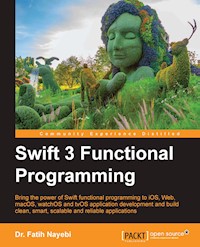
Bring the power of Swift functional programming to iOS, Web, macOS, watchOS and tvOS application development and build clean, smart, scalable and reliable applications
About This Book
- Written for Swift 3 -Developers Preview version, this is a comprehensive guide that introduces iOS and OS X developers to the all-new world of functional programming that has so far been alien to them
- Learn about first-class functions and how imperative-style patterns can be converted into functional code using some simple techniques
- The book will get you familiar with using functional programming alongside existing OOP techniques so you can get the best of both worlds and develop clean, robust code
Who This Book Is For
The book is for developers with a basic knowledge of Swift programming aiming to incorporate functional programming paradigms in their day-to-day application development
What You Will Learn
- First-class, higher-order, and pure functions
- Closures and capturing values
- Custom operators, recursion, and memoization
- Value and reference types in Swift
- Enumerations, algebraic data types, patterns, and pattern matching
- Generics and associated type protocols
- Higher-order functions such as map, flatMap filter, and reduce
- Dealing with optionals, fmap, and apply for multiple functional mapping
- Functional data structures such as Semigroup, Monoid, Binary Search Tree, Linked List, Stack, and Lazy List
- Immutability, copy constructors, and lenses
- Combining FP paradigms with OOP, FRP, and POP in your day-to-day development activities
- Developing a backend application with Swift
- Developing an iOS application with FP, OOP, FRP, and POP paradigms
In Detail
This book is based on Swift 3 Developer preview version and aims at simplifying the functional programming (FP) paradigms making it easily usable, by showing you how to solve many of your day-to-day development problems.
Whether you are new to functional programming and Swift or experienced, this book will strengthen the skills you need to design and develop high-quality, scalable, and efficient applications.
The book starts with functional programming concepts, the basics of Swift 3, and essential concepts such as functions, closures, optionals, enumerations, immutability, and generics in detail with coding examples.
Furthermore, this book introduces more advanced topics such as function composition, monads, functors, applicative functors, memoization, lenses, algebraic data types, functional data structures, functional reactive programming (FRP), protocol-oriented programming (POP) and mixing object-oriented programming (OOP) with functional programming (FP) paradigms.
Finally, this book provides a working code example of a front-end application developed with these techniques and its corresponding back-end application developed with Swift.
Style and approach
This is an easy-to-follow guide full of hands-on coding examples of real-world applications. Each topic is explained sequentially and placed in context, and for the more inquisitive, there are more details of the concepts used. It introduces the Swift language basics and functional programming techniques in simple, non-mathematical vocabulary with examples in Swift.
Sie lesen das E-Book in den Legimi-Apps auf:
Seitenzahl: 323
Veröffentlichungsjahr: 2016
Ähnliche


















Table of Contents
Swift 3 Functional Programming
Swift 3 Functional Programming
Copyright © 2016 Packt Publishing
All rights reserved. No part of this book may be reproduced, stored in a retrieval system, or transmitted in any form or by any means, without the prior written permission of the publisher, except in the case of brief quotations embedded in critical articles or reviews.
Every effort has been made in the preparation of this book to ensure the accuracy of the information presented. However, the information contained in this book is sold without warranty, either express or implied. Neither the author, nor Packt Publishing, and its dealers and distributors will be held liable for any damages caused or alleged to be caused directly or indirectly by this book.
Packt Publishing has endeavored to provide trademark information about all of the companies and products mentioned in this book by the appropriate use of capitals. However, Packt Publishing cannot guarantee the accuracy of this information.
First published: June 2016
Production reference: 1230616
Published by Packt Publishing Ltd.
Livery Place
35 Livery Street
Birmingham
B3 2PB, UK.
ISBN 978-1-78588-388-0
www.packtpub.com
Credits
Author
Dr. Fatih Nayebi
Copy Editor
Tasneem Fatehi
Reviewer
Kostiantyn Koval
Project Coordinator
Shweta H Birwatkar
Commissioning Editor
Wilson D'souza
Proofreader
Safis Editing
Acquisition Editors
Ruchita Bhansali
Reshma Raman
Indexer
Mariammal Chettiyar
Content Development Editor
Sumeet Sawant
Graphics
Disha Haria
Technical Editor
Manthan Raja
Production Coordinator
Nilesh Mohite
About the Author
Dr. Fatih Nayebi earned his Ph.D. degree in software engineering from École de technologie supérieure, Université du Québec by researching on Mobile Human-Computer Interaction, Software Engineering, and Machine Learning. Fatih has 15 years of industry experience in software engineering and architecture in various fields. He has developed various applications with Visual Basic, C++, C#, Java, MATLAB, Python, Objective-C, and Swift. He is also an enthusiastic Node, Scala, and Haskell developer.
His specialties include applied predictive and optimization models, human-computer interaction, functional programming, machine learning, and mobile application architecture and development.
Fatih currently works as a Director, Consulting at CGI Group Inc, Montreal, and continues to his academic research and publications as a postdoctoral researcher at École de technologie supérieure.
You can find him talking on Swift and Functional Programming at meetups such as http://www.meetup.com/swift-mtl/, on GitHub at https://github.com/conqueror, and on Twitter as @thefatih.
About the Reviewer
Kostiantyn Koval is a passionate software engineer with six years of experience. All this while, his main passion and work has been building iOS applications. During this time, he has build many applications, including games, enterprise apps, and big platforms. He fell in love with Swift from the beginning and keeps expressing it by sharing it with the world.
Except iOS, he is also interested in other technologies and languages such as Scala, Clojure, LLVM, Ruby, JS, Web, and others.
He is also the author of a Swift High Performance book, Packt Publishing. He loves open source and blogging. You can find him on GitHub at https://github.com/kostiakoval, his blogs can be read at https://medium.com/@kostiakoval or http://kostiakoval.github.io, and his Twitter handle is @KostiaKoval.
www.PacktPub.com
For support files and downloads related to your book, please visit www.PacktPub.com.
Did you know that Packt offers eBook versions of every book published, with PDF and ePub files available? You can upgrade to the eBook version at www.PacktPub.com and as a print book customer, you are entitled to a discount on the eBook copy. Get in touch with us at [email protected] for more details.
At www.PacktPub.com, you can also read a collection of free technical articles, sign up for a range of free newsletters and receive exclusive discounts and offers on Packt books and eBooks.
https://www2.packtpub.com/books/subscription/packtlib
Do you need instant solutions to your IT questions? PacktLib is Packt's online digital book library. Here, you can search, access, and read Packt's entire library of books.
Why subscribe?
Free access for Packt account holders
If you have an account with Packt at www.PacktPub.com, you can use this to access PacktLib today and view 9 entirely free books. Simply use your login credentials for immediate access.
Preface
Functional programming (FP) is getting a lot of attention as it eases many of the difficulties faced in object-oriented programming (OOP), such as testability, maintainability, scalability, and concurrency. Swift has a lot of functional programming features that can be easily used, but most Objective-C and Swift programmers are not familiar with these tools.
This book aims to simplify the functional programming paradigms and make it easily usable for Swift programmers, showing you how to use popular functional programming techniques to solve many of your day-to-day development problems. Whether you are new to functional programming and Swift or experienced, this book will provide you with the skills you need to design and develop high quality, easily maintainable, scalable, and efficient applications for iOS, macOS, tvOS, and watchOS. Through this book, you'll learn to build bug-free, maintainable code using functional programming.
What this book covers
Chapter 1, Getting Started with Functional Programming in Swift, introduces functional programming paradigms, such as immutability, stateless programming, pure, first-class, and higher-order functions. This chapter will provide an introduction to the Swift programming language and functional programming paradigms in Swift.
Chapter 2, Functions and Closures, begins with a definition of functions, continues with other related topics, such as function types and tuples, and finally concludes with more advanced topics such as first-class functions, higher-order functions, function composition, closures, currying, recursion, and memoization.
Chapter 3, Types and Type casting, takes a look at types in general and explores reference versus value types in detail. We will cover topics such as value and reference type constants, mixing value and reference types, and copying. Then we will discuss the characteristics of value types. We will also cover the key differences between value and reference types, and how we should decide which one to use. We will continue by exploring equality, identity, type checking, and casting topics.
Chapter 4, Enumerations and Pattern Matching, explains the enumeration definition and usage. We will cover associated and raw values and introduce the concept of algebraic data types. We will explore some examples to cover the sum, product, and recursion types. Also, in this chapter, we will explore patterns such as wildcard, value-binding, identifier, tuple, enumeration case, optional, type casting, and expression, along with related pattern matching examples.
Chapter 5, Generics and Associated Type Protocols, teaches us how to define and use generics. We will also understand the type of problems generics solve. Moving forward, we will explore type constraints, generic data structures, and associated type protocols with examples.
Chapter 6, Map, Filter, and Reduce, introduces the map, filter, and reduce methods in the Swift programming language with appropriate examples. These methods are used on arrays and can replace almost all uses of for-in loops and are more clear and concise.
Chapter 7, Dealing with Optionals, familiarizes us with different techniques to deal with optionals. We will talk about built-in techniques to deal with optionals, such as optional binding, guard, coalescing, and optional chaining. Then we will explore functional programming techniques to deal with optionals.
Chapter 8, Functional Data Structures, introduces you to the concept of functional data structures and explores examples of data structures implemented in functional way, such as Semigroup, Monoid, BST, LinkedList, Stack, and LazyList.
Chapter 9, Importance of Immutability, explores the concept of immutability. We will look at its importance and benefits with the help of examples. Then we will look into cases for mutability and go through an example to compare mutability and immutability effects on our code.
Chapter 10, The Best of Both Worlds – Combining FP Paradigms with OOP, covers object-oriented programming principles and paradigms. Then we will be introduced to protocol-oriented programming. Next, we will have an introduction of functional reactive programming and explore how to mix FP with OOP paradigms.
Chapter 11, Case Study – Developing an iOS Application with the FP and OOP Paradigms, teaches us to develop a Todo backend and an iOS application, employing the concepts we have discussed so far. We will use functional programming techniques to parse and map the data, we will use functional reactive programming to reactively manage events in applications. We will also employ protocol-oriented programming and object-oriented programming techniques as well.
What you need for this book
To follow along with the examples in this book, you'll need to have an Apple computer with macOS 10.10 or higher installed. You'll also need to install Xcode version 8 beta 1 with Swift 3.0 Preview 1.
Who this book is for
The book is for iOS and macOS developers with basic knowledge of Swift programming. Prior knowledge of object-oriented programming is assumed.
Reader feedback
Feedback from our readers is always welcome. Let us know what you think about this book-what you liked or disliked. Reader feedback is important for us as it helps us develop titles that you will really get the most out of. To send us general feedback, simply e-mail [email protected], and mention the book's title in the subject of your message. If there is a topic that you have expertise in and you are interested in either writing or contributing to a book, see our author guide at www.packtpub.com/authors.
Customer support
Now that you are the proud owner of a Packt book, we have a number of things to help you to get the most from your purchase.
Downloading the example code
You can download the example code files for this book from your account at http://www.packtpub.com. If you purchased this book elsewhere, you can visit http://www.packtpub.com/support and register to have the files e-mailed directly to you.
You can download the code files by following these steps:
Once the file is downloaded, please make sure that you unzip or extract the folder using the latest version of:
The code bundle for the book is also hosted on GitHub at https://github.com/PacktPublishing/Swift-3-Functional-Programming. We also have other code bundles from our rich catalog of books and videos available at https://github.com/PacktPublishing/. Check them out!
Downloading the color images of this book
We also provide you with a PDF file that has color images of the screenshots/diagrams used in this book. The color images will help you better understand the changes in the output. You can download this file from http://www.packtpub.com/sites/default/files/downloads/Swift3FunctionalProgramming_ColorImages.pdf.
Errata
Although we have taken every care to ensure the accuracy of our content, mistakes do happen. If you find a mistake in one of our books-maybe a mistake in the text or the code-we would be grateful if you could report this to us. By doing so, you can save other readers from frustration and help us improve subsequent versions of this book. If you find any errata, please report them by visiting http://www.packtpub.com/submit-errata, selecting your book, clicking on the Errata Submission Form link, and entering the details of your errata. Once your errata are verified, your submission will be accepted and the errata will be uploaded to our website or added to any list of existing errata under the Errata section of that title.
To view the previously submitted errata, go to https://www.packtpub.com/books/content/support and enter the name of the book in the search field. The required information will appear under the Errata section.
Piracy
Piracy of copyrighted material on the Internet is an ongoing problem across all media. At Packt, we take the protection of our copyright and licenses very seriously. If you come across any illegal copies of our works in any form on the Internet, please provide us with the location address or website name immediately so that we can pursue a remedy.
Please contact us at [email protected] with a link to the suspected pirated material.
We appreciate your help in protecting our authors and our ability to bring you valuable content.
Questions
If you have a problem with any aspect of this book, you can contact us at [email protected], and we will do our best to address the problem.
Chapter 1. Getting Started with Functional Programming in Swift
In this chapter, we will be introduced to functional programming paradigms, such as immutability, stateless programming, pure, first-class, and higher-order functions. This chapter will give an introduction to the Swift programming language and functional programming paradigms in Swift. The following topics will be covered along with examples:
Why functional programming matters?
Software solutions are becoming complex and it is necessary to structure them very well for future maintenance and extension. Software engineers try to modularize software to smaller pieces and abstract away complexities in different pieces and layers. Dividing the code into smaller pieces makes it possible to tackle each problem individually. This approach improves collaboration because different engineers can take responsibility for different pieces. Also, they can work on specific parts of software without being concerned about the other parts.
Dividing software into smaller pieces is not the biggest challenge in most of the projects and programming languages. For instance, in object-oriented programming (OOP), software is divided into smaller pieces such as packages, classes, interfaces, and methods. Engineers tend to divide the software into these building blocks by domains, logic, and layers. Classes are recipes to create instances and objects. As the name suggests, the most important building blocks in OOP are objects. Engineers deal with objects and the role and responsibility for them should be clear and understandable.
In OOP, connecting the building blocks to each other is not as easy as dividing them. Connection between different objects may propose strong coupling between them. Coupling is the biggest source of complexity in OOP. A change in a module or class could force change in all coupled modules and classes. Also, a particular module or class might be harder to reuse and test because of coupled modules or classes.
Software engineers try to loosen coupling by structuring the software well and applying different principles and design patterns. For instance, single responsibility, open-closed, Liskov substitution, interface segregation and dependency inversion (SOLID) principles when applied together properly tend to make software easy to maintain and extend.
Even though it is possible to decrease the coupling and simplify software structures, managing the memory, referencing to instances, and testing different objects remains difficult because, in OOP, objects are open to change and mutation.
In functional programming, pure functions are the most important building blocks. Pure functions do not rely on data outside of themselves and they do not change data that exists outside of them. Pure functions are easy to test because they will always provide the same results.
Pure functions can be executed on different threads or cores without any mechanisms to handle multithreading and multiprocessing. This is a very important benefit of functional programming over OOP as multicore programming mechanisms are very complex to handle in OOP. Also, programming for multicore computers is becoming more important day by day because hardware engineers have finally hit the speed limit of light. Computer clocks will not be getting faster in the near future so, in order to have more cycles per second, hardware engineers are adding more processors to chips. There seems no end to how many processors we will have in our computers. A higher number of processors to be used for a program means a more complex multithreading and multicore mechanism to handle.
Functional programming eliminates the need for a complex multicore programming mechanism, and as pure functions are not dependent on any instances or data outside of themselves, it is easy to change them without changing other parts.




