


Erhalten Sie Zugang zu diesem und mehr als 300000 Büchern ab EUR 5,99 monatlich.
- Herausgeber: Huia Publishers
- Kategorie: Für Kinder und Jugendliche
- Sprache: Englisch
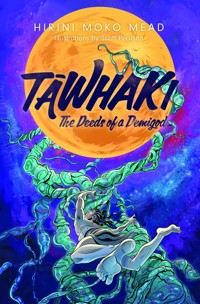
Tāwhaki: The Deeds of a Demigod recalls the miraculous life of Tāwhaki. Similar to Māui, Tāwhaki was a demigod who possessed mighty powers. Tāwhaki almost died at the hands of his brothers-in-law but was found by his wife Hine-piripiri and revived. This near-death experience revealed Tāwhaki's status as a demigod, and from this point Tāwhaki continued to use his powers and gifts to help those around him in ways no human could. This book explores many of these stories, including those of Tāwhaki restoring sight to his blind grandmother and climbing the heavens to find his wife and child.
Sie lesen das E-Book in den Legimi-Apps auf:
Seitenzahl: 114
Veröffentlichungsjahr: 2022
Das E-Book (TTS) können Sie hören im Abo „Legimi Premium” in Legimi-Apps auf:
Ähnliche













![Tintenherz [Tintenwelt-Reihe, Band 1 (Ungekürzt)] - Cornelia Funke - Hörbuch](https://legimifiles.blob.core.windows.net/images/2830629ec0fd3fd8c1f122134ba4a884/w200_u90.jpg)



First published in 1996 by Reed Consumer Books, a division of Reed Publishing (NZ) Ltd
This edition published in 2022 by Huia Publishers 39 Pipitea Street, PO Box 12280 Wellington, Aotearoa New Zealand www.huia.co.nz
ISBN 978-1-77550-657-7 (print) ISBN 978-1-77550-680-5 (ebook)
Copyright © Hirini Moko Mead 1996, 2022 Illustrations copyright © Scott Pearson 2022
This book is copyright. Apart from fair dealing for the purpose of private study, research, criticism or review, as permitted under the Copyright Act, no part may be reproduced by any process without the prior permission of the publisher.
A catalogue record for this book is available from the National Library of New Zealand.
Ebook conversion 2022 by meBooks.
CONTENTS
Introduction
Who is Tāwhaki?
1.Tāwhaki is born
2.The travels of Tāwhaki
3.Tāwhaki rises from the dead
4.Tāwhaki fetches his parents, Hema and Urutonga
5.Tāwhaki marries Tangotango
6.The perils of Tongameha
7.The old blind woman is made to see
8.The ascent into the heavens
9.Tangotango is found
10.Arahuta is dedicated
11.The final deeds of Tāwhaki
Bibliography
Introduction
Many people are aware of the deeds of Māui, topknot of Taranga: the hero who roped the sun, who obtained fire for the human race and who sought everlasting life for us humans. Much about him has been published in books for children, for young people and for adults. During mourning ceremonies, Māui’s name is frequently mentioned because it was he who provided us with an explanation of death. According to our ancestors, this is the reason we die: Māui endeavoured to conquer death, but Hinenuitepō crushed him and he died, and since that time, people born must die as a matter of course.
On the other hand, Tāwhaki, son of Hema and Urutonga, is a demigod we do not know much about and whose name is not often heard on our marae. This is the reason this book has been written: to describe some of the deeds of Tāwhaki and make them more widely known.
This man is very much like Māui, as both are demigods, or half man and half god. Tāwhaki is not like us. His remarkable deeds are large-scale events that are beyond the ability of ordinary beings. But a demigod is able to accomplish such things. Tāwhaki was very nearly killed by his brothers-in-law and was buried, but he was found by his wife, Hine-piripiri, who dug him up and revived him. This is one of the signs that he was a demigod and not an ordinary being.
Another feat was making his blind grandmother, Whaitiri, see again. Tāwhaki touched the eyes of the old woman with his fingers and straight away she was able to see.
But I suppose his big adventure was his ascent to the heavens in search of his second wife, Tangotango. Because he was descended from the gods, he was able to find the pathway to the heavens.
We know that these stories are not merely fairy tales; there are lessons in them, explanations and customs for us to think about. Some of these customs are discussed below.
First, there is the custom of naming children. When the child of Tāwhaki and Hine-piripiri was born, it was named Wahieroa, or Long Firewood. There are two sorts of names given to children. First are ancestral names, which are handed down from generation to generation. Next are memorial names. Wahieroa is a name of the second sort; it was given in memory of Tāwhaki’s revival so that this marvellous event would not be forgotten by his descendants. Herein lies a model for this kind of name. There are many persons bearing names of important events, but unfortunately this traditional practice is being forgotten by the generations coming up. They are turning instead to names of the Western world for their children. This is perhaps the time when we should return to the traditional practices of giving names. If we do not maintain these traditions, some beautiful names of the Māori world will be lost.
Another matter is belief in the traditional gods of the Māori: that is, in the prayers addressed to them. One of Tāwhaki’s prayers was such that while he and his younger brother were still some distance away, they were able to make the bones of their father, Hema, knock together. The bones were hanging in the house of the strangers, the Ponaturi. Here we can perceive their belief in the strength of the prayers, and at the same time the strength of the love of a son for his father.
Tāwhaki is the protector of all tohunga – that is, of those people who have the expertise to make the sick better, and those who conduct the ceremonies of baptism, of clearing evil influences away and that sort of thing. He was able to revive himself from death, make the blind see, transform his appearance into that of an old man at one time and a handsome young man at another, to make the bones of his father rattle, and to make lightning flash from his armpits through the power of his prayers. These are all the remarkable deeds of a priest who is a demigod. It is said that these prayers were obtained from the heavens, and this is really the main reason why Tāwhaki climbed skywards.
The most renowned priest of the heavens was Tama-i-waho, who possessed all of the prayers of the world. Tāwhaki requested that the words of the prayers be given to him. And so he obtained prayers known as Whekite, Te Whakairihia, Te Werohia, Ngā Wetewete and a host of others. Thus all of the prayers come from heaven, and it was Tama-i-waho who gave them to Tāwhaki, who in turn made them available to humans.
Third, there is the matter of avenging death. In bygone days it was the responsibility of the son to avenge the death of his father if that death was by murder, witchcraft or misadventure caused by someone else. It fell to Tāwhaki’s lot to seek revenge for the murder of his father by a strange race. The obligation is still there, but nowadays a son is sorely troubled and confused because he does not know which disasters to avenge, and he does not know how to seek revenge in this modem world, which has different laws. Nowadays, we think that sons should complete tasks not finished by their fathers during their lifetime: it is also up to the sons to correct things that were wrong.
Fourth is the custom of marriage. There are many legends that feature the separation of a husband and wife following some trouble that touches them. For example, there is the famous story of the separation of Uenuku and his wife of the heavens, Hine-pūkohu-rangi. The story about Tāwhaki and his wife from heaven, Tangotango, is similar. They got into trouble and they separated. Tangotango returned to her original home in the heavens and left Tāwhaki here on earth. Then he set off on a journey to find her. He overcame many difficult obstacles, and at length reached the heavens. There he found Tangotango and their daughter, Arahuta.
According to this account, when a wife and husband separate the larger responsibility is on the husband to mend their troubles, and it is up to him to go and bring his wife back to their home. But there is another factor pertaining to the love of one person for another: if that love is really strong, then one will climb the highest mountains, travel the most difficult and distant paths and overcome all difficulties in order to see the loved one. Tāwhaki was able to overcome all such obstacles.
Models of Māori customs of marriage are also to be found in such stories. Tāwhaki had two main wives, and according to some tribal accounts, he had many other wives. One of his wives, named Hine-piripiri, was of this world, and their child was Wahieroa or Long Firewood. His second wife was from the sky. This was Tangotango, and their daughter was Arahuta. These days the custom of having more than one wife has been put aside. The law permits one wife only.
Another custom that has now been overturned is that of owning slaves. Tāwhaki had two slaves to look after him and his younger brother, Karihi, and to cook for them. A slave was paid by allowing him to live with his owners, who provided him with food. If a chief wanted to give his slave to someone else, he did so, as Tāwhaki did when he gave his slave to Whaitiri-mātakataka. Today there are labourers who are paid with money rather than food and lodging. They cannot be given away to others as Tāwhaki’s slave was, and they have rights.
In traditional times, a person could not live comfortably among their brothers-in-law or sisters-in-law. Many cautionary tales on this theme were told by our ancestors. Tāwhaki, for example, was nearly murdered by his brothers-in-law. He was buried and left for dead. The brothers-in-law gave no thought to the hurt or wrong to their sister, Hine-piripiri. If the word for brother-in-law (taokete) is examined, it is possible to find in its meaning the attitudes of the ancestors. A taokete is a person cooked in a basket in a hāngī. Thus the word itself contains a warning. It was not right for Tāwhaki to go fishing with his brothers-in-law. It is preferable to go fishing with one’s own relatives. This is perhaps the big lesson in this story. There are no people more reliable than one’s own relatives to support and look after one. No matter what happens, in the end it is the relatives who rally around to give help or to weep for one in times of great trouble.
Of the whole family of in-laws, there is really only one person who can be relied on to give support, and that is one’s spouse. It was his wife Hine-piripiri who went in search of Tāwhaki, who dug him up, who carried him home, who cut down a tall tree to make a life-giving fire for him, and it was she who enabled him to live again. Her love for her husband did not falter; nor did it deviate. She provides the model of devotion of a wife for a husband or of a husband for a wife. The lesson is remembered in her name, Devoted Maid. But, of course, the original model for the love of wife and husband must go back to Rangi, standing above, and Papa, lying here. There is no love greater than theirs.
When Tāwhaki finished all his adventures, he became a god of the sixth heaven. This heaven is called the Gods. Beneath this is the fifth heaven, called the Learned Ones. Below this is the fourth heaven, called the Essence of Life, which is the location of the Living Waters of Tāne. These three heavens, extending from the fourth to the sixth, are under the authority of Tāwhaki. The heavens below, beginning with Kikorangi and extending upward to the Canoe of Maru and then to the Lakes, are under the authority of Maru. The highest heavens are the home of Rēhua. Thus one can see that Tāwhaki has some mana. He still lives in the sixth heaven with all of his sanctity and his authority. Tāwhaki was one of the gods who acted as an intermediary between the world of the gods and the world of humans. Though he was a god, his actions and thoughts were those of a noble human. And even though his parents were of the heavens, Tāwhaki grew up in this world. His big task on behalf of humans was to bring to them the prayers of the heavens – that is to say, the ones that were sacred and effective. This is because the heavens are the source of mana or authority, of tapu or sanctity, and of wehi or awesomeness. So who was to bring this gift to this world? This important task was accomplished by Tāwhaki.
Thus there are many insights in the stories about the demigod Tāwhaki. What follows is a chronicle of his marvellous deeds. In the stories are valuable treasures that were handed down by the ancestors. Some wise thoughts have come down from the earliest times; there are explanations for some of the customs of the Māori people, and the knowledge acquired by the learned people of centuries gone by.
Some of the information printed here was taken from Sir George Grey’s Nga Mahi a Nga Tupuna, first published in 1854, from John White’s The Ancient History of the Maori of 1887, and from Elsdon Best’s writings of 1925 and the more recently published Maori Religion and Mythology, Part 2. And other books besides these were consulted. These contained the words of knowledgeable people of the land, from Te Arawa, Mataatua, Taranaki, Kahungunu and the tribes of the South Island.
Readers of this book are cautioned. It is foolish to believe that every tribe in New Zealand tells the same story about Tāwhaki or that there is general agreement about such matters as the names of his parents or even the names of his wives. According to some tribes, Hapai was the name of Tāwhaki’s wife from heaven, and their daughter was Puanga (the star Rigel). This is the version among some Ngāi Tahu. According to Ngā Rauru, Hema was a child of Whaitiri, and when he grew up, he married Arawhita-i-te-rangi and had first Tāwhaki then Karihi. When considering these differences it is not correct to say that one version is right while another is wrong. According to current thinking all versions are correct.




