


1,99 €
Mehr erfahren.
- Herausgeber: DigiCat
- Kategorie: Poesie und Drama
- Sprache: Englisch
In her groundbreaking work 'Tender Buttons,' Gertrude Stein employs an innovative literary style that defies conventional narrative forms, creating a collage of vivid imagery and associative language that explores everyday objects and intimate experiences. Composed through a series of three sections—'Objects,' 'Food,' and 'Rooms'—the text features Stein's hallmark postmodern techniques, such as repetition, fragmentation, and abstract expression, which challenge the boundaries of perception and meaning. This experimental approach situates 'Tender Buttons' within the broader context of early 20th-century modernism, reflecting the tumultuous cultural shifts of the time as it redefines the relationship between language and reality. Gertrude Stein, an influential figure of the avant-garde, lived an extraordinary life as a writer, art collector, and key supporter of modernist artists. Her interactions with contemporaries such as Picasso and Hemingway undoubtedly shaped her unique perspective on art and language, prompting her to experiment with form and content in unprecedented ways. Stein's rich background in avant-garde literature and her relationship with the Parisian artistic milieu crystallized her desire to push the limits of expression. 'Tender Buttons' is an essential text for readers intrigued by the interplay of language and art, offering a transformative experience that encourages deep contemplation of the ordinary. Those who seek to challenge their understanding of literature and explore the aesthetics of the mundane will find Stein's work thought-provoking and rewarding.
Das E-Book können Sie in Legimi-Apps oder einer beliebigen App lesen, die das folgende Format unterstützen:
Veröffentlichungsjahr: 2022
Ähnliche

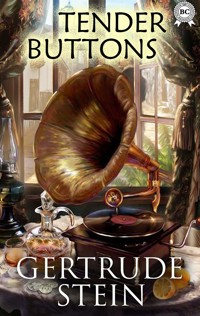


Tender Buttons
Table of Contents
Introduction
Ordinary things—food, rooms, clothing—become arenas where language tests its power to name, to unsettle, and to remake experience. Tender Buttons is a small book with an outsized reputation, a work that asks what happens when words stop behaving as transparent labels and begin acting like objects in their own right. Its sentences can feel at once playful and exacting, inviting readers to attend to rhythm, repetition, and sound as much as to reference. The central tension is simple but profound: the familiar world remains in view, yet it is continuously rearranged by the pressures of syntax and perception. That friction is the engine of the book’s strange clarity and enduring challenge.
Gertrude Stein composed Tender Buttons in the early twentieth century, a period when writers and artists were actively rethinking representation. The book was first published in 1914, and it remains one of the defining texts of literary modernism in English. Stein’s experimental approach was not an isolated eccentricity but part of a broader movement that questioned inherited forms and the stability of meaning. Within that context, Tender Buttons stands out for how radically it compresses its ambitions into brief prose pieces. It does not offer a conventional narrative; instead, it presents a sustained experiment in attention.
The premise is deceptively straightforward: the book is organized into short, titled pieces that turn toward everyday objects, food, and domestic spaces. These fragments do not aim to describe their subjects in ordinary descriptive prose. Rather, they work by shifting grammatical expectations, recasting familiar nouns and adjectives, and allowing associations to move by sound and structure. Readers encounter a sequence of verbal events—compact, self-contained, and insistently present. The effect is not to hide the world but to approach it from angles that ordinary usage usually smooths over. Meaning becomes something you assemble actively, moment by moment.
Tender Buttons holds classic status because it expanded what prose could do without leaning on plot or character as traditionally understood. Stein demonstrated that a text could be driven by the properties of language itself—its patterns, echoes, and resistances—while still remaining tethered to recognizable material. This accomplishment helped legitimize experiments that later became central to modernist and postmodernist writing. The book’s compact form, insistence on the sentence as a site of discovery, and refusal of explanatory scaffolding have made it a touchstone for writers interested in fragmentation, collage, and the poetics of everyday speech. Its influence is measured as much in methods as in themes.
The literary impact of Tender Buttons also lies in its redefinition of “description.” Stein does not merely ornament objects with surprising metaphors; she reorients the act of naming. Words are treated as tactile and audible, not only referential, and the reader is asked to register how minor shifts in syntax can produce new relations between things. By doing so, the book challenges assumptions about clarity, not to obscure but to insist that clarity can be made in more than one way. This stance has resonated with later writers who see language as shaped by habit, power, and perception.
Enduring themes emerge through the book’s persistent return to the commonplace. Food, household items, and spaces carry the weight of daily life, yet Stein’s handling of them resists sentimentality and resists mere inventory. Instead, the text keeps asking what “a thing” is when it is mediated by words, and what a word is when it is treated as a thing. The result is a meditation on attention: how we notice, how we categorize, and how quickly the mind substitutes labels for contact with experience. The domestic sphere becomes a laboratory for perception rather than a backdrop for story.
Stein’s method rewards readers who approach it as listening as well as reading. Repetition, cadence, and subtle variation become structural principles, making each piece feel like a small performance. The book invites a shift from hunting for a single paraphrasable point to noticing how meaning accrues through recurrence and difference. This is one reason Tender Buttons has remained central to conversations about modernist technique: it foregrounds process. Language here is not a window but an activity. The reader’s role is not passive reception but participation in the making of sense, even when that sense stays provisional.
As a modernist text, Tender Buttons aligns with a broader early twentieth-century interest in breaking inherited forms, yet it does so with a distinctive focus on the everyday. Rather than grand historical panoramas, it turns repeatedly toward what is near at hand. The book’s titles anchor the pieces in recognizable categories, but the prose persistently disturbs the comfort of those anchors. That dynamic mirrors modernism’s larger preoccupation with the instability of perception and the inadequacy of traditional representation. Stein’s achievement is to stage that preoccupation at the scale of a teaspoon, a room, a garment—small frames that reveal large questions.
The book’s influence can be traced in later experimental prose and poetry that treat language as material and reading as an event. Writers drawn to fragmentation, linguistic play, and the critique of ordinary discourse have found in Stein a precedent for bold formal decisions. Tender Buttons also anticipated later interests in the poetics of objects and the textures of daily life, showing how attention to the commonplace can become philosophically charged without becoming didactic. Because it resists easy summary, it continues to generate new critical approaches and creative responses. Its legacy is sustained not by consensus but by continual re-engagement.
For new readers, the challenge of Tender Buttons is part of its invitation. The text does not provide conventional cues for pacing or interpretation, and its shifts can feel disorienting. Yet that disorientation is carefully produced; it is the means by which the book loosens habitual thought. Reading slowly, allowing sentences to register by sound and by structure, often reveals patterns of emphasis and variation that a rushed approach can miss. The book rewards curiosity about how grammar guides expectation, how repetition changes meaning, and how a title can both promise stability and expose its limits.
It is also important to approach Stein’s work without expecting the satisfactions of narrative revelation. Tender Buttons is not built to culminate in a twist or a resolved plot. Its coherence lies in recurrence and in the persistent pressure it puts on familiar categories. The book’s pieces stand as discrete explorations, but together they create a sustained atmosphere of linguistic scrutiny. This makes it a useful companion to modernist art’s broader experiments with perspective and form, while remaining distinctly literary in its reliance on the sentence. The central premise remains constant: everyday things become strange when language is handled differently.
Tender Buttons endures because its questions have not been exhausted. In a contemporary world saturated with labels, slogans, and rapid naming—where words are often used to fix identities and simplify complexity—Stein’s insistence on friction between word and thing feels newly relevant. The book reminds readers that language shapes attention, and that attention shapes reality as it is lived. Its lasting appeal lies in how it renews the ordinary, making the familiar available again for scrutiny and wonder. More than a historical artifact of 1914, it remains a living experiment—demanding, intimate, and still startlingly modern.
Synopsis
Tender Buttons by Gertrude Stein is an experimental prose-poetry work first published in 1914 that resists conventional plot and instead proceeds through a sequence of compact verbal studies. The book approaches language as material to be handled, turned, and re-seen, much as its titles suggest everyday objects, foods, and domestic relations. Rather than offering a stable narrator or a clear setting, Stein presents shifting phrases, repetitions, and abrupt turns that encourage attention to sound, rhythm, and grammatical friction. The reader is invited to follow how meaning forms and dissolves as descriptions refuse to settle into ordinary reference.
paragraphs
The opening movement, commonly understood as centering on objects, establishes the method: brief pieces take a familiar thing and treat it as a site where perception and naming can be rearranged. Words that would typically clarify instead multiply angles of view, so that a simple item becomes a bundle of sensations, associations, and syntactic surprises. This early portion foregrounds the tension between label and thing, testing how far a title can guide understanding when the sentences decline to confirm it. As the sequence accumulates, the work builds an atmosphere of close observation that is also persistently destabilizing.
paragraphs
As the object-centered pieces continue, Stein’s language often cycles through reiteration and small variations, producing a sense of motion without storyline. The prose suggests the domestic sphere through its chosen nouns and textures, yet it does not provide a household narrative; the domestic becomes a laboratory for composition. Pivotal to this section is the way coherence appears in flashes and then slips, prompting the reader to recognize meaning as an activity rather than a delivered message. The book’s argumentative drift here is that perception is never neutral and that naming participates in making what is seen.
paragraphs




