


1,99 €
Mehr erfahren.
- Herausgeber: DigiCat
- Kategorie: Sachliteratur, Reportagen, Biografien
- Sprache: Englisch
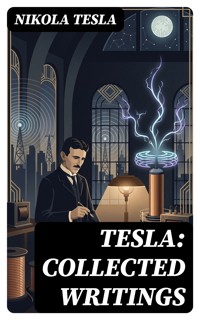
"Tesla: Collected Writings" is a comprehensive anthology that encapsulates the groundbreaking ideas and theories of Nikola Tesla, one of history's most illustrious inventors and visionaries. This collection presents Tesla's articulate essays, patents, and public lectures, reflecting his innovative literary style that melds scientific rigor with poetic expression. Contextually situated within the late 19th and early 20th centuries, a period marked by rapid technological advancement and industrial upheaval, Tesla's writings illuminate the profound implications of electricity and electromagnetism in shaping modern civilization, while also revealing his prophetic glimpses into the future of energy and communication. Nikola Tesla, a Serbian-American inventor and engineer, possessed an insatiable curiosity and an extraordinary intellect that positioned him as a pioneer in electrical engineering. His deep philosophical musings and a strong commitment to harnessing energy for the betterment of humanity are evident in his writings. Tesla's unique experiences, including collaborations with contemporaries and rivalries, influenced his inventive genius and the themes woven into this collection. "Tesla: Collected Writings" is essential for anyone interested in the intersection of science and literature, providing invaluable insights into Tesla's mind and his revolutionary ideas that continue to resonate today. Scholars, enthusiasts, and general readers alike will find inspiration in Tesla's visionary outlook and the timeless relevance of his work. In this enriched edition, we have carefully created added value for your reading experience: - A comprehensive Introduction outlines these selected works' unifying features, themes, or stylistic evolutions. - The Author Biography highlights personal milestones and literary influences that shape the entire body of writing. - A Historical Context section situates the works in their broader era—social currents, cultural trends, and key events that underpin their creation. - A concise Synopsis (Selection) offers an accessible overview of the included texts, helping readers navigate plotlines and main ideas without revealing critical twists. - A unified Analysis examines recurring motifs and stylistic hallmarks across the collection, tying the stories together while spotlighting the different work's strengths. - Reflection questions inspire deeper contemplation of the author's overarching message, inviting readers to draw connections among different texts and relate them to modern contexts. - Lastly, our hand‐picked Memorable Quotes distill pivotal lines and turning points, serving as touchstones for the collection's central themes.
Das E-Book können Sie in Legimi-Apps oder einer beliebigen App lesen, die das folgende Format unterstützen:
Veröffentlichungsjahr: 2022
Ähnliche

Tesla: Collected Writings
Table of Contents
Introduction
Tesla: Collected Writings gathers, in one authoritative volume, the major texts that Nikola Tesla published across genres and decades. It unites his autobiographical My Inventions; formal lectures such as Experiments with Alternate Currents of Very High Frequency and Their Application to Methods of Artificial Illumination and On Light and Other High Frequency Phenomena; the monographic A New System of Alternate Current Motors and Transformers; extensive scientific articles and notes; and a group of letters to editors and public statements. The purpose is to present Tesla’s own voice in its full range, tracing the progression from power engineering to high-frequency research, wireless transmission, illumination, remote control, and broader reflections on science and society.
Readers will encounter multiple text types: memoir, lecture transcripts, technical treatises, experimental reports, speculative essays, and concise letters that intervene in contemporary debates. Alongside focused studies such as Alternate Current Electrostatic Induction Apparatus, Electrical Oscillators, Phenomena of Alternating Currents of Very High Frequency, and An Electrolytic Clock stand programmatic essays including The Problem of Increasing Human Energy, Wonders of the Future, The Wonder World to Be Created by Electricity, and Nikola Tesla Sees a Wireless Vision. Letters to magazine editors and topical notes—among them Mr. Nikola Tesla on Alternate Current Motors, Nicola Tesla Objects, and Correction by Mr. Tesla—show the author addressing professional, legal, and interpretive questions in real time.
Across this diverse corpus, certain themes unify the work. Tesla treats nature as a system of resonant processes, seeking efficient conversion, transmission, and control of energy. He pairs exact descriptions of apparatus—coils, condensers, transformers, oscillators—with sweeping, often global, horizons for application. His stylistic hallmarks include a measured technical vocabulary, stepwise exposition from principle to experiment, and vivid analogies that open expert subjects to general readers. The texts move with confidence from laboratory observation to public implication, yet remain anchored in repeatable method. Throughout, the writing insists on precision in tuning, economy in design, and the ethical dimension of furnishing power and communication to society.
My Inventions provides the collection’s most direct personal frame. In this autobiographical series, Tesla outlines formative experiences, major lines of research, and the mental habits by which he approached invention. It introduces episodes that later reappear as technical themes—early illumination experiments, conceptions of rotating magnetic fields, attention to resonance—and offers a narrative of aims rather than a comprehensive life history. The autobiography situates the reader within the author’s workshop of ideas and motives, clarifying the discipline behind his prolific work and the public aims that inform later lectures, articles, and letters. It is both a testament of method and a guide to reading the technical pages that follow.
The selected lectures preserve the cadence of public demonstration. In Experiments with Alternate Currents of Very High Frequency and Their Application to Methods of Artificial Illumination, On Light and Other High Frequency Phenomena, and On Electricity, Tesla presents principles, apparatus, and observed effects in an order designed to teach and to persuade. These texts document laboratory arrangements and measured outcomes while making plain the ambitions of the research: safer illumination, higher efficiency, and new regimes of electrical behavior. They also show his emphasis on reproducibility, careful adjustment, and the didactic value of spectacle, integrating performance with pedagogy to carry complex ideas from bench to auditorium.
Power engineering is given comprehensive treatment in A New System of Alternate Current Motors and Transformers and in companion pieces dispersed through the scientific articles and letters. Here Tesla set out the logic of polyphase currents and the rotating magnetic field, explaining the operation of induction motors and practical transformer design. Essays such as the analysis of losses due to hysteresis in transformers and discussions of the so‑called Drehstrom patent reflect sustained engagement with materials, efficiency, and intellectual property. Shorter notes and letters on the alternate current motor attest to an engineer refining systems and correcting misunderstandings as his designs moved from exposition to broad technical discussion.
Another cluster centers on high-frequency currents and oscillators. Phenomena of Alternating Currents of Very High Frequency, Electrical Oscillators, and High Frequency Oscillators for Electro‑Therapeutic and Other Purposes trace ever faster oscillations, novel apparatus, and applications ranging from lighting to medical practice. The Physiological and Other Effects of High Frequency Currents and Nikola Tesla – About His Experiments in Electrical Healing treat bodily responses and clinical possibilities with attention to safety and procedure. Alternate Current Electrostatic Induction Apparatus, Notes on a Unipolar Dynamo, and Electric Discharge in Vacuum Tubes broaden this inquiry into components and experimental techniques that made high‑frequency research reproducible and increasingly adaptable to both laboratory and field conditions.
Wireless occupies a central place in the collection. The Transmission of Electric Energy Without Wires, The True Wireless, Possibilities of Wireless, Tesla’s Wireless Light, Tuned Lightning, and The Disturbing Influence of Solar Radiation on the Wireless Transmission of Energy together present a coherent program: tuned circuits, carefully matched resonators, and the prospect of global communication and power links. Pieces such as My Apparatus, Says Tesla and Nikola Tesla Sees a Wireless Vision connect laboratory practice to a public horizon, while Tesla’s Wireless Torpedo and related notes extend wireless control to vehicles and instruments. The result is a record of theory, instrumentation, and proposed infrastructures articulated by the inventor himself.
The sequence of writings on Roentgen and Lenard radiations documents rapid engagement with a new domain. On Roentgen Rays, subsequent reports on latest results, studies of reflected radiation, and detailed notes on the construction and safe operation of Lenard and X‑ray tubes map apparatus development alongside empirical caution. Tesla’s accounts of producing radiographs at tens of feet, of streams observed in vacuum tubes, and of hurtful actions under certain conditions show a methodical attempt to characterize sources, shielding, and physiological risk. Read together, these pieces form a contemporaneous laboratory notebook, pairing curiosity with procedure at a moment when standards were still emerging.
Several writings treat remote control, naval technology, and novel machines. My Submarine Destroyer, Tesla’s Wireless Torpedo, and Electric Drive for Battle Ships outline radio‑guided craft and electric propulsion as means to extend human agency while reducing risk to operators. A Lighting Machine on Novel Principles and related discussions of oscillators show mechanical and electrical design converging on compact sources of intense effects. Little Aeroplane Progress and other topical notes register the author’s assessment of contemporary engineering fields. Throughout these pieces, the stated aim is practical command at a distance, achieved through reliable control signals, energy economy, and designs amenable to manufacture and disciplined operation.
The popular essays address civilization at scale. The Problem of Increasing Human Energy proposes strategies for augmenting the effective power available to society; The Age of Electricity and Wonders of the Future interpret ongoing change; Talking with Planets, How to Signal to Mars, and Can Bridge the Gap to Mars describe methods for interplanetary signaling grounded in terrestrial experiments. How Cosmic Forces Shape Our Destinies and Some Personal Recollections interleave scientific perspective with reflective argument. Rather than reporting a single study, these texts synthesize laboratory knowledge into public programs and images of the future, demonstrating Tesla’s consistent effort to join technical detail to human purpose.
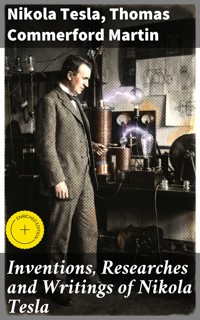
The collection also preserves Tesla’s shorter interventions—letters and notes that correct terminology, dispute attribution, or clarify scope, including Mr. Tesla on Thermo Electricity, Nicola Tesla Objects, and Mr. Tesla’s Vision. For historical orientation, The Inventions, Researches and Writings of Nikola Tesla appears here as a contemporaneous compendium centered on his work, noteworthy for preserving primary materials and contextual commentary. Taken together, these writings reveal stylistic traits that endure across forms: exact apparatus description, insistence on tuning and resonance, and a readiness to project consequences for industry and culture. They record a singular experimental imagination and a durable vocabulary for thinking about electrical modernity.
Author Biography
Introduction
Nikola Tesla (1856–1943) was a Serbian-American inventor, electrical engineer, and public intellectual whose writings and demonstrations helped inaugurate the modern electrical age. The collection foregrounds his decisive role in alternating-current power through A New System of Alternate Current Motors and Transformers and the extensive Lectures that introduced polyphase motors, transformers, and high-frequency apparatus to global audiences. My Inventions – Autobiography of Nikola Tesla supplies his retrospective narrative, linking early insights to mature achievements. Across technical papers, letters, and popular essays, Tesla refined concepts of resonance, high-frequency currents, wireless transmission, X-ray phenomena, and specialized oscillators, leaving a record of method and imagination that shaped industry, research culture, and public expectations for electrical progress.
Tesla’s authorship blends rigorous apparatus description with theatrical pedagogy and speculative projection. Visionary essays such as The Problem of Increasing Human Energy, The Transmission of Electric Energy Without Wires, The True Wireless, Talking with Planets, How to Signal to Mars, and Wonders of the Future demonstrate how he moved between laboratory detail and planetary scale. Scientific Articles in the collection range from component analyses—Swinburne’s “Hedgehog” Transformer, The Ewing High-Frequency Alternator and Parson’s Steam Engine—to notes on devices, measurement, and phenomena. Together these writings chart a consistent program: harness alternating currents, push frequency upward, master resonance, minimize losses, and extend electricity’s reach to illumination, medicine, communication, transport, and, ultimately, world-spanning energy systems.
Education and Literary Influences
Tesla’s formal preparation was in the Central European engineering tradition. He studied electrical engineering at the Polytechnic in Graz and later attended lectures in Prague, absorbing mathematics, physics, and machine design without seeking a degree. Entering professional practice in Europe before emigrating to the United States, he encountered the competing paradigms of direct and alternating current and the emerging field of high-frequency phenomena. The scientific milieu included the experimental legacy of Michael Faraday, the electromagnetic investigations of Heinrich Hertz, and the vacuum-tube work of William Crookes—contexts reflected in his own Electric Discharge in Vacuum Tubes and On the Dissipation of the Electrical Energy of the Hertz Resonator.
Nineteenth-century lecture culture decisively shaped Tesla’s style. The collection’s Lectures and the celebrated presentation Experiments with Alternate Currents of Very High Frequency and Their Application to Methods of Artificial Illumination display a pedagogy built on staged phenomena, lucid schematics, and comparative apparatus. Industrial controversies also informed his rhetoric: letters such as Mr. Nikola Tesla on Alternate Current Motors and The Losses Due to Hysteresis in Transformers address technical misunderstandings and defend design priorities. This blend of public demonstration and editorial engagement created a persuasive mode—didactic, anticipatory, and corrective—that he later extended to wireless, electro-therapeutic topics, and speculative essays on society’s electrical future.
Literary Career
Tesla’s early publications in the late 1880s and early 1890s consolidated alternating-current power as a coherent system. A New System of Alternate Current Motors and Transformers outlined the polyphase induction motor and transformer relations, while related letters—The Tesla Alternate Current Motor, Tesla’s New Alternating Motors, Alternate Current Motors, Electro-motors—clarified principles, materials, and performance. He probed component behavior in The Losses Due to Hysteresis in Transformers and compared rival designs in Swinburne’s “Hedgehog” Transformer. Pieces like The “Drehstrom” Patent and The Ewing High-Frequency Alternator and Parson’s Steam Engine place his work in international and industrial contexts, showing his habit of anchoring theory in manufacturable machines.
By the early 1890s Tesla turned to frequencies beyond conventional power practice. Experiments with Alternate Currents of Very High Frequency and Their Application to Methods of Artificial Illumination, On Light and Other High Frequency Phenomena, On Electricity, and Phenomena of Alternating Currents of Very High Frequency report spectacular demonstrations—wireless lamps, brush discharges, and corona effects—supported by careful parameter control. Alternate Current Electrostatic Induction Apparatus and Electrical Oscillators detail tuned circuits, coupling, and coil geometries that made resonance a design principle. High Frequency Oscillators for Electro-Therapeutic and Other Purposes extends these techniques to medical and industrial use, exemplifying his preference for compact, tunable oscillators that deliver high potentials at manageable currents.
The collection documents Tesla’s early engagement with X-ray and vacuum phenomena when Röntgen’s discovery galvanized experimenters. Electric Discharge in Vacuum Tubes surveys tube behavior across pressures and electrode forms. A sustained series—On Roentgen Rays (1), On Roentgen Rays (2) – Latest Results, Tesla’s Latest Results – He Now Produces Radiographs at a Distance of More Than Forty Feet, On Reflected Roentgen Rays, On Roentgen Radiations, Roentgen Ray Investigations—presents techniques for generating and detecting radiations at a distance. Safety and causation recur: On Hurtful Actions of Lenard and Roentgen Tubes and On the Source of Roentgen Rays and the Practical Construction and Safe Operation of Lenard Tubes outline precautions, while An Interesting Feature of X-Ray Radiations and On the Roentgen Streams analyze emission mechanisms and interactions.
Wireless power and signaling are central threads. The Transmission of Electric Energy Without Wires, The True Wireless, Nikola Tesla Sees a Wireless Vision, Possibilities of Wireless, and My Apparatus, Says Tesla set forth his resonant system emphasizing earth conduction and tuned circuits. Tuned Lightning and Tesla’s Wireless Light dramatize high-voltage transformer action and luminescence as practical outcomes. The Disturbing Influence of Solar Radiation On the Wireless Transmission of Energy links performance to extraterrestrial conditions, while On the Dissipation of the Electrical Energy of the Hertz Resonator frames losses and coupling. The Age of Electricity provides cultural context, presenting wireless as the culmination of a broader electrification that integrates lighting, power, and communication.
Tesla also wrote beyond the laboratory bench, articulating programmatic visions and controversies. The Problem of Increasing Human Energy, The Wonder World to Be Created by Electricity, Wonders of the Future, and How Cosmic Forces Shape Our Destinies argue that abundant electrical power can uplift industry and public welfare. Interplanetary signaling schemes in Talking with Planets, How to Signal to Mars, and Can Bridge the Gap to Mars extend his resonance concepts to cosmic scales. Military and naval proposals—My Submarine Destroyer, Tesla’s Wireless Torpedo, Electric Drive for Battle Ships, Tesla’s Tidal Wave to Make War Impossible—link deterrence to remote control. A Lighting Machine on Novel Principles and Electrical Oscillators emphasize practical machinery, while The Inventions, Researches and Writings of Nikola Tesla and Some Personal Recollections consolidate his public record.
Beliefs and Advocacy
Tesla’s writings reveal convictions about energy, method, and social consequence. He championed polyphase AC as a humane infrastructure for plentiful, low-cost power, then sought to remove wires altogether. The True Wireless and The Transmission of Electric Energy Without Wires argue for resonant, earth-coupled systems over radiative broadcasting, while The Disturbing Influence of Solar Radiation On the Wireless Transmission of Energy notes environmental limits and cosmic disturbances. He balanced enthusiasm with caution: in On Hurtful Actions of Lenard and Roentgen Tubes and On the Source of Roentgen Rays and the Practical Construction and Safe Operation of Lenard Tubes he pressed for safe practice. Medical interests in The Physiological and Other Effects of High Frequency Currents and Nikola Tesla – About His Experiments in Electrical Healing stress measured application.
As a public advocate, Tesla used editorials and letters to defend priority, clarify misreadings, and refine standards. Correction by Mr. Tesla, Nicola Tesla Objects, Mr. Tesla on Thermo Electricity, and the broader Letters to Magazine Editors show vigilant engagement with the press and professional discourse. Mr. Tesla’s Vision and What Science May Achieve This Year – New Mechanical Principle for Conservation of Energy frame progress as disciplined engineering rather than accident. He also argued that decisive technologies could reduce conflict—Tesla’s Tidal Wave to Make War Impossible and My Submarine Destroyer present remote control and overwhelming power as deterrents—while essays like Possibilities of Wireless and Tesla’s Wireless Light emphasize accessible, democratizing applications.
Final Years & Legacy
In later years Tesla increasingly addressed the public through essays and interviews rather than formal treatises, assessing fields from aviation to naval propulsion—Little Aeroplane Progress and Electric Drive for Battle Ships—and revisiting oscillators, illumination, and wireless apparatus. He died in New York in 1943. The collection records his enduring program: minimize losses, elevate frequency, tune resonance, and extend transmission. His alternating-current system became foundational infrastructure, while his wireless proposals, electro-therapeutic devices, and X-ray safeguards anticipated later practices and debates. The compilation The Inventions, Researches and Writings of Nikola Tesla preserved a canonical account, and the international adoption of the tesla as an SI unit of magnetic flux density acknowledges his lasting scientific impact.
Historical Context
Nikola Tesla’s collected writings emerge from the late nineteenth and early twentieth centuries, decades marked by the Second Industrial Revolution, rapid urbanization, and the consolidation of corporate research and patent systems. Born in 1856 in the Austrian Empire and emigrating to the United States in 1884, Tesla navigated transatlantic scientific cultures and media networks. The texts span roughly the 1880s to the 1920s, when electrification transformed factories, homes, and communication. They reflect the age’s public lecture circuits, world’s fairs, and popular magazines that promoted science as spectacle and civic promise. Read together, these pieces document both laboratory practice and a society negotiating electricity’s risks and rewards.
The struggle over electrical standards—the “War of Currents”—frames much of the early material. In 1887–1888 Tesla patented a practicable induction motor and polyphase system; his 1888 lecture “A New System of Alternate Current Motors and Transformers” and related writings in this collection sit within fierce debates pitting direct-current advocates against alternating-current proponents. Westinghouse’s licensing of Tesla’s system, the 1893 World’s Columbian Exposition’s AC illumination, and the 1895 opening of the Niagara Falls power plant crystalized a shift toward long-distance AC transmission. Technical notes and letters on motors and transformers here register the period’s anxieties about safety, standardization, and economic control of infrastructure.
Tesla’s investigations of high-frequency currents unfolded amid the consolidation of Maxwellian field theory and Hertz’s 1887–1888 demonstrations of electromagnetic waves. Lectures and articles such as “Phenomena of Alternating Currents of Very High Frequency” and “Alternate Current Electrostatic Induction Apparatus” show a laboratory culture still shaping instruments and vocabulary for the new frequencies. The “Tesla coil” emerged as a versatile research and demonstration device, enabling luminous lighting and discharge experiments. These texts capture a transitional moment before strict professional specialization, when experimenters bridged physics and engineering, and when terms, measurements, and apparatus were debated as much as the phenomena themselves.
Public lectures functioned as both pedagogy and theater. Tesla’s talks in the early 1890s to American and British engineering societies—reflected here in “Lectures,” “On Light and Other High Frequency Phenomena,” and “Experiments with Alternate Currents of Very High Frequency and Their Application to Methods of Artificial Illumination”—belonged to a culture that fused scientific authority with staged demonstration. Urban audiences and trade-press reporters amplified these performances. The shows popularized fluorescent effects, wireless lighting, and safe handling of high-frequency currents, shaping public expectations for electricity in the home and street. They also served as persuasive briefs to investors and utilities during a volatile market for new systems.
The discovery of X-rays by Wilhelm Röntgen in late 1895 sparked global replication and debate, quickly represented in Tesla’s series “On Roentgen Rays,” “On Reflected Roentgen Rays,” and related notes. These pieces document the speed with which laboratories improvised Crookes and Lenard tubes, pursued radiography, and misjudged hazards. Tesla reported injuries and proposed safer tube designs, participating in an international conversation that predated formal regulatory regimes. The writings preserve early terminology (“streams,” “radiations”) and competing causal models before quantum and atomic frameworks settled language. They also register the era’s medical optimism, when imaging promised diagnostic revolution even as the risks of exposure remained poorly understood.
Wireless communication and power transmission threads run through the collection against the backdrop of Lodge, Popov, and Marconi’s experiments, the 1901 transatlantic signal, and ensuing patent contests. Articles like “The True Wireless,” “The Transmission of Electric Energy Without Wires,” and pieces on tuned circuits and ground connections reflect Tesla’s insistence on resonance and large-scale infrastructure, shaped by work at Colorado Springs (1899) and Wardenclyffe (1901–1906). Financial and regulatory contexts matter: naval and commercial priorities, spectrum interference concerns, and—after 1912—the Radio Act’s licensing regime. These writings capture both technical divergences and the commercial realities of long-wave, high-power ambitions.
Fin-de-siècle fascination with Mars—fed by Schiaparelli’s “canals” (1877) and Percival Lowell’s popular astronomy in the 1890s—forms the cultural background for “Talking with Planets,” “How to Signal to Mars,” and related pieces. Tesla’s proposals for interplanetary signaling blended speculative cosmology with discussions of terrestrial transmitters, reflecting a media environment in which scientific conjecture circulated through general-interest magazines. The texts show how wireless technology was quickly woven into broader narratives about cosmic communication and human destiny, even as professional astronomers debated observational claims. They register credulity and skepticism coexisting in a public sphere hungry for technological wonder.
Remote control and military modernization surface amid late-nineteenth-century naval races and, later, the First World War. Tesla’s 1898 demonstration of a radio-controlled boat at Madison Square Garden, echoed in articles like “Tesla’s Wireless Torpedo” and “My Submarine Destroyer,” situated automation within contemporary hopes of reducing battlefield risk and improving naval precision. These proposals intersected with torpedo development, coastal defense planning, and international law debates raised at The Hague conferences. The writings convey the era’s tension between humanitarian rhetoric and escalating weapon sophistication, and they illuminate the patent and demonstration strategies required to persuade governments and contractors.
Electrotherapy occupied a contested space between laboratory physics and medical marketplaces. Essays such as “High Frequency Oscillators for Electro-Therapeutic and Other Purposes” and “Nikola Tesla—About His Experiments in Electrical Healing” document a period when practitioners explored diathermy, ozone, and violet-ray devices. Before robust clinical trials and federal oversight, entrepreneurs marketed electrical remedies to a receptive public. Tesla’s apparatus descriptions reflect broader currents in Progressive Era health reform and the eventual tightening of standards under measures like the Pure Food and Drug Act (1906). The pieces thus archive both exploratory therapeutic science and the subsequent professional skepticism it provoked.
Mechanical power and electrical generation were evolving together. Discussions of the Ewing high-frequency alternator and Parsons steam turbine, along with notes on oscillators and lighting machines, place Tesla’s work within a shift from reciprocating engines to turbines and from small dynamos to large alternators. Utilities in the 1890s–1910s demanded reliability, efficiency, and compatible frequency standards for lighting and motors. These writings show engineers aligning prime movers, alternators, transformers, and distribution hardware into coherent systems. They also illustrate how laboratory oscillators doubled as industrial prototypes, collapsing boundaries between experimental physics tools and commercial power technology.
Transnational exchange and priority disputes thread through articles on the “Drehstrom” (three-phase) systems and on C. E. S. Swinburne’s so‑called “hedgehog” transformer. German, British, and American firms—AEG, Siemens, Westinghouse, and others—competed to standardize frequencies, phase configurations, and transformer designs. Tesla’s notes reveal an engineer attentive to European developments and to patent landscapes that shaped adoption. References to unipolar dynamos and alternator innovations sketch a genealogy extending to Faraday and Siemens. The collection registers how national laboratories, professional societies, and trade journals mediated claims of priority, blending scientific method with legal strategy and industrial diplomacy.
Tesla’s long essays for general magazines, notably “The Problem of Increasing Human Energy” (1900), partook of Progressive Era faith in social improvement through technology. Addressing energy conservation, new power sources, and organization of labor, these pieces folded technical speculation into commentary on urban growth, environmental resources, and global interdependence. Companion essays like “Wonders of the Future” and “The Age of Electricity” articulated the civic narrative of electrification—public lighting, transport, and communication—as instruments of prosperity and education. The writings mirror a moment when engineers acted as public intellectuals, translating laboratory research into visions for municipal planning and international cooperation.
The collection also evidences the volatile financing of innovation. The 1890s financial panics, Westinghouse’s corporate pressures, and early twentieth-century investor expectations shaped the prospects of ambitious projects like Wardenclyffe. Articles such as “Mr. Tesla’s Vision,” “Tesla Describes His Efforts in Various Fields of Work,” and contemporaneous interviews functioned as strategic public relations—clarifying aims, steadying backers, and countering rumors. The 1907 panic, tightening credit, and shifting priorities in transoceanic telegraphy and wireless services complicated grand schemes for global transmitters. These documents thus serve as a ledger of the capital markets shadowing laboratory dreams.
Patent conflicts and editorial corrections punctuate the scientific narrative. Letters to magazine editors, “Correction by Mr. Tesla,” and essays like “The True Wireless” responded to misreporting and to rival claims, especially as the U.S. Patent Office and European authorities adjudicated wireless priority in the early 1900s. Although the U.S. Supreme Court’s 1943 ruling touching Marconi’s patent claims came later, the collection captures the prehistory: arguments over tuned circuits, grounding, and spectrum control. These texts show how scientific controversies migrated into public forums, and how media-savvy engineers shaped reception, sometimes anticipating legal language later used in court.
Many pieces balance utopian aspiration with anxieties about war and natural forces. “Tesla’s Tidal Wave to Make War Impossible,” “Tuned Lightning,” and essays on cosmic influences reflect early twentieth-century hopes that technology might deter conflict or reveal planetary-scale processes. Simultaneously, practical notes on interference—such as writings on solar radiation’s effects on wireless—intersect with emerging geophysics and, after 1902, with the Kennelly–Heaviside hypothesis of an ionospheric layer. Essays on aviation’s progress and electric ship drives map the uneven pace of modernization. The mix of visionary and pragmatic tones mirrors a world oscillating between optimism and catastrophe.
“My Inventions,” serialized in 1919, looks backward from a post–World War I vantage to formative episodes in Europe and the United States—Edison Machine Works, early motor patents, stagecraft of demonstrations. Appearing in a popular magazine, it belongs to a moment when the lone-inventor narrative was giving way to corporate laboratories (General Electric, AT&T’s research groups). The memoir’s emphasis on creative method, memory, and perseverance addresses a readership reconsidering the prewar technological order. It situates personal experience within broader changes to immigration, professionalization, and the shifting status of the independent inventor in an age of big engineering.
Read as a whole, the collection doubles as a chronicle of media ecologies that carried science to mass audiences. Trade journals like Electrical World, general weeklies such as Collier’s, and lecture circuits created feedback loops between laboratory claims and public expectation. Pieces on electrostatic induction, hysteresis losses, and transformer design sat alongside visionary essays for lay readers. This mixed venue helped stabilize technical vocabulary, while also encouraging sensational framings. The writings thus document how expertise was performed and contested, and how public enthusiasm—fueled by world’s fairs, exhibitions, and magazine illustration—shaped the trajectory of investment and standards-setting bodies in electricity and radio industries. The collection functions as historical commentary on its eras by embedding technical exposition within contemporaneous debates about infrastructure, health, war, and global communication. Its recurring themes—resonance, long‑distance power, safety, and standardization—track the consolidation of electrical modernity. Later readers have reinterpreted the texts through shifting lenses: mid‑twentieth‑century radio history, late‑century inventor mythology, and twenty‑first‑century interest in open hardware and renewable grids. While mythmaking sometimes obscures context, the documents themselves anchor Tesla’s career in verifiable networks of institutions, markets, and publics, revealing how scientific imagination operated within—and responded to—the social forces of his time.
Synopsis (Selection)
My Inventions – Autobiography of Nikola Tesla
Tesla recounts his formative years, inspirations, and the habits of mind that shaped his inventions, presenting a first-person map of how ideas move from intuition to apparatus. The tone is reflective and exacting, mixing personal recollection with a methodical account of creative problem-solving and setbacks. Across the narrative, he frames invention as a disciplined pursuit guided by visualization, perseverance, and a belief in electricity’s civilizing power.
Lectures
Experiments with Alternate Currents of Very High Frequency and Their Application to Methods of Artificial Illumination (Lecture) surveys dramatic demonstrations of high-frequency currents and their use in novel lighting methods. Tesla unfolds the principles behind resonant circuits and high-voltage transformers while stressing practical illumination and safety. The style is showmanlike yet analytic, turning laboratory spectacle into arguments for a new electrical era.
On Light and Other High Frequency Phenomena extends the inquiry to how matter responds to rapid electrical oscillations, with special attention to light production and discharge effects. The lecture links apparatus design to emergent optical behaviors and hints at broader possibilities for transmission and control. Its tone is exploratory, bridging careful observation with sweeping inferences about future technologies.
On Electricity offers a synoptic address that consolidates foundational concepts, measurement challenges, and applications across power, signaling, and experimentation. Tesla uses clear examples to frame electricity as a unified field of forces rather than isolated devices. The result is a didactic, forward-looking overview that underscores system-level thinking and the promise of wireless methods.
A New System of Alternate Current Motors and Transformers
Tesla outlines a coherent platform for alternating-current motors and transformers, emphasizing polyphase principles that enable efficient power generation, transmission, and mechanical work. The work methodically links theory to practical machine design, arguing for a systemic shift away from earlier approaches. Its tone is architectonic and persuasive, presenting a blueprint that treats the motor, transformer, and network as interdependent parts of a new electrical infrastructure.
High Frequency Oscillators for Electro-Therapeutic and Other Purposes
In this treatment, Tesla details oscillation-producing apparatus designed for medical and experimental uses, focusing on controllability, frequency, and safe application. The argument stresses how properly tuned high-frequency currents create distinct physiological and physical effects compared to low-frequency power circuits. The tone is clinical and apparatus-centered, foregrounding construction and operating conditions.
High Frequency Oscillators for Electro-Therapeutic and Other Purposes (September 1898) revisits the theme with updated configurations and results, emphasizing reliability and repeatability. It refines earlier claims by specifying operating modes and boundary conditions for electro-therapeutic practice and laboratory work. The piece balances caution with advocacy, positioning oscillators as versatile tools for both health and research.
Scientific Articles
On transformers and rotating machinery, Tesla engages with contemporary designs and patents to situate his own methods within the broader field. Swinburne's "Hedgehog" Transformer, The "Drehstrom" Patent, and The Ewing High-Frequency Alternator and Parson's Steam Engine examine competing solutions, efficiency concerns, and the mechanical-electrical coupling needed for high-frequency generation. The tone is comparative and technical, highlighting standards of performance and priority.
On high-frequency phenomena and illumination, Phenomena of Alternating Currents of Very High Frequency, Experiments with Alternate Currents of Very High Frequency and Their Application to Methods of Artificial Illumination (Article), and Alternate Current Electrostatic Induction Apparatus develop the physics and practice of rapid oscillations. Tesla uses resonant circuits and induction effects to argue for new lighting and transmission methods. The approach is experimental yet system-aware, tying laboratory behavior to real-world applications.
On specialized apparatus and effects, Electric Discharge in Vacuum Tubes, On the Dissipation of the Electrical Energy of the Hertz Resonator, Electrical Oscillators, Notes on a Unipolar Dynamo, and An Electrolytic Clock map out instruments, losses, and timing challenges in precision work. These pieces stress tuning, materials, and geometry as levers for performance. The tone is meticulous, showing how even minor design choices steer outcomes.
On bioelectric and therapeutic questions, The Physiological and Other Effects of High Frequency Currents and Nikola Tesla - About His Experiments in Electrical Healing frame the body as a responsive medium for carefully controlled currents. Tesla distinguishes sensation, heating, and safety limits from therapeutic promise. The result is cautiously optimistic, coupling bold possibilities with operational guidelines.
On wireless power and signaling, The Transmission of Electric Energy Without Wires, The True Wireless, Nikola Tesla Sees a Wireless Vision, Possibilities of Wireless, My Apparatus, Says Tesla, Tuned Lightning, Tesla’s Wireless Light, The Disturbing Influence of Solar Radiation On the Wireless Transmission of Energy, Tesla's New Discovery - Capacity of Electrical Conductors is Variable, Correction by Mr. Tesla, and Mr. Tesla's Vision develop a resonant, earth- and atmosphere-coupled conception of communication and power. The articles argue for tuning, grounding, and conductor properties as decisive parameters, while addressing interference and misinterpretation. The tone is both corrective and visionary, defending a distinct approach to "wireless" against prevailing models.
On interplanetary communication and cosmic perspective, Talking with Planets, Can Bridge the Gap to Mars, How to Signal to Mars, and How Cosmic Forces Shape Our Destinies imagine large-scale signaling and the influence of natural forces on civilization. Tesla treats planetary contact as an engineering problem of power, detection, and modulation. The tone mixes technical optimism with philosophical speculation.
On Roentgen and related radiations, On Roentgen Rays (1), On Roentgen Rays (2) - Latest Results, Tesla's Latest Results - He Now Produces Radiographs at a Distance of More Than Forty Feet, On Reflected Roentgen Rays, Roentgen Ray Investigations, and An Interesting Feature of X-Ray Radiations chart apparatus refinements, image formation, and propagation behaviors. Emphasis falls on intensity, distance effects, and diagnostic possibilities. The style is empirical and iterative, adjusting equipment to probe new regimes.
Continuing the radiations theme, Roentgen Rays or Streams, On the Roentgen Streams, On Hurtful Actions of Lenard and Roentgen Tubes, On the Source of Roentgen Rays and the Practical Construction and Safe Operation of Lenard Tubes, and On Roentgen Radiations focus on mechanism, safety, and best practices. Tesla frames hazards and shielding as engineering solvable, pairing causal conjectures with practical guidance. The tone is precautionary yet inventive, aiming to secure reliable, safe operation.
On futurism, mechanical vision, and progress reporting, The Age of Electricity, The Problem of Increasing Human Energy, Wonders of the Future, Some Personal Recollections, Tesla Describes His Efforts in Various Fields of Work, Little Aeroplane Progress, What Science May Achieve This Year - New Mechanical Principle for Conservation of Energy, and A Lighting Machine on Novel Principles sketch societal transformation through energy abundance and new machines. These pieces blend memoir, prognosis, and proposal, advocating for efficiency and novel mechanisms. The tone is programmatic and expansive, tying individual devices to civilizational trajectories.
War and Naval Technologies
My Submarine Destroyer, Tesla's Wireless Torpedo, and Tesla's Tidal Wave to Make War Impossible outline remote control, high-energy effects, and deterrence concepts aimed at ending or preempting conflict. Tesla frames offensive capability as a means to secure peace through technical superiority and standoff operation. The tone is bold and utilitarian, presenting engineering as a route to strategic stability.
Electric Drive for Battle Ships extends these ideas to naval propulsion and control, advocating electrification for efficiency, responsiveness, and new hull architectures. The argument treats ships as integrated electrical systems rather than solely mechanical platforms. Its style is integrative and forward-looking, fusing power distribution with command and survivability.
Letters to Magazine Editors
On motors and transformers, Mr. Nikola Tesla on Alternate Current Motors, The Tesla Alternate Current Motor, Tesla's New Alternating Motors, Alternate Current Motors, Electro-motors, and The Losses Due to Hysteresis in Transformers address performance, priority, and design trade-offs. Tesla uses the letter form to clarify misstatements, codify operating principles, and defend his system-level approach. The tone is precise and corrective, grounded in practical parameters.
On high-frequency and thermal effects, Phenomena of Currents of High Frequency and Mr. Tesla on Thermo Electricity distill experimental findings into accessible points for editors and readers. These letters translate laboratory behavior into clear claims about feasibility and limits. The voice is concise and didactic, emphasizing definitions and boundary conditions.
On interpretation and representation, Nicola Tesla Objects and The Inventions, Researches and Writings of Nikola Tesla engage public narratives about his work and its documentation. He contests inaccuracies and contextualizes achievements within broader programs. The tone is assertive yet explanatory, seeking fidelity between public record and technical reality.
Tesla: Collected Writings
My Inventions – Autobiography of Nikola Tesla
I. My Early Life.
The progressive development of man is vitally dependent on invention[1q]. It is the most important product of his creative brain. Its ultimate purpose is the complete mastery of mind over the material world, the harnessing of the forces of nature to human needs. This is the difficult task of the inventor who is often misunderstood and unrewarded. But he finds ample compensation in the pleasing exercises of his powers and in the knowledge of being one of that exceptionally privileged class without whom the race would have long ago perished in the bitter struggle against pitiless elements.
Speaking for myself, I have already had more than my full measure of this exquisite enjoyment, so much that for many years my life was little short of continuous rapture. I am credited with being one of the hardest workers and perhaps I am, if thought is the equivalent of labor, for I have devoted to it almost all of my waking hours. But if work is interpreted to be a definite performance in a specified time according to a rigid rule, then I may be the worst of idlers. Every effort under compulsion demands a sacrifice of life-energy. I never paid such a price. On the contrary, I have thrived on my thoughts.
In attempting to give a connected and faithful account of my activities in this series of articles which will be presented with the assistance of the Editors of the ELECTRICAL EXPERIMENTER and are chiefly addrest to our young men readers, I must dwell, however reluctantly, on the impressions of my youth and the circumstances and events which have been instrumental in determining my career.
Our first endeavors are purely instinctive, promptings of an imagination vivid and undisciplined. As we grow older reason asserts itself and we become more and more systematic and designing. But those early impulses, tho not immediately productive, are of the greatest moment and may shape our very destinies. Indeed, I feel now that had I understood and cultivated instead of suppressing them, I would have added substantial value to my bequest to the world. But not until I had attained manhood did I realize that I was an inventor.
This was due to a number of causes. In the first place I had a brother who was gifted to an extraordinary degree—one of those rare phenomena of mentality which biological investigation has failed to explain. His premature death left my parents disconsolate. We owned a horse which had been presented to us by a dear friend. It was a magnificent animal of Arabian breed, possest of almost human intelligence, and was cared for and petted by the whole family, having on one occasion saved my father's life under remarkable circumstances. My father had been called one winter night to perform an urgent duty and while crossing the mountains, infested by wolves, the horse became frightened and ran away, throwing him violently to the ground. It arrived home bleeding and exhausted, but after the alarm was sounded immediately dashed off again, returning to the spot, and before the searching party were far on the way they were met by my father, who had recovered consciousness and remounted, not realizing that he had been lying in the snow for several hours. This horse was responsible for my brother's injuries from which he died. I witnest the tragic scene and altho fifty-six years have elapsed since, my visual impression of it has lost none of its force. The recollection of his attainments made every effort of mine seem dull in comparison.
Anything I did that was creditable merely caused my parents to feel their loss more keenly. So I grew up with little confidence in myself. But I was far from being considered a stupid boy, if I am to judge from an incident of which I have still a strong remembrance. One day the Aldermen were passing thru a street where I was at play with other boys. The oldest of these venerable gentlemen—a wealthy citizen—paused to give a silver piece to each of us. Coming to me he suddenly stopt and commanded, "Look in my eyes." I met his gaze, my hand outstretched to receive the much valued coin, when, to my dismay, he said, "No, not much, you can get nothing from me, you are too smart." They used to tell a funny story about me. I had two old aunts with wrinkled faces, one of them having two teeth protruding like the tusks of an elephant which she buried in my cheek every time she kist me. Nothing would scare me more than the prospect of being hugged by these as affectionate as unattractive relatives. It happened that while being carried in my mother's arms they asked me who was the prettier of the two. After examining their faces intently, I answered thoughtfully, pointing to one of them, "This here is not as ugly as the other."
Then again, I was intended from my very birth for the clerical profession and this thought constantly opprest me. I longed to be an engineer but my father was inflexible. He was the son of an officer who served in the army of the Great Napoleon and, in common with his brother, professor of mathematics in a prominent institution, had received a military education but, singularly enough, later embraced the clergy in which vocation he achieved eminence. He was a very erudite man, a veritable natural philosopher, poet and writer and his sermons were said to be as eloquent as those of Abraham a Sancta-Clara. He had a prodigious memory and frequently recited at length from works in several languages. He often remarked playfully that if some of the classics were lost he could restore them. His style of writing was much admired. He penned sentences short and terse and was full of wit and satire. The humorous remarks he made were always peculiar and characteristic. Just to illustrate, I may mention one or two instances. Among the help there was a cross-eyed man called Mane, employed to do work around the farm. He was chopping wood one day. As he swung the axe my father, who stood nearby and felt very uncomfortable, cautioned him, "For God's sake, Mane, do not strike at what you are looking but at what you intend to hit." On another occasion he was taking out for a drive a friend who carelessly permitted his costly fur coat to rub on the carriage wheel. My father reminded him of it saying, "Pull in your coat, you are ruining my tire." He had the odd habit of talking to himself and would often carry on an animated conversation and indulge in heated argument, changing the tone of his voice. A casual listener might have sworn that several people were in the room.
Altho I must trace to my mother's influence whatever inventiveness I possess, the training he gave me must have been helpful. It comprised all sorts of exercises—as, guessing one another's thoughts, discovering the defects of some form or expression, repeating long sentences or performing mental calculations. These daily lessons were intended to strengthen memory and reason and especially to develop the critical sense, and were undoubtedly very beneficial.
My mother descended from one of the oldest families in the country and a line of inventors. Both her father and grandfather originated numerous implements for household, agricultural and other uses. She was a truly great woman, of rare skill, courage and fortitude, who had braved the storms of life and past thru many a trying experience. When she was sixteen a virulent pestilence swept the country. Her father was called away to administer the last sacraments to the dying and during his absence she went alone to the assistance of a neighboring family who were stricken by the dread disease. All of the members, five in number, succumbed in rapid succession. She bathed, clothed and laid out the bodies, decorating them with flowers according to the custom of the country and when her father returned he found everything ready for a Christian burial. My mother was an inventor of the first order and would, I believe, have achieved great things had she not been so remote from modern life and its multifold opportunities. She invented and constructed all kinds of tools and devices and wove the finest designs from thread which was spun by her. She even planted the seeds, raised the plants and separated the fibers herself. She worked indefatigably, from break of day till late at night, and most of the wearing apparel and furnishings of the home was the product of her hands. When she was past sixty, her fingers were still nimble enough to tie three knots in an eyelash.
There was another and still more important reason for my late awakening. In my boyhood I suffered from a peculiar affliction due to the appearance of images, often accompanied by strong flashes of light, which marred the sight of real objects and interfered with my thought and action. They were pictures of things and scenes which I had really seen, never of those I imagined. When a word was spoken to me the image of the object it designated would present itself vividly to my vision and sometimes I was quite unable to distinguish whether what I saw was tangible or not. This caused me great discomfort and anxiety. None of the students of psychology or physiology whom I have consulted could ever explain satisfactorily these phenomena. They seem to have been unique altho I was probably predisposed as I know that my brother experienced a similar trouble. The theory I have formulated is that the images were the result of a reflex action from the brain on the retina under great excitation. They certainly were not hallucinations such as are produced in diseased and anguished minds, for in other respects I was normal and composed. To give an idea of my distress, suppose that I had witnest a funeral or some such nerve-racking spectacle. Then, inevitably, in the stillness of night, a vivid picture of the scene would thrust itself before my eyes and persist despite all my efforts to banish it. Sometimes it would even remain fixt in space tho I pushed my hand thru it. If my explanation is correct, it should be able to project on a screen the image of any object one conceives and make it visible. Such an advance would revolutionize all human relations. I am convinced that this wonder can and will be accomplished in time to come; I may add that I have devoted much thought to the solution of the problem.
To free myself of these tormenting appearances, I tried to concentrate my mind on something else I had seen, and in this way I would of ten obtain temporary relief; but in order to get it I had to conjure continuously new images. It was not long before I found that I had exhausted all of those at my command; my "reel" had run out, as it were, because I had seen little of the world—only objects in my home and the immediate surroundings. As I performed these mental operations for the second or third time, in order to chase the appearances from my vision, the remedy gradually lost all its force. Then I instinctively commenced to make excursions beyond the limits of the small world of which I had knowledge, and I saw new scenes. These were at first very blurred and indistinct, and would flit away when I tried to concentrate my attention upon them, but by and by I succeeded in fixing them; they gained in strength and distinctness and finally assumed the concreteness of real things. I soon discovered that my best comfort was attained if I simply went on in my vision farther and farther, getting new impressions all the time, and so I began to travel—of course, in my mind. Every night (and sometimes during the day), when alone, I would start on my journeys—see new places, cities and countries—live there, meet people and make friendships and acquaintances and, however unbelievable, it is a fact that they were just as dear to me as those in actual life and not a bit less intense in their manifestations.
This I did constantly until I was about seventeen when my thoughts turned seriously to invention. Then I observed to my delight that I could visualize with the greatest facility. I needed no models, drawings or experiments. I could picture them all as real in my mind. Thus I have been led unconsciously to evolve what I consider a new method of materializing inventive concepts and ideas, which is radically opposite to the purely experimental and is in my opinion ever so much more expeditious and efficient. The moment one constructs a device to carry into practise a crude idea he finds himself unavoidably engrost with the details and defects of the apparatus. As he goes on improving and reconstructing, his force of concentration diminishes and he loses sight of the great underlying principle. Results may be obtained but always at the sacrifice of quality.
My method is different. I do not rush into actual work. When I get an idea I start at once building it up in my imagination. I change the construction, make improvements and operate the device in my mind. It is absolutely immaterial to me whether I run my turbine in thought or test it in my shop. I even note if it is out of balance. There is no difference whatever, the results are the same. In this way I am able to rapidly develop and perfect a conception without touching anything. When I have gone so far as to embody in the invention every possible improvement I can think of and see no fault anywhere, I put into concrete form this final product of my brain. Invariably my device works as I conceived that it should, and the experiment comes out exactly as I planned it. In twenty years there has not been a single exception. Why should it be otherwise? Engineering, electrical and mechanical, is positive in results. There is scarcely a subject that cannot be mathematically treated and the effects calculated or the results determined beforehand from the available theoretical and practical data. The carrying out into practise of a crude idea as is being generally done is, I hold, nothing but a waste of energy, money and time.
My early affliction had, however, another compensation. The incessant mental exertion developed my powers of observation and enabled me to discover a truth of great importance. I had noted that the appearance of images was always preceded by actual vision of scenes under peculiar and generally very exceptional conditions and I was impelled on each occasion to locate the original impulse. After a while this effort grew to be almost automatic and I gained great facility in connecting cause and effect. Soon I became aware, to my surprise, that every thought I conceived was suggested by an external impression. Not only this but all my actions were prompted in a similar way. In the course of time it became perfectly evident to me that I was merely an automaton endowed with power of movement, responding to the stimuli of the sense organs and thinking and acting accordingly. The practical result of this was the art of telautomatics which has been so far carried out only in an imperfect manner. Its latent possibilities will, however, be eventually shown. I have been since years planning self-controlled automata and believe that mechanisms can be produced which will act as if possest of reason, to a limited degree, and will create a revolution in many commercial and industrial departments.
I was about twelve years old when I first succeeded in banishing an image from my vision by wilful effort, but I never had any control over the flashes of light to which I have referred. They were, perhaps, my strangest experience and inexplicable. They usually occurred when I found myself in a dangerous or distressing situation, or when I was greatly exhilarated. In some instances I have seen all the air around me filled with tongues of living flame. Their intensity, instead of diminishing, increased with time and seemingly attained a maximum when I was about twenty-five years old. While in Paris, in 1883, a prominent French manufacturer sent me an invitation to a shooting expedition which I accepted. I had been long confined to the factory and the fresh air had a wonderfully invigorating effect on me. On my return to the city that night I felt a positive sensation that my brain had caught fire. I saw a light as tho a small sun was located in it and I past the whole night applying cold compressions to my tortured head. Finally the flashes diminished in frequency and force but it took more than three weeks before they wholly subsided. When a second invitation was extended to me my answer was an emphatic NO!
These luminous phenomena still manifest themselves from time to time, as when a new idea opening up possibilities strikes me, but they are no longer exciting, being of relatively small intensity. When I close my eyes I invariably observe first, a background of very dark and uniform blue, not unlike the sky on a clear but starless night. In a few seconds this field becomes animated with innumerable scintillating flakes of green, arranged in several layers and advancing towards me. Then there appears, to the right, a beautiful pattern of two systems of parallel and closely spaced lines, at right angles to one another, in all sorts of colors with yellow-green and gold predominating. Immediately thereafter the lines grow brighter and the whole is thickly sprinkled with dots of twinkling light. This picture moves slowly across the field of vision and in about ten seconds vanishes to the left, leaving behind a ground of rather unpleasant and inert grey which quickly gives way to a billowy sea of clouds, seemingly trying to mould themselves in living shapes. It is curious that I cannot project a form into this grey until the second phase is reached. Every time, before falling asleep, images of persons or objects flit before my view. When I see them I know that I am about to lose consciousness. If they are absent and refuse to come it means a sleepless night.
To what an extent imagination played a part in my early life I may illustrate by another odd experience. Like most children I was fond of jumping and developed an intense desire to support myself in the air. Occasionally a strong wind richly charged with oxygen blew from the mountains rendering my body as light as cork and then I would leap and float in space for a long time. It was a delightful sensation and my disappointment was keen when later I undeceived myself.
During that period I contracted many strange likes, dislikes and habits, some of which I can trace to external impressions while others are unaccountable. I had a violent aversion against the earrings of women but other ornaments, as bracelets, pleased me more or less according to design. The sight of a pearl would almost give me a fit but I was fascinated with the glitter of crystals or objects with sharp edges and plane surfaces. I would not touch the hair of other people except, perhaps, at the point of a revolver. I would get a fever by looking at a peach and if a piece of camphor was anywhere in the house it caused me the keenest discomfort. Even now I am not insensible to some of these upsetting impulses. When I drop little squares of paper in a dish filled with liquid, I always sense a peculiar and awful taste in my mouth. I counted the steps in my walks and calculated the cubical contents of soup plates, coffee cups and pieces of food—otherwise my meal was unenjoyable. All repeated acts or operations I performed had to be divisible by three and if I mist I felt impelled to do it all over again, even if it took hours.




