


14,99 €
Mehr erfahren.
- Herausgeber: John Wiley & Sons
- Kategorie: Geisteswissenschaft
- Sprache: Englisch
Unravel the history behind of one of the most fascinating ancient civilisations with this engaging, entertaining and educational guide to the ancient Egyptians. With a complete rundown of ancient Egyptian history and culture alongside insights in to the everyday lives of the Egyptians, you'll discover how they kept themselves entertained, the gory details of mummification, the amazing creation of the pyramids, the deciphering of hieroglyphs and much more.
Sie lesen das E-Book in den Legimi-Apps auf:
Seitenzahl: 564
Veröffentlichungsjahr: 2011
Ähnliche




















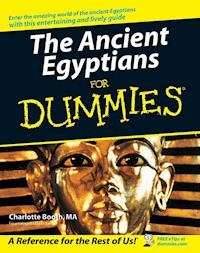
The Ancient Egyptians For Dummies
by Charlotte Booth
The Ancient Egyptians For Dummies®
Published by John Wiley & Sons, Ltd The Atrium Southern Gate Chichester West Sussex PO19 8SQ England
E-mail (for orders and customer service enquires): [email protected]
Visit our Home Page on www.wiley.com
Copyright © 2007 John Wiley & Sons, Ltd, Chichester, West Sussex, England
Published by John Wiley & Sons, Ltd, Chichester, West Sussex
All Rights Reserved. No part of this publication may be reproduced, stored in a retrieval system or transmitted in any form or by any means, electronic, mechanical, photocopying, recording, scanning or otherwise, except under the terms of the Copyright, Designs and Patents Act 1988 or under the terms of a licence issued by the Copyright Licensing Agency Ltd, 90 Tottenham Court Road, London, W1T 4LP, UK, without the permission in writing of the Publisher. Requests to the Publisher for permission should be addressed to the Permissions Department, John Wiley & Sons, Ltd, The Atrium, Southern Gate, Chichester, West Sussex, PO19 8SQ, England, or emailed to [email protected], or faxed to (44) 1243 770620.
Trademarks: Wiley, the Wiley Publishing logo, For Dummies, the Dummies Man logo, A Reference for the Rest of Us!, The Dummies Way, Dummies Daily, The Fun and Easy Way, Dummies.com and related trade dress are trademarks or registered trademarks of John Wiley & Sons, Inc. and/or its affiliates in the United States and other countries, and may not be used without written permission. All other trademarks are the property of their respective owners. Wiley Publishing, Inc., is not associated with any product or vendor mentioned in this book.
LIMIT OF LIABILITY/DISCLAIMER OF WARRANTY: The publisher, the author, AND ANYONE ELSE INVOLVED IN PREPARING THIS WORK make no representations or warranties with respect to the accuracy or completeness of the contents of this work and specifically disclaim all warranties, including without limitation warranties of fitness for a particular purpose. No warranty may be created or extended by sales or promotional materials. The advice and strategies contained herein may not be suitable for every situation. This work is sold with the understanding that the publisher is not engaged in rendering legal, accounting, or other professional services. If professional assistance is required, the services of a competent professional person should be sought. Neither the publisher nor the author shall be liable for damages arising herefrom. The fact that an organization or Website is referred to in this work as a citation and/or a potential source of further information does not mean that the author or the publisher endorses the information the organization or Website may provide or recommendations it may make. Further, readers should be aware that Internet Websites listed in this work may have changed or disappeared between when this work was written and when it is read.
For general information on our other products and services, please contact our Customer Care Department within the U.S. at 800-762-2974, outside the U.S. at 317-572-3993, or fax 317-572-4002.
For technical support, please visit www.wiley.com/techsupport.
Wiley also publishes its books in a variety of electronic formats. Some content that appears in print may not be available in electronic books.
British Library Cataloguing in Publication Data: A catalogue record for this book is available from the British Library
ISBN: 978-0-470-06544-0
Printed and bound in Great Britain by Bell and Bain Ltd, Glasgow.
Translations by James Henry Brested, B. Brier, J. and R. Janssen, Barbara S. Lesko, M. Lichtheim, C. El Mahdy, C. Nims, R. Partridge, James B. Pritchard.
With thanks to C. Banks, W. Frostick, D. Thompson, and G. Webb for their kind permission to reproduce the photographs in this book.
About the Author
Charlotte Booth is a freelance Egyptologist who started her education at Birkbeck, University of London, with a Diploma in Egyptology. From there she went to University College London and gained a degree and a Masters in Egyptian Archaeology. She is currently studying at the University of Wales, Swansea, for a PhD, and has written a number of articles and books on Egyptology. Charlotte teaches archaeology and Egyptology in various adult education institutions including the Workers’ Educational Association and Birkbeck. She is the founder of the Essex Egyptology Group.
Charlotte has worked in Egypt on the Egyptian Antiquities Information System (EAIS) project (part of the Supreme Council of Antiquities) as an Archaeological Researcher. Closer to home, she appeared on The New Paul O’Grady Show as the mummification expert!
Author’s Acknowledgements
Over the years many people have inspired me to continue researching and writing. I would like to thank my mum for giving me the all-important first break, the good education, and for her support over the years. Various Egyptologists over the years have also inspired me, including Rosalind Janssen and the late Dominic Montserrat; both were inspirational and memorable teachers. My students also help a great deal by letting me know exactly what is interesting and what is not. Apparently I get the two confused sometimes. Let’s hope I have got the right blend in this book. If I have got it right, this is due to the guidance of the For Dummies team: Sam Clapp, Rachael Chilvers, and Brian Kramer.
Publisher’s Acknowledgements
We’re proud of this book; please send us your comments through our Dummies online registration form located at www.dummies.com/register/.
Some of the people who helped bring this book to market include the following:
Acquisitions, Editorial, and Media Development
Project Editor: Rachael Chilvers
Development Editor: Brian Kramer
Content Editor: Steve Edwards
Commissioning Editor: Samantha Clapp
Copy Editor: Sally Lansdell
Proofreader: Mary White
Executive Editor: Jason Dunne
Executive Project Editor: Martin Tribe
Cover Photos: © Trip/Alamy
Cartoons: Rich Tennant (www.the5thwave.com)
Composition Services
Project Coordinator: Jennifer Theriot
Layout and Graphics: Claudia Bell, Shane Johnson, Barbara Moore, Heather Ryan, Alicia B. South, Christine Williams
Proofreaders: Laura Albert, Susan Moritz
Indexer: Aptara
Brand Reviewer: Jennifer Bingham
Publishing and Editorial for Consumer Dummies
Diane Graves Steele, Vice President and Publisher, Consumer Dummies
Joyce Pepple, Acquisitions Director, Consumer Dummies
Kristin A. Cocks, Product Development Director, Consumer Dummies
Michael Spring, Vice President and Publisher, Travel
Kelly Regan, Editorial Director, Travel
Publishing for Technology Dummies
Andy Cummings, Vice President and Publisher, Dummies Technology/General User
Composition Services
Gerry Fahey, Vice President of Production Services
Debbie Stailey, Director of Composition Services
Contents
Title
Introduction
About This Book
Conventions Used in This Book
Foolish Assumptions
How This Book Is Organised
Icons Used in This Book
Where to Go from Here
Part I : Introducing the Ancient Egyptians
Chapter 1: Getting Grounded: The Geography and History of Ancient Egypt
Splashing in the Source of Life: The Nile
Meeting the Ancient Egyptians
Unifying the Two Lands
Following the Floating Capital
Populating the Nile Valley
Climbing the Egyptian Social Ladder
Chapter 2: Examining the Lives of the Everyday Egyptians
Appreciating Village Life
Growing Up Egyptian
Considering the Lives of Women
Checking the Balance: Wages and Payment in Ancient Egypt
Tying the Knot: Marriage
Caring for the Elderly
Part II : Stepping Back in Time
Chapter 3: Building a Civilisation with Military Might
Tracing the Course of Egyptian Civilisation
Creating an Army: A Key to the New Kingdom
Chapter 4: Building the Empire: The Glories of the New Kingdom
Meeting the Egyptian Napoleon: Thutmosis III
Changing His Religion: Akhenaten
Growing Up a King: Tutankhamun
Re-establishing Imperial Power: Sety I
Fighting the Good Fight: Ramses II
Rushing the Borders: Merenptah
Sailing to Victory: Ramses III
Chapter 5: Looking at the Power Behind the Throne: Royal Women
Nothing without Him: Considering the Roles of Royal Women
The Politics of Marriage
Marrying Amun
Living with the King
Remembering the First Feminists
Chapter 6: Following the Decline and Fall of the Egyptian Civilisation
Dividing the Two Lands: Ramses XI and After
Exerting Pressure from the South: Nubian Influences
Conquering the Near East: The Assyrians
The Saite Period: Psamtik I and Others
Settling of the Persians
Invading Macedonians: Alexander the Great
Ending the Empire: The Ptolemaic Dynasty
Part III : Living Life to the Full: Culture and Beliefs
Chapter 7: Enjoying Food and Entertainment
Nourishing the Grey Matter
Telling Tall Tales
Playing Board Games
Leading a Sporting Life
Throwing Big Bashes
Chapter 8: Staying Healthy: Diseases and Medicine
Examining Egypt’s Overall Health
Becoming an Egyptian Physician
Visiting the Doctor
Opening Up and Saying ‘Agh’: Dentistry
Considering Women’s Health
Chapter 9: Worshipping like an Egyptian: Religion
Surveying the Pantheon of Egyptian Gods
Meeting the Egyptian State Gods
Worshipping the Gods
Worshipping Humans
Chapter 10: Exploring Funerary Beliefs and Mummification
Understanding the Egyptian Essence of Humanity
Cursing the Egyptologists
Getting All Wrapped Up: Mummies for Dummies
Guiding the Dead in the Underworld
Part IV : Interpreting Egyptian Art and Architecture
Chapter 11: Deciphering Egyptian Art and Hieroglyphs
Recognising the Artists
Equipping the Artists
Figuring Out Egyptian Art
Carving Masterpieces
Reading Hieroglyphs
Chapter 12: Touring the Temples
Building a Temple
Adding Finishing Touches: Obelisks and Decoration
Worshipping in the Temple
Appreciating the Roles of the King and the High Priests
Chapter 13: Excavating the Tombs: Houses of Eternity
Burying the Earliest Egyptians
Turning Pits into Palaces: Mastabas
Hewing in Rock
Interring the Divine
Embellishing Tombs: Decoration to Die For
Chapter 14: Probing the Pyramids
Defining the Shape
Filling in the Gaps: Achieving the True Pyramid Shape
Accessorising the Pyramids at Giza
Evolving Further: Later Pyramids and Complexes
Part V : The Part of Tens
Chapter 15: Top Ten Breakthroughs in Egyptology
Deciphering Hieroglyphs
Petrie’s Seriation Dating System
The Temples at Abu Simbel
The Royal Cache of 1881
KV55: The Desecrated Tomb
Tutankhamun’s Tomb
KV5: The Tomb of the Sons of Ramses II
Akhenaten’s Talatat Blocks
Palace of Cleopatra
KV63
Chapter 16: Ten Egyptians Worth Knowing
Thutmosis III: The Egyptian Napoleon
Horemheb: The Maintainer of Order
Nefertiti: The Beautiful One Has Come
Ramose: The Honest Scribe
Kenhirkhepshef: An Ancient Historian
Naunakhte: The Property Owner
Paneb: The Loveable Rogue
Mereruka: The Princess’s Husband
Asru: Chantress of Amun
Nesperenub: The Priest of Khonsu
Chapter 17: Ten Ancient Egyptian Achievements
Scientific Method
Mathematics
Astronomy
Understanding of the Human Body
Irrigation
Stone Buildings
A Surviving Wonder
Glass Production
Female Leadership
Continuing Civilisation
Chapter 18: Top Ten Places to Visit in Egypt
Giza Plateau, Cairo
Saqqara, Cairo
Museum of Egyptian Antiquities, Cairo
Tell el Amarna, Al Minya
Beni Hasan, Al Minya
Karnak Temple, Luxor
Medinet Habu, Luxor
Deir el Medina, Luxor
Luxor Museum
Abu Simbel, Aswan
Chapter 19: Ten Key Egyptologists
Giovanni Belzoni (1778–1823)
Jean-François Champollion (1790–1832)
Karl Lepsius (1819–84)
Amelia Edwards(1831–92)
W. M. Flinders Petrie (1853–1942)
Howard Carter (1874–1939)
Alan Gardiner (1879–1963)
Jac Janssen (born 1922)
Kent Weeks (born 1941)
Rosalie David (born 1947)
: Further Reading
Introduction
As a 5-year-old child, I only ever wanted to spend my Saturdays at the British Museum looking at the mummies – until my own mummy started to think I was odd. But nothing is odd about mummies (the ancient Egyptian or the parental kind). The Egyptian mummy was a fundamental part – albeit a small part – of Egyptian funerary beliefs and culture. The mummy has now become an iconic image of Egypt, and many horror films have given it a bad name. Other than questions about mummies, the first thing anyone ever asks me as an Egyptologist is ‘So who built the pyramids?’ or ‘Was Tutankhamun murdered?’ As valid as these questions are, Egyptology (the study of ancient Egypt) offers so many more interesting things to discover and explore than these age-old queries. (And while others have answered these questions frequently and well, I offer my plain-English answers too in this book.)
In my opinion, some smaller pieces of research in Egypt are far more impressive than the pyramids, such as examining clay objects that still bear the fingerprints of ancient craftsmen, discovering the specific diseases an individual suffered from prior to being mummified, or reading a note from a woman to her dressmaker stating she ‘has nothing to wear’ (we’ve all been there). These small insights into the lives of the people who make up a history that is now world famous better answer the question ‘Who were the Egyptians?’ After you know who the ancient Egyptians were, figuring out how they built the pyramids doesn’t seem like such a monumental question.
The ancient Egyptians were just like modern humans: They wanted to build pyramids, so they used all their available resources and did it. No mystery. In fact, I’m sure the ancient Egyptians would have loved a book entitled Westerners of the 21st Century AD For Dummies, so they could learn about this futuristic society that is so primitive it can’t even build pyramids!
I think it essential to stop thinking of the ancient Egyptians as some bizarre civilisation so far removed from modern life that the people are undecipherable. They were amazingly similar to us, with the same drives, motivations, emotions, and weaknesses. I hope this book goes some way to helping you make a connection with this fascinating culture and the colourful individuals who created it.
About This Book
Egyptian history has been described as a jigsaw with half the pieces missing, no picture, and no indication of how many pieces there are – it is a daunting task to try to recreate a history that makes sense. Every year, new excavations uncover information that changes or adds another dimension to the available history of this culture. What this means in regard to this book is that I present the history of Egypt as it stands today. In ten years’ time, it may look different due to new discoveries and new interpretations of the evidence – and this book would need to be updated.
The Nile Valley (a romantic way of saying Egypt) was relatively small and only covered about a mile on each side of the Nile river, but its people achieved so much. Generals waged numerous battles and went on expeditions, priests honoured a pantheon of gods numbering nearly 1,000, and hundreds of kings with what appear to be unpronounceable names (many of them the same – for example, there are eleven King Ramses) produced great architectural feats. In addition to the pyramids, the most iconic image of Egypt, ancient Egypt featured an array of temples, palaces, villages, and subterranean tombs, all with religious elements and iconic imagery, built and added to over hundreds of years.
Hundreds of texts are available from ancient Egypt that help explain the lives and beliefs of the kings, the priests, and even the ordinary people. This book weaves together all these stories to create a complicated but beautiful tapestry of the lives of the Egyptians.
If you think you’ll mispronounce all those odd names, confuse the religious practices, and get your dynasties in a diddle, relax. This book presents more than 3,000 years of history as a straightforward outline of eras and periods. To the basic sketch, I then add clusters of intriguing details about ancient Egyptian lifestyle, culture, religion, and beliefs. Further chapters layer on insights about the incredible art and buildings produced by the ancient Egyptians. It’s a fascinating journey, and you’re going to love it.
Conventions Used in This Book
The dating system used in ancient Egypt was complicated. Surviving records use regnal years (for example, ‘year 16 of Ramses II’) rather than a centralised calendar (‘1450 BC’). However, the Greek traveller Manetho divided ancient Egypt’s 3,000-year history into 30 dynasties, and his system is still applied today. This is what this book uses.
Ascertaining exact dates for these dynasties is difficult, but I have added accepted chronological dates to give an idea of when events happened, although I also refer to general eras such as the 18th dynasty, 19th dynasty and so on. All dates are BC (before Christ) unless otherwise stated. Many people prefer BCE (before the Common Era), but I opt for BC because it’s more traditional.
The names of kings are often spelt differently from publication to publication, sometimes with Greek versions of the name being used (Cheops instead of the Egyptian Khufu,for example). As an Egyptologist, I use the Egyptian version of the name that the people themselves would recognise, except when the Greek is the better known (for example, I use Thebes rather than Waset for modern Luxor).
Foolish Assumptions
I assume, perhaps wrongly, that you:
Are interested in Egyptology through watching popular television shows, going to movies, and visiting museums
Know a little about pyramids, Tutankhamun, and Cleopatra, but do not know how these flashy topics and figures fit into the wider history of ancient Egypt
Find general books on Egypt and history dry, confusing, and uninviting
Want to find out more – as long as the journey is interesting
How This Book Is Organised
You can either read this book from cover to cover, or you can dip in and out if you prefer. You can jump from chapter to chapter as their contents interest you. You can even skip around in each chapter, because each subsection offers information on a specific, selected topic. I also provide numerous cross-references between sections and chapters so you can easily jump from topic to topic and quickly locate the parts of the book that cover the specific aspects of Egyptology that you find most captivating.
The following information gives you an idea of what you can find in each part of the book.
Part I: Introducing the Ancient Egyptians
The landscape and ecology of Egypt were fundamental to the formation of the civilisation and are essential to understanding the culture, government, and even religion that developed along the Nile river. This part looks at the foundations of the ancient Egyptian culture, including its villages, careers, and social arrangements (marriage, divorce, and more). The social structure of Egyptian civilisation was particularly important, with the king at the top and everyone else beneath him, as this part details.
Part II: Stepping Back in Time
This part is the true story behind all the monuments. It covers the personalities who built them, fought for them, and later dismantled them. I take you on a chronological journey through more than 3,000 years of history, starting at the very beginning of Egyptian civilisation in the pre-dynastic period, and travelling down the timeline to the Roman invasion at the death of Cleopatra in 30 BC. This history is pitted with battles, especially in the period known as the New Kingdom, when Egypt had its first permanent army. This part investigates the life of a soldier, including the gruesome battle techniques, the victories, and the near misses.
It also considers the role of Egypt’s women – including notable queens as well as working-class wives and mothers. This part ends with the collapse of the Egyptian civilisation after a period of constant invasion and divided rule – the sobering end to a dynamic culture.
Part III: Living Life to the Full: Culture and Beliefs
The Egyptians loved life – partying, hunting, eating, dancing, and chatting with their friends. Compare the intricacies of your own social life with that of the Egyptians and be amazed at the similarities. Sadly a part of life, now and then, is disease and illness, and the Egyptians suffered many of the same ailments as modern humans – although I wouldn’t recommend their cures!
When the cures didn’t work, death often followed and involved a great number of funerary beliefs and practices. Nowadays, mummification is synonymous with ancient Egypt, although the Egyptians were not the only culture to practise it. Mummification practices were slow in developing, but quickly became an essential part of the afterlife of the deceased, because without a body, the afterlife is pretty dull. To further prevent boredom, all the deceased’s belongings were dumped in tombs for use after rebirth.
The Egyptians loved life so much they wanted it to continue for as long as possible. However, mummification and funerary practices are not the only religious beliefs covered in this part. The temples in Egypt were closed to the public, so the Egyptians developed two forms of religion – a complex state religion with the king as a direct communicator with the gods, and an equally rich household religion with a completely new set of gods to help with specific aspects of life, such as health, fertility, and childbirth.
Part IV: Interpreting Egyptian Art and Architecture
Part IV starts with the deciphering of the Egyptian hieroglyphic language, one of the most fundamental discoveries of Egyptology. Artwork is also a substantial part of any document (and of architectural remains), and being able to ‘read’ artwork is as important as reading the texts. This part explains some of the fundamental characteristics of Egyptian art.
This part also includes a study of the monumental structures of the Egyptians, including temples, tombs, and pyramids. The Egyptians did nothing randomly or because it looked nice (but it has to be said it all looks nice as well). Instead, a religious ideology influences every ancient Egyptian architectural element. So as I explore these incredible structures, I also introduce you to the inspiration behind them.
Part V: The Part of Tens
This part gives you easy-in, easy-out information, including a list of ten famous Egyptologists and ten critical discoveries and milestones in the discipline of Egyptology. You meet ten Egyptian personalities who helped the culture develop, as well as examples of the top achievements of this culture. I also present my list of ten great places to visit in Egypt.
Icons Used in This Book
Egyptology gets people thinking and coming up with their own interpretations of a complex history and culture. I use a number of icons to help highlight some of the points you may be thinking about.
We’re lucky to have so many written records from ancient Egypt. Where you see this icon, you know you’re reading the words of the ancients.
Many beliefs about ancient Egypt aren’t true or are misinterpreted. Where you see this symbol, these myths are explained away.
This icon pinpoints important information that’s essential for understanding future information.
There are many aspects of Egyptian history that get the response ‘No way! You’re making it up!’ This icon shows that the information is true, no matter how bizarre.
These are intricate details that aren’t essential for understanding the section. Skip these as you wish or absorb them so you can be the nerd at the party!
Where to Go from Here
Well, tradition says start at the beginning and continue until the end; but the thing about traditions is that someone years ago made them up because they seemed good ideas at the time. New traditions can be created right here! Simply jump in and out of the following pages and read them in whatever order you like. All the information is fun and interesting (I promise!), so does it matter what order you read it in?
If you’re interested in the pyramids, dash to Chapter 14, or if you want to join the troops in the military, march to Chapter 3. If you want the gruesome details of mummification, flip to Chapter 10. But if you’re a stickler for tradition and want to build your understanding of the roots of this intriguing culture, simply turn to the next page.
Part I
Introducing the Ancient Egyptians
In this part . . .
The ancient Egyptians are famous throughout the world for their pyramids and lashings of gold jewellery. However, this is only part of the story. The Egyptians were part of a large, intricate society, with the king at the top and the unskilled workers at the bottom. Rather like a pyramid, in fact.
Luckily, the Egyptians left loads of information regarding their everyday lives. This part explores the houses they lived in and with whom, their education system, and their social arrangements concerning marriage, divorce, adultery, childbirth, and the elderly.
Chapter 1
Getting Grounded: The Geography and History of Ancient Egypt
In This Chapter
Exploring the landscape of Egypt
Unifying the two lands
Examining the hierarchy of Egyptian society
The ancient Egyptians have gripped the imagination for centuries. Ever since Egyptologists deciphered hieroglyphs in the early 19th century, this wonderful civilisation has been opened to historians, archaeologists, and curious laypeople.
Information abounds about the ancient Egyptians, including fascinating facts on virtually every aspect of their lives – everything from the role of women, sexuality, and cosmetics, to fishing, hunting, and warfare.
Lesen Sie weiter in der vollständigen Ausgabe!
Lesen Sie weiter in der vollständigen Ausgabe!
Lesen Sie weiter in der vollständigen Ausgabe!
Lesen Sie weiter in der vollständigen Ausgabe!
Lesen Sie weiter in der vollständigen Ausgabe!
Lesen Sie weiter in der vollständigen Ausgabe!
Lesen Sie weiter in der vollständigen Ausgabe!
Lesen Sie weiter in der vollständigen Ausgabe!
Lesen Sie weiter in der vollständigen Ausgabe!
Lesen Sie weiter in der vollständigen Ausgabe!
Lesen Sie weiter in der vollständigen Ausgabe!
Lesen Sie weiter in der vollständigen Ausgabe!
Lesen Sie weiter in der vollständigen Ausgabe!
Lesen Sie weiter in der vollständigen Ausgabe!
Lesen Sie weiter in der vollständigen Ausgabe!
Lesen Sie weiter in der vollständigen Ausgabe!
Lesen Sie weiter in der vollständigen Ausgabe!
Lesen Sie weiter in der vollständigen Ausgabe!
Lesen Sie weiter in der vollständigen Ausgabe!
Lesen Sie weiter in der vollständigen Ausgabe!
Lesen Sie weiter in der vollständigen Ausgabe!
Lesen Sie weiter in der vollständigen Ausgabe!
Lesen Sie weiter in der vollständigen Ausgabe!




