



0,49 €
Niedrigster Preis in 30 Tagen: 0,00 €
Niedrigster Preis in 30 Tagen: 0,00 €
Mehr erfahren.
- Herausgeber: DigiCat
- Kategorie: Religion und Spiritualität
- Sprache: Englisch
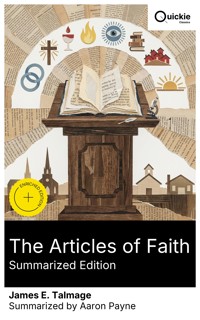
James E. Talmage's "The Articles of Faith" meticulously unpacks the fundamental beliefs of The Church of Jesus Christ of Latter-day Saints through a scholarly lens. Talmage employs a clear, didactic literary style, combining theological exposition with historical context, making complex doctrines accessible to both lay readers and scholars. As a systematic treatise, the work explores the twelve Articles of Faith, examining their implications for personal spirituality and community beliefs in the context of late 19th-century America, when religious pluralism prompted a compelling defense of Latter-day Saint theology. Born in 1862 in England, Talmage was a noted scientist, theologian, and educator whose deep understanding of both faith and reason paved the way for his profound insights in this work. His experiences in the Latter-day Saint community and his extensive academic background illuminated his approach, allowing him to blend rigorous scholarship with fervent devotion. His role as an apostle and his commitment to articulate the doctrines of his faith further underscore the significance of his contributions to Mormon literature. "The Articles of Faith" is an essential read for anyone seeking to understand the core tenets of Mormonism. It shines a light on the intricacies of faith and its intersection with life and society, making it a valuable resource for both serious scholars and inquisitive readers looking to deepen their understanding of Latter-day Saint beliefs. In this enriched edition, we have carefully created added value for your reading experience: - A succinct Introduction situates the work's timeless appeal and themes. - The Synopsis outlines the central plot, highlighting key developments without spoiling critical twists. - A detailed Historical Context immerses you in the era's events and influences that shaped the writing. - A thorough Analysis dissects symbols, motifs, and character arcs to unearth underlying meanings. - Reflection questions prompt you to engage personally with the work's messages, connecting them to modern life. - Hand‐picked Memorable Quotes shine a spotlight on moments of literary brilliance. - Interactive footnotes clarify unusual references, historical allusions, and archaic phrases for an effortless, more informed read.
Das E-Book können Sie in Legimi-Apps oder einer beliebigen App lesen, die das folgende Format unterstützen:
Veröffentlichungsjahr: 2022
Ähnliche




The Articles of Faith
Table of Contents
Introduction
Balancing the immediacy of revealed faith with the discipline of clear explanation, The Articles of Faith unfolds as a sustained effort to translate conviction into understanding, offering readers a carefully reasoned pathway through Latter-day Saint doctrine while acknowledging the reverent mystery that animates it, so that belief is neither reduced to mere assertion nor surrendered to skepticism, but instead tested, clarified, and enlarged by scriptural engagement, historical awareness, and moral reflection, inviting both adherents and inquirers to see how a living tradition can speak in the language of reason without forfeiting the wonder and worship at its heart.
As a work of religious nonfiction—part doctrinal treatise, part catechetical handbook—James E. Talmage's The Articles of Faith arose in the American West at the close of the nineteenth century, when the Church of Jesus Christ of Latter-day Saints was clarifying its public voice and expanding its missionary reach. Developed from classroom lectures and refined for publication, the volume systematizes a concise statement of belief into a full exposition. Its historical moment matters: scientific learning, institutional consolidation, and national scrutiny pressed believers to articulate what they taught and practiced, and this book entered that milieu with a scholarly, accessible, and pastoral ambition.
At its core, the book takes the brief, widely recognized Articles of Faith and treats each as a gateway into doctrine, worship, and daily discipleship, moving from first principles to lived implications with steadiness and care. The voice is confident yet invitational, drawing extensively on scriptural texts and reasoning by orderly argument. Readers encounter definitions, distinctions, and illustrative examples rather than polemic. The style is measured, patient, and pedagogical; the tone is earnest without being strident. One can read sequentially as a sustained catechesis or consult chapters as a reference, and in both modes the prose aims for clarity over flourish.
Methodically, Talmage proceeds by identifying a doctrinal locus, assembling relevant passages from the Bible and Latter-day Saint scriptures, and then organizing the material into coherent sections that explain terms, relate teachings to each other, and anticipate common questions. He frequently marks distinctions that keep concepts from collapsing into vagueness, and he traces practical consequences that show why belief matters. The chapters build a cumulative picture without requiring technical background, modeling how to read sacred texts in conversation rather than in isolation. The result is a lucid framework in which doctrines appear, not as isolated propositions, but as interdependent parts of a living whole.
Important themes recur across the exposition: the nature of Deity and the relationship within the Godhead; the meaning of revelation and continuing guidance; moral agency and accountability; the role of ordinances and covenant belonging; the reality of redemption and resurrection; spiritual gifts and church organization; and the hope that anchors history in divine purpose. Restoration is a through-line, not as novelty for its own sake but as recovery and completion of truths attested in scripture. The book frames theology as a pattern for discipleship, showing how beliefs shape worship, service, and character, and how doctrine orders personal and communal life.
For contemporary readers, the volume matters as a clear, primary-window account of Latter-day Saint belief at a time when summaries can be fragmentary or polemical. It offers a disciplined model for reasoning within faith, useful to anyone interested in how religious traditions articulate themselves with intellectual integrity. It also supports interfaith literacy by stating what the community teaches in its own terms. In an age of rapid information and abbreviated attention, the patient, cumulative style rewards slow reading, and the book’s emphasis on practice as well as principle speaks to seekers who want beliefs to bear ethical and communal fruit.
Approached as a guide rather than a verdict, The Articles of Faith invites readers to inhabit questions, test definitions against scripture, and watch as a coherent map of belief emerges from faithful reasoning. Its late-nineteenth-century provenance is evident in diction and examples, yet its architecture remains serviceable: concepts are defined, relationships clarified, and implications traced. Whether read by Latter-day Saints seeking depth, by students of American religious history, or by neighbors pursuing understanding, the book rewards attention with order, candor, and scope. To enter its pages is to see how a tradition explains itself—and how explanation can deepen devotion.
Synopsis
The Articles of Faith, first published in 1899 by James E. Talmage, offers a systematic exposition of the principal doctrines of The Church of Jesus Christ of Latter-day Saints. Built around the thirteen brief statements composed by Joseph Smith in the nineteenth century, the book expands each into sustained discussion. Talmage writes as a careful interlocutor with biblical texts, Latter-day Saint scripture, and Christian theology, aiming to clarify belief and practice rather than to argue polemically. The work proceeds article by article, establishing definitions, historical context, and scriptural bases while indicating how doctrines interlock to present a coherent view of God, humanity, and salvation.
Beginning with the nature of Deity, Talmage explains the Latter-day Saint understanding of the Godhead as united in purpose while personally distinct, rooting that view in scripture. He then addresses moral agency and responsibility, emphasizing that accountability attaches to individual choices rather than inherited guilt. From there he presents the central claim that redemption comes through Jesus Christ, whose atoning work makes salvation possible on conditions ordained by God. These opening chapters introduce themes of divine law, grace, resurrection, and human potential, framing how subsequent teachings about ordinances, authority, and community operate within a redemptive plan.
Turning to the first principles and ordinances of the gospel, Talmage develops faith in Jesus Christ as trust that leads to loyalty and action, and repentance as sincere change of heart and behavior. He treats baptism by immersion as a covenantal rite instituted by Christ, symbolizing cleansing and new life when administered by proper authority. He then expounds the laying on of hands for the gift of the Holy Ghost as a distinct ordinance that imparts divine influence for guidance and sanctification. Together, these elements form the entryway into Christian discipleship as understood by Latter-day Saints, preparing believers for lifelong growth.
He next considers the necessity of priesthood authority, contending that legitimate ministry requires calling by prophecy and ordination from those who hold divine commission. This claim is set within a narrative of ancient authority lost and restored, providing the rationale for distinct practices and sacraments. Talmage then outlines the organization of the Church, describing roles such as apostles, prophets, pastors, teachers, and evangelists, and explaining how spiritual gifts and administrative offices combine to build unity and order. Attention is given to the purposes of councils and quorums, the diffusion of responsibility, and the expectation that governance operates through revelation and service.
On spiritual gifts, Talmage surveys manifestations like healing, prophecy, tongues, and interpretation, presenting them as continuing signs that accompany faith and as means for edifying the community. He differentiates genuine gifts from counterfeits by their fruits and alignment with revealed doctrine. The discussion of scripture affirms the Bible as sacred while acknowledging the importance of accurate transmission, and it presents the Book of Mormon alongside other Latter-day Saint revelations as additional witnesses of Christ. Finally, the principle of continuing revelation anchors the belief that God still speaks to guide the Church, ensuring adaptability without surrendering core truths.
With eschatological promises in view, Talmage explains the gathering of Israel and the restoration of covenant identity as ongoing, literal processes with spiritual dimensions. He describes expectations surrounding the establishment of Zion, including the building of a New Jerusalem, and situates these hopes within larger Christian teachings about the return of Jesus Christ. The text outlines a millennial reign that brings renewal to the earth, connecting prophetic promises to ethical living in the present. Rather than fixating on timetables, the argument emphasizes preparation, holiness, and communal responsibility as the faithful response to prophesied events and divine assurances.
The closing chapters treat religious liberty and civic duty, asserting the right to worship according to conscience while extending that allowance to all people, and urging obedience to civil law. Talmage concludes with a portrait of Christian character that values honesty, chastity, benevolence, learning, and the pursuit of every good thing. Across the volume, he integrates scripture, reason, and history to articulate a distinctly Latter-day Saint theology in dialogue with broader Christianity. The book’s measured explanations and comprehensive scope have made it a durable guide for understanding Latter-day Saint belief, offering a framework whose clarity has remained influential over time.
Historical Context
The Articles of Faith by James E. Talmage appeared in 1899 in Salt Lake City, the headquarters of The Church of Jesus Christ of Latter-day Saints. Commissioned by the Church’s First Presidency, it systematized public lectures Talmage delivered during the 1890s to explain Latter-day Saint doctrine. Talmage, an English-born Latter-day Saint scholar and educator who had emigrated to Utah, brought academic rigor to the project. The volume offered a comprehensive exposition intended for members, missionaries, and interested outsiders. Its release coincided with institutional consolidation in Utah, when Church leaders sought clear, accessible statements of belief to present to a national and international audience.
Underlying the book were the thirteen “Articles of Faith,” a concise summary of Latter-day Saint beliefs first written by Joseph Smith in 1842 as part of the so‑called Wentworth letter, published in the Nauvoo newspaper Times and Seasons. The Articles were later included by Apostle Franklin D. Richards in the 1851 Pearl of Great Price, a collection of Latter-day Saint texts for British readers. In 1880, the Church adopted the Pearl of Great Price as scripture, giving the Articles canonical status. Talmage’s task in 1899 was to explicate these brief statements in detail, anchoring each to scripture and history for a broad readership.
In the decades before publication, the Church faced sustained federal pressure over plural marriage. Congress passed the Morrill Anti‑Bigamy Act (1862), the Edmunds Act (1882), and the Edmunds–Tucker Act (1887), resulting in prosecutions, property seizures, and disenfranchisement. In 1890 President Wilford Woodruff issued the Manifesto advising Latter-day Saints to refrain from future plural marriages, a decisive step toward accommodation with U.S. law. Utah achieved statehood in 1896. In this climate, Church leaders emphasized articulating core doctrines beyond the polygamy controversy. Talmage’s volume helped present a systematic, nonpolemical account of belief at a moment when public scrutiny of Latter-day Saint identity remained intense.
By the 1890s, Latter-day Saint missionary work had decades of experience in the British Isles, Scandinavia, continental Europe, and the Pacific, and was expanding in North America. Standardized teaching materials were increasingly needed to train missionaries and instruct converts. At the same time, the Church invested in education through the Deseret Sunday School Union and a network of Church schools in Utah, including institutions in Salt Lake City where Talmage taught and administered. The Articles of Faith grew from lectures delivered in this educational environment, then revised for publication, allowing consistent doctrinal instruction across missions while addressing common questions from the public.
Talmage’s intellectual formation shaped the book’s tone. Trained in the sciences at Lehigh University and Johns Hopkins University, and later a professor in Utah, he cultivated a method that emphasized definition, classification, and appeals to evidence. Late nineteenth‑century readers were attuned to scientific discourse and historical reasoning; Talmage crafted arguments that sought harmony between revelation and rational inquiry. Without abandoning distinctive Latter-day Saint claims, he used careful citations from the Bible and Latter-day Saint scripture, historical references, and precise terminology. This approach reflected a broader Latter-day Saint effort to demonstrate that its theology could withstand scholarly examination amid an increasingly professionalized intellectual culture.
American religious life in the 1890s featured vigorous public debate, denominational publishing, and comparative study of religions, exemplified by the World’s Parliament of Religions at the 1893 Chicago World’s Fair. Anti‑Mormon tracts circulated widely, while Latter‑day Saints produced their own periodicals and manuals. Catechisms and confessional statements remained common across Protestant and Catholic traditions. Talmage’s work fit this print culture by offering a sustained, source‑driven exposition rather than a brief pamphlet or a polemic. It situated Latter‑day Saint belief within recognizable theological categories while explaining differences, aiming to correct misrepresentations and to make the Church intelligible to educated readers.
The first edition appeared under Church auspices in Salt Lake City and was promptly used in Sunday School, missionary preparation, and adult theological study. Subsequent printings in the early twentieth century kept the text in circulation as a standard reference work. In 1911 Talmage entered the Quorum of the Twelve Apostles, further cementing the book’s authority, and his later Jesus the Christ (1915) complemented the doctrinal framework he had outlined. The Articles of Faith thus moved from classroom lectures to an institutional handbook, aligning Church publishing with its administrative and missionary programs and giving a durable, approved account of core teachings.
As a product of post‑Manifesto, pre‑Progressive Era Utah, the volume both reflects and critiques its time. It reflects efforts to normalize relations with the nation by emphasizing faith, ordinances, scripture, and church organization through clear, systematic argument. It implicitly critiques sensational portrayals by foregrounding doctrine rather than conflict, and by integrating scientific vocabulary and historical method without ceding religious authority. While staying within the canonical scope of the Articles of Faith, Talmage’s exposition showcases a Church consolidating institutions, expanding globally, and engaging public discourse with confidence, signaling a transition from embattled regional movement to self‑conscious, worldwide religious tradition.
The Articles of Faith
PREFACE TO FIRST EDITION.
The lectures herewith presented have been prepared in accordance with the request and appointment of the First Presidency of the Church. The greater number of the addresses were delivered before the Theology Class of the Church University; and, after the close of the class sessions, the lectures were continued before other Church organizations engaged in the study of theology. To meet the desire expressed by the Church authorities—that the lectures be published for use in the various educational institutions of the Church—the matter has been revised, and is now presented in this form.
In anticipation of probable question or criticism regarding the disparity of length of the several lectures, it may be stated that each of the addresses occupied two or more class sessions, and that the present arrangement of the matter in separate lectures is rather one of compilation than of original presentation.
The author's thanks are due and are heartily rendered to the members of the committee appointed by the First Presidency, whose painstaking and efficient examination of the manuscript prior to the delivery of the lectures, has inspired some approach to confidence in the prospective value of the book among members of the Church. The committee here referred to consisted of Elders Francis M. Lyman, Abraham H. Cannon, and Anthon H. Lund, of the Quorum of the Twelve Apostles; Elder George Reynolds, one of the Presidents of the Presiding Quorum of Seventy; Elder John Nicholson, and Dr. Karl G. Maeser.
The lectures are now published by the Church, and with them goes the hope of the author that they may prove of some service to the many students of the scriptures among our people, and to other earnest inquirers into the doctrines and practices of the Church of Jesus Christ of Latter-day Saints.
James E. Talmage.
Salt Lake City, Utah, April 3, 1899.
THE ARTICLES OF FAITH
OF THE CHURCH OF JESUS CHRIST OF LATTER-DAY SAINTS.
1. We believe in God, the Eternal Father, and in His Son, Jesus Christ, and in the Holy Ghost.
2. We believe that men will be punished for their own sins, and not for Adam's transgression.
3. We believe that through the atonement of Christ, all mankind may be saved, by obedience to the laws and ordinances of the Gospel.
4. We believe that the first principles and ordinances of the Gospel are:—(1) Faith in the Lord Jesus Christ; (2) Repentance; (3) Baptism by immersion for the remission of sins; (4) Laying on of Hands for the Gift of the Holy Ghost.
5. We believe that a man must be called of God, by prophecy, and by the laying on of hands, by those who are in authority, to preach the Gospel and administer in the ordinances thereof.
6. We believe in the same organization that existed in the Primitive Church, viz.: apostles, prophets, pastors, teachers, evangelists, etc.
7. We believe in the gift of tongues, prophecy, revelation, visions, healing, interpretation of tongues, etc.
8. We believe the Bible to be the word of God, as far as it is translated correctly; We also believe the Book of Mormon to be the word of God.
9. We believe all that God has revealed, all that He does now reveal, and we believe that He will yet reveal many great and important things pertaining to the Kingdom of God.
10. We believe in the literal gathering of Israel and in the restoration of the Ten Tribes; that Zion will be built upon this [the American] continent; That Christ will reign personally upon the earth; and, That the earth will be renewed and receive its paradisiacal glory.
11. We claim the privilege of worshiping Almighty God according to the dictates of our own conscience, and allow all men the same privilege, let them worship how, where or what they may.
12. We believe in being subject to kings, presidents, rulers, and magistrates, in obeying, honoring, and sustaining the law.
13. We believe in being honest, true, chaste, benevolent, virtuous, and in doing good to all men; indeed, we may say that we follow the admonition of Paul. We believe all things, we hope all things, we have endured many things, and hope to be able to endure all things. If there is anything virtuous, lovely, or of good report or praiseworthy, we seek after these things.—Joseph Smith.
LECTURES ON THE ARTICLES OF FAITHOF THE CHURCH OF JESUS CHRIST OF LATTER-DAY SAINTS.
LECTURE I. INTRODUCTORY.
1. Importance of Theological Study.—In the short period of time that measures the span of mortal existence, it is not possible for man to explore any considerable portion of the vast realm of knowledge; it becomes, therefore, the part of wisdom to select for study the branches that promise to prove of the greatest worth. All truth is of value—above price indeed in its place[1q]; yet with respect to their possible application, some truths are of incomparably greater worth than are others. A knowledge of the principles of trade is essential to the success of the merchant; an acquaintance with the laws of navigation is demanded of the mariner; familiarity with the relation of soil and crops is indispensable to the farmer; an understanding of the profound principles of mathematics is necessary to the engineer and the astronomer; so too is a practical knowledge of God essential to the salvation of every human soul that has attained to powers of judgment and discretion. The value of theological knowledge, therefore, ought not to be under-rated; it is doubtful if its importance can in any way be over-estimated.
2. What is Theology?—The word "theology" is of Greek origin; it comes to us from Theos, meaning God, and logos—a treatise, or discourse, signifying by derivation, therefore, collated knowledge of Divinity, or the science that teaches us of God, implying also the relation existing between the Supreme Being and His creatures. The term is of very ancient usage, and may be traced to pagan sources. Plato and Aristotle speak of theology as the doctrine of Deity and divine things. Concisely defined, theology "is that revealed science which treats of the being and attributes of God, His relations to us, the dispensations of His providence, His will with respect to our actions, and His purposes with respect to our end."1
3. It has been held by some as a truth, that theological knowledge is not properly a subject for analytical and otherwise scientific treatment on the part of man; that inasmuch as a true conception of Deity, with which theology has primarily to deal, must necessarily be based upon revelation from the source divine, we can but receive such knowledge as it is graciously given; and that to attempt critical investigation thereof by the fallible powers of human judgment would be to apply as a measure of the doings of God the utterly inadequate wisdom of man. Many truths are beyond the scope of unaided human reason, and theological facts have been declared to be above reason; this is true so far as the same remark might be applied to any other kind of truth; for all truth, being eternal, is superior to reason in the sense of being manifest to reason, but not a creation of reason; nevertheless truths are to be estimated and compared by the exercise of reason.
4. The Extent of Theology.—Who can survey the boundaries of this science? It deals with Deity—the fountain of knowledge, the source of wisdom; with the proofs of the existence of a Supreme Being, and of other supernatural personalities; with the conditions under which, and the means by which, divine revelation is imparted; with the eternal principles governing the creation of worlds; with the laws of nature in all their varied manifestations. Primarily, theology is the science of God and religion; it seeks to present "the systematic exhibition of revealed truth, the science of Christian faith and life." But in a more general sense, theology has to do with other truths than those which are specifically called spiritual; its domain is co-extensive with that of truth.
5. The industrial pursuits that benefit mankind, the arts that please and refine, the sciences that enlarge and exalt the mind, are but fragments of the great though yet uncompleted volume of truth that has come to earth from a source of eternal and infinite supply. The comprehensive study of theology, therefore, would embrace all known truths. God has constituted Himself as the great teacher;2 by personal manifestations or through the ministrations of His appointed servants, He instructs His mortal children. To Adam He introduced the art of agriculture,3 and even taught by example that of tailoring;4 to Noah and Nephi He gave instructions in ship building;5 Lehi and Nephi were taught of Him in the arts of navigation;6 and for their guidance on the water, as in their journeyings on land, He prepared for them the Liahona[1].7 a compass operated by a force more effective than that of terrestrial magnetism; furthermore, Moses received divine instructions in architecture.8
6. Theology and Religion, though closely related, are by no means identical. A person may be deeply versed in theological lore, and yet be lacking in religious, and even in moral traits. Theology may be compared to theory, while religion represents practice; if theology be precept, then religion is example. Each should be the complement of the other; theological knowledge should strengthen religious faith and practice. As accepted by the Latter-day Saints, theology comprehends the whole plan of the gospel. "Theology is ordered knowledge, representing in the region of the intellect what religion represents in the heart and life of man."9 Knowledge may have to do with the intellect only, and however sublime its import, it may fail to affect the hardened heart.
7. The "Articles of Faith."—The beliefs and prescribed practices of most religious sects are usually set forth in formal creeds. The Latter-day Saints announce no creed as a complete code of their faith; for while they hold that the precepts of eternal life are unchangeable, they accept the principle of continuous revelation as a characteristic feature of their belief. However, when asked for a concise presentation of the principal religious views of his people, Joseph Smith, the first prophet of the Church in the present dispensation, announced as a declaration of belief the "Articles of Faith of the Church of Jesus Christ of Latter-day Saints." These include the more essential and characteristic features of the gospel as accepted by this Church; but they are not complete as an exposition of our belief, for by one of the Articles it is declared, "We believe all that God has revealed, all that He does now reveal, and we believe that He will yet reveal many great and important things pertaining to the Kingdom of God." From the time of their first promulgation, the Articles of Faith have been accepted by the people,10 and on October 6, 1890, the Latter-day Saints, in general conference assembled, re-adopted the Articles as part of their guide in faith and conduct. As these Articles of Faith present the leading tenets of the Church in systematic order, they suggest themselves as a convenient outline for our plan of study.
8. The Standard Works of the Church form our written authority in doctrine; but they are by no means our only sources of information and instruction on the theology of the Church. We believe that God is as willing to-day as He ever has been to reveal His mind and will to man, and that He does so through chosen and appointed channels. We rely therefore on the teachings of the living oracles of God as of equal validity with the doctrines of the written word, the men in chief authority being acknowledged and accepted by the Church as prophets and revelators, and as being in possession of the power of the holy Priesthood. The written works adopted by the vote of the Church as authoritative guides in faith and doctrine are four—the Bible, the Book of Mormon, the Doctrine and Covenants, and the Pearl of Great Price. Other works have been and are being issued by officers and members of the Church, and many such books are unreservedly sanctioned by the people and their ecclesiastical authorities; but the four publications named are the only regularly constituted standard works of the Church. Of the doctrine treated in the authorized standards, the Articles of Faith may be regarded as a fair, though necessarily but an incomplete epitome.
JOSEPH SMITH, THE PROPHET.
9. Joseph Smith, whose name is appended to the Articles of Faith, was the prophet through whom the Lord restored to earth in these the last days the Gospel, and this in accordance with predictions made in previous dispensations. The question of the divine authenticity of this man's mission is an all-important one to earnest investigators of Latter-day Saint doctrines. If his claims to a God-given appointment be false, forming, as they do, the foundation of the Church in the last dispensation, the superstructure cannot be stable; if, however, his purported ordination under the hands of heavenly personages be a fact, one need search no further for the cause of the phenomenal strength and growing power of the restored Church. The circumstances of the divine dealings with Joseph Smith, the marvelous development of the work instituted by this modern prophet, the fulfilment through his instrumentality of many of the grandest predictions of old, and his own prophetic utterances with their literal realizations, will yet be widely acknowledged as proof conclusive of the validity of his ministry.11 The exalted claims maintained for him and his life's work, the fame that has made his name known for good or evil among most of the civilized nations of the earth, the vitality and growing strength of the religious and social systems which owe their origin as nineteenth-century establishments to the ministrations of this man, give to him an individual importance warranting at least a passing consideration.
10. His Parentage and Youth.—Joseph Smith, the third son and fourth child in a family of ten, was born December 23d, 1805, at Sharon, Windsor County, Vermont. He was the son of Joseph and Lucy Mack Smith—a worthy couple, who though in poverty lived happily amid their home scenes of industry and frugality. When the boy, Joseph, was ten years old, the family left Vermont and settled in the State of New York, first at Palmyra, and later at Manchester, Ontario County. At the place last named, the future prophet spent most of his boyhood days. In common with his brothers and sisters, he had but little schooling; and for the simple rudiments of an education, which by earnest application he was able to gain, he was mostly indebted to his parents, who followed the rule of devoting a portion of their limited leisure to the teaching of the younger members of the household.
11. In their religious inclinations, the family favored the Presbyterian church, the mother and three or four of the children having united themselves with that sect; but Joseph, while at one time favorably impressed by the Methodist creed, kept himself free from all sectarian membership, being greatly perplexed over the strife and dissensions manifesting themselves among the churches of the time. He had a right to expect that in the Church of Christ there would be unity and harmony; yet in place of such he saw among the wrangling sects only confusion. When Joseph was in his fifteenth year, the region of his home was visited by a storm of fierce religious excitement, which, beginning with the Methodists, soon became general among all the sects; there were revivals and protracted meetings, and the manifestations of sectarian rivalry were many and varied. These conditions added much to the distress of the young searcher after truth.
12. His Search for Truth and the Result.—Here is Joseph's own account of his course of action:—
"In the midst of this war of words and tumult of opinions, I often said to myself, what is to be done? who of all these parties are right? or, are they all wrong together? If any one of them be right, which is it, and how shall I know it?
"While I was laboring under the extreme difficulties caused by the contests of these parties of religionists, I was one day reading the Epistle of James, first chapter and fifth verse, which reads, 'If any of you lack wisdom, let him ask of God, that giveth to all men liberally, and upbraideth not, and it shall be given him.'12 Never did any passage of scripture come with more power to the heart of man than did this at this time to mine. It seemed to enter with great force into every feeling of my heart. I reflected on it again and again, knowing that if any person needed wisdom from God, I did; for how to act I did not know, and unless I could get more wisdom than I then had, would never know, for the teachers of religion of the different sects understood the same passage so differently as to destroy all confidence in settling the question by an appeal to the Bible. At length I came to the conclusion that I must either remain in darkness and confusion, or else I must do as James directs, that is, ask of God. I at length came to the determination to ask of God, concluding that if He gave wisdom to them that lacked wisdom, and would give liberally and not upbraid, I might venture. So, in accordance with this my determination to ask of God, I retired to the woods to make the attempt. It was on the morning of a beautiful clear day, early in the spring of 1820. It was the first time in my life that I had made such an attempt, for amidst all my anxieties I had never as yet made the attempt to pray vocally.
"After I had retired to the place where I had previously designed to go, having looked around me and finding myself alone, I kneeled down and began to offer up the desires of my heart to God. I had scarcely done so, when immediately I was seized upon by some power which entirely overcame me, and had such astonishing influence over me as to bind my tongue so that I could not speak. Thick darkness gathered around me, and it seemed to me, for a time, as if I were doomed to sudden destruction. But, exerting all my powers to call upon God to deliver me out of the power of this enemy which had seized upon me, and at the very moment when I was ready to sink into despair and abandon myself to destruction, not to an imaginary ruin, but to the power of some actual being from the unseen world, who had such a marvelous power as I had never before felt in any being; just at this moment of great alarm, I saw a pillar of light exactly above my head, above the brightness of the sun, which descended gradually until it fell upon me. It no sooner appeared than I found myself delivered from the enemy which held me bound. When the light rested upon me, I saw two personages, whose brightness and glory defy all description, standing above me in the air. One of them spake unto me calling me by name, and said (pointing to the other), 'This is my beloved Son, hear Him.'"13
13. In answer to his prayer for guidance as to which of the sects was right, he was told to join none of them, for all were wrong, with their creeds which are an abomination in the sight of God, and their professors who are corrupt, in that they draw near with their lips while their hearts are far from the Lord, teaching for doctrine the commandments of men, having a form of godliness while denying the power thereof.
14. Such knowledge as has been communicated in this unprecedented revelation was not to be held secret within the heart of the youth. He hesitated not to impart the glorious truths, first to the members of his family, who received his testimony with reverence, and then to the sectarian ministers, who had labored so diligently to convert him to their several creeds. To his surprise, these professed teachers of Christ treated his statements with the utmost contempt, declaring that the day of revelation from God had long since passed away; and that the manifestation, if indeed he had received any such at all, was surely from Satan. Nevertheless, the ministers exerted themselves, with a unity of purpose strangely at variance with their former hostility toward one another, to ridicule the young man, and to denounce his testimony. The neighborhood was aroused; persecution, bitter and vindictive, was waged against him and his family; he was actually fired upon by a would-be assassin: yet through it all he was preserved from bodily injury; and in spite of increasing opposition he remained faithfully steadfast to his testimony of the heavenly visitation.14 In this condition of trial, he continued without further manifestation for three years, constantly expecting, but never receiving the additional light and added instructions for which he yearned. He was keenly sensitive of his own frailty and conscious of human weaknesses. He pleaded before the Lord, acknowledging his errors and craving help.
15. Angelic Visitations.—On the night of September 21st, 1823, while praying for forgiveness of sins and for guidance as to his future course, he was blessed with another heavenly manifestation. There appeared in his room a brilliant light, in the midst of which stood a personage clothed in white, and with a countenance of radiant purity and loveliness. The celestial visitor announced himself as Moroni[3], a messenger sent from the presence of God; and then he proceeded to instruct the youth as to some of the Divine purposes in which Joseph was to take a most important part. The angel said that through Joseph as the earthly instrument the true Church would be again established upon the earth; that his name would be known among all nations and tongues, honored by the good, reviled by the wicked; that a record, engraven on plates of gold, giving a history of the nations that had formerly lived upon the western continent and an account of the Savior's ministrations among the people on this land, was hidden in a hill near by; that with the plates were two sacred stones, known as Urim and Thummim[2], by the use of which, men in olden times had become seers, and that through those instruments God would enable Joseph to translate the record engraved on the plates.
16. The angelic messenger then repeated several prophecies which are recorded in the ancient scriptures; some of the quotations were given with variations from our Bible readings. Of the words of Malachi the following were quoted: "For behold, the day cometh that shall burn as an oven, and all the proud, yea, and all that do wickedly, shall burn as stubble, for they that come shall burn them, saith the Lord of Hosts, and it shall leave them neither root nor branch."15 And further:—"Behold, I will reveal unto you the Priesthood by the hand of Elijah the prophet, before the coming of the great and dreadful day of the Lord. And he shall plant in the hearts of the children the promises made to the fathers, and the hearts of the children shall turn to their fathers; if it were not so, the whole earth would be utterly wasted at his coming."16 Among other scriptures, Moroni cited the prophecies of Isaiah relating to the restoration of scattered Israel, and the promised reign of righteousness on earth,17 saying that the predictions were about to be fulfilled; also the words of Peter to the Jews, concerning the prophet who Moses said would be raised up, explaining that the prophet referred to was Christ, and that the day was near at hand when all who rejected the words of the Savior would be cut off from among the people.18
17. Having delivered his message, the angel departed, the light in the room seeming to condense about his person, and disappearing with him. But the heavenly visitant returned a second and a third time during the night, each time repeating the instructions, with additional admonitions as to the requirements, and warnings regarding temptations that would assail the youthful seer. On the following day, Moroni appeared to Joseph again, reciting anew the instructions and cautions of the preceding night, and telling him to acquaint his father with all he had heard and seen. This the boy did, and the father promptly testified that the communications were from God.
18. Joseph soon repaired to the hill described to him in the vision. He recognized the spot indicated by the angel, and with some labor laid bare a stone box containing the plates and other things spoken of by Moroni. The heavenly messenger again stood beside him, and forbade the removal of the contents at that time, saying that four years were to elapse before the plates would be committed to his care, and that it would be his duty to visit the spot at yearly intervals. On the occasion of each of these visits the angel instructed the young man more fully regarding the great work awaiting him.
19. It is not the purpose of the present lecture to review in detail the life and ministry of Joseph Smith;19 so much attention has been given to the opening scenes of his divinely-appointed mission, in view of the unusual importance associated with the ushering in of the modern or new dispensation of God's providence. The bringing forth of the plates from their resting-place of centuries, their translation by divine power, and the publication of the record as the Book of Mormon, shall receive attention on a later occasion; for the present it is sufficient to say that the ancient record has been translated; that the Book of Mormon has been given to the world; and that the volume is accepted as scripture by the Latter-day Saints.
20. Later Developments: the Martyrdom.—In due time, the Church of Jesus Christ of Latter-day Saints was organized, the Priesthood having been restored through the ordination of Joseph Smith by those who had held the keys of that authority in former dispensations. From an initial membership of but six persons, the Church grew to include thousands during the life-time of the Prophet Joseph; and the growth has continued with phenomenal rapidity and stability until the present time. One by one the powers and authorities possessed by the Church of old were restored through the man who was chosen and ordained to be the first elder of the latter-day dispensation. With the spread of the Church, persecution increased, and the effect of evil opposition reached a climax in the cruel martyrdom of the prophet, and his brother Hyrum, then patriarch of the Church, June 27, 1844. The incidents leading up to and culminating in the foul murder of these men at Carthage, Illinois, are matters of common history. Suffice it to say that prophet and patriarch gave the sacred seal of their life's blood to the testimony of the truth, which they had valiantly maintained in the face of intolerant persecution for nearly a quarter of a century.20
21. Authenticity of Joseph Smith's Mission.—The evidence of divine authority in the work established by Joseph Smith, and of the justification of the claims made by and for the man, may be summarized as follows:
I. Ancient prophecy has been fulfilled in the restoration of the gospel and the re-establishment of the Church upon the earth through his instrumentality.
II. He received by direct ordination and appointment, at the hands of those who held the power in former dispensations, the authority to minister in the various ordinances of the gospel.
III. His possession of the power of true prophecy, and of other spiritual gifts, is shown by the results of his ministry.
IV. His doctrines are both true and scriptural.
Each of these classes of evidence will receive attention and find ample demonstration in the course of our study of the Articles of Faith; and a detailed consideration will not be attempted at this stage of our investigation; a few illustrations, briefly stated, however, may not be out of place.
22. I. The Fulfilment of Prophecy, wrought through the life work of Joseph Smith, is abundantly shown. John the Revelator, from his prophetic vision of the latter-day dispensation, understood and predicted that the gospel would be again sent from the heavens, and be restored to the earth through the direct ministration of an angel:—"And I saw another angel fly in the midst of heaven, having the everlasting gospel to preach unto them that dwell on the earth, and to every nation, and kindred, and tongue, and people."21 A partial fulfilment of this prediction is claimed in the manifestation of the angel Moroni to Joseph Smith, as already described, whereby the restoration of the gospel was announced, and the speedy realization of other ancient prophecies was promised; and a record, described in part as containing "the fulness of the everlasting gospel," was committed to his care for translation and publication among all nations, kindred, and tongues. The remainder of John's fateful utterance, regarding the authorized call for repentance and the execution of God's judgment preparatory to the awful scenes of the last days, is now in process of rapid and literal fulfilment.
23. Malachi predicted the coming of Elijah specially commissioned with power to inaugurate the work of co-operation between the fathers and the children, and announced this mission as a necessary preliminary to the advent of "the great and dreadful day of the Lord."22 The angel Moroni confirmed the truth and significance of this prediction in an emphatic reiteration.23 Joseph Smith and his associate in the ministry, Oliver Cowdery, solemnly testify that they were visited by Elijah the prophet, in the temple at Kirtland, Ohio, on the third day of April, 1836; on which occasion the heavenly messenger declared that the day spoken of by Malachi had fully come; "Therefore," continued he, "the keys of this dispensation are committed into your hands, and by this ye may know that the great and dreadful day of the Lord is near, even at the doors."24 The particular nature of the union of the fathers and the children, upon which both Malachi and Moroni laid great stress, has been explained as consisting in the work of vicarious ordinances, including baptism for the dead who have passed from earth without a knowledge of the gospel. In teaching this doctrine, and in complying with its behests, the Church of Jesus Christ of Latter-day Saints stands to-day alone amongst all the sects professing Christianity.
24. The ancient scriptures are teeming with prophecies concerning the restoration of Israel in the last days, and the gathering of the chosen people from among the nations and from the lands into which they have been led or driven as a penalty for their waywardness and sin.25 Such prominence and importance are attached to this work of gathering, in the predictions of olden times, that from the days of Israel's exodus, the last days have been characterized in sacred writ as a gathering dispensation. The return of the tribes after their long and wide dispersion is made a preliminary work to the establishment of the predicted reign of righteousness with Christ on the throne of the world; and its accomplishment is given as a sure precursor of the millennium. Jerusalem is to be re-established as the City of the Great King on the eastern Hemisphere; and Zion, or the New Jerusalem, is to be built on the western continent; the Ten Tribes are to be brought back from their hiding place in the north; and the curse is to be removed from Israel.26 From the early days of Joseph Smith's ministry, he taught the doctrine of the gathering as imposing a present duty upon the Church; and this phase of the Latter-day Saint labor is one of its most characteristic features. Joseph Smith and Oliver Cowdery declare that the authority for prosecuting this work was committed to the Church through them by Moses, who held the keys of authority as Israel's leader in former times. Their testimony is thus stated, in the description given of manifestations in the Kirtland Temple, April 3, 1836:—"Moses appeared before us, and committed unto us the keys of the gathering of Israel from the four parts of the earth, and the leading of the ten tribes from the land of the north."27 As to the earnestness with which this labor has been begun, and the fair progress already made therein, consider the hundreds of thousands belonging to the families of Israel already gathered in the valleys of the Rocky Mountains, about the house of the Lord, now established; and hear the hymn of the chosen seed among the nations, chanted to the accompaniment of effective deeds, "Come, and let us go up to the mountain of the Lord, and to the house of the God of Jacob; and He will teach us of His ways, and we will walk in His paths; for the law shall go forth of Zion, and the word of the Lord from Jerusalem."28
25. The bringing forth of the Book of Mormon is held by the Latter-day Saints to be a direct fulfilment of prophecy.29 In predicting the humiliation of Israel, to whom had been committed the power of the priesthood in early days, Isaiah gave voice to the word of the Lord in this wise:—"And thou shalt be brought down, and shalt speak out of the ground, and thy speech shall be low out of the dust, and thy voice shall be, as of one that hath a familiar spirit, out of the ground, and thy speech shall whisper out of the dust."30 The Book of Mormon is verily the voice of a people brought low, speaking from the dust, for from the dust the book was literally taken. The volume professes to be the history of but a small division of the house of Israel—a part of the family of Joseph indeed, who were led by a miraculous power to the western continent six centuries prior to the Christian era. Of the record of Joseph, and its coming forth as a parallel testimony to that of Judah, or the Bible in part, the Lord thus spake through the prophet Ezekiel:—"Moreover, thou son of man, take thee one stick, and write upon it, For Judah, and for the children of Israel his companions: then take another stick, and write upon it, For Joseph, the stick of Ephraim, and for all the house of Israel his companions: And join them one to another into one stick; and they shall become one in thine hand. And when the children of thy people shall speak unto thee, saying, Wilt thou not show us what thou meanest by these? Say unto them, Thus saith the Lord God; Behold, I will take the stick of Joseph, which is in the hand of Ephraim, and the tribes of Israel his fellows, and will put them with him, even with the stick of Judah, and make them one stick, and they shall be one in mine hand."31 The succeeding verses declare that the gathering and restoration of Israel would immediately follow the united testimony of the records of Judah and Joseph. The two records are before the world, a unit in their testimony of the everlasting Gospel; and the work of gathering is in effective progress.
26. It is further evident from the scriptures, that the dispensation of the Gospel in the latter days is to be one of restoration and restitution, a "dispensation of the fulness of times" in very truth. Paul declares it to be the good pleasure of the Lord, "That in the dispensation of the fulness of times he might gather together in one all things in Christ, both which are in heaven, and which are on earth; even in him."32 This prediction finds a parallel in an utterance of the prophet Nephi:—"Wherefore all things which have been revealed unto the children of men, shall at that day be revealed."33 And in accord with this is the teaching of Peter: "Repent ye therefore, and be converted, that your sins may be blotted out, when the times of refreshing shall come from the presence of the Lord; And he shall send Jesus Christ, which before was preached unto you: Whom the heavens must receive until the times of restitution of all things, which God hath spoken by the mouth of all his holy prophets since the world began."34 Now comes Joseph Smith with the declaration that unto him has been given the authority to open up this, the dispensation of fulness, restitution, and restoration; and that through him the Church has been endowed with all the keys and powers of the priesthood, held and exercised in earlier periods: Unto the Church "is the power of this priesthood given, for the last days, and for the last time, in the which is the dispensation of the fulness of times, which power you hold in connection with all those who have received a dispensation at any time from the beginning of creation."35 The actual possession of these combined and unified powers is sufficiently proved by the comprehensive work of the Church in its present scope of operation.
27. II. Joseph Smith's Authority was conferred upon him by direct ministrations of heavenly beings, each of whom had once exercised the same power upon the earth. We have already seen how the angel Moroni, formerly a mortal prophet among the Nephites, transmitted to Joseph the appointment to bring forth the record which he, Moroni, had buried in the earth over fourteen hundred years before. We learn further, that on the 15th of May, 1829, the lesser or Aaronic Priesthood[4] was conferred upon Joseph Smith and Oliver Cowdery by the hand of John the Baptist,36 who came in his immortalized state with that particular order of priesthood which comprises the keys of the ministrations of angels, the doctrine of repentance and of baptism for the remission of sins. This was the same John who, with the voice of one crying in the wilderness, had preached the self-same doctrine, and had administered the same ordinance in Judea as the immediate forerunner of the Messiah. In delivering his message, John the Baptist stated that he was acting under the direction of Peter, James, and John, apostles of the Lord, in whose hands reposed the keys of the higher or Melchizedek Priesthood[5], which in time would also be given. This promise was fulfilled a month or so later, when the apostles named manifested themselves to Joseph and Oliver, ordaining them to the apostleship,37 which comprises all the offices of the higher order of priesthood, and which carries authority to minister in all the established ordinances of the Gospel.
28. Then, some time after the Church had been duly organized, authority for certain special functions was given, the appointing messenger being in each case the one whose right it was so to officiate by virtue of the commission which he had held in the days of his mortality. Thus, as has been seen, Moses conferred the authority to prosecute the work of gathering; and Elijah, who, not having tasted death, held a peculiar relation to both the living and the dead, delivered the authority of vicarious ministry for the departed. To these appointments by heavenly authority should be added that given by Elias, who appeared to Joseph Smith and Oliver Cowdery, and "committed the dispensation of the gospel of Abraham," saying as was said of the Father of the Faithful and his descendants in olden times, that in them and in their seed should all succeeding generations be blessed.38
29. It is evident, then, that the claims made by the Church with respect to its authority are complete and consistent as to the source of the powers professed, and the channels through which such have been delivered again to earth. Scripture and revelation, both ancient and modern, support as an unalterable law the principle that no one can delegate to another an authority which the giver does not possess.
30. III. Joseph Smith was himself a true Prophet.—This statement, if fully substantiated, would be of itself sufficient proof of the validity of the claims of this modern prophet, and the test is not difficult of application. In the days of ancient Israel, an effective method of trying the claims of a professed prophet was prescribed:—"When a prophet speaketh in the name of the Lord, if the thing follow not, nor come to pass, that is the thing which the Lord hath not spoken, but the prophet hath spoken it presumptuously; thou shalt not be afraid of him."39 Conversely, if the words of the prophet are made good by fulfilment, there is at least proof presumptive of his genuineness. Of the many predictions uttered by Joseph Smith and already fulfilled or awaiting the set time of their realization, a few citations will suffice for our present purpose.
31. One of the earliest prophecies declared by him, which, while not his independent utterance but that of the angel Moroni, was nevertheless given to the world by Joseph Smith, had special reference to the Book of Mormon, of which the angel said: "The knowledge that this record contains will go to every nation, and kindred, and tongue, and people, under the whole heaven."40 This declaration was made four years before the work of translation was begun, and fourteen years before the elders of the Church began their missionary labor in foreign lands. Since that time the Book of Mormon has been translated into seventeen foreign languages, and is published in fifteen tongues; and the work is still in progress.
32. In August, 1842, while the Church was suffering persecution in Illinois, and when the western part of the continent was but little known and only as the territory of an alien nation, Joseph Smith prophesied "that the Saints would continue to suffer much affliction, and would be driven to the Rocky Mountains," and that while many then professing allegiance to the Church would apostatize, and others, faithful to their testimony, would meet the martyr's fate, some would live to "assist in making settlements and build cities and see the Saints become a mighty people in the midst of the Rocky Mountains."41 The literal fulfilment of this prediction, uttered in 1842, and it may be added, foreshadowed by an earlier prophecy in 1831,42 the one five, the other sixteen years before the migration of the Church to the West, is attested by the common history of the settlement and development of this once inhospitable region. Even the skeptic and the pronounced opponents of the Church admit the miracle of the establishment of a mighty commonwealth in the valleys of the Rocky Mountains.
33. A most remarkable prediction regarding national affairs was uttered by Joseph Smith, December 25th, 1832; it was soon thereafter promulgated among the members of the Church, and was preached by the elders, but did not appear in print until 1851.43 The revelation reads in part as follows:—"Verily thus saith the Lord, concerning the wars that will shortly come to pass, beginning at the rebellion of South Carolina, which will eventually terminate in the death and misery of many souls. The days will come that war will be poured out upon all nations, beginning at that place; For, behold, the Southern States shall be divided against the Northern States, and the Southern States will call on other nations, even the nation of Great Britain; … And it shall come to pass, after many days, slaves shall rise up against their masters, who shall be marshalled and disciplined for war." Every student of United States history is acquainted with the facts establishing a complete fulfilment, even to the minutest detail, of this astounding prophecy. In 1861, more than twenty-eight years after the foregoing prediction was recorded, and ten years after its publication in England, the Civil War broke out, beginning in South Carolina. The ghastly records of that fratricidal strife sadly support the prediction concerning "the death and misery of many souls." It is well known that slaves deserted the South and were marshalled in the armies of the North, and that the Confederate States solicited aid of Great Britain. While no open alliance between the Southern States and England was effected, the British government gave indirect assistance and substantial encouragement to the South, and this in such a way as to produce serious international complications. Vessels were built and equipped at British ports in the interests of the Confederacy; and the results of this violation of the laws of neutrality cost Great Britain the sum of fifteen and a half millions of dollars, which sum was awarded the United States at the Geneva arbitration in settlement of the "Alabama claims." The Confederacy appointed commissioners to Great Britain and France; these appointees were forcibly taken by United States officers from the British steamer on which they had embarked. This act, which the United States government had to admit as overt, threatened for a time to precipitate a war between this nation and Great Britain.
34. The revelation cited, as given through Joseph Smith, contained other predictions, some of which are yet awaiting fulfilment.44




