


0,49 €
Mehr erfahren.
- Herausgeber: DigiCat
- Kategorie: Abenteuer, Thriller, Horror
- Sprache: Englisch
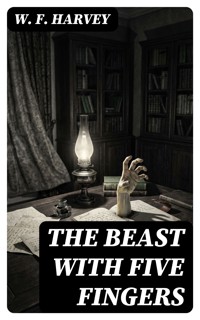
In "The Beast with Five Fingers," W. F. Harvey masterfully intertwines elements of psychological horror and the uncanny, presenting a gripping tale that explores themes of obsession, vengeance, and the interplay between the corporeal and the supernatural. Harvey's literary style is marked by a meticulous attention to atmospheric detail, where everyday settings become unsettling backdrops for extraordinary events. The narrative follows an eerily sentient disembodied hand that exacts revenge on those it deems deserving, reflecting the early 20th-century fascination with the occult and the bizarre, making it a standout piece in the realm of horror literature. W. F. Harvey, a figure often overshadowed in the annals of horror fiction, drew inspiration from his background in art and literature, as well as his experiences during World War I. His unique blend of gothic elements with modern sensibilities highlights his understanding of the human psyche's darker corners. Harvey's ability to evoke tension and fear reveals a mind deeply engaged with the complexities of morality and existence, positioning him as a precursor to later horror writers. I highly recommend "The Beast with Five Fingers" to readers who appreciate meticulously crafted narratives that linger in the mind long after reading, as well as those who seek to explore the psychological depths of horror. This compelling novella not only entertains but also provokes thoughtful reflection on the nature of fear and the supernatural. In this enriched edition, we have carefully created added value for your reading experience: - A succinct Introduction situates the work's timeless appeal and themes. - The Synopsis outlines the central plot, highlighting key developments without spoiling critical twists. - A detailed Historical Context immerses you in the era's events and influences that shaped the writing. - A thorough Analysis dissects symbols, motifs, and character arcs to unearth underlying meanings. - Reflection questions prompt you to engage personally with the work's messages, connecting them to modern life. - Hand‐picked Memorable Quotes shine a spotlight on moments of literary brilliance. - Interactive footnotes clarify unusual references, historical allusions, and archaic phrases for an effortless, more informed read.
Das E-Book können Sie in Legimi-Apps oder einer beliebigen App lesen, die das folgende Format unterstützen:
Veröffentlichungsjahr: 2022
Ähnliche


















The Beast with Five Fingers
Table of Contents
Introduction
With unnerving clarity, The Beast with Five Fingers turns the simplest image of human agency—the hand that executes our will—into a source of estrangement, exposing how easily the familiar body, the ordered room, and the reasonable mind can slip out of alignment, and how, in that slippage, dread blossoms from a place we think we command, so that grasp, touch, and gesture no longer confirm identity but threaten it, and the everyday becomes the stage on which a will not our own seems to act, reminding us that mastery is fragile and control may be only a comforting story.
Written by the English author W. F. Harvey in the early twentieth century, The Beast with Five Fingers belongs to the tradition of the supernatural short story and the broader realm of weird fiction. Its economy of scale and close attention to ordinary circumstances align it with British uncanny narratives that find terror in the commonplace rather than in exotic spectacle. The story is notable for the way it tethers an extraordinary phenomenon to recognizably everyday spaces, favoring suggestion over flamboyance. Within that literary context, Harvey’s tale exemplifies a moment when concise, artfully controlled horror moved from folkloric revenants toward psychological disquiet rooted in observation.
Without disclosing the machinery of its finale, the story presents an unsettling chain of occurrences concentrated upon the idea of a hand acting in ways that exceed expectation, and it treats this idea not as a carnival shock but as a steadily deepening problem for perception and judgment. The narrative voice is poised and rational, attentive to sequence, cause, and the look and feel of small things. The tone remains measured, even dry, so that alarm accumulates by implication rather than proclamation. Readers experience a narrowing corridor of possibilities, where each denial of the fantastic opens paradoxically onto a more troubling ambiguity.
Among the themes that anchor the tale are the instability of agency, the vulnerability of bodily boundaries, and the thin line separating intention from act. Harvey probes the friction between empirical skepticism and the stubborn residue of the inexplicable, showing how intellect can become a trap when it refuses to countenance what it cannot classify. The story also explores obsession and the way attention can animate what it observes, turning harmless pattern into menace. In its focus on parts and wholes, it raises disquieting questions about whether the self commands the body or merely narrates it after the fact.
Harvey’s craft intensifies this inquiry through precision. He builds atmosphere from unadorned detail, repeats motifs with incremental variation, and times revelations so that each apparent explanation dislodges more certainty than it supplies. The prose is plain yet pointed, designed to draw the eye to texture, position, and small dislocations that feel undeniably wrong. There is a subtle, almost surgical humor in the control of emphasis, a refusal to exaggerate that paradoxically sharpens the horror. Rather than staging spectacles, the story compresses terror into accessible scale, asking the reader to enact the investigation and, in doing so, to feel complicity in its misdirections.
For contemporary readers, the story’s concerns remain strikingly current. In an age preoccupied with automation, behavioral nudges, and data-driven prediction, it speaks to the anxiety that our actions might be steered by forces we neither perceive nor consent to. Its vision of estranged embodiment echoes debates about prosthetics, biometrics, and the commodification of physical traits, while its cool narrative temperament mirrors the modern experience of scrolling through disquieting information in a tone of calm. The tale invites reflection on personal autonomy and the narratives we construct to justify it, suggesting how easily control can become performance when tested by the anomalous.
Approach The Beast with Five Fingers as a model of concentrated unease, best read in a single sitting that honors its cumulative design. Attend to how routine objects and casual gestures accrue meaning; notice how skepticism and fear conduct a duet without resolving. The reward is not a catalogue of shocks but a sharpened sensitivity to how stories rearrange perception, and how perception, in turn, can betray us. That double awareness is why the work endures: it offers a compact, exacting demonstration of the uncanny rooted in the everyday, reminding us that the hand we trust may carry a history we do not.
Synopsis
The Beast with Five Fingers, a short story by W. F. Harvey, unfolds as a meticulous tale of the uncanny set within an educated English household. Harvey situates his narrative amid books, studies, and genteel manners, then introduces a disturbance that is at once intimate and unsettling: a single human hand that seems to act with independent purpose. The tone balances dry observation with mounting dread, allowing small oddities to accumulate into a genuine menace. Rather than rushing to spectacle, the story proceeds through careful incidents that foreground character, habit, and the uneasy interplay between cultivated skepticism and inexplicable intrusion.
In the opening movement, the household’s routines revolve around a learned elder whose wit and manual dexterity are sources of entertainment and pride. His decline and death leave behind not only property and papers but also a cluster of associations tied to skilled hands and delicate tasks. These motifs frame the atmosphere in which unusual signs appear—sounds suggestive of practiced fingering, impressions where no whole person stands, and acts of petty displacement too nimble to ascribe to chance. Those closest to the situation respond with a mixture of amusement and irritation, attitudes that gradually give way to warier curiosity.
As disturbances grow more pointed, the phenomenon narrows to a single image: a hand, unattached to any visible body, behaving as though guided by a temperamental intelligence. It leaves written traces in a familiar script, meddles with cabinets and locks, and approaches familiar objects requiring touch and technique. The more rational members comb for tricks and hidden accomplices, testing keys, counting servants, and checking entries and exits. Each explanation falters under the weight of detail, while the less skeptical read the signs as an extension of a personality unwilling to abandon mastery, even in the face of mortality.
Determined to impose order, the central observer adopts an experimental posture, turning rooms into laboratories and hours into scheduled watches. Boxes are secured, drawers sealed, and ink and paper monitored; bindings, cords, and labels become instruments of both containment and recording. Yet the agent at work rejects passivity. What begins as a nuisance grows bolder, pinching, scratching, and staging mockeries that reveal a sly sense of humor shading toward cruelty. Confidants waver between pity for a remnant that seems unable to rest and resentment at harassment that invades sleep and study. The household’s nerves fray as vigilance becomes a permanent routine.
With privacy eroded, relationships strain. Domestic staff quit or feign illness, visitors shorten their stays, and the once amiable rooms feel drafted by suspicion. The central figure, increasingly isolated, keeps notes, compares handwriting, and logs times and places, hoping to correlate pattern with cause. In those records emerge a personality defined by appetite for attention and a desire to prove control, especially through feats requiring dexterity and precise pressure. The threat is intimate rather than grand: slight shifts of a key, the smearing of a page, the light but relentless touch at a throat. Fatigue deepens judgment yet sharpens fear.
The narrative bends toward a nocturnal crisis in which study yields to self-defense. After a series of offenses that cross from prank to physical peril, the observer prepares a final countermeasure, arranging barriers and tools with a cold practicality born of sleepless nights. What follows is a swift, tactile encounter—more a grapple than a chase—in which the will to survive locks against a nimble, unrelenting pressure. The immediate aftermath suggests containment of the visible threat, yet explanations remain contested. Whether the agency was material, psychological, or some uncanny overlap, the resolution closes the case without exhausting the questions it raised.
Harvey’s achievement lies in compressing large questions into the smallest possible antagonist. By focusing on a hand severed from the rest of the person, The Beast with Five Fingers probes the boundary between skill and domination, the mind’s command over matter, and the persistence of habit after death. Its spare method—registers, locks, and ordinary furniture pressed into crisis—keeps the uncanny close to daily life. The story endures as a compact study of how reason contends with the inexplicable, and as a touchstone for the uncanny image of autonomous limbs, leaving readers with a discomfort that survives tidy conclusions.
Historical Context
The Beast with Five Fingers is a short story by English writer W. F. Harvey (1885–1937). It emerged from Britain’s early twentieth‑century market for concise tales of the macabre, appearing in periodicals and later gathered in The Beast with Five Fingers and Other Tales (J. M. Dent, 1928). The era’s thriving magazine culture—typified by outlets such as The Strand and Pearson’s—created a broad readership for compact fiction consumed in drawing rooms, rail carriages, and Christmas annuals. Within this commercial and social framework, Harvey’s narrative style—economical, urbane, and poised between wit and dread—took shape, addressing an audience accustomed to polished short forms.
In late Victorian and Edwardian Britain, the country house, private library, and the solicitor’s office were durable institutions binding property, education, and status. Wills and probate proceedings were routine mechanisms through which wealth, collections, and obligations passed, with the High Court’s Probate Division formalizing disputes. Such settings supplied writers with familiar props: sealed documents, executors, servants’ testimony, and the aura of learned seclusion. Harvey’s story draws on this recognizable social architecture, where polite surfaces and legal certainties coexist with private tensions. The self‑assured tone of clerks, men of letters, and family advisers reflects a professionalized culture confident in paperwork, catalogues, and orderly record‑keeping.
From the 1880s onward, Britain saw a vigorous debate over spiritualism, séances, and alleged supernatural phenomena. The Society for Psychical Research (founded in London in 1882) gathered testimonies, tested mediums, and published Proceedings that mingled skepticism and curiosity. Newspapers reported exposures of fraud alongside earnest case studies, while stage magicians demonstrated spirit effects as entertainment. This climate furnished writers with a vocabulary of manifestations, controlled experiments, and doubtful witnesses. Harvey’s tale benefits from a readership primed to weigh testimony and counter‑testimony: the language of evidence, experiment, and expert opinion—so prevalent in psychical research—shapes the story’s measured approach to strange occurrences without foreclosing rational inquiry.
Contemporary science also captured public attention, particularly physiology and the nervous system. Charles Sherrington’s The Integrative Action of the Nervous System (1906) popularized the reflex arc as an interpretive model, while medical journalism explained hysterical symptoms, automatism, and somnambulism. Psychical researchers debated automatic writing and dissociated states in terms that overlapped with neurology and psychology. In 1919, Sigmund Freud’s essay Das Unheimliche (The Uncanny) gave an influential vocabulary to feelings aroused by doubles, animate objects, and severed parts. Harvey’s story occupies this borderland: it presents unsettling phenomena with clinical clarity, inviting readers to test physiological explanations against experiences that feel irreducibly eerie.
Harvey wrote within a distinguished British ghost‑story tradition shaped by M. R. James’s antiquarian tales (published from 1904) and works by Algernon Blackwood and E. F. Benson. These authors favored precise settings, learned protagonists, and understated narration that lets dread accrue by inference. Continental antecedents also mattered: Guy de Maupassant’s La Main (1883) had already made the motif of the uncanny hand part of European short fiction. Harvey, known for other macabre pieces such as August Heat, adapts these currents to a crisp, conversational English style. His control of pacing and credible detail places extraordinary events within the everyday habits of educated readers.
The First World War (1914–1918) and the influenza pandemic that followed altered British reading habits and intensified cultural attention to death, mourning, and inexplicable loss. In the 1920s, supernatural fiction flourished in periodicals, anthologies, and Christmas numbers, offering a disciplined mode for contemplating uncertainty. The polite, domestic scale of many British ghost stories contrasted with public memorials and war reportage, providing intimate frames for dread. Harvey’s work, appearing and circulating in this milieu, channels a restrained register: it acknowledges an audience conversant with grief and skepticism, and it treats extraordinary claims with scrupulous civility, as if the drawing room were a laboratory for anxiety.
The story’s reach widened through reprinting and adaptation. The collection The Beast with Five Fingers and Other Tales (J. M. Dent, 1928) fixed Harvey’s reputation among interwar readers and later anthologists of supernatural fiction. In 1946, Warner Bros. released The Beast with Five Fingers, a feature film starring Peter Lorre and directed by Robert Florey, which, while diverging from the text, publicized the title internationally during a postwar cycle of psychological horror. The migration from magazine prose to hardcover anthology to cinema illustrates the period’s media ecosystem, in which concise literary shocks could be reframed for larger audiences without losing their suggestive power.
Taken together, these contexts clarify the story’s preoccupations. It stages a confrontation between institutional assurance—libraries, ledgers, wills, expert voices—and phenomena that expose the limits of documentation and control. Its poise between legal formality and the unaccountable mirrors a society balancing bureaucratic modernity with residues of folklore and belief. By deploying precise professional manners to narrate an affront to reason, Harvey critiques complacent certainties while honoring disciplined inquiry. The Beast with Five Fingers thus registers early twentieth‑century Britain’s ambivalence: a culture eager for order and explanation, yet haunted by experiences that official protocols, however carefully observed, cannot entirely domesticate.




