


1,99 €
Niedrigster Preis in 30 Tagen: 1,99 €
Niedrigster Preis in 30 Tagen: 1,99 €
Mehr erfahren.
- Herausgeber: DigiCat
- Kategorie: Abenteuer, Thriller, Horror
- Sprache: Englisch
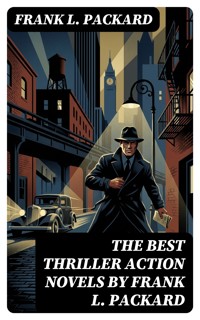
In "The Best Thriller Action Novels by Frank L. Packard," the author delivers a captivating collection that epitomizes early 20th-century pulp fiction. Renowned for his razor-sharp prose and gripping narratives, Packard employs a cinematic style that hooks readers from the very first page. His deft storytelling, combined with vivid characterizations and intricate plots, transports readers into adrenaline-fueled adventures brimming with suspense and intrigue, resonating with the literary conventions of the genre. This anthology not only showcases Packard's unique flair for action-packed storytelling but also reflects the societal anxieties and cultural narratives of its time, engaging themes of justice, morality, and the human psyche. Frank L. Packard, a Canadian author active during the early decades of the 1900s, carved a niche for himself in the world of thriller literature, drawing inspiration from his own experiences in journalism and his fascination with intricate plots. His background in crafting tales for the burgeoning film industry informed his dynamic narrative style, enabling him to create stories that were both visually arresting and dramatically compelling. This synthesis of journalistic precision and exciting storytelling has left an indelible mark on the thriller genre, influencing countless authors who followed. For readers seeking a thrilling escape into meticulously crafted action and suspense, Packard's anthology is an essential read. His ability to weave tension and excitement with moments of profound human insight ensures an engaging experience that will resonate long after the final page. Whether you are a seasoned thriller enthusiast or new to the genre, Packard's work promises to invigorate your passion for storytelling.
Das E-Book können Sie in Legimi-Apps oder einer beliebigen App lesen, die das folgende Format unterstützen:
Veröffentlichungsjahr: 2022
Ähnliche


















The Best Thriller Action Novels by Frank L. Packard
Table of Contents
Introduction
Crime Collection - Frank L. Packard Edition gathers fourteen complete novels that showcase the author’s command of high-stakes narrative, urban intrigue, and breathless suspense. It combines four entries from the celebrated Jimmie Dale cycle with ten standalone thrillers, offering both continuity and range within a single volume. The works represented here are novels—long-form narratives that move from drawing rooms to alleys, from the whisper of coded messages to the clatter of pursuit. The purpose of this collection is twofold: to provide convenient access to essential Packard titles and to present, in breadth and depth, the recurring concerns that animate his crime and action fiction.
The Jimmie Dale novels—The Adventures of Jimmie Dale, The Further Adventures of Jimmie Dale, Jimmie Dale and the Phantom Clue, and Jimmie Dale and the Blue Envelope Murder—trace the exploits of a wealthy New Yorker who leads a double life as the elusive Gray Seal. Premises turn on cryptic warnings, daring infiltrations, and a constant crossing of boundaries between high society and the underworld. Each title stages a new pattern of clues and counters, complicating loyalties while intensifying the chase. Together they refine Packard’s signature blend of polished civility, nocturnal menace, and the intricate logistics of a vigilante campaign conducted in plain sight.
In the standalone novels, Packard widens his terrain while sustaining his fascination with deception and moral trial. The Miracle Man brings a crew of criminals into orbit around a reputed healer, testing the frontier between fraud and transformation. The Belovéd Traitor examines identity under suspicion and the cost of divided allegiance. The Sin That Was His turns on guilt confronted and character remade under pressure. The Wire Devils pits audacious criminals against the lifelines of rail and communication, as coded messages and sabotage collide with determined resistance. Each premise introduces distinctive stakes while keeping the emphasis on momentum and design.
From Now On, The White Moll, Pawned, Doors of the Night, The Four Stragglers, and The Red Ledger extend this palette across new settings and pressures. The White Moll navigates the New York underworld through a young woman’s perilous initiation. Doors of the Night explores a city's after-hours gauntlet where chance encounters trigger relentless pursuit. Pawned turns on leverage and entrapment, tracing how a single compromise can spiral into threat. The Four Stragglers follows lives reshaped after conflict, when comradeship and danger fuse in unexpected ways. The Red Ledger centers on peril encoded in records best left hidden, tightening suspense around dangerous knowledge.
Packard’s stylistic signature is unmistakable: swift, lucid prose; tightly ratcheted scenes; and chapter endings calibrated to accelerate the next turn. He writes cities as living mechanisms—stations, hotels, offices, and shadowed lanes that conduct characters toward collision. Methods of concealment and revelation dominate: disguises, false identities, passwords, and cryptic notes function as both props and structuring motifs. Technology is practical and plot-driving rather than ornamental; when messages move or safes yield, consequences follow quickly. Above all, Packard constructs action as argument: the strategies chosen under pressure reveal character, and the choreography of pursuit becomes a moral geometry readers can trace and test.
Across these novels, unifying themes recur with clarifying force. Dual identity is less a gimmick than a disciplined ethic—an ongoing negotiation between obligation and autonomy. Justice often advances from the margins, when official channels stall or compromise. Loyalty, betrayal, and redemption are not abstractions but decisions taken in rooms, on rooftops, and along tracks where time is short. Packard’s heroes and antiheroes move between social strata, exposing the fragile seams joining respectability to survival. The result is crime fiction that entertains while mapping responsibility under stress, whether through a masked vigilante’s calculus or through ordinary figures pressed into extraordinary resolve.
The ongoing significance of Frank L. Packard’s work lies in its durable pleasures and its shaping of popular crime narratives. These novels demonstrate how pacing, ingenuity, and moral stakes can cohere without ornament—how a single clue can pivot an entire night. They also offer a vivid snapshot of early twentieth‑century modernity, where networks, crowds, and speed reconfigure risk. This collection presents complete novels only, free-standing works that reward sequential reading yet remain individually satisfying. For first-time readers and returning admirers alike, it is an invitation to follow Packard’s sure hand from opening premise to hard-won resolution.
Historical Context
Frank L. Packard (1877–1942), a Montreal-born civil engineer turned bestselling novelist, wrote most of the works in this collection between the 1910s and early 1930s, when pulp magazines and mass-market publishers shaped North American popular taste. His gentleman-criminal Jimmie Dale adapts the late-Victorian “amateur cracksman” model—E. W. Hornung’s Raffles (from 1898) and Maurice Leblanc’s Arsène Lupin (since 1905)—to the distinctly American setting of New York City. The Jimmie Dale stories first appeared in magazines during 1914–1916 and were gathered in book form by 1917, presenting a vigilante ethic that resonated with readers anxious about corruption, inequality, and the reach of the modern city.
Packard’s New York is a product of the explosive urbanization between 1900 and 1925, when consolidation, skyscraper booms, and the 1904 subway opened new frontiers of mobility and anonymity. Fifth Avenue drawing rooms sat uneasily beside the Bowery and Lower East Side, where tenement reformers and settlement houses confronted entrenched poverty. This social topography animates Jimmie Dale’s double life—from clubland to the “Sanctuary”—and informs stand-alone underworld tales such as The White Moll and Doors of the Night. Contemporary readers recognized the map: newspaper crime pages traced these neighborhoods daily, and reform-era rhetoric cast the metropolis as both opportunity and moral hazard.
Modern policing and criminology also shaped Packard’s plots. New York Police Commissioner Arthur Woods (1914–1918) professionalized patrols, promoted scientific methods, and expanded vice and bomb squads amid anarchist scares. Departments moved from Bertillon measurements toward fingerprinting; by 1924, national fingerprint files were centralized in Washington. Private agencies—the Pinkertons and William J. Burns’s organization—competed with public detectives, popularizing forensic spectacle in the press. Packard’s criminals and sleuths therefore trade in disguises, coded notes, and misdirection, reflecting a cat‑and‑mouse contest with increasingly bureaucratic surveillance. The Gray Seal’s calling cards, the “blue envelope” clues, and elaborate safecracking echo an era enamored with technique.
Trains and telegraph lines run through the collection because Packard trained as a civil engineer and worked on North American railways before turning full-time to fiction. The Wire Devils, in particular, exploits the vast railroad telegraph network and the quasi-police powers of railway detectives and express companies. During World War I, when the U.S. Railroad Administration (1917–1920) briefly nationalized operations, fears of sabotage, theft, and codebreaking were widespread. Packard translates that infrastructure into high-stakes chases across junctions, yards, and Pullman cars, dramatizing how modern mobility enabled both crime and its pursuit. The result grounds his melodrama in technical detail familiar to contemporary readers.
World War I and its unsettled aftermath shaped Packard’s emphasis on loyalty, secrecy, and displaced men. The Espionage Act (1917) and Sedition Act (1918) sharpened anxieties about sabotage and informers, themes that shadow plots of treachery and hidden identities. Demobilization brought joblessness and trauma; stories like The Four Stragglers imagine veterans navigating a black market of favors and debts. The 1919–1920 Red Scare, mail bombings, and political raids heightened the sense that radicalism and crime overlapped in shadowy networks. Against this backdrop, Packard’s criminals often rationalize themselves as patriots or avengers, complicating conventional boundaries between lawbreaking and civic duty.
Prohibition (1919–1933, with enforcement beginning January 1920 under the Volstead Act) reconfigured the American underworld into capitalized syndicates. While Packard rarely names real gang bosses, novels such as The White Moll, Doors of the Night, Pawned, and the later Jimmie Dale and the Blue Envelope Murder reflect a landscape of speakeasies, protection rackets, and porous police lines. The illicit economy professionalized burglary, counterfeiting, and smuggling, turning street toughs into entrepreneurs. This transformation deepened the moral ambiguity of Packard’s plots: philanthropists mingle with bootleggers, and upright officials bend rules, mirroring newspaper exposés of municipal corruption that kept crime fiction firmly tethered to current headlines.
Packard’s rise coincided with the golden age of the pulps and early Hollywood, which powerfully shaped reception. His stories appeared in widely circulated magazines before being issued by New York houses as popular hardbacks, reaching cross-border Canadian and U.S. audiences. The Miracle Man (1914) gained national fame through George Loane Tucker’s 1919 film adaptation starring Thomas Meighan, Betty Compson, and Lon Chaney, whose performance as the contortionist “Frog” became iconic. The novel’s fusion of con artistry and spiritual yearning matched Progressive Era fascination with revivalism and social uplift, while its cinematic success validated Packard’s blend of swift plotting, urban milieu, and moral melodrama.
Changing gender roles and financial upheavals further contour the series’ concerns. Women’s suffrage, ratified in 1920, and expanding urban employment opened narrative space for capable female figures—detectives, informants, and altruists—seen in the mysterious “Tocsin” of the Jimmie Dale tales and in The White Moll. Simultaneously, the Panic of 1907 and the creation of the Federal Reserve in 1913 fed public doubts about bankers and trusts, making the gentleman-thief’s raids on high finance feel cathartic rather than merely criminal. Packard’s crime worlds thus register an era negotiating new civic identities and economic systems, rendering his melodramas legible as social barometers as much as entertainments.
Synopsis (Selection)
Jimmie Dale Mysteries
Across The Adventures of Jimmie Dale, The Further Adventures of Jimmie Dale, Jimmie Dale and the Phantom Clue, and Jimmie Dale and the Blue Envelope Murder, a masked gentleman-thief-turned-vigilante stalks New York’s underworld using disguises, safecracking skills, and cryptic communiqués.
Fast-paced nocturnal capers blend urban glamour with grit, exploring double lives, honor among thieves, and the pull between social respectability and shadow justice.
The Miracle Man
A crew of city sharpers circles a famed healer and a secluded community, scheming for profit while encountering the unsettling force of belief.
Mixing sentiment with suspense, it probes redemption, faith, and the possibility that hardened lives can turn.
The Belovéd Traitor
Amid war-clouded intrigue and romance, a figure branded a traitor navigates loyalties that are not what they seem.
The tone is high-stakes and emotionally charged, examining patriotism, sacrifice, and the costs of misjudgment.
The Sin That Was His
A man burdened by a secret wrong struggles between public duty and inner reckoning.
With intimate, moral melodrama, it weighs guilt, penance, and the chance of renewal without revealing the decisive turn.
The Wire Devils
A criminal syndicate exploits telegraph codes and the rail system, prompting a relentless struggle of brains and nerve along the lines.
A brisk techno-procedural for its era, it revels in ciphers, logistics, and the duel between organized crime and organized transport.
From Now On
After a life upended, a vow sets the protagonist on a straightened path that collides with lingering ties to crime and romance.
An earnest, forward-looking thriller, it treats resolve, trust, and the challenge of starting clean under pressure.
The White Moll
A resourceful woman moves through the city’s dark quarters, aiding the vulnerable while outmaneuvering crooks who underestimate her.
Tense, street-level episodes highlight disguise, quick-witted improvisation, and the thin line between mercy and law.
Pawned
Caught in a web of debt, leverage, and mistaken identities, a protagonist finds their life hocked to the schemes of others.
A taut urban melodrama, it turns on bargaining, moral collateral, and the perilous cost of buying time.
Doors of the Night
Night-bound chases, hidden sanctuaries, and shifting allegiances draw a hunter and hunted through the city’s shadows.
Brooding yet fleet, it contemplates secrecy, trust, and how one decisive choice can open—or close—every door.
The Four Stragglers
Four chance-met outsiders, tempered by war and wandering, are pulled into a compact of survival and justice.
Adventure tinged with elegy, it explores comradeship, luck, and the stubborn aftershocks of conflict.
The Red Ledger
A fateful list—of names, debts, or wrongs—binds a life to an escalating cycle of pursuit and reprisal.
Lean and relentless, it centers on accountability, memory, and whether the past can ever be balanced.
Motifs and Style Across the Collection
Packard’s crime worlds favor masks, codes, and double identities, marrying speed and ingenuity to moral reckoning.
Across urbane capers and war-shadowed dramas, he shifts from exuberant pulp action to reflective redemption tales, while sustaining a clean, propulsive narrative drive.
Crime Collection - Frank L. Packard Edition: 14 Thriller & Action Novels in One Volume
Jimmie Dale Mysteries
THE ADVENTURES OF JIMMIE DALE
Table of Contents
Part One: The Man in the Case
Chapter I. The Gray Seal
Among New York's fashionable and ultra-exclusive clubs, the St. James stood an acknowledged leader—more men, perhaps, cast an envious eye at its portals, of modest and unassuming taste, as they passed by on Fifth Avenue, than they did at any other club upon the long list that the city boasts. True, there were more expensive clubs upon whose membership roll scintillated more stars of New York's social set, but the St. James was distinctive. It guaranteed a man, so to speak—that is, it guaranteed a man to be innately a gentleman. It required money, it is true, to keep up one's membership, but there were many members who were not wealthy, as wealth is measured nowadays—there were many, even, who were pressed sometimes to meet their dues and their house accounts, but the accounts were invariably promptly paid. No man, once in, could ever afford, or ever had the desire, to resign from the St. James Club. Its membership was cosmopolitan; men of every walk in life passed in and out of its doors, professional men and business men, physicians, artists, merchants, authors, engineers, each stamped with the "hall mark" of the St. James, an innate gentleman. To receive a two weeks' out-of-town visitor's card to the St. James was something to speak about, and men from Chicago, St. Louis, or San Francisco spoke of it with a sort of holier-than-thou air to fellow members of their own exclusive clubs, at home again.
Is there any doubt that Jimmie Dale was a gentleman—an INNATE gentleman[1q]? Jimmie Dale's father had been a member of the St. James Club, and one of the largest safe manufacturers of the United States, a prosperous, wealthy man, and at Jimmie Dale's birth he had proposed his son's name for membership. It took some time to get into the St. James; there was a long waiting list that neither money, influence, nor pull could alter by so much as one iota. Men proposed their sons' names for membership when they were born as religiously as they entered them upon the city's birth register. At twenty-one Jimmie Dale was elected to membership; and, incidentally, that same year, graduated from Harvard. It was Mr. Dale's desire that his son should enter the business and learn it from the ground up, and Jimmie Dale, for four years thereafter, had followed his father's wishes. Then his father died. Jimmie Dale had leanings toward more artistic pursuits than business. He was credited with sketching a little, writing a little; and he was credited with having received a very snug amount from the combine to which he sold out his safe-manufacturing interests. He lived a bachelor life—his mother had been dead many years—in the house that his father had left him on Riverside Drive, kept a car or two and enough servants to run his menage smoothly, and serve a dinner exquisitely when he felt hospitably inclined.
Could there be any doubt that Jimmie Dale was innately a gentleman?
It was evening, and Jimmie Dale sat at a small table in the corner of the St. James Club dining room. Opposite him sat Herman Carruthers, a young man of his own age, about twenty-six, a leading figure in the newspaper world, whose rise from reporter to managing editor of the morning NEWS-ARGUS within the short space of a few years had been almost meteoric.
They were at coffee and cigars, and Jimmie Dale was leaning back in his chair, his dark eyes fixed interestedly on his guest.
Carruthers, intently engaged in trimming his cigar ash on the edge of the Limoges china saucer of his coffee set, looked up with an abrupt laugh.
"No; I wouldn't care to go on record as being an advocate of crime," he said whimsically; "that would never do. But I don't mind admitting quite privately that it's been a positive regret to me that he has gone."
"Made too good 'copy' to lose, I suppose?" suggested Jimmie Dale quizzically. "Too bad, too, after working up a theatrical name like that for him—the Gray Seal—rather unique! Who stuck that on him—you?"
Carruthers laughed—then, grown serious, leaned toward Jimmie Dale.
"You don't mean to say, Jimmie, that you don't know about that, do you?" he asked incredulously. "Why, up to a year ago the papers were full of him."
"I never read your beastly agony columns," said Jimmie Dale, with a cheery grin.
"Well," said Carruthers, "you must have skipped everything but the stock reports then."
"Granted," said Jimmie Dale. "So go on, Carruthers, and tell me about him—I dare say I may have heard of him, since you are so distressed about it, but my memory isn't good enough to contradict anything you may have to say about the estimable gentleman, so you're safe."
Carruthers reverted to the Limoges saucer and the tip of his cigar.
"He was the most puzzling, bewildering, delightful crook in the annals of crime," said Carruthers reminiscently, after a moment's silence. "Jimmie, he was the king-pin of them all. Clever isn't the word for him, or dare-devil isn't either. I used to think sometimes his motive was more than half for the pure deviltry of it, to laugh at the police and pull the noses of the rest of us that were after him. I used to dream nights about those confounded gray seals of his—that's where he got his name; he left every job he ever did with a little gray paper affair, fashioned diamond-shaped, stuck somewhere where it would be the first thing your eyes would light upon when you reached the scene, and—"
"Don't go so fast," smiled Jimmie Dale. "I don't quite get the connection. What did you have to do with this—er—Gray Seal fellow? Where do you come in?"
"I? I had a good deal to do with him," said Carruthers grimly. "I was a reporter when he first broke loose, and the ambition of my life, after I began really to appreciate what he was, was to get him—and I nearly did, half a dozen times, only—"
"Only you never quite did, eh?" cut in Jimmie Dale slyly. "How near did you get, old man? Come on, now, no bluffing; did the Gray Seal ever even recognise you as a factor in the hare-and-hound game?"
"You're flicking on the raw, Jimmie," Carruthers answered, with a wry grimace. "He knew me, all right, confound him! He favoured me with several sarcastic notes—I'll show 'em to you some day—explaining how I'd fallen down and how I could have got him if I'd done something else." Carruthers' fist came suddenly down on the table. "And I would have got him, too, if he had lived."
"Lived!" ejaculated Jimmie Dale. "He's dead, then?"
"Yes," averted Carruthers; "he's dead."
"H'm!" said Jimmie Dale facetiously. "I hope the size of the wreath you sent was an adequate tribute of your appreciation."
"I never sent any wreath," returned Carruthers, "for the very simple reason that I didn't know where to send it, or when he died. I said he was dead because for over a year now he hasn't lifted a finger."
"Rotten poor evidence, even for a newspaper," commented Jimmie Dale. "Why not give him credit for having, say—reformed?"
Carruthers shook his head. "You don't get it at all, Jimmie," he said earnestly. "The Gray Seal wasn't an ordinary crook—he was a classic. He was an artist, and the art of the thing was in his blood. A man like that could no more stop than he could stop breathing—and live. He's dead; there's nothing to it but that—he's dead. I'd bet a year's salary on it."
"Another good man gone wrong, then," said Jimmie Dale capriciously. "I suppose, though, that at least you discovered the 'woman in the case'?"
Carruthers looked up quickly, a little startled; then laughed shortly.
"What's the matter?" inquired Jimmie Dale.
"Nothing," said Carruthers. "You kind of got me for a moment, that's all. That's the way those infernal notes from the Gray Seal used to end up: 'Find the lady, old chap; and you'll get me.' He had a damned patronising familiarity that would make you squirm."
"Poor old Carruthers!" grinned Jimmie Dale. "You did take it to heart, didn't you?"
"I'd have sold my soul to get him—and so would you, if you had been in my boots," said Carruthers, biting nervously at the end of his cigar.
"And been sorry for it afterward," supplied Jimmie Dale.
"Yes, by Jove, you're right!" admitted Carruthers, "I suppose I should. I actually got to love the fellow—it was the GAME, really, that I wanted to beat."
"Well, and how about this woman? Keep on the straight and narrow path, old man," prodded Jimmie Dale.
"The woman?" Carruthers smiled. "Nothing doing! I don't believe there was one—he wouldn't have been likely to egg the police and reporters on to finding her if there had been, would he? It was a blind, of course. He worked alone, absolutely alone. That's the secret of his success, according to my way of thinking. There was never so much as an indication that he had had an accomplice in anything he ever did."
Jimmie Dale's eyes travelled around the club's homelike, perfectly appointed room. He nodded to a fellow member here and there, then his eyes rested musingly on his guest again.
Carruthers was staring thoughtfully at his coffee cup.
"He was the prince of crooks and the father of originality," announced Carruthers abruptly, following the pause that had ensued. "Half the time there wasn't any more getting at the motive for the curious things he did, than there was getting at the Gray Seal himself."
"Carruthers," said Jimmy Dale, with a quick little nod of approval, "you're positively interesting to-night. But, so far, you've been kind of scouting around the outside edges without getting into the thick of it. Let's have some of your experiences with the Gray Seal in detail; they ought to make ripping fine yarns."
"Not to-night, Jimmie," said Carruthers; "it would take too long." He pulled out his watch mechanically as he spoke, glanced at it—and pushed back his chair. "Great Scott!" he exclaimed. "It's nearly half-past nine. I'd no idea we had lingered so long over dinner. I'll have to hurry; we're a morning paper, you know, Jimmie."
"What! Really! Is it as late as that." Jimmie Dale rose from his chair as Carruthers stood up. "Well, if you must—"
"I must," said Carruthers, with a laugh.
"All right, O slave." Jimmie Dale laughed back—and slipped his hand, a trick of their old college days together, through Carruthers' arm as they left the room.
He accompanied Carruthers downstairs to the door of the club, and saw his guest into a taxi; then he returned inside, sauntered through the billiard room, and from there into one of the cardrooms, where, pressed into a game, he played several rubbers of bridge before going home.
It was, therefore, well on toward midnight when Jimmie Dale arrived at his house on Riverside Drive, and was admitted by an elderly manservant.
"Hello, Jason," said Jimmie Dale pleasantly. "You still up!"
"Yes, sir," replied Jason, who had been valet to Jimmie Dale's father before him. "I was going to bed, sir, at about ten o'clock, when a messenger came with a letter. Begging your pardon, sir, a young lady, and—"
"Jason"—Jimmie Dale flung out the interruption, sudden, quick, imperative—"what did she look like?"
"Why—why, I don't exactly know as I could describe her, sir," stammered Jason, taken aback. "Very ladylike, sir, in her dress and appearance, and what I would call, sir, a beautiful face."
"Hair and eyes—what color?" demanded Jimmie Dale crisply. "Nose, lips, chin—what shape?"
"Why, sir," gasped Jason, staring at his master, "I—I don't rightly know. I wouldn't call her fair or dark, something between. I didn't take particular notice, and it wasn't overlight outside the door."
"It's too bad you weren't a younger man, Jason," commented Jimmie Dale, with a curious tinge of bitterness in his voice. "I'd have given a year's income for your opportunity to-night, Jason."
"Yes, sir," said Jason helplessly.
"Well, go on," prompted Jimmie Dale. "You told her I wasn't home, and she said she knew it, didn't she? And she left the letter that I was on no account to miss receiving when I got back, though there was no need of telephoning me to the club—when I returned would do, but it was imperative that I should have it then—eh?"
"Good Lord, sir!" ejaculated Jason, his jaw dropped, "that's exactly what she did say."
"Jason," said Jimmie Dale grimly, "listen to me. If ever she comes here again, inveigle her in. If you can't inveigle her, use force; capture her, pull her in, do anything—do anything, do you hear? Only don't let her get away from you until I've come."
Jason gazed at his master as though the other had lost his reason.
"Use force, sir?" he repeated weakly—and shook his head. "You—you can't mean that, sir."
"Can't I?" inquired Jimmie Dale, with a mirthless smile. "I mean every word of it, Jason—and if I thought there was the slightest chance of her giving you the opportunity, I'd be more imperative still. As it is—where's the letter?"
"On the table in your studio, sir," said Jason, mechanically.
Jimmie Dale started toward the stairs—then turned and came back to where Jason, still shaking his head heavily, had been gazing anxiously after his master. Jimmie Dale laid his hand on the old man's shoulder.
"Jason," he said kindly, with a swift change of mood, "you've been a long time in the family—first with father, and now with me. You'd do a good deal for me, wouldn't you?"
"I'd do anything in the world for you, Master Jim," said the old man earnestly.
"Well, then, remember this," said Jimmie Dale slowly, looking into the other's eyes, "remember this—keep your mouth shut and your eyes open. It's my fault. I should have warned you long ago, but I never dreamed that she would ever come here herself. There have been times when it was practically a matter of life and death to me to know who that woman is that you saw to-night. That's all, Jason. Now go to bed."
"Master Jim," said the old man simply, "thank you, sir, thank you for trusting me. I've dandled you on my knee when you were a baby, Master Jim. I don't know what it's about, and it isn't for me to ask. I thought, sir, that maybe you were having a little fun with me. But I know now, and you can trust me, Master Jim, if she ever comes again."
"Thank you, Jason," said Jimmie Dale, his hand closing with an appreciative pressure on the other's shoulder "Good-night, Jason."
Upstairs on the first landing, Jimmie Dale opened a door, closed and locked it behind him—and the electric switch clicked under his fingers. A glow fell softly from a cluster of shaded ceiling lights. It was a large room, a very large room, running the entire depth of the house, and the effect of apparent disorder in the arrangement of its appointments seemed to breathe a sense of charm. There were great cozy, deep, leather-covered lounging chairs, a huge, leather-covered davenport, and an easel or two with half-finished sketches upon them; the walls were panelled, the panels of exquisite grain and matching; in the centre of the room stood a flat-topped rosewood desk; upon the floor was a dark, heavy velvet rug; and, perhaps most inviting of all, there was a great, old-fashioned fireplace at one side of the room.
For an instant Jimmie Dale remained quietly by the door, as though listening. Six feet he stood, muscular in every line of his body, like a well-trained athlete with no single ounce of superfluous fat about him—the grace and ease of power in his poise. His strong, clean-shaven face, as the light fell upon it now, was serious—a mood that became him well—the firm lips closed, the dark, reliant eyes a little narrowed, a frown on the broad forehead, the square jaw clamped.
Then abruptly he walked across the room to the desk, picked up an envelope that lay upon it, and, turning again, dropped into the nearest lounging chair.
There had been no doubt in his mind, none to dispel. It was precisely what he had expected from almost the first word Jason had spoken. It was the same handwriting, the same texture of paper, and there was the same old haunting, rare, indefinable fragrance about it. Jimmie Dale's hands turned the envelope now this way, now that, as he looked at it. Wonderful hands were Jimmie Dale's, with long, slim, tapering fingers whose sensitive tips seemed now as though they were striving to decipher the message within.
He laughed suddenly, a little harshly, and tore open the envelope. Five closely written sheets fell into his hand. He read them slowly, critically, read them over again; and then, his eyes on the rug at his feet, he began to tear the paper into minute pieces between his fingers, depositing the pieces, as he tore them, upon the arm of his chair. The five sheets demolished, his fingers dipped into the heap of shreds on the arm of the chair and tore them over and over again, tore them until they were scarcely larger than bits of confetti, tore at them absently and mechanically, his eyes never shifting from the rug at his feet.
Then with a shrug of his shoulders, as though rousing himself to present reality, a curious smile flickering on his lips, he brushed the pieces of paper into one hand, carried them to the empty fireplace, laid them down in a little pile, and set them afire. Lighting a cigarette, he watched them burn until the last glow had gone from the last charred scrap; then he crunched and scattered them with the brass-handled fender brush, and, retracing his steps across the room, flung back a portiere from where it hung before a little alcove, and dropped on his knees in front of a round, squat, barrel-shaped safe—one of his own design and planning in the years when he had been with his father.
His slim, sensitive fingers played for an instant among the knobs and dials that studded the door, guided, it seemed by the sense of touch alone—and the door swung open. Within was another door, with locks and bolts as intricate and massive as the outer one. This, too, he opened; and then from the interior took out a short, thick, rolled-up leather bundle tied together with thongs. He rose from his knees, closed the safe, and drew the portiere across the alcove again. With the bundle under his arm, he glanced sharply around the room, listened intently, then, unlocking the door that gave on the hall, he switched off the lights and went to his dressing room, that was on the same floor. Here, divesting himself quickly of his dinner clothes, he selected a dark tweed suit with loose-fitting, sack coat from his wardrobe, and began to put it on.
Dressed, all but his coat and vest, he turned to the leather bundle that he had placed on a table, untied the thongs, and carefully opened it out to its full length—and again that curious, cryptic smile tinged his lips. Rolled the opposite away from that in which it had been tied up, the leather strip made a wide belt that went on somewhat after the fashion of a life preserver, the thongs being used for shoulder straps—a belt that, once on, the vest would hide completely, and, fitting close, left no telltale bulge in the outer garments. It was not an ordinary belt; it was full of stout-sewn, up-right little pockets all the way around, and in the pockets grimly lay an array of fine, blued-steel, highly tempered instruments—a compact, powerful burglar's kit.
The slim, sensitive fingers passed with almost a caressing touch over the vicious little implements, and from one of the pockets extracted a thin, flat metal case. This Jimmie Dale opened, and glanced inside—between sheets of oil paper lay little rows of GRAY, ADHESIVE, DIAMOND-SHAPED SEALS.
Jimmie Dale snapped the case shut, returned it to its recess, and from another took out a black silk mask. He held it up to the light for examination.
"Pretty good shape after a year," muttered Jimmie Dale, replacing it.
He put on the belt, then his vest and coat. From the drawer of his dresser he took an automatic revolver and an electric flashlight, slipped them into his pocket, and went softly downstairs. From the hat stand he chose a black slouch hat, pulled it well over his eyes—and left the house.
Jimmie Dale walked down a block, then hailed a bus and mounted to the top. It was late, and he found himself the only passenger. He inserted his dime in the conductor's little resonant-belled cash receiver, and then settled back on the uncomfortable, bumping, cushionless seat.
On rattled the bus; it turned across town, passed the Circle, and headed for Fifth Avenue—but Jimmie Dale, to all appearances, was quite oblivious of its movements.
It was a year since she had written him. SHE! Jimmie Dale did not smile, his lips were pressed hard together. Not a very intimate or personal appellation, that—but he knew her by no other. It WAS a woman, surely—the hand-writing was feminine, the diction eminently so—and had SHE not come herself that night to Jason! He remembered the last letter, apart from the one to-night, that he had received from her. It was a year ago now—and the letter had been hardly more than a note. The police had worked themselves into a frenzy over the Gray Seal, the papers had grown absolutely maudlin—and she had written, in her characteristic way:
Things are a little too warm, aren't they, Jimmie? Let's let them cool for a year.
Since then until to-night he had heard nothing from her. It was a strange compact that he had entered into—so strange that it could never have known, could never know a parallel—unique, dangerous, bizarre, it was all that and more. It had begun really through his connection with his father's business—the business of manufacturing safes that should defy the cleverest criminals—when his brains, turned into that channel, had been pitted against the underworld, against the methods of a thousand different crooks from Maine to California, the report of whose every operation had reached him in the natural course of business, and every one of which he had studied in minutest detail. It had begun through that—but at the bottom of it was his own restless, adventurous spirit.
He had meant to set the police by the ears, using his gray-seal device both as an added barb and that no innocent bystander of the underworld, innocent for once, might be involved—he had meant to laugh at them and puzzle them to the verge of madness, for in the last analysis they would find only an abortive attempt at crime—and he had succeeded. And then he had gone too far—and he had been caught—by HER. That string of pearls, which, to study whose effect facetiously, he had so idiotically wrapped around his wrist, and which, so ironically, he had been unable to loosen in time and had been forced to carry with him in his sudden, desperate dash to escape from Marx's the big jeweler's, in Maiden Lane, whose strong room he had toyed with one night, had been the lever which, AT FIRST, she had held over him.
The bus was on Fifth Avenue now, and speeding rapidly down the deserted thoroughfare. Jimmie Dale looked up at the lighted windows of the St. James Club as they went by, smiled whimsically, and shifted in his seat, seeking a more comfortable position.
She had caught him—how he did not know—he had never seen her—did not know who she was, though time and again he had devoted all his energies for months at a stretch to a solution of the mystery. The morning following the Maiden Lane affair, indeed, before he had breakfasted, Jason had brought him the first letter from her. It had started by detailing his every move of the night before—and it had ended with an ultimatum: "The cleverness, the originality of the Gray Seal as a crook lacked but one thing," she had naively written, "and that one thing was that his crookedness required a leading string to guide it into channels that were worthy of his genius." In a word, SHE would plan the coups, and he would act at her dictation and execute them—or else how did twenty years in Sing Sing for that little Maiden Lane affair appeal to him? He was to answer by the next morning, a simple "yes" or "no" in the personal column of the morning NEWS-ARGUS.
A threat to a man like Jimmie Dale was like flaunting a red rag at a bull, and a rage ungovernable had surged upon him. Then cold reason had come. He was caught—there was no question about that—she had taken pains to show him that he need make no mistake there. Innocent enough in his own conscience, as far as actual theft went, for the pearls would in due course be restored in some way to the possession of their owner, he would have been unable to make even his own father, who was alive then, believe in his innocence, let alone a jury of his peers. Dishonour, shame, ignominy, a long prison sentence, stared him in the face, and there was but one alternative—to link hands with this unseen, mysterious accomplice. Well, he could at least temporise, he could always "queer" a game in some specious manner, if he were pushed too far. And so, in the next morning's NEWS-ARGUS, Jimmie Dale had answered "yes." And then had followed those years in which there had been NO temporising, in which every plan was carried out to the last detail, those years of curious, unaccountable, bewildering affairs that Carruthers had spoken of, one on top of another, that had shaken the old headquarters on Mulberry Street to its foundations, until the Gray Seal had become a name to conjure with. And, yes, it was quite true, he had entered into it all, gone the limit, with an eagerness that was insatiable.
The bus had reached the lower end of Fifth Avenue, passed through Washington Square, and stopped at the end of its run. Jimmie Dale clambered down from the top, threw a pleasant "good-night" to the conductor, and headed briskly down the street before him. A little later he crossed into West Broadway, and his pace slowed to a leisurely stroll.
Here, at the upper end of the street, was a conglomerate business section of rather inferior class, catering doubtless to the poor, foreign element that congregated west of Broadway proper, and to the south of Washington Square. The street was, at first glance, deserted; it was dark and dreary, with stores and lofts on either side. An elevated train roared by overhead, with a thunderous, deafening clamour. Jimmie Dale, on the right-hand side of the street, glanced interestedly at the dark store windows as he went by. And then, a block ahead, on the other side, his eyes rested on an approaching form. As the other reached the corner and paused, and the light from the street lamp glinted on brass buttons, Jimmie Dale's eyes narrowed a little under his slouch hat. The policeman, although nonchalantly swinging a nightstick, appeared to be watching him.
Jimmie Dale went on half a block farther, stooped to the sidewalk to tie his shoe, glanced back over his shoulder—the policeman was not in sight—and slipped like a shadow into the alleyway beside which he had stopped.
It was another Jimmie Dale now—the professional Jimmie Dale. Quick as a cat, active, lithe, he was over a six foot fence in the rear of a building in a flash, and crouched a black shape, against the back door of an unpretentious, unkempt, dirty, secondhand shop that fronted on West Broadway—the last place certainly in all New York that the managing editor of the NEWS-ARGUS, or any one else, for that matter, would have picked out as the setting for the second debut of the Gray Seal.
From the belt around his waist, Jimmie Dale took the black silk mask, and slipped it on; and from the belt, too, came a little instrument that his deft fingers manipulated in the lock. A curious snipping sound followed. Jimmie Dale put his weight gradually against the door. The door held fast.
"Bolted," said Jimmie Dale to himself.
The sensitive fingers travelled slowly up and down the side of the door, seeming to press and feel for the position of the bolt through an inch of plank—then from the belt came a tiny saw, thin and pointed at the end, that fitted into the little handle drawn from another receptacle in the leather girdle beneath the unbuttoned vest.
Hardly a sound it made as it bit into the door. Half a minute passed—there was the faint fall of a small piece of wood—into the aperture crept the delicate, tapering fingers—came a slight rasping of metal—then the door swung back, the dark shadow that had been Jimmie Dale vanished and the door closed again.
A round, white beam of light glowed for an instant—and disappeared. A miscellaneous, lumbering collection of junk and odds and ends blocked the entry, leaving no more space than was sufficient for bare passageway. Jimmie Dale moved cautiously—and once more the flashlight in his hand showed the way for an instant—then darkness again.
The cluttered accumulation of secondhand stuff in the rear gave place to a little more orderly arrangement as he advanced toward the front of the store. Like a huge firefly, the flashlight twinkled, went out, twinkled again, and went out. He passed a sort of crude, partitioned-off apartment that did duty for the establishment's office, a sort of little boxed-in place it was, about in the middle of the floor. Jimmie Dale's light played on it for a moment, but he kept on toward the front door without any pause.
Every movement was quick, sure, accurate, with not a wasted second. It had been barely a minute since he had vaulted the back fence. It was hardly a quarter of a minute more before the cumbersome lock of the front door was unfastened, and the door itself pulled imperceptibly ajar.
He went swiftly back to the office now—and found it even more of a shaky, cheap affair than it had at first appeared; more like a box stall with windows around the top than anything else, the windows doubtless to permit the occupant to overlook the store from the vantage point of the high stool that stood before a long, battered, wobbly desk. There was a door to the place, too, but the door was open and the key was in the lock. The ray of Jimmie Dale's flashlight swept once around the interior—and rested on an antique, ponderous safe.
Under the mask Jimmie Dale's lips parted in a smile that seemed almost apologetic, as he viewed the helpless iron monstrosity that was little more than an insult to a trained cracksman. Then from the belt came the thin metal case and a pair of tweezers. He opened the case, and with the tweezers lifted out one of the gray-coloured, diamond-shaped seals. Holding the seal with the tweezers, he moistened the gummed side with his lips, then laid it on a handkerchief which he took from his pocket, and clapped the handkerchief against the front of the safe, sticking the seal conspicuously into place. Jimmie Dale's insignia bore no finger prints. The microscopes and magnifying glasses at headquarters had many a time regretfully assured the police of that fact.
And now his hands and fingers seemed to work like lightning. Into the soft iron bit a drill—bit in and through—bit in and through again. It was dark, pitch black—and silent. Not a sound, save the quick, dull rasp of the ratchet—like the distant gnawing of a mouse! Jimmie Dale worked fast—another hole went through the face of the old-fashioned safe—and then suddenly he straightened up to listen, every faculty tense, alert, and strained, his body thrown a little forward. WHAT WAS THAT!
From the alleyway leading from the street without, through which he himself had come, sounded the stealthy crunch of feet. Motionless in the utter darkness, Jimmie Dale listened—there was a scraping noise in the rear—someone was climbing the fence that he had climbed!
In an instant the tools in Jimmie Dale's hands disappeared into their respective pockets beneath his vest—and the sensitive fingers shot to the dial on the safe.
"Too bad," muttered Jimmie Dale plaintively to himself. "I could have made such an artistic job of it—I swear I could have cut Carruthers' profile in the hole in less than no time—to open it like this is really taking the poor old thing at a disadvantage."
He was on his knees now, one ear close to the dial, listening as the tumblers fell, while the delicate fingers spun the knob unerringly—the other ear strained toward the rear of the premises.
Came a footstep—a ray of light—a stumble—nearer—the newcomer was inside the place now, and must have found out that the back door had been tampered with. Nearer came the steps—still nearer—and then the safe door swung open under Jimmie Dale's hand, and Jimmie Dale, that he might not be caught like a rat in a trap, darted from the office—but he had delayed a little too long.
From around the cluttered piles of junk and miscellany swept the light—full on Jimmie Dale. Hesitation for the smallest fraction of a second would have been fatal, but hesitation was something that in all his life Jimmie Dale had never known. Quick as a panther in its spring, he leaped full at the light and the man behind it. The rough voice, in surprised exclamation at the sudden discovery of the quarry, died in a gasp.
There was a crash as the two men met—and the other reeled back before the impact. Onto him Jimmie Dale sprang, and his hands flew for the other's throat. It was an officer in uniform! Jimmie Dale had felt the brass buttons as they locked. In the darkness there was a queer smile on Jimmie Dale's tight lips. It was no doubt THE officer whom he had passed on the other side of the street.
The other was a smaller man than Jimmie Dale, but powerful for his build—and he fought now with all his strength. This way and that the two men reeled, staggered, swayed, panting and gasping; and then—they had lurched back close to the office door—with a sudden swing, every muscle brought into play for a supreme effort, Jimmie Dale hurled the other from him, sending the man sprawling back to the floor of the office, and in the winking of an eye had slammed shut the door and turned the key.
There was a bull-like roar, the shrill CHEEP-CHEEP-CHEEP of the patrolman's whistle, and a shattering crash as the officer flung his body against the partition—then the bark of a revolver shot, the tinkle of breaking glass, as the man fired through the office window—and past Jimmie Dale, speeding now for the front door, a bullet hummed viciously.
Out on the street dashed Jimmie Dale, whipping the mask from his face—and glanced like a hawk around him. For all the racket, the neighbourhood had not yet been aroused—no one was in sight. From just overhead came the rattle of a downtown elevated train. In a hundred-yard sprint, Jimmie Dale raced it a half block to the station, tore up the steps—and a moment later dropped nonchalantly into a seat and pulled an evening newspaper from his pocket.
Jimmie Dale got off at the second station down, crossed the street, mounted the steps of the elevated again, and took the next train uptown. His movements appeared to be somewhat erratic—he alighted at the station next above the one by which he had made his escape. Looking down the street it was too dark to see much of anything, but a confused noise as of a gathering crowd reached him from what was about the location of the secondhand store. He listened appreciatively for a moment.
"Isn't it a perfectly lovely night?" said Jimmie Dale amiably to himself. "And to think of that cop running away with the idea that I didn't see him when he hid in a doorway after I passed the corner! Well, well, strange—isn't it?"
With another glance down the street, a whimsical lift of his shoulders, he headed west into the dilapidated tenement quarter that huddled for a handful of blocks near by, just south of Washington Square. It was a little after one o'clock in the morning now and the pedestrians were casual. Jimmie Dale read the street signs on the corners as he went along, turned abruptly into an intersecting street, counted the tenements from the corner as he passed, and—for the eye of any one who might be watching—opened the street door of one of them quite as though he were accustomed and had a perfect right to do so, and went inside.
It was murky and dark within; hot, unhealthy, with lingering smells of garlic and stale cooking. He groped for the stairs and started up. He climbed one flight, then another—and one more to the top. Here, treading softly, he made an examination of the landing with a view, evidently, to obtaining an idea of the location and the number of doors that opened off from it.
His selection fell on the third door from the head of the stairs—there were four all told, two apartments of two rooms each. He paused for an instant to adjust the black silk mask, tried the door quietly, found it unlocked, opened it with a sudden, quick, brisk movement—and, stepping in side, leaned with his back against it.
"Good-morning," said Jimmie Dale pleasantly.
It was a squalid place, a miserable hole, in which a single flickering, yellow gas jet gave light. It was almost bare of furniture; there was nothing but a couple of cheap chairs, a rickety table—unpawnable. A boy, he was hardly more than that, perhaps twenty-two, from a posture in which he was huddled across the table with head buried in out-flung arms, sprang with a startled cry to his feet.
"Good-morning," said Jimmie Dale again. "Your name's Hagan, Bert Hagan—isn't it? And you work for Isaac Brolsky in the secondhand shop over on West Broadway—don't you?"
The boy's lips quivered, and the gaunt, hollow, half-starved face, white, ashen-white now, was pitiful.
"I—I guess you got me," he faltered "I—I suppose you're a plain-clothes man, though I never knew dicks wore masks."
"They don't generally," said Jimmie Dale coolly. "It's a fad of mine—Bert Hagan."
The lad, hanging to the table, turned his head away for a moment—and there was silence.
Presently Hagan spoke again. "I'll go," he said numbly. "I won't make any trouble. Would—would you mind not speaking loud? I—I wouldn't like her to know."
"Her?" said Jimmie Dale softly.
The boy tiptoed across the room, opened a connecting door a little, peered inside, opened it a little wider—and looked over his shoulder at Jimmie Dale.
Jimmie Dale crossed to the boy, looked inside the other room—and his lip twitched queerly, as the sight sent a quick, hurt throb through his heart. A young woman, younger than the boy, lay on a tumble-down bed, a rag of clothing over her—her face with a deathlike pallor upon it, as she lay in what appeared to be a stupor. She was ill, critically ill; it needed no trained eye to discern a fact all too apparent to the most casual observer. The squalor, the glaring poverty here, was even more pitifully in evidence than in the other room—only here upon a chair beside the bed was a cluster of medicine bottles and a little heap of fruit.
Jimmie Dale drew back silently as the boy closed the door.
Hagan walked to the table and picked up his hat.
"I'm—I'm ready," he said brokenly. "Let's go."
"Just a minute," said Jimmie Dale. "Tell us about it."
"Twon't take long," said Hagan, trying to smile. "She's my wife. The sickness took all we had. I—I kinder got behind in the rent and things. They were going to fire us out of here—to-morrow. And there wasn't any money for the medicine, and—and the things she had to have. Maybe you wouldn't have done it—but I did. I couldn't see her dying there for the want of something a little money'd buy—and—and I couldn't"—he caught his voice in a little sob—"I couldn't see her thrown out on the street like that."
"And so," said Jimmie Dale, "instead of putting old Isaac's cash in the safe this evening when you locked up, you put it in your pocket instead—eh? Didn't you know you'd get caught?"
"What did it matter?" said the boy. He was twirling his misshappen hat between his fingers. "I knew they'd know it was me in the morning when old Isaac found it gone, because there wasn't anybody else to do it. But I paid the rent for four months ahead to-night, and I fixed it so's she'd have medicine and things to eat. I was going to beat it before daylight myself—I"—he brushed his hand hurriedly across his cheek—"I didn't want to go—to leave her till I had to."
"Well, say"—there was wonderment in Jimmie Dale's tones, and his English lapsed into ungrammatical, reassuring vernacular—"ain't that queer! Say, I'm no detective. Gee, kid, did you think I was? Say, listen to this! I cracked old Isaac's safe half an hour ago—and I guess there won't be any idea going around that you got the money and I pulled a lemon. Say, I ain't superstitious, but it looks like luck meant you to have another chance, don't it?"
The hat dropped from Hagan's hands to the floor, and he swayed a little.
"You—you ain't a dick!" he stammered. "Then how'd you know about me and my name when you found the safe empty? Who told you?"
A wry grimace spread suddenly over Jimmie Dale's face beneath the mask, and he swallowed hard. Jimmie Dale would have given a good deal to have been able to answer that question himself.
"Oh, that!" said Jimmie Dale. "That's easy—I knew you worked there. Say, it's the limit, ain't it? Talk about your luck being in, why all you've got to do is to sit tight and keep your mouth shut, and you're safe as a church. Only say, what are you going to do about the money, now you've got a four months' start and are kind of landed on your feet?
"Do?" said the boy. "I'll pay it back, little by little. I meant to. I ain't no—" He stopped abruptly.
"Crook," supplied Jimmie Dale pleasantly. "Spit it right out, kid; you won't hurt my feelings none. Well, I'll tell you—you're talking the way I like to hear you—you pay that back, slide it in without his knowing it, a bit at a time, whenever you can, and you'll never hear a yip out of me; but if you don't, why it kind of looks as though I have a right to come down your street and get my share or know the reason why—eh?"
"Then you never get any share," said Hagan, with a catch in his voice. "I pay it back as fast as I can."
"Sure," said Jimmie Dale. "That's right—that's what I said. Well, so long—Hagan." And Jimmie Dale had opened the door and slipped outside.
An hour later, in his dressing room in his house on Riverside Drive, Jimmie Dale was removing his coat as the telephone, a hand instrument on the table, rang. Jimmie Dale glanced at it—and leisurely proceeded to remove his vest. Again the telephone rang. Jimmie Dale took off his curious, pocketed leather belt—as the telephone repeated its summons. He picked out the little drill he had used a short while before, and inspected it critically—feeling its point with his thumb, as one might feel a razor's blade. Again the telephone rang insistently. He reached languidly for the receiver, took it off its hook, and held it to his ear.
"Hello!" said Jimmie Dale, with a sleepy yawn. "Hello! Hello! Why the deuce don't you yank a man out of bed at two o'clock in the morning and have done with it, and—eh? Oh, that you, Carruthers?"
"Yes," came Carruthers' voice excitedly. "Jimmie, listen—listen! The Gray Seal's come to life! He's just pulled a break on West Broadway!"
"Good Lord!" gasped Jimmie Dale. "You don't say!"
Chapter II. By Proxy
"The most puzzling bewildering, delightful crook in the annals of crime," Herman Carruthers, the editor of the MORNING NEWS-ARGUS, had called the Gray Seal; and Jimmie Dale smiled a little grimly now as he recalled the occasion of a week ago at the St. James Club over their after-dinner coffee. That was before his second debut, with Isaac Brolsky's poverty-stricken premises over on West Broadway as a setting for the break.




