


11,51 €
Mehr erfahren.
- Herausgeber: Carcanet Poetry
- Kategorie: Poesie und Drama
- Sprache: Englisch
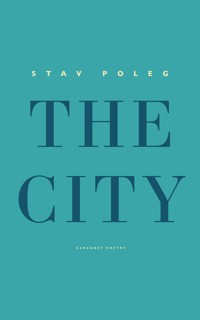
Shortlisted for the Seamus Heaney First Collection Poetry Prize 2023 Stav Poleg's poems are about cities, what they contain and what they lack; and all cities are habitable and analogous, The City: London, New York, London, New York, Rome. 'Think 'La Città / e la Casa', pages revealing city by city as if every city / is cut into rivers and sliced into streets down to the seeds of each scene.' This, her much anticipated debut collection, includes work from her 2017 pamphlet Lights, Camera, and from Carcanet's New Poetries VIII, as well as poems that have featured in The New Yorker, Poetry London, Poetry Ireland Review and PN Review. Her poems are fascinated by the freedom of motion and its constraints: how by means of technique they defy the gravity that draws them down the page to a conclusion. They subvert what they see and, as language, they also subvert how they see: we are always seeing but with all our senses, including our ears and our semantic facilities, our echo detector, how the poems relate to one another and how they relate to the worlds of art and invention in different modes and ages. Poleg regularly collaborates with fellow artists and poets – her graphic-novel installation, Dear Penelope: Variations on an August Morning, created with artist Laura Gressani, was acquired by the Scottish National Gallery of Modern Art in 2014.
Das E-Book können Sie in Legimi-Apps oder einer beliebigen App lesen, die das folgende Format unterstützen:
Veröffentlichungsjahr: 2022
Ähnliche











3
The City
STAV POLEG
TABLE OF CONTENTS
7
C’era qualcosa di insostenibile nelle cose, nelle persone, nelle palazzine, nelle strade, che solo reinventando tutto come in un gioco diventava accettabile.
Elena Ferrante, L’amica Geniale8
CAMERA
10
THE RIVER
So the sun’s sensational yellow. The river, dark iris and ultramarine. There’s a girl on a train as if she’s featured on-screen. Lips, bicycle red. Sunglasses, cerulean ink. Hair, Da-Vinci’s flying machine. In her palm, the heart of a plum. A blue heron by the water, watching rain rain into circles, into the street. Sometimes people make a fuss over moments in the painter’s life, but we know there are no moments, there are dreams and do they count? Shall we add a streetlamp? It’s getting dark. The sky, kingfisher feathers. The hands, holding a torch. The heron-blue stretched over the highway in a rainstorm reservoir. Plum trees flower into smoke like in a still shot from a film noir. Yes, there are stars. Yes, front lights flicker and blossom into the night. Yes, the river is flowing and impossible. Ladies and Gentlemen, I give you. The city.
ALPINE
This morning she breathes in smoke,
watches how clouds flower
rain.
Around her, trees grow like bottles
of whisky.
The moon is a magnetic-north
feather,
shifting away
from the glass.
Now,
waiting.
The radio is on, the TV is on, words falling
like leaves on the forest-floor
snow,
buses roaming outside like big cats,
the neighbour
shouts at his girlfriend,
a door
shuts.
There is noise everywhere. Everywhere13
there is silence.
Her eyes are rice-field terraces,
suspended in water
or smoke.
Outside snow is tucked under
snow-leopard
fog.
The ring
of a bell like a thunder uncurling.
She opens the door.
TOOTH
It begins with November, a moon escalating, a river asleep
and awake. The girl with the yellow hairclip
steps out of the 5 a.m. train, a cyclist—
watch out—the imprint of raindrops
on impossible sand. The day starts
with fog flowers. Restarts
with coffee, Liverpool Street, the girl reading the girl
in the French Marie-Claire, Maigrir
Autrement, the hiss
of espresso in London Bridge Station, the rust
on the scaffolding’s spine like blue
arrows, the waiter’s everything’s fine? How you never
answer the phone.
All the way back from the Tate
I’m not crying. The Thames fires quicksilver
light, the tarmac’s high fever pounds like a definite
thought—and to think I wanted to tell you a story
that began with a river and ended
with a bow. The wrath of Poseidon, the train’s flashing
hours, like on-and-off sketches
of boats. At home: finish the Rimbaud, call
the dentist, it’s been two years, book the Botticelli
Reimagined at the V&A, read more Sempé because you know
it works. Call the dentist.
LISTEN, YOU HAVE TO READ IN A FOREIGN LANGUAGE
Read it like poetry—don’t expect
to understand everything—
fill in the gaps with your own
half sentences. Don’t read translation
theories. Just don’t
treat a language as if it’s a precious
vase that could break
any second. It is a precious vase. It breaks
while we’re talking—that’s why we fall for it and
with it, and—listen—you have to
think for yourself but in more
than one language, and yes—life is
an exercise in freethinking, and yes—
a different language could make you
furious at first—and isn’t it
strange? But so many things
can happen: the moon, a Pegasus wing
at your door, a telephone ring
(and you know who
I’m thinking), the sky making
no sense. So many things
may never. But listen—don’t listen
to me. Listen to yourself. You wouldn’t
believe it.




