


3,99 €
Mehr erfahren.
- Herausgeber: David De Angelis
- Kategorie: Ratgeber
- Sprache: Englisch
The real problem isn't money
Most people believe that the problem is not knowing how to make money.
The truth is different: the problem is who they believe themselves to be while trying to make it.
Every human being acts according to an invisible program, a sort of mental software that determines:
- how much they will earn
- how much they will be able to keep
- how comfortable they will feel with success
It is not rational.
It is not conscious.
But it is extremely powerful.
You can learn all the strategies in the world:
if your internal model is not up to date, you will always return to your usual level.
This book is a map for reprogramming.
Das E-Book können Sie in Legimi-Apps oder einer beliebigen App lesen, die das folgende Format unterstützen:
Veröffentlichungsjahr: 2025
Ähnliche


















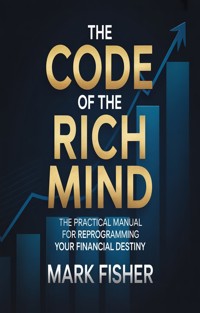
THE CODE OF THE RICH MIND
The practical manual for reprogramming your financial destiny
MARK FISHER
Translation and 2025 Edition by David De Angelis
All rights reserved
TABLE OF CONTENTS
PART I – THE INVISIBLE SOFTWARE OF MONEY
CHAPTER 1 - Financial destiny is not random
CHAPTER 2 - The unconscious financial model
CHAPTER 3 - Why willpower doesn't work
CHAPTER 4 - Identity before income
PART II – REPROGRAMMING THE MIND FOR WEALTH
CHAPTER 5 - Total responsibility
CHAPTER 6 - Playing to Win, Not to Survive
CHAPTER 7 - Decision, not Attempt
CHAPTER 8 - Think Big Without Asking Permission
PART III – THE CODES OF WEALTH (MIND + ACTION)
CHAPTER 9 - The Code of Opportunity
CHAPTER 10 - The Code of Admiration
CHAPTER 11 - The Code of Environment
CHAPTER 12 - The Code of Value
CHAPTER 13 - The Code of Results
CHAPTER 14 - The Code of Management
CHAPTER 15 - The Code of Emotional
CHAPTER 16 - The Code of Imperfect Action
CHAPTER 17 - The Code of Continuous Evolution
CHAPTER 18 - The Code of Self-Discipline
CHAPTER 19 - The Code of Time
PART IV – THE IDENTITY OF WEALTH
CHAPTER 20 - Acting Rich Before You Are Rich
CHAPTER 21 - Money, Purpose, and Contribution
CHAPTER 22 - Deserving Without Justifying
CONCLUSION - The Identity That Creates Wealth
PART I – THE INVISIBLE SOFTWARE OF MONEY
CHAPTER 1 - Financial destiny is not random
How your economic reality takes shape before you even realize it
Most people view their economic life as a sequence of unrelated events: a missed opportunity, a lucky streak, a sudden crisis, an unexpected expense, a wrong choice. Everything seems fragmented, random, often unfair. But if you stop and look closely, a much more coherent pattern emerges than it seems. The same dynamics tend to repeat themselves. The contexts change, the numbers change, but the underlying feeling remains surprisingly similar.
This is because money does not enter your life as an isolated event. It enters as a consequence of an internal system that operates silently, every day, long before you sign a contract, make a purchase, or make a financial decision. Your economic destiny is not born of what happens to you, but of what you embody as things happen to you.
Money is a delayed mirror. It reflects, with a certain delay, what already exists at a deeper level: the way you think, the way you react emotionally, the way you make decisions when no one is watching. When you look only at the end result, your bank account, your turnover, your debt, or your stability, you are looking at the last link in a chain that starts much earlier.
This is why two people with the same skills, in the same industry, with similar opportunities, can achieve completely different results. It is not a question of intelligence or commitment in the abstract sense. It is a question of internal alignment. Or, more precisely, identity.
Identity is not what you tell others. It is what you take for granted within yourself. It is how you define yourself without words. It is the invisible boundary of what you feel is possible, sustainable, normal. When it comes to money, identity plays a decisive role. Not because money defines who you are, but because you allow money to go only as far as your identity tolerates.
Many people want to earn more, but they have never explored what happens inside them when they really imagine that possibility. Not in the abstract, but in everyday reality. More responsibility, more visibility, more decisions to make, more exposure to judgment, more risk of making mistakes. The brain does not distinguish between real danger and perceived danger. If it associates economic growth with a loss of emotional security, it will do everything it can to avoid it, even at the cost of sabotaging results that seem desirable on paper.
This explains why financial change is often not linear. There are phases of momentum followed by setbacks. Moments when everything seems to be finally working, followed by incomprehensible choices that take you backwards. From the outside, it looks like inconsistency. From the inside, it is profound consistency with a self-image that has not yet changed.
Financial destiny, therefore, is not a straight line. It is a comfort zone. Everyone lives within an invisible band of results that feels familiar. Below that band, fear and urgency emerge. Above it, discomfort, guilt, self-deprecation, or a subtle tension that leads to questioning everything emerge. Until this band expands, any progress is unconsciously scaled back.
It is not a lack of discipline or willpower. Willpower acts on the surface. The internal system governs at a deeper level. You can force yourself to behave differently for a while, but if your internal structure remains unchanged, sooner or later you will return to the point that feels like 'yours'. Not because you want to, but because that is where your nervous system feels safe.
A common mistake is to believe that the problem is a lack of strategies. In reality, many people know perfectly well what they should do. They know they should manage better, invest wisely, create value, expose themselves more, think systemically. The point is not knowledge. It is the ability to emotionally sustain what that knowledge requires. Every strategy presupposes a certain level of identity. If you don't have it yet, the strategy remains theory or is applied intermittently.
There is an even more subtle aspect. Money is not neutral. It is loaded with meaning. For some, it represents freedom; for others, control. For some, security; for others, conflict. These meanings are not consciously chosen. They are formed over time, through experiences, observations, and repeated emotions. And once formed, they become the lens through which you interpret every financial situation.
If money is associated with stress for you, any increase in financial responsibility will trigger a defensive response. If it is associated with judgment, you will unconsciously avoid expanding so as not to be seen. If it is associated with loss, you will tend to hold on to it or spend it impulsively to relieve yourself of the tension it generates. In all these cases, the problem is not money itself, but the meaning you attach to it.
Your financial destiny is built right here, in the silent dialogue between what you desire and what you fear. Every economic decision is the result of this dialogue. Sometimes desire wins, sometimes fear. But as long as fear remains invisible, it will continue to guide your most important choices.
Understanding this radically changes the starting point. You are not broken. You are not incapable. You are not "wrong" for success or stability. You are simply living according to a system that you have never updated. A system that protected you in the past, but that may limit you today.
The real work doesn't start by asking yourself how to earn more. It starts by asking yourself who you become when money comes into play. How does your breathing, your body, your internal dialogue change? What thoughts automatically emerge? What scenarios do you unwittingly imagine? Those reactions are the map of your current economic destiny.
This chapter serves to create a gentle but decisive break: separating your identity from your achievements. Your value is not your income. But your income will inevitably follow the value you learn to embody in a stable, consistent, and sustainable way.
Financial destiny is neither a sentence nor a reward. It is a process. And every process can be understood. When understood, it can be transformed. In the following chapters, we will delve deeper and deeper into this mechanism, showing how what seems automatic today can become a conscious choice.
For now, a simple but powerful awareness is enough:your economic reality is not a mystery to be endured, it is a language to be learned to read. And like any language, once understood, it ceases to control you and begins to serve you.




