


Erhalten Sie Zugang zu diesem und mehr als 300000 Büchern ab EUR 5,99 monatlich.
- Herausgeber: Musaicum Books
- Kategorie: Abenteuer, Thriller, Horror
- Sprache: Englisch
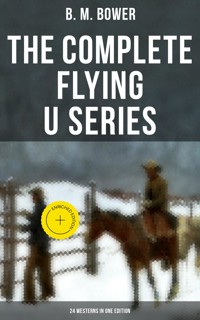
B. M. Bower's 'The Complete Flying U Series – 24 Westerns in One Edition' is a collection of classic Western novels that paint a vivid picture of the American West. The series captures the essence of cowboy life, ranching, and the challenges faced by individuals in the rugged terrain of the West. Bower's writing style is known for its descriptive imagery and authentic portrayal of cowboys and ranchers, making the reader feel as though they are right alongside the characters on the open range. This collection is a valuable piece of American literature that provides insight into the Western genre and its influence on popular culture. B. M. Bower, a female author writing under a male pseudonym, drew inspiration for her Western novels from her own experiences living in the American West. Her unique perspective as a woman in a male-dominated genre adds depth and complexity to her characters and settings. Bower's dedication to accurately depicting the Western lifestyle shines through in each novel in 'The Complete Flying U Series'. I highly recommend 'The Complete Flying U Series – 24 Westerns in One Edition' to readers who enjoy classic Western literature or are interested in exploring the rich history of the American West. Bower's captivating storytelling and profound understanding of the Western landscape make this collection a must-read for fans of the genre. In this enriched edition, we have carefully created added value for your reading experience: - A comprehensive Introduction outlines these selected works' unifying features, themes, or stylistic evolutions. - A Historical Context section situates the works in their broader era—social currents, cultural trends, and key events that underpin their creation. - A concise Synopsis (Selection) offers an accessible overview of the included texts, helping readers navigate plotlines and main ideas without revealing critical twists. - A unified Analysis examines recurring motifs and stylistic hallmarks across the collection, tying the stories together while spotlighting the different work's strengths. - Reflection questions inspire deeper contemplation of the author's overarching message, inviting readers to draw connections among different texts and relate them to modern contexts. - Lastly, our hand‐picked Memorable Quotes distill pivotal lines and turning points, serving as touchstones for the collection's central themes.
Sie lesen das E-Book in den Legimi-Apps auf:
Seitenzahl: 2937
Veröffentlichungsjahr: 2017
Das E-Book (TTS) können Sie hören im Abo „Legimi Premium” in Legimi-Apps auf:
Ähnliche

The Complete Flying U Series – 24 Westerns in One Edition
Published by
Books
Table of Contents
Introduction
This single-author collection gathers B. M. Bower’s complete Flying U cycle and its closely connected stories into one reading edition of twenty-four Westerns. It presents the full run of the ranch novels alongside character-centered volumes and shorter works that share the same world, voices, and concerns. Readers will find the cornerstone narratives that established the Flying U Ranch, as well as companion tales that follow its cowboys into episodes comic, romantic, and perilous. The purpose is both archival and immersive: to provide, in one place, the essential fictional record of Bower’s most beloved creation and the evolving community it portrays.
At the heart of the set stand the early and defining novels: Chip of the Flying U, The Flying U Ranch, and The Flying U’s Last Stand. They introduce the ranch outfit and the group of hands affectionately known as the Happy Family, whose loyalty and banter frame much of the action. An artist-cowboy’s divided ambitions, the pressures on an established outfit, and the rhythms of work on the open range supply initial premises rather than puzzles to solve. These books establish the series’ blend of humor, everyday realism, and swift incident that would remain a signature across subsequent installments.
As the series progresses, Bower turns the ranch outward to meet a changing West. The Phantom Herd brings a moving-picture company onto the range, creating frictions between showmanship and stock work. The Heritage of the Sioux touches on questions of identity and inheritance. Rodeo considers competition as livelihood and spectacle, while Dark Horse explores how reputations are made and unmade. The Flying U Strikes gathers the outfit against a common threat. Without retelling plots, it is enough to say these novels expand the social map of the series, testing camaraderie against modernity, and finding comedy and courage in the tests.
Other volumes and shorter narratives refine individual portraits. The Happy Family highlights the ensemble itself. Stories such as Ananias Green, Blink, Miss Martin’s Mission, Happy Jack, Wild Man, A Tamer of Wild Ones, Andy, the Liar, and Wolf! Wolf! follow favorite hands through pranks, mishaps, and moments of unexpected resourcefulness. Pieces like Fool’s Gold and Lords of the Pots and Pans turn to camp life, household improvisations, and the logistics that make range work possible. These works broaden the tonal palette, balancing action with domestic comedy and showing how character is revealed in talk, in crisis, and in the everyday.
This edition also includes The Lonesome Trail and Other Stories, along with its constituent pieces—The Lonesome Trail, First Aid to Cupid, When the Cook Fell Ill, The Lamb, The Spirit of the Range, The Reveler, and The Unheavenly Twins. While not all unfold squarely at the Flying U, they share the author’s preoccupation with companionship, pride, and the pull between independence and belonging. Their compact form showcases Bower’s economy of scene and ear for speech. Read beside the longer novels, they act as counterpoint and echo, amplifying themes of persistence, vulnerability, and the fragile bargains that sustain range communities.
Across forms, Bower’s style is immediately recognizable: brisk, idiomatic dialogue; an ensemble that argues and jokes without losing mutual respect; and clear, unfussy description that renders sky, coulee, and pasture as working landscapes rather than postcards. She writes Westerns of labor more than ornament, where a day’s ride, a cook’s absence, or a new machine can set a story in motion. Humor steadies the narratives without dissolving their stakes. The result is a distinctive blend of camaraderie and candor that resists myth while acknowledging the myths people live by.
A pioneering woman in popular Western fiction, B. M. Bower used the Flying U to imagine continuity amid upheaval: how a crew adapts, how traditions bend, and how affection persists under pressure. Gathered here as a contiguous reading experience, these novels and stories illuminate her sustained project rather than isolated successes. The collection invites newcomers to start at the beginning and longtime admirers to trace patterns across the whole arc. As record and narrative pleasure, it confirms why the Flying U remains a touchstone—an ensemble, a place, and a style that continues to shape the genre’s conversation.
Historical Context
Bertha Muzzy Bower (1871–1940), writing as B. M. Bower, built the Flying U cycle between 1904 and the mid‑1930s, drawing on years in Montana ranch country and later in California. The period spanned the “closing” of the American frontier, declared by the 1890 census, and the nation’s rapid urbanization. Readers encountering Chip of the Flying U and its sequels lived through accelerated change: telephones and automobiles reached remote counties, while mass magazines and inexpensive reprints circulated nationally. Publishing under initials allowed Bower to negotiate a male‑dominated market for Westerns, yet her perspective—close to everyday ranch labor—helped the series feel contemporary rather than archaic.
In Montana and the northern plains, the cattle industry transformed after the catastrophic winter of 1886–87 shattered open‑range herds. Barbed wire, patented in 1874, and windmills consolidated fenced pastures and water control, ending the classic trail‑drive era. The Reclamation Act of 1902 and later irrigation projects encouraged settlement, while the Enlarged Homestead Act (1909) and Stock‑Raising Homestead Act (1916) drew newcomers into conflict with established outfits. Bower’s ranch conflicts, line‑camps, and roundups echo this tightening landscape. Titles spotlighting cooks and camp routine—Lords of the Pots and Pans, When the Cook Fell Ill—reflect the chuckwagon system, standardized since Charles Goodnight’s 1866 innovation.
Federal conservation reshaped grazing. Forest reserves proclaimed in the 1890s and the U.S. Forest Service, created in 1905, instituted permits that curtailed free use of mountain pastures. Predator eradication, formalized by the U.S. Biological Survey after 1915, sanctioned wolf and coyote poisoning to protect calves and sheep, backgrounding plots like “Wolf! Wolf!” Range regulation culminated in the Taylor Grazing Act (1934), organizing leases on remaining public domain—timing that coincides with late Flying U titles such as The Flying U Strikes. Bower’s cowboys often dispute survey lines, water rights, and bureaucrats, mirroring real tensions as law replaced custom across the intermountain West.
Railroads bound Montana to national markets: the Northern Pacific (completed 1883) and Great Northern (1893) linked range country to Chicago’s Union Stock Yards, while refrigerated cars standardized beef distribution. Such networks compress time in Bower’s stories: telegrams, then telephones, catalyze rescues and pranks; passenger trains deliver schoolteachers and film crews to remote depots. By the 1910s–20s, automobiles and trucks begin to supplant horse relays, altering the scale of ranch mobility and law enforcement. These material changes underpin plot devices in tales of rustling, mistaken identity, and the logistics of shipping, helping explain the series’ balance of classic horsemanship with modern pace.
At the same moment, the working cowboy’s skills moved onto public stages. Cheyenne Frontier Days launched in 1897, followed by the Pendleton Round‑Up (1910) and high‑profile indoor rodeos at Madison Square Garden in the 1920s. Standardization of bronc riding, steer roping, and relay races professionalized competition for both men and women, notably cowgirl stars like Lucille Mulhall. Bower folds this spectacle into fiction—Rodeo and related episodes—while preserving the gap between showmanship and ranch necessity. The popularization of cowboy contests made her characters legible to urban readers, who recognized arena events even when the stories remained anchored in calving seasons and line‑riding.
The rise of silent cinema converged with print Westerns. Studios such as Selig, Essanay, and Thomas H. Ince’s companies sent units west by the 1910s; stars William S. Hart and Tom Mix defined screen types familiar to Bower’s audience. The Phantom Herd turns filmmaking itself into a plot engine, registering how cameras, stunt stampedes, and publicity invaded ranch space. Serial publication in mass magazines amplified that cross‑media appeal, placing the Flying U alongside national advertising and modern domesticity. Bower’s later move to California underscores this proximity; her comic ensembles and melodramas borrow timing and structure from the popular entertainments that reshaped frontier myth.
Federal Indian policy framed depictions of Indigenous presence in Montana and the Dakotas. The Dawes Act (1887) had parceled communal lands into allotments, while boarding schools enforced assimilation; after World War I, the Indian Citizenship Act (1924) extended citizenship without dismantling reservation boundaries. Tribes such as the Blackfeet, Crow, and Sioux navigated curtailed sovereignty amid resource pressures. In The Heritage of the Sioux and other episodes, Bower’s plots reflect—and sometimes question—contemporary newspaper narratives about identity, treaty rights, and jurisdiction. Though limited by period conventions, the stories register the legal and cultural crosscurrents that complicated ranch expansion and settler confidence on the high plains.
War and recession also shape the series’ timeline. World War I boosted beef and wool prices, yet drought and the post‑1919 farm crash devastated northern plains homesteads, especially in 1917–1921. Prohibition (1920–1933) and rural law enforcement appear at the margins, while the Great Depression collapsed cattle prices after 1929. Late volumes’ solidarity—defending wages, neighbors, and home ranges—reads against that backdrop, culminating as the Taylor Grazing Act reorganized public ranges in 1934. Contemporary readers, influenced by Frederick Jackson Turner’s 1893 frontier thesis and national nostalgia, found in the Flying U a reassuring blend of camaraderie, competence, and modern pressures met with stubborn humor.
Synopsis (Selection)
Flying U Series (Overview)
Across linked adventures at the Montana ranch, a tight-knit crew balances pranks and hard work as the open range collides with railroads, movies, and other modern intrusions.
The tone blends brisk humor and colloquial realism with loyalty-and-land themes, recurring horse lore, campfire banter, and strong-willed women, marking a gradual shift from open-range idyll to pressures of modernization.
Early Flying U Novels: Chip of the Flying U; The Flying U Ranch; The Flying U's Last Stand
These foundational tales focus on building a community around the ranch as Chip and the crew juggle courtship, range work, and the first waves of outside challenge.
A romantic-comic Western register and painterly landscape detail highlight themes of belonging, frontier ethics, and group solidarity, setting the optimistic baseline the later books complicate.
Hollywood and Heritage Arc: The Phantom Herd; The Heritage of the Sioux
When film-makers and other outsiders enter the range, clashes over who shapes Western stories intersect with a heritage-tinted mystery tied to local history.
With meta-Western curiosity and suspense in the foreground, these entries probe representation, mythmaking, and memory, signaling a shift toward plot-driven intrigue and cultural commentary.
Competition and Conflict: Rodeo; Dark Horse; The Flying U Strikes
From arenas to range showdowns, the crew faces contests where skill, horses, and pride meet spectacle while collective action answers threats to the ranch.
Kinetic, horse-savvy sequences and wry humor frame themes of professionalism, fair play, labor solidarity, and the commercialization of the West, keeping horsemanship central to identity under pressure.
The Happy Family and Camp-Sketches: The Happy Family; Ananias Green; Blink; Miss Martin's Mission; Happy Jack, Wild Man; A Tamer of Wild Ones; Andy, the Liar; 'Wolf! Wolf!'; Fool's Gold; Lords of the Pots and Pans; First Aid to Cupid; When the Cook Fell Ill; The Lamb; The Spirit of the Range; The Reveler; The Unheavenly Twins
Character-driven episodes and light novellas turn bunkhouse antics, tall tales, tender missteps, and kitchen crises into comic folklore drawn from everyday ranch life.
Breezy, affectionate tones and deadpan punchlines underscore camaraderie, storytelling-as-social-glue, and small moral reckonings, with signatures of nicknamed cowpunchers, trickster yarns, culinary chaos, and slangy dialogue.
The Lonesome Trail (collection and title story): The Lonesome Trail and Other Stories; The Lonesome Trail
This suite pivots to quieter range pieces, led by the title story, tracing solitude, miscommunication, and the pull of open country beyond the crew’s usual bustle.
More reflective and melancholy than the ranch comedies, it explores wandering, pride, and reconciliation, with restrained sentiment and landscape mood-painting broadening Bower’s Western palette.
The Complete Flying U Series – 24 Westerns in One Edition
Flying U Series
Chip of the Flying U
Chapter I. The Old Man’s Sister
The weekly mail had just arrived at the Flying U ranch. Shorty, who had made the trip to Dry Lake on horseback that afternoon, tossed the bundle to the “Old Man” and was halfway to the stable when he was called back peremptorily.
“Shorty! O-h-h, Shorty! Hi!”
Shorty kicked his steaming horse in the ribs and swung round in the path, bringing up before the porch with a jerk.
“Where’s this letter been?” demanded the Old Man, with some excitement. James G. Whitmore, cattleman, would have been greatly surprised had he known that his cowboys were in the habit of calling him the Old Man behind his back. James G. Whitmore did not consider himself old, though he was constrained to admit, after several hours in the saddle, that rheumatism had searched him out—because of his fourteen years of roughing it, he said. Also, there was a place on the crown of his head where the hair was thin, and growing thinner every day of his life, though he did not realize it. The thin spot showed now as he stood in the path, waving a square envelope aloft before Shorty, who regarded it with supreme indifference.
Not so Shorty’s horse. He rolled his eyes till the whites showed, snorted and backed away from the fluttering, white object.
“Doggone it, where’s this been?” reiterated James G., accusingly.
“How the devil do I know?” retorted Shorty, forcing his horse nearer. “In the office, most likely. I got it with the rest to-day.”
“It’s two weeks old,” stormed the Old Man. “I never knew it to fail—if a letter says anybody’s coming, or you’re to hurry up and go somewhere to meet somebody, that letter’s the one that monkeys around and comes when the last dog’s hung. A letter asking yuh if yuh don’t want to get rich in ten days sellin’ books, or something, ‘ll hike along out here in no time. Doggone it!”
“You got a hurry-up order to go somewhere?” queried Shorty, mildly sympathetic.
“Worse than that,” groaned James G. “My sister’s coming out to spend the summer—t’-morrow. And no cook but Patsy—and she can’t eat in the mess house—and the house like a junk shop!”
“It looks like you was up against it, all right,” grinned Shorty. Shorty was a sort of foreman, and was allowed much freedom of speech.
“Somebody’s got to meet her—you have Chip catch up the creams so he can go. And send some of the boys up here to help me hoe out a little. Dell ain’t used to roughing it; she’s just out of a medical school—got her diploma, she was telling me in the last letter before this. She’ll be finding microbes by the million in this old shack. You tell Patsy I’ll be late to supper—and tell him to brace up and cook something ladies like—cake and stuff. Patsy’ll know. I’d give a dollar to get that little runt in the office—”
But Shorty, having heard all that it was important to know, was clattering down the long slope again to the stable. It was supper time, and Shorty was hungry. Also, there was news to tell, and he was curious to see how the boys would take it. He was just turning loose the horse when supper was called. He hurried back up the hill to the mess house, performed hasty ablutions in the tin wash basin on the bench beside the door, scrubbed his face dry on the roller towel, and took his place at the long table within.
“Any mail for me?” Jack Bates looked up from emptying the third spoon of sugar into his coffee.
“Naw—she didn’t write this time, Jack.” Shorty reached a long arm for the “Mulligan stew.”
“How’s the dance coming on?” asked Cal Emmett.
“I guess it’s a go, all right. They’ve got them coons engaged to play. The hotel’s fixing for a big crowd, if the weather holds like this. Chip, Old Man wants you to catch up the creams, after supper; you’ve got to meet the train to-morrow.”
“Which train?” demanded Chip, looking up. “Is old Dunk coming?”
“The noon train. No, he didn’t say nothing about Dunk. He wants a bunch of you fellows to go up and hoe out the White House and slick it up for comp’ny—got to be done t’-night. And Patsy, Old Man says for you t’ git a move on and cook something fit to eat; something that ain’t plum full uh microbes.”
Shorty became suddenly engaged in cooling his coffee, enjoying the varied emotions depicted on the faces of the boys.
“Who’s coming?”
“What’s up?”
Shorty took two leisurely gulps before he answered:
“Old Man’s sister’s coming out to stay all summer—and then some, maybe. Be here to-morrow, he said.”
“Gee whiz! Is she pretty?” This from Cal Emmett.
“Hope she ain’t over fifty.” This from Jack Bates.
“Hope she ain’t one of them four-eyed school-ma’ams,” added Happy Jack—so called to distinguish him from Jack Bates, and also because of his dolorous visage.
“Why can’t some one else haul her out?” began Chip. “Cal would like that job—and he’s sure welcome to it.”
“Cal’s too dangerous. He’d have the old girl dead in love before he got her over the first ridge, with them blue eyes and that pretty smile of his’n. It’s up to you, Splinter—Old Man said so.”
“She’ll be dead safe with Chip. HE won’t make love to her,” retorted Cal.
“Wonder how old she is,” repeated Jack Bates, half emptying the syrup pitcher into his plate. Patsy had hot biscuits for supper, and Jack’s especial weakness was hot biscuits and maple syrup.
“As to her age,” remarked Shorty, “it’s a cinch she ain’t no spring chicken, seeing she’s the Old Man’s sister.”
“Is she a schoolma’am?” Happy Jack’s distaste for schoolma’ams dated from his tempestuous introduction to the A B C’s, with their daily accompaniment of a long, thin ruler.
“No, she ain’t a schoolma’am. She’s a darn sight worse. She’s a doctor.”
“Aw, come off!” Cal Emmett was plainly incredulous.
“That’s right. Old Man said she’s just finished taking a course uh medicine—what’d yuh call that?”
“Consumption, maybe—or snakes.” Weary smiled blandly across the table.
“She got a diploma, though. Now where do you get off at?”
“Yeah—that sure means she’s a doctor,” groaned Cal.
“By golly, she needn’t try t’ pour any dope down ME,” cried a short, fat man who took life seriously—a man they called Slim, in fine irony.
“Gosh, I’d like to give her a real warm reception,” said Jack Bates, who had a reputation for mischief. “I know them Eastern folks, down t’ the ground. They think cow-punchers wear horns. Yes, they do. They think we’re holy terrors that eat with our six-guns beside our plates—and the like of that. They make me plum tired. I’d like to—wish we knew her brand.”
“I can tell you that,” said Chip, cynically. “There’s just two bunches to choose from. There’s the Sweet Young Things, that faint away at sight of a six-shooter, and squawk and catch at your arm if they see a garter snake, and blush if you happen to catch their eye suddenly, and cry if you don’t take off your hat every time you see them a mile off.” Chip held out his cup for Patsy to refill.
“Yeah—I’ve run up against that brand—and they’re sure all right. They suit ME,” remarked Cal.
“That don’t seem to line up with the doctor’s diploma,” commented Weary.
“Well, she’s the other kind then—and if she is, the Lord have mercy on the Flying U! She’ll buy her some spurs and try to rope and cut out and help brand. Maybe she’ll wear double-barreled skirts and ride a man’s saddle and smoke cigarettes. She’ll try to go the men one better in everything, and wind up by making a darn fool of herself. Either kind’s bad enough.”
“I’ll bet she don’t run in either bunch,” began Weary. “I’ll bet she’s a skinny old maid with a peaked nose and glasses, that’ll round us up every Sunday and read tracts at our heads, and come down on us with both feet about tobacco hearts and whisky livers, and the evils and devils wrapped up in a cigarette paper. I seen a woman doctor, once—she was stopping at the T Down when I was line-riding for them—and say, she was a holy fright! She had us fellows going South before a week. I stampeded clean off the range, soon as my month was up.”
“Say,” interrupted Cal, “don’t yuh remember that picture the Old Man got last fall, of his sister? She was the image of the Old Man—and mighty near as old.”
Chip, thinking of the morrow’s drive, groaned in real anguish of spirit.
“You won’t dast t’ roll a cigarette comin’ home, Chip,” predicted Happy Jack, mournfully. “Yuh want t’ smoke double goin’ in.”
“I don’t THINK I’ll smoke double going in,” returned Chip, dryly. “If the old girl don’t like my style, why the walking isn’t all taken up.”
“Say, Chip,” suggested Jack Bates, “you size her up at the depot, and, if she don’t look promising, just slack the lines on Antelope Hill. The creams ‘ll do the rest. If they don’t, we’ll finish the job here.”
Shorty tactfully pushed back his chair and rose. “You fellows don’t want to git too gay,” he warned. “The Old Man’s just beginning to forget about the calf-shed deal.” Then he went out and shut the door after him. The boys liked Shorty; he believed in the old adage about wisdom being bliss at certain times, and the boys were all the better for his living up to his belief. He knew the Happy Family would stop inside the limit—at least, they always had, so far.
“What’s the game?” demanded Cal, when the door closed behind their indulgent foreman.
“Why, it’s this. (Pass the syrup, Happy.) T’morrow’s Sunday, so we’ll have time t’ burn. We’ll dig up all the guns we can find, and catch up the orneriest cayuses in our strings, and have a real, old lynching bee—sabe?”
“Who yuh goin’ t’ hang?” asked Slim, apprehensively. “Yuh needn’t think I’LL stand for it.”
“Aw, don’t get nervous. There ain’t power enough on the ranch t’ pull yuh clear of the ground. We ain’t going to build no derrick,” said Jack, witheringly. “We’ll have a dummy rigged up in the bunk house. When Chip and the doctor heave in sight on top of the grade, we’ll break loose down here with our bronks and our guns, and smoke up the ranch in style. We’ll drag out Mr. Strawman, and lynch him to the big gate before they get along. We’ll be ‘riddling him with bullets’ when they arrive—and by that time she’ll be so rattled she won’t know whether it’s a man or a mule we’ve got strung up.”
“You’ll have to cut down your victim before I get there,” grinned Chip. “I never could get the creams through the gate, with a man hung to the frame; they’d spill us into the washout by the old shed, sure as fate.”
“That’d be all right. The old maid would sure know she was out West—we need something to add to the excitement, anyway.”
“If the Old Man’s new buggy is piled in a heap, you’ll wish you had cut out some of the excitement,” retorted Chip.
“All right, Splinter. We won’t hang him there at all. That old cottonwood down by the creek would do fine. It’ll curdle her blood like Dutch cheese to see us marching him down there—and she can’t see the hay sticking out of his sleeves, that far off.”
“What if she wants to hold an autopsy?” bantered Chip.
“By golly, we’ll stake her to a hay knife and tell her to go after him!” cried Slim, suddenly waking up to the situation.
The noon train slid away from the little, red depot at Dry Lake and curled out of sight around a hill. The only arrival looked expectantly into the cheerless waiting room, gazed after the train, which seemed the last link between her and civilization, and walked to the edge of the platform with a distinct frown upon the bit of forehead visible under her felt hat.
A fat young man threw the mail sack into a weather-beaten buggy and drove leisurely down the track to the post office. The girl watched him out of sight and sighed disconsolately. All about her stretched the rolling grass land, faintly green in the hollows, brownly barren on the hilltops. Save the water tank and depot, not a house was to be seen, and the silence and loneliness oppressed her.
The agent was dragging some boxes off the platform. She turned and walked determinedly up to him, and the agent became embarrassed under her level look.
“Isn’t there anyone here to meet me?” she demanded, quite needlessly. “I am Miss Whitmore, and my brother owns a ranch, somewhere near here. I wrote him, two weeks ago, that I was coming, and I certainly expected him to meet me.” She tucked a wind-blown lock of brown hair under her hat crown and looked at the agent reproachfully, as if he were to blame, and the agent, feeling suddenly that somehow the fault was his, blushed guiltily and kicked at a box of oranges.
“Whitmore’s rig is in town,” he said, hastily. “I saw his man at dinner. The train was reported late, but she made up time.” Grasping desperately at his dignity, he swallowed an abject apology and retreated into the office.
Miss Whitmore followed him a few steps, thought better of it, and paced the platform self-pityingly for ten minutes, at the end of which the Flying U rig whirled up in a cloud of dust, and the agent hurried out to help with the two trunks, and the mandolin and guitar in their canvas cases.
The creams circled fearsomely up to the platform and stood quivering with eagerness to be off, their great eyes rolling nervously. Miss Whitmore took her place beside Chip with some inward trepidation mingled with her relief. When they were quite ready and the reins loosened suggestively, Pet stood upon her hind feet with delight and Polly lunged forward precipitately.
The girl caught her breath, and Chip eyed her sharply from the corner of his eye. He hoped she was not going to scream—he detested screaming women. She looked young to be a doctor, he decided, after that lightning survey. He hoped to goodness she wasn’t of the Sweet Young Thing order; he had no patience with that sort of woman. Truth to tell, he had no patience with ANY sort of woman.
He spoke to the horses authoritatively, and they obeyed and settled to a long, swinging trot that knew no weariness, and the girl’s heart returned to its normal action.
Two miles were covered in swift silence, then Miss Whitmore brought herself to think of the present and realized that the young man beside her had not opened his lips except to speak once to his team. She turned her head and regarded him curiously, and Chip, feeling the scrutiny, grew inwardly defiant.
Miss Whitmore decided, after a close inspection, that she rather liked his looks, though he did not strike her as a very amiable young man. Perhaps she was a bit tired of amiable young men. His face was thin, and refined, and strong—the strength of level brows, straight nose and square chin, with a pair of paradoxical lips, which were curved and womanish in their sensitiveness; the refinement was an intangible expression which belonged to no particular feature but pervaded the whole face. As to his eyes, she was left to speculate upon their color, since she had not seen them, but she reflected that many a girl would give a good deal to own his lashes.
Of a sudden he turned his eyes from the trail and met her look squarely. If he meant to confuse her, he failed—for she only smiled and said to herself: “They’re hazel.”
“Don’t you think we ought to introduce ourselves?” she asked, composedly, when she was quite sure the eyes were not brown.
“Maybe.” Chip’s tone was neutrally polite.
Miss Whitmore had suspected that he was painfully bashful, after the manner of country young men. She now decided that he was not; he was passively antagonistic.
“Of course you know that I’m Della Whitmore,” she said.
Chip carefully brushed a fly off Polly’s flank with the whip.
“I took it for granted. I was sent to meet a Miss Whitmore at the train, and I took the only lady in sight.”
“You took the right one—but I’m not—I haven’t the faintest idea who you are.”
“My name is Claude Bennett, and I’m happy to make your acquaintance.”
“I don’t believe it—you don’t look happy,” said Miss Whitmore, inwardly amused.
“That’s the proper thing to say when you’ve been introduced to a lady,” remarked Chip, noncommittally, though his lips twitched at the corners.
Miss Whitmore, finding no ready reply to this truthful statement, remarked, after a pause, that it was windy. Chip agreed that it was, and conversation languished.
Miss Whitmore sighed and took to studying the landscape, which had become a succession of sharp ridges and narrow coulees, water-worn and bleak, with a purplish line of mountains off to the left. After several miles she spoke.
“What is that animal over there? Do dogs wander over this wilderness alone?”
Chip’s eyes followed her pointing finger.
“That’s a coyote. I wish I could get a shot at him—they’re an awful pest, out here, you know.” He looked longingly at the rifle under his feet. “If I thought you could hold the horses a minute—”
“Oh, I can’t! I—I’m not accustomed to horses—but I can shoot a little.”
Chip gave her a quick, measuring glance. The coyote had halted and was squatting upon his haunches, his sharp nose pointed inquisitively toward them. Chip slowed the creams to a walk, raised the gun and laid it across his knees, threw a shell into position and adjusted the sight.
“Here, you can try, if you like,” he said. “Whenever you’re ready I’ll stop. You had better stand up—I’ll watch that you don’t fall. Ready? Whoa, Pet!”
Miss Whitmore did not much like the skepticism in his tone, but she stood up, took quick, careful aim and fired.
Pet jumped her full length and reared, but Chip was watching for some such performance and had them well under control, even though he was compelled to catch Miss Whitmore from lurching backward upon her baggage behind the seat—which would have been bad for the guitar and mandolin, if not for the young woman.
The coyote had sprung high in air, whirled dizzily and darted over the hill.
“You hit him,” cried Chip, forgetting his prejudice for a moment. He turned the creams from the road, filled with the spirit of the chase. Miss Whitmore will long remember that mad dash over the hilltops and into the hollows, in which she could only cling to the rifle and to the seat as best she might, and hope that the driver knew what he was about—which he certainly did.
“There he goes, sneaking down that coulee! He’ll get into one of those washouts and hide, if we don’t head him off. I’ll drive around so you can get another shot at him,” cried Chip. He headed up the hill again until the coyote, crouching low, was fully revealed.
“That’s a fine shot. Throw another shell in, quick! You better kneel on the seat, this time—the horses know what’s coming. Steady, Polly, my girl!”
Miss Whitmore glanced down the hill, and then, apprehensively, at the creams, who were clanking their bits, wild-eyed and quivering. Only their master’s familiar voice and firm grip on the reins held them there at all. Chip saw and interpreted the glance, somewhat contemptuously.
“Oh, of course if you’re AFRAID—”
Miss Whitmore set her teeth savagely, knelt and fired, cutting the sentence short in his teeth and forcing his undivided attention to the horses, which showed a strong inclination to bolt.
“I think I got him that time,” said she, nonchalantly, setting her hat straight—though Chip, with one of his quick glances, observed that she was rather white around the mouth.
He brought the horses dexterously into the road and quieted them.
“Aren’t you going to get my coyote?” she ventured to ask.
“Certainly. The road swings back, down that same coulee, and we’ll pass right by it. Then I’ll get out and pick him up, while you hold the horses.”
“You’ll hold those horses yourself,” returned Miss Whitmore, with considerable spirit. “I’d much rather pick up the coyote, thank you.”
Chip said nothing to this, whatever he may have thought. He drove up to the coyote with much coaxing of Pet and Polly, who eyed the gray object askance. Miss Whitmore sprang out and seized the animal by its coarse, bushy tail.
“Gracious, he’s heavy!” she exclaimed, after one tug.
“He’s been fattening up on Flying U calves,” remarked Chip, his foot upon the brake.
Miss Whitmore knelt and examined the cattle thief curiously.
“Look,” she said, “here’s where I hit him the first time; the bullet took a diagonal course from the shoulder back to the other side. It must have gone within an inch of his heart, and would have finished him in a short time, without that other shot—that penetrated his brain, you see; death was instantaneous.”
Chip had taken advantage of the halt to roll a cigarette, holding the reins tightly between his knees while he did so. He passed the loose edge of the paper across the tip of his tongue, eying the young woman curiously the while.
“You seem to be pretty well onto your job,” he remarked, dryly.
“I ought to be,” she said, laughing a little. “I’ve been learning the trade ever since I was sixteen.”
“Yes? You began early.”
“My Uncle John is a doctor. I helped him in the office till he got me into the medical school. I was brought up in an atmosphere of antiseptics and learned all the bones in Uncle John’s ‘Boneparte’—the skeleton, you know—before I knew all my letters.” She dragged the coyote close to the wheel.
“Let me get hold of the tail.” Chip carefully pinched out the blaze of his match and threw it away before he leaned over to help. With a quick lift he landed the animal, limp and bloody, squarely upon the top of Miss Whitmore’s largest trunk. The pointed nose hung down the side, the white fangs exposed in a sinister grin. The girl gazed upon him proudly at first, then in dismay.
“Oh, he’s dripping blood all over my mandolin case—and I just know it won’t come out!” She tugged frantically at the instrument.
“‘Out, damned spot!’” quoted Chip in a sepulchral tone before he turned to assist her.
Miss Whitmore let go the mandolin and stared blankly up at him, and Chip, offended at her frank surprise that he should quote Shakespeare, shut his lips tightly and relapsed into silence.
Chapter II. Over the “Hog’s Back”
“That’s Flying U ranch,” volunteered Chip, as they turned sharply to the right and began to descend a long grade built into the side of a steep, rocky bluff. Below them lay the ranch in a long, narrow coulee. Nearest them sprawled the house, low, white and roomy, with broad porches and wide windows; further down the coulee, at the base of a gentle slope, were the sheds, the high, round corrals and the haystacks. Great, board gates were distributed in seemingly useless profusion, while barbed wire fences stretched away in all directions. A small creek, bordered with cottonwoods and scraggly willows, wound aimlessly away down the coulee.
“J. G. doesn’t seem to have much method,” remarked Miss Whitmore, after a critical survey. “What are all those log cabins scattered down the hill for? They look as though J. G. had a handful that he didn’t want, and just threw them down toward the stable and left them lying where they happened to fall.”
“It does, all right,” conceded Chip. “They’re the bunk house—where us fellows sleep—and the mess house, where we eat, and then come the blacksmith shop and a shack we keep all kinds of truck in, and—”
“What—in—the world—”
A chorus of shouts and shots arose from below. A scurrying group of horsemen burst over the hill behind the house, dashed half down the slope, and surrounded the bunk house with blood-curdling yells. Chip held the creams to a walk and furtively watched his companion. Miss Whitmore’s eyes were very wide open; plainly, she was astonished beyond measure at the uproar. Whether she was also frightened, Chip could not determine.
The menacing yells increased in volume till the very hills seemed to cower in fear. Miss Whitmore gasped when a limp form was dragged from the cabin and lifted to the back of a snorting pony.
“They’ve got a rope around that man’s neck,” she breathed, in a horrified half whisper. “Are—they—going to HANG him?”
“It kinda looks that way, from here,” said Chip, inwardly ashamed. All at once it struck him as mean and cowardly to frighten a lady who had traveled far among strangers and who had that tired droop to her mouth. It wasn’t a fair game; it was cheating. Only for his promise to the boys, he would have told her the truth then and there.
Miss Whitmore was not a stupid young woman; his very indifference told her all that she needed to know. She tore her eyes from the confused jumble of gesticulating men and restive steeds to look sharply at Chip. He met her eyes squarely for an instant, and the horror oozed from her and left only amused chagrin that they should try to trick her so.
“Hurry up,” she commanded, “so I can be in at the death. Remember, I’m a doctor. They’re tying him to his horse—he looks half dead with fright.”
Inwardly she added: “He overacts the part dreadfully.”
The little cavalcade in the coulee fired a spectacular volley into the air and swept down the slope like a dry-weather whirlwind across a patch of alkali ground. Through the big gate and up the road past the stables they thundered, the prisoner bound and helpless in their midst.
Then something happened. A wide-open River Press, flapping impotently in the embrace of a willow, caught the eye of Banjo, a little blaze—faced bay who bore the captive. He squatted, ducked backward so suddenly that his reins slipped from Slim’s fingers and lowered his head between his white front feet. His rider seemed stupid beyond any that Banjo had ever known—and he had known many. Snorting and pitching, he was away before the valiant band realized what was happening in their midst. The prisoner swayed drunkenly in the saddle. At the third jump his hat flew off, disclosing the jagged end of a two-by-four.
The Happy Family groaned as one man and gave chase.
Banjo, with almost human maliciousness, was heading up the road straight toward Chip and the woman doctor—and she must be a poor doctor indeed, and a badly frightened one, withal, if she failed to observe a peculiarity in the horse thief’s cranium.
Cal Emmett dug his spurs into his horse and shot by Slim like a locomotive, shouting profanity as he went.
“Head him into the creek,” yelled Happy Jack, and leaned low over the neck of his sorrel.
Weary Willie stood up in his stirrups and fanned Glory with his hat. “Yip, yee—e-e! Go to it, Banjo, old boy! Watch his nibs ride, would yuh? He’s a broncho buster from away back.” Weary Willie was the only man of them all who appeared to find any enjoyment in the situation.
“If Chip only had the sense to slow up and give us a chance—or spill that old maid over the bank!” groaned Jack Bates, and plied whip and spur to overtake the runaway.
Now the captive was riding dizzily, head downward, frightening Banjo half out of his senses. What he had started as a grim jest, he now continued in deadly earnest; what was this uncanny semblance of a cow-puncher which he could not unseat, yet which clung so precariously to the saddle? He had no thought now of bucking in pure devilment—he was galloping madly, his eyes wild and staring.
Of a sudden, Chip saw danger lurking beneath the fun of it. He leaned forward a little, got a fresh grip on the reins and took the whip.
“Hang tight, now—I’m going to beat that horse to the Hog’s Back.”
Miss Whitmore, laughing till the tears stood in her eyes, braced herself mechanically. Chip had been laughing also—but that was before Banjo struck into the hill road in his wild flight from the terror that rode in the saddle.
A smart flick of the whip upon their glossy backs, and the creams sprang forward at a run. The buggy was new and strong, and if they kept the road all would be well—unless they met Banjo upon the narrow ridge between two broad-topped knolls, known as the Hog’s Back. Another tap, and the creams ran like deer. One wheel struck a cobble stone, and the buggy lurched horribly.
“Stop! There goes my coyote!” cried Miss Whitmore, as a gray object slid down under the hind wheel.
“Hang on or you’ll go next,” was all the comfort she got, as Chip braced himself for the struggle before him. The Hog’s Back was reached, but Banjo was pounding up the hill beyond, his nostrils red and flaring, his sides reeking with perspiration. Behind him tore the Flying U boys in a vain effort to head him back into the coulee before mischief was done.
Chip drew his breath sharply when the creams swerved out upon the broad hilltop, just as Banjo thundered past with nothing left of his rider but the legs, and with them shorn of their plumpness as the hay dribbled out upon the road.
A fresh danger straightway forced itself upon Chip’s consciousness. The creams, maddened by the excitement, were running away. He held them sternly to the road and left the stopping of them to Providence, inwardly thanking the Lord that Miss Whitmore did not seem to be the screaming kind of woman.
The “vigilantes” drew hastily out of the road and scudded out of sight down a gully as the creams lunged down the steep grade and across the shallow creek bed. Fortunately the great gate by the stable swung wide open and they galloped through and up the long slope to the house, coming more under control at every leap, till, by a supreme effort, Chip brought them, panting, to a stand before the porch where the Old Man stood boiling over with anxiety and excitement. James G. Whitmore was not a man who took things calmly; had he been a woman he would have been called fussy.
“What in—what was you making a race track out of the grade for,” he demanded, after he had bestowed a hasty kiss beside the nose of his sister.
Chip dropped a heavy trunk upon the porch and reached for the guitar before he answered.
“I was just trying those new springs on the buggy.”
“It was very exciting,” commented Miss Whitmore, airily. “I shot a coyote, J. G., but we lost it coming down the hill. Your men were playing a funny game—hare and hounds, it looked like. Or were they breaking a new horse?”
The Old Man looked at Chip, intelligence dawning in his face. There was something back of it all, he knew. He had been asleep when the uproar began, and had reached the door only in time to see the creams come down the grade like a daylight shooting star.
“I guess they was breaking a bronk,” he said, carelessly; “you’ve got enough baggage for a trip round the world, Dell. I hope it ain’t all dope for us poor devils. Tell Shorty I want t’ see him, Chip.”
Chip took the reins from the Old Man’s hands, sprang in and drove back down the hill to the stables.
The “reception committee,” as Chip sarcastically christened them, rounded up the runaway and sneaked back to the ranch by the coulee trail. With much unseemly language, they stripped the saddle and a flapping pair of overalls off poor, disgraced Banjo, and kicked him out of the corral.
“That’s the way Jack’s schemes always pan out,” grumbled Slim. “By golly, yuh don’t get me into another jackpot like that!”
“You might explain why you let that” (several kinds of) “cayuse get away from you!” retorted Jack, fretfully. “If you’d been onto your job, things would have been smooth as silk.”
“Wonder what the old maid thought,” broke in Weary, bent on preserving peace in the Happy Family.
“I’ll bet she never saw us at all!” laughed Cal. “Old Splinter gave her all she wanted to do, hanging to the rig. The way he came down that grade wasn’t slow. He just missed running into Banjo on the Hog’s Back by the skin of the teeth. If he had, it’d be good-by, doctor—and Chip, too. Gee, that was a close shave!”
“Well,” said Happy Jack, mournfully, “if we don’t all get the bounce for this, I miss my guess. It’s a little the worst we’ve done yet.”
“Except that time we tin-canned that stray steer, last winter,” amended Weary, chuckling over the remembrance as he fastened the big gate behind them.
“Yes, that was another of Jack’s fool schemes,” put in Slim. “Go and tin-can a four-year-old steer and let him take after the Old Man and put him on the calf shed, first pass he made. Old Man was sure hot about that—by golly, it didn’t help his rheumatism none.”
“He’ll sure go straight in the air over this,” reiterated Happy Jack, with mournful conviction.
“There’s old Splinter at the bunk house—drawing our pictures, I’ll bet a dollar. Hey, Chip! How you vas, already yet?” sung out Weary, whose sunny temper no calamity could sour.
Chip glanced at them and went on cutting the leaves of a late magazine which he had purloined from the Dry Lake barber. Cal Emmett strode up and grabbed the limp, gray hat from his head and began using it for a football.
“Here! Give that back!” commanded Chip, laughing. “DON’T make a dish rag of my new John B. Stetson, Cal. It won’t be fit for the dance.”
“Gee! It don’t lack much of being a dish rag, now, if I’m any judge. Now! Great Scott!” He held it at arm’s length and regarded it derisively.
“Well, it was new two years ago,” explained Chip, making an ineffectual grab at it.
Cal threw it to him and came and sat down upon his heels to peer over Chip’s arm at the magazine.
“How’s the old maid doctor?” asked Jack Bates, leaning against the door while he rolled a cigarette.
“Scared plum to death. I left the remains in the Old Man’s arms.”
“Was she scared, honest?” Cal left off studying the “Types of Fair Women.”
“What did she say when we broke loose?” Jack drew a match sharply along a log.
“Nothing. Well, yes, she said ‘Are they going to H-A-N-G that man?’” Chip’s voice quavered the words in a shrill falsetto.
“The deuce she did!” Jack indulged in a gratified laugh.
“What did she say when you put the creams under the whip, up there? I don’t suppose the old girl is wise to the fact that you saved her neck right then—but you sure did. You done yourself proud, Splinter.” Cal patted Chip’s knee approvingly.
Chip blushed under the praise and hastily answered the question.
“She hollered out: ‘Stop! There goes my COYOTE!’”
“Her COYOTE?”
“HER coyote?”
“What the devil was she doing with a COYOTE?”
The Happy Family stood transfixed, and Chip’s eyes were seen to laugh.
“HER COYOTE. Did any of you fellows happen to see a dead coyote up on the grade? Because if you did, it’s the doctor’s.”
Weary Willie walked deliberately over and seized Chip by the shoulders, bringing him to his feet with one powerful yank.
“Don’t you try throwing any loads into THIS crowd, young man. Answer me truly-s’help yuh. How did that old maid come by a coyote—a dead one?”
Chip squirmed loose and reached for his cigarette book. “She shot it,” he said, calmly, but with twitching lips.
“Shot it!” Five voices made up the incredulous echo.
“What with?” demanded Weary when he got his breath.
“With my rifle. I brought it out from town today. Bert Rogers had left it at the barber shop for me.”
“Gee whiz! And them creams hating a gun like poison! She didn’t shoot from the rig, did she?”
“Yes,” said Chip, “she did. The first time she didn’t know any better—and the second time she was hot at me for hinting she was scared. She’s a spunky little devil, all right. She’s busy hating me right now for running the grade—thinks I did it to scare her, I guess. That’s all some fool women know.”
“She’s a howling sport, then!” groaned Cal, who much preferred the Sweet Young Things.
“No—I sized her up as a maverick.”
“What does she look like?”
“How old is she?”
“I never asked her age,” replied Chip, his face lighting briefly in a smile. “As to her looks, she isn’t cross-eyed, and she isn’t four-eyed. That’s as much as I noticed.” After this bald lie he became busy with his cigarette. “Give me that magazine, Cal. I didn’t finish cutting the leaves.”
Chapter III. Silver
Miss Della Whitmore gazed meditatively down the hill at the bunk house. The boys were all at work, she knew. She had heard J. G. tell two of them to “ride the sheep coulee fence,” and had been consumed with amazed curiosity at the order. Wherefore should two sturdy young men be commanded to ride a fence, when there were horses that assuredly needed exercise—judging by their antics—and needed it badly? She resolved to ask J. G. at the first opportunity.
The others were down at the corrals, branding a few calves which belonged on the home ranch. She had announced her intention of going to look on, and her brother, knowing how the boys would regard her presence, had told her plainly that they did not want her. He said it was no place for girls, anyway. Then he had put on a very dirty pair of overalls and hurried down to help for he was not above lending a hand when there was extra work to be done.
Miss Della Whitmore tidied the kitchen and dusted the sitting room, and then, having a pair of mischievously idle hands and a very feminine curiosity, conceived an irrepressible desire to inspect the bunk house.
J. G. would tell her that, also, was no place for girls, she supposed, but J. G. was not present, so his opinion did not concern her. She had been at the Flying U ranch a whole week, and was beginning to feel that its resources for entertainment—aside from the masculine contingent, which held some promising material—were about exhausted. She had climbed the bluffs which hemmed the coulee on either side, had selected her own private saddle horse, a little sorrel named Concho, and had made friends with Patsy, the cook. She had dazzled Cal Emmett with her wiles and had found occasion to show Chip how little she thought of him; a highly unsatisfactory achievement, since Chip calmly over-looked her whenever common politeness permitted him.
There yet remained the unexplored mystery of that little cabin down the slope, from which sounded so much boylike laughter of an evening. She watched and waited till she was positive the coast was clear, then clapped an old hat of J. G.‘s upon her head and ran lightly down the hill.
With her hand upon the knob, she ran her eye critically along the outer wall and decided that it had, at some remote date, been treated to a coat of whitewash; gave the knob a sudden twist, with a backward glance like a child stealing cookies, stepped in and came near falling headlong. She had not expected that remoteness of floor common to cabins built on a side hill.
“Well!” She pulled herself together and looked curiously about her. What struck her at first was the total absence of bunks. There were a couple of plain, iron bedsteads and two wooden ones made of rough planks. There was a funny-looking table made of an inverted coffee box with legs of two-by-four, and littered with a characteristic collection of bachelor trinkets. There was a glass lamp with a badly smoked chimney, a pack of cards, a sack of smoking tobacco and a box of matches. There was a tin box with spools of very coarse thread, some equally coarse needles and a pair of scissors. There was also—and Miss Whitmore gasped when she saw it—a pile of much-read magazines with the latest number of her favorite upon the top. She went closer and examined them, and glanced around the room with doubting eyes. There were spurs, quirts, chaps and queer-looking bits upon the walls; there were cigarette stubs and burned matches innumerable upon the rough, board floor, and here in her hand—she turned the pages of her favorite abstractedly and a paper fluttered out and fell, face upward, on the floor. She stooped and recovered it, glanced and gasped.
“Well!”
It was only a pencil sketch done on cheap, unruled tablet paper, but her mind dissolved into a chaos of interrogation marks and exclamation points—with the latter predominating more and more the longer she looked.
It showed blunt-topped hills and a shallow coulee which she remembered perfectly. In the foreground a young woman in a smart tailored costume, the accuracy of which was something amazing, stood proudly surveying a dead coyote at her feet. In a corner of the picture stood a weather-beaten stump with a long, thin splinter beside it on the ground. Underneath was written in characters beautifully symmetrical: “The old maid’s credential card.”
There was no gainsaying the likeness; even the rakish tilt of the jaunty felt hat, caused by the wind and that wild dash across country, was painstakingly reproduced. And the fanciful tucks on the sleeve of the gown—“and I didn’t suppose he had deigned so much as a glance!” was her first coherent thought.
Miss Whitmore’s soul burned with resentment. No woman, even at twenty-three, loves to be called “the old maid”—especially by a keen-witted young man with square chin and lips with a pronounced curve to them. And whoever supposed the fellow could draw like that—and notice every tiny little detail without really looking once? Of course, she knew her hat was crooked, with the wind blowing one’s head off, almost, but he had no business: “The old maid’s credential card!”—“Old maid,” indeed!
“The audacity of him!”
“Beg pardon?”
Miss Whitmore wheeled quickly, her heart in the upper part of her throat, judging by the feel of it. Chip himself stood just inside the door, eying her coldly.
“I was not speaking,” said Miss Whitmore, haughtily, in futile denial.
To this surprising statement Chip had nothing to say. He went to one of the iron beds, stooped and drew out a bundle which, had Miss Whitmore asked him what it was, he would probably have called his “war sack.” She did not ask; she stood and watched him, though her conscience assured her it was a dreadfully rude thing to do, and that her place was up at the house. Miss Whitmore was frequently at odds with her conscience; at this time she stood her ground, backed by her pride, which was her chiefest ally in such emergencies.
When he drew a huge, murderous-looking revolver from its scabbard and proceeded calmly to insert cartridge after cartridge, Miss Whitmore was constrained to speech.
“Are you—going to—SHOOT something?”
The question struck them both as particularly inane, in view of his actions.
“I am,” replied he, without looking up. He whirled the cylinder into place, pushed the bundle back under the bed and rose, polishing the barrel of the gun with a silk handkerchief.
Miss Whitmore hoped he wasn’t going to murder anyone; he looked keyed up to almost any desperate deed.
“Who—what are you going to shoot?” Really, the question asked itself.
Chip raised his eyes for a fleeting glance which took in the pencil sketch in her hand. Miss Whitmore observed that his eyes were much darker than hazel; they were almost black. And there was, strangely enough, not a particle of curve to his lips; they were thin, and straight, and stern.
“Silver. He broke his leg.”
“Oh!” There was real horror in her tone. Miss Whitmore knew all about Silver from garrulous Patsy. Chip had rescued a pretty, brown colt from starving on the range, had bought him of the owner, petted and cared for him until he was now one of the best saddle horses on the ranch. He was a dark chestnut, with beautiful white, crinkly mane and tail and white feet. Miss Whitmore had seen Chip riding him down the coulee trail only yesterday, and now—Her heart ached with the pity of it.
“How did it happen?”
“I don’t know. He was in the little pasture. Got kicked, maybe.” Chip jerked open the door with a force greatly in excess of the need of it.
Miss Whitmore started impulsively toward him. Her eyes were not quite clear.
“Don’t—not yet! Let me go. If it’s a straight break I can set the bone and save him.”
Chip, savage in his misery, regarded her over one square shoulder.
“Are you a veterinary surgeon, may I ask?”
Miss Whitmore felt her cheeks grow hot, but she stood her ground.
“I am not. But a broken bone is a broken bone, whether it belongs to a man—or some OTHER beast!”
“Y—e-s?”
Chip’s way of saying yes was one of his chief weapons of annihilation. He had a peculiar, taunting inflection which he could give to it, upon occasion, which caused prickles of flesh upon the victim. To say that Miss Whitmore was not utterly quenched argues well for her courage. She only gasped, as though treated to an unexpected dash of cold water, and went on.




