


Erhalten Sie Zugang zu diesem und mehr als 300000 Büchern ab EUR 5,99 monatlich.
- Herausgeber: Clink Street Publishing
- Kategorie: Abenteuer, Thriller, Horror
- Sprache: Englisch
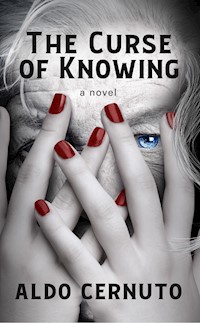
Vittoria Armieri—a humble worker at a ministry in Rome—has the ability to access people's lives: their pasts, their thoughts and feelings, and especially their tragic memories. Others would call it a superpower, but to her it's a curse: it's the source of such misery for her, that she's now desperate to die, possibly at the hands of a murderer. But while she recalls her youth and the events that brought her to this point, something unexpected occurs. Something that not even Vittoria, with all her eerie savviness, could possibly have foreseen.
Sie lesen das E-Book in den Legimi-Apps auf:
Seitenzahl: 318
Veröffentlichungsjahr: 2020
Das E-Book (TTS) können Sie hören im Abo „Legimi Premium” in Legimi-Apps auf:
Ähnliche

















Published by Clink Street Publishing 2020
Copyright © 2020
First edition.
This is a work of fiction. Names, characters, businesses, events, and incidents are either the products of the author’s imagination or used in a fictitious manner. Any resemblance to actual persons, living or dead, or actual events is purely coincidental.
The author asserts the moral right under the Copyright, Designs and Patents Act 1988 to be identified as the author of this work.
All rights reserved. No part of this publication may be reproduced, stored in a retrieval system or transmitted, in any form or by any means without the prior consent of the author, nor be otherwise circulated in any form of binding or cover other than that with which it is published and without a similar condition being imposed on the subsequent purchaser.
ISBN:
978-1-913340-01-8 - paperback
978-1-913340-02-5 - ebook
To my wife, my children and my dear mother
Foreword
Like many readers, I find myself searching for sympathetic or relatable characters when I first start reading a new book. In Aldo Cernuto’s novel, we find a character who has an ability to know everything about those she meets. In another story, such an ability would be a kind of superpower, but from this perspective, it is a curse.
When we first meet Vittoria, we find that this curse has taken a toll on her. She is world-weary, pessimistic, and just wants to be left alone. At first glance, our protagonist does not seem all that relatable. She is in her sixties, living in Rome, and suffering from an otherworldly affliction. That said, as I learn more about Vittoria, her past, her present, and her way of thinking, I find myself not only sympathizing with her but also relating.
At some time or other, we have all thought about what it would be like to read someone else’s mind. How would that feel? How would it change our lives?
As I wondered why I felt some connection to the plight suffered by Vittoria—the plight of knowing too much—I realized that this is something we all live with nowadays, in some way. A few years ago, I was set up on a blind date. I knew little of this girl except an assurance that we would get along and a single photograph. That was not good enough for me, so I found her on multiple social media platforms and searched for information. I wanted to find things we might have in common, things we could talk about and maybe bond over.
Soon, I found what I was looking for: information on her hobbies, films she liked, and a few coincidences that I no longer had to worry about us discovering by chance. And as I scrolled, I also found a note left on one of her accounts that suggested her mom had passed away just a few weeks before.
This was personal information I wish I had not discovered. I thought about cancelling our date; I now felt her time was better spent without me. But I also worried about cancelling the date and seeming insensitive. We met and, all the while, that information ate away at me. I worried whether she would tell me herself and how I would react. I worried about mentioning my family or asking about hers. I read everything in the context of knowing information she had never told me and had no idea I knew.
We never met again. This is just an example, but, truthfully, we experience such things every day. It is not just the big stuff but the little things. We know what our friends, family, and near strangers have for breakfast, what music they are listening to, and what restaurant they went to for their birthday. We know where they are at all times, we know what they thought of a recent political debate, and we know with whom they are spending time.
We know of their vanity and their need for attention. We know about their petty thoughts, hurtful comments, and frequent nastiness.
This is what Vittoria experiences each day with anyone she comes across. A curse of not just knowing the dark secrets of others but the insignificant too. Over time, the small things become legion and weigh more heavily. With all that noise, all that unwanted information, it is hard to realize that there is a difference between knowing details and truly understanding someone. Vittoria’s story is not just about how she became the burdened woman we find her, but about how opening up to love and friendship can change one’s outlook and, thereby, the course of one’s entire life.
Daniel Bergamini
FIRSTKnowing
ONE
Rome, present day
My name is Vittoria Armieri, I work at the Ministry of Cultural Heritage and I know everything.
If you feel safe, well, you aren’t. I know everything about you too, beginning with who you are and what your name is. I can tell where you are right now, what you do for a living and whom you fantasized about just minutes ago.
Like so many of the things that I know about you and anybody else, these are trivialities. These are facts that nobody cares about, least of all me. So, I treat them like gnats that are buzzing around. I wait for them to fly off, without even bothering to wave them away.
But things are different when I come across a murderer, like the guy on the bench opposite. I’m not talking about the older man with thick glasses: he is as clean as a whistle; in fact, he deserves compassion. At age twelve, he was beaten unconscious by three seniors of his boarding school and a year later he was raped by a janitor. He has always kept it from everyone, denying it even to himself. But it happened. I know it did.
Anyway, I was talking about the man sitting next to him, the guy in the blue coat who is now devouring his sandwich. His name is Domenico Morgelli and he’s sixty-four. Back when he used to inflict on human beings the same savagery that he’s now reserving for his food, he slaughtered a young man and a girl in their twenties. It’s no coincidence that he was christened Dom the butcher by the whole of Rome at the time of his crime.
I turn my gaze towards the passersby here at Villa Borghese. Unaware of what this guy did, they stroll around the park, looking for some rays of sun in this insipid early autumn. Most of them are employees on their lunch breaks, but I can spot some students too. There’s a pair of lovebirds among them. They’re crossing the pathway now, preventing me from seeing the murderer for an instant. Their names are Giada and Marcello and they attend medical school. They’re both twenty-four years old and have been together for a few weeks. Last Sunday they screwed without a condom; now she is living in anxiety, desperately waiting for her next period. From the way they are holding each other, they seem to have eight arms. Caught by their mutual love, they ignore everyone else, as if they’re living in a world confined to themselves.
Yes, that’s right: a world confined to themselves.
Oh, how I envy them that!
I dwell on the two lovers. They’re walking a few yards from a man who could slice them up, like he did to that couple years ago, and they’re practically naked in front of me. But oblivious as they are, they pay no attention to either of us.
As for me, a gloomy and withered figure, I’m not surprised that I go unnoticed by them or by anyone. I see my decay as a conquest, and my desire to hasten it exceeds by far any wish I may have of detaining it. With the misfortune I bear and the stage that I’ve now reached, my life as an outcast, ignored by everyone, is a blessing.
You wouldn’t say it today, but forty years ago anyone would have dislocated their necks to crane at me. The black waves of my hair drank in their gazes like swirls of the sea. Not to talk about my eyes—an out-of-stock hue of blue, as my mother once said; despite being azure they were like two black holes in the way they swallowed the attention of everyone around me. In the summer, when I used to wear a suntan and little else, every step I took was like a whiplash: most people gasped with pleasure; some were eaten up by envy.
But why am I distracting myself with this decades-old nonsense when I’m facing this criminal, who could be just the man for the job?
Meanwhile, the two lovers have moved on, taking the man’s gaze with them as he recalls his murder. In 1972, he stabbed both his girlfriend Mirella and Valerio, a young cook who was coming on to her on a park bench on the outskirts of Rome. He ended them with a total of twenty-two thrusts. The first four straight to Valerio’s heart. Then, in tears, he delivered the remaining eighteen to Mirella.
But this young couple has no reason to be afraid of him. I’ve already made a mental note that he served a total of twenty-three years at Regina Coeli for his crime, and he has never thought of committing another one. He wouldn’t raise a hand to call a waiter now, let alone kill someone. Other facts I know—he works for his cousin’s cleaning company and he has an infection in the lower right third molar, but he can’t afford a dentist.
Here’s the thing that annoys me the most: irrelevant details sneak stealthily into my consciousness in the same way as significant facts, but I can’t choose which to keep and which to discard.
Now the murderer has noticed me and is staring at me. After another bite of his sandwich, he looks away. He can’t imagine that this little woman wrapped in a beige coat, with her bag on her knees, knows about his crime. He cannot know, neither he nor anyone else, that I know everything. About everyone.
***
I don’t know what the origin of my illness is.
In fact, when I go back in time, in search of a triggering event, it feels like a breath of air is sliding away from my fingers.
Weird, isn’t it? I’m damned to know the most worthless details of other people’s lives, but not a fact of such magnitude concerning mine. And this is one more reason for me to call it a curse.
What I do know, though, is that I lived a quasi-normal existence at a very young age. Until I reached the age of twelve, I felt like any other child, except that I was a bit more reserved and had fewer friends than other classmates. Other than that, my quirks were like everyone else’s.
At the time, no one used to call me Vittoria. I was Vicky to friends, relatives and acquaintances. I loved being called Vicky. I adored the lightness of my nickname. It helped me feel a merry, lighthearted child, with no other thoughts than playing and having fun. In short, the child that I wasn’t.
In fact, I was a bit of a crybaby. Seeing someone suffering gave me great pain. And things started getting worse during my second year of secondary school. While my classmates were making friends by the score, I struggled to greet acquaintances. They exchanged their first kisses with boys, but I shied away from them. They laughed and talked to anyone, while I winced at hearing unfamiliar voices. If, all of a sudden, someone spoke to me, I startled like a frightened rabbit.
An early sign of my curse dates back to my sixteenth year. It was a hot summer afternoon when I was coming home from the library. A blonde woman in her fifties stopped me in the street. I remember her northern European accent, perhaps German. She told me that she had lost her way to the hospital and asked if I could help her. The stiffness of her inflection was softened by the warm and persuasive tone. What amazed me was the curious dissonance between her calmness and the urgency that her destination implied. Thanks to her patient expression, I quickly overcame the moment of alienation that I typically experienced when a stranger spoke to me. Her smile, sweet and prolonged, was accompanied by a caring look. She appeared ready to wait an eternity for my answer. Rather than making me anxious, she had released the pressure.
For a long moment, the hustle and bustle of the city seemed suspended in time, as if suddenly immersed in oil. The woman was wearing a large cotton dress with thin multi-colored stripes, very fashionable at the time. With the sun high in the sky and its rays also slowed down, it seemed to me that she was wrapped in a rainbow of cloth. Suddenly, her figure began to lose consistency. For an instant, her whole body evaporated to turn into colors, so many colors, of countless shades, and each had a familiar meaning to me. I can’t say how much time passed between the answer I had in mind, namely that I did not know where there was a hospital, and my actual reply with the precise directions to reach it. The immediacy between thought and word, so natural to every human being in a good state of health, was also submerged in that bath of oil. Replaced by notions I didn’t know I possessed.
The woman thanked me, touching my arm with a caress. Then she walked away without looking back, and I continued on my way. After a hundred yards, maybe even less, I started thinking that I had sent her down the wrong path. Of course I had. I thought I must have misled her, as I didn’t know about any hospital nearby. I then retraced my steps to the place where I had met the woman. From there, I followed the directions I had given her. Walking along unfamiliar streets, I eventually found myself in front of a hospital, which I was seeing for the first time. I was tempted to enter and find the woman again, but I gave up. I thought I’d guessed the route by pure chance— or, for all I knew, I had recovered a forgotten memory.
Years later, with the occurrence of new and increasingly severe episodes, I often thought again about this encounter. For a while, I cultivated the fairytale idea that someone had put a spell on me, just to delude myself that one day I would recover at the touch of a magic wand. In the following years, though, my naive hopes gave way to more logical assumptions, and I started to believe that there had been no first event whatsoever. I convinced myself that I’d been born with my illness. It had remained dormant for most of my youth, only to become more and more invasive over time. Today, aged sixty-five, I have no faith that I’ll ever find a cure. I have also lost hope of a stable course. On the contrary, I feel that my symptoms are getting worse day by day. The lives of others break into my consciousness with increasing frequency, while details become more and more precise. Other people’s emotions, especially the strongest ones, invade me with such violence as to overwhelm me. I avoid any large gatherings: meetings, concerts, crowded squares, metro queues, museums clogged with tourists. At peak times, I even stay away from the local markets.
One morning, two months ago, I was walking along Via Bocca di Leone and I came across a student rally. They had left Piazza di Spagna and were heading for Via del Corso. To maneuver the narrow streets of the area, their procession had forked between Via Condotti and Via Borgognona. Stuck as I was in the middle of the rally, I had no escape. In an instant, the din of young and intense lives turned into colors. Infinite colors of blinding vivacity that began to swirl around, until they collapsed in absolute darkness. I awoke to the wail of the ambulance siren. A moment later I was being laid on a stretcher. In such situations, other people’s emotions no longer reach me one at a time. They lose their individuality to become a shapeless mass, whose physical substance hurts me. Colors turn into matter. They wrap themselves in a solid wave that culminates in an explosion of black. When the impact overwhelms me, throwing me to the ground, the pain is excruciating.
Today, sitting here in the park with a few people around, I can stand the blow. Of course, the vicissitudes of others are annoying and invasive. I feel them jostling nervously around me. I feel their stinging urge to slip into my consciousness. But I can manage them. Although they hit me like a hailstorm along an unsheltered road, I can tolerate them.
My only refuge lies in nothingness. The void is my panacea. Void of color, of life, of souls. And of memories. Even a photograph on a shelf, or a forgotten letter in a book can attack me with emotions I don’t seek, nor would I want to know. My sanctuaries, the terra franca where I finally find peace, are closed and unadorned rooms, or deserted places, if I could just find some.
But when I come across a murderer, someone like this Morgelli, I bless the moment. Rather than looking for shelter, I stand fearlessly in front of him, trying to dig into his past life. I have to work up the nerve, because the violent emotions, the memories of bloody episodes, are those that strike me the hardest, and, in the end, they leave me drained. But at least I can create an advantage and kindle a hope.
I return to observe the man on the bench for a few seconds. I close my eyes, keeping his image in my memory. It shrivels up, as if about to implode. Then it suddenly tears and blazes up in a forest of colors. It takes on iridescent shades and nuances. They are colors, but to me they mean acts, names, dates and places. I do not see images, yet I see. I don’t hear sounds, yet I hear. The man is transfigured; he’s young; covered with blood; kneeling; he cries. The data comes to me in succession, with an irregular flow, which I cannot control or interrupt.
I feel them like waves of a malign and violent orgasm, a harbinger of pain. The only pleasure, if you can call it a pleasure, is feeling that it’s approaching the end—the flow begins to diminish, and fades away, slowly. Until it disappears.
Then, a last piece of information comes, faint like a watercolor: the most recent detail of this man’s life. I feel, without seeing it, that he has stood up. He’s watching me.
I open my eyes and in fact there he is, motionless, three yards from me—Domenico Morgelli. I memorize his image and lower my eyelids. He’s wondering whether we know each other. He’s now rating my age. Then he scrutinizes me again, looking at my clothing for signs of my social status. He’s considering whether I might have had a role in his trial, held here in Rome in April 1981. He wonders whether I may have been a member of the jury.
As I raise my face to the sun, I feel his gaze insist on me. I have no fear of him, and I have a thousand reasons for having none.
***
I’m looking for someone to execute me; that’s the ugly truth. I have focused my hunt on experienced killers, in the hope of finding someone who will cut short my life too. In other words, I’m in search of an armed hand (or even unarmed, provided it’s murderous) that turns me, Vittoria Armieri, or Vicky if you like, into good fuel for a crematorium.
I have plenty of reasons for craving death, as you’ll soon realize. There are so many of them, and so valid, that I struggle to establish a priority.
Obviously, my curse is high on the list.
I wish I could find a murderer for that part of me alone, while saving all the rest, as a surgeon does when removing a tumor. Unfortunately, such a specialized criminal doesn’t seem to exist. Same for a doctor: no surgical compendium includes the partial or total excision of human-life receptors. My illness is not recognized by science: how could there be a therapy? Since there is no scalpel for the diseased part only, I look for a knife that will sever the whole thing.
I’m not that picky, though: guns and bare hands would do the trick as well. I just need someone who knows how to make good use of them.
My dream is of a serial killer. With such a criminal, the chances of success should multiply. Finding one of them out of prison is quite hard, though. And those I’ve come across, have proved themselves utterly disappointing.
A few weeks ago, as an enthusiast of medieval art, I entered the Tre Fontane Abbey. Knowing it was semi-deserted, I had decided to immerse myself in its Cistercian stillness. When I entered the church, a mass was underway, attended by a handful of people. To avoid bothering anyone, I took a seat on an empty and secluded pew. After a few minutes, when the priest called for the exchange of peace, a man, all hunched over, moved from two rows ahead to shake my hand. His burden of emotions was so heavy that, at the moment of releasing his grip, I thought I would fall unconscious. That guy had already slit three people’s throats and was pleading for God’s help not to kill a fourth. I could have stopped him at the exit, as to offer myself as an easy prey to his murderous temptations and, at the same time, perhaps save another life. But his contrition was sincere: his current dream was to get locked in a cell of that same monastery, wearing a habit and holding a rosary until his dying breath. If I had followed him, I would have only wasted my time.
Sometimes, especially on Saturday mornings, I slip into a bar near my home, a few steps from the Rebibbia prison, and wait for some fresh ex-inmates to come in. On the unlucky days, which is most of them, it is frequented only by small-time criminals like pickpockets or drug dealers. That depresses me. Worst of all, however, is when I come across the innocent; people who have spent decades in prison for no reason. More than being sad for their fate (everyone has their own), I feel irritated by the time I waste. I root around for a while into their pasts, but the most heinous fault I find, at the best of times, is that they once slapped their wives.
When I manage to identify a soft subject (a thug, of course, but who yields to my expectations), I glue myself to them for hours. Sometimes, if I find one of them in front of me, I stare at him boldly, hoping he will meet my challenge. So far, though, I’ve only managed to get some angry jibes, like: You old shit, why the fuck are you watchin’ me?
One evening three months ago, at the metro turnstiles, the man of my life, that is of my death, which is just the same, had slipped behind me. His name was Giovanni Buccelli, a brute of fifty-eight years obsessed with old—and preferably ugly— women. Sentenced to eighteen years in prison for killing two of them, he had got away with the murder of his wife, whom he had thrown under a train. This last crime, especially, had ignited my hopes. When I got to the platform, I began to stare at him. I stood at the edge of the safety line. He was only five feet from me. All he had to do was extend his arm at the arrival of the train, and the thing was done. But he did nothing. We both got onto the same carriage, then he got out at my stop, following me for a long stretch along a dark alley. When I heard him come beside me, I expected a knife to suddenly appear, or, better yet, I hoped to feel it slip between my ribs, its tip straight to my heart. Instead, that guy just asked me, with irritating kindness, if I wanted to sleep with him.
That’s why I’m pissed off with these two-bit hoods: making them take out a knife or a gun seems an impossible task, but they’re always ready with their fucking dicks.
I shouted to him that he should have rotted in jail, paying for killing his wife as well. I told him to immediately disappear from my life, which he did in a flash. Then I regretted it, because clearly he’d wondered how I knew about his past. And this is so dangerous. My wish is to be killed, not pointed at as a witch.
Returning to the man of earlier today, this Domenico Morgelli, I’m now certain that I failed with him too. He has killed two people, that’s true, but it happened almost forty years ago. Since then, he’s lived like a saint. And here is the problem: this man is completely useless to my purpose. Volunteering for the Red Cross could help him atone for his sins, and it will be useful to the people whose lives he saves, but not to someone like me, who just yearns to expire.
I know what’s going on in your mind. I know what’s going on in anyone’s mind, so how can you possibly hope to escape me? You’re wondering why I bother hunting for a murderer when I could throw myself off a bridge (here in Rome there are plenty), or under a train, and end it there for good, instantly. But then there are another couple of questions that come first. I could have used this curse of mine to become some kind of almighty potentate—rich and powerful, right? So why am I, at sixty-five, a humble worker, living alone in a two-room flat on the outskirts of Rome, just longing to be dispatched?
Rummaging through people’s lives, I have learned to refrain from hasty judgements. Mind you, that’s not for ethical reasons. What principles could I champion? Not unlike Morgelli, I caused the death of two people. Not just any two people, by the way: the two I loved the most.
The fact is, precipitate judgements always lead to wrong conclusions.
Listen to someone who knows everything: either you have all the information or shut up. So, before you step into the shoes of a judge, listen to my full story.
Listen from the beginning, though.
And all the way to the very end.
TWO
1977 – April to June
If my ability to get into people’s heads and grasp their secrets has left you open-mouthed, it’s only because you have no idea what I was like as a young woman. My beauty was way more prodigious.
At that time—I was in my early twenties—I didn’t need to discover the thoughts of people, and, in particular, what was going on in the heads of men. Guys blurted it all out. They were so ecstatic to be in my presence that, to overcome silences and embarrassments, they instantly dispensed with their inhibitions. As a result, they spoke freely and unreservedly, even at the cost of talking nonsense.
Back in those days, my illness manifested itself occasionally, and I used to consider those desultory phenomena nothing but an overactive imagination. Instead of giving them relevance and sensing the dangers, I treated them as natural extensions of my mesmerizing allure.
I know I might appear arrogant, if not obnoxious, by insisting on how beautiful I was at that time. But you’ll soon understand that it’s for the sake of truth, and not for pride. Vanity never took hold of me. In fact, up to the age of twenty, I did everything I could to remain in the shadows. I scoffed at the philanderers and shunned the compliments of the adulators. I even neglected my appearance to evade their drooling glances. I often bundled myself up in clumsy and unfashionable clothes to avoid jealousy amongst my group of friends.
My third year of university, however, marked the peak of my desirability. The generosity of nature had extended to my whole figure to such a degree that my modesty ended up stinking of hypocrisy. In other words, I was at risk of serving the envious one more reason for hating me.
Back in those days, I was still living with my parents. A couple so drawn to one another by mutual passion that they saw in conjugal love the ultimate scope of existence. Proud of my slew of full marks, they could only imagine a bright future ahead of me. A graduation with flying colors was now within reach, and a brilliant career a logical consequence. They could start dreaming of a good son-in-law, the necessary step towards a couple of grandchildren—joy for their third age.
In April 1977, my heart bumped into a strapping young man a few years my senior. In one fell swoop, I managed to disappoint everyone: my friends, my many other suitors and, most of all, my parents.
His name was Antonello and from a physical standpoint he was nothing special, except for his blue eyes, a 6-foot-1 height and two refrigerator-like shoulders: excellent genetic stock fortified by a past as a scrum half in rugby.
Wow, that’s really saying something! Weren’t you about to say that? I’m talking to you, female reader. In your dreamy little head, avid for romance, you had already pictured a Greek god, right? Have you forgotten what I just said about hasty judgements? Always wait to hold both hammer and nail before hanging the picture on the wall.
Just like the fish, which rots from the head, his skull should have alerted me from the start. Round and perfectly shaven, it was undersized, especially if compared with his robust frame. But it was his chiseled look that challenged the aesthetic canons of the time. An aquiline nose stood out from his face, coupled with a mouth so tiny as to seem squished up. The result was a contemptuous expression—a nasty look that instilled in others that particular form of respect that arises from fear.
As for being undersize, his hands lumped together with his head. Even his penis, miserably, was of the same batch. But I would discover this only after coming across other more impressive members, that dwarfed his in comparison.
I had been struck by Antonello’s low voice, which was set to vibrate every organ of mine, and by his wreck-it-all attitude. He seemed to be born holding a little hammer, like the ones to access fire extinguishers. A tool that he was poised to use at all times. You gave him a rule and he pledged to tear it apart. In the pubs where smoking was prohibited (a rarity at the time), he used to light up a cigar with the express purpose of messing with the owner. Same fate for those who didn’t take a shine to him. If some guy dared eye me up, he found Antonello’s hands at their collar in no time.
His manners of savage-in-the-city impressed me as well. He wore sweaters on bare skin, drove barefoot, always drank from the neck of the bottle and when he ate pizza, he tore it with his hands. His sensibility for culture clashed with his bearish habits. Just to give you an example, he used to devour the works of Beckett, Ginsberg, Bukowski and the like; after finishing each book he passed it to me without uttering a comment. As if to say read and learn, woman.
As an enthusiast of theater, his favorite subject at university, Antonello dreamed of knocking down both its scenic conventions and its physical walls. He talked about improvising plays in the public squares, with actors recruited on the spot. He suggested that cultural associations gave passersby free coupons for buying books to persuade them to watch the shows. “Let’s give the people the culture that football has stolen from them and the whole country will benefit from it,” he used to say, with solemnity.
He spoke little and listened even less, but for almost any word he had a precise gesture. There’s one in particular that I remember. When I happened to speak eagerly to him about an idea that I had come up with, he used to keep his head down, as focused on other issues; then, all of a sudden, he would interrupt me, showing his open palm and rotating his forefinger, two or three times, to invite me to repeat my last sentence. And I would start again from there, in desperate search of the best words to make myself understood.
One evening in late May of 1977, Antonello and I went to dine in a crowded and noisy trattoria at Trastevere. His powerful voice dominated the Romanesque chatter in the background, as if he wanted to shut them all up. Colors, voices, and cries were coming from all around us. So many candle lights were pinching my eyes. The surrounding chaos was about to explode in my head. I could barely understand a word out of three of what Antonello was saying. But the one thing I understood was the one I cared about the most. He was proposing that we start a life together. He had only hastily hinted at that possibility, because the issue at stake, that night, was rather the kind of business he wanted to start up. The gist of the conversation was how we would make a living, and its essence was his career. But, in love as I was with love, I retained from his speech what best crowned my infatuation for him—the promise of a nest where our hearts would vibrate in unison.
His business project, on which he had long dwelt, slipped away from my head like a lock of hair in the wind. What I loved in his project wasn’t so much the idea of making money but starting a life together. And, later, even a family. I didn’t even consider an alternative path—with money as our main goal. I had always thought that love is the source of all that is good, never vice versa. Just as a torrent always goes down a mountain, and not the other way around.
Antonello’s plan, in short, was to earn our living by holding acting classes. During his three years at the School of Dramatic Arts in Bologna, which he often defined as enlightening, he had acquired a good theoretical basis of directing and acting. His only practical experience dated back to August, two years earlier, when he had formed with other students a small company—five amateur actors performing along the Adriatic Riviera. Their stage was the beach, and the hapless sunbathers were their audience. They didn’t make much money with their show, but some local newspapers were intrigued by the foolishness of their project. Antonello, co-protagonist of the play, had stolen everyone’s thunder in the various interviews, earning himself the role of leader. These are all facts that I had learned through a patient collage of his cut-up phrases, which he used to drop into our conversations. He indulged in more articulate narratives only when he found himself among new acquaintances. On those occasions, smelling the scent of a public all for himself, he became garrulous. In those narrations, all of a sudden, their performances on the beach became epic, their audience in shorts and bikinis immense and ecstatic. With entire crowds of half-naked holidaymakers clapping like crazy. Antonello’s self-confidence in front of strangers, combined with his attitude of a seasoned director, bestowed upon him the aura of a capable master. The more so in an era, the late ’70s, in which it was rather easy to undo the shoes of a fresh graduate and slip on those of a fully-fledged teacher.
Going back to the night of Antonello’s proposal, towards one o’clock we had remained all alone in the trattoria. Just the two of us. We were seated at a rough wooden table, all badly scored with names, old dates and little hearts—remnants of generations of bygone lovebirds. A candle stub, about to breathe its last, was weakly glimmering halfway between us. I stared at it, resting my gaze on its final gasp. In that moment, I was no longer there. And I wasn’t anywhere. A second later, the flame was stirring on a long white candle, which I held in my hand. Around, it was all dark. I moved the candle towards the center of the table. But it was no longer a table. The wood was now smooth, polished, curved at the sides. Stretching out my free hand, I skimmed its surface, until my fingers hesitated at a small ledge. It was cold to the touch and seemingly metallic. I moved the candle to that point, until I saw that it was a cross, at the center of a coffin. I suddenly retracted my hand, as if burnt, while Antonello’s theatrical voice sucked me back into the present.
“We’ll start the school in September. We’ve just three months to get ready.”
Tiredness, I told myself. I must just be a bit tired.
“Certainly,” I smiled, regaining presence. “I’m ready, I’m looking forward to it, amor mio.”
When I went back home that night, Mom and Dad were about to go to sleep. I greeted them as if they were now two distant relatives and reached my bed, intending that I would talk to them about Antonello’s project, which had now become mine too, in a few days’ time.
I chose to do it one morning, at breakfast, just before my father left for work. I wanted to avoid at all costs the kind of quarrel that blows up out of impulsiveness and lasts for hours.




