


1,99 €
Mehr erfahren.
- Herausgeber: Booksell-Verlag
- Kategorie: Abenteuer, Thriller, Horror
- Sprache: Englisch
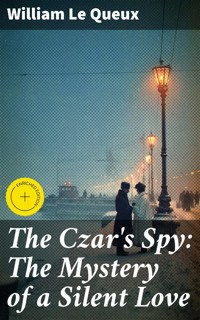
In "The Czar's Spy: The Mystery of a Silent Love," William Le Queux crafts an intricate tale woven with espionage, romance, and political intrigue, reflective of the heightened tensions of early 20th-century Europe. Le Queux's prose combines atmospheric descriptions with fast-paced narrative, immersing readers in a world of clandestine plots and veiled identities. The novel navigates the undercurrents of a society on the brink of upheaval, showcasing the intertwining of personal desires and national dilemmas against the backdrop of impending war. William Le Queux, a pioneer of spy fiction and a contemporary of other literary giants, was profoundly influenced by his experiences as a journalist and his deep engagement with European politics. Growing up in a politically charged environment, Le Queux's works often reflect his insights into the fragile alliances and rivalries that defined his era. His previous writings on international espionage inform a narrative that not only entertains but prompts reflections on loyalty, betrayal, and the complexities of love amid chaos. Readers seeking a thrilling blend of romance and intrigue will find "The Czar's Spy" an essential addition to their literary repertoire. Le Queux's mastery in evoking tension and emotion makes this work a compelling exploration of the human condition against a backdrop of suspense, ultimately revealing how love can thrive in even the most perilous circumstances. In this enriched edition, we have carefully created added value for your reading experience: - A succinct Introduction situates the work's timeless appeal and themes. - The Synopsis outlines the central plot, highlighting key developments without spoiling critical twists. - A detailed Historical Context immerses you in the era's events and influences that shaped the writing. - A thorough Analysis dissects symbols, motifs, and character arcs to unearth underlying meanings. - Reflection questions prompt you to engage personally with the work's messages, connecting them to modern life. - Hand‐picked Memorable Quotes shine a spotlight on moments of literary brilliance. - Interactive footnotes clarify unusual references, historical allusions, and archaic phrases for an effortless, more informed read.
Das E-Book können Sie in Legimi-Apps oder einer beliebigen App lesen, die das folgende Format unterstützen:
Veröffentlichungsjahr: 2023
Ähnliche















The Czar's Spy: The Mystery of a Silent Love
Table of Contents
Introduction
Love unspoken is tested against the ruthless machinery of espionage, where silence can protect the heart even as it endangers the state. William Le Queux’s The Czar’s Spy: The Mystery of a Silent Love blends intrigue with romantic tension, inviting readers into a world where private feeling collides with public danger. The title signals a double fascination: the aura of imperial power and the inward secrecy of an attachment that cannot be voiced. Le Queux, a British journalist-novelist known for popularizing espionage fiction, crafts a tale that exploits suspicion, disguise, and coded behavior to press on the fault lines between duty and desire.
Situated firmly in early twentieth-century popular fiction, the book inhabits the emergent spy genre shaped by European rivalries in the years before the First World War. Its action unfolds against the shadow of the late Tsarist era, drawing on anxieties about surveillance, treachery, and the fragility of borders. Readers should expect a continental canvas—railways, seaports, and diplomatic salons—rather than a single, sequestered locale. Le Queux wrote for an audience alert to rumors of plots and counterplots, and the novel reflects that sensibility. The atmosphere is cosmopolitan, tense, and mobile, with the promise of revelations as perilous as the secrets they conceal.
Without straying beyond its initial premise, the story sets a civilian entangled with agents linked to the Czar’s interests, compelled to navigate an underworld of watchers and informants while protecting a love that must remain unspoken. The mystery turns on identities obscured for safety and motives disguised by necessity. The experience is that of a brisk, suspense-forward adventure: narrow escapes, sudden reversals, and the steady tightening of a net that may or may not be visible to the characters. Le Queux’s narrative favors momentum and immediacy, keeping readers close to peril while withholding enough to sustain a persistent, unsettling curiosity.
Themes of secrecy and surveillance pervade the novel, but they are refracted through an intimate lens: what it means to keep faith with another person when truth itself is weaponized. Loyalty, patriotism, and personal conscience pull in conflicting directions, testing both the will and the heart. Silence operates on several registers: as a tactical necessity, as an ethical restraint, and as the emotional condition of a love that cannot safely be declared. The book asks how far trust can stretch under pressure, and whether an identity can remain intact when every introduction, letter, or glance might be a trap set by invisible adversaries.
Le Queux draws on the everyday mechanics of his era—the timetables of modern travel, bureaucratic paperwork, and the rhythms of diplomatic society—to give intrigue a tactile, contemporary feel. The prose is direct and journalistic in spirit, favoring scenes built for impact and clarity over ornament. Episodes are arranged to end with questions sharpened by danger, tapping the serialized energy that made such tales widely read. While the settings evoke exoticism by distance, the conflicts themselves are domestic in their consequences: whom to trust, what to reveal, and when silence is the only defensible choice. The effect is immersion without unnecessary labyrinths.
For readers today, the novel’s preoccupations feel strikingly current. It speaks to a world of surveillance anxieties, contested borders, and information asymmetries, while acknowledging that emotional life rarely fits the clean lines of political allegiance. The romance at its core underscores the costs of secrecy—not only to states, but to individuals navigating love’s vulnerabilities amidst public risk. In an age of encrypted messages and shifting loyalties, its moral questions still resonate: how do we balance transparency and protection, and when does concealment become complicity? The book’s historical distance offers a lens for considering those dilemmas without surrendering their urgency.
Approached as a classic of popular espionage with a strong romantic undercurrent, The Czar’s Spy: The Mystery of a Silent Love offers fast-paced suspense anchored by an emotional undertow. It rewards readers who enjoy atmosphere and momentum, light-footed exposition, and the psychological tension of playing roles in order to survive. Expect a narrative that privileges movement and crisis over introspection, yet leaves room for contemplation about what remains unspoken between people who cannot safely speak. Le Queux’s work endures as a bridge between the adventure tale and the modern spy novel, and this volume captures that transition with clarity and verve.
Synopsis
The Czar’s Spy: The Mystery of a Silent Love follows Gordon Gregg, an observant English traveler whose casual movements among Europe’s fashionable resorts draw him into covert affairs. While on the Italian coast, he takes notice of an elegant yacht and the cosmopolitan set surrounding it, including English acquaintances whose activities seem unusually guarded. A minor incident—easily overlooked by others—alerts him to a hidden struggle involving secret communications and careful surveillance. Without announcing himself as an investigator, Gregg begins to assemble small clues. His curiosity is sharpened by hints of Russian influence and by the quiet distress of a young woman he cannot safely approach.
Gregg’s path crosses that of Elma Heath, an Englishwoman whose silence is striking and inexplicable. Unable to speak, she communicates by fragmentary notes and troubled glances, suggesting danger that stretches beyond the polite circles they share. Her mute appeal lends weight to Gregg’s suspicions of a conspiracy spanning multiple countries. Through discreet contact with British consular acquaintances, he learns that certain travelers’ movements have attracted attention in diplomatic reports. The connections point toward Russian interests and to a pattern of transit between southern ports and the Baltic. Gregg resolves to follow the signs cautiously, recognizing that the woman’s imperiled secrecy is central to understanding the plot.
Among the figures orbiting the yacht are people of means and ease—names familiar in racing and yachting calendars—whose polished hospitality conceals obscure business. Gregg becomes a regular presence at gatherings where casual talk hints at coded arrangements. He notices a monogram on a trinket, an altered photograph, and the orderly disappearance of a guest before awkward questions can be asked. A near-accident on a mountain road and a misdirected invitation suggest he has attracted watchful attention. The linked personalities move with purpose, toward northern waters. A suggestion of Russian protection—unstated but unmistakable—presses Gregg to continue his inquiry under the cover of ordinary travel.
The trail leads to the Baltic and Finland, where life under imperial administration is heavily policed. In this austere setting, Gregg encounters a stark incident: a motor-car standing on a lonely road, its occupant lifeless under circumstances too precise to be random. Local authorities appear, followed closely by gendarmes, and the inquiries take on a political tone. Gregg’s identity as an Englishman provokes interest, and he answers questions carefully while concealing the threads that tie the dead man to earlier encounters. Names already noticed in Italy resurface in murmured exchanges. The impression forms that an invisible hand smooths obstacles—or creates them—according to hidden plans.
Elma Heath reappears in the northern capital, under watch, her silence now clearly both personal burden and protective barrier. Through clandestine notes and brief meetings arranged in neutral places, she conveys that her knowledge concerns a secret gathering and a transaction carrying state repercussions. She has seen and heard enough to incriminate powerful people, yet cannot speak openly without placing herself at immediate risk. Gregg arranges discreet assistance and proposes a path to safety, but attempts to move her are met by sudden searches and the quiet closing of exits. The effort to shield her becomes the axis on which the wider investigation turns.
As he probes deeper, Gregg encounters the machinery of the empire’s security: dossiers, coded messages, and whispers naming a high official whose reach extends across borders. The elusive figure referred to as the Czar’s spy appears to manipulate both radicals and loyalists, guiding events for ends not openly declared. Gregg uncovers false passports, a cipher-book, and hints of a cache of documents capable of compromising a prominent statesman. A person he believed sympathetic proves unreliable, emphasizing the story’s climate of duplicity. Threatened with detention and worse, Gregg relies on diplomatic tact and careful timing to stay at liberty and continue piecing together the design.
The narrative moves between Helsingfors, Abo, and St. Petersburg, shifting from crowded boulevards to secluded villas and guarded refuges. Gregg and Elma work to interpret a cipher whose plain solution points to a hidden compartment and a portable packet that changes hands under cover of routine travel. Encounters on railway platforms and aboard small craft suggest converging lines of pursuit. The yacht glimpsed earlier returns to the foreground, its graceful movements masking a practical role in the transfer of people and papers. A near capture is averted by seconds, while each clue confirms that murder, secrecy, and high policy are stubbornly intertwined.
The final act gathers the principal players: those who would silence witnesses, those prepared to expose wrongdoing, and those intent on preserving appearances. Coordinating with trustworthy officials and disaffected insiders, Gregg prompts a confrontation in which documents, identifications, and testimonies intersect. The chain of events aligns the northern road death, the yacht’s itinerary, and the enforced silence of Elma Heath. The operational method of the Czar’s spy—balancing fear and favor—becomes intelligible, even if every hand behind the curtain is not publicly named. With careful precision, traps are sprung and defenses probed, yielding outcomes that address immediate dangers without indiscriminately widening the scandal.
In the aftermath, the machinery of intrigue slows, and its exposed cogs are removed or rendered harmless. Formal consequences follow, while certain accommodations reflect the era’s diplomatic caution. Elma’s condition and situation are resolved in a manner consistent with her ordeal and the title’s quiet poignancy. Gregg closes his account by noting the limits of certainty in a world governed by secrecy, the precarious balance between private feeling and public duty, and the reach of power across borders and classes. The novel’s central message emphasizes patience, observation, and restraint as tools against covert manipulation, while acknowledging the human costs borne by those who cannot speak.
Historical Context
Set against the closing years of Nicholas II’s reign, The Czar’s Spy unfolds in a Europe stitched together by railways, steamships, and telegraph cables, where St. Petersburg’s autocratic court exerted influence from the Baltic littoral to Central Europe. The Russian Empire’s political center, flanked by strategic ports like Libau (Liepāja) and Reval (Tallinn), interfaced uneasily with Western capitals such as Paris and Berlin. The novel, published in 1905, mirrors a landscape of embassies, frontier checkpoints, and clandestine rooms where dossiers changed hands. The atmosphere is distinctly pre-war and transnational, with imperial police and revolutionary conspirators alike moving through hotels, salons, and quay-side warehouses that framed Europe’s espionage economy.
The Okhrana—the Department for Protecting the Public Security and Order—formed in 1880 amid rising revolutionary violence (after decades culminating in Alexander II’s assassination in 1881), provided the era’s model of clandestine statecraft. Its Paris bureau under Pyotr Rachkovsky (1885–1902) pioneered foreign surveillance, mail interception, and infiltration of émigré networks; agent provocateur tactics and double agents, such as Evno Azef within the Socialist-Revolutionaries, blurred lines between policing and conspiracy. Domestically, the Okhrana used the gendarmerie, censorship, and Siberian exile to stifle dissent. The Czar’s Spy consistently echoes these methods—covert files, shadowing, and engineered betrayals—depicting a pan-European reach of secret policing that renders borders porous and private life precariously exposed.
The Russo-Japanese War (1904–1905) erupted over rival ambitions in Manchuria and Korea, beginning with Japan’s surprise attack on Port Arthur on 8 February 1904 and culminating in devastating Russian defeats at Mukden (February–March 1905) and Tsushima (27–28 May 1905). Admiral Tōgō Heihachirō’s annihilation of Admiral Rozhestvensky’s Baltic Fleet, dispatched from Libau, symbolized imperial vulnerability; the Treaty of Portsmouth on 5 September 1905, mediated by Theodore Roosevelt, formalized Russia’s humiliation. This geopolitical shock catalyzed domestic unrest and elite anxiety. Le Queux’s novel resonates with the ensuing atmosphere: naval fiascos, cable-choked war rooms, and fears of sabotage energize its scenes, suggesting how military setbacks sharpened spy panics and tightened the net of surveillance across Europe.
The Revolution of 1905, ignited by Bloody Sunday in St. Petersburg on 9 January 1905 when troops fired on Father Gapon’s petitioners, produced nationwide strikes, peasant uprisings, and mutinies such as the Potemkin (June 1905). The St. Petersburg Soviet formed on 13 October 1905, and Nicholas II’s October Manifesto (17 October) promised a Duma and civil liberties, while reactionary forces, including the Black Hundreds, unleashed pogroms. Moscow’s December rising met brutal repression, and later “Stolypin neckties” became shorthand for hangings under Prime Minister Pyotr Stolypin. The novel’s conspiracies, aristocratic vulnerabilities, and coded rendezvous parallel this turbulence, depicting noble salons and border stations as theatres where revolution, counterrevolution, and espionage converged in a single, fraught public sphere.
Imperial Russification intensified on the empire’s edges, notably in the Grand Duchy of Finland and the Polish and Baltic provinces. Finland’s February Manifesto (1899) and language policies (1900) curbed autonomy; Governor-General Nikolai Bobrikov was assassinated in Helsinki on 16 June 1904 by Eugen Schauman, a dramatic blow to imperial authority. In Congress Poland, mass strikes and the Łódź insurrection (22–24 June 1905) underscored urban militancy. Across Latvia and Estonia, the “Burning of the Manors” in 1905 saw hundreds of estates attacked, followed by punitive expeditions and summary courts-martial. The novel’s itineraries through ports and manor houses evoke these fault lines, portraying local nationalisms, imperial officials, and secret agents colliding amid repression and resistance.
The longer arc of Anglo-Russian rivalry—the Great Game—shaped British perceptions of Russian power and clandestine methods. Crises such as Panjdeh (1885) nearly sparked war, and boundary settlements on the Pamirs (1895) left distrust simmering until the Anglo-Russian Convention (31 August 1907) regularized spheres in Persia, Afghanistan, and Tibet. Before 1907, Britain’s Naval Intelligence Department (formed 1882) and diplomatic posts cultivated ad hoc espionage, worried by Russian moves from Central Asia to the Straits. Le Queux wrote into this climate of suspicion. His protagonists’ use of consular corridors and coded introductions reflects a world where newspapers, attachés, and informants blurred, and where the specter of Russian intrigue haunted British strategic imagination.
Technological modernity remade espionage. The Trans-Siberian Railway, begun in 1891 and linked across Lake Baikal by ferry by 1904 (with the Amur line completed in 1916), enabled rapid troop and courier movement; international telegraph cables and early wireless (Marconi’s 1901 transatlantic signal) permitted real-time intelligence and interception. Naval operations, including the Baltic Fleet’s long wireless-enabled voyage to Tsushima, revealed the strategic premium on signals security. Passport regimes tightened and postal censorship expanded. The Czar’s Spy exploits these infrastructures: express trains, steamers, and cable offices facilitate pursuit and evasion, while encrypted messages and forged documents dramatize how modern networks allowed states and conspirators alike to project power swiftly across borders.
As a political and social critique, the novel indicts late-imperial autocracy for breeding secrecy, corruption, and social fracture. It exposes a state reliant on covert coercion and intermediaries rather than legal transparency, highlighting the costs of Okhrana tactics, from provocation to surveillance, on civil society. The work underscores class divides—aristocratic privilege, bureaucratic impunity, and the vulnerability of workers and minorities amid pogroms and punitive justice. It also questions the moral equilibrium of European diplomacy, where expediency trumps principle. By staging love, loyalty, and betrayal within this machinery, the book suggests that systemic repression deforms private life, revealing an empire faltering under the weight of fear and unaddressed grievances.




