


0,49 €
Niedrigster Preis in 30 Tagen: 1,99 €
Niedrigster Preis in 30 Tagen: 1,99 €
Mehr erfahren.
- Herausgeber: DigiCat
- Kategorie: Gesellschafts- und Liebesromane
- Sprache: Englisch
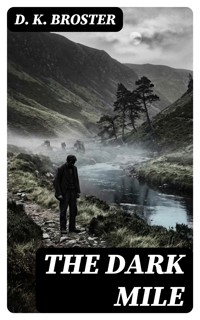
In "The Dark Mile," D. K. Broster crafts a haunting narrative set against the backdrop of the Scottish Highlands, blending elements of supernatural horror with a profound psychological exploration of fear and guilt. The novel's structure reveals a meticulous attention to atmospheric detail and vivid imagery, reflecting a literary style reminiscent of early 20th-century Gothic fiction. Broster deftly weaves folklore and mythology into the fabric of her storytelling, inviting readers to confront the darker aspects of human nature through a lens of supernatural tension. The interplay between the natural landscape and its eerie manifestations creates an unsettling ambiance, underscoring the themes of isolation and the struggle between rationality and the irrational. D. K. Broster, an influential Scottish author and a pivotal figure in the early feminist literary movement, draws upon her own experiences growing up in a family steeped in Scottish culture and history. Her fascination with folklore and the occult translates into a narrative that captures the complexities of human emotion and the weight of legacy. Having lived through the societal shifts of her time, Broster's perspectives on identity and place inform the chilling essence of "The Dark Mile." For readers drawn to the intersection of psychological depth and supernatural intrigue, "The Dark Mile" is an indispensable addition to the canon of Gothic literature. Broster's skillful storytelling and rich thematic exploration compel readers to reflect on their own fears and the shadows that linger within the human psyche. This novel promises a captivating journey into darkness, making it a must-read for those who seek both suspense and substance. In this enriched edition, we have carefully created added value for your reading experience: - A succinct Introduction situates the work's timeless appeal and themes. - The Synopsis outlines the central plot, highlighting key developments without spoiling critical twists. - A detailed Historical Context immerses you in the era's events and influences that shaped the writing. - A thorough Analysis dissects symbols, motifs, and character arcs to unearth underlying meanings. - Reflection questions prompt you to engage personally with the work's messages, connecting them to modern life. - Hand‐picked Memorable Quotes shine a spotlight on moments of literary brilliance. - Interactive footnotes clarify unusual references, historical allusions, and archaic phrases for an effortless, more informed read.
Das E-Book können Sie in Legimi-Apps oder einer beliebigen App lesen, die das folgende Format unterstützen:
Veröffentlichungsjahr: 2022
Ähnliche




The Dark Mile
Table of Contents
Introduction
Poised between the pull of loyalty and the demands of survival, The Dark Mile unfolds where private conscience clashes with public power, tracing how a conquered people weigh love, honor, and memory against the urgent need to endure, as friendships, kinship ties, and long-cherished customs are tested by suspicion and reprisal, while the very landscape seems to absorb grief and resilience alike, and choices that once felt absolute blur into hard-won compromises, quiet acts of courage, and the persistent question of what remains when the drums of open rebellion fall silent but its echoes continue to shape every step.
D. K. Broster’s The Dark Mile is a historical novel set in the Scottish Highlands in the aftermath of the 1745 Jacobite rising, published in the late 1920s amid renewed interest in Britain’s past. Part of Broster’s sequence of Jacobite books, it returns to a time when the Highlands were under intense scrutiny, travel was perilous, and loyalties could not be worn openly. Broster writes within the adventure-and-romance tradition, yet grounds her narrative in carefully observed social texture and consequence. The novel stands at the intersection of historical reconstruction and moral inquiry, offering an immersive setting without sacrificing clarity or pace.
Without requiring specialist knowledge, the story opens on communities still bruised by defeat, where soldiers’ routines, new laws, and economic pressures force everyday people to reshape their lives. An encounter, small in scale yet weighty in implication, draws several figures into a tightening web of obligation and danger, and the subsequent journey moves between moments of tense action and quiet watchfulness. Broster’s voice is lucid and controlled, favoring clean description over ornament, and she builds suspense through moral stakes as much as physical jeopardy. The tone is grave but humane, attentive to irony, dignity, and the solace of companionship.
Running through the novel are questions of allegiance in an environment where old hierarchies have been dismantled but new certainties have not yet formed. Broster explores how trust is earned, how silence can be both protection and complicity, and how acts of mercy reverberate in communities under pressure. The Highlands themselves—weather, terrain, and remoteness—shape moral choice as much as any edict. While conflict drives the plot, its deepest currents concern responsibility: to family, to neighbors, to principles that might endanger those one loves. The result is a meditation on courage that resists bravado, and on prudence that never becomes cowardice.
For contemporary readers, The Dark Mile offers a study of what happens when state power meets local custom, and when collective punishment casts shadows that last longer than campaigns. Its attention to displacement, to curtailed movement, and to the precariousness of speaking freely resonates with debates about security, surveillance, and cultural survival. Broster’s interest in reconciliation—never simple, never costless—invites reflection on how divided societies rebuild trust. The novel also asks what history feels like from the ground: not as slogans, but as altered livelihoods, strained marriages, and improvised solidarities. Such lenses remain urgent wherever memory and identity are contested.
Broster’s craft depends on lucid architecture: scenes that pivot on small gestures, a careful calibration of who knows what, and an unfussy prose line that keeps historical detail in service of character. She favors cumulative tension over melodrama, and when violence comes it matters because we care about its human costs. The dialogue carries a light period flavor without obscurity, and description privileges clarity of light, weather, and movement. Readers encounter both the exhilaration of pursuit and the quiet ache of waiting, a blend that sustains momentum while allowing space for tenderness, humor, and the stubborn dignity of ordinary lives.
Approached today, The Dark Mile rewards both first-time explorers of Broster’s work and seasoned readers of historical fiction who value moral complexity alongside narrative drive. It belongs to a lineage that treats the past not as picturesque backdrop but as a field of choice and consequence, and it succeeds through its empathy for people shaped by forces larger than themselves. Read for its atmosphere, its suspense, and its insight into how communities survive defeat, it remains a compelling companion to conversations about justice and belonging. Broster’s novel does not lecture; it invites us to walk, with care, through contested ground.
Synopsis
First published in 1929, The Dark Mile by D. K. Broster concludes her Jacobite trilogy, returning to the Scottish Highlands in the uneasy years after the 1745 Rising and Culloden. Broster revisits Ewen Cameron of Ardroy, a Highland gentleman whose loyalties have survived defeat, and the English officer Keith Windham, whose professional duty has long been complicated by respect for a former adversary. The novel opens on a countryside chastened by reprisals and restrictions, where memory and obligation bind survivors to their chiefs and kin even as law and policy press for compliance. Against this historical backdrop, private commitments become perilous undertakings.
Ewen’s first concern is to steady a household and community rattled by confiscations and disarmament. Broster evokes a landscape of watchful glens and emptied hearths, where clan ties endure but resources and authority have thinned. Officials monitor movements, and the old ways—dress, weapons, gatherings—are curtailed. In this climate of suspicion, kindness itself can be subversive. News reaches Ardroy that draws Ewen beyond the safety of his estate and into duties he cannot comfortably refuse, duties that ask for judgment as much as courage, and that risk enmeshing him once more with those who hunt what remains of the Jacobite cause.
Keith Windham re-enters the Highlands under orders that define loyalty in narrow, legal terms. His past link with Ewen, born in conflict, is both a liability and a quiet resource. The men’s paths cross within a web of patrols, petitions, and appeals to clemency, where a misplaced word could mean ruin. Broster traces their guarded conversations and perceived slights with restraint, allowing the mounting pressure to emerge from the routines of enforcement and evasion. Duty strains friendship, friendship complicates duty, and both are measured against a wider question: what is owed to law, and what is owed to honor, when the two diverge.
As obligations tighten, Ewen undertakes a journey that threads through remote straths and wooded passes, including the gloomy stretch that gives the novel its title. The “dark mile” functions as setting and emblem: a passage overshadowed by circumstance, where visibility is poor and missteps costly. Shelter must be weighed against the danger it brings to hosts; messages are carried by trusted hands that may not prove entirely trustworthy. Broster keeps the action close to necessity—quiet ferryings, tense halts, wary truces—so that even small choices carry a sense of irreversible commitment.
Pressure intensifies with the arrival of sweeping directives and local zeal that leave little room for discretion. An accusation or discovery threatens to draw Ewen into open jeopardy, while Keith is confronted with decisions that will reveal what limits he places on obedience. The fragile understanding between them is tested by rumor, interception, and the ungovernable momentum of events. In scenes that balance pursuit with pause, Broster allows reversals and narrow escapes without relying on sensational turns, maintaining the sense that chance and character together steer outcomes in a landscape already tilted by defeat.
The later movement of the narrative considers consequence rather than spectacle. Communities adjust to absences; estates learn new economies; loyalties express themselves in quieter forms. Ewen keeps faith with responsibilities that cannot be delegated, measuring prudence against fidelity. Keith’s path bends toward a reckoning with his own record, the better to account for what has been done in the name of order. Secondary figures—kinsfolk, retainers, and officials—embody the many ways ordinary life is reshaped by policy, showing how survival depends as much on restraint and forbearance as on bold action.
Without disclosing final turns, The Dark Mile closes Broster’s exploration of friendship across political divides and the moral weather of the Highlands after rebellion. Its power lies in the steadiness of its historical vision and the delicacy with which it traces choices made under constraint. As the capstone to the trilogy that began with The Flight of the Heron and continued with The Gleam in the North, it offers a measured meditation on reconciliation, endurance, and the costs of keeping faith, leaving a resonance that extends beyond its period setting to any aftermath in which principle and pragmatism must learn to coexist.
Historical Context
The Dark Mile (1929) by D. K. Broster concludes her Jacobite trilogy and is set in the Scottish Highlands during the decade after the 1745 rising, chiefly in Lochaber, traditional territory of Clan Cameron. Its title evokes a wooded pass near Achnacarry, the Camerons’ seat, a landscape scarred by post‑Culloden repression. The novel’s world is shaped by the institutions of the newly assertive British state: garrisoned forts, circuit courts, and an expanding bureaucracy supervising forfeited estates. Broster situates her characters within a society still organized by clanship but facing the intrusive mechanisms of Hanoverian governance and a reordering of land, authority, and daily custom.
The immediate background is the Jacobite Rising of 1745–46, when Charles Edward Stuart sought to restore the Stuarts to the British throne with Highland and some Lowland support, aided by French money and officers. The campaign ended at the Battle of Culloden on 16 April 1746 near Inverness, where government forces under the Duke of Cumberland defeated the Jacobite army. Afterward, fugitives hid in the glens; executions, imprisonments, and transportations followed. Clans closely involved, including the Camerons of Lochaber, were subjected to military occupation and scrutiny that reached into households, chapels, and cattle folds, shaping loyalties and risks in everyday life.
In response, Parliament and the Crown reshaped Highland governance. The Act of Proscription 1746 extended disarming measures and banned much Highland dress, including tartan, for most men, a prohibition not lifted until 1782. The Heritable Jurisdictions (Scotland) Act 1746 abolished many chiefs’ hereditary courts and sheriffships, compensating some proprietors but transferring legal authority to the Crown. Forfeited estates were placed under commissioners, who managed rents, timber, and improvements on behalf of the state. Such policies curtailed the visible signs of chiefship and redefined obligations between tenants and landlords, a shift acutely felt in districts like Lochaber that had supported the Stuarts.
The Highlands saw intensified militarization and infrastructure. Fort William at Inverlochy guarded Lochaber; Fort Augustus at the head of Loch Ness controlled the Great Glen; and the massive new Fort George near Ardersier was begun in 1748 to secure the Moray Firth approaches. General Wade’s earlier military roads, extended by Major William Caulfeild, enabled patrols to reach remote glens and passes. In 1746 government troops burned Achnacarry, the Camerons’ house, part of systematic reprisals. The wooded roadway later known as the Dark Mile, near Achnacarry and Loch Arkaig, lay within this network of surveillance, checkpoints, and escorts, producing both constraint and clandestine movement.
Gaelic society, organized by kinship and clanship, was also an economic world of cattle raising, small-scale agriculture, and seasonal droving to markets such as Crieff and, later, Falkirk. Mid‑eighteenth‑century landlords increasingly pursued “improvements”: enclosure, new crops, and linen production encouraged by the Board of Trustees for Fisheries and Manufactures in Scotland (founded 1727). The removal of heritable jurisdictions and tighter rent collection weakened intermediary figures like tacksmen. While the later, large‑scale Clearances belong mainly to subsequent decades, the 1750s already brought experiments in estate management and population movement. Broster’s setting reflects this pivot from customary obligations to contractual relations, with livelihoods navigated amid shifting expectations.
Religion and education add further context. The established Church of Scotland (Presbyterian) predominated nationally, yet Lochaber contained significant Roman Catholic communities and lingering Episcopalian loyalties often associated with Jacobitism. After 1746, Catholic chapels in some Highland districts were destroyed and priests were harried under existing penal laws. The Society in Scotland for Propagating Christian Knowledge, founded in 1709, ran schools that promoted Protestant instruction and, over time, literacy in both English and Gaelic. These institutions intersected with state aims, pressing cultural change while providing limited avenues of advancement. Such pressures inform the novel’s attention to conscience, allegiance, and the language people used at home.
The international and clandestine dimensions of the rising also cast long shadows. During 1746, French funds and supplies reached the west coast—famously the gold landed at Loch nan Uamh, part of which was later hidden around Loch Arkaig, generating disputes among Jacobite agents. Government intelligence networks watched suspected couriers, while coastal patrols and excise officers targeted smuggling and illicit distilling. Loyalist Highland regiments and regular troops worked alongside civil officials to map, enumerate, and police the glens. This atmosphere of secrecy, pursuit, and divided obligations animates Broster’s narrative world without requiring readers to master every intrigue that preoccupied both sides after Culloden.
Published in interwar Britain, The Dark Mile participates in a long tradition of Scottish historical fiction shaped by Walter Scott yet attentive to modern research. Its reconstruction of post‑1746 Lochaber echoes documented laws, garrisons, and estate reforms, while foregrounding human ties strained by centralization. Rather than celebrating defeat or demonizing authority, the book explores how people negotiated honor, friendship, and survival within a reorganized British state. In doing so, it reflects early twentieth‑century interest in national memory and reconciliation, and it implicitly critiques the blunt instruments of retribution by showing their lasting social and cultural costs in a particular Highland community.
The Dark Mile
PROLOGUE THE THIRTEENTH CHIEF
§ 1
Its own peculiarly vehement and gusty wind was curvetting about Edinburgh this October afternoon of 1754, forerunner and abettor of the brief but wholehearted squalls of rain which now and then were let loose upon the defenceless city, and sent every pedestrian running to the nearest doorway. Yet between these cloudbursts it was fine enough, and during one of these sunny intervals a young man in black, holding on to his hat, walked quickly up the slope of the Canongate. His long stride accorded well with his fine height and build, and though his mourning was new and very deep, there was no trace of recent bereavement in his air. Indeed—despite the difficulty with his hat—he held his head with a sort of natural arrogance, and his glance at his surroundings in general was something that of a newly-crowned monarch surveying his territory and subjects. For only six weeks had elapsed since the earth had been shovelled down upon his old father’s coffin in the roofless chapel of Holyrood, and the son who bore him no particular affection was come at twenty-nine into his inheritance as thirteenth Chief of Glenshian ... into possession of a ruined castle, an empty treasury, and immense prestige in the Western Highlands. But he already possessed some very singular assets of his own.
Just where the High Street, having succeeded the Canongate, gave way in its turn to the Lawnmarket, this Highland gentleman came to an abrupt and apparently unpremeditated halt in front of a small shop-window. It was rather a dingy window with bulging panes, evidently, from its contents, the property of a vendor of almanacs and broad-sheets; but the new Chief’s attention was pretty plainly engaged by a roughly-executed wood engraving which was propped, unframed, against a pile of books in the very centre of the window. There was nothing about this to distinguish it from any other equally bad print of the time; one could only say that it was a stock representation of a man of early middle age. But the inscription ran, “A True Effigies of Doctor Archibald Cameron[1], who lately suffered Death at Tyburn[2] for High Treason.”
At this “effigies” the young man in black stood looking with a frown, and a deepening frown. Regret, no doubt, was heavy upon him (since he too was a partisan of the White Rose) and a natural if vain desire for vengeance upon the English Government which, only a year and four months before, had sent his fellow-Jacobite and compatriot to the scaffold.
It would have required a more than human insight to discover what was really causing that scowl; more insight, certainly, than was possessed by the middle-aged, down-at-heels and partially drunken Edinburgh chairman who was lounging at the entrance of the close by the shop, and looking at the tall, stationary figure with a gaze half sodden and half cunning. Once, indeed, he detached himself from the dark and greasy wall of the entry as though to accost it; then, muttering something inaudible, relapsed once more against his support.
Yet, for all that, he was to speak to the gentleman in black; the Fates would have it so, desiring no doubt to show that they at least could read the mind of Finlay MacPhair of Glenshian. Nevertheless it would not have come about but for this day’s inclement weather. For while the young Chief, his hand at his chin, yet stood looking at the dead Jacobite’s portrait, the heavens without warning opened afresh, and there descended such an unmitigated flood of water that no one, save an amphibian, would willingly have endured it. Mr. MacPhair in his new blacks uttered an exclamation, took hold of the handle of the shop door, discovered that it was fastened, cursed strongly, and turning, hurled himself into the mouth of the adjacent close, almost colliding with the lounger already there.
“A bit o’ a shooer!” observed the latter in a wheezy voice. He looked as if neither internally nor externally was he over-familiar with the fluid of which the cataract Was composed.
Mr. MacPhair gave him a contemptuous glance and said nothing. The rain flashed in sheets past the entry and drummed and bounced upon the cobbles.
“Sae ye were keekin’ at the puir Doctor’s picter in the windy,” commented the chairman, who, unlike most of his kind, was plainly a Lowlander. “Dod, yon was a fearfu’ end, a fearfu’ end! Mony’s the time Ah hae regretted it—mony’s the time Ah hae been near greetin’ ower it.”
“You must be uncommon tenderhearted,” observed Finlay MacPhair indifferently, and, looking out, cursed the downpour with precision.
“Nae mair than anither!” returned his companion in an injured tone. “Nae mair than yersel’, sir! Hendry Shand is no’ gi’en tae greetin’. But Ah’d hae ye ken that there’s whiles sic a thing as remorrse—aye, remorrse.” He sighed windily. “The worrm the Guid Buik tells o’ ... Ye’ll be ower young, Ah’m thinkin’, tae ken it yersel’.”
“I may run the risk of knowing it very soon,” returned Glenshian meaningly. “If I have to throttle you to stop your havers, for instance. Damn this rain!”
“Ma havers!” exclaimed the chairman with deep indignation. “Havers!—me that’s been stane-dumb a’ this while, and never tellt a soul aboot the letter——”
“Continue your reticence, then,” said the Highlander, very much bored. “I have no wish to hear your reminiscences.”
This word, with which he immediately grappled, seemed to offend the toper still more deeply. “Remis—remishenshes.... They’re nathing o’ the sort! What for suld the Lord Justice-Clerk hae gi’en me a gowden guinea when Ah brocht him yon letter, gin it had been a matter o’ remyshish——”
But the tall gentleman in black was no longer bored, no longer even on the other side of the alley. He was beside the speaker, gripping his shoulder. “What’s that you said about the Lord Justice-Clerk? For what letter, pray, did he give you a guinea?”
The other tried to shuffle off the hand. “But that wad be tellin’,” he murmured, with a sly glance. “Forbye, sir, ye said ye werena wishfu’ for tae hear aboot ma remorrse. And indeed Ah hae nane the noo, for Ah’ve refleckit that Ah was but a puir body that was ready tae oblige the gentleman and earn a piece of siller.” He wriggled anew. “Ye’ll please tae let me gang, sir!”
For all answer his captor laid hold of his other shoulder, and thus held Hendry Shand’s unsavoury person pinned against the wall. The rain, winged by a momentary gust, blew in upon them both unheeded. “Since you have chattered of your remorse and of Doctor Cameron’s death, you’ll tell me before you leave this place of what letter you were speaking, and why Lord Tinwald gave you a guinea for it. And you shall thereby earn two ... if you tell the truth ... and it’s worth it,” added the young Chief in a couple of afterthoughts.
In the semi-darkness Hendry Shand’s eyes glistened. Finlay MacPhair saw the phenomenon, released him, pulled out a purse and, extracting two gold coins, held them up. Mr. Shand moistened his lips at that fair sight. But, half drunk as he was, he had not mislaid his native caution as completely as had at first appeared.
“And wha’s tae judge if it’s warth it?” he enquired. “And why sud ye be sae wishfu’—” He broke off. “Are ye for Geordie or Jamie? Ah’d like fine tae ken that first.”
“You cannot know who I am that you ask that,” replied the young man with hauteur. “I am MacPhair of Glenshian[1q].”
“Gude hae maircy on us!” ejaculated Hendry. “Ye’ll be the new Chief, then! The auld yin was for Jamie, they say, although he never stirred for him himsel’. Aiblins then ye were a frien’ o’ puir Doctor Cameron’s?”
Finlay MacPhair bent his head. “I knew him well. And I am aware that he was informed against, and so captured. If the letter you took to Lord Tinwald had to do with that matter,”—his voice sank until it was almost drowned by the rain, “—and it had, had it not?—and if you will tell me who gave it to you, you shall know what it means to be for the rest of your days in the good graces of the Chief of Glenshian.”
There was a pause, filled by the drip of the now slackening rain from overfilled gutters. Hendry passed his hand once or twice over his mouth, his eyes fixed on him who made this promise. “Aye,” he said slowly, “and what guid will that dae me when Ah hae ma craig yerked by the next Whig, or lie shiverin’ i’ the Tolbooth? What for did Ah no’ haud ma tongue a wee while langer!”
The coins jingled in Glenshian’s impatient hand, and when the chairman spoke again his voice betrayed weakening.
“Forbye Ah canna tell ye the name, for Ah never lairnt it.”
“Nonsense!” said the young man roughly. “You are playing with me. I warn you ’tis no good holding out for more than I have offered.”
“Gin ye were tae dress me in jewels,” replied Mr. Shand earnestly and inappropriately, “Ah cudna tell ye what Ah dinna ken masel’. Bit Ah can tell ye what like the man was,” he added.
There was another pause. “I doubt ’twill not be worth the two guineas, then,” said Glenshian, in a tone which showed his disappointment. “But I’ll give you one.”
“For ae guinea Ah’ll tell ye naething,” responded Hendry with firmness. He seemed a good deal less drunk than he had been. “But—hear ye noo!—for the twa Ah’ll tell ye what was intill the letter, for Ah ken that. And aiblins when Ah describe the gentleman tae ye, ye’ll find that ye ken him yersel’.”
“It was a gentleman, then?”
“For sure it was a gentleman like yersel’.”
“Very good then,” said the new Chief, “the two guineas are yours. But”—he glanced round—“this is not a very suitable spot for you to earn them in. Is there not a more private place near?”
“Aye, there’s ma ain wee bit hoose up the close—though ’tis hardly fit for the likes o’ yersel’, Chief of Glenshian. But you an’ me wad be oor lane there.”
“Take me to it,” said Finlay MacPhair without hesitation.
§ 2
Although it necessitated a change of scene to an environment even less pleasing than the unclean and draughty alley-way, Hendry Shand’s was not a long story. Late one evening in the March of the previous year he had, it seemed, been accosted by a gentleman—whom he described—and offered a crown if he would take a letter to the house of Lord Tinwald, the Lord Justice-Clerk. At first Hendry had thought that the gentleman was ill, for he was as pale as a corpse and his hand shook, but afterwards came to the conclusion that he was merely agitated. On Hendry’s asking if he should say whom the letter was from, and suggesting that the name, however, was probably inside it, the gentleman shook his head, and replied that the name was of no moment, though the letter was, and urged him to make haste.
“Aweel,” continued Hendry now, as he sat upon his frowsty bed in the one tiny dark room which constituted his “hoose” and gave himself to the pleasures of narration, “aweel, Ah set ma best fit foremost and gaed doun the street. Syne Ah thocht Ah heard ma gentleman cry efter me, ‘Come back, come back!’, but Ah’d nae mind tae lose the croun he’d gi’en me, sae Ah took tae ma heels. A’ the way Ah was wonderin’ what micht be i’ the letter—for ye maun mind Ah hadna the least notion—an’ it may be that as Ah rinned Ah held the letter a wee bit ower tight in ma hand, for a’ on a sudden Ah heard the seal gie a crack. Syne Ah stoppit, and losh, the letter was open!”
“In short, you opened it,” observed his listener.
“Na, na,” denied Hendry; but an eyelid fluttered for a second. “Never say that, Chief o’ Glenshian! But, seein’ the bit letter was open, hadna Ah the richt tae lairn what for Ah was earnin’ a siller croun? ... Aweel, ye can jalouse what was intill the letter—it sent the Doctor ootbye i’ the windy tae the gallows.”
Mr. MacPhair drew a long breath. “You remember the wording?”
“Aye, certes. ‘If ye wish tae tak Doctor Cameron, send wi’oot delay tae the hoose o’ Duncan Stewart o’ Glenbuckie in Balquhidder, where the writer saw him no’ ten days syne.’ ”
“That was all? And there was no name of any kind—not even initials?”
“No’ a letter! Ye may be sure Ah keekit inside an’ oot. There wasna a scratch.... Aweel, Ah cam tae Lord Tinwald’s hoose, an’ Ah thocht tae masel’, Gin this letter is sae important, the Lord Justice-Clerk may gie me anither croun tae lie beside ma gentleman’s. Sae Ah tellt his man there wad aiblins be an answer, ‘though Ah dinna ken for sure,’ Ah says, ‘for though the bit seal is broken, Ah canna read ae ward o’ write.’ (Yon was a guid lee, but it was better tae say that.) Syne the auld judge sent for me, and Ah cud see he was fair uplifted; and he speired what like was the man who gied me the letter. Ah tellt him, a douce sort o’ man, yin that Ah’d never seen afore in ma life. Then he gied me na croun, but a hale gowden guinea.... And when Ah heard that Doctor Cameron was ta’en by the redcoats i’ Glenbuckie, and a’ the Whigs in Enbra was sae cock-a-hoop, Ah had a mind tae gang tae Lord Tinwald and speir if the bit letter wasna worth mair, but Ah thocht better o’ it, for Ah micht hae fand masel’ i’ the Tolbooth for meddlin’ wi’ affairs o’ State.... And unless ye keep a shut mouth, Chief o’ Glenshian, Ah micht find masel’ there yet!”
And he looked anxiously at the listener in the dirty wooden chair.
“It’s for you to keep that,” said the young man, leaning forward. “This is to be kept a secret betwixt you and me, Mr. Shand; and you shall not find yourself the worse of that, I promise you. You have not condescended much to me upon the particulars of your gentleman’s appearance, but I suppose that you would know him again if you saw him?”
“Ma certie Ah wad that.”
“And you could write a letter?”
“Aye... mebbe Ah cud.”
“If it were made worth your while, I presume? What I propose, then, is that if you see this gentleman again you shall use every endeavour to find out who he is and where he lives. You will then communicate these facts to me, by word of mouth if I be still in Edinburgh, by writing if I have taken my departure for the Highlands, as I am about to do. Do you understand?”
“Aye.”
“You undertake to do that then? I will pay you well for it.” The guineas jingled.
“Ah’d like fine tae ken first what ye intend tae dae wi’ the gentleman gin Ah find him for ye?”
“I shall do him no harm. I merely wish to have a conversation with him, by which he will not suffer; on the contrary. ’Tis not vengeance that I am after, man! What’s done is done, and Doctor Cameron cannot be brought to life again. Is it a bargain?”
“There’s aye twa sides tae a bargain,” observed Mr. Shand, wriggling on the bed. “What wad Ah get, noo, for a’ this wark an’ the fash of sendin’ a letter tae ye in the Hielands?”
“You shall have three guineas for it,” responded his visitor. “That’s paying you well—overpaying you, in fact.”
Once more Hendry was seen slightly to lick his lips. “Yon will be as well as the twa ye’re tae gie me the noo?”
Glenshian hesitated a moment. “Yes,” he said at last reluctantly. “You shall have the three guineas in addition, making five in all. Three more guineas when I receive the gentleman’s name and his direction.”
Hendry licked his lips openly this time. “Five guineas!” he repeated below his breath. “Ye swear that, Mr. MacPhair?”
“My word is my bond,” responded Mr. MacPhair haughtily. “Nevertheless, I swear it.” He pulled out a pocketbook, scribbled something and tore out a leaf. “Here is where I lodge in Edinburgh; should I be gone for the Highlands, you’ll address your letter to me at Invershian.”
His agent did not immediately take the paper. “Ah’ll need ye tae be swearin’ too that ye’ll never tell the gentleman, if ye get this bit crack wi’ him that ye’re ettlin’ after, wha ’twas that fand him for ye?”
The young Chief rose. “I am willing to swear that too, and by the sword of Red Finlay of the Battles, my ancestor. A MacPhair who breaks that oath is like to die within the year. Take this paper, hold your tongue, and be diligent. Here’s your two guineas.”
Hendry held out his dirty palm, bit the coins severally, stowed them away in some recess inside his shabby coat, then seized the unwilling hand of his visitor and dissolved into maudlin tears.
“Ah’ll scarce tak bite nor sup nor sleep o’ nichts till Ah find him for ye, Chief o’ Glenshian,” he hiccoughed. “Ah’ll hunt like the tod efter him—wi’ the Lord’s assistance—and ye sall ken his name near as soon as Ah lairn it masel’ .... Ye’re awa? Ah’ll unsnib the dure for ye, sir. Gude bless ye, Gude bless ye in a’ yer undertakin’s!”
§ 3
The rain had quite ceased, and a tremulous sunlight was now gilding the pools and the wet pebbles beyond the archway as MacPhair of Glenshian, with this benediction upon his head, closed the door of Mr. Shand’s retreat behind him. People had even come into the streets again, for, as he then emerged into the mouth of the close, he was aware of a figure standing where he had stood a little while ago, in front of the shop window. But this figure was a woman’s.
For one brief second Finlay MacPhair studied her from the mouth of the wynd. He was looking at a gentlewoman of about thirty, whose bare hands were loosely clasped in front of her, and who was undoubtedly gazing at the print of Doctor Cameron; from his position in a line with the window Mr. MacPhair could even see the deeply sorrowful expression on her face, and guessed that her eyes were brimming with unshed tears. If sad, she was uncommonly pretty. But was that a wedding ring upon her left hand, or was it not?
He stepped out from the archway, and was aware that the lady never so much as moved an eyelash, so absorbed was she in her mournful gazing. The young Chief knew a stab of pique; he drew up his fine figure and cast a glance, as he passed, at the lady’s back. So doing, he saw an excellent opportunity of breaking in upon that unflattering reverie, for on the stones between her and the gutter lay a forlorn little grey glove. He picked it up and approached the fair owner.
“Madam,” he said in the most courtly tones, “I think this glove must be your property.”
Startled out of her preoccupation, the lady half turned. “My glove, sir ... have I dropped one?”
“I believe so. Allow me the privilege of restoring it,” said Glenshian with a smile. He put it into her hand, took the opportunity of directing an appraising stare under her bonnet, then swept her a low bow, replaced his hat, and walked slowly away.
A few seconds later, while the lady, holding her recovered glove, was still looking after the figure of its rescuer, who by now had crossed the Lawnmarket and was walking down the other side, the door of the shop opened and a very tall and broad-shouldered man was stooping his head to come out of it.
“So you finished with your mantua-maker sooner than you expected, my dear,” he observed with a smile. “And whom, by the way, were you talking to just now? I did not see.”
“I have no notion,” replied the lady. “ ’Twas merely a gentleman who was kind enough to restore the glove I had dropped. There he goes!”
The newcomer turned and looked, and instantly the most remarkable change came over him. At first he stood as still as death, staring after the departing figure of Finlay MacPhair; the next moment he had taken a couple of steps forward and was at his wife’s side.
“Let me have that glove, Alison,” he said in a suffocated voice,—“the one he gave back to you!”
Overcome with amazement, Alison Cameron made but a half movement to comply. Her husband took the glove from her hand and went instantly and dropped it, as one drops something repellent, into the rain-swelled gutter in the middle of the street, where, in company with cabbage-stalks and other refuse, it began to voyage along the Lawnmarket.
“Ewen, what ails you?” exclaimed its owner, looking up in alarm. “My poor glove was not poisoned ... and now you have left me with but the one!”
“Anything MacPhair of Glenshian touches is poisoned!” answered Ewen Cameron between his teeth. “And to think he dare come within a mile of that portrait!” He indicated the window; and then, making an effort to curb the fury which had so suddenly risen in him, said more quietly, as he drew his wife’s arm through his, “Come with me, m’eudail, and I will buy you another pair of gloves for your little cold hands.”
CHAPTER I WHAT THE MOON SAW
June 15th, 1755.
“If the moon looks through the roof she will see us all in bed!” a little boy had gleefully announced this evening, sitting up suddenly in that retreat. “—Can the moon look through the roof?”
Nobody knows for certain, though it is commonly held that she cannot. Yet, even if she has that power, and high as she was riding on this clear June night above the old house of Invernacree in Appin, she would not have seen all its inmates in bed. The child who had spoken of her, yes, and his elder brother, both very soundly and rosily slumbering; these she would indeed have seen; and in their respective apartments their great-uncle, old Alexander Stewart of Invernacree, to whom these, his dead sister’s grandchildren, were paying a visit; and his two daughters, Grizel and Jacqueline, between whom there lay twenty-five years’ difference in age, seeing that Invernacree had married twice; and Morag Cameron, the children’s nurse, who had come with them from their own home of Ardroy, in Lochaber, while their mother lay in of the daughter whose presence would be such a surprise to Donald and little Keithie when they returned. All the servants likewise would the moon have seen laid out on their truckle beds or pallets—all save a young maid who was awake with the toothache, and wishing she had access to the skill of the wise woman at home.
But in one of the larger bedrooms there were two persons—two men—who had not even begun to undress, though it was fully an hour since they had come upstairs. The younger was sitting on the edge of the old four-poster bed, with an arm round one of the columns at the foot; it might be presumed that he usually occupied this bed himself, and so he did; for he was Ian Stewart, the son of the house. He was of the dark type of Highlander, lithe and dark-haired, with deep blue eyes under black lashes, lean and sensitive in feature and looking about five and twenty. The other, of larger build altogether, unusually finely made in fact, fair complexioned and some ten years his senior, was his first cousin and very good friend, Ewen Cameron of Ardroy, the father of the two little boys in the green bedchamber, come to fetch them both home again. He was now leaning over the back of a high chair, gazing at his kinsman with eyes more markedly blue than his, because they were not so dark.
“Yes, my father is set upon my marrying soon,” said the young man on the bed with a sigh. “One can well understand it, Ewen; he is old, and desires to see a grandson before he dies. But if Alan had lived——”
“No, there would not then have been the same necessity,” agreed Ardroy. Alan Stewart, the elder brother, had been killed, unmarried, at Culloden[3], nine years before. “Yet, Ian, you have taken no vow against wedlock, have you? Or is there someone ... ?”
Ian Stewart ran his finger round and round a detail of the acanthus carving on the bedpost. “There is no one,” he confessed. “Indeed I wish there were. My father would not then have to look about for a suitable match—for which the choice is none so wide neither, since I naturally cannot marry a lady from a Whig family.”
“And has Uncle Alexander found anyone?”
“Two,” said Ian with a little grimace. “Miss MacLaren, and Maclean of Garroch’s second daughter—the eldest is promised. I have no objection to either of them ... save that I do not desire to marry either. I want someone of my own choice. Now do not, Ewen, tell me that arranged matches generally turn out very well, as I can see that you are upon the point of doing, for you have no right to possess an opinion on that subject, you who had the luck to marry the woman you chose for yourself and waited for!”
Ewen Cameron smiled and, coming round, threw himself into the chair on which he had been leaning. “I was not going to say anything of the sort. I wish I could help you, Ian; and I am sure that Alison would if she could. She’d not be a true woman if she did not hanker after the chance.”
“If only I had the means to travel a little!” said his cousin regretfully. “Still and on, to go from place to place looking for a wife as one might search for a brood mare would not content me neither. A spaewife once told me that I should love a woman who would be other than she seemed—not a very pleasant prophecy, was it?—But enough of my affairs. Tell me, Ewen, how are matters between you and the new Chief of Glenshian since he succeeded his father last autumn, and is now become almost your neighbour?”
Very likely Ewen Cameron of Ardroy could prevent his sentiments from appearing on his face if he so wished—he looked as though he could—but with his present companion there was evidently no need to hide the signs of a most uncompromising antipathy to the individual just named. His bright blue eyes seemed to change colour till they were the match of his cousin’s dark blue ones; his already decided chin appeared still more decided. “I am glad to say that I have not seen even his shadow near Ardroy, and I think it will be many a long day before Finlay MacPhair of Glenshian comes near my house. I know too much about him.”
Ian looked at him curiously. “But is he aware of that?”
“Very well aware of it. I sometimes wonder that in the couple of years which have passed since I was enlightened as to his true character he has neither made overtures to me nor——” Ewen paused.
“Nor what?”
“—Nor found means to send a gillie behind me some dark night with a sgian dubh. We were both in Edinburgh last autumn—in fact I saw him, though he did not see me.” Ardroy seemed to be going to add something else, but apparently changed his mind. “However, I know now that he will not touch me, and I have sworn not to touch him. It is checkmate.”
Ian had got off the bed. “Ewen,” he said, and his tone was grave, “are you jesting? Do you indeed go in danger of that man, because if so——”
“No, no,” said Ardroy lightly. “I was not meaning that about the gillie; my tongue ran away with me.”
“Then ’tis the first time I have ever known it do so,” retorted his cousin, surveying him doubtfully. “And what is the discreditable secret that you know about Glenshian?”
Ewen put his elbow on the arm of the chair and shaded his brow with his hand. “There is nothing to be gained by sharing it.” His voice had grown all at once very sombre. Ian stood still and looked at him.
“Oh, very well,” he said at length, a trifle piqued. “I have no wish to pry into your relations with Glenshian, though they seem devilish uncomfortable ones. And why you should have sworn not to defend yourself against him passes my comprehension. I always thought you had more common sense than most.”
“I did not swear that,” answered Ewen after a pause. “I made a vow, two years ago, that it was not for me to take vengeance.” He dropped his hand now, and young Stewart could see that he was very pale. “I cannot explain why I took such an oath ... perhaps I was fey with grief ... but I have never regretted it, and even if I should regret it in the future, still I must hold by it.”
“Two years ago,” “fey with grief”—Ian realised to what his cousin must be referring, to the execution of his kinsman, Archibald Cameron, which had been so great a sorrow to him and which he had risked his life to avert. His own slight resentment vanished; he laid a hand for a moment on Ewen’s shoulder, and then went past him and, drawing the window-curtains aside, looked out. Yet he wondered what could possibly be Finlay MacPhair’s connection with the tragedy—no, he must have misunderstood Ewen; there could be none. And he would not reopen so painful a subject.
“I hope we do not disturb Uncle Alexander by our talk,” observed Ewen, rousing himself. “Is not this room of yours next to his?”
“My father grows a little hard of hearing,” said Ian in reply. He dropped the curtain. “And the wind blows to-night. Speaking of my father’s deafness, by the way, I think that was the reason why I overheard you telling him something about your brother-in-law, Hector Grant—that he had come into an inheritance; or was I mistaken?”
“No, you were not mistaken,” answered his cousin, and rose suddenly to his towering height. “Hector has been left a small property in Glenmoriston by some remote kinsman of his father’s, and he will soon be coming over from his regiment in France to visit it. Indeed, Alison wonders whether he will not resign his commission and settle in Glenmoriston.”
“Oh, indeed,” said Ian drily. “But Mr. Grant will find the existence of a Highland laird but a poor thing after his life as an officer in France. Would he not be better advised to think twice before taking such a plunge?”
Ewen swung round on him. “I never knew that you disliked Hector!” he exclaimed in a tone of surprise.
“My dear Ewen, I don’t. But I cannot think him, somehow, suited to the Highlands.”
“He’s as Highland as yourself, laochain; his mother was a Macrae.”
“Maybe. But a lifetime spent in France has given him ... too much French polish for my taste.”
“Is that your objection?” said Ewen, laughing. “I had not noticed the defect myself; and as to a ‘lifetime,’ why, he is only about two years older than you. He is younger than my wife.”
Ian made a gesture to dismiss Mr. Hector Grant. “Talking of Lady Ardroy, is the daughter like you or like her, Ewen? Your boys, I think, favour you both, one apiece.”
“You had better come with me when I return and see for yourself,” answered his cousin. “I shall insist upon Uncle Alexander sparing you for a night or two. You have not visited us, I think, since you gave Donald that claymore hilt which Keithie threw into the loch, two years ago last autumn. Now, if you’ll forgive me, I am going to bed!”
On that announcement his host remorsefully snatched up a candle to light him to his room, excusing himself for having selfishly, as he declared, called him into his, by the fact that he saw him so rarely.
But, coming back, Ian Stewart did not follow his kinsman’s example and go to bed. He sat down on the window-seat, where the curtain was already drawn aside, and gazed for a long time at the silver road which led across Loch Linnhe to the mountains beyond. The Celt in him had gone dreaming; dreaming as a girl is supposed to dream of the ideal lover. But his romance had never come to him, and soon it would be too late for it. He must mate, since it was his duty to beget children to come after him, without ever knowing that high rapture of which the poets sang, and the moonlight, and the flight of wild swans over the pool. There would be no Deirdre or white-breasted Bronwen for him, only a decorous young housewife, a MacLaren or a Maclean, whom he would respect and cherish, and to whom he would be faithful. In time, perhaps, would come affection too. Well, perhaps that was better in the end than passion, but youth was slipping away, and he had never known youth’s prerogative, to give, and hazard everything in the giving. His marriage would be as tepid an affair as that impassive moon now looking at him over the mountains of Ardgour.
Yet under that same roof, up in her little turret room, Ian’s young sister Jacqueline was smiling in her sleep, having heard something that evening which had pleased her. For her sentiments about Lieutenant—now Captain—Hector Grant differed entirely from her brother’s. In her dreams she did not seek the ideal lover, for it seemed to her that she had already met him, here in her father’s house, more than two years ago. She had been but seventeen then. If, on his way to his recent inheritance in Glenmoriston, he should come this way again? ... She was dreaming that he had.
And away in northern France, where the same moon was silvering the steep-pitched roofs of Lille, a handsome young man in uniform was going home to his quarters, after a game of cards, with pockets somewhat lightened. But what did that matter? He was almost a man of substance now—no longer, at any rate, a mere landless Jacobite. In the deserted streets, whence all good burghers had long ago departed, and where his footfalls woke such echoes on the cobbles, he began to whistle a Scots air. And who knows whether, when at last he reached his couch, he was not visited by the image of a girl in far away Appin? But the moon could not be sure of this, for she sank to rest before he did.
She missed, therefore, by the hour of her setting, the conclusion of a novel and most interesting experiment in cattle-lifting not far from Ewen Cameron’s home at Ardroy in Lochaber.
CHAPTER II ON HIS VERY HEARTHSTONE
June 17th.
“Eh, Alison, my lass, she’s going to be a beauty!” declared Miss Margaret Cameron, indicating a red and puckered object in which only the eye of faith or of close kinship could discern any such promise. Both these requirements, however, were fulfilled by the keen gaze of Miss Cameron, the infant’s great-aunt, who had brought up Ewen Cameron himself from a child.
“You really think so?” asked Alison Cameron as, propped up in bed, she stooped her pretty becapped head with a smile over the sleeping baby in the crook of her arm. “I am afraid that Donald and Keithie may not be of that opinion when they return to-morrow. It was to-morrow that Ewen said, was it not, Aunt Marget?”
“To-morrow it was, my dear. Now, shall I open your window a wee, since ’tis such a fine afternoon?” Erect, silver-haired and comely, she went to the window for that purpose, and gave an exclamation. “Preserve us, there’s about half a score of gillies[4] or what not down below there! Now, might they but wear the tartan again, one could tell whose they were.”
She continued to look out, uttering various surmises as to the identity of the invaders, until bent old Marsali, who had the entrée, came into the bedchamber.
“There’s a gentleman below asking for Mac ’ic Ailein, and he from home,” she announced in the Gaelic and unemotionally.
“A gentleman? Who is it?” inquired Miss Cameron with interest.
“By what he says, it will be MacPhair of Glenshian.”
Alison uttered a little exclamation, and her arm tightened round Miss Cameron the younger.
“Glenshian!” exclaimed the elder lady. “And what’s Glenshian wanting here?”
“He’s wanting the laird on an affair of business,” replied the old woman. “Then he asked could he see Lady Ardroy.”
“The idea!” exclaimed Miss Cameron. “I will come down, Marsali, and find out what he desires. Am I sufficiently à la mode, think you, Alison? This is the first time the present Glenshian has set foot in this house, and I must not disgrace its master.”
Alison beckoned her to the bed. “Aunt Margaret,” she said in a rather troubled voice, “I do not know how much you know, but Ewen and Glenshian are ... not good friends. I wonder what has brought him?”




