


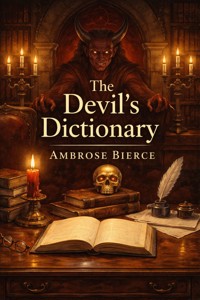
4,49 €
4,49 €
oder
-100%
Sammeln Sie Punkte in unserem Gutscheinprogramm und kaufen Sie E-Books und Hörbücher mit bis zu 100% Rabatt.
Mehr erfahren.
Mehr erfahren.
- Herausgeber: Kim Paradowski
- Kategorie: Gesellschafts- und Liebesromane
- Sprache: Englisch
- Illustrated Edition with 20 Engaging Illustrations
- Includes Book Summary
- Contains Characters List
- Features Author Biography
More than a dictionary, this work is a mirror to the human condition—provocative, witty, and surprisingly insightful. Readers will discover biting definitions, thought-provoking commentary, and the enduring relevance of Bierce’s words over a century after their first publication. Whether you are a lover of language, satire, or philosophy, The Devil’s Dictionary offers endless amusement and reflection.
This edition also includes a summary, a detailed characters list, and an author biography, making it a complete collection for both casual readers and literary enthusiasts.
Das E-Book können Sie in Legimi-Apps oder einer beliebigen App lesen, die das folgende Format unterstützen:
Veröffentlichungsjahr: 2026
0,0
Bewertungen werden von Nutzern von Legimi sowie anderen Partner-Webseiten vergeben.
Legimi prüft nicht, ob Rezensionen von Nutzern stammen, die den betreffenden Titel tatsächlich gekauft oder gelesen/gehört haben. Wir entfernen aber gefälschte Rezensionen.
Ähnliche












The Devil’s Dictionary By Ambrose Bierce
ABOUT BIERCE
Ambrose Bierce (1842–c.1914): A Maverick of American Letters
Ambrose Gwinnett Bierce, often called “Bitter Bierce” for his scathing wit and caustic critiques, was one of the most distinctive voices in 19th- and early 20th-century American literature. Born on June 24, 1842, in Meigs County, Ohio, Bierce grew up in a modest, rural household that instilled in him a keen observation of human nature and a penchant for sharp, uncompromising commentary.
Bierce’s early life was shaped by the turbulence of his time. During the American Civil War, he enlisted in the Union Army, serving as a soldier and later as a journalist. His experiences on the battlefield left a lasting impression, giving him intimate knowledge of war’s horrors—a knowledge that would fuel some of his most enduring works, including Tales of Soldiers and Civilians and the legendary short story “An Occurrence at Owl Creek Bridge.” His writing reflected a profound skepticism toward human institutions, heroism, and the romanticized notions of war.
After the war, Bierce pursued a career in journalism, becoming known for his incisive political commentary and trenchant book reviews. His time as a newspaper editor in San Francisco allowed him to cultivate a reputation as a literary critic who could wield satire like a weapon, unafraid to expose hypocrisy and pretension. Bierce’s style was concise, often darkly humorous, and relentless in its precision, earning him both admiration and animosity from his contemporaries.
Bierce’s literary legacy is particularly notable for his mastery of the short story form. His tales often explore the macabre, the supernatural, and the tragic ironies of human life, blending realism with psychological insight. Stories like “The Damned Thing” and “Chickamauga” illustrate his fascination with death, fear, and the unknowable forces that shape human existence. Beyond fiction, Bierce’s The Devil’s Dictionary remains a quintessential work of satirical lexicography, a compendium of witty, cynical definitions that expose the absurdities of society and human behavior.
Despite his literary success, Bierce’s personal life was marked by solitude and restlessness. In 1913, he embarked on a mysterious journey to Mexico, then engulfed in revolution, and was never seen again. His disappearance has become one of literature’s enduring enigmas, cementing his reputation as a figure both brilliant and elusive.
Ambrose Bierce’s writing endures because it refuses to comfort. It challenges, provokes, and illuminates the darker corners of human experience, leaving readers both unsettled and enlightened. He remains a singular figure in American letters—a storyteller, satirist, and critic whose sharp pen continues to cut through the pretensions of time.
SUMMARY
Here’s a captivating and attractive summary of The Devil’s Dictionary by Ambrose Bierce:
The Devil’s Dictionary is Ambrose Bierce’s masterwork of wit, satire, and dark humor—a literary classic that turns language itself into a mirror reflecting human folly. First published in 1906, this brilliant work reimagines the dictionary as a playground for Bierce’s razor-sharp observations on society, politics, love, and human nature. Each entry is a sardonic twist on familiar words, exposing hypocrisy, absurdity, and the often ironic truths behind everyday life.
From the cynical definitions of “politician” and “lawyer” to the ironic musings on “marriage” and “education,” Bierce’s words bite with precision and leave readers both amused and unsettled. More than just a dictionary, it is a timeless commentary on human behavior, full of wisdom cloaked in satire, that continues to resonate over a century later.
CHARACTERS LIST
Characters / Key Figures in The Devil’s Dictionary
The Politician – Hypocritical, self-serving, and endlessly manipulative; Bierce’s lens exposes the absurdities of political life.
The Lawyer – Clever, scheming, and morally flexible; represents the legal profession’s opportunism.
The Cynic – Observant, skeptical, and witty; often acts as Bierce’s voice within the definitions.
The Fool – The unsuspecting, naïve human being; often the target of irony and satire.
The Lover / Spouse – Figures in Bierce’s sardonic definitions of “love” and “marriage,” revealing the contradictions in human relationships.
Society – The collective human institutions, norms, and hypocrisies that Bierce mocks relentlessly.
Death / The Devil – Conceptual “characters” that appear frequently, symbolizing inevitability, irony, and dark humor.
The Scholar / Intellectual – Often lampooned for pretension, pedantry, or self-importance.
The Everyman – Readers encounter themselves in Bierce’s mirror, recognizing universal human flaws.
Table of Contents
Titlepage
Imprint
Author’s Preface
The Devil’s Dictionary
A
B
C
D
E
F
G
H
I
J
K
L
M
N
O
P
Q
R
S
T
U
V
W
X
Y
Z
Colophon
Uncopyright
Author’s Preface
The Devil’s Dictionary was begun in a weekly paper in 1881, and was continued in a desultory way at long intervals until 1906. In that year a large part of it was published in covers with the title The Cynic’s Word Book, a name which the author had not the power to reject or happiness to approve. To quote the publishers of the present work:
“This more reverent title had previously been forced upon him by the religious scruples of the last newspaper in which a part of the work had appeared, with the natural consequence that when it came out in covers the country already had been flooded by its imitators with a score of ‘cynic’ books—The Cynic’s This, The Cynic’s That, and The Cynic’s t’Other. Most of these books were merely stupid, though some of them added the distinction of silliness. Among them, they brought the word ‘cynic’ into disfavor so deep that any book bearing it was discredited in advance of publication.”
Meantime, too, some of the enterprising humorists of the country had helped themselves to such parts of the work as served their needs, and many of its definitions, anecdotes, phrases and so forth, had become more or less current in popular speech. This explanation is made, not with any pride of priority in trifles, but in simple denial of possible charges of plagiarism, which is no trifle. In merely resuming his own the author hopes to be held guiltless by those to whom the work is addressed—enlightened souls who prefer dry wines to sweet, sense to sentiment, wit to humor and clean English to slang.
A conspicuous, and it is hoped not unpleasant, feature of the book is its abundant illustrative quotations from eminent poets, chief of whom is that learned and ingenius cleric, Father Gassalasca Jape, S.J., whose lines bear his initials. To Father Jape’s kindly encouragement and assistance the author of the prose text is greatly indebted.
—A. B.
The Devil’s Dictionary
A
A is the first letter in every properly constructed alphabet. It is the first natural utterance of the human vocal organs, and is variously sounded, according to the pleasure and convenience of the speaker. In logic, A asserts and B denies. Assertions being proverbially untrue, the presumption would be in favor of B’s innocence were it not that denials are notoriously false. In grammar, A is called the indefinite article, probably because, denoting a definite number, it is so obviously a numeral adjective.
Abacot
A cap of state wrought into the shape of two crowns, formerly worn by kings. Very petty monarchs had it made in the form of three crowns.
Abactor
One who steals a whole herd of cattle, as distinguished from the inferior actor who steals one animal at a time—a superior stock actor, as it were.
Abacus
In architecture, the upper part of a column, upon which, in all good architecture, sits the thoughtful stork pondering unutterable things.
Abada
An African animal having three horns, two on the head and one on the nape of the neck by which to hang up the carcass after the head has been removed. In those varieties that are not hunted by man, this third horn is imperfectly developed or wholly wanting.
Abaddon
A certain person who is much in society, but whom one does not meet. A bad one.
Abandon
To correct an erring friend or admonish a needy one. Of women the word abandoned is used in the sense of indiscreet.
Abasement
A decent and customary mental attitude in the presence of wealth or power. Peculiarly appropriate in an employee when addressing an employer.
Abatis
Embarrassing circumstances placed outside a fort in order to augment the coy reluctance of the enemy.Rubbish in front of a fort, to prevent the rubbish outside from molesting the rubbish inside.
Abattoir
A place where cattle slaughter kine. It is commonly placed at some distance from the haunts of our species, in order that they who devour the flesh may not be hocked by the sight of the blood.
Abat-voix
A sounding brass above a tinkling cymbal.
Abba
A father who has made a vow not to be a husband.
Abbess
A female father.
Abderian
Abderian laughter is idle and senseless laughter; so called because Democritus, an idle and senseless philosopher, is said to have been born at Abdera, whence the word was hardly worth importing.
Abdest
The Muslim ceremony of inspiring water through the nose before expiring prayer from the stomach.
Abdication
An act whereby a sovereign attests his sense of the high temperature of the throne. The surrender of a crown for a cowl, in order to compile the shinbones and toenails of saints. The voluntary renunciation of that of which one has previously been deprived by force. The giving up of a throne for the purpose of enjoying the discomfiture of a successor. For these several definitions we are indebted to Spanish history.
Poor Isabella’s Dead, whose abdication
Set all tongues wagging in the Spanish nation.
For that performance ’twere unfair to scold her:
She wisely left a throne too hot to hold her.
To History she’ll be no royal riddle—
Merely a plain parched pea that jumped the griddle.
—G. J.
Abdomen
A shrine enclosing the object of man’s sincerest devotion; the temple of the god Stomach, in whose worship, with sacrificial rights, all true men engage. From women this ancient faith commands but a stammering assent. They sometimes minister at the altar in a halfhearted and ineffective way, but true reverence for the one deity that men really adore they know not. If woman had a free hand in the world’s marketing the race would become graminivorous.
Abduction
In law, a crime; in morals, a punishment.
Abelians
A religious sect of Africa who practiced the virtues of Abel. They were unfortunate in flourishing contemporaneously with the Cainians, and are now extinct.
Aberration
Any deviation in another from one’s own habit of thought, not sufficient in itself to constitute insanity.
Abet
To encourage in crime, as to aid poverty with pennies.
Abhorrence
One of the degrees of disapproval due to what is imperfectly understood.
Abide
To treat with merited indifference the landlord’s notification that he has let his house to a party willin’ to pay.
Ability
That rare quality of mind to which monuments are erected by posterity above the bones of paupers.The natural equipment to accomplish some small part of the meaner ambitions distinguishing able men from dead ones. In the last analysis ability is commonly found to consist mainly in a high degree of solemnity. Perhaps, however, this impressive quality is rightly appraised; it is no easy task to be solemn.
Abject
Innocent of income; without estate; devoid of good clothing.
Abjectly
In the manner of a poor but honest person.
Abjure
To take the preliminary step toward resumption.
Ablative
A certain case of Latin nouns. The ablative absolute is an ancient form of grammatical error much admired by modern scholars.
Abnegation
Renunciation of unprofitable pleasures or painful gains.
Abnormal
Not conforming to standard. In matters of thought and conduct, to be independent is to be abnormal, to be abnormal is to be detested. Wherefore the lexicographer adviseth a striving toward the straiter resemblance of the Average Man than he hath to himself. Whoso attaineth thereto shall have peace, the prospect of death and the hope of Hell.
Abominable
The quality of another’s opinions.
Aborigines
Persons of little worth found cumbering the soil of a newly discovered country. They soon cease to cumber; they fertilize.Considerate persons who will not trouble the lexicographer of the future to describe them.
Abracadabra
By Abracadabra we signify
An infinite number of things.
’Tis the answer to What? and How? and Why?
And Whence? and Whither?—a word whereby
The Truth (with the comfort it brings)
Is open to all who grope in night,
Crying for Wisdom’s holy light.
Whether the word is a verb or a noun
Is knowledge beyond my reach.
I only know that ’tis handed down.
From sage to sage,
From age to age—
An immortal part of speech!
Of an ancient man the tale is told
That he lived to be ten centuries old,
In a cave on a mountain side.
(True, he finally died.)
The fame of his wisdom filled the land,
For his head was bald, and you’ll understand
His beard was long and white
And his eyes uncommonly bright.
Philosophers gathered from far and near
To sit at his feet and hear and hear,
Though he never was heard
To utter a word
But “Abracadabra, abracadab,
Abracada, abracad,
Abraca, abrac, abra, ab!”
’Twas all he had,
’Twas all they wanted to hear, and each
Made copious notes of the mystical speech,
Which they published next—
A trickle of text
In a meadow of commentary.
Mighty big books were these,
In number, as leaves of trees;
In learning, remarkable—very!
He’s dead,
As I said,
And the books of the sages have perished,
But his wisdom is sacredly cherished.
In Abracadabra it solemnly rings,
Like an ancient bell that forever swings.
O, I love to hear
That word make clear
Humanity’s General Sense of Things.
—Jamrach Holobom
Abridge
To shorten.
When in the course of human events it becomes necessary for people to abridge their king, a decent respect for the opinions of mankind requires that they should declare the causes which impel them to the separation.
—Oliver Cromwell
Abridgement
A brief summary of some person’s literary work, in which those parts that tell against the convictions of the abridger are omitted for want of space.
Abroad
At war with savages and idiots. To be a Frenchman abroad is to be miserable; to be an American abroad is to make others miserable.
Abrupt
Sudden, without ceremony, like the arrival of a cannon-shot and the departure of the soldier whose interests are most affected by it. Dr. Samuel Johnson beautifully said of another author’s ideas that they were “concatenated without abruption.”
Abruption
Dr. Johnson said of a certain work that the ideas were “concatenated without abruption.” In deference to that great authority we have given the word a place.
Abscond
To be unexpectedly called away to the bedside of a dying relative and miss the return train.To “move in a mysterious way,” commonly with the property of another.
Spring beckons! All things to the call respond;
The trees are leaving and cashiers abscond.
—Phela Orm
Absence
That which “makes the heart grow fonder”—of absence. Absence of mind is the cerebral condition essential to success in popular preaching. It is sometimes termed lack of sense.
Absent
Exposed to the attacks of friends and acquaintances; defamed; slandered.Peculiarly exposed to the tooth of detraction; vilifed; hopelessly in the wrong; superseded in the consideration and affection of another.
To men a man is but a mind. Who cares
What face he carries or what form he wears?
But woman’s body is the woman. O,
Stay thou, my sweetheart, and do never go,
But heed the warning words the sage hath said:
A woman absent is a woman dead.
—Jogo Tyree
Absentee
A person with an income who has had the forethought to remove himself from the sphere of exaction.
Absolute
In Philosophy, existing without reference to anything, and for a purely selfish purpose. Absolute certainty is one of the possible degrees of probability.Independent, irresponsible. An absolute monarchy is one in which the sovereign does as he pleases so long as he pleases the assassins; a form of government in which the chief power is vested in a gentleman who is near his end. Not many absolute monarchies are left, most of them having been replaced by limited monarchies, where the sovereign’s power for evil (and for good) is greatly curtailed, and by republics, which are governed by chance.
Abstainer
A weak person who yields to the temptation of denying himself a pleasure. A total abstainer is one who abstains from everything but abstention, and especially from inactivity in the affairs of others.
Said a man to a crapulent youth: “I thought
You a total abstainer, my son.”
“So I am, so I am,” said the scapegrace caught—
“But not, sir, a bigoted one.”
—G. J.
Abstemious
Thoughtfully deferential to one’s overtaxed capacity.
Abstruseness
The bait of a bare hook.
Absurdity
The argument of an opponent. A belief in which one has not had the misfortune to be instructed.A statement or belief manifestly inconsistent with one’s own opinion.
Abundance
A means, under Providence, of withholding alms from the destitute.
Abuse
The goal of debate. Abuse of power is the exercise of authority in a manner unpleasant to ourselves.
Academe
An ancient school where morality and philosophy were taught.
Academy
(from academe)
Originally a grove in which philosophers sought a meaning in nature; now a school in which naturals seek a meaning in philosophy.A modern school where football is taught.
Accept
In Courtship to reap the whirlwind after sowing the wind. To accept office is to take with decent reluctance the reward of immodest avidity. To accept a challenge is to become a sincere believer in the sanctity of human life.
Accident
An inevitable occurrence due to the action of immutable natural laws.
Acclimated
Secured against endemic diseases through having died of one.
Accommodate
To oblige; to lay the foundation of future exactions.
Accomplice
One associated with another in a crime, having guilty knowledge and complicity, as an attorney who defends a criminal, knowing him guilty. This view of the attorney’s position in the matter has not hitherto commanded the assent of attorneys, no one having offered them a fee for assenting.Your partner in business.
Accord
Harmony.
Accordion
An instrument in harmony with the sentiments of an assassin.
Accoucheur
The devil’s purveyor.
Accountability
The mother of caution.
“My accountability, bear in mind,”
Said the Grand Vizier: “Yes, yes,”
Said the Shah: “I do—’tis the only kind
Of ability you possess.”
—Joram Tate
Accuse
To affirm another’s guilt or unworth; most commonly as a justification of ourselves for having wronged him.
Acephalous
In the surprising condition of the Crusader who absently pulled at his forelock some hours after a Saracen scimitar had, unconsciously to him, passed through his neck, as related by de Joinville.
Achievement
The death of endeavor and the birth of disgust.
Acknowledge
To confess. Acknowledgement of one another’s faults is the highest duty imposed by our love of truth.
Acquaintance
A person whom we know well enough to borrow from, but not well enough to lend to. A degree of friendship called slight when its object is poor or obscure, and intimate when he is rich or famous.
Actually
Perhaps; possibly.
Adage
Boned wisdom for weak teeth.
Adamant
A mineral frequently found beneath a corset. Soluble in solicitate of gold.
Adder
A species of snake. So called from its habit of adding funeral outlays to the other expenses of living.
Adherent
A follower who has not yet obtained all that he expects to get.
Administration
An ingenious abstraction in politics, designed to receive the kicks and cuffs due to the premier or president. A man of straw, proof against bad-egging and dead-catting.
Admiral
That part of a warship which does the talking while the figurehead does the thinking.
Admiration
Our polite recognition of another’s resemblance to ourselves.
Admonition
Gentle reproof, as with a meat-axe. Friendly warning.
Consigned by way of admonition,
His soul forever to perdition.
—Judibras
Adore
To venerate expectantly.
Advice
The smallest current coin.
“The man was in such deep distress,”
Said Tom, “that I could do no less
Than give him good advice.” Said Jim:
“If less could have been done for him
I know you well enough, my son,
To know that’s what you would have done.”
—Jebel Jocordy
Affianced
Fitted with an ankle-ring for the ball-and-chain.
Affliction
An acclimatizing process preparing the soul for another and bitter world.
African
A nigger that votes our way.
Age
That period of life in which we compound for the vices that we still cherish by reviling those that we have no longer the enterprise to commit.
Agitator
A statesman who shakes the fruit trees of his neighbors—to dislodge the worms.
Aim
The task we set our wishes to.
“Cheer up! Have you no aim in life?”
She tenderly inquired.
“An aim? Well, no, I haven’t, wife;
The fact is—I have fired.”
—G. J.
Air
A nutritious substance supplied by a bountiful Providence for the fattening of the poor.
Alderman
An ingenious criminal who covers his secret thieving with a pretence of open marauding.
Alien
An American sovereign in his probationary state.
Allah
The Muslim Supreme Being, as distinguished from the Christian, Jewish, and so forth.
Allah’s good laws I faithfully have kept,
And ever for the sins of man have wept;
And sometimes kneeling in the temple I
Have reverently crossed my hands and slept.
—Junker Barlow
Allegiance
This thing Allegiance, as I suppose,
Is a ring fitted in the subject’s nose,
Whereby that organ is kept rightly pointed
To smell the sweetness of the Lord’s anointed.
—G. J.
Alliance
In international politics, the union of two thieves who have their hands so deeply inserted in each other’s pockets that they cannot separately plunder a third.
Alligator
The crocodile of America, superior in every detail to the crocodile of the effete monarchies of the Old World. Herodotus says the Indus is, with one exception, the only river that produces crocodiles, but they appear to have gone West and grown up with the other rivers. From the notches on his back the alligator is called a sawrian.
Alone
In bad company.
In contact, lo! the flint and steel,
By spark and flame, the thought reveal
That he the metal, she the stone,
Had cherished secretly alone.
—Booley Fito
Altar
The place whereupon the priest formerly raveled out the small intestine of the sacrificial victim for purposes of divination and cooked its flesh for the gods. The word is now seldom used, except with reference to the sacrifice of their liberty and peace by a male and a female fool.
They stood before the altar and supplied
The fire themselves in which their fat was fried.
In vain the sacrifice!—no god will claim
An offering burnt with an unholy flame.
—M. P. Nopput
Ambidextrous
Able to pick with equal skill a right-hand pocket or a left.
Ambition
An overmastering desire to be vilified by enemies while living and made ridiculous by friends when dead.
Amnesty
The state’s magnanimity to those offenders whom it would be too expensive to punish.
Anoint
To grease a king or other great functionary already sufficiently slippery.
As sovereigns are anointed by the priesthood,
So pigs to lead the populace are greased good.
—Judibras
Antipathy
The sentiment inspired by one’s friend’s friend.
Aphorism
Predigested wisdom.
The flabby wineskin of his brain
Yields to some pathologic strain,
And voids from its unstored abysm
The driblet of an aphorism.
—“The Mad Philosopher,” 1697
Apologize
To lay the foundation for a future offence.
Apostate
A leech who, having penetrated the shell of a turtle only to find that the creature has long been dead, deems it expedient to form a new attachment to a fresh turtle.
Apothecary
The physician’s accomplice, undertaker’s benefactor and grave worm’s provider.
When Jove sent blessings to all men that are,
And Mercury conveyed them in a jar,
That friend of tricksters introduced by stealth
Disease for the apothecary’s health,
Whose gratitude impelled him to proclaim:
“My deadliest drug shall bear my patron’s name!”
—G. J.
Appeal
In law, to put the dice into the box for another throw.
Appetite
An instinct thoughtfully implanted by Providence as a solution to the labor question.
Applause
The echo of a platitude.
April Fool
The March fool with another month added to his folly.
Archbishop
An ecclesiastical dignitary one point holier than a bishop.
If I were a jolly archbishop,
On Fridays I’d eat all the fish up—
Salmon and flounders and smelts;
On other days everything else.
—Jodo Rem
Architect
One who drafts a plan of your house, and plans a draft of your money.
Ardor
The quality that distinguishes love without knowledge.
Arena
In politics, an imaginary rat-pit in which the statesman wrestles with his record.
Aristocracy
Government by the best men. (In this sense the word is obsolete; so is that kind of government.) Fellows that wear downy hats and clean shirts—guilty of education and suspected of bank accounts.
Armor
The kind of clothing worn by a man whose tailor is a blacksmith.
Arrayed
Drawn up and given an orderly disposition, as a rioter hanged to a lamppost.
Arrest
Formally to detain one accused of unusualness.
God made the world in six days and was arrested on the seventh.
—The Unauthorized Version
Arsenic
A kind of cosmetic greatly affected by the ladies, whom it greatly affects in turn.
“Eat arsenic? Yes, all you get,”
Consenting, he did speak up;
“ ’Tis better you should eat it, pet,
Than put it in my teacup.”
—Joel Huck
Art
This word has no definition. Its origin is related as follows by the ingenious Father Gassalasca Jape, S.J.
One day a wag—what would the wretch be at?—
Shifted a letter of the cipher rat,
And said it was a god’s name! Straight arose
Fantastic priests and postulants (with shows,
And mysteries, and mummeries, and hymns,
And disputations dire that lamed their limbs)
To serve his temple and maintain the fires,
Expound the law, manipulate the wires.
Amazed, the populace that rites attend,
Believe whate’er they cannot comprehend,
And, inly edified to learn that two
Half-hairs joined so and so (as Art can do)
Have sweeter values and a grace more fit
Than Nature’s hairs that never have been split,
Bring cates and wines for sacrificial feasts,
And sell their garments to support the priests.
Artlessness
A certain engaging quality to which women attain by long study and severe practice upon the admiring male, who is pleased to fancy it resembles the candid simplicity of his young.
Asperse
Maliciously to ascribe to another vicious actions which one has not had the temptation and opportunity to commit.
Ass
A public singer with a good voice but no ear. In Virginia City, Nevada, he is called the Washoe Canary, in Dakota, the Senator, and everywhere the Donkey. The animal is widely and variously celebrated in the literature, art and religion of every age and country; no other so engages and fires the human imagination as this noble vertebrate. Indeed, it is doubted by some (Ramasilus, lib. II., De Clem., and C. Stantatus, De Temperamente) if it is not a god; and as such we know it was worshiped by the Etruscans, and, if we may believe Macrobious, by the Cupasians also. Of the only two animals admitted into the Muslim Paradise along with the souls of men, the ass that carried Balaam is one, the dog of the Seven Sleepers the other. This is no small distinction. From what has been written about this beast might be compiled a library of great splendor and magnitude, rivalling that of the Shakespearean cult, and that which clusters about the Bible. It may be said, generally, that all literature is more or less Asinine.
“Hail, holy Ass!” the quiring angels sing;
“Priest of Unreason, and of Discords King!
Great co-Creator, let Thy glory shine:
God made all else, the Mule, the Mule is thine!”
—G. J.
Auctioneer
The man who proclaims with a hammer that he has picked a pocket with his tongue.
Australia
A country lying in the South Sea, whose industrial and commercial development has been unspeakably retarded by an unfortunate dispute among geographers as to whether it is a continent or an island.
Avernus
The lake by which the ancients entered the infernal regions. The fact that access to the infernal regions was obtained by a lake is believed by the learned Marcus Ansello Scrutator to have suggested the Christian rite of baptism by immersion. This, however, has been shown by Lactantius to be an error.
Facilis descensus Averni,
The poet remarks; and the sense
Of it is that when downhill I turn I
Will get more of punches than pence.
—Jehal Dai Lupe




