


9,59 €
Mehr erfahren.
- Herausgeber: Salt
- Kategorie: Abenteuer, Thriller, Horror
- Sprache: Englisch
A 'Withnail' for the twenty-first century Tim Vine's satirical thriller appears to revolve around the dysfunctional lives of Norman and Peter – the latter becoming an accidental terrorist. Driven by his warped religious tendencies and mental illness, Peter is encouraged by none other than the singer Rick Astley, who instructs and leads him during most excellent recurring dreams. Along the bizarre journey we explore a cult, infidelity, drug abuse, frustration, extremism, all tinged by a strong awareness of the weirdness of late-Capitalist society.
Das E-Book können Sie in Legimi-Apps oder einer beliebigen App lesen, die das folgende Format unterstützen:
Veröffentlichungsjahr: 2019
Ähnliche



















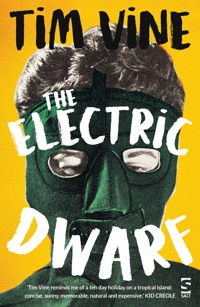
THE ELECTRIC DWARF
by
TIM VINE
SYNOPSIS
A ‘Withnail’ for the twenty-first century
Tim Vine’s satirical thriller appears to revolve around the dysfunctional lives of Norman and Peter – the latter becoming an accidental terrorist. Driven by his warped religious tendencies and mental illness, Peter is encouraged by none other than the singer Rick Astley, who instructs and leads him during most excellent recurring dreams.
Along the bizarre journey we explore a cult, infidelity, drug abuse, frustration, extremism, all tinged by a strong awareness of the weirdness of late-Capitalist society.
PRAISE FOR THIS BOOK
‘Bizarre but impossible to put down, a truly original voice.’ —REBECCA NEWMAN, contributing editor, GQ Magazine
‘Tim Vine reminds me of a ten-day-holiday on a tropical island: concise, sunny, memorable, natural and expensive.’ —AUGUST DARNELL aka Kid Creole
The Electric Dwarf
TIM VINEis a renowned musician, known primarily as a pianist and keyboard player. Born in Jersey, his career is extremely varied. Growing up in a musical family, he was a chorister at St. Paul’s Cathedral in London from the age of seven. A music scholarship to Cranleigh School followed, then regular lessons and workshops at the Weekend Arts College in Kentish Town, mainly taught by Ian Carr. He later attended Berklee College of Music in Boston, USA, with personal sponsorship from Phil Collins and a scholarship. He has toured and/or recorded with Groove Armada, Noisettes, Moloko, Simply Red, Wilco Johnson, Malcolm McLaren, Terence Trent D’Arby, Paul ‘Trouble’ Anderson, US3, Incognito, Marlena Shaw, Art Farmer, Baby D, Toploader, Nellee Hooper, Howie Day, The Pasadenas, Jimmy Witherspoon, Pee Wee Ellis, Doc Gyneco and Kid Creole & the Coconuts amoung others. Tim now lives between Paris and London and has written the music forThe Musical of Dorian Grayas well as appearing in the short filmJet-Pack Willy.
Published by Salt Publishing Ltd
12 Norwich Road, Cromer, Norfolk NR27 0AX
All rights reserved
Copyright © Tim Vine,2019
The right ofTim Vineto be identified as the author of this work has been asserted by him in accordance with Section 77 of the Copyright, Designs and Patents Act 1988.
This book is in copyright. Subject to statutory exception and to provisions of relevant collective licensing agreements, no reproduction of any part may take place without the written permission of Salt Publishing.
Salt Publishing 2019
Created by Salt Publishing Ltd
This book is sold subject to the conditions that it shall not, by way of trade or otherwise, be lent, re-sold, hired out,or otherwise circulated without the publisher’s prior consent in any form of binding or cover other than that in which it is published and without a similar condition including this condition being imposed on the subsequent purchaser.
ISBN 978-1-78463-173-4 electronic
To Mary Whitehouse CBE
Contents
The Electric Dwarf
Acknowledgements
‘One of the great things about books is sometimes there are some fantastic pictures.’
GEORGE W. BUSH
The Electric Dwarf
A Modern Tale featuring a Small Red Herring
The man waspanting as he scrambled up the bank towards the bridge, startling an innocent blackbird with a broken wing that sat in a bush. Dazed, he powered over rocks and shrubs, negotiating thick patches of inhospitable brambles before clambering awkwardly over an unforgiving barbed-wire fence.Glancing down at his hands and legs, he became aware of blood patches staining him, turning his trousers a warm wet camouflage. As well as a weird numb sensation there was a pervasive ache throughout his body, yet he couldn’t perceive whether it brought him pain or pleasure. Any feeling he was experiencing flatly refused to transmit to, or accurately compute in his brain. A pronounced dullness deafened his eardrums, all senses suspended as if he’d been heavily anaesthetised, mummified in glue. This was a person in a state of shock, face pale as chalk, feeling detached yet acutely aware at the same time, trance-like. His hair was plastered onto sweaty forehead, dirt marking his left cheek above an unruly beard. A barren escarpment ahead of him led up sharply to a road, but before tackling it he stole a glance back at the scene on the rail track. Mangled train carriages were strewn across the lines in a zigzag, some slewed over each other like discarded Legobricks in a child’s playroom. Shards of glass peppered the ground, and a number of windows were hanging precariously from their frames, smashed and fragmented yet somehow still holding together like shimmering, jewelled jigsaw-puzzle pieces. As he looked down to survey the horrific carnage, the man saw – but did not register – various limp human bodies scattered about, nor did he hear the rising groans coming from the injured, which blended curiously to form a macabre choir of agony. Dense white smoke was emanating from somewhere in the epicentre of the crash, acrid and harsh in the otherwise pure country air, and an uneasy stunned hush enveloped the atmosphere as if a damp blanket had cloaked the surrounding locality. The spectacular wreckage of the train – dramatically derailed and concertinaed – appeared to be almost in miniature, so surreal and implausible, an extravagant scene from a movie set. The man paused as an uncontrollable tick forced his left eye to jerk with ludicrous and violent spasms, and he nodded his head in slow motion, taking it all in carefully, suddenly very aware of the fact that this was all his doing. This was the outcome ofhisactions,hisintentions, an act initiated and carried out byhim. The Lone Wolf had struck, almost without understanding. You see, he was neither a moral nihilist nor abadman, but just quite simply a fucked-up cookie, that’s all. Shielded within an eerie stillness, nobody noticed him as he turned to climb up to the road before brushing himself down and walking away.
Norman couldn’t sleep. Yet another drink and drugs binge – this one enjoyed over the last few days – continued mercilessly to take its toll on his poisoned, frail brain. Sick internal organs had also suffered another brutal battering, and now the grim chemical hangover stubbornly refused to die. As a juicy, fat and particularly noisy fly smashed itself repeatedly against the bedroom window, Norman lounged around uselessly, barely paying it any attention. He lunged just once with a pathetic gesture as if he was swatting it. ‘Bloody thing! It’s like a cross between badminton and cribbage trying to get these bastards!’
He had always had trouble sleeping, before, and indeed after his habit of smoking fields of pot. It had started in childhood, when his bedside lamp was obliged to burn throughout the night or else he would never fall into the arms of Morpheus. His teddy Roger, a relic from an innocent era, didn’t even provide solace from this condition. Even when he was an acne-ridden teenager, a radio would sing or the TV crackle, otherwise insomnia ruled. This particular evening had been painfully dull for him as he’d stayed in at his grubby flat off Portobello Road, and unusually there had been no visitors to pass the time with, drinking or taking drugs in his squalid living room, as was so often the case. Down below on the street the market traders were packing up after selling their last Chinese-made ILondon hooded tops of the day to a gaggle of keen, plump Spanish girls. The relentless London drizzle had at first been a fun novelty for them, but now they were cold and fed up. A tall Rasta with cigarette-ash grey locks shuffled nonchalantly past a couple of arty young men both sporting silly over-sized plastic glasses, angular haircuts and bright trousers that looked a couple of inches too short, as a noisy group of Moroccan kids on bikes that were too small for them raced by on their way back to the nearby estate. A young skinny dude with tattoos and a cravat darted off the pavement into the gutter to avoid the bikes, then lit a Camel Light as he crossed the quiet road, enjoying the first lung-full of smoke. In the distance an aggressive-looking Polish man sporting a Taxi Driver-style Mohican approached, an achingly beautiful yet cheaply dressed and bored looking girl draped on his arm. A shrill electronic shriek from Norman’s phone abruptly cut through the relative quiet of his living room. It was an unwelcome call from his father, who again lectured him on his indolence and lamentable lack of effort with life in general. Tony had grown increasingly impatient with him over the recent months, and it was hardly surprising. Norman was painfully aware that his multi-millionaire father was on the brink of cutting him out of his will, with the possible intention of leaving his fortune instead to an array of deserving and not-so-deserving charities around the country. Norman’s life had descended into a squalid existence of near chaos in which he somehow scraped together some kind of living from low-level drug dealing, supplemented by occasionally putting on a night locally. This would generally mean booking a DJ to spin a few records in the latest trendy bar if he could organise it for the evening, then attempting to sell various illegal powders to the assembled crowd. The downward spiral of his own rapidly-increasing use was becoming clear to everyone but himself; he shrugged it off, putting the large use of drugs on his part down to ‘the job’. Most drugs flew up his nose or ended up in his lungs in the form of smoke. LSD was one drug, however, that Norman only took about every four years as ‘that’s how long it takes me to forget how full-on and scary it is, before I decide it might be a good plan to give it another try.’ If he were ever to attend a Narcotics Anonymous meeting – which he never would – he’d more than likely turn up high; likewise, he’d be the guy that would bowl in pissed-up at an Alcoholics Anonymous group.
In physical appearance the nebbish Norman had recently changed, and certainly not for the better. Grotesque yet compelling, he remained ludicrously, laughably short, having always been vertically challenged for as long as he could recall. He luckily wasn’t, however, so short that if he was sitting down and stood up he would actually shrink in stature, which bizarrely is the case for an unfortunate few. Weight loss had affected him – the once superfluous blubber around his middle flank and under a squat stubbly chin had disappeared, leaving unsightly loose skin flapping around without a lot to hang onto. Pathetic spikes of wispy facial follicle growth only just made it through a vitamin-deficient pallid skin, neither quite managing to form what could be regarded as a beard nor a coiffed unshaven look. Any youthful tone and colour in his cheeks that he may have once possessed had gently but markedly surrendered to the regular battering of general abuse and a wayward city lifestyle pushed to excess. His grey pallor was not a flattering one, especially on such a young man. Formerly alert and lively, darting eyes now seemed deadened, markedly shrunken and set back, their place now alarmingly misunderstood in his photofit-style ovoid face, segments of which refused to match naturally as they had once during his youth. Unhealthy, strange, grey semi-circles had appeared under his eyes in recent months, mottled like a lunar landscape, ominous indicators of an underlying condition darkly and secretly developing deep within his body. Generous thick brown hair that could be witnessed in serious school photos of the younger man had now radically thinned out, exposing the intolerable crust that was an excuse for his diseased scalp, which only just allowed greasy lank strands to dare sprout almost apologetically, resembling some unearthly variety of deep seaweed, and often snowing sizeable flecks of dandruff onto his dark collar. Any charm and charisma that he may have formerly possessed had been gradually drained out of his character by the magnetic drugs that he so adored, essentially leaving behind an inherently far more uninteresting being hidden in an oblivion of smoke. Needless to say, he looked as though he urgently required at least a fortnight’s holiday in sunnier climes. The nickname, The Electric Dwarf, had followed him since his schooldays, haunting and irritating him, but never ceasing to entertain others. The Electric part stemmed from his insanely-charged demeanour after snorting speed. The Dwarf part, well . . . A peculiar homunculus was the Electric Dwarf.
The shabby rented flat was dark, and clearly on the small side for two grown (or nearly grown, in the case of one of them) men to be sharing. Stinking plates and bowls cluttered the sideboard, the grimy once-white plastic bin overfilled as usual, mainly with half-crushed beer cans that had been carelessly tossed over. Neglected take-away pizza boxes gently festered in the corner, crumpled, with cigarette butts loose inside, a science experiment in place. Norman’s flatmate was out on a date, the first in two years. In his employment as a motorbike courier, Yatter had been one of the best, but ever since being knocked off his bike one crisp March morning near Hyde Park, he had suffered increasingly nasty flashbacks and panic attacks, and rarely accepted work these days. Before this he had always been lucky out on the mean streets, his only other collision being a bizarre minor incident with a milk float around 5 a.m. one morning, which subsequently caused more mirth than distress. Nowadays a heavy cloud of ongoing depression enveloped him, the general stress of his own existence outwardly apparent having permanently etched itself into his face, boring deep furrows and lines of worry. Yatter’s only solace was his poetry-writing.
The Motorbike Vibes
How the beast rumbles beneath my groin!
Gas tank shines, flash, as a new coin
Engine screams, vibes feeling good
I love my bike, she knew that I would.
I love my bike, I knew that I would
She smells, I sniff, she says that I should
Shift into gear, all vibes are good
I love my bike, we knew that I would.
by Yatter
His continuing use of drugs as a prop for his misery might fulfil him momentarily and provide ongoing occasional relief, but it was also taking its toll on his delicate psychological state, as well as his general physical health. The two of them had their rows, but generally got on, largely due to their mutual enjoyment in partaking of the same drugs. Norman and Yatter painted a funny picture when out together. Yatter would tower over everyone, whilst people generally ignored Norman, often barely noticing him, unless to nudge a friend and share a chuckle at his appearance. This had got Norman’s back up more than once, to such an extent that he now rarely invited Yatter along if he was going out somewhere.
Norman couldn’t sleep. He deftly rolled a joint and reached for the TV remote. There was a documentary about a triple murder, with a Philip Glass-esque soundtrack, intended to give it gravitas. Everything appeared to have become so safe on TV; even Art had conformed to the maximum in this risk-averse culture. Still, murderers were ‘up there’ with the list of other public hate figures, which now encompassed politicians, bankers, paedos, landlords, terrorists, hipsters and, to some . . . immigrants (or were they refugees?). Norman felt uncomfortable and switched over. Flitting between a John Lennon retrospective and Peter Andre: the Next Chapter, he sparked up and relaxed. John and Peter both started to irritate him in their very different ways. He ventured up a channel to see Freddie Mercury, who practically exploded out of the screen larger than life as if in 3D, on stage at a mid-80s gig from Rio. Norman turned it up. Although not particularly a massive Queen fan, he was transfixed by the undeniable charisma of the sweating singing star and his solid band of hair, and found himself deciding to pick up a copy of their Greatest Hits sometime soon, preferably on vinyl. Why were there no bands around like that anymore, with that amount of raw talent? A little while and another joint later, it seemed more likely to him that perhaps sleep could now be achieved, so without washing or brushing his nicotine-stained teeth, the stoned little man floated effortlessly into his bedroom and climbed into bed, removing a porn DVD Chew the Fat from his pillow, soon to drift off to a better place in a catatonic stupor. The dusty TV with its greasy, smeared screen blasted out Death Wish 4, unapologetically flooding the deserted room with violence.
Norman’s father had had enough of his son’s laziness. His habitual apathy clashed with Tony’s work ethic and his attitude to life that he held dear; indeed, the very principles that had aided the ever-increasing rise in profits at the company that he’d set up many years before as a young man. Tony considered himself an altogether fair yet strict parent, any harsh words or hard discipline was only ever meted out for the overall benefit of his children. Besides, the distinct absence of affection shown by him to Norman would never cross his mind as being lacking in any regard, as it had been how his own father had been with him many years previously.
Tony was equally as stressed out regarding the current behaviour of his beloved daughter, who had regrettably hooked up with a rather strange character called Brian, a middle-aged bearded vegetarian who she had met on the Northern Line somewhere near Clapham. Perhaps if she hadn’t had lost her balance and reeled backwards, flailing her arms as the train jerked sharply on that Special Day, she would never had tried his home-made hummus, his courgette fritters or wonderful tofu curry. Wearing sandals without socks, as he nearly always did, a direct hit scored by Polly’s high heel had barbarically torn Brian’s defenceless big toenail, ripping it clean off as she tumbled onto the filth of the tube carriage floor, down by his bloodied hairy foot. For a split second, as she clumsily pulled herself to her feet, Polly glanced at the unknown, unshaven man who she had inadvertently hurt and felt a strange jolt of joy – a pang of guilt-free pleasure. ‘I never liked that particular nail anyway,’ Brian calmly quipped as he winced, trying to ignore the sudden rush of intense pain. She grinned back involuntarily like a lovestruck teenager. The unusual encounter would lead to a surprising and intense sexual encounter only hours later at Brian’s flat, such immediacy and liberalism highly unusual for both parties involved. Polly’s insistence in helping him home made for an entertaining hobble through a maze of south London residential streets, with the princess propping up her prince who was dripping a trail of blood all the way to his front door. Then followed an almost ritualistic washing of his feet – delicate, sexy yet efficient on Polly’s part – painful and highly erotic for Brian the recipient. Acted out by the pair of them, their actions had the distant abstraction of a dream, and it seemed to be the very cleansing act itself that was steadily and enjoyably guiding them both to its inevitable, beautiful and sybaritic conclusion.
The intoxicated pair were recently back from a religious camping retreat in Wales, and Polly had sent her dad a postcard that had disturbed him as it suggested that Brian the vegetarian might be the one. However, Brian painted for Tony the worst image of a son-in-law that he could ever imagine, and was without doubt nowhere near good enough for his little girl. The two men were off each others’ radars in terms of world outlook, humour, sentiment and ideas, to such an extent that on the three brief occasions that they had met, disagreements were avoided only by the pacifying tact of Polly and her deft skill at swift subject-changing. This familiar conflict-avoidance tactic was something that she had been forced to hone throughout her childhood, often keeping the peace between younger brother Norman and their father. Now Brian seemed to be filling Norman’s boots and taking on his role when they were with Tony, and she sensed that it would be only a matter of time before it kicked off between the two of them. For the time being, however, things appeared to be rolling along fairly smoothly, with both sides not rising to each other’s bait. However, she had little idea about the important and life-altering ultimatum her father was planning to issue to her before the week was up. He was intending to take Polly and Norman out for dinner, and inform them that they were both to be cut off from his Estate, unless:--
Tony was to stipulate that the Electric Dwarf had to cease all his current drug-related activities, move out of London and find himself some genuine employment. For her part, Polly was now obliged to cut all ties with Brian, as well as promising to sever all future relations with the man – his sandals, beard and everything that accompanied him. They all agreed on an Italian place near Victoria Station that Tony had been frequenting for years, nearly always ordering the same dish – meatballs. He raved about them loudly at every visit to each bemused waiter, insisting on ‘compliments to the chef.’ He would never have a suspicion that they were inexpensive, frozen meatballs from a sprawling cash & carry in Wembley, put together with zero love at a nondescript meat-processing packaging plant on the edge of a grim industrial estate in Milton Keynes, bought in ugly plastic sacks for industrial freezing.
‘The provenance of the meat?’ I hear you ask.
Back to plate, confused waiter, microwave door shuts, heat! Aaaggghh, events are taking a terrible and unexpected turn. what’s all that sauce? out into a fridge, nestling between huge butter slab and unidentified plastic storage container, out back into kitchen, it goes dark in a sack surrounded by other meatballs, then a long wait, freezing cold! are we in a lorry or van? here we go, we are driving, out of vehicle, another inordinate wait, then I’m being pulled apart viciously in a series of machines, mixed up again and again, this is hell, what are all the powders that keep getting poured over me? in a bag, another drive, what the . . . ? blood, so much blood, agghhh, I’m pulled together, I’m a cow my God! walking backwards . . . all the others are so scared, waiting, I’m so hungry, beaten, back in a stinking lorry with no air, long journey it’s horrible, stop, more driving, some grim holding area, water – at last, and a tiny bit of food, back to a filthy overcrowded shed, there are thousands of us, food, days turn to weeks, months, water, I am getting small, smaller, I fall,Mummy, is that you? I am sucked upwards into a wet and warm comforting place . . .
It was true, however, that the chef achieved results and was deft with the microwave, so perhaps should indeed be applauded. He had a great skill in knowing exactly the combination and number of minutes and seconds for anything that came his way. Some put it down just to experience, but he really was special. Plates were certainly never returned to the kitchen with a ‘table four’s complaining that their dinner’s not hot enough, Chef’ from a waiter. This was Norman’s first square meal for some time, as he generally lived on sugary supermarket-branded yoghurt or white toast with margarine whenever he felt the urge to eat. Eating – or, rather, nutrition – for him was a slight aggravation bred out of necessity, intruding into his life rather than being a pleasure in it. But on this occasion, peculiarly, he enjoyed the meatballs in particular.
Over the just-defrosted tiramisu, Tony dropped the impending bombshell on his two stupefied offspring. Polly – who had felt that something was brewing, was fuming inside, but she bottled up all the anger as her faith and character insisted that she must. Such intense personal restraint wasn’t always healthy and it certainly left her with many issues to deal with, when perhaps she should have had a good shout or wobbled through a self-purging row with somebody. Instead, a straining vein in her delicate and slender neck appeared to throb and bulge from nowhere, and she became aware of a sudden and unwelcome dampness under her armpits. Norman was too weak and emotionally crippled to complain, and besides, he felt that his father’s wishes had been expressed with an indisputable air of finality, certainly not inviting any questions or debate. He was, for once, correct on that score. Tony had decided that he had put up with too much nonsense from his two beloved children, and recently he’d not been enjoying the realization that comes to us all that he wasn’t going to be around on this Earth forever. Led by both his paternal instincts and a misguided intention of improving his children’s lives, Tony had rashly decided upon this thinly-disguised attempt at blackmail.
With an ugly scrape of her chair, Polly got up, grabbed her jacket and shiny bag, turned on her heels and spat out an abrupt and near-sarcastic ‘Thanks for dinner, Dad, I’ve gotta run. See ya, Norm, gimme a ding sometime.’ Then she disappeared out into the night, still thin-lipped with scarcely-hidden fury.
The two men remained at the table and sat together uncomfortably. They could have been players in a Harold Pinter scene. It had been many years since they’d been together at a mealtime, and once the usual conversation would have consisted of Tony dishing out endless advice to Norman that was generally rejected before it had even been uttered.
‘Best to just leave it now, Dad,’ mumbled the son meekly, like a boy under half his age. ‘I think I’ll be off too.’




